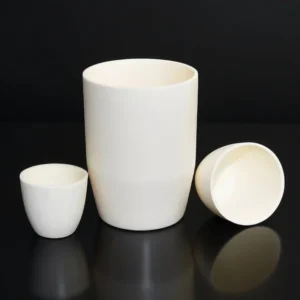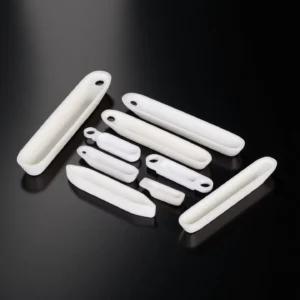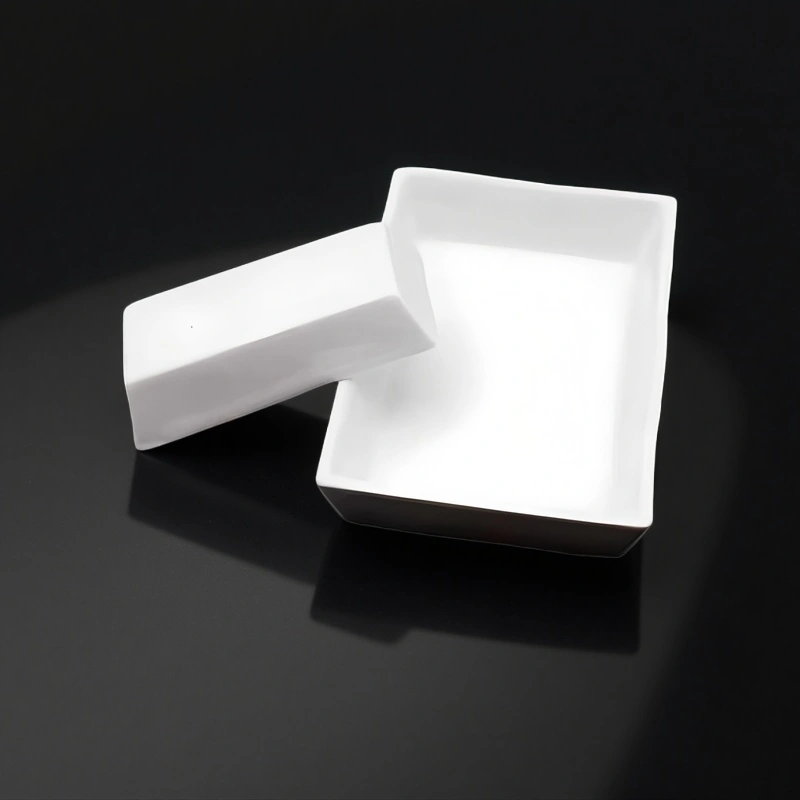
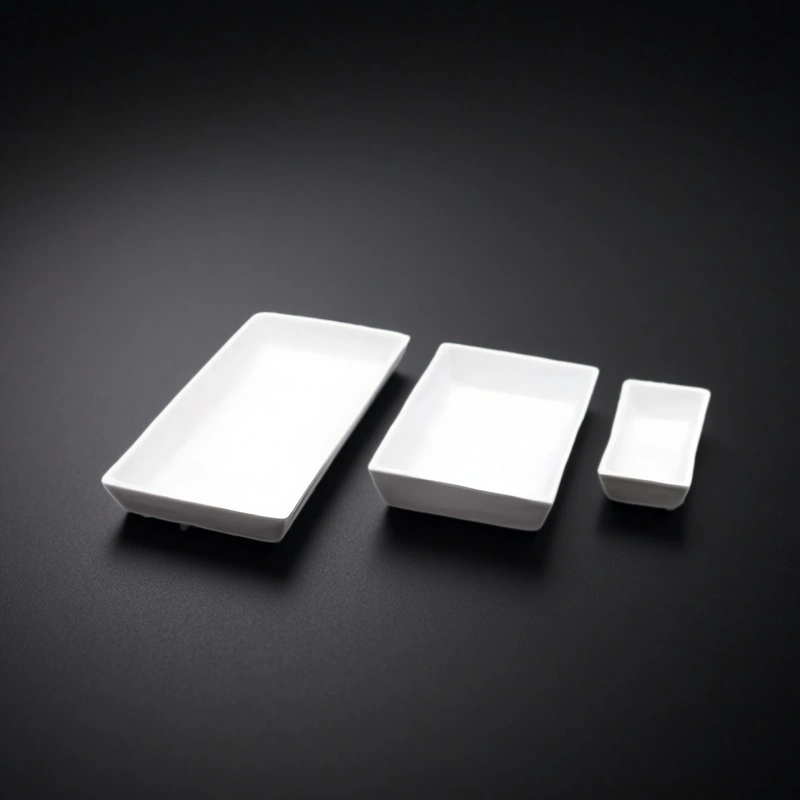
What are trapezoid alumina crucibles?
Trapezoid alumina crucibles are Al₂O₃ ceramic vessels with angled sidewalls and a flat base, used to hold powders, ash samples, minerals, ceramics and inorganic materials during laboratory ashing, calcination, combustion testing and high-temperature pre-treatment. Compared with round crucibles, the trapezoid shape helps improve placement stability on trays and fixtures.
Why Trapezoid Alumina Crucibles Improve Laboratory Ashing Workflows?
-
Stable tray positioning
The trapezoid footprint helps each crucible stay in a fixed position on furnace trays, racks or holders. This is especially useful when many samples are loaded and unloaded in one batch. -
More consistent sample spacing
Flat sides and predictable external dimensions make it easier to keep equal gaps between crucibles. Stable spacing supports more uniform airflow and heat exposure during ash or combustion cycles. -
Better batch organization
The angled shape allows laboratories to arrange multiple crucibles in a repeatable layout. This helps operators track sample orders, reduce handling mistakes and maintain consistent testing routines. -
Custom fit for existing fixtures
Dimensions, side angle, wall thickness and base geometry can be reviewed to match customer furnace trays, frames or analytical equipment. This reduces the need to modify existing fixtures. -
Material options for different heating conditions
ADCERAX can review 99%, 99.5% and 99.7% alumina options according to temperature, sample chemistry and handling requirements.
Technical Factors for Selecting Trapezoid Alumina Crucibles
| Property | Unit | 96% Al₂O₃ | 99% Al₂O₃ | 99.5% Al₂O₃ | 99.6% Al₂O₃ | 99.7% Al₂O₃ | 99.8% Al₂O₃ | 99.9% Al₂O₃ | 99.99% Al₂O₃ |
| Alumina content | % | 96 | 99 | 99.5 | 99.6 | 99.7 | 99.8 | 99.9 | 99.99 |
| Density | g/cm³ | 3.6-3.75 | 3.83 | 3.89 | 3.91 | 3.92 | 3.93 | 3.94 | 3.98 |
| Color | – | white | Ivory | Ivory | Ivory | Ivory | Ivory | Ivory | Ivory |
| Water absorption | % | 0 | 0 | – | 0 | 0 | 0 | 0 | 0 |
| Young’s modulus (Elastic modulus) | GPa | 300 | 350 | 375 | 356 | 357 | 358 | 359 | 362 |
| Shear modulus | GPa | – | – | 152 | – | – | – | – | – |
| Bulk modulus | GPa | – | – | 228 | – | – | – | – | – |
| Poisson’s ratio | – | – | – | 0.22 | – | – | – | – | – |
| Compressive strength | MPa | 1910 | 2210 | 2500 | 2552 | 2554 | 2556 | 2558 | 2570 |
| Flexural strength | MPa | 260 | 300 | 340 | 345 | 346 | 347 | 348 | 365 |
| Fracture toughness | MPa·m¹ᐟ² | – | – | 4 | – | – | – | – | – |
| Hardness | GPa | 14.5 | 17 | 17 | 23 | 24 | 25 | 26 | 30 |
| Thermal conductivity | W/m·K | 20 | 31 | 31 | 31-33 | 31-33 | 31-33 | 31-35 | 31-35 |
| Thermal shock resistance ΔT | °C | – | – | – | 222 | 223 | 224 | 225 | 228 |
| Maximum use temperature (no load) | °C | 1450 | 1680 | ≤1750 | 1755 | 1760 | 1765 | 1770 | 1800 |
| Coefficient of thermal expansion | 10⁻⁶/°C | 7.6 | 7.6 | 7.6 | 7.6 | 7.5 | 7.5 | 7.4 | 7.4 |
| Volume resistivity | Ω·cm | >1×10¹⁴ | >1×10¹⁴ | >1×10¹⁴ | >1×10¹⁴ | >1×10¹⁴ | >1×10¹⁴ | >1×10¹⁴ | >1×10¹⁴ |
| Dielectric constant (relative permittivity) | – | 9.2 | 9.5 | 9.8 | 9.83 | 9.84 | 9.85 | 9.86 | 9.92 |
| Dielectric strength | kV/mm | 15 | 19 | 16.9 | 23.2 | 23.4 | 23.6 | 23.8 | 24 |
| Dissipation factor (loss factor @ 1 kHz) | – | – | – | 0.0002 | – | – | – | – | – |
Trapezoid Alumina Crucibles Specifications
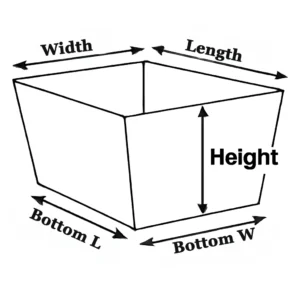
| Item NO. | length (mm) | width (mm) | height (mm) |
| TE-AS-071 | 100 | 84 | 35 |
| TE-AS-072 | 100 | 56 | 35 |
| TE-AS-073 | 100 | 43 | 26 |
| TE-AS-074 | 100 | 27 | 27 |
| TE-AS-075 | 100 | 24 | 17 |
| TE-AS-075-1 | 100 | 20 | 20 |
| TE-AS-075-2 | 100 | 27 | 27 |
| TE-AS-075-3 | 103 | 28 | 30 |
| TE-AS-075-4 | 100 | 43 | 25 |
| TE-AS-075-5 | 100 | 24 | 17 |
| TE-AS-075-6 | 100 | 27 | 25 |
| TE-AS-075-7 | 100 | 43 | 26 |
| TE-AS-075-8 | 100 | 56 | 35 |
| TE-AS-075-9 | 100 | 50 | 35 |
| TE-AS-075-10 | 100 | 56 | 35 |
| TE-AS-076 | 73 | 30 | 22 |
| TE-AS-076-1 | 73 | 30 | 22 |
| TE-AS-076-2 | 70 | 30 | 22 |
| TE-FA-001 | 300 | 70 | 30 |
| TE-FA-002 | 200 | 80 | 35 |
| TE-FA-003 | 200 | 11 | 12 |
| TE-FA-004 | 105 | 23 | 20 |
| TE-FA-005 | 100 | 30 | 25 |
| TE-FA-006 | 90 | 10 | 10 |
| TE-FA-007 | 80 | 30 | 20 |
| TE-FA-008 | 88 | 12 | 10 |
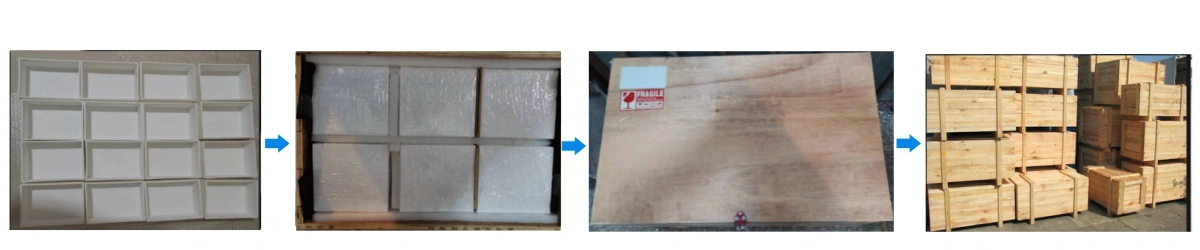
Trapezoid Ceramic Alumina Crucibles Packaging
- Individual protective ceramic separators to prevent edge damage
- Batch packaging with shock-absorbing inserts for transport stability