
Industrial Silicon Carbide Crucibles for Corrosive and High-Temp Atmospheres
Silicon carbide crucibles are high-temperature ceramic and carbon-bonded containers used for metal melting and holding, powder calcination and sintering, and laboratory material processing. The right choice depends on your material route — a SiC-graphite / carbon-bonded crucible for non-ferrous metal melting, or a technical SiC crucible (SSiC / RBSiC) for high-temperature, high-purity or corrosive processing.
ADCERAX reviews each requirement by metal or sample contact, furnace type, capacity, dimensions, temperature and atmosphere, then recommends the material route and a manufacturable design. Share your drawing, old part or working conditions for an engineering review.
180–320 MPa
Flexural Strength
What Is a Silicon Carbide Crucible?
A silicon carbide crucible is a high-temperature container for metal melting, calcination, sintering and lab processing. There are two main routes: SiC-graphite (carbon-bonded) crucibles for melting non-ferrous metals — aluminium, copper, brass, zinc, precious metals — in crucible, induction and resistance furnaces; and technical SiC crucibles (SSiC / RBSiC) for high-temperature, high-purity or corrosive processing such as calcination and sintering.
Silicon Carbide Crucible Properties
Silicon carbide crucibles are engineered to maintain stable performance during repeated thermal cycling and corrosive atmosphere exposure. The specifications below summarize the typical properties required for high-temperature industrial processing and powder sintering operations.
Typical SiC Routes for Crucibles & Related Shapes (TDS Rev05)
Values follow ADCERAX silicon carbide grade comparison TDS (Rev05). Crucible route depends on atmosphere, melt/medium, thermal cycle and required porosity — confirmed per RFQ.
| Property | AD-SIC-RB | AD-SIC-SS | AD-SIC-NB |
|---|---|---|---|
| SiC / notes | 85% SiC + ~15% free Si | ≥99% SiC, no free Si | SiC/Si₃N₄ 80/20; porous |
| Density (g/cm³) | ≥3.02 | 3.10 typical | 2.80 |
| Porosity | ≤0.1% open | <0.1% open | 12 vol% |
| Flexural (MPa) | 250 @20°C; 280 @1200°C | 380 | 160 @20°C; 180 @1200°C |
| App-temp ceiling (°C) | 1380 | 1600 | 1550 |
| Thermal conductivity | 45 @1200°C | 100–120 | 15 @1000°C |
RSiC (AD-SIC-RC): qualitative porous recrystallized route only — specify porosity / hot strength / permeability per order; no invented grade numbers.
Source: ADCERAX SiC TDS Rev05. Drawings welcome for RFQ.
How to Choose: Silicon Carbide Crucible Shape & Material by Application
The most common crucible mistake is choosing the wrong material route — SiC-graphite for metal melting and technical SSiC / RBSiC for high-temperature or powder work are not interchangeable. Match your application to a shape and route below before you send an RFQ.
| Application / Process | Recommended Shape | Material Route | Notes |
|---|---|---|---|
| Non-ferrous metal melting & holding (Al, Cu, brass, Zn) | Cylindrical (conical for easy pour/discharge) | SiC-graphite (carbon-bonded) | Match capacity and furnace type. |
| Precious metal / jewelry / dental casting | Conical or small cylindrical | SiC-graphite (small capacity) | Small, repeatable, and low contamination. |
| Battery cathode / ceramic powder sintering & calcination | Square (flat bed) or cylindrical | Technical SiC (SSiC / RBSiC) | For large flat powder loads, a sagger or setter may fit better. |
| Glass frit / specialty glass melting | Cylindrical | Technical SiC (SSiC, corrosion-resistant) | Confirm glass chemistry. |
| Material testing / ashing / sample fusion | Small cylindrical or conical | Technical SiC (SSiC) | Small capacity; confirm sample compatibility. |
- Quick rules:
- Melting metal, not powder? → SiC (carbon-bonded).
- Need high purity / no carbon pickup? → technical SiC (SSiC), not SiC-graphite.
- Large flat powder bed? → consider a sagger/setter, not a deep crucible.
- The route sets the temperature limit — don't apply SSiC's high controlled-atmosphere limit to a SiC-graphite melting crucible.
- These are starting points; final selection depends on your metal or sample, furnace, capacity, temperature and atmosphere.
Silicon Carbide Crucible Product Range
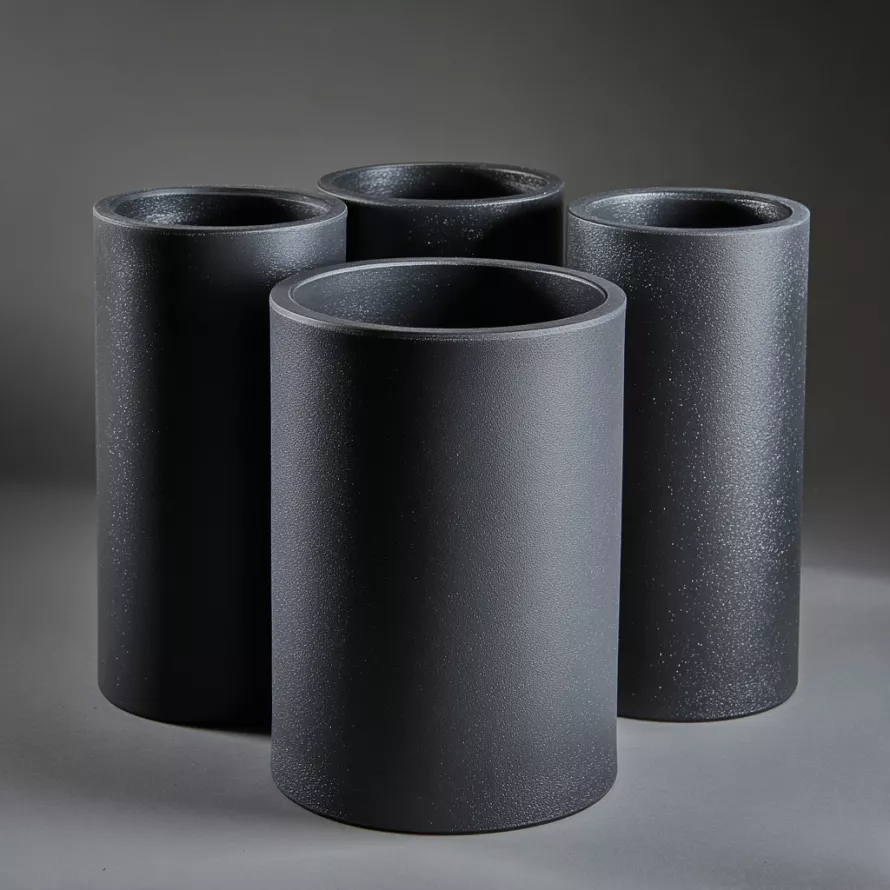
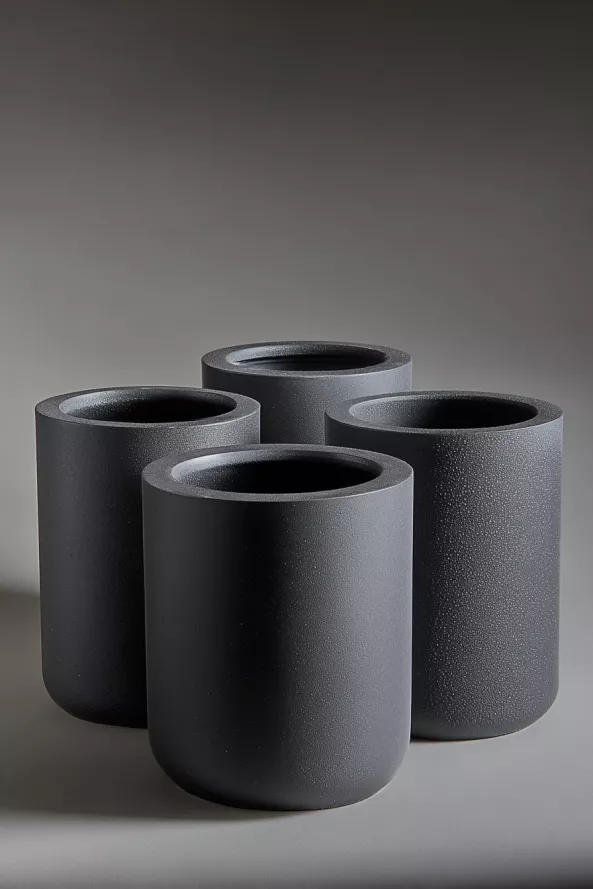
This form supports uniform radial heat distribution for melting and calcination tasks.
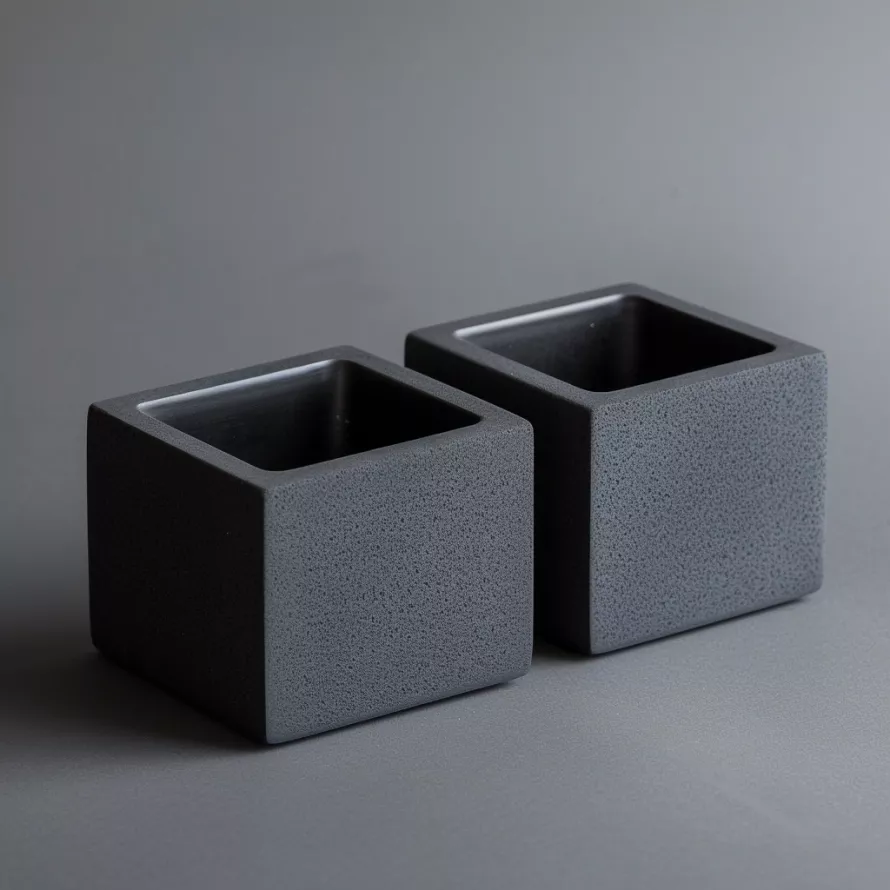
This design provides a full 2D flat-bed surface for powder layer control.
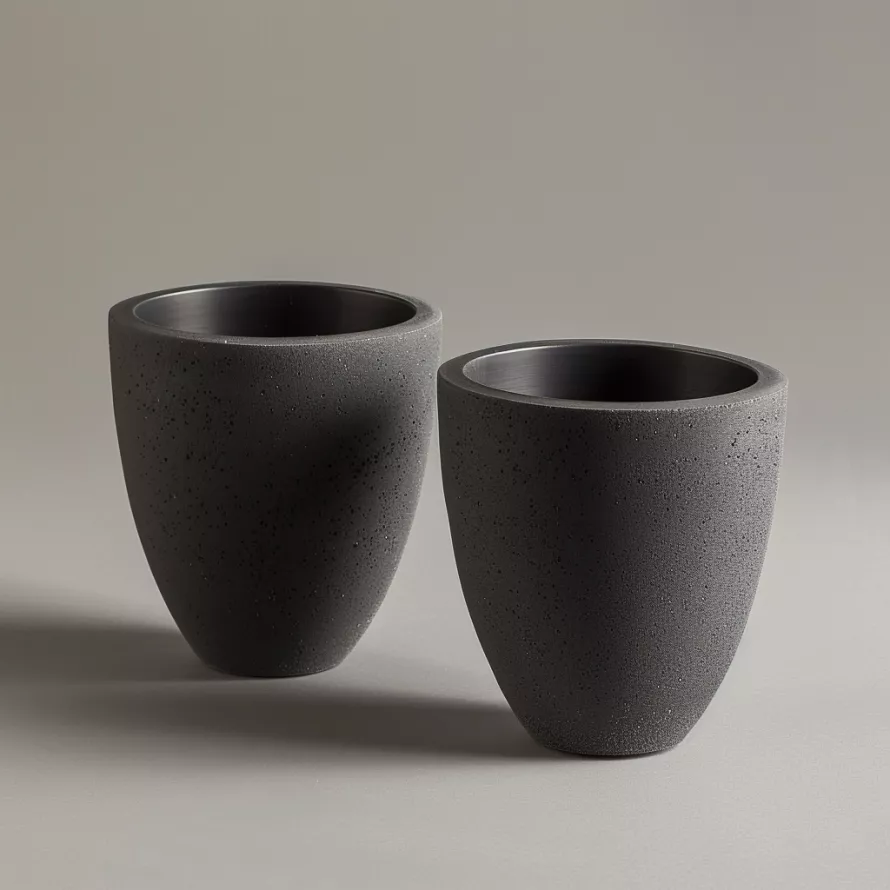
This profile enhances downward flow and promotes concentrated thermal distribution.
SiC Crucible Applications Across High-Temp Industries
Silicon carbide crucibles are used in high-temperature industries where thermal cycling, corrosive vapours and uniform heating affect product quality. The right crucible depends on the process — metal melting uses SiC-graphite, while powder sintering and calcination use technical SiC (SSiC / RBSiC).
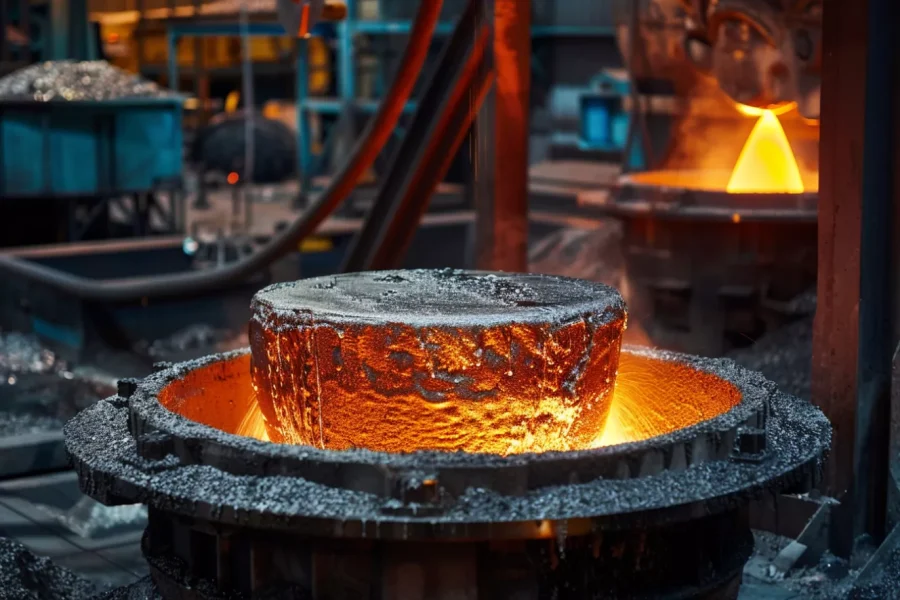
Non-Ferrous Metal Melting & Holding
For melting and holding aluminium, copper, brass and zinc, SiC-graphite crucibles combine fast, even heat transfer with strong resistance to thermal shock and flux attack.
- Even, fast heating — stable melt temperature and clean pour.
- Handles heavy charges — high compressive strength for dense metal loads.
- Resists thermal shock — holds up through rapid melt-and-hold cycles.
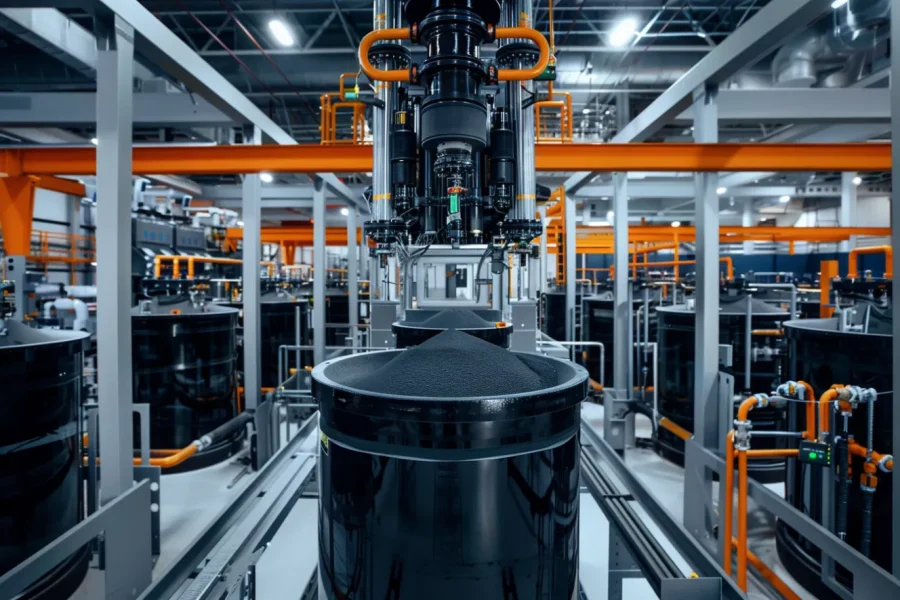
Lithium Battery Cathode & Precursor Sintering
For cathode and precursor sintering, technical SiC crucibles (SSiC / RBSiC) deliver consistent heat fields for NCM, NCA and LFP powders.
- Uniform heating — steadier BET across powder layers.
- Longer service — dense SiC resists wear and thermal fatigue.
- Fewer cracks — strong thermal-shock resistance during rapid cycling.
- Note: for large flat powder loads, a sagger or setter may fit better.
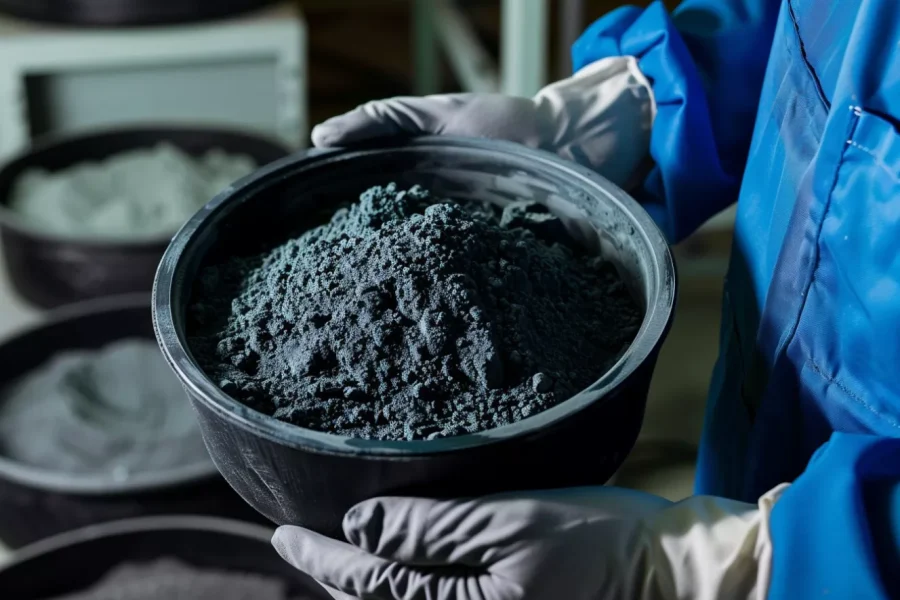
Advanced Ceramic Powder Calcination
For ceramic powder calcination, technical SiC crucibles hold uniform 2D/3D heat fields and stay dimensionally stable across repeated cycles.
- Even heat — better batch consistency across flat layers.
- Low adhesion — smooth inner surface reduces regrinding.
- High endurance — dense SiC withstands repeated calcination cycles.
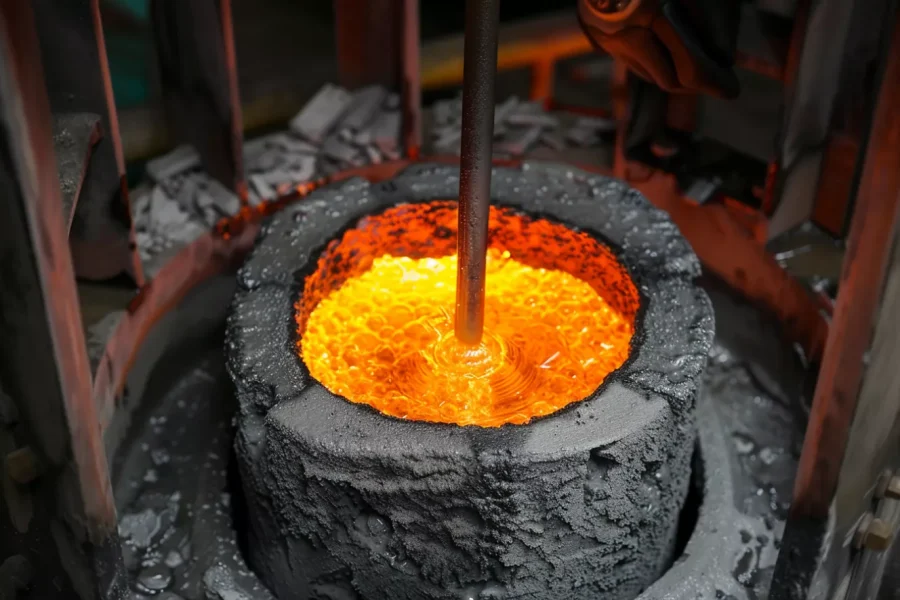
Glass Frit & Specialty Glass Melting
For glass frit and specialty glass, technical SiC crucibles resist corrosive oxide melts while heating fast and evenly.
- Corrosion resistance — withstands aggressive oxide and frit chemistries.
- Even melt temperature — uniform heat across the melt zone.
- Fast, stable ramp — controlled heat-up for consistent batches.
Not Sure Which Crucible You Need?
Send your metal or powder, furnace type, size or drawing, and working conditions. Our engineers confirm the material route (SiC-graphite vs SSiC / RBSiC), shape and feasibility before you commit — including matching or replacing an existing crucible.
Customized Silicon Carbide Crucibles — Drawing-Based & Small-Batch
We specialize in customizing silicon carbide crucibles with special sizes, tight tolerances, and complex features. OEM and small-batch support available.
Customization Options
Extra-large / Extra-small diameters, non-standard thicknesses, and ultra-long / ultra-short lengths.
Provide higher - level dimensional accuracy and concentricity control than the standard.
Flanges, steps, threads, drilling holes, grooves, etc.
Adjust the material according to the application requirements.
Polish and grind the surface to achieve a specific surface roughness.
Customization Process
Send us your drawing, CAD file, or physical sample with material grade, dimensions, tolerances, and quantity. Our engineers will evaluate the design and provide a detailed quotation with lead time and pricing.
Once the quote is approved, we proceed with sample prototyping (1–50 pcs) if needed, for testing and validation.
After sample approval or direct confirmation, we begin batch manufacturing using CNC machining, sintering, and polishing. All parts undergo dimensional checks, material purity testing, and surface finish inspection.
Finished products are securely packed and shipped via DHL/FedEx/UPS or your preferred method. We support global delivery with full documentation.
One-Stop Custom Silicon Carbide Crucible Supplier for Industrial Projects
Choosing an industrial silicon carbide crucible means matching furnace geometry, thermal load and operating conditions. ADCERAX runs an engineering-grade review — geometry, thermal fit, powder flow, load and tolerances — before recommending a design, for both project buyers and high-volume procurement.
-
Geometry Compatibility Assessment:
Crucible geometry is aligned with furnace fixtures. -
Thermal Distribution Review:
Heat field behavior is evaluated for stable cycles. -
Powder Flow Verification:
Material settling patterns are checked for uniformity. -
Structural Load Analysis:
Cycling stress effects are predicted for safe operation. -
Dimensional Accuracy Control:
Critical tolerances are maintained within stable limits.


Manufacturing Strength Behind Silicon Carbide Crucible Production
Each crucible is backed by controlled manufacturing steps for dimensional accuracy, thermal reliability and volume production.
| Manufacturing Capabilities Overview | |||
|---|---|---|---|
| Category | Specification / Capability | ||
| SiC Material System | Supported RBSiC and SSiC grades | ||
| Isostatic Pressing Capacity | Max forming diameter 600 mm | ||
| Green Body Density Control | ±3% density deviation per batch | ||
| High-Temperature Kilns | 2100°C SSiC sintering capability | ||
| Kiln Chambers | 8 independent chambers for parallel production | ||
| Thermal Uniformity | ±5°C uniformity across effective zone | ||
| CNC Machining Centers | Five-axis SiC-compatible machining lines | ||
FAQs About ADCERAX Silicon Carbide Crucibles
Choose by your process:
- SiC-graphite (carbon-bonded) crucible — melting and holding non-ferrous metals such as aluminium, copper, brass, zinc and precious metals in crucible, induction or resistance furnaces.
- Technical SiC crucible (SSiC or RBSiC/SiSiC) — high-temperature, high-purity, corrosive or powder processing such as calcination, sintering and material testing.
Share your metal or sample, furnace type, temperature and atmosphere, and we will recommend the route.
- Silicon carbide — better oxidation resistance in air at high temperature; holds shape, conductivity and corrosion resistance over repeated cycles.
- Graphite — performs best in inert atmospheres and can offer high purity, but degrades faster when exposed to oxygen.
For melting, SiC-graphite (carbon-bonded) crucibles combine both; for high-purity or oxidising high-temperature work, a technical SiC crucible is usually preferred.
- Carbon-bonded SiC-graphite — carbon binder; made for melting and holding non-ferrous metals.
- Clay-graphite — lower cost, but lower thermal-fatigue resistance and needs careful atmosphere control.
- Technical SiC (SSiC / RBSiC) — tolerates higher temperatures and faster heating; suits high-purity or corrosive processing.
The right choice depends on your metal or sample, temperature, atmosphere and purity needs.
Crucibles come in cylindrical, square and conical forms across a wide size range, with custom dimensions made to drawing.
For an accurate review, send:
- Material route or your metal / powder / sample
- Furnace type
- Capacity (kg or cc) and dimensions (OD, ID, height, wall thickness) — or a drawing / old part
- Working and peak temperature, and atmosphere
- Quantity
Our engineers confirm feasibility and lead time before quotation.
Service life depends on your metal, furnace, flux, thermal cycle and handling, so it is not a fixed number. Common signs to plan a replacement include visible cracking, wall thinning or erosion, slag build-up that affects capacity, and slower or uneven heating. Share your cycle and furnace conditions and we can help you plan replacements and spares.
- Technical SiC (SSiC / RBSiC) — formed by isostatic pressing or extrusion, then sintered at high temperature; consolidation sets density and thermal-shock behaviour.
- SiC-graphite (carbon-bonded) — formed from silicon carbide and carbon with a binder, then fired.
Both routes finish with inspection and, where needed, precision machining.
Condition a new crucible with gradual pre-heating before full-temperature use, so the microstructure stabilises and thermal gradients that can start micro-cracks are minimised.
The ideal ramp depends on your furnace load and atmosphere — slow first heating and controlled cooling help extend cycle life.
In air at high temperature, SiC forms a thin protective SiO₂ layer that slows further oxidation; heavy thermal cycling can disturb this layer, so controlled ramp profiles help. In inert or vacuum atmospheres, SiC keeps its structure and strength well, supporting stable metal, alloy and high-temperature processing. Confirm your atmosphere so we can advise the right route and grade.
What to Send for a Silicon Carbide Crucible Quote
For a fast engineering review, please share:
- Your material or process — the metal you melt (aluminium, copper, brass, zinc, precious metals) or the powder/sample you process; or let us recommend the route (SiC-graphite vs SSiC / RBSiC).
- Furnace & conditions — furnace type (crucible / induction / resistance / lab), plus working and peak temperature and atmosphere.
- Size — capacity (kg or cc), OD, ID, height and wall thickness — or send a drawing / old part.
- Shape & features — cylindrical, square or conical; spout, lid or special profile.
- Temperature & atmosphere — continuous and peak temperature, and air / inert / vacuum.
Our engineers confirm the material route, shape, feasibility and lead time before quotation.
*Our team will answer your inquiries within 24 hours.
*Your information will be kept strictly confidential.
Partner with ADCERAX for Silicon Carbide Crucibles
Looking for a reliable silicon carbide crucible supplier? Let us help you with your next project.
info@adcerax.com
Tel:+86-0731-84428843
WhatsApp:+86 19311583352
Within 24 hours
