Alumina Gauge Blocks Set for Dimensional Calibration – Non-Magnetic Ceramic Length Standards

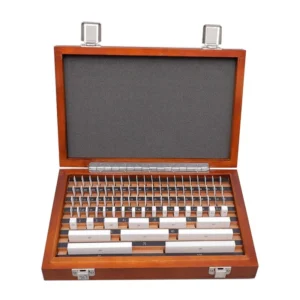
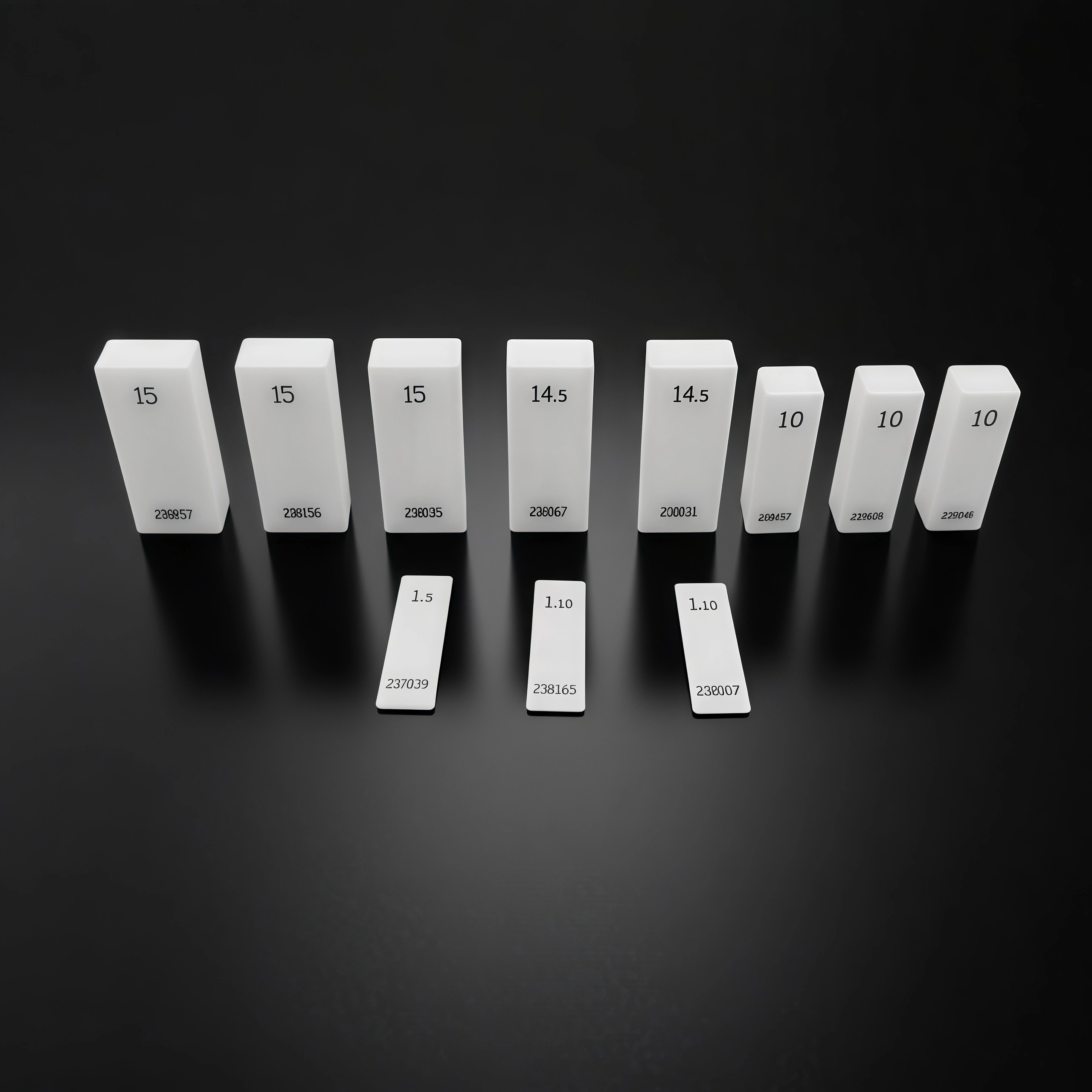
Alumina gauge blocks are available as metric and inch sets covering 0.5–100 mm or 0.05–4 inch ranges, and individual blocks can be customized in length, cross-section, and grade to match specific calibration tasks and fixture locations.

Catalogue No. AT-CMT-015
Material Al₂O₃
Flatness ≤1 µm
Thermal Expansion Coefficient 6.8 × 10⁻⁶ /K (20–800°C)
Coefficient of thermal expansion ~8–8.5 × 10⁻⁶ /K (20–1000 °C)
24H Standard Dispatch
Small Batch Support OEM
Factory Direct
Expert Engineering Support

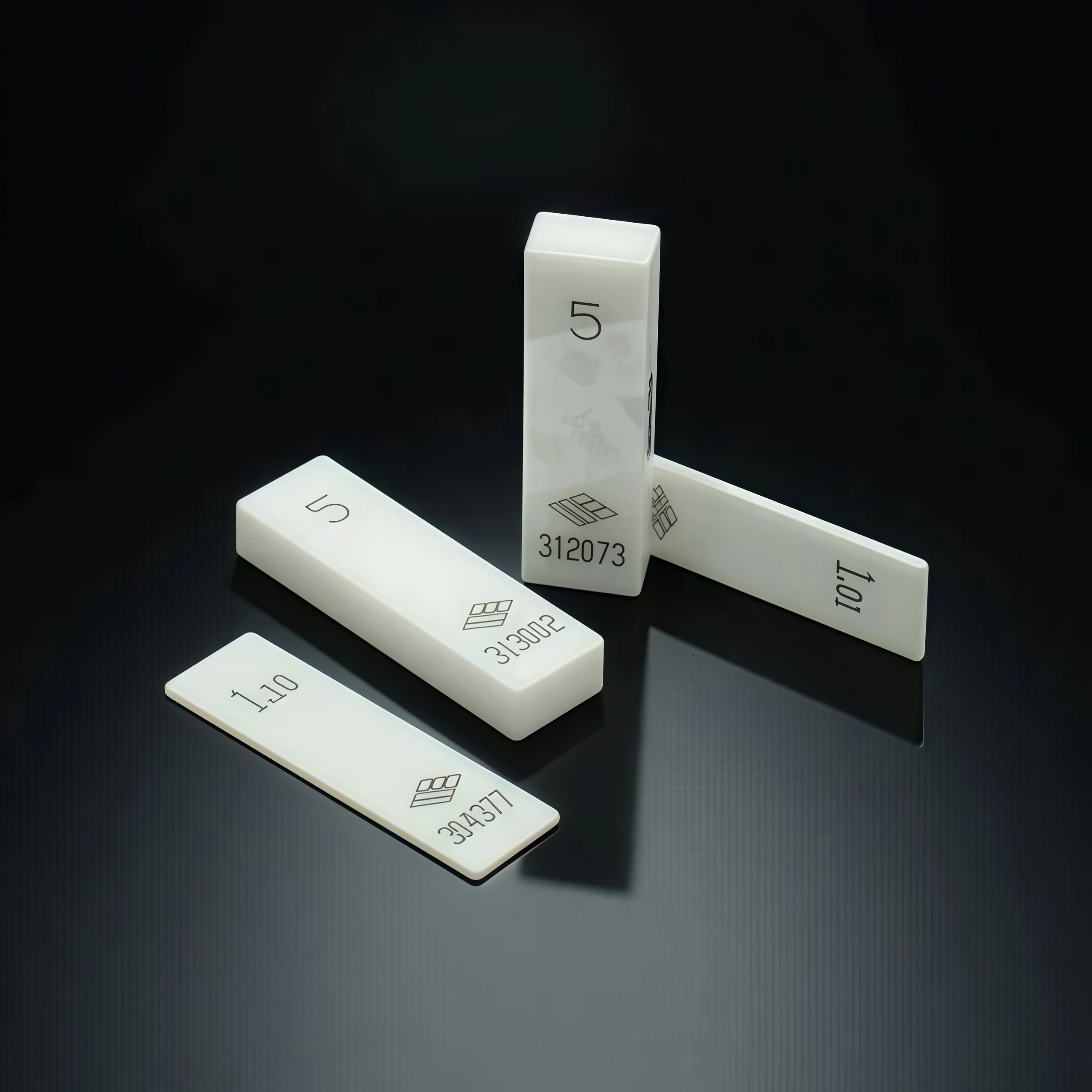
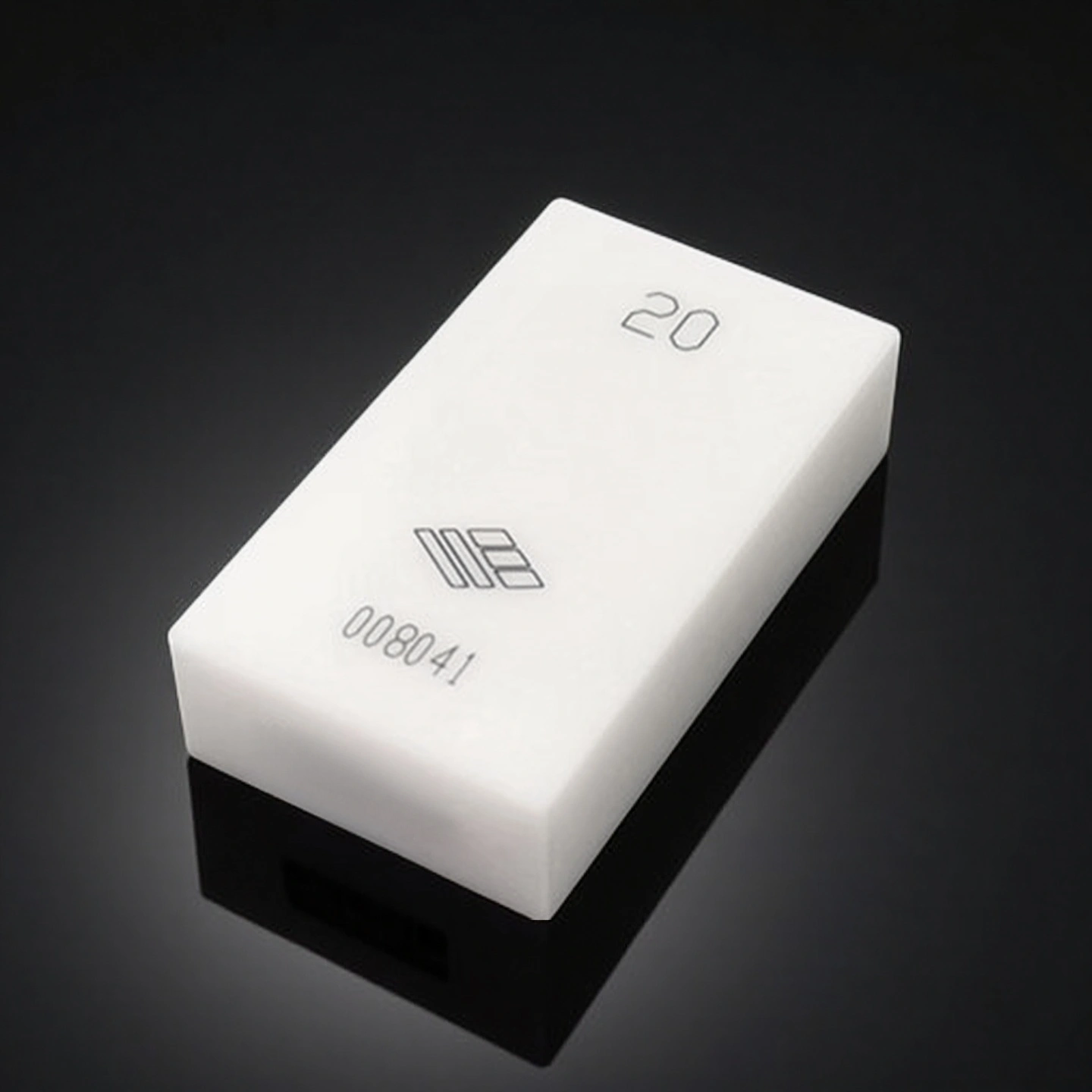
Alumina gauge blocks are precision ceramic length standards made from high-purity aluminum oxide, used to set and verify dimensional measuring instruments. Their non-magnetic and corrosion-free ceramic structure provides stable length, high wear resistance, and reliable performance in both laboratory calibration and shop-floor inspection environments.

Advantages of Alumina Gauges Blocks & Sets

  • Non-magnetic and corrosion-free
    Alumina gauge blocks are immune to rust in humid or oily environments and remain non-magnetic, reducing measurement interference with magnetic or electronic instruments.

  • High wear resistance and dimensional stability
    The high hardness and dense microstructure of alumina support strong abrasion resistance, enabling more calibration cycles before re-lapping or replacement is required.

  • Low thermal expansion for stable readings
    With a thermal expansion coefficient around 8 × 10⁻⁶/K, alumina gauge blocks help minimize length change around the reference temperature, which is important for high-precision grade 0 and grade 1 measurements.

  • Clear laser markings and good readability
    The contrast between the ceramic surface and laser-etched legends supports quick identification of nominal length, grade, and serial number, which simplifies daily use in metrology labs.

  • Configurable sets and long blocks
    Users can combine standard sets with long alumina gauge blocks up to 1000 mm to cover both small instrument setting tasks and machine tool alignment work under a unified material system.

Alumina Gauges Blocks Properties

Property Unit 99.5% Al₂O₃ 99.6% Al₂O₃ 99.7% Al₂O₃ 99.8% Al₂O₃ 99.9% Al₂O₃ 99.99% Al₂O₃
Alumina content % 99.5 99.6 99.7 99.8 99.9 99.99
Density g/cm³ 3.89 3.91 3.92 3.93 3.94 3.98
Open porosity % 0
Color Ivory Ivory Ivory Ivory Ivory Ivory
Water absorption % 0 0 0 0 0
Young’s modulus (Elastic modulus) GPa 375 356 357 358 359 362
Shear modulus GPa 152
Bulk modulus GPa 228
Poisson’s ratio 0.22
Compressive strength MPa 2600 2552 2554 2556 2558 2570
Flexural strength MPa 379 312 313 314 315 320
Fracture toughness MPa·m¹ᐟ² 4
Hardness GPa 14.1 (≈1440 kg/mm²) 23 24 25 26 30
Thermal conductivity W/m·K 35 32–37 33–38 34–39 35–40 36–42
Thermal shock resistance ΔT °C 222 223 224 225 228
Maximum use temperature (no load) °C ≤1750 1755 1760 1765 1770 1800
Coefficient of thermal expansion 10⁻⁶/°C 8.4
Specific heat J/kg·K 880
Volume resistivity Ω·cm >1×10¹⁴ >1×10¹⁴ >1×10¹⁴ >1×10¹⁴ >1×10¹⁴ >1×10¹⁴
Dielectric constant (relative permittivity) 9.8 9.83 9.84 9.85 9.86 9.92
Dielectric strength kV/mm 16.9 23.2 23.4 23.6 23.8 24
Dissipation factor (loss factor @ 1 kHz) 0.0002


Specifications of Alumina Gauge Blocks Sets

Type 1-Alumina Gauges Blocks
Laboratory Use of Non-Magnetic Gauge Blocks

Item Gauge Size(mm) Grades of Gauge Blocks(H) Options for Grades(h) Weight (g)
AT-CMT-015 0.5mm 1 1/0/K 10
AT-CMT-016 0.5mm 0 1/0/K 11
AT-CMT-017 25mm 1 1/0/K 26
AT-CMT-018 25mm 0 1/0/K 27
AT-CMT-019 30mm 1 1/0/K 28
AT-CMT-020 30mm 0 1/0/K 29
AT-CMT-021 40mm 1 1/0/K 30
AT-CMT-022 40mm 0 1/0/K 31
AT-CMT-023 41.2mm 1 1/0/K 32
AT-CMT-024 41.2mm 0 1/0/K 33
AT-CMT-025 41.3mm 1 1/0/K 34
AT-CMT-026 41.3mm 0 1/0/K 35
AT-CMT-027 50mm 1 1/0/K 36
AT-CMT-028 50mm 0 1/0/K 37
AT-CMT-029 60mm 1 1/0/K 38
AT-CMT-030 60mm 0 1/0/K 39
AT-CMT-031 70mm 1 1/0/K 40
AT-CMT-032 70mm 0 1/0/K 41
AT-CMT-033 75mm 1 1/0/K 42
AT-CMT-034 75mm 0 1/0/K 43
AT-CMT-035 80mm 1 1/0/K 44
AT-CMT-036 80mm 0 1/0/K 45
AT-CMT-037 81.5mm 1 1/0/K 46
AT-CMT-038 81.5mm 0 1/0/K 47
AT-CMT-039 90mm 1 1/0/K 48
AT-CMT-040 90mm 0 1/0/K 49
AT-CMT-041 100mm 1 1/0/K 50
AT-CMT-042 100mm 0 1/0/K 51
AT-CMT-043 125mm 1 1/0/K 52
AT-CMT-044 125mm 0 1/0/K 53
AT-CMT-045 150mm 1 1/0/K 54
AT-CMT-046 150mm 0 1/0/K 55


Type 2-Alumina Gauges Block Sets

Alumina Gauges Block Sets

Item Gauge Size(mm) Increments(mm) Total Blocks Grades of Gauge Blocks(h) Weight (g)
AT-CMT-001 1-1.5mm 0.01 51 1 12
AT-CMT-002 1-1.5mm 0.01 51 0 13
AT-CMT-003 1.6-1.9mm 0.1 4 1 14
AT-CMT-004 1.6-1.9mm 0.01 31 0 15
AT-CMT-005 2-6.5mm 0.5 10 1 16
AT-CMT-006 2-6.5mm 0.5 10 0 17
AT-CMT-007 7-9.5mm 0.5 6 1 18
AT-CMT-008 7-9.5mm 0.5 6 0 19
AT-CMT-009 10-13.5mm 0.5 8 1 20
AT-CMT-010 10-13.5mm 0.5 8 0 21
AT-CMT-011 14-19.5mm 0.5 12 1 22
AT-CMT-012 14-19.5mm 0.5 12 0 23
AT-CMT-013 20-24.5mm 0.5 10 1 24
AT-CMT-014 20-24.5mm 0.5 10 0 25


2.1 Metric set of Gauge Blocks

  • Common gauge block sets: Grade K, Grade 0, Grade 1

  • Caliper and micrometer setting sets: Grade 0, Grade 1

  • Applicable standards: GB/T 6093, DIN EN ISO 3650, JIS B 7506

Set Size Standard Block Composition (English)
32-piece set DIN EN ISO 3650 1.005 mm × 1; 1.01–1.09 mm (0.01 step, 9); 1.1–1.9 mm (0.1 step, 9); 1–9 mm (1 step, 9); 10–30 mm (10 step, 3); 50 mm × 1
32-piece set JIS B 7506 1.005 mm × 1; 1.01–1.09 mm (0.01 step, 9); 1.1–1.9 mm (0.1 step, 9); 1–9 mm (1 step, 9); 10–30 mm (10 step, 3); 60 mm × 1
38-piece set GB/T 6093 1.005 mm × 1; 1.01–1.09 mm (0.01 step, 9); 1.1–1.9 mm (0.1 step, 9); 1–9 mm (1 step, 9); 10–100 mm (10 step, 10)
46-piece set DIN EN ISO 3650 1.001–1.009 mm (0.001 step, 9); 1.01–1.09 mm (0.01 step, 9); 1.1–1.9 mm (0.1 step, 9); 1–9 mm (1 step, 9); 10–100 mm (10 step, 10)
47-piece set DIN EN ISO 3650 1.005 mm × 1; 1.01–1.19 mm (0.01 step, 19); 1.2–1.9 mm (0.1 step, 8); 1–9 mm (1 step, 9); 10–100 mm (10 step, 10)
47-piece set JIS B 7506 1.005 mm × 1; 1.01–1.09 mm (0.01 step, 9); 1.1–1.9 mm (0.1 step, 9); 1–24 mm (1 step, 24); 25–100 mm (25 step, 4)
56-piece set JIS B 7506 0.5 mm × 1; 1.001–1.009 mm (0.001 step, 9); 1.01–1.09 mm (0.01 step, 9); 1.1–1.9 mm (0.1 step, 9); 1–24 mm (1 step, 24); 25–100 mm (25 step, 4)
76-piece set JIS B 7506 1.005 mm × 1; 1.01–1.49 mm (0.01 step, 49); 0.5–10 mm (0.5 step, 20); 20–50 mm (10 step, 4); 75 mm × 1; 100 mm × 1
83-piece set GB/T 6093 1.005 mm × 1; 1.01–1.49 mm (0.01 step, 49); 1.6–1.9 mm (0.1 step, 4); 0.5–9.5 mm (0.5 step, 19); 10–100 mm (10 step, 10)
87-piece set DIN EN ISO 3650 1.001–1.009 mm (0.001 step, 9); 1.01–1.49 mm (0.01 step, 49); 0.5–9.5 mm (0.5 step, 19); 10–100 mm (10 step, 10)
88-piece set JIS B 7506 1.0005 mm × 1; 1.001–1.009 mm (0.001 step, 9); 1.01–1.49 mm (0.01 step, 49); 0.5–9.5 mm (0.5 step, 19); 10–100 mm (10 step, 10)
91-piece set GB/T 6093 1.001–1.009 mm (0.001 step, 9); 1.01–1.49 mm (0.01 step, 49); 1.6–1.9 mm (0.1 step, 4); 0.5–9.5 mm (0.5 step, 19); 10–100 mm (10 step, 10)
103-piece set DIN EN ISO 3650 1.005 mm × 1; 1.01–1.49 mm (0.01 step, 49); 0.5–24.5 mm (0.5 step, 49); 25–100 mm (25 step, 4)
112-piece set DIN EN ISO 3650 1.0005 mm × 1; 1.001–1.009 mm (0.001 step, 9); 1.01–1.49 mm (0.01 step, 49); 0.5–24.5 mm (0.5 step, 49); 25–100 mm (25 step, 4)
121-piece set DIN EN ISO 3650 1.001–1.009 mm (0.001 step, 9); 1.01–1.49 mm (0.01 step, 49); 1.6–1.9 mm (0.1 step, 4); 0.5–24.5 mm (0.5 step, 49); 30–100 mm (10 step, 8); 25 mm × 1; 75 mm × 1
122-piece set DIN EN ISO 3650 1.0005 mm × 1; 1.001–1.009 mm (0.001 step, 9); 1.01–1.49 mm (0.01 step, 49); 1.6–1.9 mm (0.1 step, 4); 0.5–24.5 mm (0.5 step, 49); 30–100 mm (10 step, 8); 25 mm × 1; 75 mm × 1


2.2 Inch set of Gauge Blocks

  • Accuracy (Grades): Grade 0, Grade 1, Grade 2
  • Applicable Standard: ASME B89
Set Size Standard Block Composition (English)
36-piece set ASME B89 0.05 in × 1; 0.1 in × 1; 0.1001–0.1009 in (0.0001 step, 9); 0.101–0.109 in (0.001 step, 9); 0.11–0.19 in (0.01 step, 9); 0.2–0.5 in (0.1 step, 4); 1–2 in (1 step, 2); 4 in × 1
81-piece set ASME B89 0.1001–0.1009 in (0.0001 step, 9); 0.101–0.149 in (0.001 step, 49); 0.05–0.95 in (0.05 step, 19); 1–4 in (1 step, 4)


2.3 Detailed Size of Gauge Blocks

Gauge Size(mm) 1-1.5mm 1.6-1.9mm 1.6-1.9mm 2-6.5mm 7-9.5mm 10-13.5 mm 14-19.5  mm 20-24.5 mm
Increments(mm) 0.01 0.1 0.01 0.5 0.5 0.5 0.5 0.5
1 1 1.6 1.6 2 7 10 14 20
2 1.01 1.7 1.61 2.5 7.5 10.5 14.5 20.5
3 1.02 1.8 1.62 3 8 11 15 21
4 1.03 1.9 1.63 3.5 8.5 11.5 15.5 21.5
5 1.04 1.64 4 9 12 16 22
6 1.05 1.65 4.5 9.5 12.5 16.5 22.5
7 1.06 1.66 5 13 17 23
8 1.07 1.67 5.5 13.5 17.5 23.5
9 1.08 1.68 6 18 24
10 1.09 1.69 6.5 18.5 24.5
11 1.1 1.7 19
12 1.11 1.71 19.5
13 1.12 1.72
14 1.13 1.73
15 1.14 1.74
16 1.15 1.75
17 1.16 1.76
18 1.17 1.77
19 1.18 1.78
20 1.19 1.79
21 1.2 1.8
22 1.21 1.81
23 1.22 1.82
24 1.23 1.83
25 1.24 1.84
26 1.25 1.85
27 1.26 1.86
28 1.27 1.87
29 1.28 1.88
30 1.29 1.89
31 1.3 1.9
32 1.31
33 1.32
34 1.33
35 1.34
36 1.35
37 1.36
38 1.37
39 1.38
40 1.39
41 1.4
42 1.41
43 1.42
44 1.43
45 1.44
46 1.45
47 1.46
48 1.47
49 1.48
50 1.49
51 1.5


Alumina Gauges Blocks Packaging

  • Each alumina gauge block set is supplied in a rigid case with fitted foam compartments to avoid impact and edge chipping during transport.
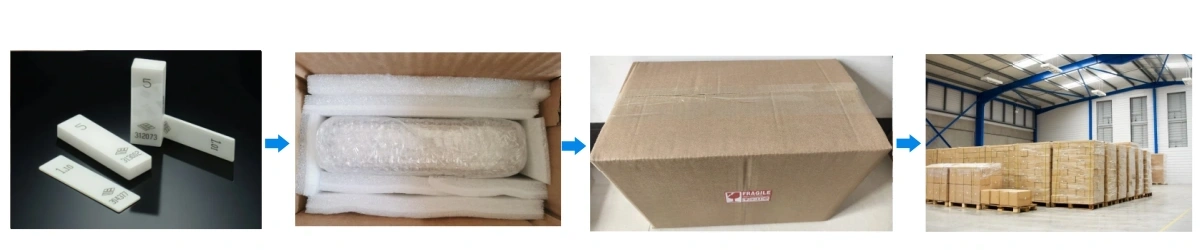

Alumina Gauges Blocks Packaging

Applications of Alumina Gauge Blocks

  • Precision Metrology Labs and Calibration Centres

    ✅Key Advantages

    1. Dimensional reference with ceramic stability – Alumina gauge blocks used as grade K or grade 0 masters support length deviations in the sub-micrometer range according to ISO 3650 algorithms.

    2. Low wear and reduced re-lapping frequency – Ceramic gauge blocks can show up to an order of magnitude higher abrasion resistance than steel in repeated wringing and measuring cycles.

    3. Non-magnetic behavior for sensitive instruments – The non-magnetic alumina body avoids magnetic coupling with test pieces or instrument components.

    ✅ Problem Solved

    A calibration lab using steel gauge blocks found that around 15% of blocks required re-lapping or replacement after several years of intensive use due to wear and corrosion. After adopting alumina gauge blocks as masters for high-grade length calibration, annual replacement dropped to under 5%, and the recalibration interval for working standards was extended, which reduced overall calibration and maintenance costs for the lab.

  • Automotive and General Machining Plants

    ✅Key Advantages

    1. Stable reference in oily and humid shop environments – Alumina gauge blocks resist corrosion when exposed to cutting fluids and air humidity, preventing rust-related length changes seen with unprotected steel.

    2. Support for frequent instrument setting on the shop floor – High hardness and wear resistance allow repeated setting of calipers, bore gauges, and micrometers without rapid face degradation.

    3. Consistent performance near 20 °C reference – Alumina’s moderate thermal expansion behaves predictably around standard room temperature, which supports repeatability when instruments are set at similar conditions.

    ✅ Problem Solved

    A machining plant used steel gauge blocks near machining cells for daily instrument checks. Coolant mist and temperature fluctuations caused corrosion spots and more frequent recalibration, leading to unplanned device downtime. Transitioning to alumina gauge blocks reduced corrosion-related issues and helped keep daily checks within tolerance, which lowered re-inspection work and improved availability of the quality control station.

  • Machine Tool and Automation Equipment Builders

    ✅Key Advantages

    1. Long alumina gauge blocks for machine alignment – Extended blocks up to several hundred millimeters assist in defining straightness and motion accuracy during machine tool build and service.

    2. Custom reference steps for fixtures and pallets – Alumina reference steps and blocks with controlled thickness allow repeatable fixture setup for automated lines.

    3. Unified material across build and service – Using alumina gauge blocks in both assembly and customer-side service tasks helps keep measurement behavior consistent across the full equipment life cycle.

    ✅ Problem Solved

    An automation integrator building multi-station lines for precision components introduced custom alumina reference blocks integrated into fixtures. Fixture setup time for new batches was reduced by approximately 20–30%, and repeatability of alignment between stations improved, lowering the number of parts requiring re-work after changeovers.

Usage Instructions for Alumina Gauge Blocks Sets

  • Installation and Initial Handling

    1. Inspect each alumina gauge block visually under good lighting; check that the measuring faces are clean and free from chips and cracks.
    2. Before first use, wipe the faces with a lint-free cloth and approved cleaning solution to remove packaging dust.
    3. For set-up of instruments or fixtures, place the gauge block on a clean reference surface and avoid side impact on the edges.

  • Daily Use

    1. Bring alumina gauge blocks, instruments, and workpieces to a stable temperature close to 20 °C for high-accuracy work.
    2. When wringing blocks, ensure both surfaces are clean and apply uniform pressure without twisting excessively to avoid edge stress.
    3. For micrometre or calliper setting, clamp gently against the gauge block without overtightening to prevent localized deformation of the instrument.

  • Storage

    1. Store alumina gauge blocks in the supplied case after use; keep the case in a controlled environment away from heavy vibration and direct sunlight.
    2. Use desiccant to limit humidity; while alumina does not rust, a stable environment helps preserve the measuring surfaces and markings.
    3. Assign a storage position and ID for each block to simplify traceability and calibration management.

  • Cleaning and Maintenance

    1. Clean measuring faces with a neutral cleaning fluid suitable for precision gauge blocks and dry with lint-free wipes.
    2. Do not use aggressive abrasives on the faces; if minor burrs or contamination occur, work with qualified metrology staff or a calibration lab for correction.
    3. Schedule periodic verification or recalibration based on usage frequency and grade; masters (grade K/0) should be checked more frequently than working blocks.

  • Precautions and Typical Misuse Scenarios

    1. Common issue 1 – Using alumina gauge blocks on dirty surfaces
    Risk: contamination between block and surface leads to incorrect length and scratches.
    Solution: always clean both the reference surface and the gauge block before wringing or setting instruments; include visual checks in daily work instructions.

    2. Common issue 2 – Dropping blocks or striking edges against hard parts
    Risk: ceramic edges may chip even though the material is hard.
    Solution: handle blocks close to the table surface, use both hands, and avoid fast movements near metal tools or fixtures.

    3. Common issue 3 – Mixing different materials in one chain without considering expansion
    Risk: combining alumina blocks with steel accessories in large stacks may introduce small additional thermal effects.
    Solution: for high-accuracy chains, keep material consistent where possible and stabilize the temperature around 20 °C during measurement.

Alumina Gauge Blocks FAQ

  1. Q: How do alumina gauge blocks differ from steel gauge blocks?
    A: Alumina gauge blocks are ceramic length standards made from aluminum oxide. Compared with steel gauge blocks, alumina gauge blocks are non-magnetic, do not corrode in humid conditions, and offer high wear resistance and stable dimensions over time.
  2. Q: Which accuracy grades are available for alumina gauge blocks?
    A: Alumina gauge blocks can be manufactured to ISO 3650 calibration grade K and grades 0, 1, and 2, with the tolerance formulas defined for each grade to support master, reference, and working applications.
  3. Q: Are alumina gauge blocks suitable for use on the shop floor, or only in labs?
    A: Alumina gauge blocks can be used both in metrology labs and on the shop floor. Their resistance to corrosion and wear makes them suitable for environments exposed to oil mist and humidity, as long as they are protected from impact and stored properly.
  4. Q: How does the thermal expansion of alumina gauge blocks affect measurement accuracy?
    A: Alumina’s thermal expansion coefficient is typically around 8–8.5 × 10⁻⁶/K, which is similar to or lower than many steels, so dimensional changes around 20 °C remain small. For high-accuracy work, blocks, instruments, and parts should still be stabilized at the reference temperature.
  5. Q: Can alumina gauge blocks be used as masters for calibrating other gauge blocks?
    A: Yes, alumina gauge blocks manufactured to grade K or grade 0 and calibrated by a recognized laboratory can serve as master standards for comparison calibration of working gauge blocks and length instruments.
  6. Q: Do alumina gauge blocks come with calibration certificates?
    A: Sets and individual alumina gauge blocks can be supplied with manufacturer test reports and, when requested, third-party calibration certificates that trace length measurements to international standards.

Alumina Gauge Blocks Reviews

  • ⭐️⭐️⭐️⭐️⭐️
    We use alumina gauge blocks as working standards in our engine machining plant. The ceramic blocks stay clean in coolant mist, and instrument setting is more consistent than with our previous steel sets.
    -- Michael H., Quality Manager – EuroMec Automotive Systems
  • ⭐️⭐️⭐️⭐️⭐️
    Our lab adopted alumina gauge blocks as grade 0 masters alongside existing steel sets. The ADCERAX ceramic blocks show minimal wear after repeated comparison runs, and the laser markings make identification straightforward.
    -- Sarah L., Metrology Lab Supervisor – Northline Calibration Services
  • ⭐️⭐️⭐️⭐️⭐️
    We requested a custom alumina gauge block set with several long pieces for mill alignment. The custom lengths matched our drawings, and the blocks integrate well with our existing fixtures.
    -- Kenji S., Production Engineer – Osaka Precision Machinery Co.
  • ⭐️⭐️⭐️⭐️⭐️
    For fixture setup on our automatic lines, the alumina gauge blocks combined with ceramic reference steps helped us standardize tool offsets. Pricing from the ADCERAX factory was competitive for the custom configuration we needed.
    -- Luis R., Tooling Engineer – Iberia Automation Solutions
customize size

Custom Alumina Gauge Blocks

We supply standard alumina gauge blocks and support drawing-based customization so that gauge blocks and reference steps can match your fixtures, measuring instruments, and alignment procedures.

1. Nominal Length Range

  • Metric options: 0.5–1000 mm, supporting fine increments for calibration chains.
  • Inch options: 0.05–40 in, available in selected sub-ranges for metrology and tooling applications.

2. Cross-Section & Block Style

  • Standard rectangular blocks for general calibration work.
  • Slim blocks for compact setups or stacked assemblies.
  • Extra-wide blocks for improved wringing stability during long-length builds.

3. Accuracy Grades

  • Calibration grades available: Grade K, Grade 0, Grade 1, Grade 2, depending on whether blocks serve as masters, working standards, or shop-floor verification tools.

4. Dimensional Tolerances (Custom Lengths)

  • Length tolerance aligned with chosen gauge block standard (ISO 3650 / JIS / GB / ASME).
  • Flatness & parallelism held within micrometer-level ranges suited for wringing assemblies.
  • Optional tight-tolerance blocks for high-precision metrology labs.

5. Surface Finish Options

  • Standard lapped faces for consistent wringing performance.
  • Super-finished faces available for reference masters or low-wear environments.
  • Chamfered or squared edges depending on handling preference.

6. Markings & Identification

  • Laser-etched data: nominal length, grade, ID code.
  • Optional customer part number, asset code, serial number, or calibration cycle mark.
  • QR-code marking available for digital asset tracking.

7. Set Configuration

  • Standard sets: 32 / 38 / 46 / 47 / 56 / 76 / 83 / 87 / 88 / 91 / 103 / 112 / 121 / 122 pieces, plus 36-pc and 81-pc ASME sets.
  • Application-specific sets for micrometre setting, calliper calibration, CMM verification, toolroom gauge setups, or custom count.

8. Material-Related Customization

  • High-purity alumina with selectable density levels for wear resistance.
  • Optional anti-contamination finish for environments with oils or coolants.
  • Coefficient-of-thermal-expansion options aligned to specific workshop temperatures.

Related Products

ADCERAX - Your Trusted Advanced Ceramics Manufacturing Partner

Direct factory manufacturing with comprehensive ceramic materials expertise and global supply capabilities

Direct Factory Manufacturing

China-based ceramic materials production facility with state-of-the-art equipment

Engineering Team

Experienced professionals in advanced ceramics applications and custom design

Quality Control

Strict quality control standards for technical ceramics manufacturing and quality management

Global Supply Chain

Serving customers worldwide with technical ceramics and rapid response

24/7 Technical Support

Round-the-clock support for ceramic components inquiries and technical assistance

500+ Satisfied Customers

Trusted by global customers for advanced ceramic materials and precision components

Get in touch with us

Our team will be happy to respond to you in less than 24 hours.

Adcerax's factory

Quick Quotation

*Our team will answer your inquiries within 24 hours.

*Your information will be kept strictly confidential.

Ready to Solve Your Engineering Challenge?

Partner with ADCERAX for reliable, high-performance advanced ceramic solutions. Our engineers are ready to discuss your project.

E-mail

info@adcerax.com

Phone

+(86) 0731-74427743 | WhatsApp: +(86) 19311583352

Response Time

Within 24 hours

Quick Quote

The more details you provide, the faster we can quote.

*We respond within 24 hours. All inquiries are confidential.

Download Catalog

Get Your Custom Sulution

The more details you provide, the faster we can respond.

customize size

*We respond within 24 hours. All inquiries are confidential.

Download Catalog