Selecting materials for thermocouples requires careful balance of durability, temperature resistance, and insulation.
A 4-bore alumina tube separates and insulates thermocouple wires in high-temperature environments. Engineers rely on it to balance wire gauge, insulation stability, and temperature resistance.
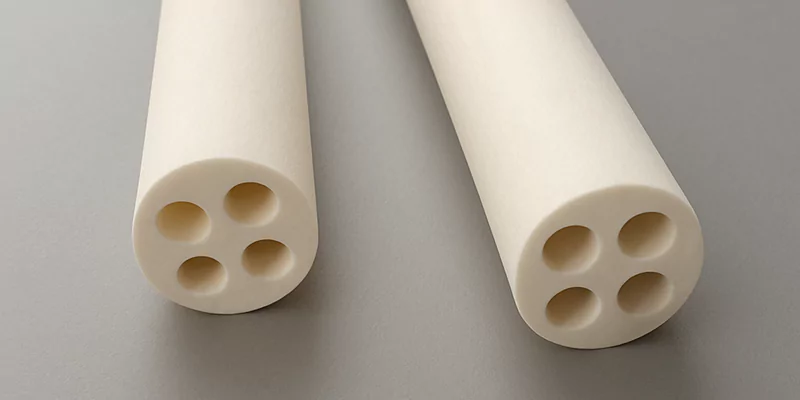
Engineers evaluating thermocouple assemblies must consider geometry, insulation, and procurement factors. This guide organizes those decisions into structured steps.
What Defines a 4-Bore Alumina Tube in Thermocouple Applications?
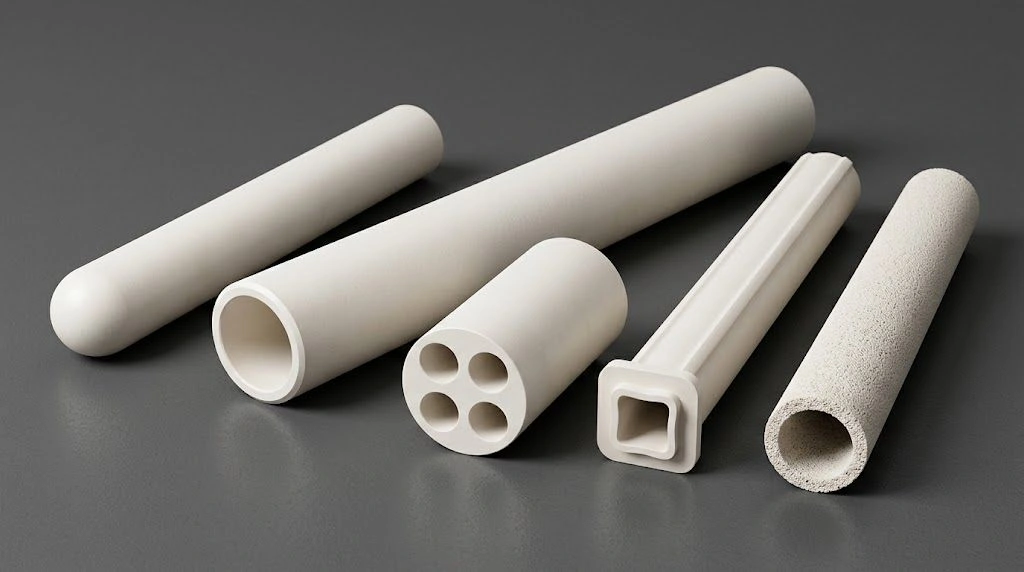
Distinct features make a 4-bore alumina tube suitable for thermocouple wire insulation within the broader alumina tubes catalog. It combines geometry, material purity, and specific assembly roles to maintain separation under stress. Understanding these aspects helps engineers choose the correct design.
Channel Geometry and Wire Positioning
The four channels in an alumina tube allow parallel placement of thermocouple wires. Correct positioning reduces the risk of electrical interference and mechanical vibration. This ensures more reliable long-term performance in industrial environments.
Different geometries influence both ease of wire insertion and retention of stability. Narrower bores support smaller wire gauge, while larger bores accommodate multiple pairs. Consistent clearance reduces friction that leads to premature insulation breakdown.
Therefore, considering geometry is central to matching with application needs.
- Proper alignment minimizes vibration impact
- Correct bore spacing reduces electrical contact
- Consistent geometry prolongs insulation reliability
Material Purity and Ceramic Properties
High-purity alumina contributes to durability in extreme heat. Its purity level determines dielectric performance and resistance to corrosion. This directly affects the lifespan of thermocouple assemblies.
990-class and higher alumina grades are common screening choices for strength and dielectric stability in TC wire-separation duty — confirm purity on COA and duty, not as a universal contract purity claim. Thermal conductivity near ~25 W/m·K at 25°C is a typical screening figure (T-/grade-dependent). Engineers benefit from reduced risk of electrical leakage under stress when grade matches the RFQ.
Consequently, material quality is non-negotiable in high-performance scenarios.
- Purity enhances dielectric strength
- Low porosity reduces contamination risk
- Stable conductivity supports predictable heat transfer
Typical Thermocouple Assembly Configurations
Thermocouple assemblies often use 4-bore tubes for conductor isolation. Positioning pairs of wires in adjacent bores balances separation with mechanical security. This design minimizes cross-interference in demanding environments.
Common assemblies integrate protective sheaths and connectors with alumina tubes. These structures allow repeated heating cycles without insulation failure. The consistent design ensures reproducibility across manufacturing runs.
This reliability improves consistency in measurement accuracy.
- Isolation prevents signal drift
- Mechanical security withstands thermal cycling
- Reproducibility supports standardized builds
How Do Temperature Limits Affect 4-Bore Alumina Tube Selection?
Temperature limits define where a 4-bore alumina tube can be safely applied. High-temperature stability, shock resistance, and standardized test data are critical to understanding performance. Engineers use these parameters to avoid material failure in operation.
Continuous Operating Temperature Range
Screen continuous temperature by alumina TDS grade rather than treating purity as a blanket SLA: AD-ALU-990-class ~1600°C, AD-ALU-997-class ~1700°C, and AD-ALU-950-class ~1400°C long-term screening windows. Peak short-excursion ratings are not the same as continuous service.
Actual ceilings are atmosphere- and load-dependent — confirm on the grade TDS and RFQ duty, not by assuming “99% always guarantees 1600°C.” Choosing the wrong grade may compromise insulation stability.
These ranges are screening benchmarks for design, not universal acceptance gates.
- 990-class ~1600°C / 997-class ~1700°C / 950-class ~1400°C screening
- Peak ≠ continuous — confirm on TDS
- Atmosphere-/load-dependent grade selection
Thermal Shock and Cycling Resistance
Temperature cycling places stress on ceramic structures. Ramp limits are geometry- and grade-dependent; treat published gradients as process guidance, not a universal acceptance gate. Careful ramping helps avoid sudden cracking during thermal transitions.
A ~250°C ΔT figure is illustrative thermal-shock screening only — geometry-/grade-dependent and not an acceptance SLA. Engineers designing cyclic operations should confirm allowable ΔT and cycle count on the RFQ.
This resilience ensures durability across cycles.
- Shock resistance prevents cracking under gradients
- Stable cycles enhance operational lifespan
- Dynamic heating conditions remain manageable
Data from Standardized Test Methods
ASTM and IEC methods are useful screening references for alumina tubes. Dielectric checks on standard specimens and dimensional inspection against the drawing support RFQ acceptance — not installed 4-bore withstand SLAs.
Typical dense alumina dielectric screening is on the order of ~10 kV/mm on standard specimens (TDS-typical). That is not an installed multi-bore withstand rating; size the web to voltage class and confirm test method on the RFQ.
| Test Standard | Property Measured | Screening Note | Condition |
|---|---|---|---|
| ASTM C1171 | Thermal Cycling | Illustrative ΔT screening — not acceptance SLA | Confirm cycle/ΔT on RFQ |
| IEC 60672 | Dielectric Strength | ~10 kV/mm specimen typical (not installed withstand) | Standard specimen / confirm method |
| ASTM C799 | Dimensional Tolerance | Drawing-class — confirm on drawing | Per drawing / OD class |
How Should Wire Gauge Be Matched with 4-Bore Alumina Tubes?
Matching wire gauge with bore size ensures mechanical and electrical stability. Engineers need reliable tables and guidelines to cross-check dimensions. This prevents insulation failure caused by mismatched clearance.
Wire Diameter vs Bore Size Chart
Wire gauges must align with bore size on a drawing-class basis. For example, AWG 24 with a ~0.8 mm bore is an illustrative pairing — confirm gauge, insulation OD, and bore on the drawing/RFQ. Larger wires require proportionally larger channels.
Insufficient clearance leads to abrasion and overheating. Conversely, excess clearance allows vibration and contact between wires. Both extremes raise shorting / insulation-breakdown risk when bore↔AWG is mismatched.
| AWG Size | Wire Diameter (mm) | Illustrative Bore (mm) | Illustrative Clearance (mm) |
|---|---|---|---|
| 20 | 0.81 | 1.2 | 0.39 |
| 24 | 0.51 | 0.8 | 0.29 |
| 28 | 0.32 | 0.6 | 0.28 |
| 30 | 0.25 | 0.5 | 0.25 |
AWG↔bore values above are illustrative drawing-class screening — confirm on the manufacturing drawing and RFQ.
Ensuring Mechanical Stability of Wires
Mechanical stability depends on bore-to-wire fit. A snug fit prevents wires from shifting under vibration. This avoids stress points that may cause breakage.
Insufficient support allows wires to bend or rub against bore walls. This accelerates wear and compromises insulation. Controlled bore sizing minimizes these risks.
Reliable stability improves long-term safety.
- Snug fit reduces mechanical vibration
- Stable positioning avoids premature wear
- Controlled sizing supports consistency
Preventing Contact and Shorting
Short circuits often occur from wire contact. Correct bore clearance ensures conductors remain separated. This is vital for measurement accuracy.
Bore↔AWG mismatch raises shorting and insulation-breakdown risk — confirm gauge and bore on the RFQ before procurement. This simple check avoids costly downtime.
Dimensional checks provide measurable protection.
- Clearance prevents electrical contact
- Confirm gauge and bore on RFQ to lower shorting risk
- Pre-checks safeguard operational uptime
What Electrical Insulation Properties Do 4-Bore Alumina Tubes Provide?
Electrical insulation defines the reliability of thermocouple signals. Alumina tubes provide stable dielectric strength, minimize leakage, and maintain performance over extended service. These features make them essential in demanding applications.
Dielectric Strength in High Temperatures
Alumina maintains useful dielectric performance under heat. Typical dense alumina shows on the order of ~10 kV/mm dielectric strength on standard specimens (TDS-typical) — not an installed 4-bore withstand SLA. Size the ceramic web to the voltage class and confirm RFQ test method for electrical separation in service.
High dielectric margin on specimens helps protect signals from interference when geometry and grade match duty. It also supports accurate readings during furnace operations when purity class is confirmed on COA.
Performance under heat defines reliability when screened — not when oversold as installed withstand.
- ~10 kV/mm specimen typical (TDS) — not installed withstand
- T-/grade-dependent; confirm test method on RFQ
- Protects signals when web and grade match voltage class
Leakage Current Minimization
Low leakage is essential for precise measurements. Dense high-purity alumina often screens above ~10¹⁴ Ω·cm at room temperature (T-/grade-dependent); resistivity falls with temperature (illustrative order ~10¹² at mid-range, ~10¹⁰ near 1000°C). Confirm on TDS for the selected grade.
This property reduces the risk of signal distortion when grade and geometry match duty. It allows thermocouples to operate more reliably in sensitive experiments. Engineers benefit from predictable screening stability.
| Condition | Resistivity (Ω·cm) screening | Note |
|---|---|---|
| 25°C | >10¹⁴ (typical screening) | T-/grade-dependent |
| 500°C | ~10¹² (illustrative) | Falls with temperature |
| 1000°C | ~10¹⁰ (illustrative) | Confirm on TDS |
Long-Term Insulation Stability
Extended service requires consistent performance. Insulation life is duty-, atmosphere-, and grade-dependent — confirm expected service window on RFQ/duty data rather than a fixed hour SLA. Matched grade and geometry reduce replacement frequency.
Aging behavior under repeated heating is grade- and environment-dependent. Confirm continuity expectations for long-term industrial setups on the RFQ. Dependability translates into operational efficiency when screened correctly.
Durability translates into sustained accuracy when duty matches TDS.
- Service life is duty-/grade-dependent — confirm on RFQ
- Resistance to thermal aging varies by atmosphere and load
- Improved operational continuity when specs match duty
How Do 4-Bore Alumina Tubes Compare to 2-Bore and 6-Bore Alumina Types?
Different bore counts influence suitability. Engineers compare them by capacity, structural integrity, and insulation trade-offs. Understanding these distinctions clarifies design choices.
Wire Accommodation Differences
Two-bore tubes house one pair of wires. Four-bore tubes hold multiple pairs while maintaining separation. Six-bore tubes expand capacity but reduce wall thickness.
Choice depends on wire quantity and required stability. Four-bore tubes balance capacity with mechanical strength. This makes them versatile for multiple scenarios.
Design variety reflects engineering needs.
- Two-bore supports single pairs
- Four-bore balances capacity and insulation
- Six-bore prioritizes channel count with thinner walls
Wall Thickness and Structural Stability
Wall thickness defines tube stability. Four-bore designs maintain stronger walls than six-bore tubes. This reduces risk of cracking under high load.
Six-bore tubes sacrifice wall integrity for capacity. Under repeated heating, they are more prone to structural issues. Four-bore tubes remain stable in more conditions.
| Bore Type | Wall Integrity (qualitative) | Shorting / Fit Risk (qualitative) | Typical Use Screen |
|---|---|---|---|
| 2-Bore | Stronger walls | Lower channel count | Single TC pair |
| 4-Bore | Balanced | Balanced multi-pair separation | Multi-pair wire separation |
| 6-Bore | Thinner webs | Higher packing / thinner wall trade-off | Dense channel count (confirm wall) |
Light contrast only — not a multi-bore encyclopedia; lock RFQ on 4-bore wire separation.
Trade-Offs in Temperature and Insulation
Temperature tolerance varies by design. Four-bore tubes preserve insulation at high heat. Six-bore tubes face insulation challenges under stress.
Two-bore tubes are simpler but limited in capacity. Four-bore types offer insulation stability without excessive risk. This trade-off defines why they dominate practical applications.
Balanced performance guides preference.
- 4-bore sustains insulation at high heat
- 6-bore risks insulation breakdown
- 2-bore offers limited scalability
What Dimensional Standards Apply to 4-Bore Alumina Tubes?
Dimensional standards ensure compatibility across industries. Engineers rely on ASTM and IEC references to validate tube conformity. These standards minimize procurement uncertainty.
Length and Diameter Tolerances
Diameter and length tolerances are drawing-class. Illustrative screening bands such as ±0.2 mm on diameter or ±0.5 mm on length (<300 mm class) are not universal acceptance SLAs — confirm on the manufacturing drawing and RFQ.
Agreed drawing tolerances prevent mismatch with protective sheaths and improve alignment with wire gauges when confirmed before release.
| Dimension | Illustrative / drawing-class | Application |
|---|---|---|
| Diameter | ±0.2 mm illustrative — confirm on drawing | Bore / OD fit |
| Length <300 mm class | ±0.5 mm illustrative — confirm on drawing | Assembly compatibility |
Bore Concentricity Requirements
Bore concentricity prevents uneven wall thickness. Treat concentricity as drawing-class / inspection screening — confirm the allowable deviation on the drawing rather than a fixed percentage SLA.
Non-concentric bores reduce insulation uniformity. Engineers risk higher leakage and stress concentration when walls run thin on one side. Agree inspection method on the RFQ.
Concentricity supports functional precision when controlled on drawing.
- Drawing-class concentricity screening — confirm on drawing
- Even spacing reduces electrical imbalance risk
- Inspection method agreed on RFQ
Reference to ASTM and IEC Standards
Standards provide global benchmarks. ASTM C799 and IEC 60672 specify ceramic tolerances and testing. Compliance ensures universal acceptance.
Adhering to these norms reduces procurement risk. It also increases confidence in long-term stability. Standardized rules enable predictable supply.
Compliance supports global use.
- ASTM C799 defines tolerance limits
- IEC 60672 governs dielectric testing
- Standards support procurement trust
How Should Engineers Procure 4-Bore Alumina Tubes for Thermocouple Separation?
Procurement requires verification of purity, lead time, and inspection processes. Engineers should align selection with application requirements. Standards guide supplier evaluation.
Supplier Capability in High-Purity Alumina
Suppliers must deliver the grade specified on the RFQ. Certificates (COA) should confirm the selected alumina class (e.g., 990-class screening when that duty is required) — not a vague “≥99% always” contract purity. Purity class influences dielectric screening.
Failure to confirm grade on COA+duty increases breakdown risk. Engineers should request supporting documentation matched to the TDS grade.
Purity / grade verification reduces uncertainty.
- COA confirms selected grade (e.g., 990-class) — confirm on duty
- Grade screening supports dielectric performance
- Supplier validation protects end-use reliability
Lead Time and Batch Consistency
Batch consistency ensures uniform performance. Lead time influences project scheduling. Engineers need clear communication on supply timelines.
Consistency across batches prevents unexpected variations. Documented controls strengthen reliability. Evaluating these factors improves supply outcomes.
| Factor | Screening Note | Impact |
|---|---|---|
| Lead Time | Confirm typical lead on RFQ (not a fixed SLA) | Schedule planning |
| Batch Consistency | Documented QA / COA | Stable performance |
Inspection and Acceptance Criteria
Inspection verifies supplier claims. Engineers should conduct dimensional checks and dielectric tests. Acceptance criteria prevent defects from entering production.
Testing results confirm suitability. Rejected samples should trigger corrective action. Clear standards reduce operational risks.
Robust inspection builds confidence.
- Dimensional checks confirm accuracy
- Dielectric tests validate insulation
- Acceptance standards filter out defects
What Quality Assurance Tests Verify 4-Bore Alumina Tubes for Wire Protection?
Quality assurance validates tube performance. Tests address dimensions, dielectric strength, and mechanical integrity. Verification reduces operational failures.
Dimensional Verification of Bores
Dimensional accuracy ensures proper fit. Optical inspection to a drawing-class band (illustrative fine check on the order of ±0.05 mm when specified) supports compatibility with wire gauges — confirm the acceptance band on the drawing.
Deviations lead to mismatch and stress. Agreed inspection checks secure production stability. Dimensional reliability underpins insulation quality.
Consistency supports fitment reliability when drawing-class limits are confirmed.
- Drawing-class bore check — confirm band on drawing
- Optical systems validate dimensions when specified
- Stable results enhance usability
High-Temperature Insulation Testing
Dielectric testing on standard specimens screens electrical stability. Typical dense alumina is on the order of ~10 kV/mm (TDS specimen typical) — not an installed 4-bore withstand SLA at temperature. Agree method and acceptance on the RFQ.
Testing protocols often reference IEC specimen methods. Engineers gain assurance when results match the agreed RFQ band. Passing specimen screening supports — but does not replace — application review.
| Temperature (°C) | Dielectric screening note |
|---|---|
| 25 (specimen) | ~10 kV/mm typical dense alumina — not installed withstand |
| Elevated (confirm method) | T-/grade-dependent; agree RFQ test — not an installed withstand SLA |
Mechanical Integrity under Load
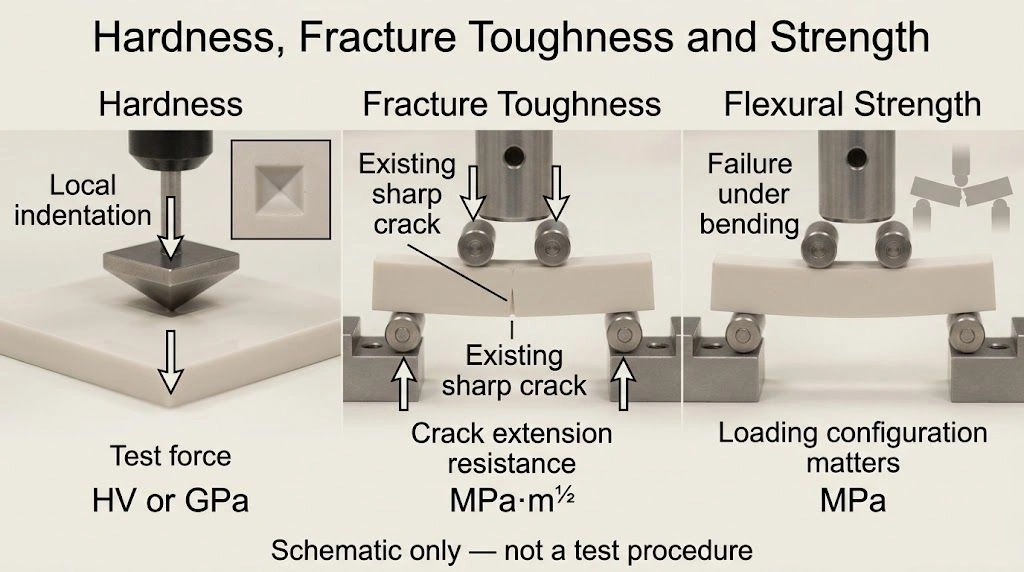
Mechanical tests assess flexural strength. Typical RT flexural screening is roughly ~280–350 MPa by grade (TDS screening). This resists cracking under operational stress when grade matches duty.
Flexural stability supports handling during installation. It also helps under thermal cycling when geometry and grade are confirmed. Strength supports long-term reliability as a screening band — confirm on TDS+RFQ.
Structural capacity sustains durability when matched to load.
- Flexural ~280–350 MPa by grade (TDS screening)
- Strength resists installation stress when grade matches
- Durability maintained under load — confirm on RFQ
Conclusion
4-bore alumina tubes provide reliable wire separation, insulation, and dimensional control for thermocouple assemblies when bore↔AWG, grade, and dielectric screening are locked on the RFQ.
Specify bore count (4), AWG/insulation OD, OD/length, purity class, and dielectric/dimensional inspection on the RFQ. Start from alumina tubes for catalog geometry notes; use custom services for bore/AWG/OD/purity drawings; keep the 4-bore alumina tube product page as the SKU exit when it matches.
Related reading
- How engineers evaluate 2-hole alumina ceramic tubes in critical applications — when two channels are enough for a simple TC pair and you still need clean wire separation.
- Why 9-hole alumina ceramic tubes matter for multi-channel thermal runs — when a compact run needs more channels than a 4-bore insulator can carry.
- Alumina ceramic parts for thermal electrical protection in high-temperature use — when the insulator is one piece in a broader high-temperature electrical-protection stack.
FAQ (Frequently Asked Questions)
Q1: What maximum temperature can 4-bore alumina tubes handle in thermocouple systems?
Screen by TDS grade (990-class ~1600°C, 997-class ~1700°C, 950-class ~1400°C long-term). Peaks are not continuous SLAs — confirm atmosphere/load on TDS+RFQ.
Q2: How should procurement teams evaluate suppliers of 4-bore alumina tubes?
Prioritize COA for the selected grade, drawing-class dimensional consistency, dielectric specimen method, and confirmed lead — not brand slogans.
Q3: Can 4-bore alumina tubes be customized for specific wire gauges?
Yes — bore sizes are matched to AWG/insulation OD on a drawing-class basis; confirm gauge and bore on the RFQ.
Q4: How does a 4-bore alumina tube compare to a 2-bore design for thermocouple separation?
A 4-bore design supports multiple pairs with balanced wall integrity; 2-bore fits a simple pair. Keep the contrast light — this page locks on 4-bore wire separation RFQ.
References:
[^1]: Wire gauge background for thermocouple accuracy and durability in high-temperature duty.
[^2]: Insulation-failure mechanisms relevant to bore↔AWG mismatch and shorting risk.
[^3]: Dielectric performance of alumina — specimen typical values are not installed withstand SLAs.
[^4]: Electrical separation concepts for high-temperature conductor isolation.