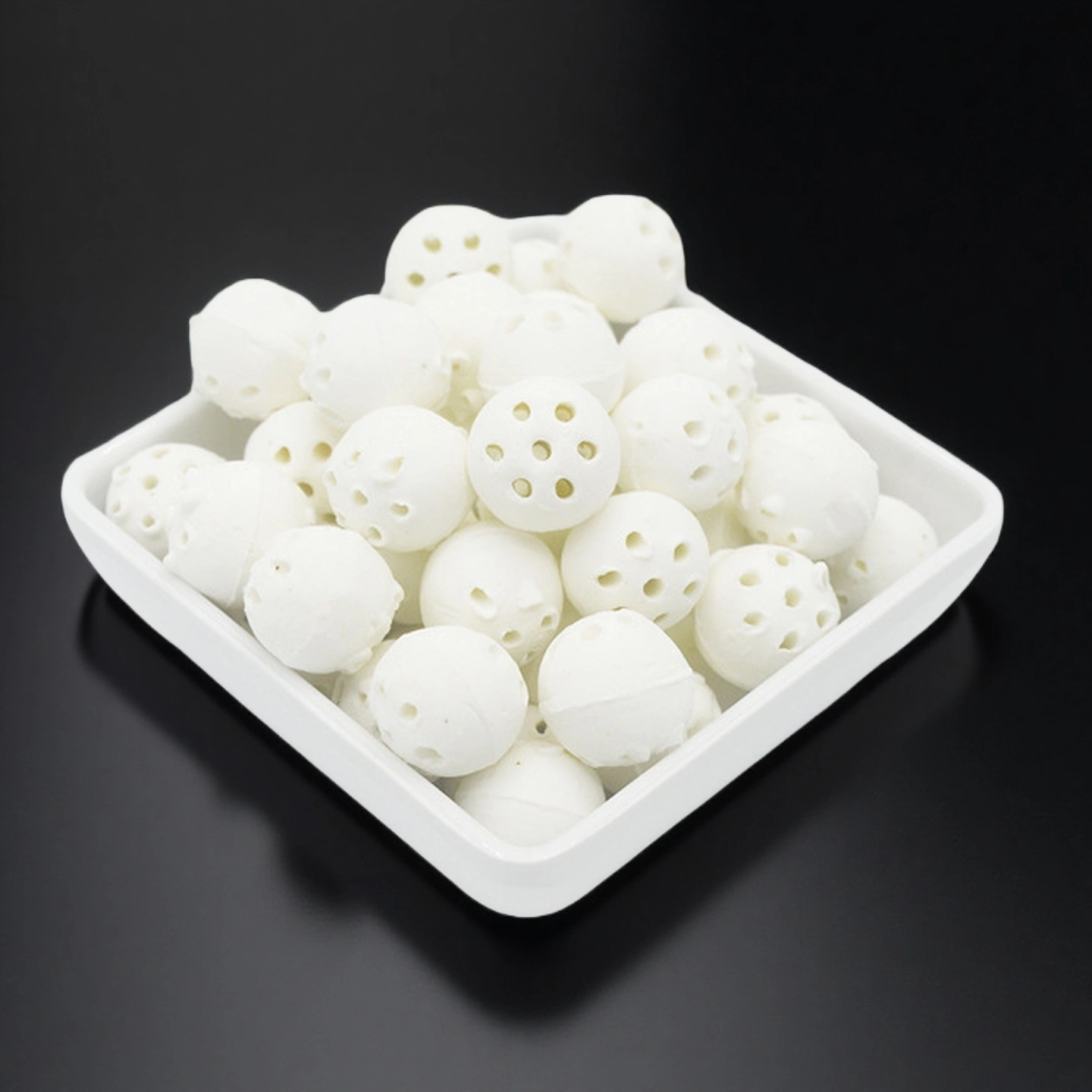
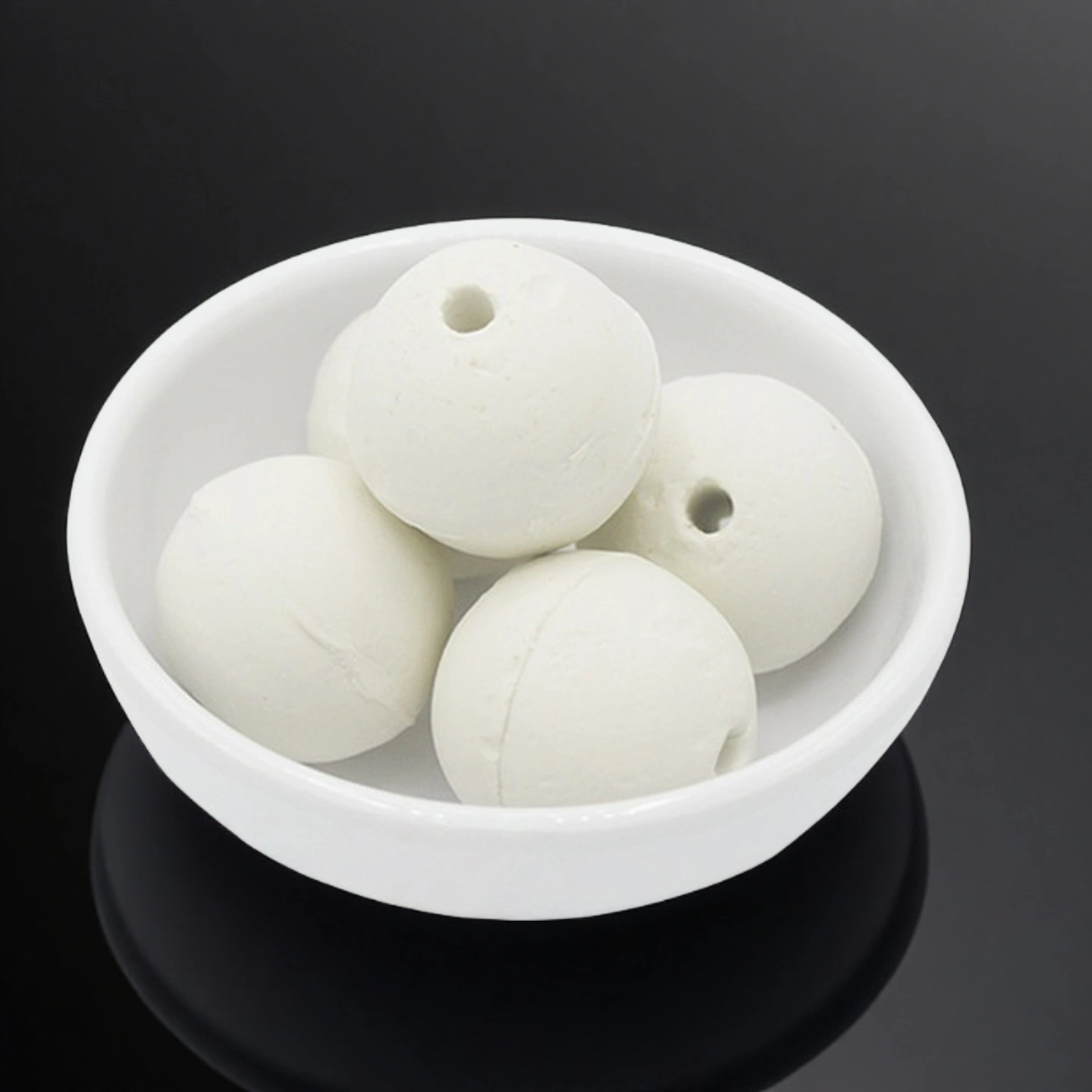
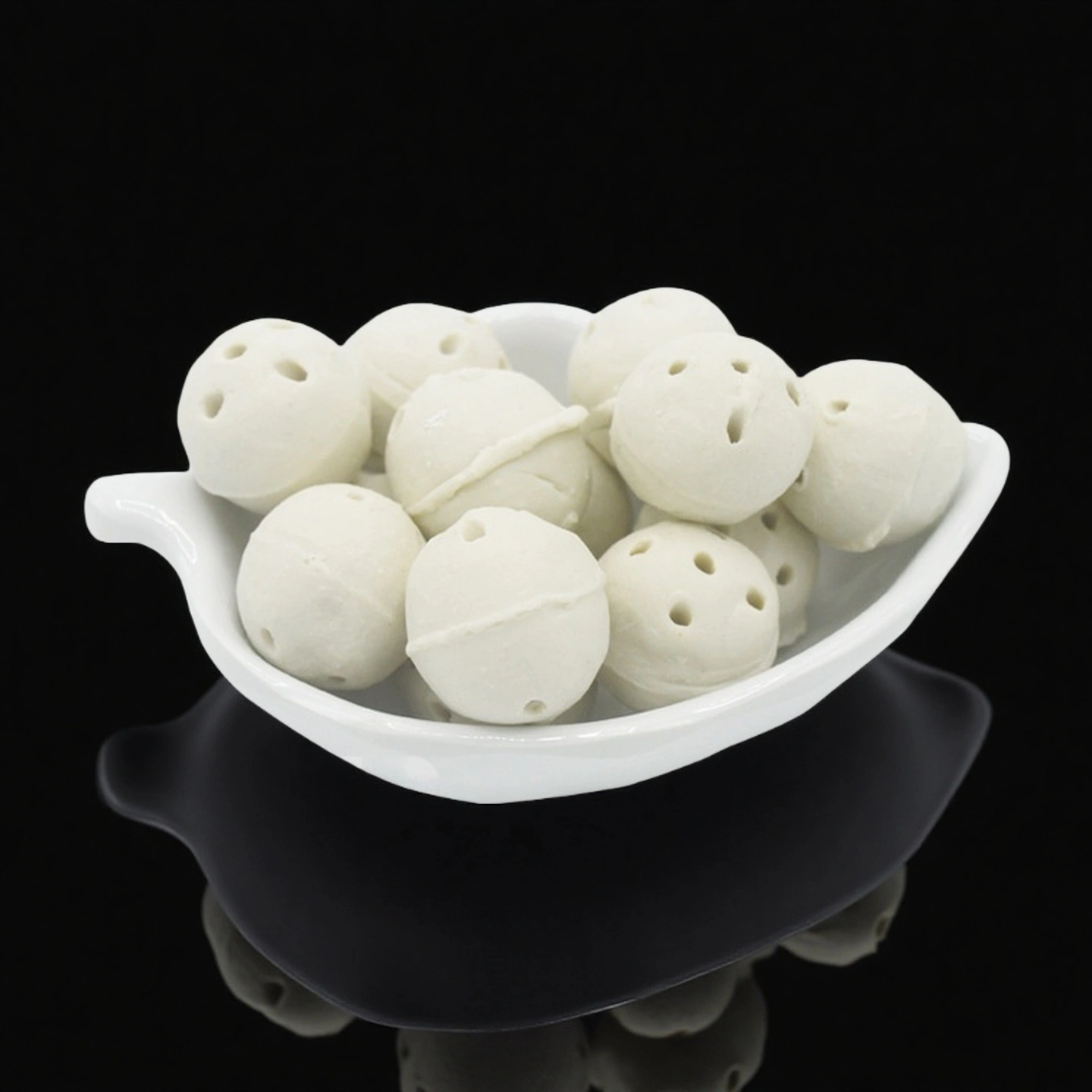
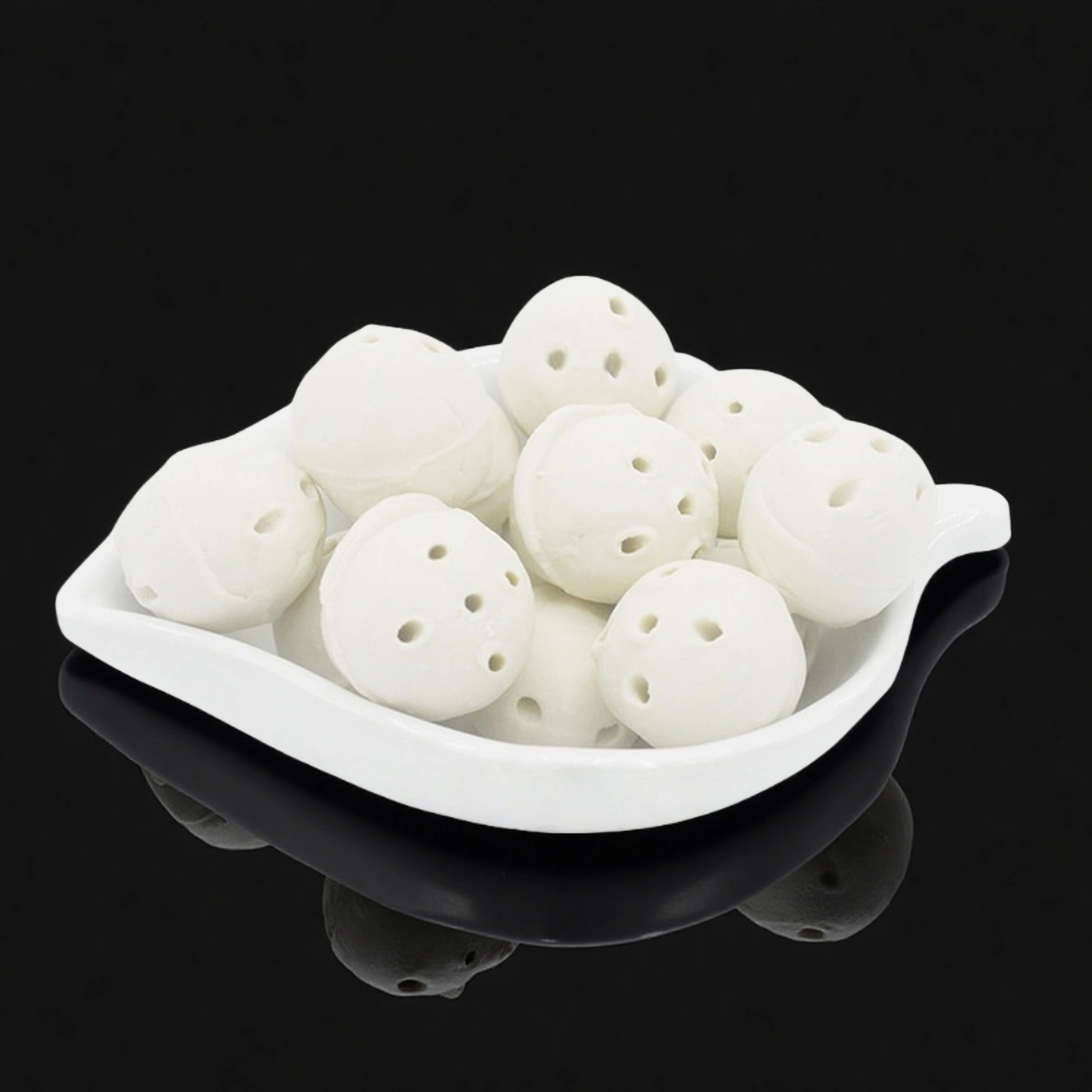
Alumina Ceramic Multi-Bore Beads for Catalyst Bed Support

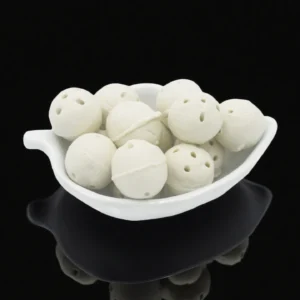
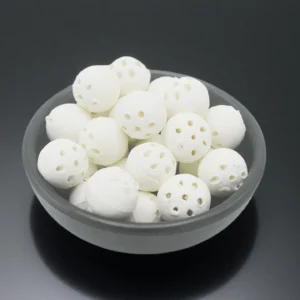
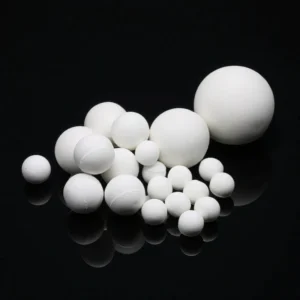
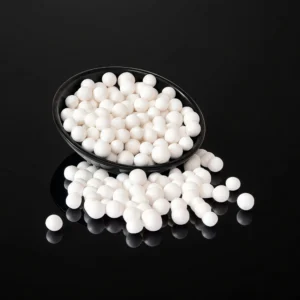
Alumina ceramic multi-bore beads are spherical support media for fixed-bed reactors, available in 6–50 mm sizes with 3/4/5/7/9-hole or custom layouts. Their open-channel geometry supports stable bed layering and improved fluid distribution, while ADCERAX can review bead size, bore diameter, rib thickness and tolerances for hydrotreating, hydrocracking, reforming and gas-treatment applications.

Catalogue No. AT-YM-DK1001
Material Al₂O₃
Bead Diameter (D)  6–50 mm
Hole Count & Hole Ø 3/4/5/7/9 holes; hole Ø per design
Dimensions/Sizes Download PDF
Engineering RFQ Review
Small-Batch Custom Support
Factory-Direct Manufacturing
Drawing & Process Review

Alumina ceramic multi-bore beads are open-channel support media designed for catalyst and adsorbent beds in fixed-bed hydrotreating, hydrocracking, reforming, shift and gas-treatment reactors. Their spherical multi-channel geometry increases open flow area, helping reduce bed pressure drop and improve fluid distribution while maintaining mechanical support and thermal stability.

Key Benefits of Alumina Ceramic Multi-Bore Beads

  • Lower pressure-drop potential: Open channels increase voidage and provide more direct flow paths, helping reduce resistance across the support layer.
  • Stable bed support: The spherical body and engineered ribs distribute bed loads while preserving open flow area.
  • Thermal and chemical stability: Alumina supports high-temperature operation and resistance to many process environments; final compatibility depends on the material grade and process chemistry.
  • Configurable geometry: Bead size, hole count, bore diameter, rib thickness and tolerances can be reviewed against the support grid, catalyst size and hydraulic requirements.

How to Select a Multi-Bore Configuration

Hole count is only one part of the support-media design. Bead diameter, bore size, rib thickness, open area, support-grid opening, bed load and operating conditions must be reviewed together.

Hole Pattern Hydraulic Tendency Structural Tendency Typical Design Objective
3-Hole Lower open-area potential More ceramic between bores Prioritize mechanical support under higher bed loads
5-Hole Balanced flow-path potential Balanced rib structure Combine bed support with improved flow distribution
7-Hole Higher open-area potential Requires closer rib-thickness review Support pressure-drop-sensitive fixed-bed designs
9-Hole Maximum open-area potential Requires mechanical qualification Prioritize flow capacity where bed loads permit
Single Open-Hole One direct central channel Simple, robust geometry Transition layers or special support-grid arrangements

Engineering note: Do not select the configuration by hole count alone. ADCERAX reviews reactor type, support-layer function, bead size, bore diameter, rib thickness, catalyst or adsorbent size, grid opening, bed load and target hydraulics before quotation.

Multi-Bore Beads vs Solid Support Balls — Which Fits Your Bed Design?

Decision Factor Multi-Bore Beads Solid Support Balls
Hydraulic behavior Internal channels can increase open flow area and help reduce flow resistance Flow passes through the interstitial voids between packed balls
Mechanical support Load capacity depends strongly on hole layout, rib thickness, bead size and material grade Uninterrupted solid geometry generally provides a simpler load-bearing structure
Flow distribution Multi-channel geometry may support more direct flow paths Conventional packing provides established interstitial flow paths
Design flexibility Hole count, bore diameter, rib thickness and bead size can be customized Simpler geometry with fewer design variables
Manufacturing complexity More complex geometry requires closer dimensional and mechanical review Generally easier to manufacture and specify
Typical fit Hydraulically constrained beds where the mechanical margin has been verified Heavy-load or conventional support layers that already meet hydraulic targets

Consider Multi-Bore Beads When

  • The existing support layer contributes significantly to bed pressure drop.
  • Additional open flow area is required by the process design.
  • Bead ribs and hole geometry can be qualified for the expected bed load.
  • Reactor calculations or comparative testing confirm a hydraulic benefit.

Consider Solid Support Balls When

  • Mechanical or impact loading is the primary design concern.
  • The conventional support layer already meets pressure-drop targets.
  • Simple geometry and established loading practice are preferred.
  • No verified hydraulic advantage has been demonstrated for a multi-bore design.

Engineering note: Multi-bore beads are not a universal drop-in upgrade. ADCERAX reviews bead size, hole geometry, rib thickness, support-grid opening, catalyst or adsorbent size, bed load and operating conditions before recommending either configuration.

Alumina Ceramic Multi-Bore Beads Properties

Item Ordinary Porcelain Ball 23–30% Al₂O₃ Ceramic Ball Medium-Alumina Ceramic Ball High-Alumina Ceramic Ball 99 High-Alumina Ceramic Ball
Al₂O₃ + SiO₂ (%) > 93 > 92 > 93 > 94 > 99
Al₂O₃ (%) 17–23 23–30 40–75 85–97 99
Fe₂O₃ (%) < 1 < 1 < 1 < 1 0.2
CaO (%) < 0.5 < 1.5 < 1.5 < 0.5 0.2
MgO (%) < 0.5 < 1.5 < 0.5 < 0.5 0.1
K₂O + Na₂O (%) < 4 < 4 < 3.5 < 4 > 0.5
TiO₂ (%) < 0.5 < 0.5 < 0.1 < 0.1 0.5
Leachable Fe₂O₃ (free) (%) < 0.1 < 0.1 < 0.005 < 0.001 —
Water Absorption (%) < 0.5 < 0.5 < 1 < 2 2–5
Particle Density (g/cm³) 2.3–2.4 2.3–2.4 2.6–2.9 3.4 3.2–3.6
Max. Operating Temperature (°C) 980 980 1450 1580 1580
Mohs Hardness > 6.5 > 7 > 7 > 7.5 > 7.5
φ6 > 0.5 > 0.5 > 0.5 > 0.6 > 1
φ25 > 6.5 > 6.5 > 4.9 > 55 > 8
φ38 > 8.9 > 8.9 > 5.5 > 54 > 8
φ50 > 9 > 9.8 > 6.5 > 7.8 > 15

Alumina Multi Hole Beads Specifications

Type 1: open-hole alumina support balls
open-hole ceramic balls support layer in fixed-bed reactor

Item Diameter(mm)
AT-YM-DK1001 6
AT-YM-DK1002 8
AT-YM-DK1003 10
AT-YM-DK1004 13
AT-YM-DK1005 15
AT-YM-DK1006 19
AT-YM-DK1007 25
AT-YM-DK1008 38
AT-YM-DK1009 50

Type 2: alumina ceramic 5 holes bead

Multi-Bore Alumina Support Bead 5-Hole

Item Diameter(mm)
AT-YM-DK1001 6
AT-YM-DK1002 8
AT-YM-DK1003 10
AT-YM-DK1004 13
AT-YM-DK1005 15
AT-YM-DK1006 19
AT-YM-DK1007 25
AT-YM-DK1008 38
AT-YM-DK1009 50

Type 3: alumina ceramic 7 holes bead

installing alumina multi-bore support media on reactor grid

Item Diameter(mm)
AT-YM-DK1001 6
AT-YM-DK1002 8
AT-YM-DK1003 10
AT-YM-DK1004 13
AT-YM-DK1005 15
AT-YM-DK1006 19
AT-YM-DK1007 25
AT-YM-DK1008 38
AT-YM-DK1009 50

Recommended Bead Size by Application

Reactor Type Bottom Support Layer Transition Layer Top Hold-Down
Hydrotreating (small catalyst) 25-50mm 13- 19 mm 6-10mm
Hydrocracking 38- 50 mm 19- 25 mm 10-13mm
Reforming 25- 38 mm 13- 19 mm 6-10mm
CO Shift / Ammonia 25-38mm 15- 19 mm 8-13mm
Adsorbent Beds (Mole Sieve) 19- 25 mm 10- 15 mm 6-8mm

Note: Final sizing depends on catalyst particle size, grid opening, and bed design. Contact engineering for detailed recommendations.

Alumina Ceramic Multi-Bore Beads Packaging

  • High alumina grinding beads are packaged in 25 kg heavy-duty plastic bags, which are then placed inside 1-ton jumbo bags with inner waterproof liners. The jumbo bags are palletized and shrink-wrapped for secure, moisture-free international transport.
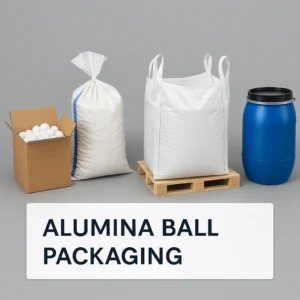

High Alumina Ball Packaging

Alumina Ceramic Multi-Bore Bead Applications

Multi-bore alumina beads are used where a fixed bed must support catalyst or adsorbent layers without consuming unnecessary hydraulic margin. Their open internal channels and load-bearing ceramic structure can be configured around bed load, flow resistance, media retention and operating conditions.

  • Hydrotreating and Hydrocracking Reactors

    Deep catalyst beds place significant mechanical and hydraulic demands on the support layer. The selected media must carry the catalyst load, retain smaller catalyst particles and avoid adding excessive resistance to the process flow.
    Multi-bore beads provide internal flow channels while the ceramic ribs maintain the supporting structure. Different bead sizes can be arranged in bottom-support, transition and top hold-down layers according to the catalyst size, support-grid opening and bed design.
    ADCERAX design capability: 6–50 mm bead sizes, 3/4/5/7/9-hole or custom layouts, controlled bore diameter, rib thickness, alumina grade and dimensional tolerance.

  • Ammonia, Shift and Hydrogen-Process Reactors

    Shift, ammonia and hydrogen-processing units require a stable support layer under hot process gases and changing operating conditions. Common concerns include support-layer pressure drop, uneven loading, media movement and the compatibility of the ceramic material with the process atmosphere.
    The open-channel structure can help preserve flow area through the support layer, while the alumina body provides a stable ceramic interface between the support grid and the active catalyst bed.
    ADCERAX design capability: Hole layout, bead diameter, bulk density, rib structure and material grade can be reviewed against the expected bed load, gas conditions and hydraulic requirements.

  • Desulfurization and Adsorbent Beds

    Molecular sieve, activated alumina and other adsorbent beds often use graded support layers to prevent smaller media from entering the support screen. Poor size transitions, fines accumulation or restricted flow paths can contribute to media loss, screen fouling and increasing bed pressure drop.
    Multi-bore beads can provide a mechanically stable transition layer while maintaining open flow paths below the adsorbent bed. Mixed bead sizes and hole configurations can be arranged around the adsorbent particle size and screen opening.
    ADCERAX design capability: Graded 6–50 mm sizes, mixed hole patterns, controlled bulk density, surface finishing and packaging can be matched to the required loading arrangement.

User Guide — Alumina Ceramic Multi-Bores Beads

  • Installation

    1. Inspect and clean reactor internals; remove dust, old media, and welding debris.
    b. Check support grids and hold-down hardware before loading.
    c. Install the bottom screens/grids.

    2. Position the correct mesh or grid plate and seat it firmly to prevent bypass.
    a. Check alignment and sealing to prevent bead migration.

    3. Load beads gently using a chute or soft-loading method.
    b. Limit the drop height to prevent cracking or chipping.

    4. Level the support layer evenly using approved tools or vibration.
    b. Verify the layer thickness against the design drawing.

    5. Add transition media and catalyst/adsorbent in the planned sequence (multi-bore beads → transition media → active catalyst).
    b. Record each layer thickness.

  • Operation

    1. Controlled start-up: Ramp temperature and flow according to the process design.
    2. ΔP monitoring: Track pressure drop for signs of fines or maldistribution.
    3. Temperature check: Review thermowell readings for bed settling or bypass.
    4. Carryover prevention: Check top screens and bead layers during operation.

  • Storage

    1. Keep beads in their original sealed packaging.
    2. Store pallets indoors or under cover, away from rain and ground contact.
    3. Stack within approved load limits to prevent breakage.
    4. Use older batches first.

  • Cleaning & Handling

    1. Before reuse, inspect beads visually and perform the required crush test.
    2. Remove fines by sieving, air blowing, or approved light tumbling.
    3. Discard cracked or chipped beads.
    4. Use clean gloves and tools to prevent contamination.

  • Common Misuse & Fix

    1. Rapid ΔP rise → Possible causes include uneven levelling, the wrong size mix, or clogged screens.
    Solution: Re-level the support layer and inspect upstream distribution devices.

    2. Early breakage → Possible causes include rapid thermal ramps or poor bead-to-grid fit.
    Solution: Slow the thermal ramp and verify bead-to-grid clearance.

    3. Catalyst carryover → Possible causes include inadequate hold-down or a poor top transition layer.
    Solution: Review the top screen, transition layer, and bead configuration.

Alumina Ceramic Multi-Bore Beads FAQ

  1. Q: What are alumina ceramic multi-bore beads used for?
    A: They are used as bottom-support, transition, or hold-down media in fixed-bed catalyst and adsorbent systems. Their spherical ceramic structure supports the active media, while the internal channels help preserve open flow area through the support layer.
  2. Q: How should the hole pattern be selected?
    A: Hole count must be reviewed together with bead diameter, bore size, rib thickness, support-grid opening, catalyst or adsorbent size, bed load, and hydraulic requirements. A higher hole count can increase open-area potential but may reduce the ceramic material between the bores.
  3. Q: What bead sizes and hole configurations are available?
    A: Available designs include 6–50 mm bead diameters with 3/4/5/7/9-hole or custom configurations. Final suitability depends on the bore diameter, rib thickness, material grade, tolerance, and expected mechanical load.
  4. Q: What is the difference between multi-bore beads and solid support balls?
    A: Multi-bore beads provide internal flow channels and may be considered when additional open flow area is required. Solid support balls have a simpler load-bearing structure and may be preferred for heavy-load or conventional support layers. Neither design is a universal replacement for the other.
  5. Q: Can ADCERAX customize alumina ceramic multi-bore beads?
    A: ADCERAX can review custom bead diameter, hole count, bore diameter, rib thickness, dimensional tolerance, alumina grade, bulk density, surface condition, and packaging requirements. Manufacturability is confirmed against the complete geometry and operating conditions.
  6. Q: What determines the price of alumina ceramic multi-bore beads?
    A: Pricing depends on the alumina grade, bead size, hole geometry, dimensional tolerance, inspection requirements, packaging, and order quantity. An accurate review also considers the support-layer function, catalyst or adsorbent size, grid opening, bed load, and operating conditions.
customize size

Customized Alumina Ceramic Multi Bores Beads

  • Diameter & tolerance: Beads available in 6–50 mm diameters. Tolerance ranges from ±0.5 to ±1.0 mm depending on bead size and grade, ensuring consistent layer packing and predictable bed performance.
  • Hole layout & geometry: Select from 3/4/5/7/9-hole or more designs. You can define hole diameter and rib thickness to control bed voidage, hydraulic resistance, and catalyst support stability.
  • Material grade: Standard choices from 92–99% Al₂O₃, with options for abrasion-resistant formulations or corrosion-tuned mixes suitable for sulfur, amine, or acidic streams.
  • Bulk density window: Specify target bulk density range to match reactor layer weight requirements and to achieve the desired pressure drop profile across the bed.
  • Surface condition: Options include as-fired, deburred, or post-tumbled finishes to minimize fines generation. Beads are delivered in clean bags or lined bulk packaging to prevent contamination.

Related Products

ADCERAX - Your Trusted Advanced Ceramics Manufacturing Partner

Direct factory manufacturing with comprehensive ceramic materials expertise and global supply capabilities

China-Based Manufacturer

ADCERAX supplies ceramic components for overseas OEMs, equipment builders, and labs.

Custom Drawing Support

We review drawings, dimensions, materials, and application conditions before quotation.

Ceramic Process Control

Forming, sintering, machining, grinding, and finishing are arranged by part requirements.

Pre-Shipment Inspection

Dimensional checks, visual inspection, and packaging review help reduce procurement risk.

Get in Touch with Us

Our team will be happy to respond to you in less than 24 hours.

Pingxiang Factory — Silicon carbide, silicon nitride, high-temperature ceramics

Quick Quotation

*Our team will answer your inquiries within 24 hours.

*Your information will be kept strictly confidential.

Ready to Solve Your Engineering Challenge?

Partner with ADCERAX for reliable, high-performance advanced ceramic solutions. Our engineers are ready to discuss your project.

E-mail

info@adcerax.com

Phone

Tel: +86-0731-84428843 WhatsApp: +86 19311583352

Response Time

Within 24 hours

Alumina ceramic multi-bore beads are open-channel support media designed for catalyst and adsorbent beds in fixed-bed hydrotreating, hydrocracking, reforming, shift and gas-treatment reactors. Their spherical multi-channel geometry increases open flow area, helping reduce bed pressure drop and improve fluid distribution while maintaining mechanical support and thermal stability.

Key Benefits of Alumina Ceramic Multi-Bore Beads

  • Lower pressure-drop potential: Open channels increase voidage and provide more direct flow paths, helping reduce resistance across the support layer.
  • Stable bed support: The spherical body and engineered ribs distribute bed loads while preserving open flow area.
  • Thermal and chemical stability: Alumina supports high-temperature operation and resistance to many process environments; final compatibility depends on the material grade and process chemistry.
  • Configurable geometry: Bead size, hole count, bore diameter, rib thickness and tolerances can be reviewed against the support grid, catalyst size and hydraulic requirements.

How to Select a Multi-Bore Configuration

Hole count is only one part of the support-media design. Bead diameter, bore size, rib thickness, open area, support-grid opening, bed load and operating conditions must be reviewed together.

Hole Pattern Hydraulic Tendency Structural Tendency Typical Design Objective
3-Hole Lower open-area potential More ceramic between bores Prioritize mechanical support under higher bed loads
5-Hole Balanced flow-path potential Balanced rib structure Combine bed support with improved flow distribution
7-Hole Higher open-area potential Requires closer rib-thickness review Support pressure-drop-sensitive fixed-bed designs
9-Hole Maximum open-area potential Requires mechanical qualification Prioritize flow capacity where bed loads permit
Single Open-Hole One direct central channel Simple, robust geometry Transition layers or special support-grid arrangements

Engineering note: Do not select the configuration by hole count alone. ADCERAX reviews reactor type, support-layer function, bead size, bore diameter, rib thickness, catalyst or adsorbent size, grid opening, bed load and target hydraulics before quotation.

Multi-Bore Beads vs Solid Support Balls — Which Fits Your Bed Design?

Decision Factor Multi-Bore Beads Solid Support Balls
Hydraulic behavior Internal channels can increase open flow area and help reduce flow resistance Flow passes through the interstitial voids between packed balls
Mechanical support Load capacity depends strongly on hole layout, rib thickness, bead size and material grade Uninterrupted solid geometry generally provides a simpler load-bearing structure
Flow distribution Multi-channel geometry may support more direct flow paths Conventional packing provides established interstitial flow paths
Design flexibility Hole count, bore diameter, rib thickness and bead size can be customized Simpler geometry with fewer design variables
Manufacturing complexity More complex geometry requires closer dimensional and mechanical review Generally easier to manufacture and specify
Typical fit Hydraulically constrained beds where the mechanical margin has been verified Heavy-load or conventional support layers that already meet hydraulic targets

Consider Multi-Bore Beads When

  • The existing support layer contributes significantly to bed pressure drop.
  • Additional open flow area is required by the process design.
  • Bead ribs and hole geometry can be qualified for the expected bed load.
  • Reactor calculations or comparative testing confirm a hydraulic benefit.

Consider Solid Support Balls When

  • Mechanical or impact loading is the primary design concern.
  • The conventional support layer already meets pressure-drop targets.
  • Simple geometry and established loading practice are preferred.
  • No verified hydraulic advantage has been demonstrated for a multi-bore design.

Engineering note: Multi-bore beads are not a universal drop-in upgrade. ADCERAX reviews bead size, hole geometry, rib thickness, support-grid opening, catalyst or adsorbent size, bed load and operating conditions before recommending either configuration.

Alumina Ceramic Multi-Bore Beads Properties

Item Ordinary Porcelain Ball 23–30% Al₂O₃ Ceramic Ball Medium-Alumina Ceramic Ball High-Alumina Ceramic Ball 99 High-Alumina Ceramic Ball
Al₂O₃ + SiO₂ (%) > 93 > 92 > 93 > 94 > 99
Al₂O₃ (%) 17–23 23–30 40–75 85–97 99
Fe₂O₃ (%) < 1 < 1 < 1 < 1 0.2
CaO (%) < 0.5 < 1.5 < 1.5 < 0.5 0.2
MgO (%) < 0.5 < 1.5 < 0.5 < 0.5 0.1
K₂O + Na₂O (%) < 4 < 4 < 3.5 < 4 > 0.5
TiO₂ (%) < 0.5 < 0.5 < 0.1 < 0.1 0.5
Leachable Fe₂O₃ (free) (%) < 0.1 < 0.1 < 0.005 < 0.001 —
Water Absorption (%) < 0.5 < 0.5 < 1 < 2 2–5
Particle Density (g/cm³) 2.3–2.4 2.3–2.4 2.6–2.9 3.4 3.2–3.6
Max. Operating Temperature (°C) 980 980 1450 1580 1580
Mohs Hardness > 6.5 > 7 > 7 > 7.5 > 7.5
φ6 > 0.5 > 0.5 > 0.5 > 0.6 > 1
φ25 > 6.5 > 6.5 > 4.9 > 55 > 8
φ38 > 8.9 > 8.9 > 5.5 > 54 > 8
φ50 > 9 > 9.8 > 6.5 > 7.8 > 15

Alumina Multi Hole Beads Specifications

Type 1: open-hole alumina support balls
open-hole ceramic balls support layer in fixed-bed reactor

Item Diameter(mm)
AT-YM-DK1001 6
AT-YM-DK1002 8
AT-YM-DK1003 10
AT-YM-DK1004 13
AT-YM-DK1005 15
AT-YM-DK1006 19
AT-YM-DK1007 25
AT-YM-DK1008 38
AT-YM-DK1009 50

Type 2: alumina ceramic 5 holes bead

Multi-Bore Alumina Support Bead 5-Hole

Item Diameter(mm)
AT-YM-DK1001 6
AT-YM-DK1002 8
AT-YM-DK1003 10
AT-YM-DK1004 13
AT-YM-DK1005 15
AT-YM-DK1006 19
AT-YM-DK1007 25
AT-YM-DK1008 38
AT-YM-DK1009 50

Type 3: alumina ceramic 7 holes bead

installing alumina multi-bore support media on reactor grid

Item Diameter(mm)
AT-YM-DK1001 6
AT-YM-DK1002 8
AT-YM-DK1003 10
AT-YM-DK1004 13
AT-YM-DK1005 15
AT-YM-DK1006 19
AT-YM-DK1007 25
AT-YM-DK1008 38
AT-YM-DK1009 50

Recommended Bead Size by Application

Reactor Type Bottom Support Layer Transition Layer Top Hold-Down
Hydrotreating (small catalyst) 25-50mm 13- 19 mm 6-10mm
Hydrocracking 38- 50 mm 19- 25 mm 10-13mm
Reforming 25- 38 mm 13- 19 mm 6-10mm
CO Shift / Ammonia 25-38mm 15- 19 mm 8-13mm
Adsorbent Beds (Mole Sieve) 19- 25 mm 10- 15 mm 6-8mm

Note: Final sizing depends on catalyst particle size, grid opening, and bed design. Contact engineering for detailed recommendations.

Alumina Ceramic Multi-Bore Beads Packaging

  • High alumina grinding beads are packaged in 25 kg heavy-duty plastic bags, which are then placed inside 1-ton jumbo bags with inner waterproof liners. The jumbo bags are palletized and shrink-wrapped for secure, moisture-free international transport.
High Alumina Ball Packaging

Quick Quote

The more details you provide, the faster we can quote.

*All inquiries are confidential.

Get Your Custom Solution

The more details you provide, the faster we can respond.

customize size

*We respond within 24 hours. All inquiries are confidential.

Download Catalog