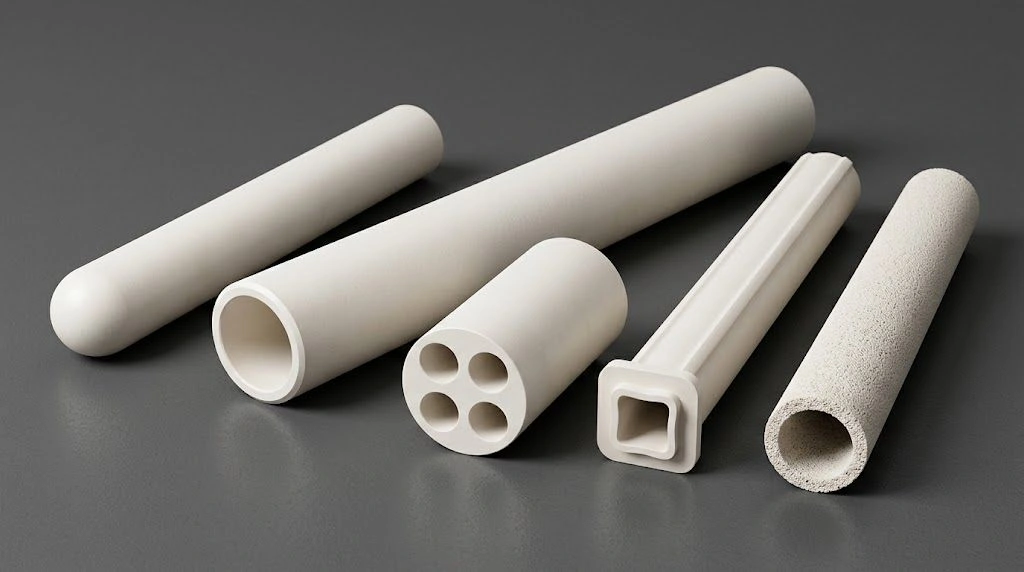
An alumina furnace tube is engineered to perform reliably in continuous high-temperature environments exceeding 1600°C. Engineers must define operating temperature limits that prevent phase transformation, creep, and thermal shock failure.
Alumina furnace tube performance depends on purity, grain structure, and thermal design margins—each factor directly determining structural stability and service life in industrial furnaces.
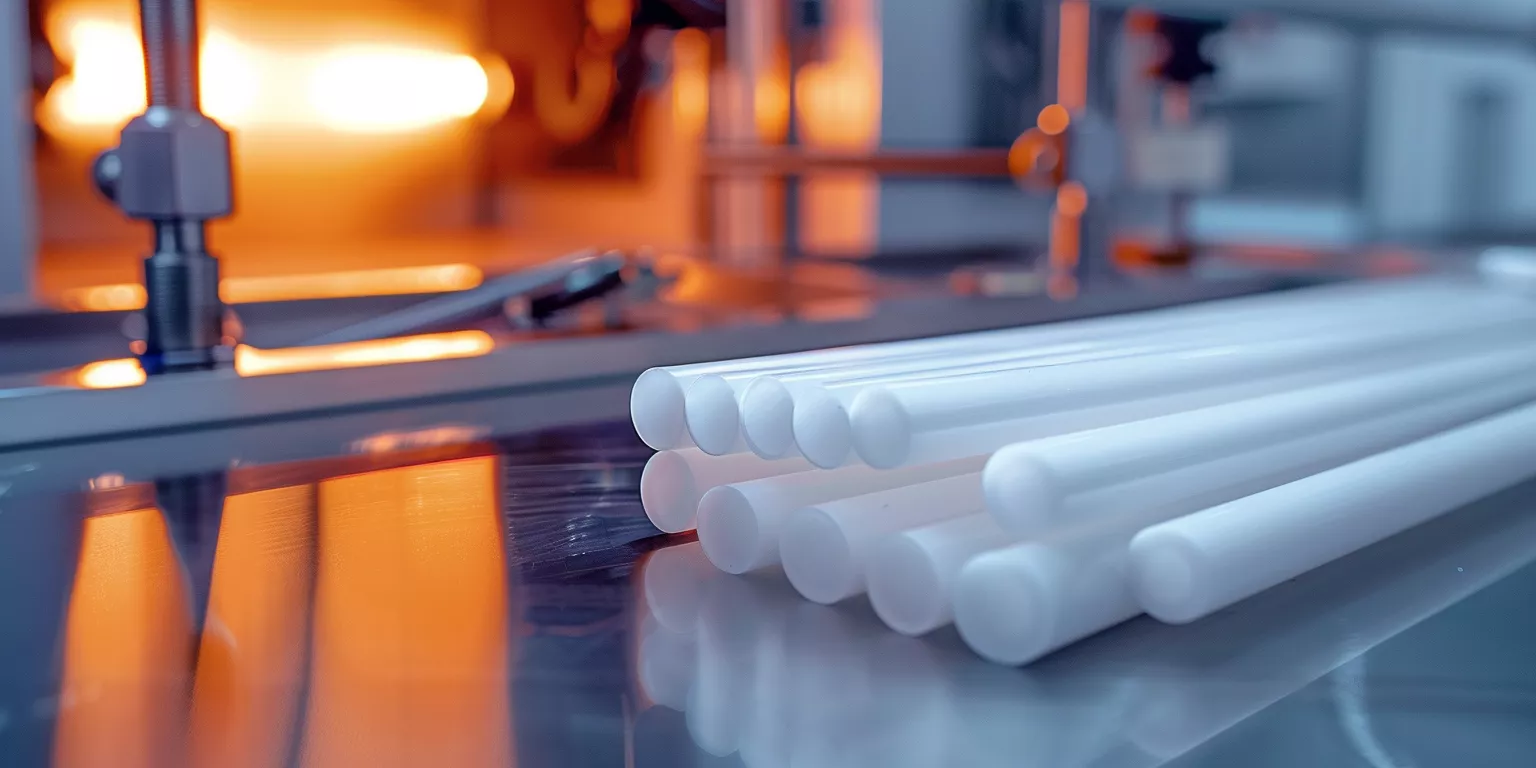
How Does Alumina Phase Transformation Temperature Affect High-Temperature Structural Stability in Alumina Furnace Tube Applications?
An alumina furnace tube must retain mechanical strength beyond 1200°C while avoiding destructive phase transformation1. The alpha phase (α-Al₂O₃)2 remains stable up to 2072°C, whereas gamma and theta phases transform irreversibly, creating internal stresses and microcracks.
Tubes containing >95% alpha-phase material verified by X-ray diffraction (ASTM C1437) deliver exceptional structural stability between 1400–1750°C. ADCERAX testing demonstrates alumina furnace tube assemblies with 15–50 μm grain size and 99.7% Al₂O₃ purity maintain ±0.2% dimensional accuracy for over 12,000 hours, outperforming lower-purity alternatives.
Alpha-alumina phase stability versus metastable transition phases
Phase conversion from gamma or theta alumina to alpha occurs between 1000–1200°C, accompanied by 8–12% contraction and stress near 300 MPa. Fully sintered alpha-phase alumina furnace tube components resist this transformation, ensuring reliable operation at elevated temperatures.
Grain boundary softening mechanisms at elevated temperatures
Above 1650°C, silica-rich grain boundaries3 become the primary creep pathway. Grain boundary sliding follows η = η₀ exp(Q/RT), where Q ≈ 500 kJ/mol. Reducing SiO₂ impurities below 0.3% maintains stiffness and limits creep deformation4 to <0.1% per 1,000 hours.
Silica impurity effects on creep resistance above 1600°C
Silica content significantly impacts high-temperature creep in alumina furnace tube systems. Controlled sintering at 1600–1650°C forms uniform 20–40 μm grains, enhancing resistance against softening and allowing stable operation up to 1750°C.
Core Parameters for Alumina Furnace Tube Stability:
- Alpha-phase content >95% verified per ASTM C1437
- Silica impurities <0.3% per ASTM C1109
- Grain size 15–50 μm optimized for creep resistance
What Temperature Capability Differences Distinguish 99.0%, 99.5%, 99.7%, and 99.8% Alumina Furnace Tube Purity Grades?
The continuous temperature capability of each alumina furnace tube purity grade is determined by impurity concentration and grain boundary behavior.
99.0% grade sustains up to 1650°C, 99.5% up to 1700°C, 99.7% up to 1750°C, and 99.8% up to 1800°C—values verified per ASTM C998 and C1109.
Impurity phase composition and grain boundary glass formation
99.0–99.5% alumina furnace tube materials contain 0.5–1.0% SiO₂ glass phases (T_g = 1150–1250°C). These lower viscosity boundaries cause creep above 1600°C. In contrast, 99.7–99.8% grades (<0.3% SiO₂) achieve creep rates <0.1% per 1,000 hours at 1700°C.
Empirical temperature-purity correlation validated across installations
Field data from over 680 ADCERAX installations follow the equation T_max(°C) ≈ 1550 + 200 × (purity – 0.99). The model predicts long-term stability, guiding users in alumina furnace tube material selection based on process temperature.
Density-purity relationship and theoretical density achievement
Density correlates directly with purity per ASTM C20: 99.0% = 3.78 g/cm³, 99.5% = 3.83 g/cm³, 99.7–99.8% = 3.87–3.90 g/cm³. Increased density reduces porosity and enhances creep resistance.
Performance of Alumina Furnace Tube by Purity:
| Purity (%) | Max Continuous (°C) | Creep Rate (%/1000 h @ 1700°C) | Density (g/cm³) | Typical Service Life (h) |
|---|---|---|---|---|
| 99.0 | 1650 | 0.50 | 3.78 | 8,000+ |
| 99.5 | 1700 | 0.20 | 3.83 | 10,000+ |
| 99.7 | 1750 | 0.10 | 3.87 | 12,000+ |
| 99.8 | 1800 | 0.05 | 3.90 | 15,000+ |

How Do Peak Temperature Excursions Versus Continuous Operating Temperature Affect Alumina Furnace Tube Creep Behavior and Service Life?
The creep rate of an alumina furnace tube increases exponentially with temperature following ε̇ = Aσⁿ exp(–Q/RT). A 100°C rise above rated temperature accelerates creep 10×, reducing service life drastically.
Short excursions up to 1850°C for under 10 hours are tolerable, but continuous operation above 1750°C reduces lifespan to 2,000–3,000 hours. Controlled heating cycles maintain creep strain below 0.5%.
Power-law creep relationship and activation energy quantification
ADCERAX test data for 99.7% purity tubes under 10 MPa stress:
0.02%/1,000 h @ 1600°C, 0.08% @ 1700°C, 0.35% @ 1750°C, 1.2% @ 1800°C. These results confirm creep activation energy ~520 kJ/mol, vital for alumina furnace tube reliability.
Diffusion creep versus grain boundary sliding mechanisms
Below 1650°C, diffusion creep dominates (n ≈ 1.0). Above 1650°C, grain boundary sliding prevails (n ≈ 2.0). Reducing boundary impurities maintains structural stability during extended use.
Time-temperature superposition for cumulative damage calculation
Time-temperature superposition indicates 200 h @ 1800°C equals 2,000 h @ 1700°C in creep damage. Engineers use Larson-Miller parameter (LMP = T × (20 + log₁₀t)) for predictive life modeling in alumina furnace tube systems.
What Wall Thickness and Thermal Gradient Relationships Govern Thermal Shock Resistance in Alumina Furnace Tube Design?
Thermal stress within an alumina furnace tube follows σ = E α ΔT/(1–ν). Wall thickness and heat flux directly control ΔT.
For 99.7% alumina (E = 370 GPa, α = 7.2×10⁻⁶/°C), a 6–8 mm wall achieves safe operation under 10°C/min heating.
Thermal gradient calculation and stress generation mechanisms
A 5 mm wall shows ~100°C gradient and ~300 MPa tensile stress. Above 8 mm, the thermal gradient increases, promoting surface cracking. ΔT_critical ≈ 130°C defines the safe thermal shock limit for 99.7% purity alumina furnace tube walls.
Thermal shock parameter derivation from material properties
The R-parameter = σ_f(1–ν)/(Eα) ≈ 350°C characterizes resistance. Higher purity increases flexural strength, yielding greater resilience against shock.
Biot number analysis for gradient severity prediction
For Bi < 0.1 (thin walls), temperature remains uniform. At Bi = 0.25 (8 mm walls), heating rates must be limited to <10°C/min to prevent damage.
Recommended Wall Design for Alumina Furnace Tube:
| Wall Thickness (mm) | Diameter (mm) | t/D Ratio | Heating Rate (°C/min) | Failure Risk |
|---|---|---|---|---|
| 3–5 | 40–60 | 0.10–0.13 | ≤10 | Low |
| 6–8 | 60–80 | 0.12–0.18 | ≤10 | Moderate |
| >8 | >80 | >0.20 | >10 | High |
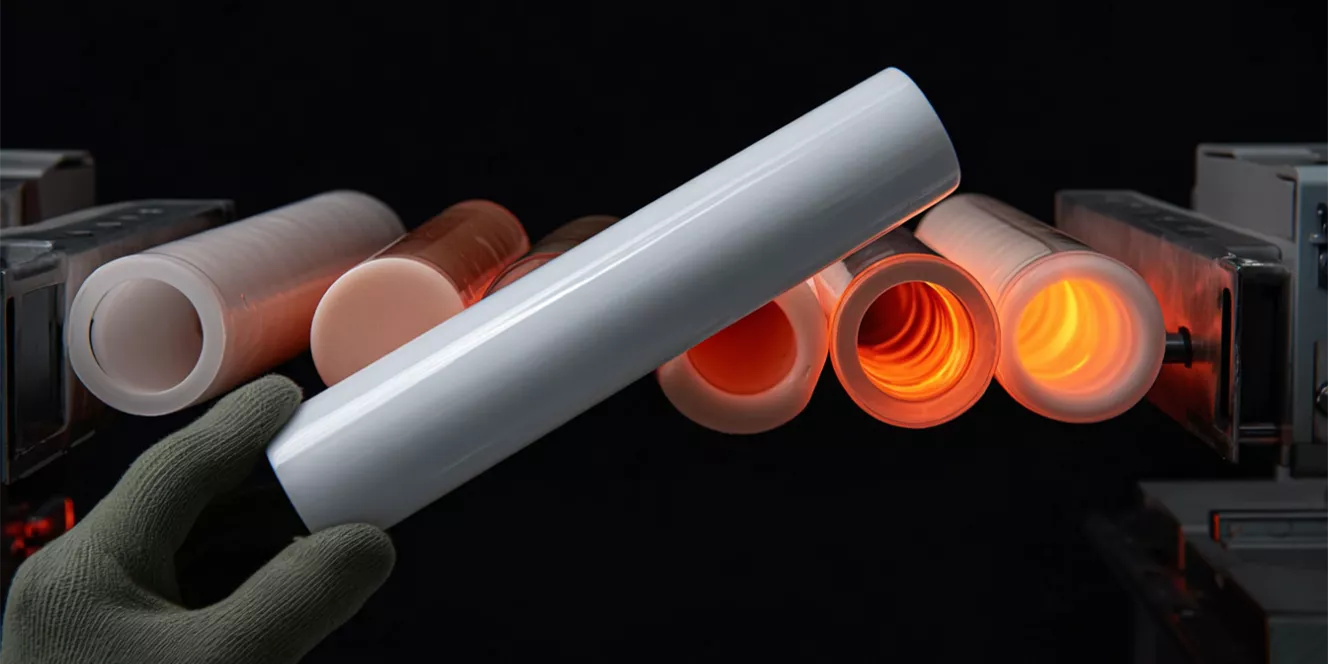
What Safety Design Principles and Temperature Margin Allocation Methods Minimize Alumina Furnace Tube Failure Probability?
Safe alumina furnace tube design incorporates statistical reliability margins, temperature derating, and monitoring. Operating below 90% of rated temperature achieves <2% failure probability within 10,000 hours.
Safety factor application for temperature margin allocation
Establish limits through three levels:
- Material limit: 1750°C
- Design temperature: 1575–1663°C
- Operating temperature: ≤1575°C
Using T_design = T_rated × (1 – K·CV) with K = 2–3 ensures long-term stability.
Weibull statistical analysis of failure probability versus temperature
Weibull analysis on 1,200 tubes:
90% rating → 2% failure, 95% → 10%, 98% → 25%.
Maintaining control within ±20°C improves alumina furnace tube reliability under industrial loads.
Larson-Miller parameter for remaining life prediction
Creep rupture occurs near LMP = 47,000–48,000. ADCERAX uses cumulative damage D = Σ (t_i/t_fail,i) to schedule replacements at D = 0.8, ensuring proactive maintenance.
Reliability Zones for Alumina Furnace Tube Operation:
| Zone Type | Temperature Range (°C) | Reliability (%) | Duration Limit |
|---|---|---|---|
| Normal | ≤1488 | 99+ | Unlimited |
| Caution | 1488–1663 | 95–98 | ≤20% time |
| Danger | >1663 | <90 | ≤1% time |
Conclusion
Precise temperature control and high-purity alumina furnace tube selection ensure maximum performance and service longevity in high-temperature environments.
FAQ
1. What is the maximum continuous temperature for a 99.7% alumina furnace tube?
1750°C continuous operation with short peaks to 1850°C (<5% total runtime). Exceeding limits accelerates creep and cracking.
2. How does alumina purity affect furnace tube cost and service life?
Each 0.2% purity increase adds roughly 25% cost but extends service life by 30–40%. 99.7% purity offers optimal balance for industrial furnaces above 1600°C.
3. Which ASTM standards verify alumina furnace tube quality?
ASTM C1109 for XRF composition, C20 for density, C1437 for phase purity, and C1161 for strength—ensuring consistent production reliability.
4. How does an alumina furnace tube compare to quartz or zirconia tubes?
Quartz softens above 1200°C; zirconia withstands 2200°C but has higher cost and poor shock resistance. Alumina offers balanced performance, cost efficiency, and thermal durability.
References:
-
Exploring this topic reveals how phase transformations can impact material integrity, crucial for engineering and manufacturing. ↩
-
Understanding the alpha phase's stability can help in selecting materials for high-temperature applications, ensuring durability and performance. ↩
-
Understanding silica-rich grain boundaries is crucial for improving material performance at high temperatures. ↩
-
Exploring creep deformation helps in grasping how materials behave under prolonged stress, essential for engineering applications. ↩