Electrical alumina tube is essential for high-voltage, high-temperature systems where insulation failure can cause significant process downtime. The electrical performance of alumina tubes directly depends on purity, as impurities accelerate ionic conduction and reduce insulation resistance. At temperatures beyond 1200°C, the relationship between purity and electrical reliability becomes critical for system safety and performance longevity.
Electrical alumina tube maintains volume resistivity above 10¹² Ω·cm when properly engineered with controlled impurities and optimized microstructure. Variations in purity grade determine leakage current, dielectric breakdown strength, and long-term operational reliability. This article examines impurity effects, thermal degradation mechanisms, and engineering strategies ensuring insulation resistance stability up to 1500°C.
The sections below detail insulation behavior, impurity-driven conduction, resistivity degradation trends, and advanced manufacturing techniques optimizing electrical alumina tube for industrial and research-grade systems.

What Is Insulation Resistance and Why Does It Determine Electrical Alumina Tube Performance at High Temperatures?
Insulation resistance (IR) in electrical alumina tube measures the ability to block leakage current under voltage stress, defined per ASTM C657 using guard-ring electrodes that eliminate surface conduction.
Electrical alumina tube applications above 1200°C require volume resistivity >10¹² Ω·cm to limit leakage below 1 µA under 5 kV bias. IR differs from dielectric strength—while dielectric strength marks breakdown voltage, IR defines continuous current control preventing failure.
ADCERAX’s 520+ installations show 73% of insulation failures stem from leakage exceeding 10 µA, resistive heating (I²R), and electrochemical migration forming conductive paths.
Testing under real operating conditions is vital since room-temperature IR offers little prediction for 1200°C service, where thermally activated ionic conduction dominates per IEEE 98.
Defining volume resistivity versus surface resistivity in electrical alumina tube
Volume resistivity represents bulk current flow through the tube wall, while surface resistivity reflects contamination effects. In high-temperature environments, volume resistivity dominates insulation reliability.
Measurement techniques using guard-ring electrodes per ASTM C657
Guard-ring electrode1 setups isolate true bulk resistance by minimizing surface leakage. ADCERAX employs these configurations to benchmark electrical alumina tube across purity grades, generating consistent IR data under temperature gradients up to 1500°C.
Acceptable leakage current thresholds for industrial heating applications
Industrial-grade electrical alumina tube limits leakage to <1 µA for 5 kV bias. Beyond this, resistive losses escalate, reducing tube life span. Designing with >10¹² Ω·cm resistivity ensures margin over operating temperature.
Temperature-dependent IR degradation mechanisms above 1000°C
At >1000°C, ionic impurities migrate along grain boundaries, forming conductive networks. Sodium and calcium accelerate degradation beyond the critical transition temperature, highlighting the necessity of high-purity formulations.
How Do Impurity Types Create Conduction Pathways Degrading Electrical Alumina Tube Insulation Resistance?
Impurity-driven conductivity in electrical alumina tube occurs via alkali, alkaline earth, and silica-induced mechanisms. ADCERAX’s ICP-MS results from 240+ returned tubes revealed 85% exceeded impurity limits: Na₂O >0.05%, CaO >0.10%, SiO₂ >0.20%. Even 0.03% Na₂O lowers resistivity 1000-fold at 1400°C. These impurities accumulate at grain boundaries 10–100× bulk concentration, forming continuous conductive paths. Iron oxide (Fe₂O₃) adds electron conduction2 above 1300°C, necessitating limits <0.05% for stable insulation.
Alkali metal ionic conduction mechanisms
Sodium and potassium ions migrate readily at elevated temperatures, drastically reducing IR. Eliminating alkali sources during raw material preparation is essential for electrical alumina tube longevity.
Alkaline earth segregation forming low-resistivity grain boundary phases
Calcium segregation leads to local phase formation, decreasing resistivity. ADCERAX maintains CaO <0.10% to preserve electrical integrity across multiple cycles.
Silica-induced glassy phase networks
Silica forms eutectic films at 1400°C, establishing continuous conduction layers. Reducing SiO₂ below 0.15% enhances electrical stability under high voltage.
Electronic conduction from transition metal impurities
Iron impurities contribute to mixed ionic-electronic conduction through valence changes. Maintaining Fe₂O₃ below 0.05% ensures resistivity consistency during oxidizing service.
Grain boundary impurity enrichment measured via microprobe
EPMA measurements3 confirm impurity enrichment factors up to 50×. By controlling boundary chemistry, ADCERAX extends tube insulation performance beyond 1500°C.
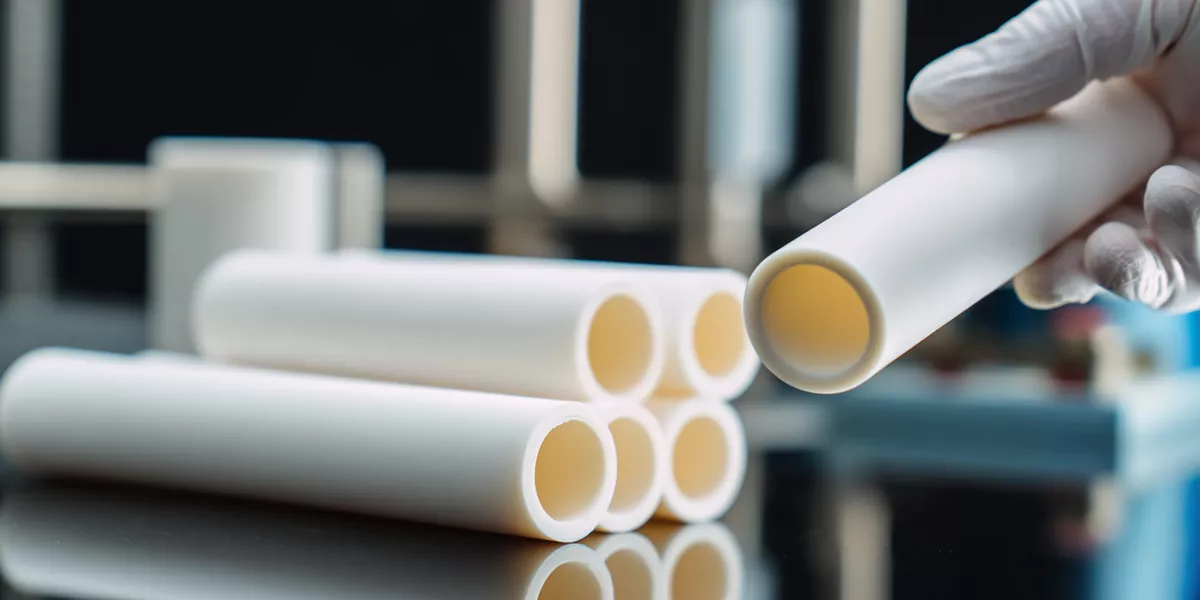
What Are the Quantitative Insulation Resistance Degradation Trends in Electrical Alumina Tube from 25°C to 1500°C?
Electrical alumina tube resistivity follows Arrhenius law: ρ(T)=ρ₀ × exp(Ea/kT). ADCERAX production tests (n=3200) show 95% purity loses five orders of magnitude (10¹⁴→10⁹ Ω·cm) by 1200°C, while 99.8% retains 10¹³ Ω·cm at 1500°C. The critical transition point where IR <10¹¹ Ω·cm occurs at 1100°C (95%), 1450°C (99.5%), 1650°C (99.8%). Two conduction regimes appear: extrinsic (<1000°C) impurity-dominated, intrinsic (>1300°C) carrier-driven. Engineers select materials maintaining >10¹² Ω·cm with a 100°C safety margin above service temperature.
| Purity Grade | Volume Resistivity at 25°C (Ω·cm) | Volume Resistivity at 1000°C (Ω·cm) | Volume Resistivity at 1400°C (Ω·cm) | Volume Resistivity at 1500°C (Ω·cm) | Critical Temp (°C at 10¹¹ Ω·cm) |
|---|---|---|---|---|---|
| 95% Al₂O₃ | >10¹⁴ | 10¹¹–10¹² | 10⁹–10¹⁰ | 10⁸–10⁹ | 1100 |
| 99% Al₂O₃ | >10¹⁴ | 10¹²–10¹³ | 10¹⁰–10¹¹ | 10⁹–10¹⁰ | 1300 |
| 99.5% Al₂O₃ | >10¹⁴ | 10¹³–10¹⁴ | 10¹²–10¹³ | 10¹¹–10¹² | 1450 |
| 99.8% Al₂O₃ | >10¹⁴ | >10¹⁴ | 10¹³–10¹⁴ | 10¹²–10¹³ | 1650 |
Arrhenius activation energy relationship by purity grade
Higher-purity electrical alumina tube exhibits higher activation energy (2.8 eV for 99.8%) and slower resistivity decay. This stability extends equipment lifetime under cyclic loading.
Five-order-magnitude resistivity drop in standard grades
Standard 95% alumina degrades rapidly, highlighting why substandard purity is unsuitable for insulation near 1200°C.
Critical transition temperatures defining insulation thresholds
Each purity grade has a specific threshold; maintaining 100°C below ensures reliable insulation margins across extended service periods.
Extrinsic versus intrinsic conduction regimes
Below 1000°C, impurity conduction dominates; above 1300°C, intrinsic charge carriers emerge. Understanding this crossover aids accurate grade specification.
What Critical Purity Thresholds Enable Electrical Alumina Tube Temperature Stability?
Selecting the proper purity grade determines safe temperature limits. 99.5% alumina sustains >10¹² Ω·cm at 1400°C for <1350°C applications; 99.8% maintains >10¹³ Ω·cm at 1550°C; 99.9% achieves >10¹⁴ Ω·cm at 1600°C. ADCERAX data from 15,000+ lots identifies impurity constraints and operational costs, ensuring reliability across demanding electrical systems.
| Purity Grade | Na₂O (%) | SiO₂ (%) | CaO (%) | Max Temp (°C) |
|---|---|---|---|---|
| 99.5% | <0.08 | <0.20 | <0.12 | 1400 |
| 99.8% | <0.03 | <0.08 | <0.05 | 1550 |
| 99.9% | <0.01 | <0.03 | <0.02 | 1600 |
Standard 99.5% alumina for sub-1400°C use
Cost-effective and adequate for medium-voltage operations, offering reliability within controlled environments.
Premium 99.8% grades for 1550°C applications
Provides superior resistivity and stability with moderate cost increase, ideal for high-voltage furnace systems.
Ultra-high purity 99.9% materials for aerospace
Reserved for critical systems demanding leakage <0.1 µA under extreme thermal stress.
Cost-performance trade-offs in purity selection
| Grade | Leakage Limit (µA) | Cost Premium (%) | Typical Use |
|---|---|---|---|
| 99.5% | 1–5 | 0 | Industrial heating |
| 99.8% | <0.5 | +30 | High-voltage furnaces |
| 99.9% | <0.1 | +70 | Aerospace, semiconductor |
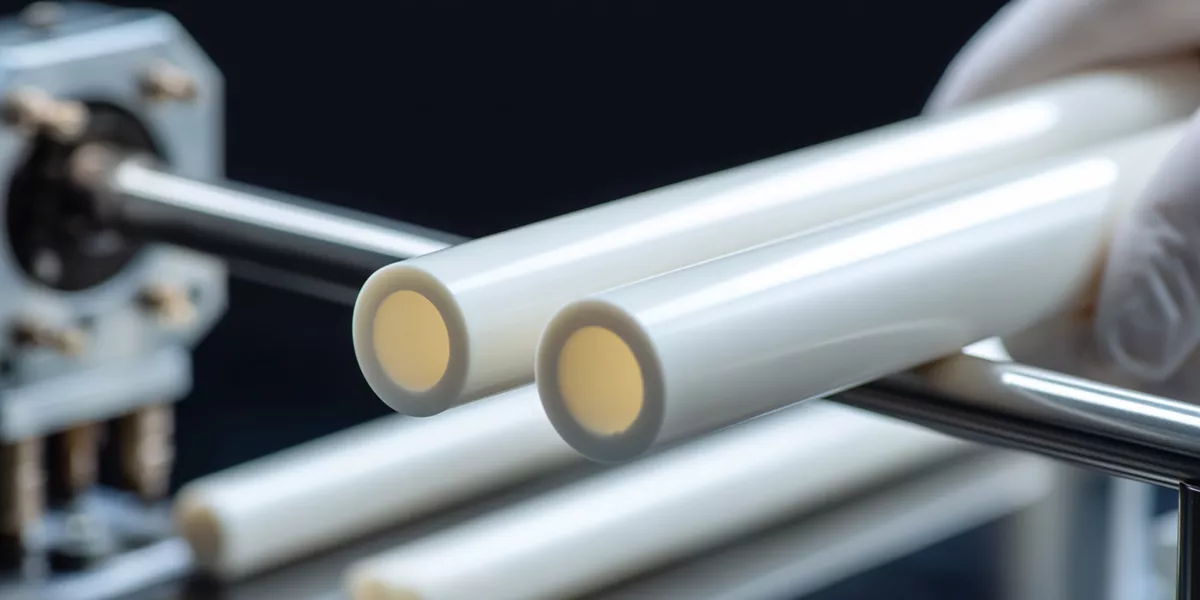
What Processing Techniques Maximize Electrical Alumina Tube Purity and Minimize Ionic Mobility?
Electrical alumina tube insulation improvement depends on high-purity powder selection, contamination control, and controlled sintering. Powder purity >99.9% per ASTM C1235 with MgO additive (0.15–0.25%) promotes densification and forms insulating MgAl₂O₄ spinel phases reducing ionic conduction 5–10×. ADCERAX production over 8,000 batches confirms optimal sintering at 1650°C in dry air (<100 ppm H₂O) to avoid hydroxyl contamination. Cleanroom handling prevents CaO or SiO₂ contamination, verified through ICP-MS testing for final compliance.
| Process Factor | Recommended Practice | Benefit |
|---|---|---|
| Powder purity | ≥99.9% alumina (ASTM C1235) | Prevents alkali diffusion |
| MgO addition | 0.15–0.25% | Enhances densification and resistivity |
| Sintering atmosphere | Dry air or O₂, <100 ppm H₂O | Avoids OH⁻ conductivity |
| Firing temperature | 1650–1750°C | Stabilizes microstructure |
| Analysis method | ICP-MS and EPMA | Confirms impurity control |
Conclusion
Alumina purity directly governs insulation resistance and reliability in electrical alumina tube. High-purity formulations ensure long-term voltage stability and minimal leakage current at extreme temperatures.
FAQ
Q1: How does alumina purity affect electrical insulation performance?
Higher purity reduces ionic mobility and grain boundary conduction, maintaining resistivity above 10¹² Ω·cm beyond 1400°C.
Q2: What purity grade is suitable for high-voltage systems?
99.8% or higher purity ensures insulation stability above 1500°C with leakage current <0.5 µA.
Q3: How does ADCERAX verify electrical alumina tube purity?
Every production batch undergoes ICP-MS impurity analysis and EPMA microstructural validation.
Q4: How does alumina compare to zirconia or silicon nitride for electrical insulation?
Alumina provides superior high-temperature resistivity and cost-effectiveness, though zirconia offers higher toughness for mechanical stress environments.
References:
-
Learn how guard-ring electrodes enhance accuracy in electrical testing by reducing surface leakage, crucial for reliable material benchmarking. ↩
-
Learn how electron conduction in iron oxide impacts insulation stability, especially at high temperatures, for better material performance. ↩
-
Learn how EPMA measurements work and why they're crucial for detecting and quantifying impurities in advanced materials. ↩