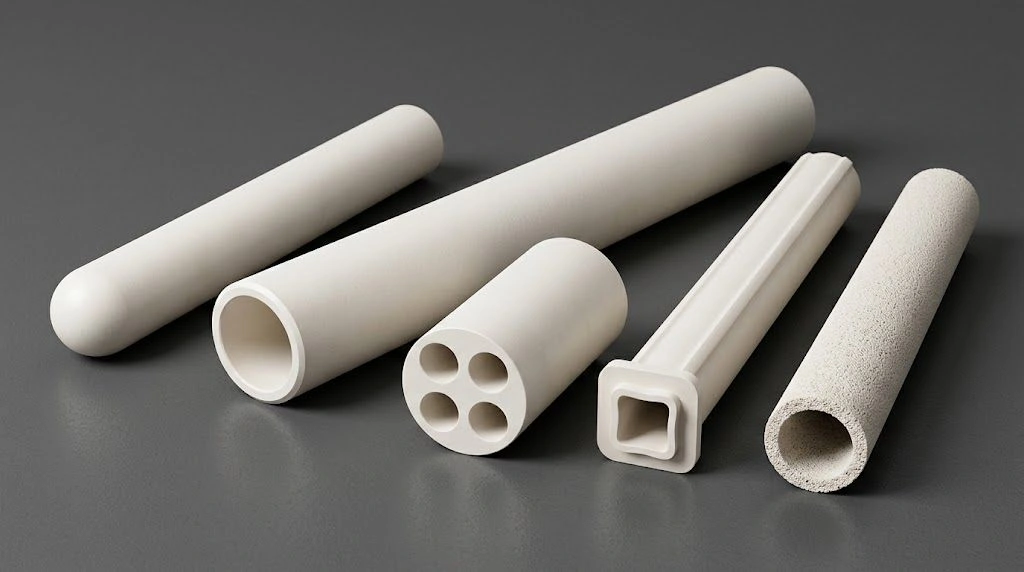
An alumina tube for industrial applications requires complete technical and commercial information before accurate quotations can be prepared.
When specifications are missing or unclear, suppliers must assume production tolerances — an illustrative procurement risk that can swing quotes widely and add multi-week delays (not a quote guarantee).
Precise data on dimensions, material grade, and environment ensures that every alumina tube for industrial applications is priced and manufactured correctly. This article outlines the RFQ fields procurement teams and engineers must provide — dimensions, material, and duty — before a quote pack is priced. Product family: alumina tubes; drawing·tolerance·duty·qty pack: custom ceramic services.

Defining Essential Physical Dimensions for Alumina Tube for Industrial Applications
Dimensional accuracy directly determines the production method and cost of an alumina tube for industrial applications. Missing tolerances or unclear datum references cause high variation in quotation accuracy.
Precise measurements of OD, ID, wall thickness, and length are mandatory for consistency and functional compatibility. Each should follow established metrology standards such as ASTM C1161 and ISO 129.
Outer diameter and inner diameter specification with tolerance notation per ASTM C1161
Outer and inner diameters must be listed with exact tolerances (e.g., 25.0 ± 0.1 mm OD and 20.0 ± 0.1 mm ID). ASTM C1161 guides proper definition of mean or point diameter. If no tolerance is specified, a common assumption-typical ±0.2 mm as-sintered band is often used — confirm supplier standard / drawing. Explicit OD/ID data supports fit, sealing, and accurate pricing.
Length specification with datum reference and end condition clarification per ISO 129
State total length with measurement datum and end condition (e.g., 500 ± 2 mm, measured center-to-center). Length control is vital in furnace, chemical reactor, and analytical instrument assembly alignment. Unclear datum positions lead to mismatch or sealing distortion during installation.
Geometric tolerance requirements including concentricity and straightness per ISO 1101
Define concentricity, straightness, and perpendicularity for functional geometry (GD&T). These tolerances help the alumina tube for industrial applications maintain uniform wall thickness and proper sealing across length. ISO 11011 provides notation for clarity and consistency across global suppliers.
Typical Dimensional Control Parameters
| Parameter | Drawing-driven example (confirm OD/ID/length class) | Method Reference | Functional Impact |
|---|---|---|---|
| OD Tolerance (mm) | ±0.1–0.2 | ASTM C1161 | Controls grinding requirement |
| ID Tolerance (mm) | ±0.1–0.2 | ASTM C1161 | Ensures sealing and pressure consistency |
| Concentricity (mm) | ≤ 0.05 example | ISO 1101 | Wall uniformity — confirm drawing |
| Straightness (mm/m) | 0.5–2.0 | ISO 1101 | Enables accurate assembly |
| Perpendicularity (mm/100 mm dia) | 0.05–0.20 | ISO 1101 | Maintains even gasket pressure |
Mandatory Material Specifications for Alumina Tube for Industrial Applications
Material selection determines cost, temperature capability, and corrosion performance of any alumina tube for industrial applications. Defining purity, density, and porosity eliminates ambiguity.
Each parameter links directly to manufacturing control and service life. Suppliers rely on ASTM-verified data to confirm compatibility between material and environment.
Alumina purity grade selection based on temperature and chemical resistance requirements
Purity levels (95%, 99%, 99.5%, 99.7-class / 99.9-class) define performance and pricing. TDS banding for long-term selection ceilings is typically ~1700 °C for 997-class (~99.7%) and ~1750 °C for 999-class (~99.9%) — atmosphere-/chemistry-dependent; confirm TDS. There is no independent 99.8 SKU in the AD-ALU map — use 997/999-class. A 95% grade is typically limited near ~1400 °C and degrades faster under corrosive exposure. Selecting purity aligned with temperature and chemical load minimizes risk; do not treat “>99.7% → continuous 1750 °C for every grade” as a contract claim.
Density and porosity specifications with test method references per ASTM C20 and C373
Density ≥ 3.90 g/cm³ and open porosity < 0.2% are useful screening values for dense high-purity tubes (995+ class) — confirm grade TDS. These metrics support microstructural integrity and impermeability checks; they are not a site-wide acceptance limit. ASTM C202 and C3733 provide standard testing methods for evaluation, ensuring global traceability.
Microstructural requirements including grain size and secondary phase limits
A typical microstructure window of grain size 5–15 µm and secondary phases such as SiO₂ ≤ 0.3% supports long-term strength and chemical stability — confirm process route. This window helps reduce micro-cracking risk under thermal cycling when matched to the process.
Material Specification Parameters
| Property | Range | Test Method | Engineering Relevance |
|---|---|---|---|
| Al₂O₃ Purity (%) | 99.5–99.7 / 99.9-class | XRF / ICP-OES | High-temp and chemical resistance — confirm TDS |
| Density (g/cm³) | 3.85–3.95 (≥3.90 screening for 995+) | ASTM C20 | Strength and load capacity — confirm grade TDS |
| Open Porosity (%) | < 0.2 screening (995+) | ASTM C373 | Sealing and corrosion protection — confirm grade TDS |
| Grain Size (µm) | 5–15 typical window | ASTM E112 | Thermal shock control — confirm process route |
| SiO₂ Impurity (%) | ≤ 0.3 typical window | XRF | Grain-boundary chemistry — confirm process route |

Application Details for Alumina Tube for Industrial Applications
An alumina tube for industrial applications must operate under defined environmental and mechanical conditions. Incomplete data causes manufacturers to assume unrealistic parameters, leading to overdesign or early failure.
Comprehensive operating descriptions reduce ambiguity and improve compatibility between design and material.
Temperature specifications with continuous and intermittent maximum values
Specify both continuous and intermittent limits as grade-typical examples (e.g., continuous near a 997-class selection ceiling vs a higher peak) — confirm duty RFQ. A 200–300 °C safety margin is engineering practice-typical; confirm peak vs continuous + atmosphere before locking grade.
Chemical environment documentation including compounds, concentrations, and exposure duration
List chemical compositions, concentrations, and exposure durations (e.g., 70% H₂SO₄, 160 °C — example exposure field only, not a universal acid-proof claim). This defines corrosion exposure and helps select an appropriate purity grade for the stated duty.
Thermal cycling parameters and mechanical loading descriptions
Include heating and cooling rates, cycle frequencies, and load types (pressure, compression, bending). These influence wall thickness and thermal shock risk, ensuring the alumina tube for industrial applications meets endurance expectations.
Required Operational Data for Quotation
| Parameter | Specification Detail | Importance |
|---|---|---|
| Max Continuous Temp (°C) | 1400–1750 TDS banding (997~1700 / 999~1750) | Defines material capability — confirm TDS |
| Peak Temp (°C) | Grade-typical peak examples | Confirm peak vs continuous + atmosphere |
| Heating Rate (°C/min) | 3–6 | Evaluates thermal shock |
| Chemical Type & Conc. | Specify | Determines corrosion rate |
| Pressure/Bending Load | Numeric | Ensures structural safety |
Tolerance and Geometry Standards for Alumina Tube for Industrial Applications
Geometric tolerances define performance stability in service.
For an alumina tube for industrial applications, they ensure consistent assembly fit and sealing reliability.
Specify concentricity, straightness, perpendicularity, and surface finish explicitly to avoid miscommunication and post-delivery rework.
Concentricity specifications for wall thickness uniformity and sealing performance
Concentricity ≤ 0.05 mm between OD and ID datums (drawing-driven example) is often cited to keep wall uniformity near a 10% class — confirm OD/ID/length class on the drawing. This helps prevent binding and supports even load distribution in pressure vessels or mechanical couplings.
Straightness and cylindricity tolerances for assembly fit requirements per ISO 1101
Set straightness ≤ 1.0 mm/m and cylindricity ≤ 0.10 mm for long tubes. Proper control enables alignment with heating elements or reactors, reducing installation failures.
Surface finish requirements for sealing and contamination-sensitive applications
Surface roughness Ra 0.4–0.8 µm is an application-typical finish band for standard sealing; Ra < 0.2 µm is typical for high-purity vacuum or analytical use — confirm seal/vacuum duty. Define finish areas explicitly to avoid excessive polishing cost.
Geometric and Finish Specifications
| Attribute | Typical Value | Standard | Functional Role |
|---|---|---|---|
| Concentricity (mm) | ≤ 0.05 example | ISO 1101 | Wall uniformity — confirm drawing |
| Straightness (mm/m) | ≤ 1.0 | ASTM C1161 | Alignment precision |
| Perpendicularity (mm/100 mm) | 0.05–0.20 | ISO 1101 | Gasket compression balance |
| Surface Roughness (Ra µm) | 0.2–0.8 application-typical | ASTM B46.1 | Confirm seal/vacuum duty |
Quantity, Delivery Timelines, and Compliance for Alumina Tube for Industrial Applications
For each alumina tube for industrial applications RFQ, commercial details determine manufacturing feasibility and lead time accuracy.
Provide quantity, delivery schedule, testing, and certification requirements to align with production cycles.
Quantity specification with initial order and annual volume forecast
Define both first-order and yearly demand. Small runs (< 50 pcs) source from stock; 50–200 pcs justify batch runs; 200+ pcs enable cost optimization. Accurate volume data allows suppliers to plan tooling and firing cycles efficiently.
Delivery timeline requirements and flexibility enabling production schedule optimization
Specify target delivery date and flexibility (e.g., “by June 30 ± 7 days”). Clear expectations enable slot optimization and an illustrative scheduling benefit when existing firing schedules can be reused — not a guaranteed % faster lead time.
Testing, certification, and regulatory compliance documentation requirements
Request necessary test reports and certifications—ASTM C1161 mechanical test data, XRF material certificates, RoHS/REACH compliance, and FDA documentation if required. This prevents shipment delays due to missing validation records.
Commercial and Quality Framework
| Requirement | Practice | Impact |
|---|---|---|
| Order Quantity | <50 / 50–200 / >200 pcs | Defines MOQ and cost tier |
| Delivery Time | 4–8 weeks | Affects lead time cost |
| Inspection Level | Visual to CMM | Adds 5–35% QA cost |
| Certificates | ISO, RoHS, REACH, FDA | Ensures export compliance |
| Documentation | CoC, MSDS | Supports regulatory documentation |
Conclusion
Providing complete dimensional, material, and operational data ensures accurate pricing and reliable performance for every alumina tube for industrial applications. Lock OD/ID/wall/length + grade TDS banding + duty (peak vs continuous, atmosphere, chemistry) + tolerance/Ra + qty/lead/compliance on the RFQ — then confirm on drawing·grade·duty. Product family: alumina tubes; drawing·tolerance·duty·qty pack: custom ceramic services.
Preparing an alumina-tube quote pack? Send OD/ID/wall/length with datum, material grade (or TDS class), continuous vs peak temperature, atmosphere/chemistry, tolerance/Ra class, quantity, and compliance needs via custom ceramic services. A manufacturability review against the stated duty can be returned — turnaround depends on inquiry complexity; no RFQ commitment required at this stage.
Related reading
- Precision alumina tube dimensional tolerances — When achievable tolerance class must be locked before the quote pack is priced
- Alumina ceramic in semiconductor manufacturing — When semiconductor process duty fields belong on the alumina-tube RFQ
- Alumina ceramic in laboratory applications — When lab / analytical duty fields belong on the RFQ
FAQ
Q1: How does purity level affect alumina tube for industrial applications?
TDS banding typically places 997-class (~99.7%) near a ~1700 °C long-term selection ceiling and 999-class (~99.9%) near ~1750 °C — atmosphere-/chemistry-dependent; confirm TDS. Acid resistance is duty-specific (example exposure fields belong on the RFQ); do not treat “>99.7% → continuous 1750 °C for every grade” as a contract claim.
Q2: How do tight tolerances change the price of alumina tube for industrial applications?
Grinding toward a ±0.05 mm class is a process-typical cost uplift often discussed in a +40–80% band versus as-sintered — confirm size/grade/stock. Contract lead time is not fixed by that band; grinding can add weeks depending on capacity — confirm on RFQ, not as a guaranteed schedule SLA.
Q3: What documentation must accompany an order for alumina tube for industrial applications?
Include full drawings, tolerances, purity data, application temperature, annual volume, and compliance documents for accurate quoting.
Q4: How does alumina tube for industrial applications compare to zirconia or silicon nitride alternatives?
For quoting RFQ fields, stay on alumina tube dimensions/material/duty. Broadly, alumina is often chosen for cost-efficiency and electrical insulation; zirconia and silicon nitride serve different duty axes (toughness vs extreme thermal shock) — confirm the duty RFQ rather than expanding this page into a material-toughness or selection encyclopedia.
References:
-
ISO 1101 covers global standards for geometrical tolerances in manufacturing. ↩
-
ASTM C20 is a referenced test method for apparent porosity, water absorption, and bulk density of refractory shapes. ↩
-
ASTM C373 covers water absorption, bulk density, apparent porosity, and apparent specific gravity of fired whiteware products. ↩