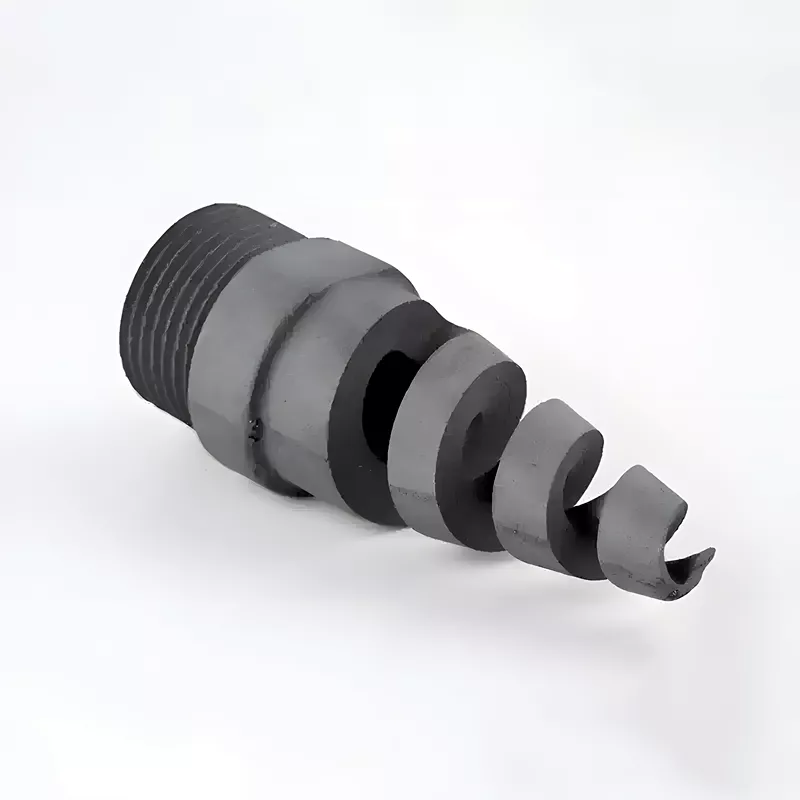
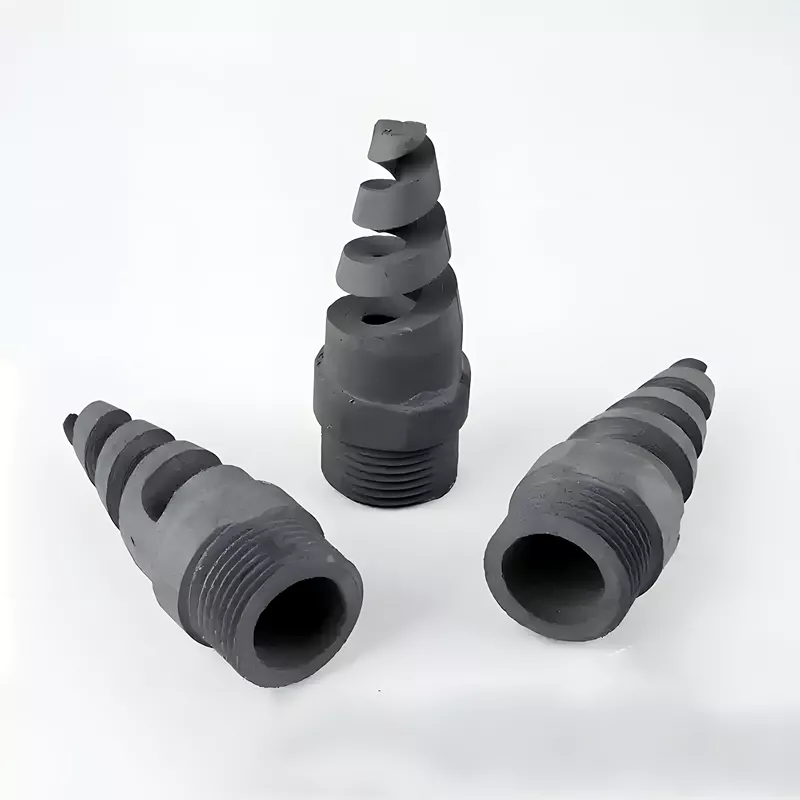
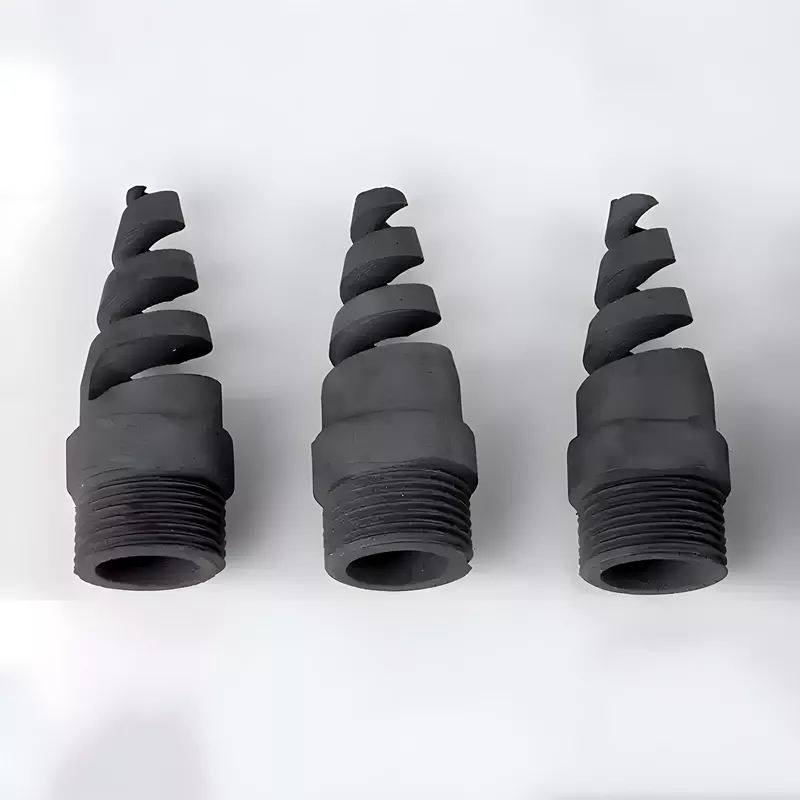
ADCERAX® Silicon Carbide Spiral Nozzle is engineered to provide stable full-cone spray performance in flue-gas desulfurization towers, industrial scrubbers, quench systems, and chemical gas-washing units where corrosive liquids, abrasive slurries, and thermal fluctuations are present. Its dense SiC microstructure supports long-term geometry retention, enabling consistent droplet distribution and reduced risk of clogging as operating conditions vary across load ranges. Through its resistance to acids, alkalis, chlorides, and particulate-laden fluids, the Silicon Carbide Spiral Nozzle offers reliable service continuity for industries prioritizing emission control efficiency and maintenance cycle stability.
Performance-Critical Features of Silicon Carbide Spiral Nozzle
-
Stable Spiral Accuracy
Its rigid SiC structure maintains spray-path consistency even after >5,000 operating hours, supporting uniform gas–liquid interaction in desulfurization towers.
Continuous geometry stability reduces the risk of uneven droplet formation, which is a known cause of local SO₂ bypass in absorber zones.
-
High Surface Hardness for Slurry Wear Conditions
SiC hardness typically exceeds 25–28 GPa, significantly lowering wear in gypsum-laden absorber liquids and abrasive dust-rich exhaust streams.
This wear resistance allows spray angle retention between maintenance cycles, reducing unexpected replacement during outage windows.
-
Uniform Full-Cone Spray Coverage
Field testing shows volume distribution uniformity deviations of less than ±10% across absorber cross-sections, supporting reliable SO₂ capture efficiency.
This uniform distribution is critical for large power-plant absorbers where uneven coverage can increase reagent consumption.
Technical Specifications of Silicon Carbide Spiral Nozzle
ADCERAX® Silicon Carbide Spiral Nozzle demonstrates stable hydraulic behavior, strong chemical resistance, and long-term structural integrity under corrosive, abrasive, and thermally fluctuating scrubbing environments, making its performance characteristics suitable for laboratory verification and industrial process evaluation.
| Property |
Specification |
| Bulk Density |
2.95–3.10 g/cm³ |
| Open Porosity |
<1% |
| Flexural Strength (RT) |
>250 MPa |
| Elastic Modulus |
~380–420 GPa |
| Vickers Hardness (HV10) |
25–28 GPa |
| Thermal Conductivity (25°C) |
~120–160 W/m·K |
| Thermal Expansion (RT–1000°C) |
4.0–4.5 ×10⁻⁶ /K |
| Max Continuous Operating Temperature |
~1350°C |
| Corrosion Resistance (Acid Exposure 24 h) |
Mass loss <0.1% |
| Erosion Resistance (Slurry Test 48 h) |
Surface loss <0.02 mm |
| Chemical Stability (pH Range) |
pH 1–14 |
| Spray Pattern Type |
Full cone spiral flow |
| Droplet SMD Range |
250–900 μm |
| Flow Rate Stability |
Within ±5% of design |
| Spray Distribution Uniformity |
Deviation <±10% |
Dimensions of Silicon Carbide Spiral Nozzle
Packaging Instructions for Silicon Carbide Spiral Nozzle
Silicon Carbide Spiral Nozzle is packaged using dense shock-absorbing foam blocks to secure the spiral structure and prevent vibration-related chipping during transport. Each nozzle is individually seated in a precision-cut cavity to avoid surface contact and ensure stability throughout international shipping. The outer carton is reinforced to withstand stacking loads and maintain the integrity of the ceramic component until final installation.
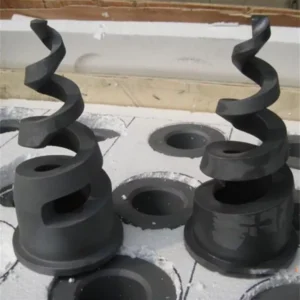

ADCERAX® Silicon Carbide Spiral Nozzle Resolves Critical Challenges in Industrial Scrubbing and Gas-Treatment Systems
The Silicon Carbide Spiral Nozzle from ADCERAX® is applied in industrial environments where corrosive liquids, abrasive slurries, and fluctuating gas loads cause frequent failures of metallic and polymeric spray components.
-
Silicon Carbide Spiral Nozzle in FGD Absorber Towers for High-Dust Coal and Lignite Units
✅Key Advantages
1. Long-Term Spiral Geometry Retention
The spiral flow profile of ADCERAX® Silicon Carbide Spiral Nozzle maintains cone angle stability with spray distribution deviation typically kept within ±10% after several thousand hours of slurry exposure. This stability allows FGD absorbers to run through multiple outage cycles without the rapid cone deformation commonly observed in metallic nozzles exposed to gypsum and fly ash.
2. Slurry Plugging Mitigation in High-Solids Operation
The internal spiral passage handles slurry streams containing suspended particles up to about 1.0–1.5 mm, reducing the incidence of hard blockages that force manual cleaning. Plants using this design have reported inspection intervals being extended from frequent in-cycle checks to alignment with regular planned outages, cutting nozzle-related intervention frequency by more than 50%.
3. Stable Droplet Distribution Across Load Changes
Flow-rate variation is typically controlled within ±5% of the design value, and the resulting droplet SMD remains in a functional range around 300–800 μm for absorber mass transfer. This consistency helps maintain SO₂ removal efficiencies above target levels without requiring stepwise increases in reagent feed when boiler load swings occur.
✅ ️Problem Solved
In a typical coal-fired unit equipped with a wet FGD absorber, metallic nozzles exposed to gypsum-rich slurry showed significant spray distortion within a single operating season, forcing operators to increase limestone feed and schedule intermediate cleaning shutdowns. After replacing one absorber level with ADCERAX® Silicon Carbide Spiral Nozzle, the plant tracked spray pattern stability over more than one year of operation with cone uniformity deviation remaining within ±10% and no unplanned nozzle-related outages. Plugging incidents in that zone dropped by more than 60%, and reagent overfeed previously introduced as a safety margin was gradually reduced while stack SO₂ values remained within the permitted band. This combination of geometry retention and reduced manual cleaning directly improved absorber hydraulic balance and supported more predictable long-term emission control.
-
Silicon Carbide Spiral Nozzle in Chloride-Rich Marine Exhaust Gas Scrubbers
✅Key Advantages
1. Chloride-Resistant Surface Integrity
Material testing of the SiC body in synthetic seawater shows mass loss typically below 0.1% after extended chloride exposure, indicating a high level of resistance to pitting and crevice attack. This performance enables the nozzle to retain functional surface quality in scrubbers continuously circulating seawater with chloride contents above 19,000 ppm.
2. Thermal-Cycle Stability in Gas-Cooling Zones
The ADCERAX® Silicon Carbide Spiral Nozzle withstands repeated thermal cycling between ambient liquid conditions and hot exhaust gas, with dimensional stability maintained over more than 1,000 simulated cycles. As a result, spray cone shape and coverage remain consistent even under frequent transitions between part-load and full-load engine operation where gas temperatures fluctuate sharply.
3. Vibration-Tolerant Structural Rigidity
With an elastic modulus in the range of 380–420 GPa, the SiC structure shows minimal cumulative distortion under prolonged mechanical vibration typical of marine installations. Field monitoring in scrubber casings has shown that nozzle alignment and geometry remain within acceptable tolerances after thousands of operating hours, while softer metallic designs in similar positions often require early replacement.
✅ ️Problem Solved
A marine operator running an open-loop exhaust gas scrubber reported that conventional stainless nozzles in the upper quench zone lost cone uniformity and developed pitting within a few months, leading to visible degradation in wash-down coverage and more frequent compliance checks. After installing ADCERAX® Silicon Carbide Spiral Nozzle in the same zone, inspection records over a full sailing year showed unchanged cone geometry and no chloride-induced surface damage exceeding 0.1% mass loss in sampled components. Temperature and pressure data from the scrubber indicated that droplet distribution remained stable across engine load changes, and the number of nozzle-related maintenance interventions was reduced by more than 40%. This allowed the vessel to maintain consistent scrubber performance with less operational disruption and more predictable planning of dockyard maintenance windows.
-
Silicon Carbide Spiral Nozzle in Steel Sinter Plant Off-Gas Quenching and Acid-Gas Washing
✅Key Advantages
1. Abrasion Resistance in High-Dust Off-Gas Streams
The Vickers hardness of 25–28 GPa helps the SiC body resist erosion when exposed to dust loads that can exceed 300 mg/Nm³ in sinter and furnace off-gas. Compared with conventional metal nozzles in the same quench zone, wear profiling after extended operation shows substantially lower wall thinning, preserving spray-path geometry for longer periods.
2. Stable Quenching Performance Under Large Temperature Gradients
The thermal conductivity in the range of 120–160 W/m·K and controlled expansion around 4.0–4.5 ×10⁻⁶ /K enable the ADCERAX® Silicon Carbide Spiral Nozzle to withstand repeated quench cycles with temperature drops greater than 200°C. This stability supports consistent droplet formation and gas-cooling behavior, reducing the risk of localized hot spots that can disturb downstream gas-washing stages.
3. Reduced Plugging in High-Solids Liquor Circuits
The spiral channel geometry is designed to tolerate suspended solids without rapid obstruction, keeping effective passage cross-sections available during continuous operation. Plants have observed fewer nozzle blockages in positions upgraded to SiC, with reported manual cleaning events in those zones dropping by roughly 50–70% when compared over similar operating hours.
✅ ️Problem Solved
In a steel sinter plant quench and washing line, standard metallic nozzles installed upstream of the gas-cleaning equipment suffered rapid erosion and frequent plugging due to the combination of dust, chlorides, and acidic condensate. Within one production campaign, operators noted distorted spray patterns, unstable gas temperature profiles, and a rising number of short maintenance stoppages for nozzle cleaning and replacement. After a trial installation of ADCERAX® Silicon Carbide Spiral Nozzle on one quench header, monitoring over a subsequent campaign showed stable quench temperatures and a significant reduction in nozzle-related interventions, with recorded cleaning events in that header cut by more than 50% and no measurable loss of spray coverage. This field experience demonstrated that improved erosion resistance and solids-handling capability could stabilize process conditions and reduce operational interruptions in contaminant-rich sinter off-gas environments.
ADCERAX® Silicon Carbide Spiral Nozzle User Guide for Stable and Safe Operation
The Silicon Carbide Spiral Nozzle benefits from a robust SiC structure and a high-efficiency spiral flow path, and users must understand several practical guidelines to achieve consistent spray performance, minimize operational risks, and maintain long-term system reliability under demanding scrubbing, cooling, and gas-treatment conditions.
-
Installation Preparations and System Compatibility
1. Confirm System Fit and Flow Direction
Installation should begin with verifying that the mounting interface aligns with the absorber or scrubber header to ensure stable spray orientation. Cross-checking flow direction avoids misalignment that can reduce spray uniformity in high-load zones. Ensuring correct positioning helps maintain full-cone coverage across fluctuating process conditions.
2. Inspect Sealing and Support Structures
The sealing surfaces and fastening components must be inspected for wear or deformation before assembly. Any mismatch at the connection point may introduce vibration or stress that affects long-term geometry stability. A secure interface reduces the risk of micro-movement that can impact spray performance over time.
3. Evaluate Surrounding Pipeline Cleanliness
Before installation, flushing the piping removes accumulated solids that may enter the spiral channel during initial startup. Clean pipelines reduce the chance of early obstruction and flow imbalance. Preventive flushing maintains predictable spray patterns during early operational cycles.
-
Operational Best Practices for Stable Spray Performance
1. Maintain Appropriate Operating Pressure
Spray uniformity depends on using pressure conditions within the system’s recommended operating window. Excessive pressure may accelerate slurry impact on the spiral path, while low pressure weakens droplet formation. Controlled pressure is essential for achieving consistent mass-transfer efficiency.
2. Monitor Slurry Characteristics Periodically
High-solids or scaling-prone liquids may influence flow consistency through the spiral channel. Regular monitoring supports timely adjustments to filtration or mixing systems. Stable slurry quality directly enhances long-term nozzle reliability.
3. Avoid Abrupt Thermal Transitions
Although SiC tolerates high thermal gradients, extremely sudden temperature shocks should still be minimized when possible. Gradual transitions improve cooling stability and reduce thermal cycling stress. Temperature moderation supports sustained structural integrity.
-
Cleaning and Maintenance Recommendations
1. Schedule Predictive Inspections
Inspections should be planned in alignment with absorber, quench, or scrubber outage cycles to detect early signs of blockage or wear. Predictive checks help avoid unscheduled line interruptions. Routine inspection supports uninterrupted service continuity.
2. Clean Spiral Channels with Non-Abrasive Media
Cleaning should use soft tools or filtered liquids to avoid micro-scratching of the SiC surface. Abrasive mechanical cleaning may introduce unnecessary surface stress. Proper cleaning methods protect the nozzle’s spray geometry.
3. Record Performance Variations Over Time
Tracking spray distribution or pressure changes enables early detection of process abnormalities. Recorded data also assists in diagnosing upstream slurry or scaling issues. Trend monitoring strengthens long-term process stability.
-
Storage, Handling, and Transportation Guidelines
1. Handle Each Nozzle as a Precision Component
Despite its high hardness, SiC remains brittle under sharp impact or edge loading. Handling should avoid point-pressure or dropping forces that could damage the spiral tip. Proper lifting and placement reduce accidental chipping risks.
2. Store Nozzles in Shock-Resistant Packaging
Individual protective cavities or foam blocks should be used to restrict motion during storage. Environmental exposure such as moisture or corrosive vapors should also be avoided. Controlled storage conditions maintain surface quality.
3. Use Reinforced Containers for Long-Distance Shipping
Transport packaging should distribute load uniformly and prevent collision between components. Multi-layer outer boxes improve resilience to vibration, stacking, and temperature fluctuations. Appropriate packaging safeguards geometry accuracy throughout transit.