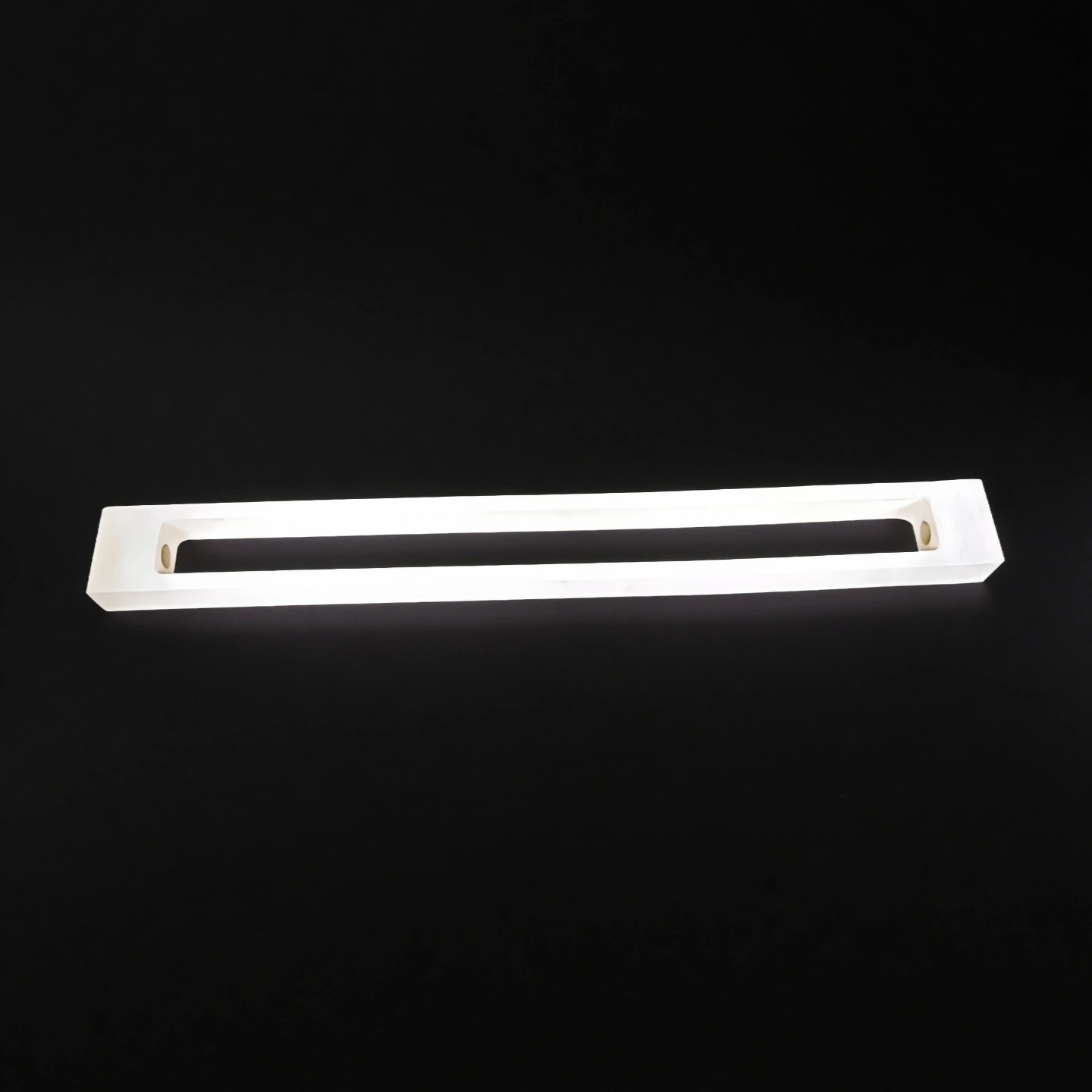
What Is a High Purity Alumina Ceramic Insulation Frame?
A high purity alumina ceramic insulation frame is a machined Al₂O₃ structural insulator used to separate conductive parts, support assemblies and maintain electrical isolation in high-voltage, vacuum, laser and industrial equipment. It is selected when polymer, glass or metal-supported insulation parts cannot meet the required temperature resistance, dielectric stability, dimensional accuracy or cleanliness level.
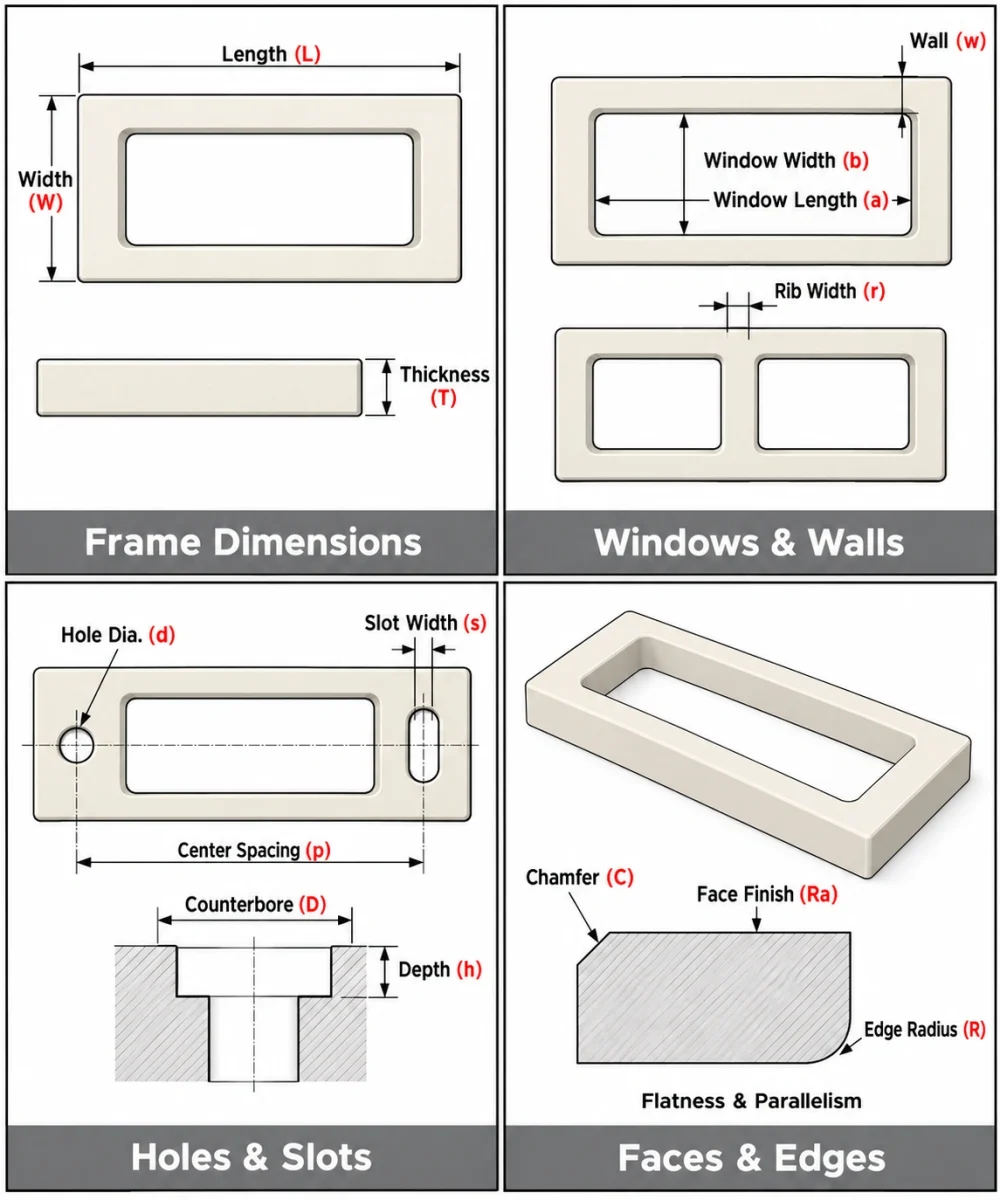
What sets this frame apart from a plain ceramic plate is the opening. A window or aperture has to stay open for an optical path, gas flow, a feedthrough or an assembly clearance, while the sections around it carry the support and keep the electrical path separated. The frame is therefore judged by its opening, its support sections and its mounting contacts together — not by outer size alone.
High Purity Alumina Ceramic Insulation Frame Specifications
This frame is made to drawing, so the specification table lists what you define rather than fixed stock sizes. Each line — outer size, aperture, thickness, hole and slot design, and surface finish — is confirmed from your drawing or sample before production.
| Custom Alumina Ceramic Insulation Frame Specifications | |||||
| Item No. | Outer Size | Aperture / Window | Thickness | Hole / Slot Design | Surface Finish |
| AT-HP-K01 | Custom | Custom | Custom | Custom | As-sintered, ground or polished |
Download the Product Catalogue
High Purity Alumina Ceramic Insulation Frame Properties
This frame is made in one of four dense sintered alumina grades. The values below are typical material values measured on test samples. Use them to compare grades; they are not ratings for a finished frame.
| Property | Unit / condition | AD-ALU-990 | AD-ALU-995 | AD-ALU-997 | AD-ALU-999 |
|---|---|---|---|---|---|
| Al₂O₃ content | wt% | 99.00 | 99.50 | 99.70 | 99.90 |
| Density | g/cm³ | 3.80–3.91 | 3.90–3.92 | 3.94 | 3.94 |
| Water absorption | % | ≤0.10 | ≤0.10 | ≤0.05 | ≤0.01 |
| Volume resistivity | Ω·cm at 20 °C | >10¹⁴ | >10¹⁴ | >10¹⁴ | >10¹⁴ |
| Dielectric strength | kV/mm, 5 mm specimen | 10 | 10 | 10 | 10 |
| Relative permittivity | 1 MHz, 25 °C | 9.6 | 9.7 | 9.8 | 9.8 |
| Dissipation factor tan δ | 1 MHz, 25 °C | 0.0006 | <0.0001 | <0.0001 | <0.0001 |
| Flexural strength | MPa | 300–320 | 320–350 | 330 | 315–340 |
| Elastic modulus | GPa | 355 | 365 | 370 | 359–375 |
| Fracture toughness KIC | MPa·m⁰·⁵ | 3.3 | 3.5 | 3.6 | 3.8–4.2 |
| Thermal conductivity | W/(m·K) at 25 °C | 24 | 30–38 | 35–40 | 35–42 |
| Coefficient of thermal expansion | 10⁻⁶/K | 7.2 (range not specified) | 7.6 (range not specified) | 7.6 (range not specified) | 7.6 (25–800 ° |
How to Choose an Alumina Insulation Frame
Five questions decide most frames. Work through them before you fix the drawing.
1. Define the opening
Choose a single window, multiple windows, a stepped opening or a slot to suit the optical path, gas flow, feedthrough or assembly clearance.
Check the opening size together with the surrounding wall or rib width. A larger opening leaves less ceramic to support the load.
2. Check the span and support points
Review the unsupported span, minimum wall thickness, ribs and support locations against the expected load.
Long spans and thin walls are more sensitive to bending. Direct loads through supported sections and avoid concentrated loads on thin edges.
3. Plan the mounting and clamping
Specify the mounting holes or slots, edge distances and datum faces. Use load-spreading washers or plates on the designated mounting faces, with controlled clamping torque.
Do not copy a metal part’s press fit or clamping force without review; it can crack the ceramic.
4. Select the alumina grade
AD-ALU-990 and AD-ALU-995 are common starting points for general insulation frames. Consider AD-ALU-997 or AD-ALU-999 when lower water absorption or fewer sintering additives matter to the process.
Confirm the grade against operating temperature, voltage and atmosphere—not purity alone.
5. Check the insulation path
Locate conductors and grounded parts, then check clearance and creepage distances around the openings. Include aperture spacing, edge condition and surface finish in the review.
Agree a voltage acceptance test for the actual frame or assembly. The table’s dielectric strength is measured on a 5 mm specimen and does not establish the finished frame’s voltage rating.
Include these five points on your drawing to help speed up the quotation review.
Common Failure Modes of Alumina Insulation Frames
1. Cracks at Corners, Holes or Window Edges
Common causes include forced fits, overtightened fasteners, sharp internal corners and debris on mating surfaces.
Use suitable corner radii, load-spreading washers or plates, and controlled fastening torque. Check that mating surfaces are clean, flat and aligned before installation.
2. Edge Chipping During Handling
Prying, dropping or levering against the frame can chip ceramic edges.
Remove obstructing metal parts first, then support the frame from below and lift it clear. Do not use the ceramic as a lever point.
3. Surface Flashover or Reduced Insulation
Conductive dust, metal particles, oil and handling residue can reduce surface insulation. Sharp edges and narrow aperture gaps can increase local electric-field concentration.
Keep surfaces clean and review creepage distance, aperture spacing and edge geometry. During maintenance, inspect corners and high-field areas for contamination or discoloration.
4. Loosening or Misalignment After Thermal Cycling
Different thermal expansion rates between the ceramic and mating metal can change contact stress, alignment and clamping preload.
Allow for relative movement and review the support and clamping arrangement across the full heating and cooling cycle.
5. Deposits or Discoloration in Vacuum or Gas Service
Check for residue from handling, cleaning and nearby assembly materials.
Specify material purity and surface cleanliness separately. Agree the cleaning, drying or bake-out procedure and acceptance criteria for the actual assembly.
Before reusing a frame under different voltage, pulse or temperature conditions, review its insulation distances, material limits and mounting arrangement.
For replacement inquiries, send photos of the damaged part and its mounting arrangement, together with the operating conditions.
High Purity Alumina Insulation Frame Packaging
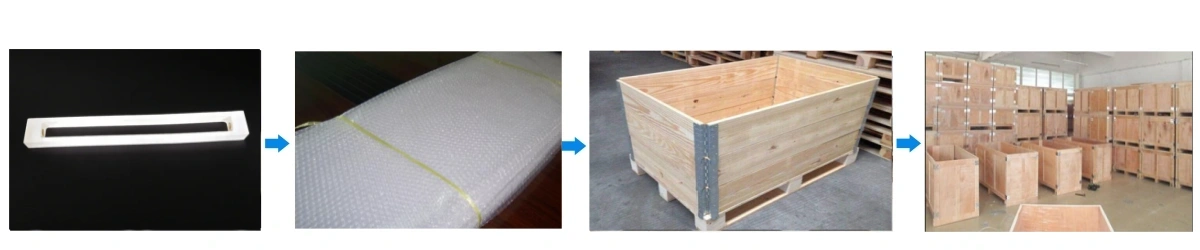
- Each alumina ceramic insulation frame is individually separated using foam or soft interlayers to avoid ceramic-to-ceramic contact.
- Parts are packed in clean PE bags and then located in custom cut foam or honeycomb cartons to minimize movement during transport.