
See How Drawing Requirements Become Inspection Checkpoints
Watch how material, geometry, tolerances, surfaces, and working conditions are translated into a practical quality-review path for custom precision ceramic components.
* Share your drawing and project requirements. ADCERAX will review manufacturability, critical features, and the appropriate inspection scope before quotation.
Dimensional and Surface Inspection Capability
Dimensional and surface inspection defines whether ceramic components can be assembled, sealed, and operated reliably under real service conditions.
Surface Roughness Control
Surface roughness directly affects wear behavior, sealing performance, friction, and fluid interaction in ceramic components.
Contact roughness testers are used to verify Ra and Rz values on ground and polished surfaces, ensuring consistency between batches and compliance with functional specifications.
Typical applications include sealing faces, sliding interfaces, and flow-contact surfaces.
Height and Linear Dimension Measurement
Height gauges and digital micrometers verify critical step heights, thicknesses, and datum distances.
Height control is essential for ceramic components used in stacked assemblies, fixtures, and precision alignment systems where dimensional deviation cannot be compensated during assembly.
Hardness Verification
Hardness testing confirms material densification quality and sintering stability.
Vickers hardness measurements are applied to alumina, zirconia, silicon carbide, and silicon nitride components to validate resistance to wear, indentation, and surface damage during service.
Hardness data also serves as an indirect indicator of microstructural consistency.
Cylindricity and Roundness Inspection
Rotational ceramic parts require controlled roundness, cylindricity, and concentricity to function reliably.
Dedicated cylindrical inspection setups and precision measurement fixtures are used to evaluate shafts, sleeves, bushings, and flow components where rotational accuracy determines wear life and sealing behavior.
Density Measurement
Density meters verify material densification and internal porosity control.
Measured density values are compared against material standards to confirm sintering completeness, especially for high-strength and wear-resistant ceramic grades.
Density inspection is critical for detecting hidden defects not visible through surface inspection.
CMM and 2D Vision Inspection
Three-coordinate measuring machines (CMM) and 2D vision systems are applied to complex geometries where conventional gauges cannot capture full dimensional relationships.
These systems enable true position, profile, flatness, perpendicularity, and geometric tolerance verification for precision ceramic components.
CMM and vision inspection are particularly important for multi-feature parts, mating interfaces, and components with tight positional tolerances.
Calibrated measurement ensures tolerance compliance at key features.
Finish and edge integrity are inspected after machining and cleaning.
Repeat orders are monitored for
stability across
production cycles.
Inspection results can be organized for procurement and quality review.
Achievable Tolerance Capability
Choose standard machining for cost-efficient general parts, or precision machining for tight-fit, alignment-critical, and sealing applications.
Standard Machining
- Length / Diameter (<50 mm): ±0.05 mm
- Length / Diameter (50–200 mm): ±0.10 mm
- Flatness: 0.05 mm
- Concentricity / Runout: 0.05 mm
- Perpendicularity: 0.05 mm
- Surface Roughness: Ra ≤0.8 μm
Precision Machining
- Length / Diameter (<50 mm): ±0.01 mm
- Length / Diameter (50–200 mm): ±0.02 mm
- Flatness: 0.01 mm
- Concentricity / Runout: 0.02 mm
- Perpendicularity: 0.02 mm
- Surface Roughness: Ra ≤0.2 μm
Inspection Equipment Overview
All inspection equipment is calibrated according to ISO/IEC 17025 requirements and traceable to national/international standards.
| Equipment Type | Measurement Capability | Resolution / Accuracy |
|---|---|---|
| CMM (Coordinate Measuring Machine) | 3D geometry, true position, profile, GD&T | ±0.003 mm |
| 2D Vision Measuring System | Contour, hole position, flatness | ±0.005 mm |
| Surface Roughness Tester | Ra, Rz, Rmax, Rq values | 0.001 μm resolution |
| Vickers Hardness Tester | HV hardness measurement | Load: 0.1-30 kgf |
| Digital Height Gauge | Step height, datum distance | ±0.01 mm |
| Digital Micrometer | OD, ID, thickness | ±0.001 mm |
| Density Meter (Archimedes) | Bulk density, apparent porosity | ±0.01 g/cm³ |
| Roundness / Cylindricity Tester | Roundness, cylindricity, concentricity | 0.1 μm resolution |
Inspection Coverage Across Production Stages
Inspection coverage spans the full manufacturing lifecycle to ensure dimensional accuracy, surface integrity, and material stability are maintained from raw material intake to final delivery.
Quality control is structured as a continuous verification process rather than a single end-of-line checkpoint.
Raw ceramic materials are verified upon receipt to confirm material grade, density baseline, and conformance to specified standards.
Early verification prevents unsuitable material from entering forming or sintering stages, reducing downstream variation and rework risk.
Dimensional checks and surface condition monitoring are applied during machining and finishing operations.
Critical features such as thickness, diameter, flatness, roughness, and concentricity are verified at defined process steps to detect deviation before tolerance limits are exceeded.
Completed ceramic components undergo full dimensional and visual inspection prior to release.
Final verification confirms compliance with drawing requirements, geometric tolerances, and surface specifications, ensuring readiness for assembly and service.
Staged inspection reduces late-stage rejection, shortens customer approval cycles, and supports batch-to-batch consistency across repeat orders.
Controlled inspection checkpoints also improve traceability and simplify root-cause analysis when process adjustments are required.
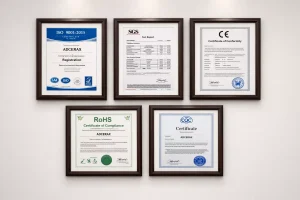
Quality Systems and Certifications
Production facilities operate under recognized international and domestic quality frameworks to ensure traceability, compliance, and repeatability.
- ISO 9001 Quality Management System
- SGS Testing & Certification
- CE Marking (European Conformity)
- RoHS Compliance
- CQC (China Quality Certification)
Quality Consultation
Quality questions often surface when tolerances tighten, failures repeat, or approval cycles stall.
Direct technical review helps confirm inspection scope, acceptance criteria, and risk points before issues escalate.
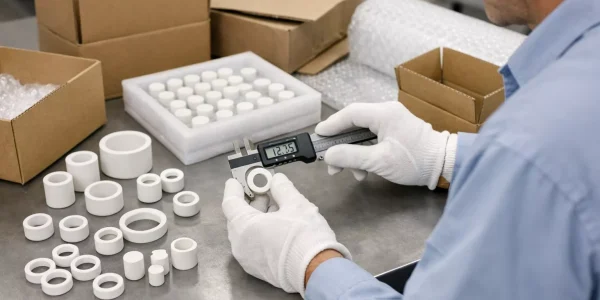
Unclear acceptance criteria, inspection scope, or measurement method often delay approvals and repeat validation work.
