High-performance zirconia components often fail to meet expectations because density assumptions are oversimplified or incorrectly generalized across stabilized systems.
Zirconia ceramic density varies with stabilizer chemistry, phase constitution, and lattice defect populations, shaping structural reliability and functional limits. Clarifying these variations enables more accurate material interpretation across engineering and scientific applications.
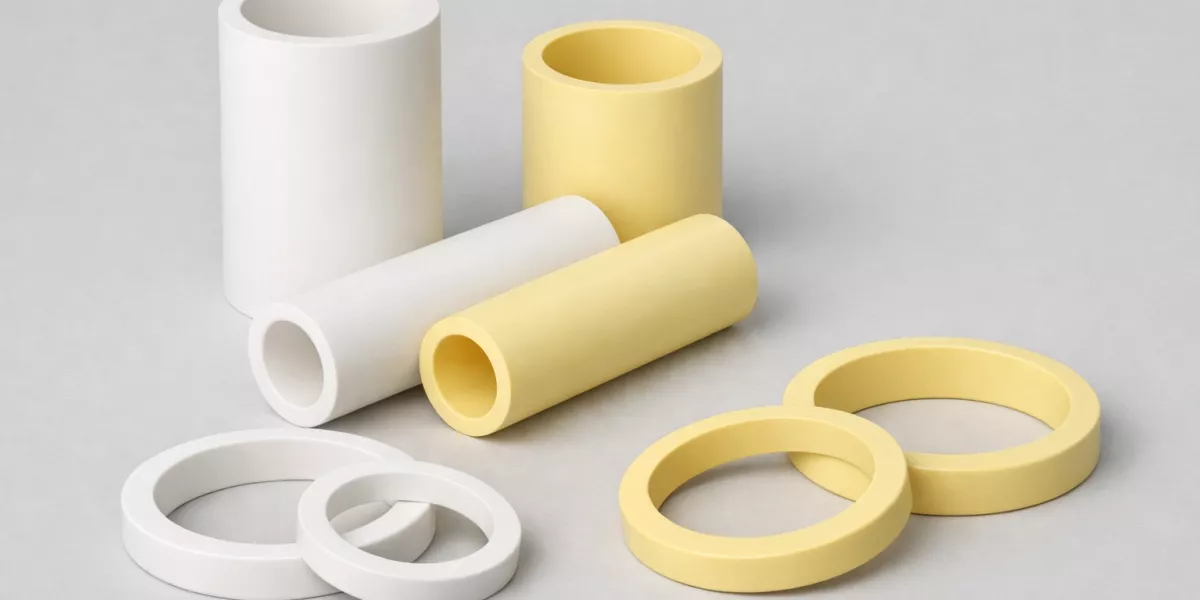
Across stabilized zirconia systems, density is not a static property but a consequence of atomic packing efficiency, vacancy concentration, and stabilizer content. Establishing this foundation allows later sections to quantify how Y-TZP, YSZ, MSZ, and CSZ diverge in measurable density ranges under controlled conditions.
Why Zirconia Ceramic Density Varies Across Stabilized Structures
Before numerical density ranges are compared, one fundamental observation frames the discussion: zirconia does not possess a single intrinsic density value. Instead, density reflects how different stabilizers reshape crystal packing and defect populations within the ZrO₂ lattice.
-
Stabilizer-dependent lattice expansion
Dopant ions such as Y³⁺, Mg²⁺, or Ca²⁺ substitute Zr⁴⁺ sites, introducing oxygen vacancies for charge balance. These vacancies reduce average atomic packing efficiency, causing measurable density shifts even when porosity is minimal. Consequently, two fully dense zirconia ceramics may exhibit different bulk densities solely due to stabilizer chemistry. -
Phase constitution effects on atomic packing
Monoclinic, tetragonal, and cubic zirconia phases exhibit distinct coordination geometries and unit cell volumes. Tetragonal-dominant structures generally achieve higher packing efficiency than vacancy-rich cubic lattices, while monoclinic structures show lower symmetry but limited stabilizer-induced expansion. Density variations therefore track phase distribution rather than processing assumptions. -
Measured density versus intrinsic lattice density
Practical density values reported for zirconia ceramics combine lattice density and residual microstructural effects. Even under near-full densification, stabilizer type governs achievable density ranges, explaining why values differ across stabilized systems without implying processing inconsistency.
These structural influences establish why zirconia ceramic density must always be interpreted within its stabilization framework, rather than as a universal material constant.
Crystal Phase Influence on Zirconia Ceramic Density
Across stabilized zirconia systems, density variations become clearer once crystal phase effects are isolated. Beyond stabilizer chemistry alone, the dominant zirconia phase establishes baseline atomic packing efficiency that constrains achievable density ranges.
-
Monoclinic phase and baseline lattice density
Unstabilized zirconia at room temperature exists in the monoclinic phase, characterized by lower symmetry and relatively larger unit cell volume. Typical lattice density for monoclinic ZrO₂ remains lower than stabilized counterparts, even in fully dense form, because atomic coordination is less efficient. In practical terms, monoclinic zirconia rarely exceeds 5.65–5.75 g/cm³, setting a reference point rather than an engineering target.During early zirconia development, density expectations were often anchored to monoclinic values, leading to misinterpretation when stabilized ceramics exhibited higher or lower bulk densities. Recognizing this baseline prevents incorrect assumptions when comparing stabilized systems. As a result, monoclinic density serves primarily as a structural reference rather than a performance benchmark.
-
Tetragonal phase and enhanced packing efficiency
Tetragonal zirconia, retained through controlled stabilizer addition, exhibits improved atomic packing relative to the monoclinic structure. Reduced lattice distortion and higher symmetry enable tighter Zr–O coordination, raising intrinsic lattice density. Fully dense tetragonal-dominant zirconia typically occupies the 5.95–6.10 g/cm³ range under controlled stabilization.In engineering practice, this phase is often associated with the highest achievable bulk density among zirconia ceramics. Experience from dense structural components shows that once tetragonal phase fraction exceeds a critical threshold, density values cluster tightly with minimal scatter. Consequently, tetragonal stabilization establishes the upper density envelope for most high-strength zirconia systems.
-
Cubic phase stabilization and vacancy-driven density reduction
Cubic zirconia introduces a different density mechanism despite its high symmetry. Stabilization at higher dopant levels generates a substantial population of oxygen vacancies, which expand the effective lattice volume. Although cubic symmetry promotes uniform packing, vacancy concentration counteracts this advantage, lowering intrinsic density.Fully stabilized cubic zirconia commonly reports densities in the 5.6–5.9 g/cm³ range, depending on stabilizer content. Long-term observations across thermal and electrochemical environments consistently show that vacancy concentration, rather than porosity, governs this reduction. Accordingly, cubic phase density should be interpreted as a vacancy-controlled structural outcome rather than a processing limitation.
Together, these phase-dependent effects explain why zirconia ceramic density cannot be evaluated without reference to dominant crystal structure, even before stabilizer type and concentration are considered.
Typical Zirconia Density by Crystal Phase
Phase-structure reference only — not purchase acceptance bands and not grade TDS rows.
| Dominant Crystal Phase | Typical Density Range (g/cm³) |
|---|---|
| Monoclinic | 5.65–5.75 |
| Tetragonal | 5.95–6.10 |
| Cubic | 5.60–5.90 |
Zirconia Ceramic Density in 3Y-TZP
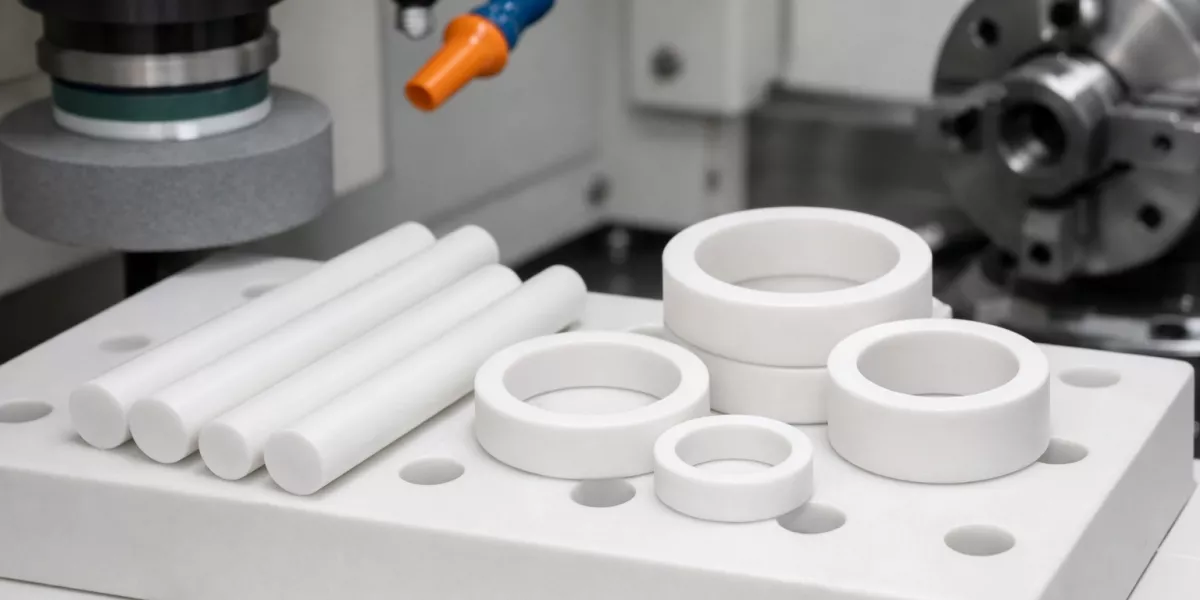
Within stabilized zirconia systems, 3Y-TZP is widely treated as the density reference point because its composition balances high packing efficiency with controlled defect concentration. Consequently, density values reported for other zirconia ceramics are frequently compared against this material class.
Typical bulk density range of 3Y-TZP ceramics
In fully sintered technical ceramics, 3Y-TZP consistently exhibits one of the highest bulk densities among stabilized zirconia materials. Under standard industrial densification conditions, bulk density for structural 3Y-TZP selection typically cites 6.00–6.08 g/cm³ on the grade sheet (confirm ordered grade TDS + test method).
Field measurements across precision-machined components reveal that density scatter is narrow when powder homogeneity and sintering control are maintained. Structural 3Y-TZP selection typically cites bulk density in 6.00–6.08 g/cm³; drawing/PO sets acceptance. Values well below the grade-sheet band warrant process/phase review — not an automatic cubic diagnosis at a fixed cutoff. As a result, density serves as a rapid indicator of microstructural completeness in 3Y-TZP.
Across long production runs, experience shows that density values clustering near the upper end of this range correlate with stable dimensional behavior and predictable mechanical response. This consistency explains why 3Y-TZP is frequently cited as the benchmark for zirconia ceramic density.
Density variation under yttria content deviation
Although nominally defined by 3 mol% yttria, practical compositions may vary slightly around this target. Small deviations in yttria concentration introduce measurable density shifts due to changes in oxygen vacancy concentration and phase stability. As yttria content increases beyond the optimal tetragonal retention window, bulk density gradually declines.
Within the TZP window, bulk density is grade- and process-dependent; as yttria increases in that window density often trends slightly lower — confirm grade TDS. Small density shifts with stabilizer level are real but are not a universal slope.
Composition control remains critical for reproducible 3Y-TZP performance; treat grade-sheet density rows as the RFQ reference rather than informal mol%-step rules.
Practical density thresholds observed in dense 3Y-TZP
For RFQ screening, structural 3Y-TZP selection typically cites bulk density in 6.00–6.08 g/cm³. Drawing and PO language — not blog screening bands — set acceptance.
Values well below the grade-sheet band warrant process/phase review. Do not treat a single cutoff (for example 5.90 g/cm³) as an automatic cubic-phase diagnosis.
Used this way, zirconia ceramic density is a diagnostic RFQ field tied to grade TDS and method, not a freestanding absolute.
Density Ranges Observed in 3Y-TZP Zirconia
| Grade / System | Typical Bulk Density (g/cm³) | Note |
|---|---|---|
| 3Y-TZP / Y-TZP (selection) | 6.00–6.08 | Grade-sheet typical band; confirm TDS + method |
Fine mol%-step density tables are omitted — within the TZP window, density is grade- and process-dependent; confirm the ordered grade TDS row rather than interpolating contract bands.
Zirconia Ceramic Density in YSZ
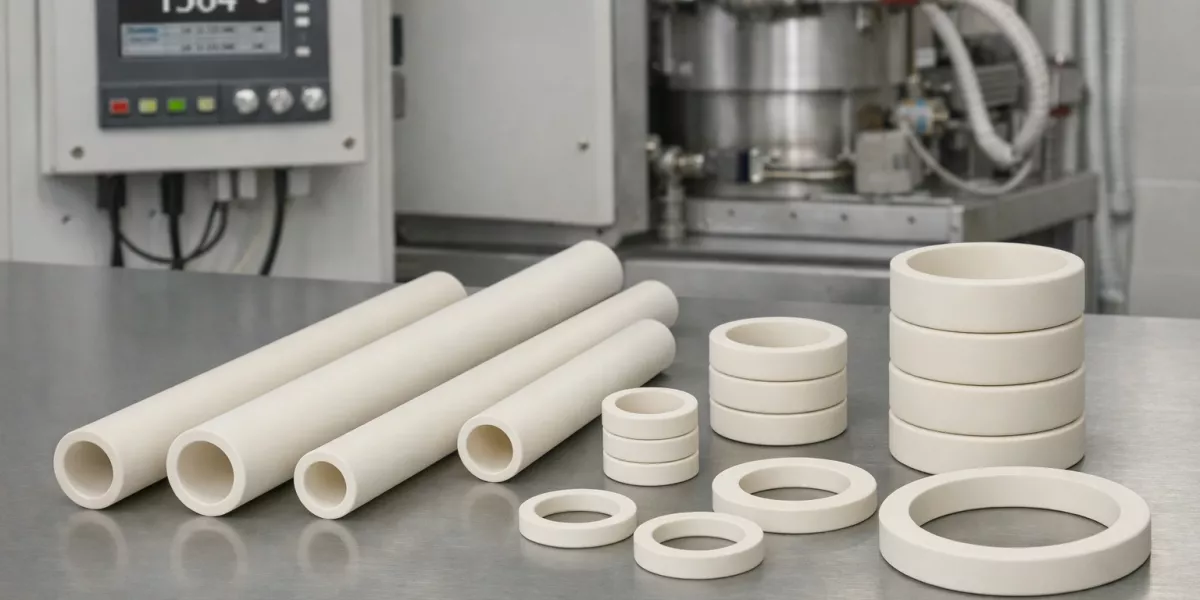
As yttria content increases beyond the tetragonal stabilization window, zirconia transitions into fully stabilized cubic structures, altering achievable density ranges. Compared with 3Y-TZP, YSZ demonstrates a distinctly different density profile shaped primarily by vacancy concentration rather than porosity effects.
Typical density range of fully stabilized YSZ
Fully stabilized YSZ, commonly containing 8–10 mol% yttria, exhibits bulk density values lower than tetragonal-dominant zirconia despite high sintering quality. Across controlled industrial and laboratory conditions, 8YSZ typical bulk density is about ~5.90 g/cm³ on the grade sheet. Other Y₂O₃ mol% / porosity routes vary — confirm the ordered grade TDS; do not publish a wide all-YSZ contract band — pin 8YSZ to the grade-sheet typical and confirm other mol% on TDS.
For 8YSZ selection, densities near ~5.90 g/cm³ are the usual grade-sheet reference when open porosity is negligible. This behavior reflects intrinsic lattice expansion driven by oxygen vacancy formation rather than incomplete densification. Consequently, YSZ density values should be interpreted as a structural outcome of stabilization strategy, not as an indicator of processing limitation.
In long-duration service environments, cubic YSZ density should be read against the ordered grade sheet — lower lattice density versus 3Y-TZP is an inherent stabilization outcome, not automatically a densification failure.
Density shifts across different yttria concentrations
Within the YSZ family, density is mol%-dependent. Keep 8YSZ near ~5.90 g/cm³ as the plant selection anchor; other yttria levels and porosity routes vary — confirm the grade sheet rather than applying a universal per-mol% slope.
Lattice vacancy effects still dominate packing relative to 3Y-TZP, but RFQ acceptance must follow the ordered grade density row and stated test method.
Upper and lower density bounds commonly reported for YSZ
Stay inside the ordered grade density row. Outliers relative to that row should trigger RFQ review (porosity, phase, stabilizer level, method) rather than absolute blog cutoffs detached from the ordered grade sheet.
Functionally, YSZ occupies a lower lattice-density regime than structural 3Y-TZP; that separation is stabilizer-driven, but contract numbers come from the grade sheet.
Density Ranges Observed in YSZ Zirconia
| Grade / System | Typical Bulk Density (g/cm³) | Note |
|---|---|---|
| 8YSZ / 8Y-FSZ (selection) | ~5.90 | Typical point on grade sheet; other mol% confirm TDS |
Fine mol%-step YSZ density tables and per-mol% slopes are omitted to avoid conflicting with the 8YSZ ~5.90 selection anchor.
Zirconia Ceramic Density in MSZ
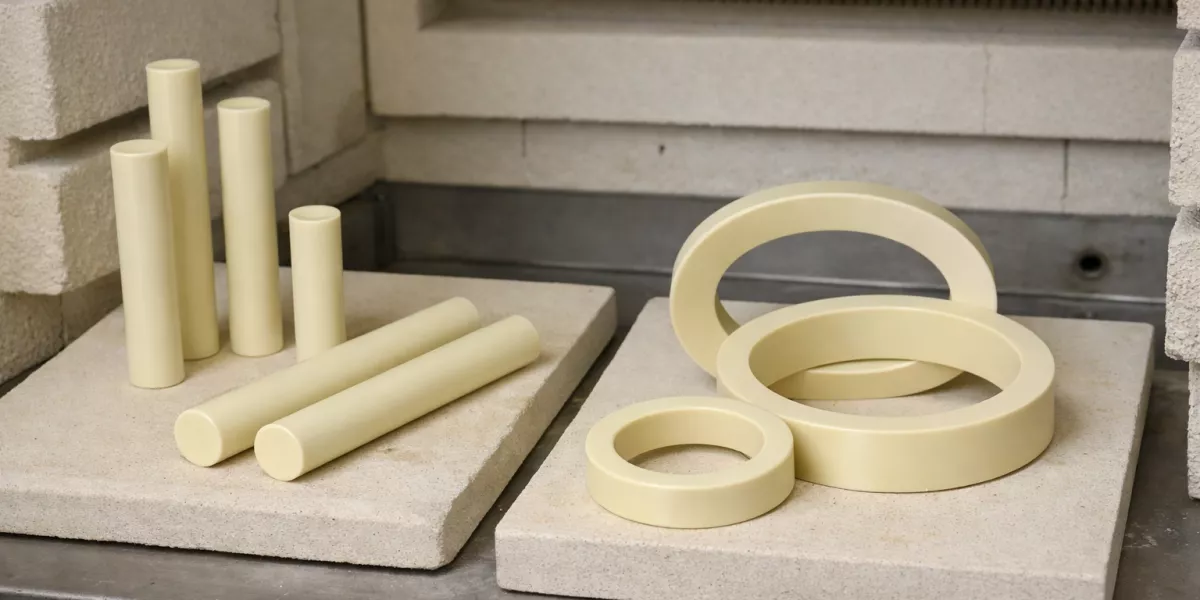
Magnesia stabilized zirconia occupies a distinct position among stabilized systems because density behavior emphasizes long-term stability rather than peak packing efficiency. Compared with yttria-based zirconia, MSZ exhibits moderate density values that remain relatively consistent across extended thermal exposure.
Typical bulk density values of magnesia stabilized zirconia
In dense MSZ ceramics, bulk density for MSZ selection typically cites 5.70–5.80 g/cm³ on the grade sheet (confirm ordered grade TDS). These values are lower than those of 3Y-TZP but generally higher than heavily stabilized YSZ compositions. Measurements from industrial furnace components and structural inserts repeatedly confirm this intermediate density interval.
Unlike yttria-stabilized systems, MSZ density rarely approaches the upper limits observed in tetragonal zirconia. Even under optimized densification conditions, MSZ remains below structural 3Y-TZP packing, reflecting lattice expansion associated with Mg²⁺ substitution. As a result, MSZ density should be evaluated within its own stabilization context rather than against yttria-based benchmarks.
Across multiple production batches, density scatter in MSZ tends to remain narrow, indicating that composition-driven lattice effects dominate over processing variability.
Density consistency across MgO content ranges
Magnesia content in MSZ typically ranges from 8 to 10 mol%, sufficient to stabilize cubic or mixed cubic–tetragonal phases at operating temperatures. Within this window, bulk density varies only modestly, often within ±0.05 g/cm³, provided phase composition remains stable.
Partial-tetragonal MSZ may read higher than the cubic-leaning end of the family — state that only qualitatively, without inventing a higher plant band. Externally, pin MSZ selection to 5.70–5.80 g/cm³ and confirm grade TDS.
MSZ density is comparatively reproducible across large-format components when the grade sheet and densification route are controlled.
Density stability limits observed in MSZ ceramics
Aging drift is duty- and phase-specific — qualify on the application rather than quoting a universal drift ceiling.
Read MSZ density against the 5.70–5.80 g/cm³ selection band; outliers need grade/process review rather than blog absolute cutoffs.
MSZ density ranges reflect a balance between stabilization and packing efficiency — a thermally robust zirconia system rather than a high-density benchmark versus 3Y-TZP.
Density Ranges Observed in MSZ Zirconia
| Grade / System | Typical Bulk Density (g/cm³) | Note |
|---|---|---|
| MSZ / Mg-PSZ (selection) | 5.70–5.80 | Grade-sheet typical band; higher readings not plant contract |
Mol%-step MSZ density rows outside the TDS band are omitted.
Zirconia Ceramic Density in CSZ
Calcia stabilized zirconia presents the widest density dispersion among common stabilized zirconia systems. Unlike yttria- or magnesia-stabilized materials, CSZ density is strongly influenced by stabilizer size mismatch and long-term phase evolution, leading to broader and less clustered density ranges.
Typical density range of calcia stabilized zirconia
In dense CSZ ceramics, bulk density for CSZ selection typically cites 5.60–5.75 g/cm³ on the grade sheet (confirm ordered grade TDS). This range overlaps partially with YSZ and MSZ but shows noticeably greater scatter across comparable densification conditions. Measurements from high-temperature refractory and corrosion-resistant components consistently fall within this interval.
Fully dense CSZ remains below structural 3Y-TZP packing even under aggressive densification routes. The larger ionic radius of Ca²⁺ relative to Zr⁴⁺ expands the lattice more significantly than Mg²⁺ or Y³⁺ substitution, lowering intrinsic lattice density. As a result, CSZ density values should be interpreted as an inherent structural outcome rather than a densification shortfall.
Across multiple service environments, CSZ density remains lower on average than MSZ while demonstrating broader variability across batches and compositions.
Density dispersion linked to CaO concentration levels
Calcia content and phase evolution still broaden scatter relative to MSZ, but external selection should pin to 5.60–5.75 g/cm³ and confirm the ordered grade TDS rather than publishing fine mol% contract rows.
Stabilizer-induced lattice effects dominate density outcomes even when open porosity is low — which is why method and specimen condition belong on the RFQ.
Density drift ranges reported after long-term exposure
Aging drift is duty- and phase-specific — qualify on the application. Do not publish universal drift ceilings or hard “beyond X g/cm³ = instability” rules.
Evaluate CSZ density against the 5.60–5.75 g/cm³ selection band and the ordered grade sheet, especially under sustained thermal duty.
Density Ranges Observed in CSZ Zirconia
| Grade / System | Typical Bulk Density (g/cm³) | Note |
|---|---|---|
| CSZ / Ca-PSZ (selection) | 5.60–5.75 | Grade-sheet typical band; confirm TDS + method |
Mol%-step CSZ density rows and numeric aging-drift claims are omitted.
Zirconia Ceramic Density Differences Across Stabilizer Systems
Once individual stabilized systems are examined independently, meaningful interpretation emerges only through direct comparison. Density differences across Y-TZP, YSZ, MSZ, and CSZ do not overlap randomly but follow clear, stabilizer-driven patterns that define practical separation zones.
Density ranking among Y-TZP YSZ MSZ and CSZ
When evaluated under fully dense conditions, zirconia systems exhibit a consistent density hierarchy governed by stabilizer valence, ionic radius, and vacancy concentration. Across repeated measurements, 3Y-TZP occupies the highest density range, followed by MSZ, then YSZ, while CSZ consistently shows the lowest average density.
Quantitatively, pin selection bands to grade sheets: 3Y-TZP 6.00–6.08, 8YSZ ~5.90, MSZ 5.70–5.80, and CSZ 5.60–5.75 g/cm³. Do not swap families by density alone — stabilizer systems are not interchangeable.
This ranking has been repeatedly confirmed across structural, thermal, and refractory zirconia components, establishing a reliable comparative framework for density interpretation.
Density gaps driven by stabilizer type and concentration
The density gaps separating stabilized zirconia systems are not marginal. Adjacent stabilizer families can differ by on the order of a few tenths g/cm³ at comparable densification — compare grade sheets; do not swap families. These gaps arise primarily from stabilizer chemistry rather than processing variation.
Yttria-stabilized tetragonal zirconia benefits from relatively small Y³⁺ substitution and limited vacancy formation, preserving compact lattice packing. In contrast, Mg²⁺ and Ca²⁺ substitutions introduce higher vacancy densities per mole of stabilizer, expanding the lattice and reducing density. Higher stabilizer concentrations amplify this effect, widening the separation between systems.
Observed density differences therefore scale predictably with stabilizer valence and ionic size, forming discrete density bands rather than a continuous spectrum.
Practical density overlap and separation zones across systems
Partial overlap can still occur at boundary compositions and porosity routes — which is why stabilizer system + grade TDS beat density-alone identification.
Structural 3Y-TZP selection remains the high-packing end of the set; cubic-leaning YSZ/MSZ/CSZ sit lower on grade sheets. Use density as a diagnostic RFQ field together with system/mol% — not as a standalone identity proof.
Comparative Zirconia Ceramic Density Ranges by Stabilizer System
| Stabilized System | Typical Bulk Density Range (g/cm³) |
|---|---|
| 3Y-TZP / Y-TZP | 6.00–6.08 |
| 8YSZ | ~5.90 |
| MSZ | 5.70–5.80 |
| CSZ | 5.60–5.75 |
Typical selection bands from grade sheets — not PO guarantees. Confirm method (e.g. ISO 18754), specimen condition, and open porosity.
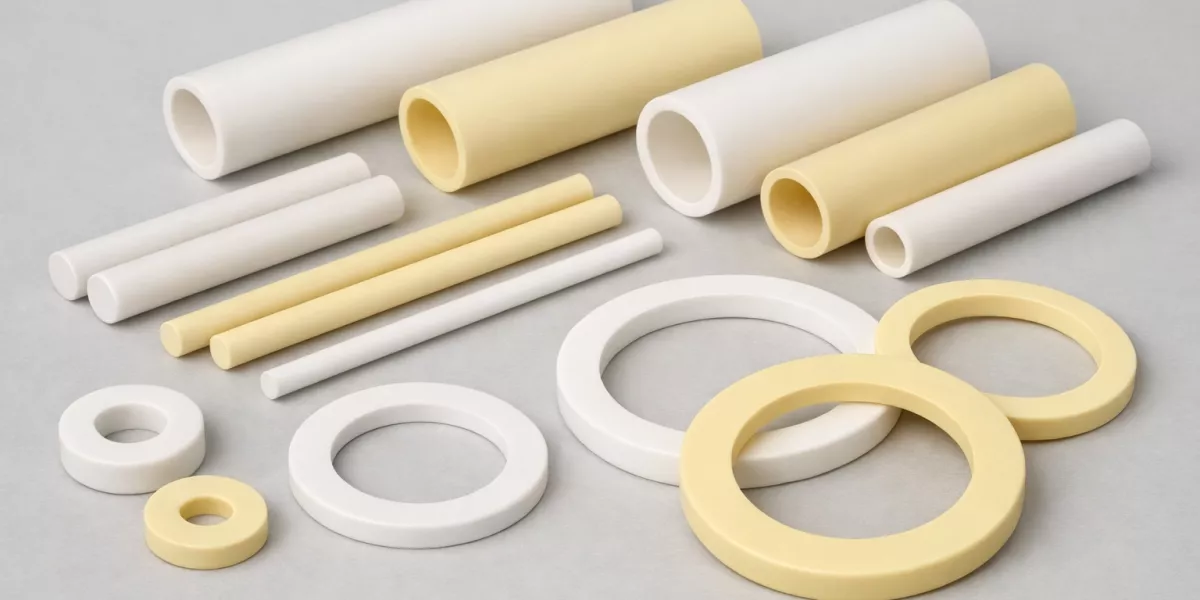
When density is specified on the drawing for structural parts, map the stabilizer system to the component family before RFQ — for example zirconia tubes, zirconia ceramic components, or zirconia rods. For non-catalog geometry, use custom ceramic services with the grade density row and test method on the inquiry.
Typical Zirconia Ceramic Density Ranges Across Stabilized Systems
After examining each stabilized zirconia system individually and comparatively, density values can be consolidated into clearly bounded ranges. These ranges summarize stabilizer-driven outcomes rather than processing variation, allowing zirconia ceramic density to be interpreted as a material signature.
Across experimental datasets, industrial measurements, and long-term service observations, stabilized zirconia systems occupy distinct density intervals. Although minor overlap exists at compositional boundaries, the overall distribution remains consistent, enabling reliable differentiation based on bulk density alone.
Density values reported within these ranges assume fully sintered ceramics with minimal open porosity. Deviations outside these intervals typically indicate either atypical stabilizer concentration or unintended phase composition rather than normal manufacturing fluctuation.
Consolidated Density Ranges of Stabilized Zirconia Ceramics
| Stabilized Zirconia System | Stabilizer Type | Typical Bulk Density Range (g/cm³) |
|---|---|---|
| Y-TZP (3Y-TZP) | Y₂O₃ ~3 mol% | 6.00–6.08 |
| 8YSZ | Y₂O₃ ~8 mol% | ~5.90 |
| MSZ | MgO (grade-dependent) | 5.70–5.80 |
| CSZ | CaO (grade-dependent) | 5.60–5.75 |
Use these as drawing/RFQ screening bands; request the grade TDS density row and state the bulk-density method.
RFQ Density Checklist
- Stabilizer system (Y-TZP / 3Y-TZP, YSZ/8YSZ, MSZ, CSZ)
- Nominal mol% / grade identity
- Target bulk density band (from grade sheet)
- Test method (e.g. ISO 18754) and specimen condition
- Open porosity / water absorption expectation
- Part family (tube / rod / component / custom)
Table bands are selection/screening aids — not PO guarantees.
Conclusion
Zirconia ceramic density reflects stabilization chemistry and crystal structure, not a single fixed material value.
Lock system + grade density row + method on the RFQ before treating any blog band as acceptance.
FAQ
Why does zirconia ceramic density differ between stabilized grades
Different stabilizers introduce varying oxygen vacancy concentrations and lattice expansions, altering atomic packing efficiency.
Is higher zirconia density always better
Higher density often indicates improved packing but does not universally translate to superior performance across all stabilized systems.
Can two fully dense zirconia ceramics have different densities
Yes, intrinsic lattice density differs between Y-TZP, YSZ, MSZ, and CSZ due to stabilizer chemistry.
Does phase structure affect zirconia ceramic density
Crystal phase composition directly influences unit cell volume and packing efficiency, impacting density values.
Related reading
- Zirconia toughness by material system — How fracture toughness shifts across 3Y-TZP, YSZ, MSZ, and CSZ when density alone is not the ranking metric.
- Zirconia max temperature limits — Temperature limits by the same stabilizer families — after you lock the density band on the drawing.
- Zirconia crucibles for melting and casting stability — Where crucible melting/casting stability depends on stabilizer choice and dense ceramic integrity.