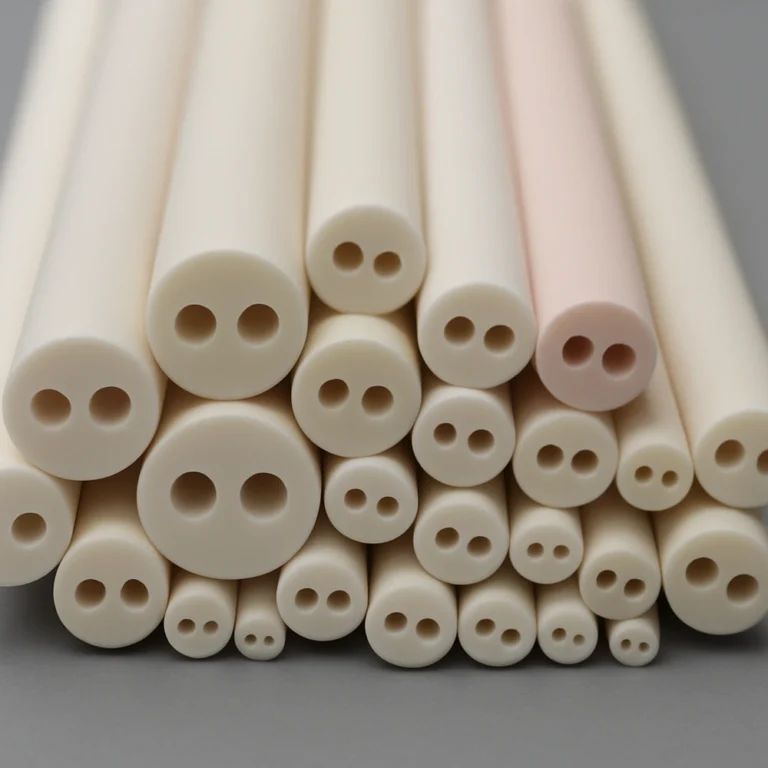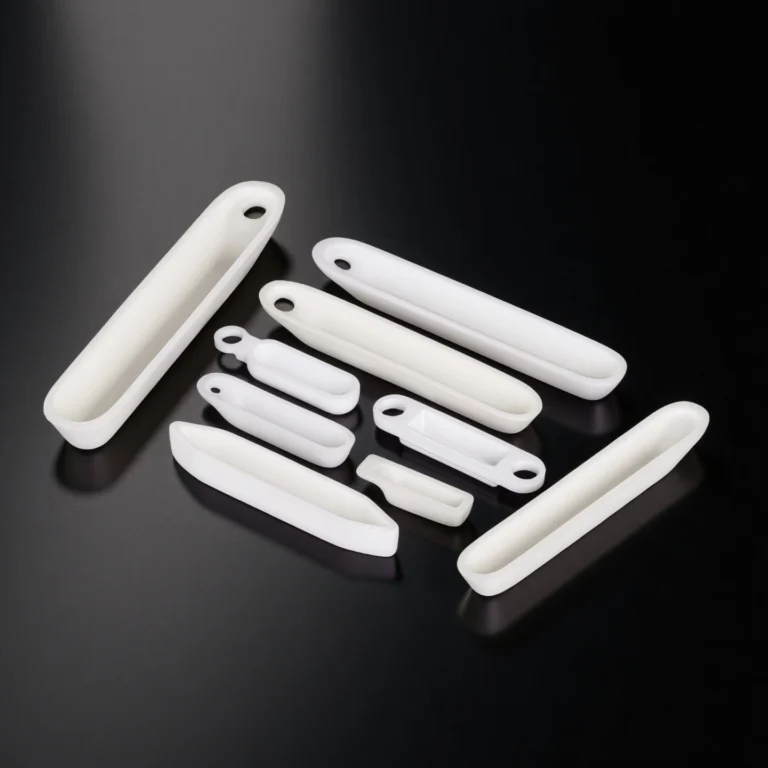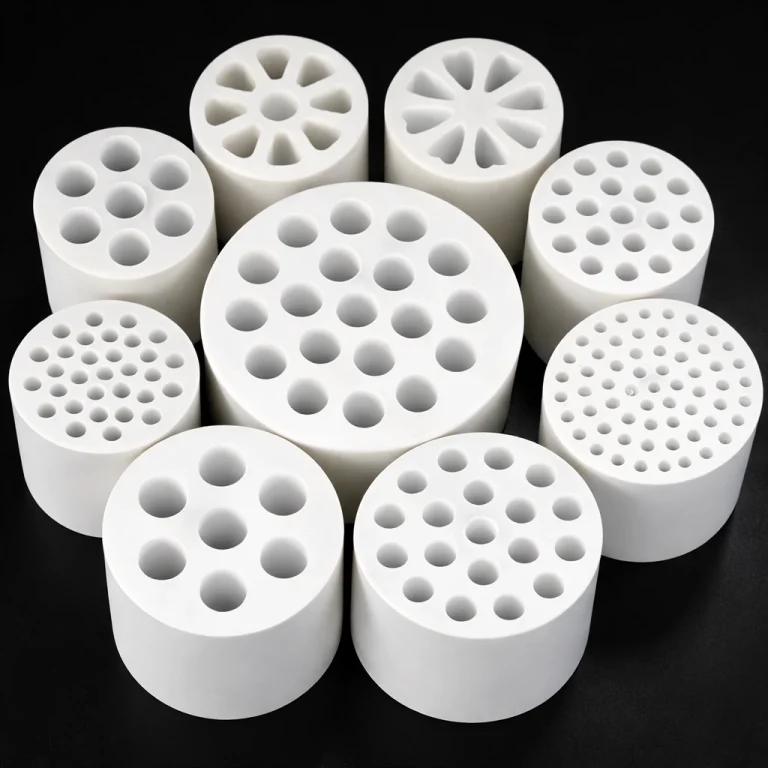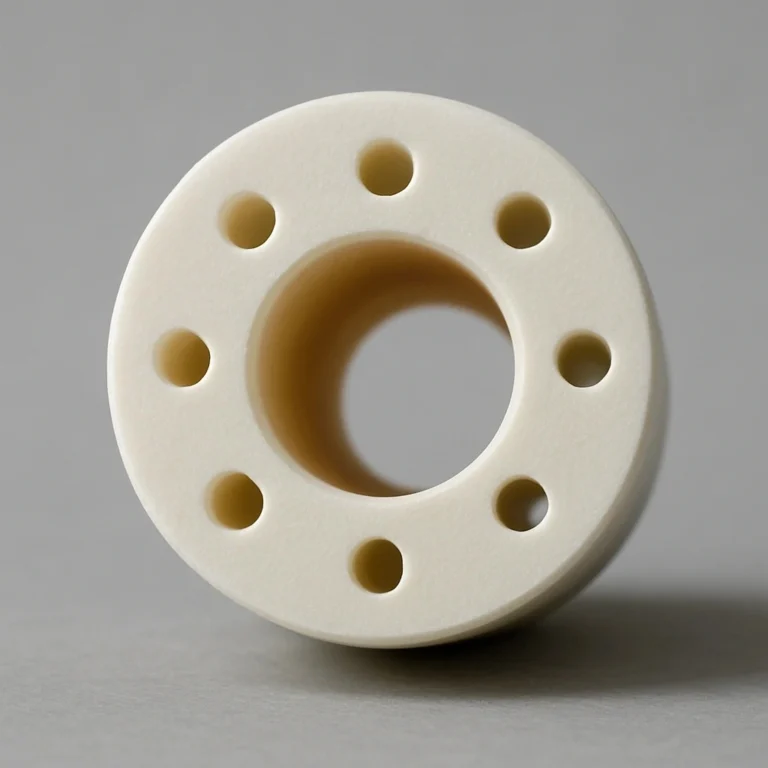
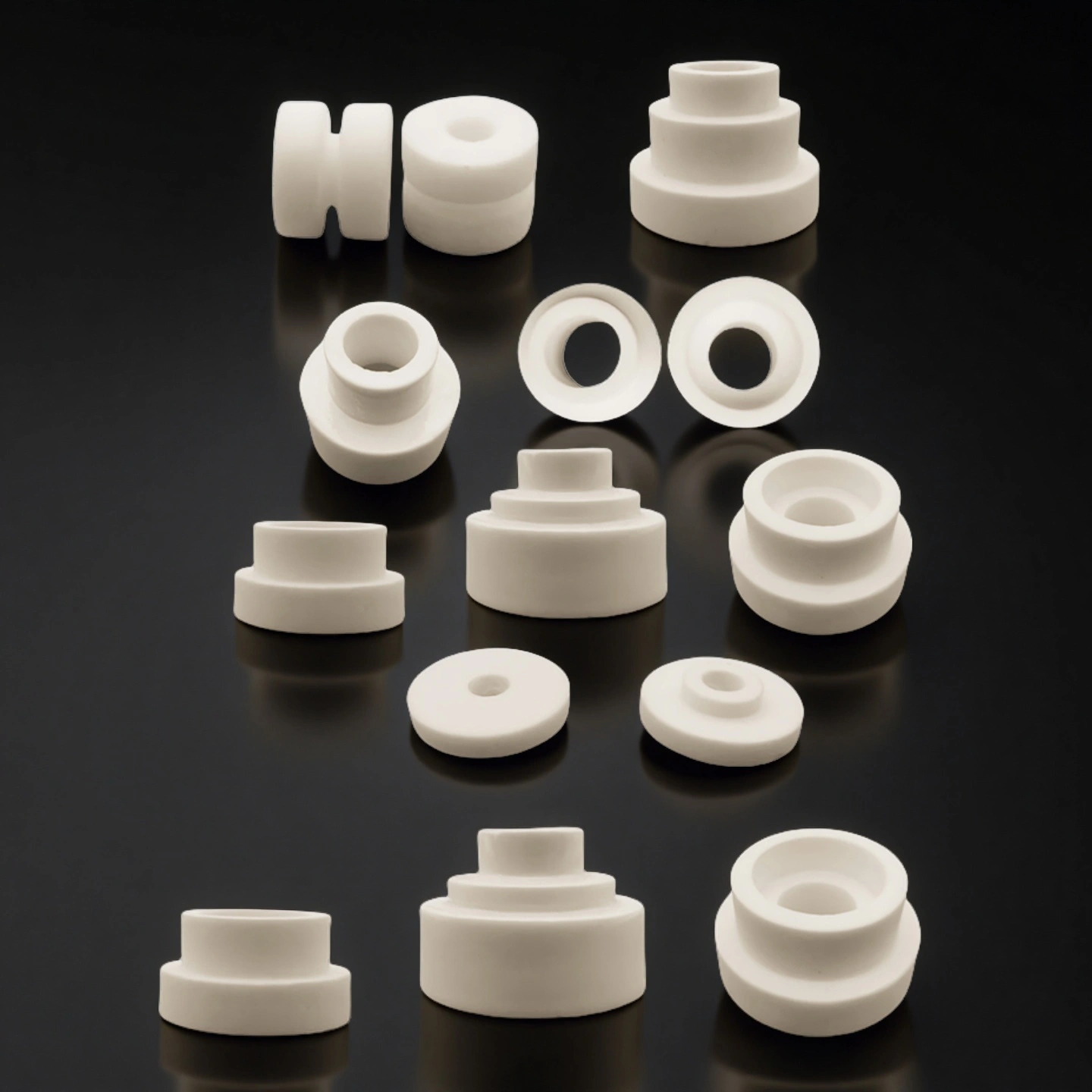
Alumina Ceramic Insulator Parts for Industrial Heaters and Power Equipment

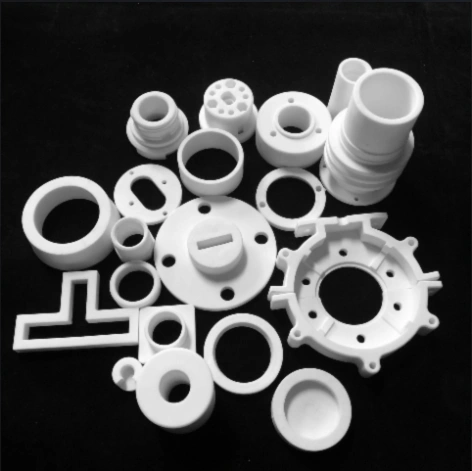
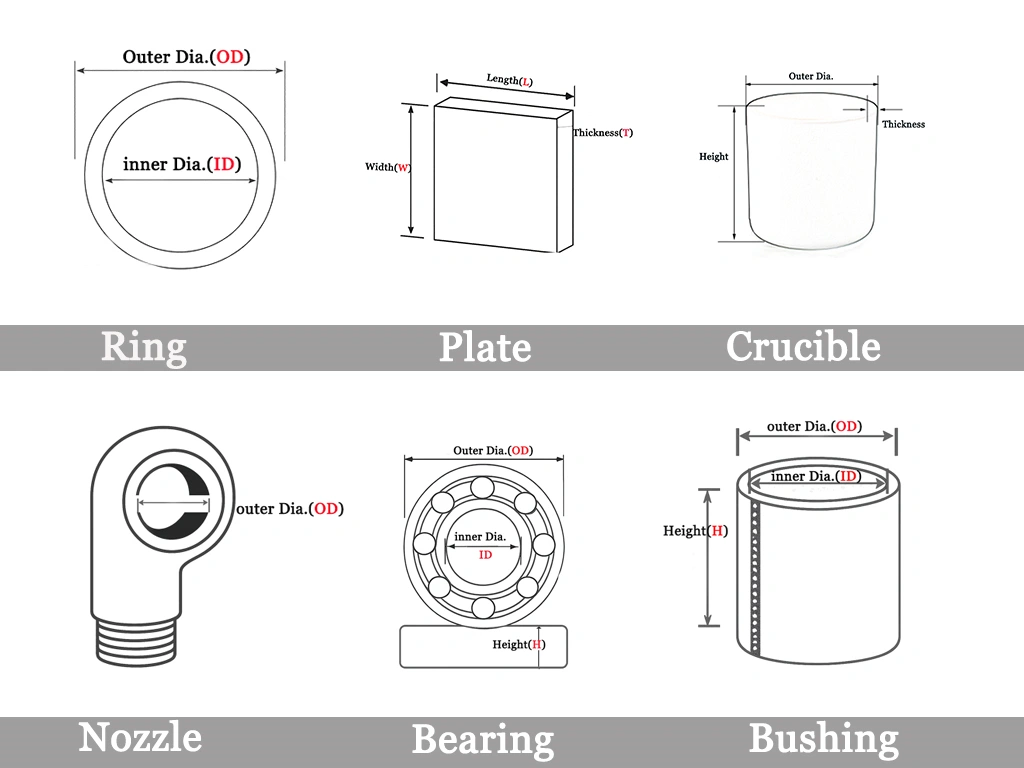
ADCERAX offers alumina ceramic insulator parts in a wide range of outer diameters, inner diameters and lengths, with optional slots, counterbores and mounting holes, and can produce fully custom insulator geometries based on 2D/3D drawings to match your equipment layouts.

Catalogue No. AT-AM1-001
Material ≥ 96% Al2O3
Thermal Conductivity <10 W/m·K @ 25°C
Electrical Resistivity >10¹² Ω·cm @ room temperature
Volume resistivity ≥1×10¹⁴ Ω·cm at 25 °C
24H Standard Dispatch
Small Batch Support OEM
Factory Direct
Expert Engineering Support

Alumina ceramic insulator parts are high-purity Al₂O₃ components used to electrically isolate conductors from metal structures under high temperature and voltage. Produced as bushings, sleeves, standoffs, spacers, rings and terminal supports, they are applied in industrial furnaces, heating equipment, power electronics, high-voltage cabinets, welding systems and automation fixtures.

Alumina Ceramic Insulator Parts Benefits

  • Stable dielectric performance under high temperature
    Alumina ceramic insulator parts maintain dielectric strength in the order of tens of kV/mm and high resistivity even near red-heat conditions, helping to keep insulation clearances safe in heaters, kilns and power cabinets.

  • Mechanical rigidity and dimensional stability
    The dense alumina body resists creep and deformation at elevated temperature, keeping bolt holes, slots and creepage distances within tolerance over long service life.

  • Geometry flexibility for complex assemblies
    Components can be produced as thick-wall bushings, thin spacers, long standoffs or shaped insulating blocks, allowing engineers to integrate electrical insulation and mechanical support in a single ceramic part.

  • Wear and erosion resistance around live conductors
    Alumina ceramic insulator parts withstand abrasion from clamping hardware, wire movement and occasional contamination better than many polymeric insulating parts in hot, dusty or chemically active environments.

  • Compatibility with high-voltage and high-frequency systems
    With low dielectric loss and stable permittivity, alumina insulators are suitable for power electronics, high-voltage test rigs and RF heating equipment where electrical field distribution must remain predictable.


Alumina Ceramic Insulator Parts Properties

Property Unit 99.5% Al₂O₃ 99.6% Al₂O₃ 99.7% Al₂O₃ 99.8% Al₂O₃ 99.9% Al₂O₃ 99.99% Al₂O₃
Alumina content % 99.5 99.6 99.7 99.8 99.9 99.99
Density g/cm³ 3.89 3.91 3.92 3.93 3.94 3.98
Open porosity % 0
Color Ivory Ivory Ivory Ivory Ivory Ivory
Water absorption % 0 0 0 0 0
Young’s modulus (Elastic modulus) GPa 375 356 357 358 359 362
Shear modulus GPa 152
Bulk modulus GPa 228
Poisson’s ratio 0.22
Compressive strength MPa 2600 2552 2554 2556 2558 2570
Flexural strength MPa 379 312 313 314 315 320
Fracture toughness MPa·m¹ᐟ² 4
Hardness GPa 14.1 (≈1440 kg/mm²) 23 24 25 26 30
Thermal conductivity W/m·K 35 32–37 33–38 34–39 35–40 36–42
Thermal shock resistance ΔT °C 222 223 224 225 228
Maximum use temperature (no load) °C ≤1750 1755 1760 1765 1770 1800
Coefficient of thermal expansion 10⁻⁶/°C 8.4
Specific heat J/kg·K 880
Volume resistivity Ω·cm >1×10¹⁴ >1×10¹⁴ >1×10¹⁴ >1×10¹⁴ >1×10¹⁴ >1×10¹⁴
Dielectric constant (relative permittivity) 9.8 9.83 9.84 9.85 9.86 9.92
Dielectric strength kV/mm 16.9 23.2 23.4 23.6 23.8 24
Dissipation factor (loss factor @ 1 kHz) 0.0002


Alumina Insulator Parts Specifications

Type 1: Round Alumina Plate
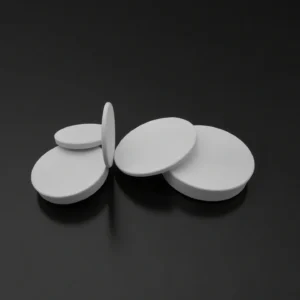
Alumina ceramic plate

Round Alumina Plate
Item no. Diameter(mm) Thickness(mm) Purity
AT-AM1-001 100 20 96%-99%
AT-AM1-002 90 5.5 96%-99%
AT-AM1-003 80 14.5 96%-99%
AT-AM1-004 70 7.5 96%-99%
AT-AM1-005 60 4.5 96%-99%
AT-AM1-006 50 6 96%-99%
AT-AM1-007 40 5 96%-99%
AT-AM1-008 30 4 96%-99%

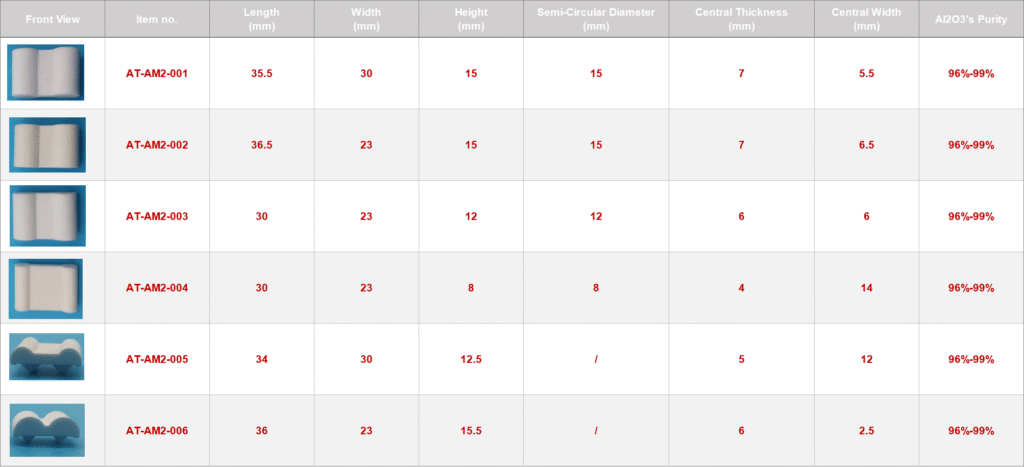
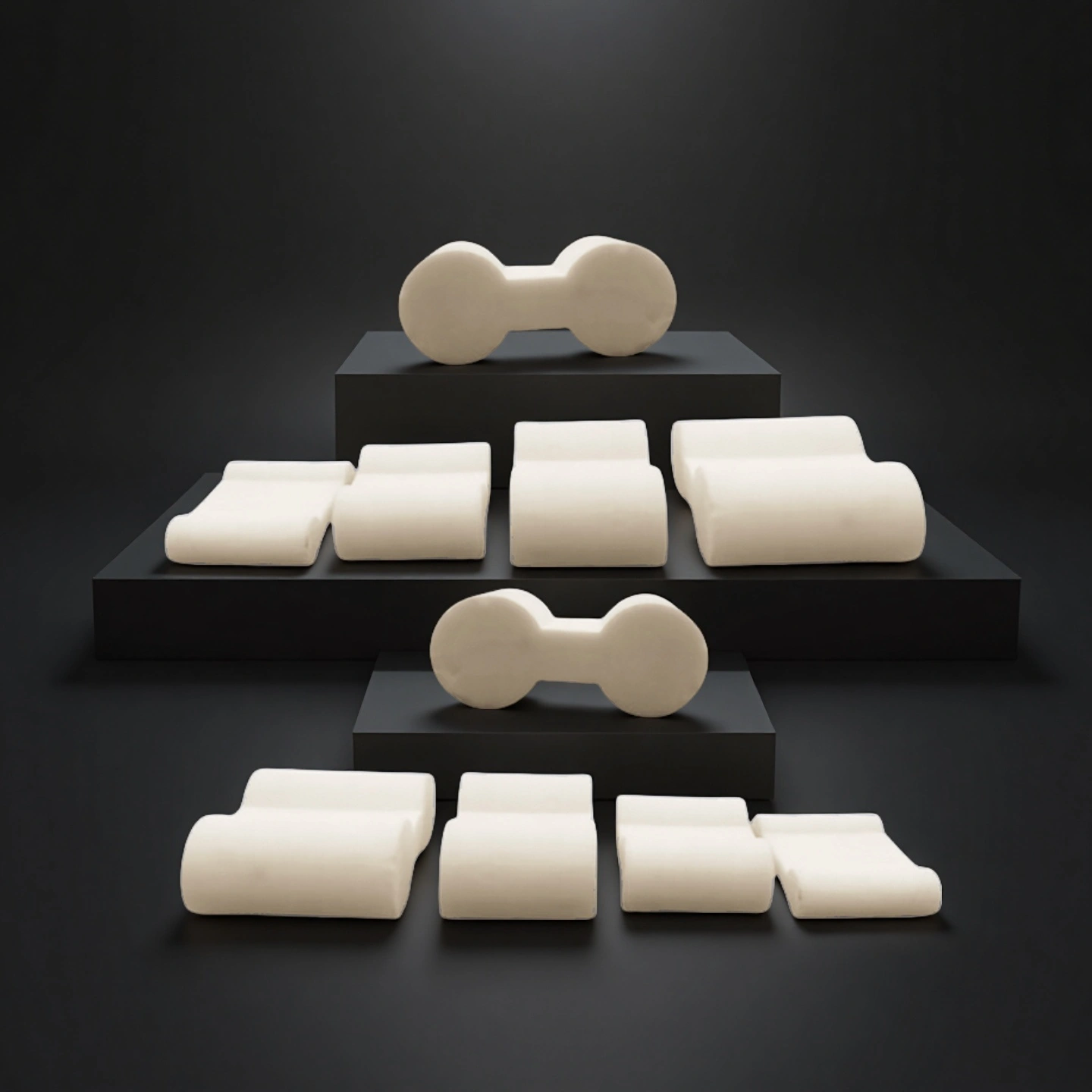
Type 2: Alumina Ceramic Cushion

1

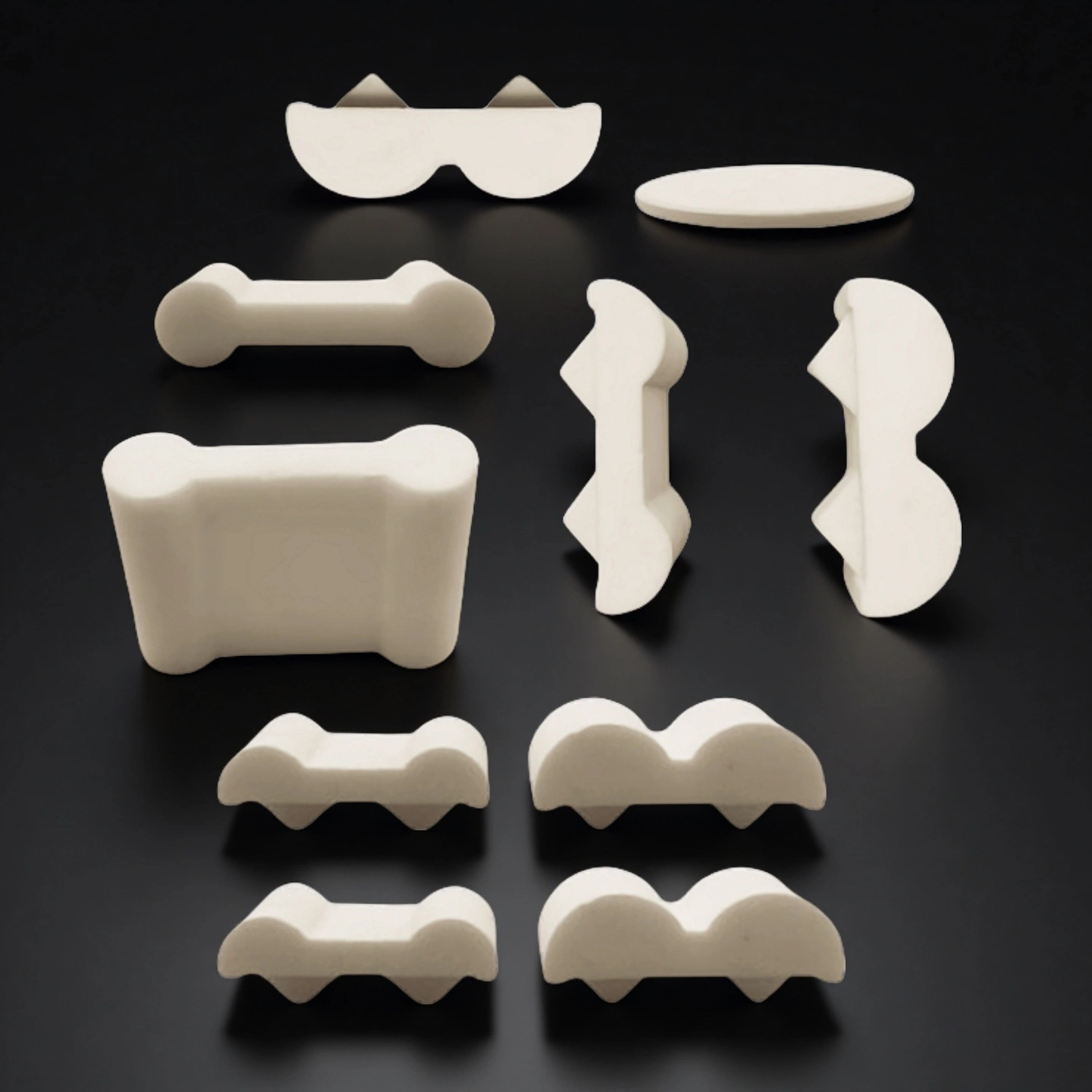
Type 3: Alumina Ceramic Clip

Alumina Ceramic Insulation Structural Parts1

Type 4: Aluminum Oxide Heat Sink

Alumina Ceramic Insulation Structural Parts2

Type 5: Aluminum Oxide Connector

Alumina Ceramic Insulation Structural Parts3

Type 6: Aluminum Oxide Column

Alumina Ceramic Insulation Structural Parts4

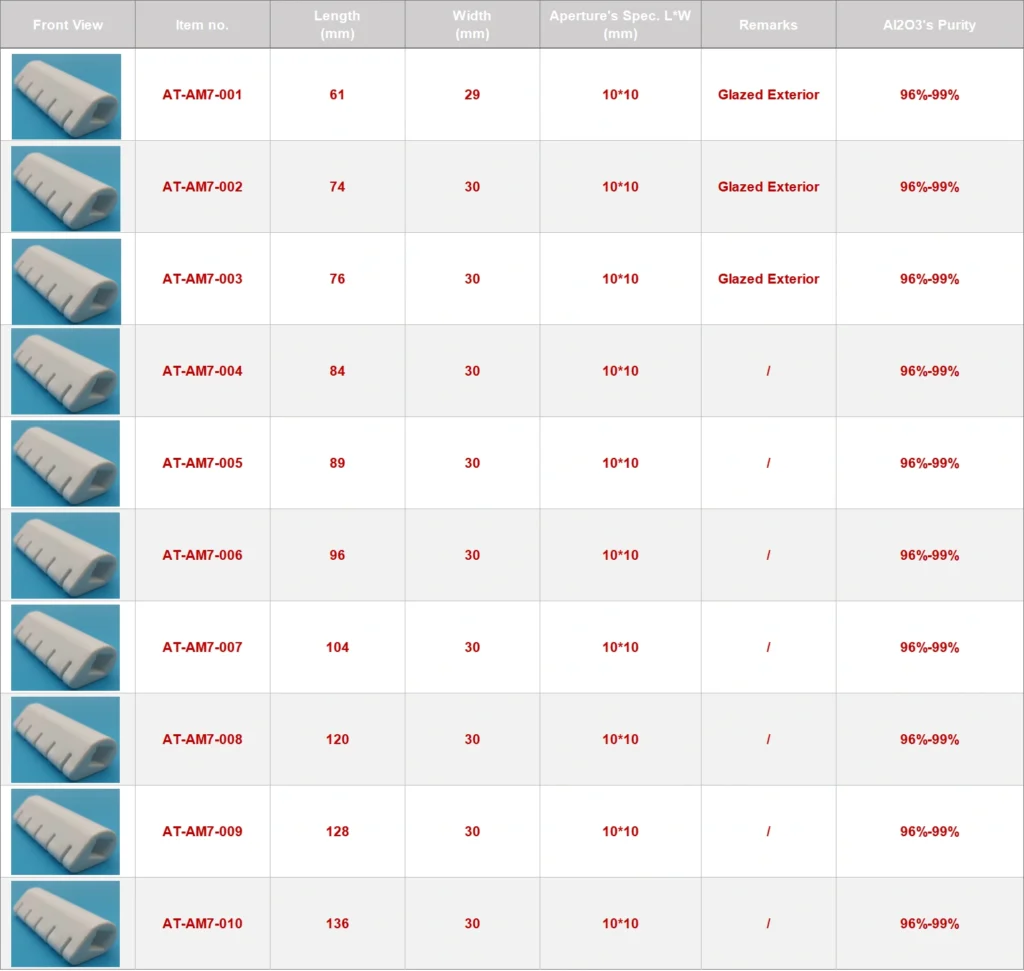
Type 7: Alumina Install Ceramic Strips
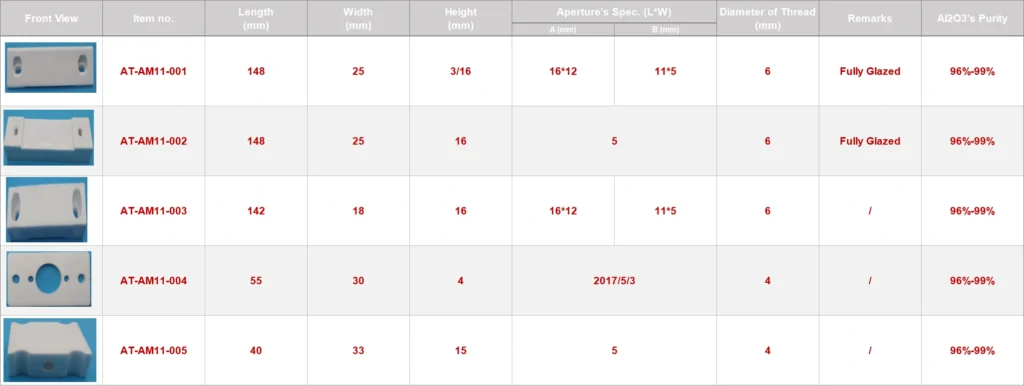
Alumina Ceramic Insulation Structural Parts5

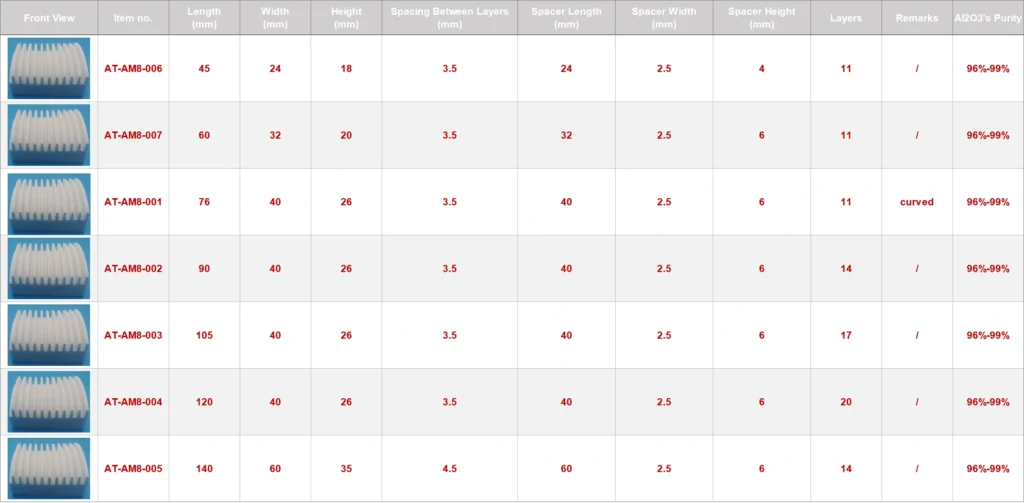
Type 8: Alumina Install Ceramic Block
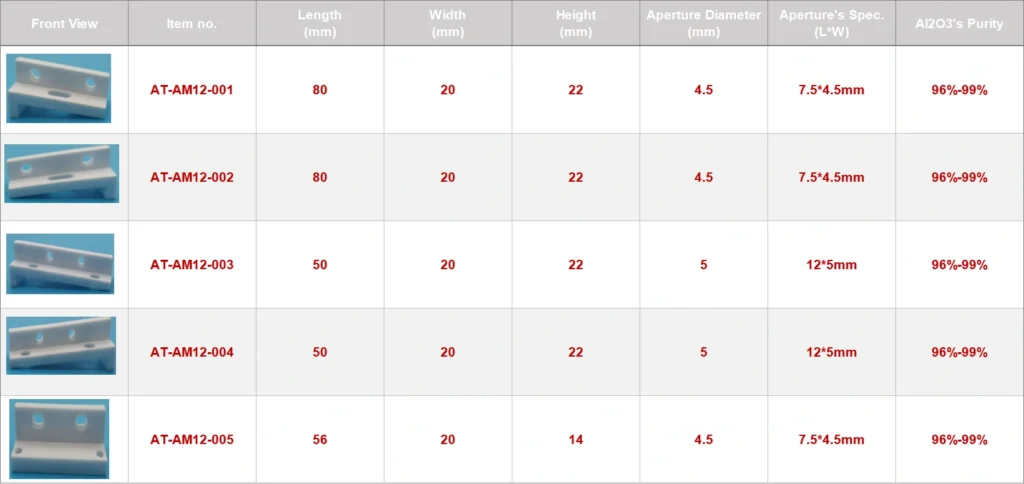
Alumina Ceramic Insulation Structural Parts6

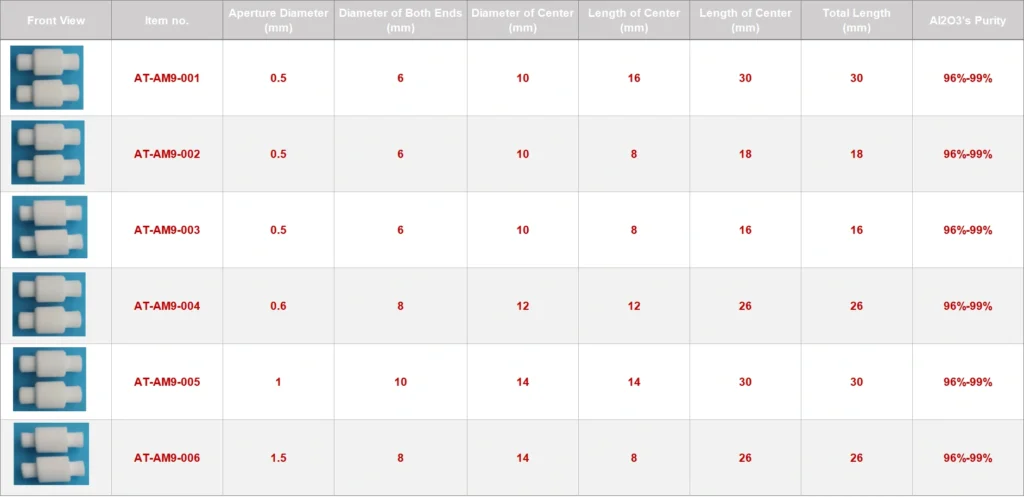
Type 9: Alumina Ceramic Sleeve I

Alumina Ceramic Insulation Structural Parts7

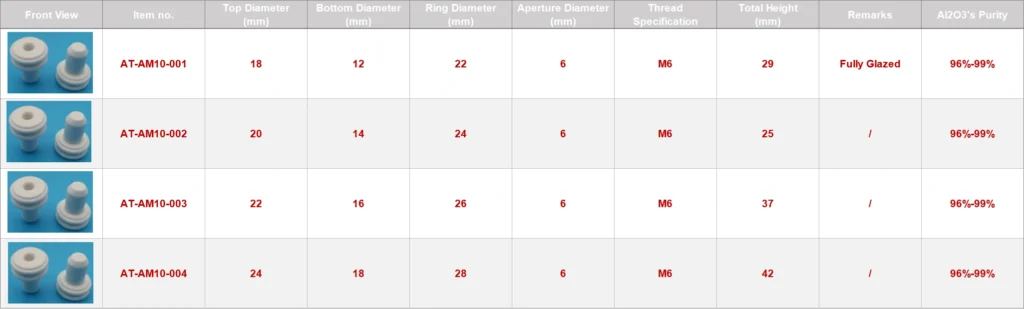
Type 10: Alumina Ceramic Sleeve II

Alumina Ceramic Insulation Structural Parts8

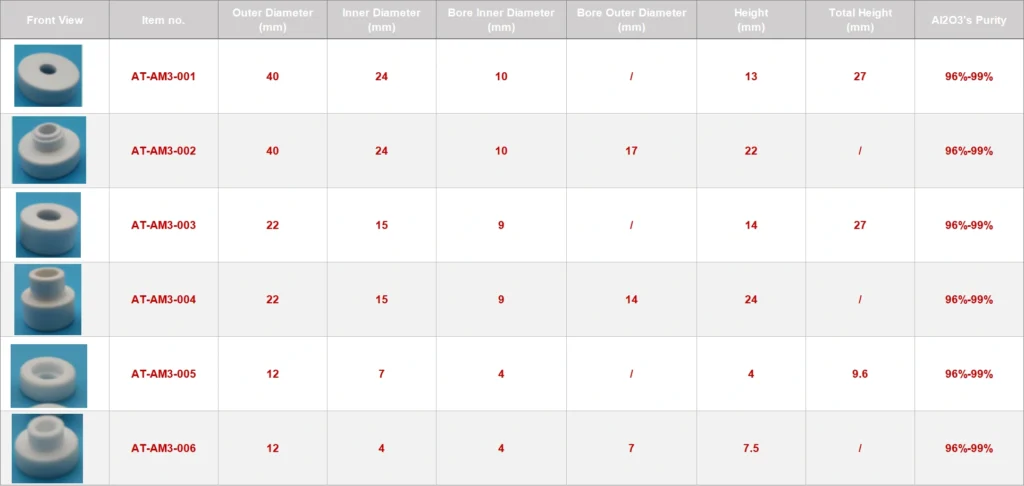
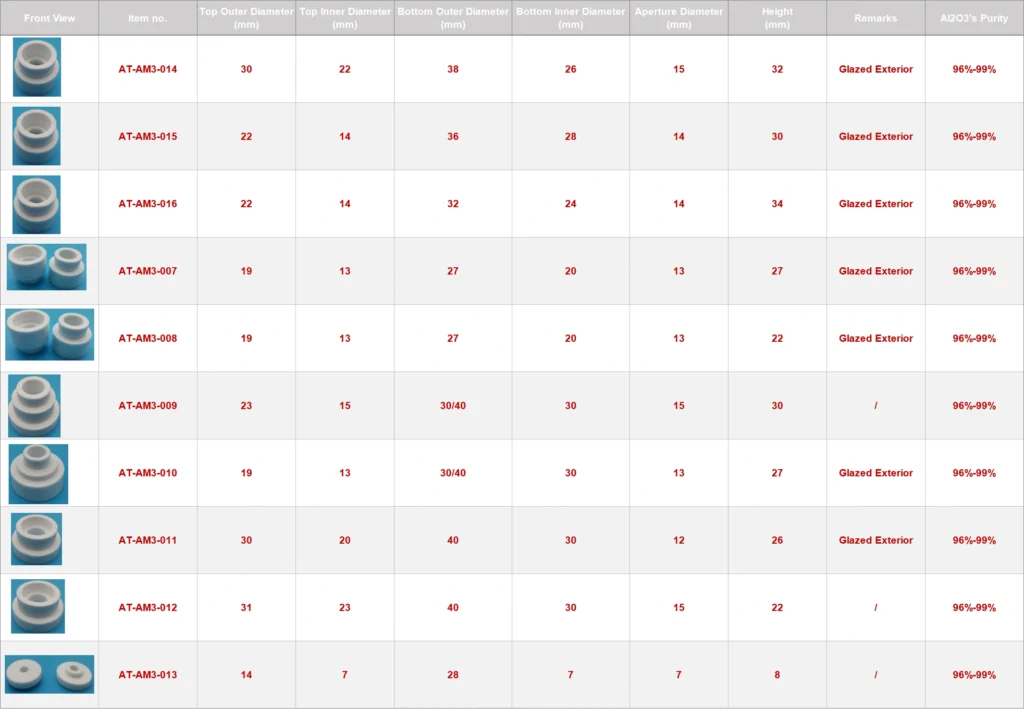
Type 11: Alumina Ceramic Seat

Alumina Ceramic Insulation Structural Parts-Alumina Ceramic Seat

Type 12: Alumina Ceramic Terminal Support Insulator
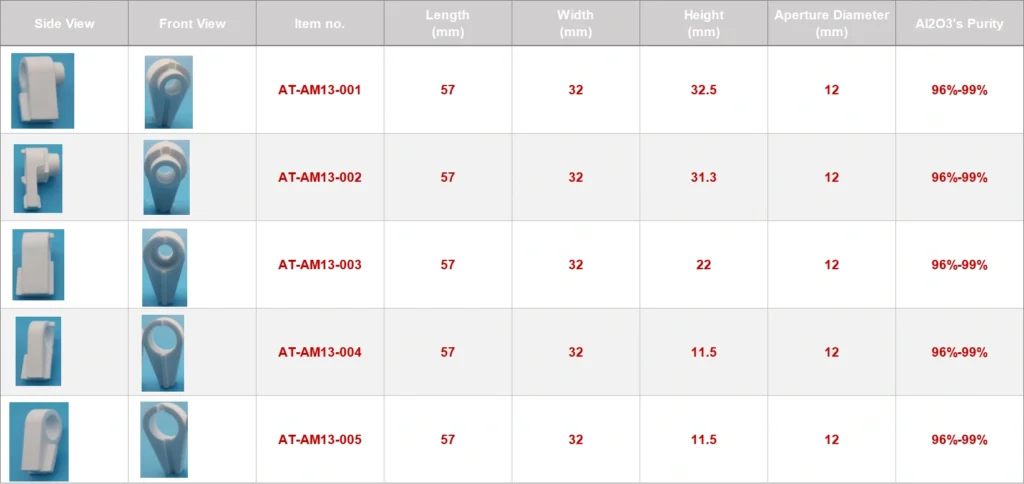
Alumina Ceramic Seat

Type 12: Alumina Ceramic Support Bottle
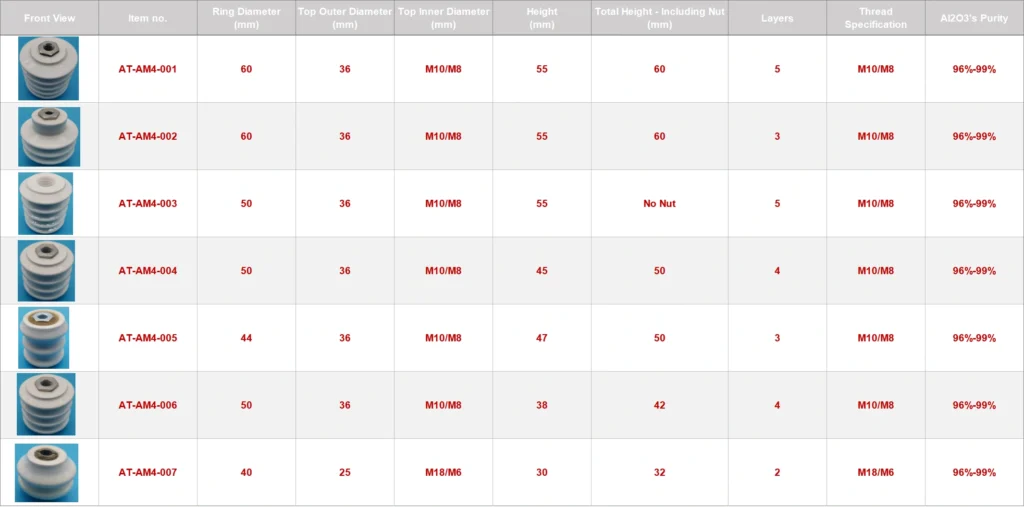
Alumina Ceramic Support Bottle

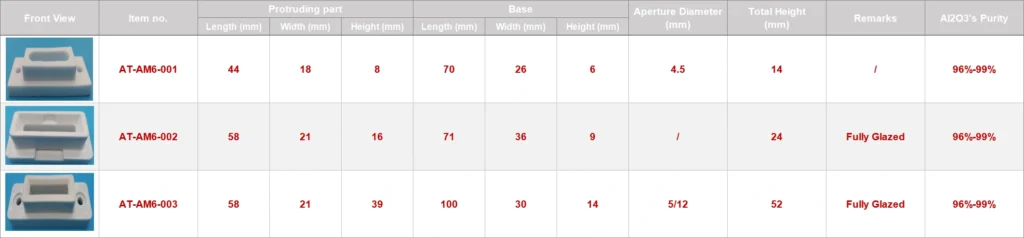
Type 12: Alumina Ceramic Wiring Seat
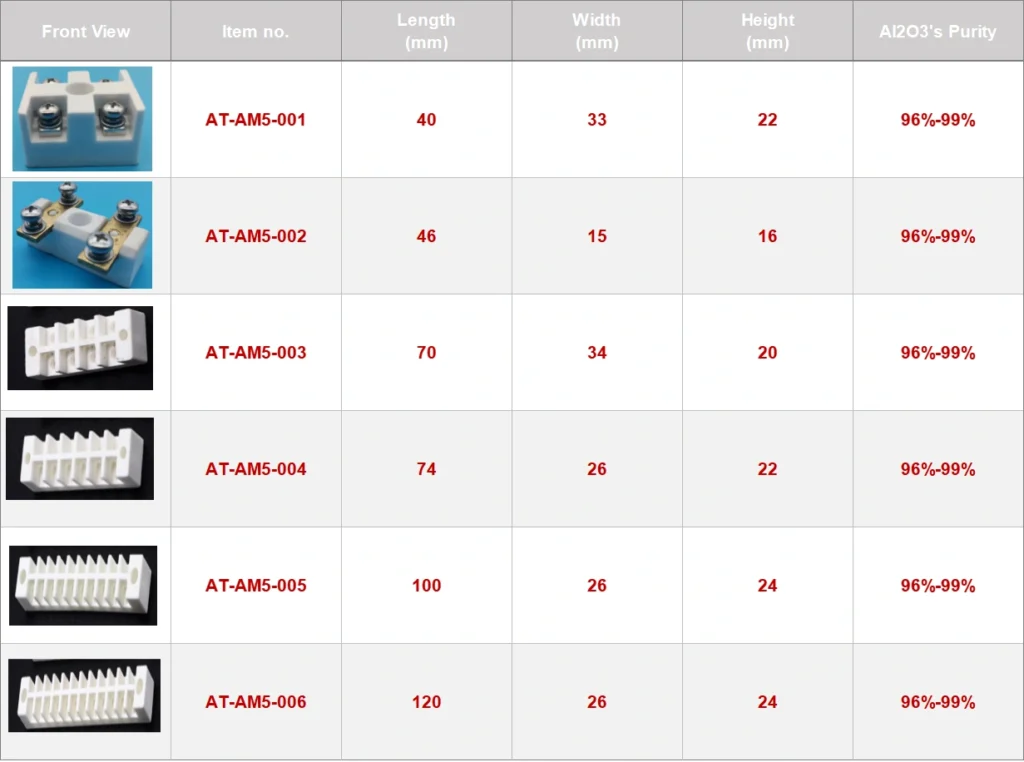
 Alumina Ceramic Wiring Seat


Alumina Ceramic Insulator Parts Packaging

  • Each part or matched set is individually wrapped with soft protective material to avoid direct ceramic-to-ceramic contact and prevent edge chipping during transit.
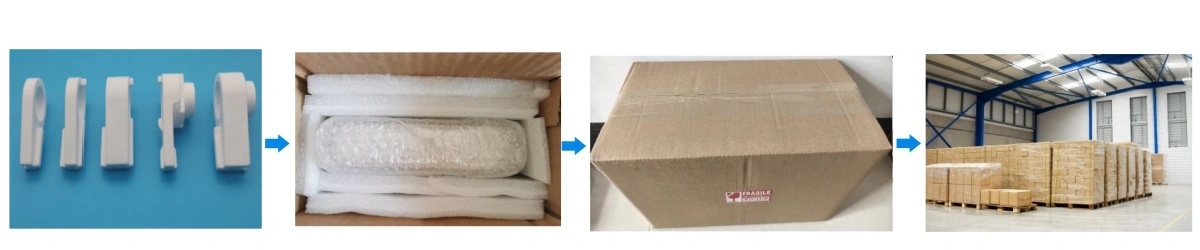
Alumina Ceramic Insulator Parts Packaging

Alumina Ceramic Insulator Parts Applications

  • Industrial Furnaces and Heating Systems

    ✅Key Advantages

    1. Stable creepage distance at high temperature
    Alumina ceramic insulator parts keep creepage distance and insulation spacing stable in furnace terminals, reducing flashover risk when heaters run near red-heat.

    2. Support for heater coils and busbars
    Rigid bushings and standoffs carry mechanical loads from heater coils and copper bars without softening or creeping during long high-temperature cycles.

    3. Lower unplanned downtime due to insulation failure
    By resisting thermal ageing and surface tracking, alumina insulators help minimise unexpected shutdowns of kilns and ovens where each hour of downtime can cost well above 100,000 USD in lost output and recovery effort.

    ✅ Problem Solved

    A heat-treatment OEM replacing polymer-based terminal insulators with alumina ceramic insulator parts in a continuous furnace line aimed to reduce insulation-related shutdowns. Before the change, electrical faults in the terminal box caused several hours of unplanned downtime per quarter, and industry data show that a single hour of manufacturing downtime frequently exceeds 100,000 USD in total cost. After switching to alumina insulators with higher dielectric strength and better heat resistance, insulation failures were eliminated over a full year of operation, helping the end user avoid multiple high-cost interruptions and stabilise delivery schedules.

  • Power Electronics, Drives and High-Voltage Cabinets

    ✅Key Advantages

    1. Controlled electric field around busbars
    Machined alumina standoffs and spacers help maintain defined distances between high-voltage busbars, improving field distribution and reducing local overstress.

    2. Low dielectric loss for high-frequency systems
    Alumina ceramic insulator parts show low dielectric loss and stable permittivity, suitable for inverters, high-frequency transformers and test rigs.

    3. Compact insulation for limited enclosure space
    The high electric strength of alumina allows shorter insulation paths compared with many organic materials, supporting compact cabinet layouts without compromising safety.

    ✅ Problem Solved

    A drive manufacturer needed to increase the output current of a compact cabinet without enlarging the enclosure. By redesigning the busbar layout and replacing thick polymer blocks with slim alumina ceramic insulator parts, the engineering team maintained required creepage distances while freeing space for larger conductors. The higher power cabinet passed internal high-potential tests and type testing without partial discharge issues, enabling a capacity increase within the same footprint and avoiding the tooling cost of a new enclosure design.

  • Welding, Plasma Cutting and Automation Fixtures

    ✅Key Advantages

    1. Resistance to hot metal spatter and mechanical impact
    Alumina ceramic insulator parts tolerate weld spatter and mechanical knocks better than many plastic supports around welding guns and fixtures.

    2. Stable insulation under high current
    Insulating bushings and sleeves keep power cables and contact tips separated from grounded metal housings, even when current peaks and local heating are significant.

    3. Dimensional stability in repetitive motion systems
    In robotic welding cells, rigid alumina standoffs maintain alignment of sensors and clamps over many cycles, reducing drift and re-adjustment work.

    ✅ Problem Solved

    In a robotic welding line, conventional plastic insulators near the torch assembly degraded under hot spatter and heat, causing occasional short circuits and rework. After switching to alumina ceramic insulator parts shaped as bushings and spacer rings, the cell ran several thousand hours without insulation-related alarms. Maintenance intervals increased, and the user recorded fewer unexpected stoppages on the line, supporting a more predictable production plan.

Alumina Ceramic Insulator Parts Usage Instructions

  • Installation

    1. Check dimensions and tolerances against your drawings before installation, especially the inner diameter fit on studs and the outer diameter fit in mounting holes.
    2. Avoid excessive mechanical stress on alumina ceramic insulator parts during tightening; use torque values specified for the metal fasteners, and support the ceramic to prevent bending.
    3. Where high-voltage is present, align flats, grooves or ribs on the insulators according to your creepage distance design to keep surfaces free of sharp field concentrations.

  • Operation

    1. Verify that the actual operating temperature and voltage are within the design envelope for the chosen alumina grade and creepage distances.
    2. In dusty or humid environments, keep ceramic surfaces as clean as practical to reduce surface leakage and tracking; schedule inspections during planned maintenance stops.
    3. For dynamic systems such as welding arms, ensure that cables and hoses are routed so they do not load the ceramic parts with cyclic bending or impact.

  • Storage

    1. Store alumina ceramic insulator parts in their original packaging or on padded shelves to avoid chipping during handling.
    2. Keep storage areas dry and free from corrosive vapours; while alumina itself is chemically stable, metal inserts and accessories should be protected from corrosion.
    3. Avoid stacking heavy components directly on top of ceramic parts to prevent hidden cracks.

  • Cleaning

    1. Remove dust and light contamination using a soft brush or clean compressed air.
    2. For more stubborn deposits, wipe with a lint-free cloth slightly moistened with appropriate solvent or de-ionised water, then dry thoroughly before energising the equipment.
    3. Do not use metal tools to scrape the ceramic surface, so as not to introduce scratches that can concentrate electric field.

  • Typical User Issues and How to Handle Them

    1. Issue: Cracks appearing after installation
    Cause: Excessive tightening torque or misalignment between metal parts, leading to bending stress on the alumina ceramic insulator parts.
    Handling: Reduce torque to the recommended level, use flat washers to distribute load, and check that mounting faces are parallel and properly machined.

    2. Issue: Unexpected tracking marks or surface discharge
    Cause: Pollution films, moisture or conductive dust accumulating on insulator surfaces, especially near high-voltage terminals.
    Handling: Improve sealing or shielding around the terminals, schedule periodic cleaning, and review creepage distances for the actual contamination class.

    3. Issue: Fit between ceramic bushing and metal stud too tight or too loose
    Cause: Mismatch between nominal tolerances on drawing and actual machining of both metal and ceramic parts.
    Handling: Confirm both tolerance stacks, adjust either the ceramic ID or metal OD for future batches, and for critical assemblies consider pre-production samples to lock the fit before mass production.

Alumina Ceramic Insulator Parts FAQ

  1. Q: Which alumina grade is suitable for alumina ceramic insulator parts in high-voltage applications?
    A: For most medium- to high-voltage applications, technical alumina in the 95–99% Al₂O₃ range provides sufficient dielectric strength and resistivity; very high-purity grades are selected when lower dielectric loss or cleaner environments are required.
  2. Q: How high is the dielectric strength of alumina ceramic insulator parts?
    A: Typical electric strength values for dense alumina insulators are around 14–16 kV/mm at room temperature, though final performance depends on geometry, surface finish and test conditions.
  3. Q: What maximum temperature can alumina ceramic insulator parts withstand?
    A: High-purity alumina ceramics are generally used up to about 1650–1750°C in air, with some grades capable of even higher temperatures in controlled atmospheres, provided mechanical loads and thermal gradients are well managed.
  4. Q: Can alumina ceramic insulator parts be customised for special mounting geometries?
    A: Yes, ADCERAX can machine custom bushings, standoffs, sleeves and spacers with specific IDs, ODs, lengths, slots, grooves and mounting holes to match your terminal layouts and creepage distance design.
  5. Q: How tight can dimensional tolerances be on alumina ceramic insulator parts?
    A: For many insulator geometries, ground features can reach typical tolerances around ±0.05–0.1 mm, depending on size and wall thickness; simpler as-fired sections may use wider tolerances where function allows.
  6. Q: Are alumina ceramic insulator parts suitable for high-frequency or RF applications?
    A: Yes, alumina has stable permittivity and low dielectric loss over a wide frequency range, which makes alumina ceramic insulator parts suitable for high-frequency power electronics and certain RF heating systems when designed accordingly.

Customer Reviews – Alumina Ceramic Insulator Parts

  • ⭐️⭐️⭐️⭐️⭐️
    We replaced several legacy plastic blocks with ADCERAX alumina ceramic insulator parts in our box furnaces. The new bushings and standoffs fitted our existing studs with minimal drawing changes, and after one year of operation we have had no insulation-related shutdowns.
    -- David K., Engineering Manager  HeatPro Kiln Systems (USA)
  • ⭐️⭐️⭐️⭐️⭐️
    Our power converters use compact busbar layouts, so we needed custom alumina ceramic insulator parts with tight tolerances and specific grooves. ADCERAX handled the drawings, samples and production batches smoothly, and the parts passed high-potential and partial discharge tests without issues.
    -- Markus H., Head of R&D  EuroDrive Control Solutions (Germany)
  • ⭐️⭐️⭐️⭐️⭐️
    Our power converters use compact busbar layouts, so we needed custom alumina ceramic insulator parts with tight tolerances and specific grooves. ADCERAX handled the drawings, samples and production batches smoothly, and the parts passed high-potential and partial discharge tests without issues.
    -- Markus H., Head of R&D EuroDrive Control Solutions (Germany)
  • ⭐️⭐️⭐️⭐️⭐️
    We needed long, thin alumina ceramic insulator parts to isolate sensor pins inside a heated probe. The custom sleeves met our dimensional requirements and survived repeated thermal cycles in the lab, so we decided to standardise this design in our new product line.
    -- Kenji S., Senior Mechanical Engineer J-Process Instruments (Japan)
customize size

Custom Alumina Ceramic Insulator Parts

ADCERAX manufactures alumina ceramic insulator parts to both standard and fully custom specifications, allowing engineers to match insulator geometry and material grade to specific voltage levels, thermal profiles and mounting conditions in their equipment.

1. Material grade

  • Standard technical alumina (e.g. ≥95% Al₂O₃) or high-purity grades (up to ≥99% Al₂O₃) for higher dielectric and chemical stability.

2. Outer and inner dimensions

  • Outer diameter / inner diameter ranges from a few millimetres up to large bushings;
  • Wall thickness and length with typical machining tolerances down to about ±0.05–0.1 mm for critical features, depending on geometry.

3. Part geometry and cross-section

  • Straight sleeves, stepped bushings, standoff posts, flat spacers, insulating rings and custom blocks;
  • Cross-sections: round, oval, rectangular or special profiles defined in your CAD.

4. End details and mounting features

  • Chamfered or radiused edges;
  • Counterbores, slots, keyways, through-holes or recesses to accept screws, studs and terminals;
  • Grooves to increase creepage distance where required.

5. Surface finish

  • As-fired surfaces for general insulation;
  • Ground or lapped surfaces on seating and sealing faces for better contact and dimensional control.

6. Special features (optional)

  • Localised polishing for high-voltage field control;
  • Metallisation pads or brazeable areas where ceramic-to-metal joints are needed (subject to separate process conditions).

Related Products

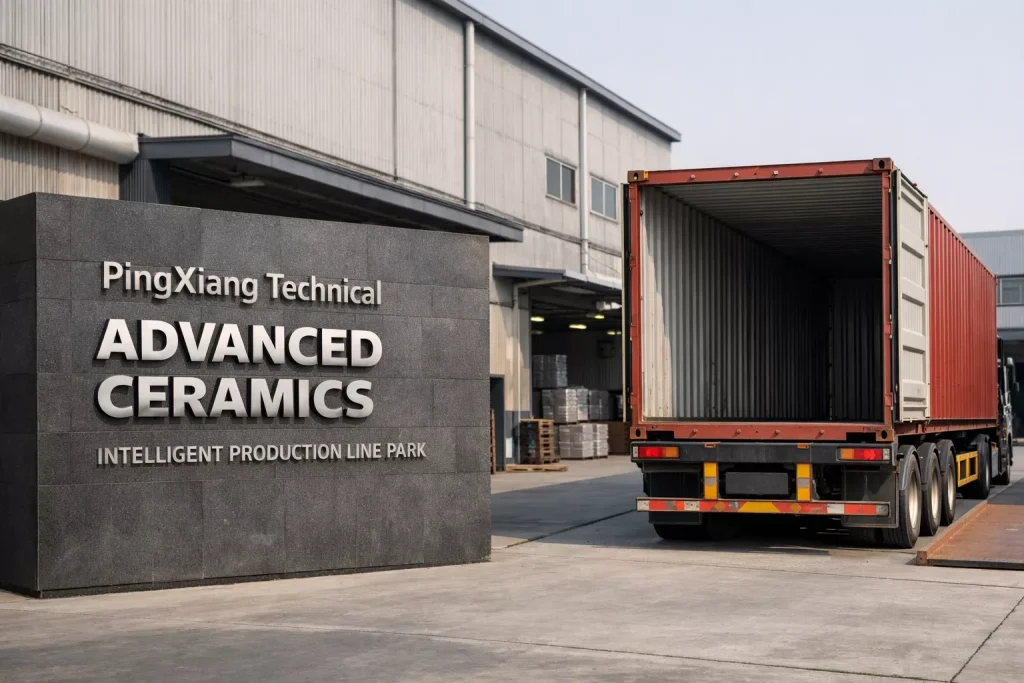
ADCERAX - Your Trusted Advanced Ceramics Manufacturing Partner

Direct factory manufacturing with comprehensive ceramic materials expertise and global supply capabilities

Direct Factory Manufacturing

China-based ceramic materials production facility with state-of-the-art equipment

Engineering Team

Experienced professionals in advanced ceramics applications and custom design

Quality Control

Strict quality control standards for technical ceramics manufacturing and quality management

Global Supply Chain

Serving customers worldwide with technical ceramics and rapid response

24/7 Technical Support

Round-the-clock support for ceramic components inquiries and technical assistance

500+ Satisfied Customers

Trusted by global customers for advanced ceramic materials and precision components

Get in touch with us

Our team will be happy to respond to you in less than 24 hours.

Adcerax's factory

Quick Quotation

*Our team will answer your inquiries within 24 hours.

*Your information will be kept strictly confidential.

Ready to Solve Your Engineering Challenge?

Partner with ADCERAX for reliable, high-performance advanced ceramic solutions. Our engineers are ready to discuss your project.

E-mail

info@adcerax.com

Phone

+(86) 0731-74427743 | WhatsApp: +(86) 19311583352

Response Time

Within 24 hours

Quick Quote

The more details you provide, the faster we can quote.

*We respond within 24 hours. All inquiries are confidential.

Download Catalog

Get Your Custom Sulution

The more details you provide, the faster we can respond.

customize size

*We respond within 24 hours. All inquiries are confidential.

Download Catalog