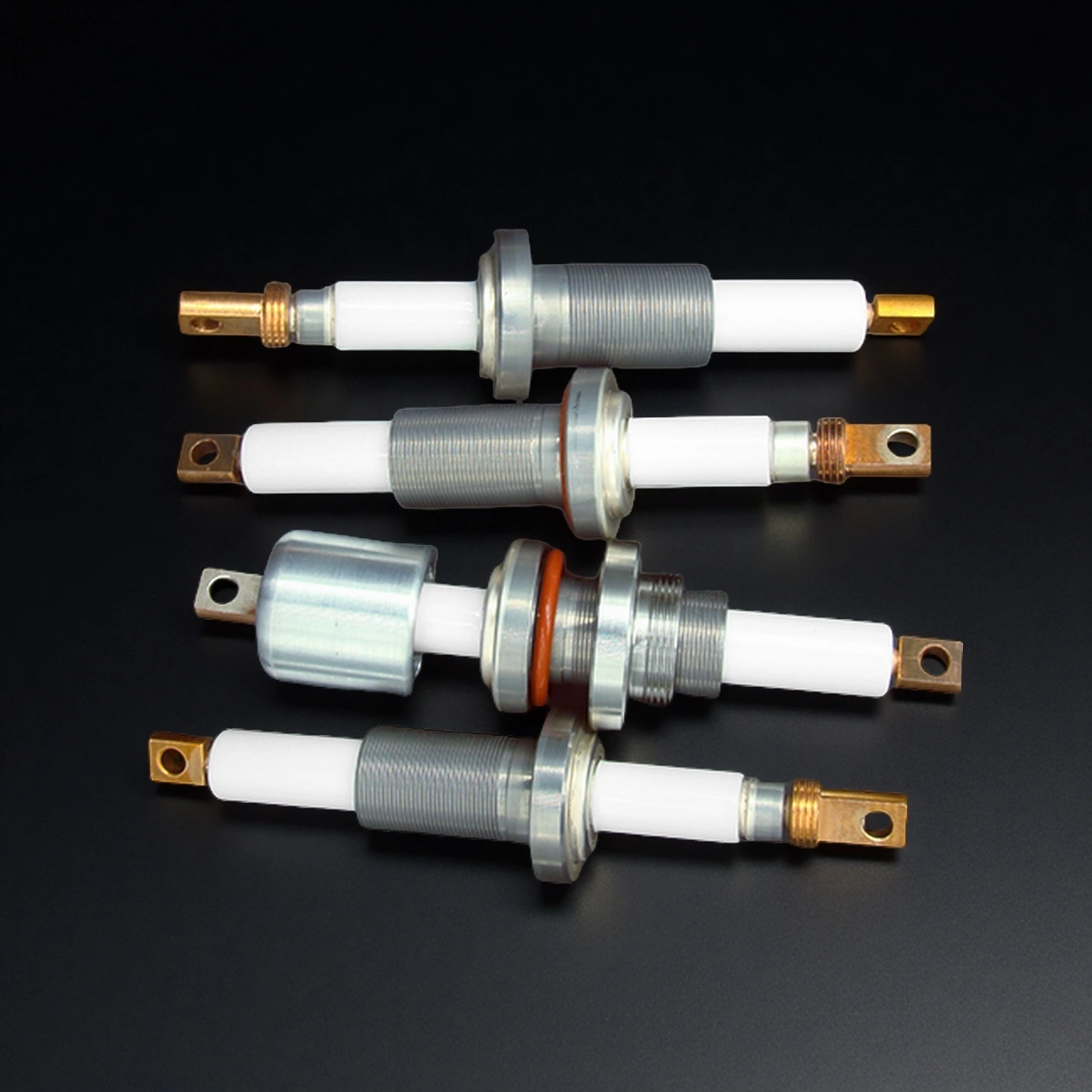
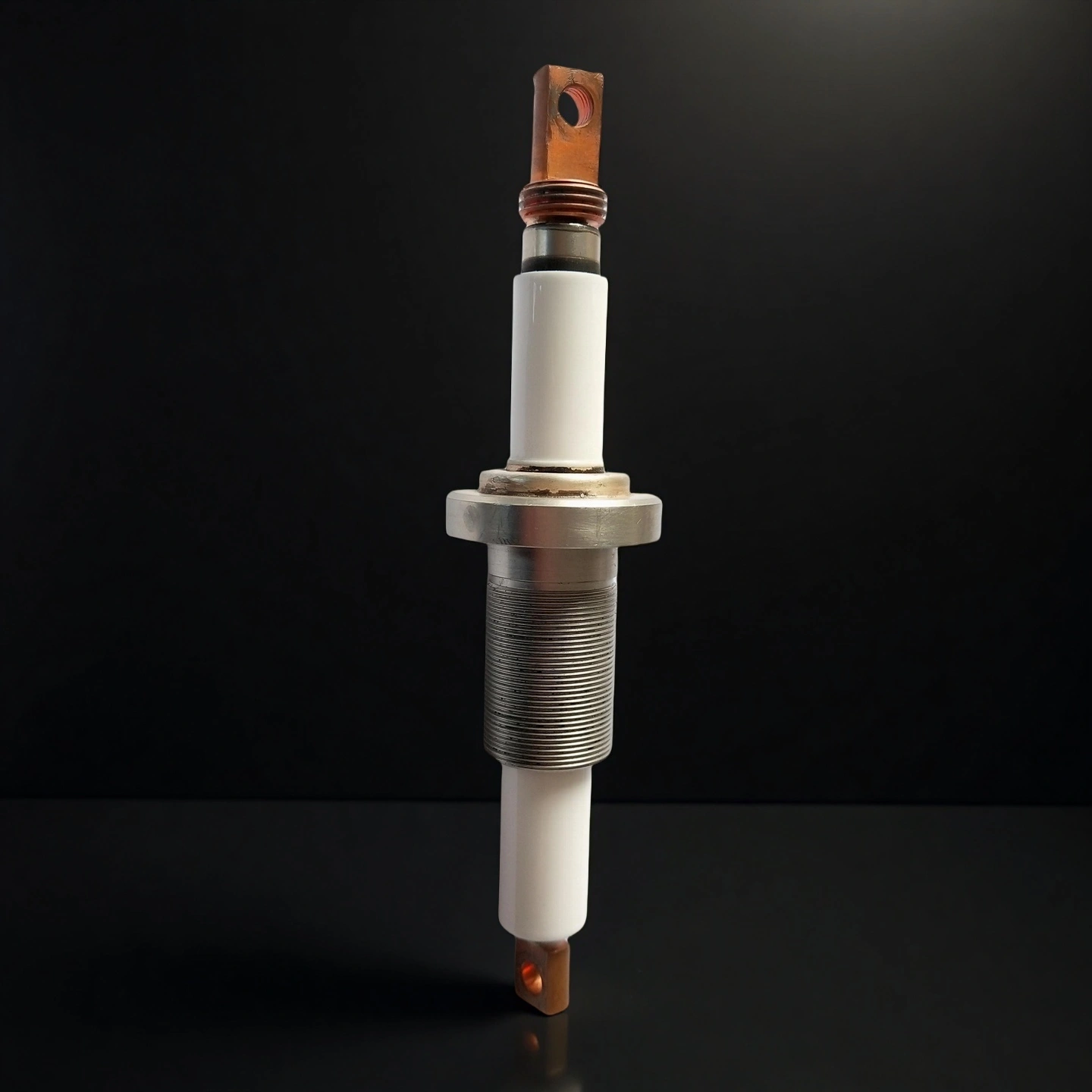
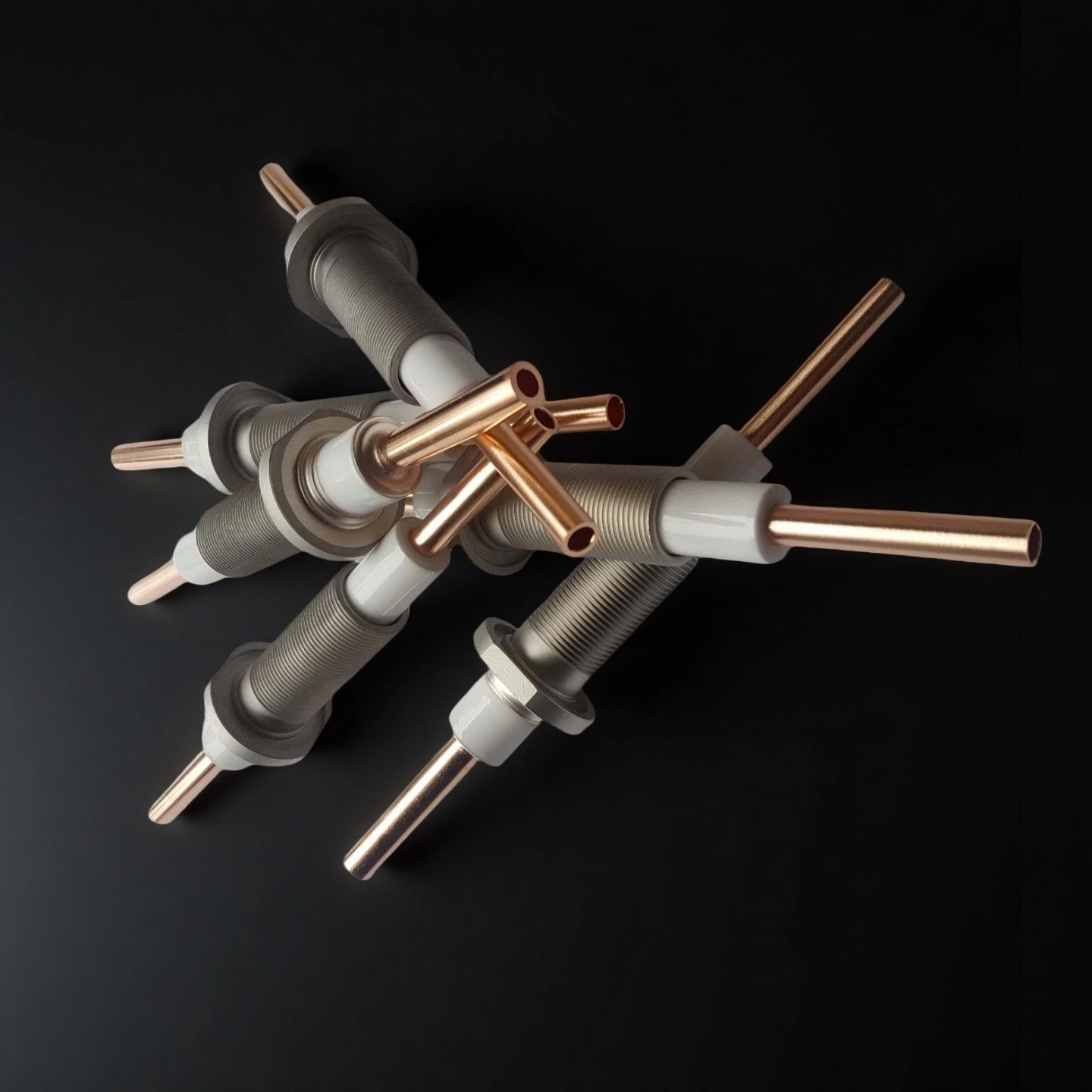
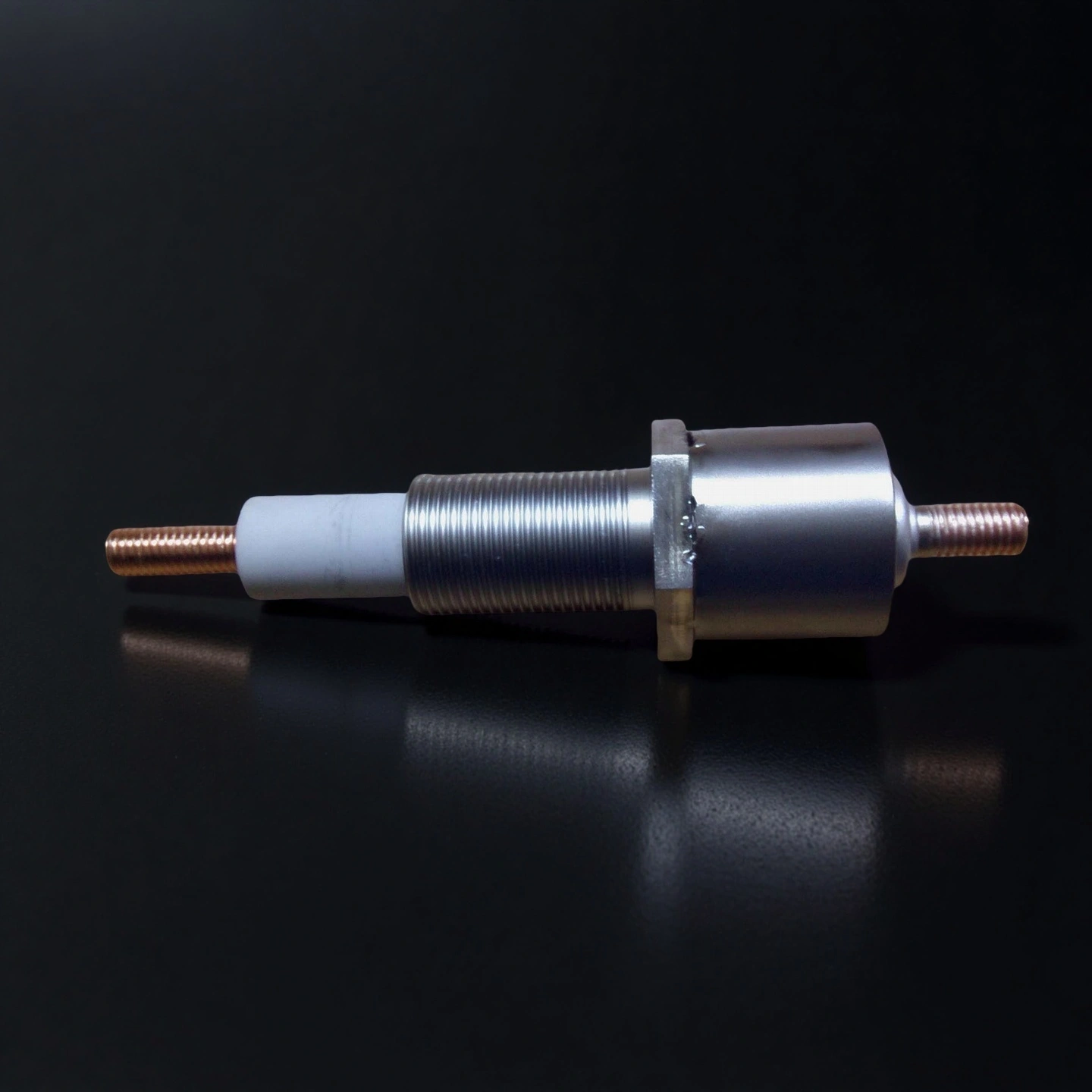
Ceramic Electrode for Vacuum Coating Machine (HV Ceramic Feedthrough, CF/KF Flange)

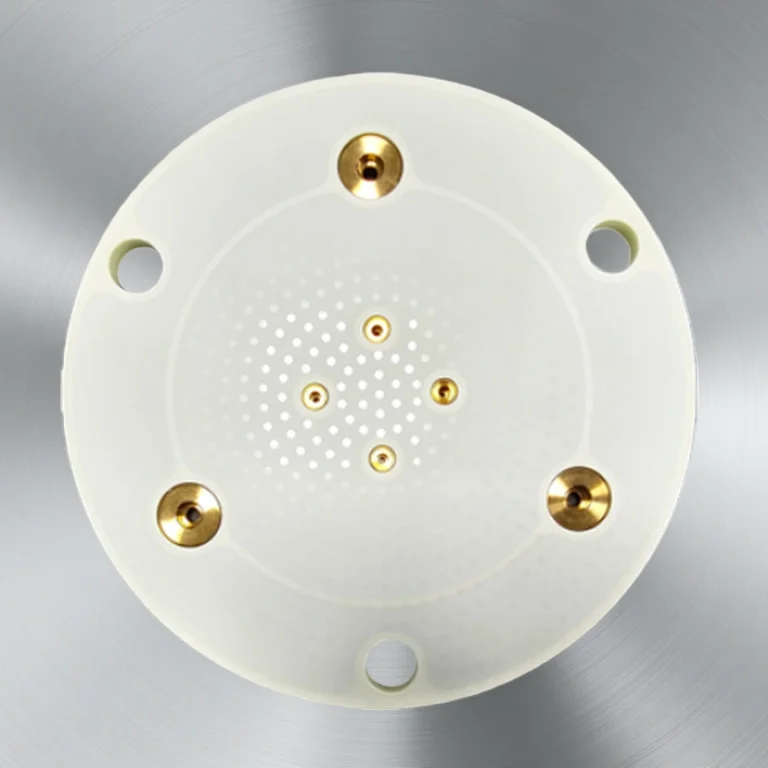
Ceramic electrode for vacuum coating machine providing a hermetic, high-voltage/current electrical feedthrough via alumina insulator and CF/KF/ISO flange options. Standard CF16/CF40 and KF40 interfaces with straight-pin or shielded tips; custom lengths, multi-pin layouts, and conductor materials (Kovar/Mo/Cu) available upon drawing.

Catalogue No. AT-TCDJ-1001
Material Al2O3/Zro2
Working Voltage 10–40 kV (custom up to 60 kV)
Leak Rate Class ≤1×10⁻⁹ mbar·L/s (helium test)
Dimensions/Sizes Download PDF
24H Standard Dispatch
Small Batch Support OEM
Factory Direct
Expert Engineering Support

Ceramic electrode for vacuum coating machine is a high-voltage electrical feedthrough component designed to conduct power through the wall of a sealed vacuum chamber while maintaining electrical insulation and gas-tight integrity. It typically consists of a high-purity alumina (Al₂O₃) ceramic insulator brazed to a metal flange (CF, KF, or ISO type) and a central conductor made of copper, molybdenum, or Kovar alloy.

Ceramic Electrode for Vacuum Coating Machine Benefits

  • Extended creepage geometry supports higher working voltage in compact flange sizes.
  • Ceramic-to-metal brazed joint minimizes outgassing and supports high vacuum integrity.
  • Conductor choices (Cu/Mo/Kovar) balance current capacity with thermal/mechanical stability.
  • Sealing faces are machined for consistent torque and repeatable installation alignment.
  • Optional shielded or chamfered electrode tips to reduce local field concentration.

Ceramic Electrode for Vacuum Coating Machine Properties

  1. Voltage Resistance: up to 2 kV
  2. Current Capacity: up to 1000 A
  3. Leak Rate: < 1 × 10⁻¹⁰ Pa·L/s
  4. Baking Temperature Resistance: < 500 °C
  5. Tensile Strength: ≥ 120 MPa
  6. Mounting Thread Options: M24, M25, M28, M32, M33, etc.
  7. Electrode Rod Size & Connection Type: M6, M8, M10, M12 threads, or flat-type terminals
  8. Sealing Method: O-ring vacuum sealing


Ceramic Electrode for Vacuum Coating Machine Specifications

Ceramic Electrode for Vacuum Coating Machine
Item NO. Sealing seat thread Electrode rod threaded/flat structure
AT-TCDJ-1001 M24 M8
AT-TCDJ-1002 M24 flat structure
AT-TCDJ-1003 M25 M10
AT-TCDJ-1004 M25 M6
AT-TCDJ-1005 M25 flat structure
AT-TCDJ-1006 M25 M12
AT-TCDJ-1007 M28 M10
AT-TCDJ-1008 M28 M12
AT-TCDJ-1009 M32 M8
AT-TCDJ-1010 M33 flat structure


Ceramic Electrode for Vacuum Coating Machine Packaging

  • Each ceramic electrode is individually packed in anti-static foam and sealed in plastic bags.
  • Bulk orders are shipped in reinforced wooden crates with shock-absorbing inserts.
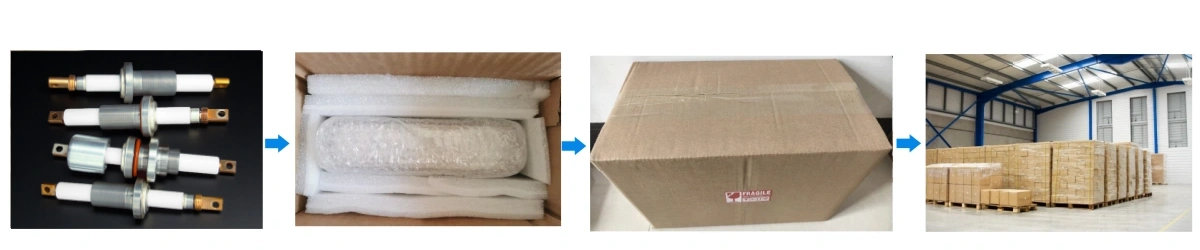
ceramic electrode for vacuum coating machine packaging

Ceramic Electrode for Vacuum Coating Machine Applications

  • Coated Glass Production Lines (Architectural/Automotive)

    ✅Key Advantages

    1. High-voltage headroom — 30–40 kV working window reduces arc events during ramp-up.
    2. Low leak rate — ≤1×10⁻⁹ mbar·L/s helps maintain base pressure and improves cycle stability.
    3. Service-oriented geometry — Swappable electrode modules shorten chamber turnaround.

    ✅ Problem Solved

    A glass line upgraded to 30 kV electrodes with extended creepage paths across six cathodes. Start-up arc incidents dropped by ~35% over two weeks of runs. Base pressure recovery after each wash cycle improved by ~15%, attributed to better sealing stability and consistent torque on machined faces. Spare pool size was reduced from 18 to 12 pieces while maintaining availability.

  • Decorative PVD Job Shops (Hardware/Watches/Sanitary)

    ✅Key Advantages

    1. Compact CF/KF footprints — Fits multi-chamber layouts with limited port spacing.
    2. Conductor flexibility — Copper or Mo conductors support 30–150 A duty profiles.
    3. Field-mitigation tips — Chamfered/shielded ends reduce local field concentration.

    ✅ Problem Solved

    A job shop running mixed batches moved from a single conductor spec to two conductor options (Cu for high-current tools, Mo for thermal stability). Tip redesign cut false trips by ~28% over 60 days and trimmed changeover time by ~20 minutes per batch due to standardized fasteners and gauge marks.

  • R&D & University Labs

    ✅Key Advantages

    1. Wide configurability — Multi-pin and coax layouts support instrumentation + power in one port.
    2. Drawing-friendly tolerances — Typical ±0.05–0.20 mm on sealing faces for repeatable assembly.
    3. Documentation — hipot and He-leak test records simplify lab compliance.

    ✅ Problem Solved

    A lab consolidated three pass-throughs into a single multi-pin ceramic feedthrough to free ports for viewports and gauges. Leak checks passed at 1×10⁻⁹ mbar·L/s; swap to a coax signal pin stabilized RF bias measurements, improving repeatability across 12 deposition runs.

Ceramic Electrode for Vacuum Coating Machine Usage Instructions

  • Installation

    1. Verify flange standard and knife-edge/gasket compatibility; confirm torque sequence and values.
    2. Keep sealing faces free from oil/particles; use lint-free wipes and solvent per plant practice.
    3. Route conductors with strain relief; maintain minimum bend radius per cable spec.

  • Operation

    1. Ramp voltage in steps; confirm no abnormal partial discharge near tip or shields.
    2. Maintain clearance to nearby grounded features; avoid sharp edges that raise field intensity.
    3. Monitor temperature near the conductor base if carrying high current; add cooling if specified.

  • Storage

    1. Keep in a dry cabinet with protective caps; avoid ceramic surface contact with metal objects.
    2. Log serial/lot numbers with drawing revision for traceability.

  • Cleaning

    1. Use non-abrasive solvents; avoid aggressive mechanical scrubbing on ceramic glaze or seals.
    2. Dry completely before chamber installation to prevent micro-arcing.

  • Common Misuse & Fixes

    1. Over-torque on CF/KF hardware → Use calibrated wrench and cross-pattern; replace distorted gaskets.
    2. Arcing at startup → Increase ramp time, confirm creepage path cleanliness, check tip-to-ground clearance.
    3. Intermittent leaks after bake → Inspect brazed joint area for contamination; re-seat with new gasket and even torque.

Ceramic Electrode for Vacuum Coating Machine FAQ

  1. Q: What information should I provide to get a quotation for a ceramic electrode for a vacuum coating machine?
    A: Provide your working voltage and current, flange standard (CF/KF/ISO), conductor material, and effective length or creepage distance. Drawings or photos of the interface help ensure 1:1 matching to your chamber design.
  2. Q: How do ceramic electrodes differ from ordinary vacuum electrical feedthroughs?
    A ceramic electrode is optimized for high voltage and current (10–60 kV, 5–200 A) with ceramic-to-metal brazed sealing, offering higher dielectric strength and lower leakage compared with standard signal feedthroughs used for low-power instrumentation.
  3. Q: What determines the lifespan of a ceramic electrode in a vacuum coating system?
    A: Service life depends on power load, temperature cycles, vacuum quality, and torque consistency during installation. In stable PVD environments, typical life expectancy is 3–5 years or over 10,000 operating hours before requalification.
  4. Q: Can the same ceramic electrode be used for both DC and RF power supplies?
    A: Yes, if properly specified. For RF use, conductor geometry and plating are adjusted to minimize impedance mismatch and arcing. Always specify the frequency range when ordering RF-compatible electrodes.
  5. Q: Can these ceramic electrodes be retrofitted into existing coating machines?
    A: Yes. By matching flange standards and electrical ratings, electrodes can replace older feedthroughs in most magnetron sputtering or evaporation systems. Adapter rings or gasket variations allow easy retrofit.

Ceramic Electrode for Vacuum Coating Machine Reviews

  • ⭐️⭐️⭐️⭐️⭐️
    We adopted ceramic electrodes for vacuum coating machines with extended creepage on two CF40 ports. Arc trips during ramp-up dropped and base pressure stabilized faster after cleaning cycles.
    -- Ethan Morales — Maintenance Lead, GlassCo Lines (USA)
  • ⭐️⭐️⭐️⭐️⭐️
    We integrated ADCERAX ceramic electrodes for vacuum coating machines on our new magnetron sputtering lines. The CF40 type maintained leak rates below 1×10⁻⁹ mbar·L/s, and voltage stability was excellent during 30 kV testing. After six months of operation, no insulation degradation or arcing was observed
    -- Lena Schubert — Production Engineer, DecoFinish GmbH (Germany)
  • ⭐️⭐️⭐️⭐️⭐️
    Our PVD glass line required durable ceramic-to-metal feedthroughs for 24/7 production. ADCERAX delivered custom-length designs with Mo conductors and fast flange alignment. Installation fit perfectly, and creepage reliability improved—helping reduce downtime by nearly 20 %.
    -- Victor Tan — Operations Manager, PVD Job Shop Asia
  • ⭐️⭐️⭐️⭐️⭐️
    ADCERAX supplied a ceramic electrode for the vacuum coating equipment that matched our old connectors exactly. The O-ring seal and brazed joints passed all helium tests, and the customer support team provided full dimensional reports. We plan to standardize these feedthroughs across our plasma cleaning tools.
    -- Emily Carter — Lab Manager, MetroTech University (UK)
customize size

Customize Ceramic Electrode for Vacuum Coating Machine

Engineering teams can specify electrical ratings, flange standards, and electrode geometry to align with chamber layout and power supply characteristics. What you can specify:

  • Electrical: Working voltage 10–60 kV, current 5–200 A, DC/RF mode, frequency range, insulation class.
  • Creepage & Clearance: External creepage path, internal clearance, standoff length, optional shielded or extended skirt designs.
  • Flange & Interface: CF16 / CF40 / ISO-K / KF40 or custom flanges, bolt circle, adapter rings, or double-ended feedthroughs.
  • Conductor: Copper / Molybdenum / Kovar, selectable diameter, Ag/Ni plating, thread (M6–M12) or flat-lug terminal.
  • Ceramic: Al₂O₃ ≥95%, Zro2 define wall thickness, glazed or unglazed zones, and surface finish.
  • Geometry: Straight, elbowed, multi-pin, coaxial, or bus-bar types; effective length adjustable (±0.2 mm).

Related Products

ADCERAX - Your Trusted Advanced Ceramics Manufacturing Partner

Direct factory manufacturing with comprehensive ceramic materials expertise and global supply capabilities

Direct Factory Manufacturing

China-based ceramic materials production facility with state-of-the-art equipment

Engineering Team

Experienced professionals in advanced ceramics applications and custom design

Quality Control

Strict quality control standards for technical ceramics manufacturing and quality management

Global Supply Chain

Serving customers worldwide with technical ceramics and rapid response

24/7 Technical Support

Round-the-clock support for ceramic components inquiries and technical assistance

500+ Satisfied Customers

Trusted by global customers for advanced ceramic materials and precision components

Get in touch with us

Our team will be happy to respond to you in less than 24 hours.

Adcerax's factory

Quick Quotation

*Our team will answer your inquiries within 24 hours.

*Your information will be kept strictly confidential.

Ready to Solve Your Engineering Challenge?

Partner with ADCERAX for reliable, high-performance advanced ceramic solutions. Our engineers are ready to discuss your project.

E-mail

info@adcerax.com

Phone

+(86) 0731-74427743 | WhatsApp: +(86) 19311583352

Response Time

Within 24 hours

Quick Quote

The more details you provide, the faster we can quote.

*We respond within 24 hours. All inquiries are confidential.

Download Catalog

Get Your Custom Sulution

The more details you provide, the faster we can respond.

customize size

*We respond within 24 hours. All inquiries are confidential.

Download Catalog