
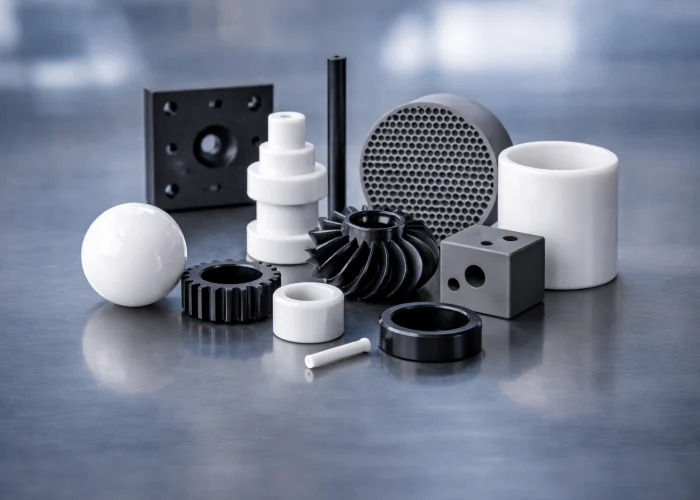
Silicon-Based Nano Polymer Composite Ceramic | Ultra-High Temperature & Corrosion Resistant
ADCERAX, a factory-direct manufacturer of custom nano ceramic parts, helps industrial buyers develop solutions that combine material performance, design flexibility, and practical manufacturability. From prototypes to repeat production, we support advanced ceramic solutions built for wear, heat, corrosion, and precision-driven applications.
Engineered for performance. Customized for your application. Built for reliable production.
What is Silicon-Based Nano Polymer Composite Ceramic?
Silicon-Based Nano Polymer Composite Ceramic refers to a new class of advanced ceramic materials built on silicon-based systems and enhanced through nano-scale engineering and polymer composite technology. It is developed for specialized industrial use where material design plays a critical role.
2600-2800 HV (Vickers), second only to diamond
3.15 g/cm³ (40% lighter than steel)
<0.1 mm/year in concentrated acids and alkalis
Up to 1700°C (oxidizing atmosphere)
Nano Ceramic Material Technologies
Different nano ceramic material technologies offer distinct advantages in mechanical, thermal, electrical, and chemical performance. This comparison helps you identify the right material for your application.
| Property | Value | Test Method / Notes |
|---|---|---|
| Density | 3.15 ± 0.03 g/cm³ | 40% of steel weight |
| Flexural Strength | ≈400 MPa | 3-point bending |
| Compressive Strength | ≈2470 MPa | - |
| Vickers Hardness | 2600-2800 HV | Second only to diamond |
| Fracture Toughness | ≈5.07 MPa·m1/2 | Notch method |
| Elastic Modulus | ≈410 GPa | - |
| Poisson's Ratio | ≈0.16 | - |
| Friction Coefficient | <0.02 | Ice-like surface |
| Property | Value | Notes |
|---|---|---|
| Max Operating Temperature | 1700°C | Oxidizing atmosphere |
| Melting Point | ≈2830°C | - |
| Thermal Conductivity | ≈147 W/m·K | High heat dissipation |
| Thermal Expansion Coefficient | 4.5 × 10⁻⁶/°C | Low expansion, high stability |
| Property | Value | Notes |
|---|---|---|
| Dielectric Constant | 100-120 | - |
| Volume Resistivity | 1014-1016 Ω·cm | Excellent insulator |
| Environment | Performance | Corrosion Rate |
|---|---|---|
| Concentrated H₂SO₄ | Excellent | <0.1 mm/year |
| Concentrated HCl (80°C) | Excellent | <0.02 mm/year |
| HF + HNO₃ mixture | Very Good | 10× better than alumina |
| NaOH 30% (boiling) | Excellent | 1/10 of alumina ceramic |
| Molten salts (NaCl) | Excellent | 5× cryolite resistance |
| pH range | 1-14 | Full spectrum stability |
Why Choose Nano Ceramic?
AM Ceramic offers a practical solution for complex geometries, rapid prototyping, and custom low-volume parts. It reduces tooling constraints while supporting high precision, material flexibility, and faster product development.
Vickers hardness 2600-2800 HV, second only to diamond. Exceptional wear resistance for abrasive environments where metals fail rapidly.
Stable operation at 1600-1700°C in oxidizing atmospheres. Maintains dimensional stability through repeated thermal cycles.
Corrosion rate <0.1 mm/year in concentrated acids and alkalis. 10× better HF resistance than alumina. Equipment life extended from months to years.
Density only 3.15 g/cm³ – 40% of steel weight. Reduces structural load and energy consumption in kiln furniture applications.
Friction coefficient <0.02, comparable to ice surface. Reduces wear, prevents material sticking, and improves product release.
Despite higher initial cost, total cost of ownership is significantly lower due to extended service life (8-16× longer than traditional materials).
Nano Ceramic Products We Supply
Explore nano ceramic products engineered for heat, wear, corrosion, and demanding industrial service. From standard components to custom parts, this range helps you find the right ceramic solution for more reliable performance and longer service life.
Key Benefits:No warpage, energy saving, longer service life, extended durability
Nano Ceramic Kiln Furniture
Typical Applications: Ceramic sintering, glass firing, tableware production
Key Benefits: 1700°C stable, no carbon buildup, energy efficient
Nano Ceramic Burner Nozzles
Typical Applications: Industrial kilns, ceramic furnaces, metal heat treatment
Key Benefits: High wear resistance, uniform air distribution
Nano Ceramic Boiler Wind Caps
Typical Applications: CFB boilers, power plants, fluidized bed systems
See How ADCERAX Builds Custom Nano Ceramic Solutions
Explore the manufacturing capabilities, engineering support, and process control behind our custom nano ceramic parts for demanding industrial applications.
Nano Ceramic Industrial Applications
From metallurgy and power generation to chemical processing and sintering, nano ceramic components support harsh industrial applications. Explore how different products improve service life, process stability, and reliability.
| Application | Product | Benefits |
|---|---|---|
| Tableware firing | Kiln furniture / Setter plates | No warpage at high temp, clean product release |
| Sanitary ware sintering | Support plates, rollers | Dimensional stability, extended kiln cycles |
| Technical ceramics production | Setter plates, spacers | No contamination, consistent flatness |
| Glass bottle firing | Kiln furniture | Energy savings up to 40% |
Case highlight: Setter plates maintain original flatness after 1000+ firing cycles at 1300°C, reducing energy costs by 30-40% compared to traditional cordierite kiln furniture.
| Application | Product | Benefits |
|---|---|---|
| CFB boiler air distribution | Wind caps | High wear resistance, uniform fluidization |
| Coal pulverizer | Wear liners | 5× longer life than cast steel |
| Ash handling systems | Pipe linings | Low friction, self-cleaning surface |
| Desulfurization systems | Nozzles, liners | Acid + heat resistance |
Case highlight: Nano ceramic wind caps in CFB boilers operate at 800-1000°C with 5× improved cryolite erosion resistance and thermal expansion coefficient of only 4.5×10⁻⁶/°C.
| Application | Product | Benefits |
|---|---|---|
| Chlorination reactors | Reactor linings | 8 years vs 6 months (Hastelloy), 90% maintenance cost reduction |
| Acid processing systems | Pipes, valves, liners | Corrosion rate <0.1 mm/year |
| Alkali production | Tank linings | 1/10 corrosion of alumina in 30% NaOH |
| High-temp flue gas treatment | Duct linings | Resistant to SO₃ at 800°C+ |
Case highlight: Chlorination reactor lining in 98% H₂SO₄ + Cl₂ environment extended equipment life from 6 months (Hastelloy alloy) to 8 years, reducing annual maintenance cost by 90%.
| Application | Product | Benefits |
|---|---|---|
| Aluminum electrolysis cells | Sidewall linings | 5× cryolite resistance, low thermal expansion |
| Metal melting furnaces | Crucibles, liners | High temp + corrosion resistance |
| Continuous casting | Nozzles, submerged entry | Non-wetting, low friction |
Case highlight: Chlorination reactor lining in 98% H₂SO₄ + Cl₂ environment extended equipment life from 6 months (Hastelloy alloy) to 8 years, reducing annual maintenance cost by 90%.
Custom Nano Ceramic Parts
From custom geometry to performance-driven material selection, ADCERAX helps you develop nano ceramic parts that are easier to manufacture, easier to validate, and more reliable in real industrial use.
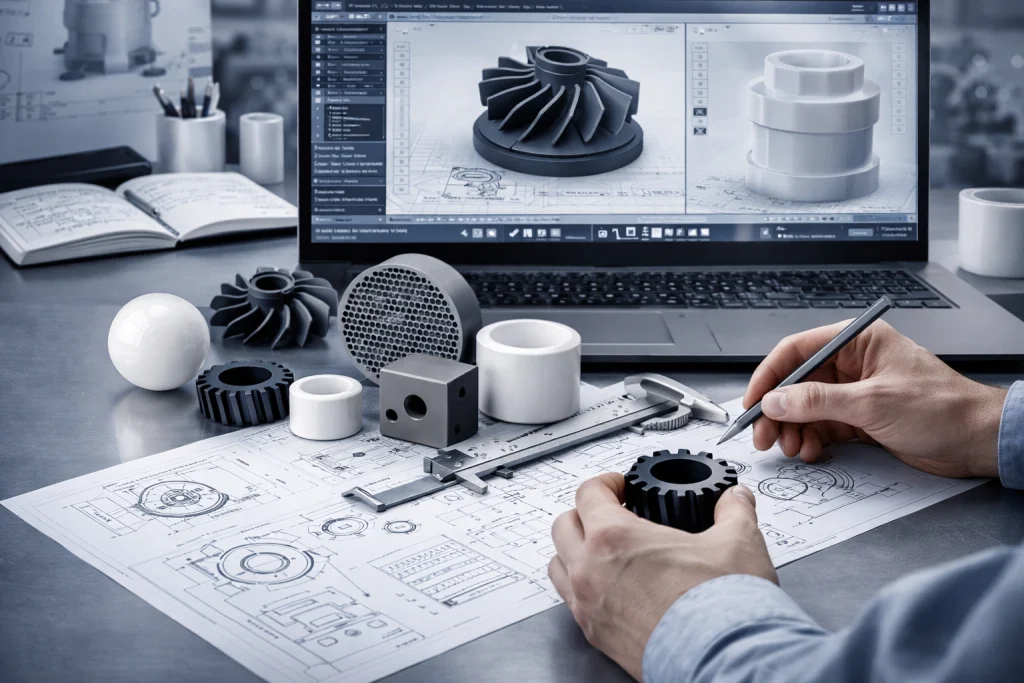
Send us your drawing, sample, or application requirement to discuss the most suitable nano ceramic customization options.
Customization Nano Ceramics Options
- Material: Alumina, zirconia, silicon nitride, silicon carbide, boron nitride, aluminum nitride, and ZTA options are available.
- Shape and Structure: Custom tubes, rods, plates, rings, sleeves, nozzles, insulating parts, wear parts, and special geometries can be produced.
- Size and Tolerance: Dimensions, wall thickness, bore size, flatness, concentricity, and other critical tolerances can be customized.
- Surface and Finishing: As-fired, ground, polished, chamfered, or other required finishing options can be discussed.
- Performance Target: Solutions can be adjusted for wear resistance, heat resistance, corrosion resistance, insulation, and dimensional stability.
- File format: Submit STL, STEP, or native CAD files. Minimum 0.01mm resolution for STL.
Custom Nano Ceramic Workflow
Total lead time: 7–15 days (prototype) · 15–30 days (production batch)
24 hours
Share your drawing, sample, or technical requirements for initial review and quotation.
1-2 days
We assess geometry, ceramic material, tolerances, and production feasibility.
2–4 days
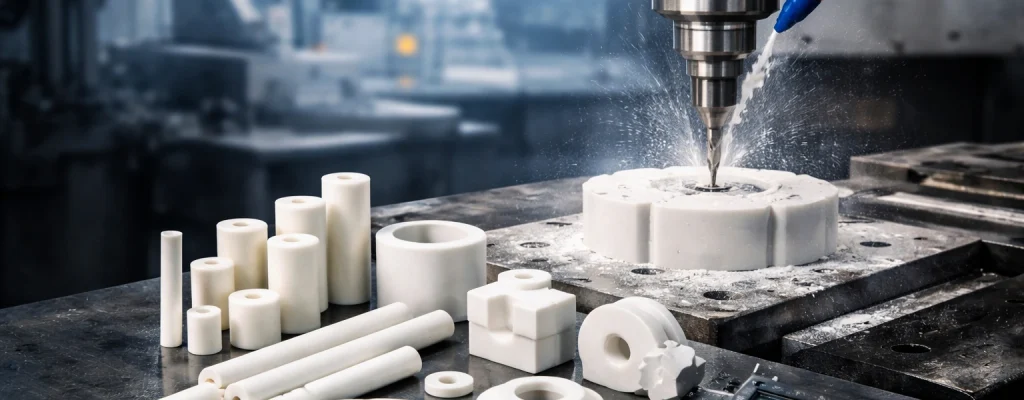
The nano ceramic part is formed into the approved structure as a green body.
3–7 days
Controlled firing densifies the part and develops the required ceramic properties.
2-5 days
Grinding, inspection, and packaging are completed before shipment.
How does nano ceramic compare to traditional silicon carbide (SiC)?
Higher density (3.15 vs 3.0-3.1 g/cm³), better fracture toughness (5.07 vs 3-4 MPa·m¹ᐟ²), superior acid/alkali resistance, and lower friction coefficient (<0.02).
What temperature can nano ceramic withstand?
Up to 1700°C in oxidizing atmosphere. Melting point is approximately 2830°C. Thermal expansion coefficient of 4.5×10⁻⁶/°C ensures dimensional stability.
Is nano ceramic resistant to acids and alkalis?
Yes, excellent resistance to concentrated H₂SO₄, HCl, NaOH, and even HF+HNO₃ mixtures. Corrosion rate typically <0.1 mm/year, 10× better than alumina in many environments.
What industries use nano ceramic products?
Ceramic/glass sintering, chemical processing, power generation (CFB boilers), metallurgy (aluminum electrolysis), petrochemical, and environmental equipment.
Can you manufacture large or custom-shaped components?
Yes. Production capability includes components up to 7 meters in length and single-batch capacity of 10 tons. Custom shapes manufactured to drawing.
What is the cost advantage of nano ceramic?
Higher initial cost but significantly lower lifecycle cost. Example: reactor lining life extended from 6 months (alloy) to 8 years, reducing annual maintenance cost by 90%.
Get in touch with us
We believe that Adcerax will become your best partner!
Please fill in your contact information in the form or call us.
info@adcerax.com
Telephone: +(86) 0731-74427743
WhatsApp: +(86) 19311583352
Within 24 hours
*Our team will answer your inquiries within 24 hours.
*Your information will be kept strictly confidential.
