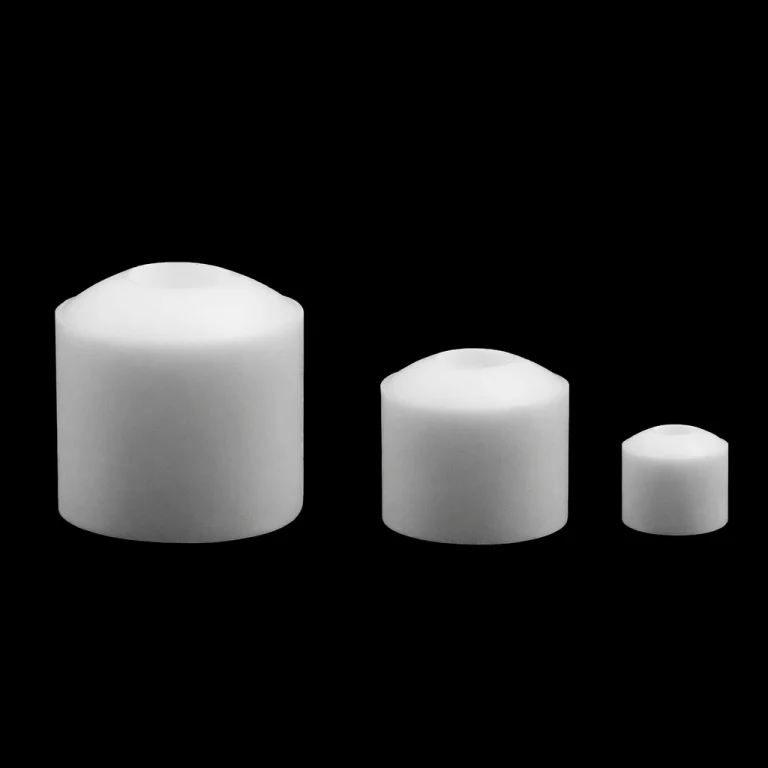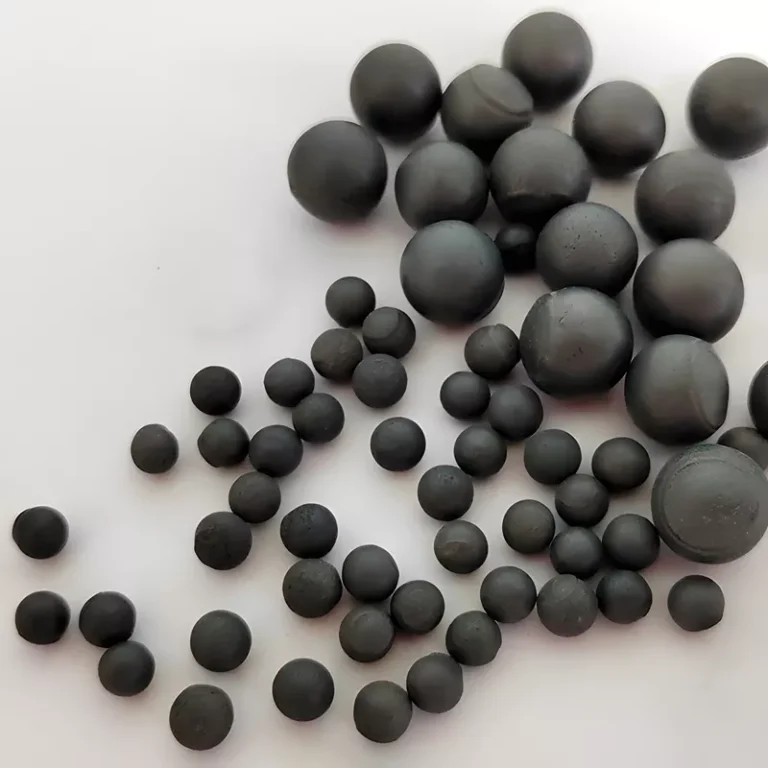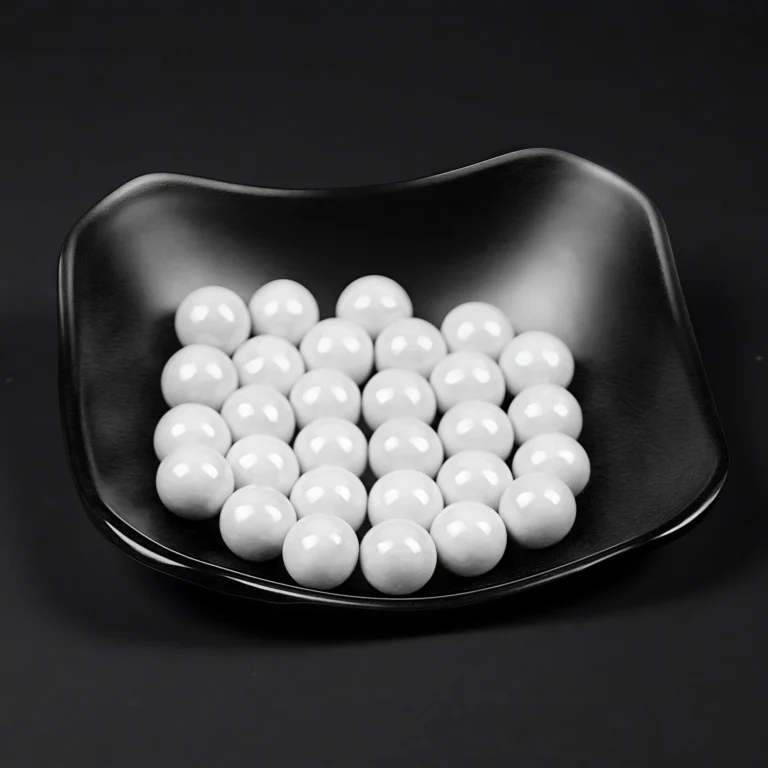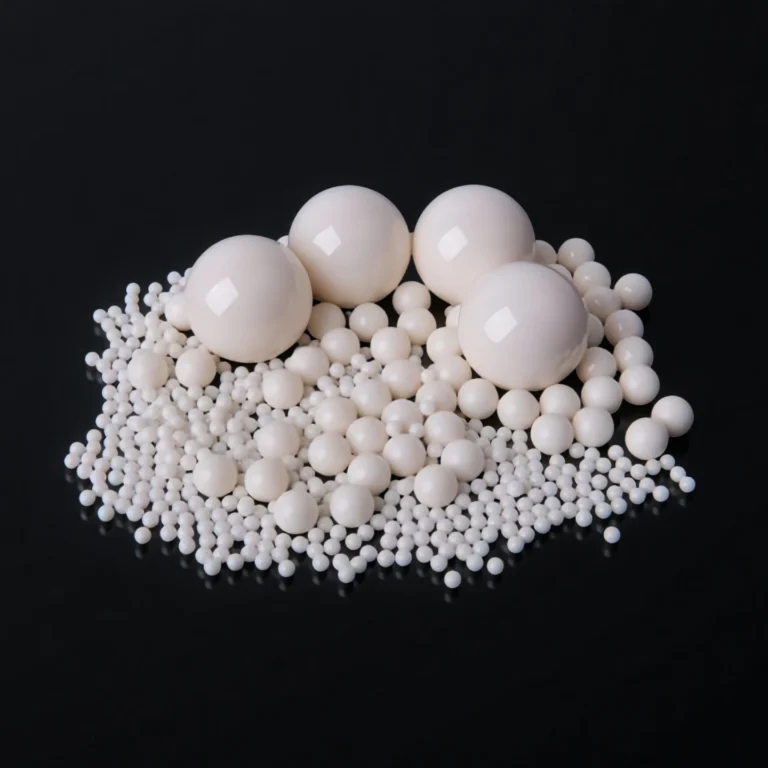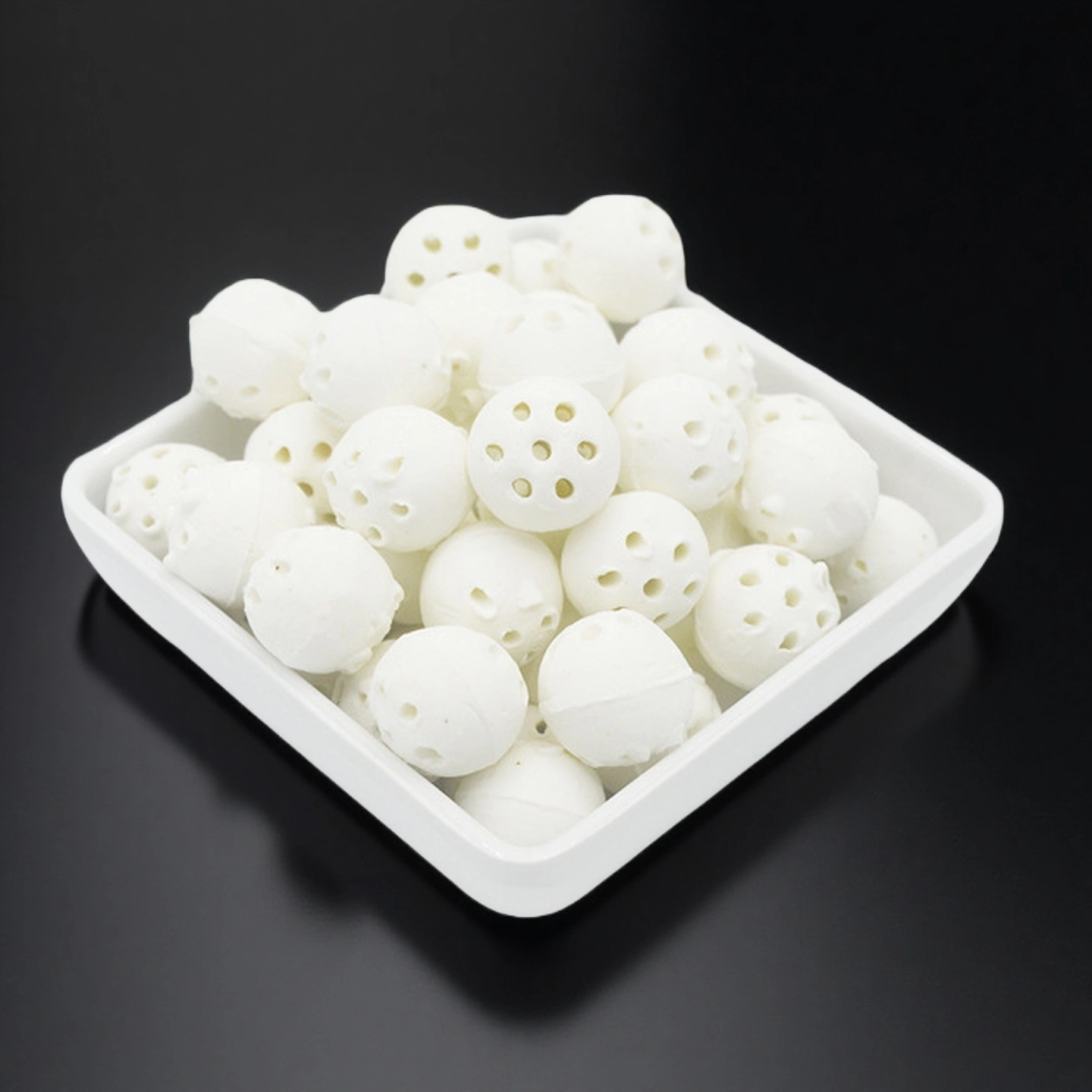
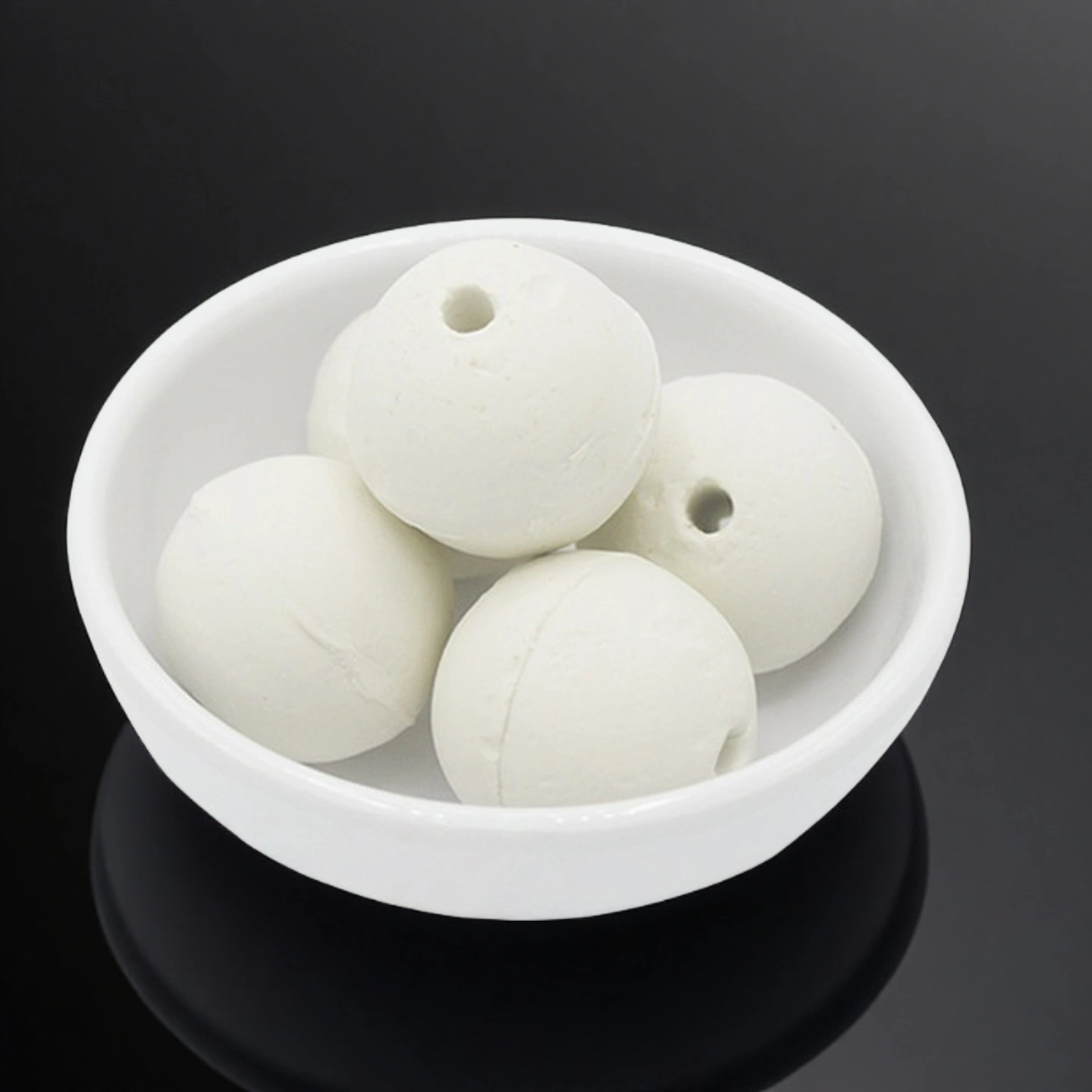
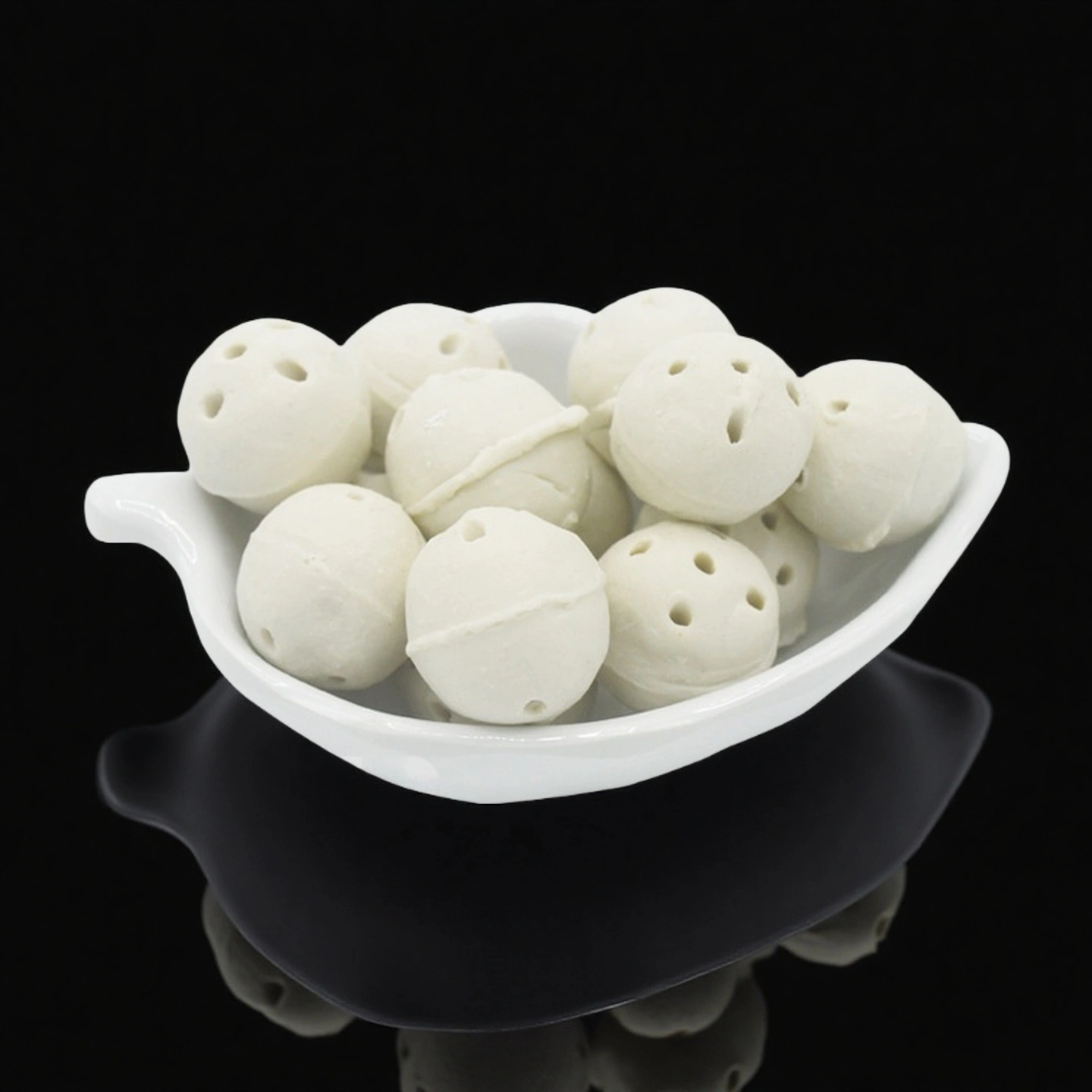
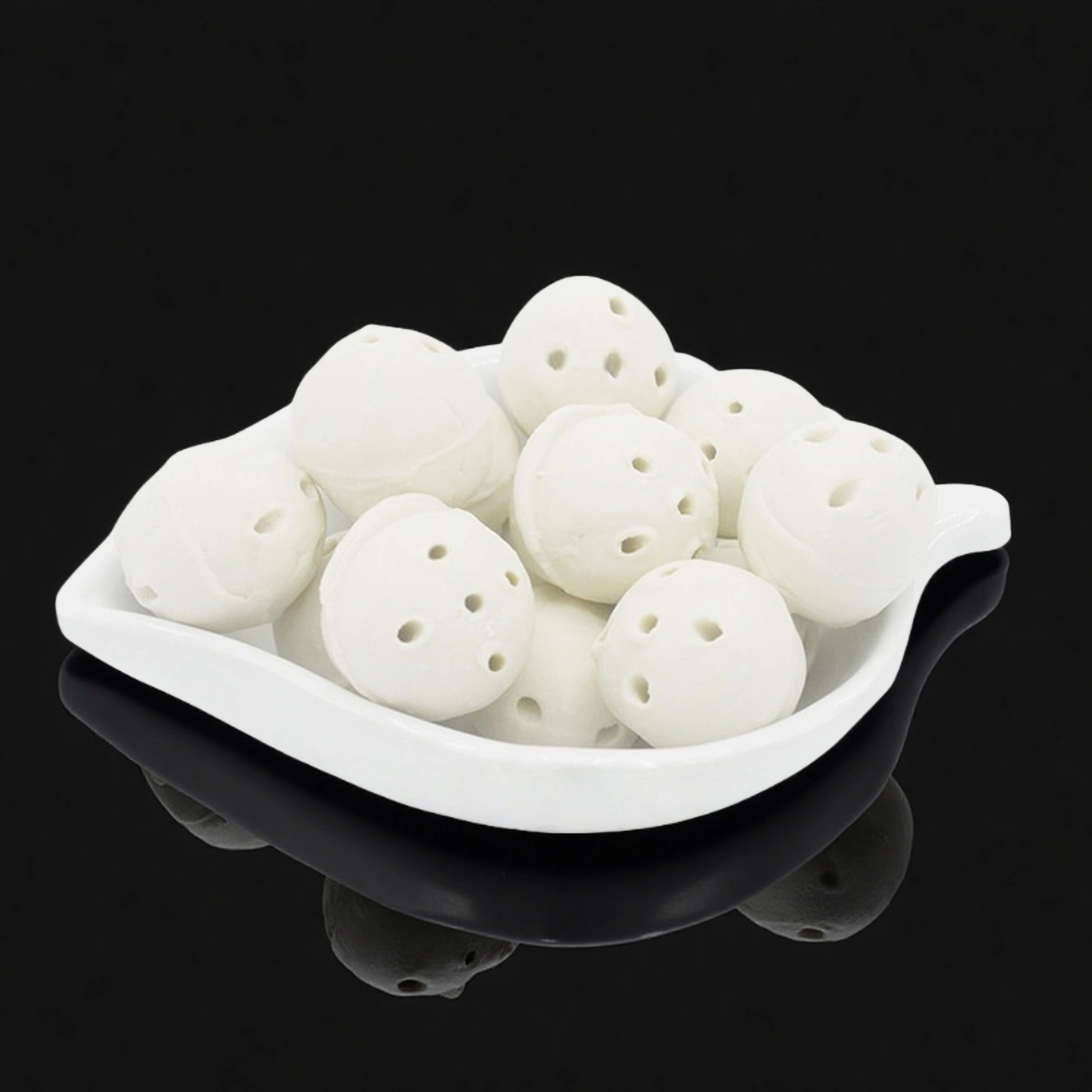
Alumina ceramic multi bores beads are open-hole support media engineered for fixed-bed hydrotreating, hydrocracking, reforming, shift, and gas-treating reactors. The multi-bore structure increases voidage and straight channels to lower pressure drop (ΔP) while providing reliable mechanical support and thermal stability.
Alumina Ceramic Multi Bores Beads Benefits
- Low pressure drop: Multi-channel paths increase voidage for measurable ΔP relief at set bed heights.
- Stable support layer: Spherical ribs give high crush strength and resist abrasion during start/stop cycles.
- Thermal/chemical margin: Alumina matrix performs in high-temperature, sulfur/amine/acid gas environments where plastics or low-temp packings fail.
How to Choose the Right Hole Pattern
The number of holes affects voidage, pressure drop, and support stability. Use this guide to select the optimal configuration:
| Hole Pattern | Voidage | ΔP Reduction | Crush Strength | Best For |
|---|---|---|---|---|
| 3-Hole | Low-Medium | 5-8% | Highest | Heavy catalyst loads, high-pressure reactors |
| 5-Hole | Medium | 8-12% | High | Balanced ΔP control and support strength |
| 7-Hole ⭐ | Medium-High | 10-15% | Good | Most hydrotreating/hydrocracking applications |
| 9-Hole | High | 12-18% | Moderate | Maximum ΔP reduction, lighter catalyst beds |
| Open-Hole (Single) | Low | 3-5% | Very High | Transition layers, heavy-duty support grids |
Most common choice: 7-hole alumina beads cover 60%+ of refinery hydrotreating applications.
Still not sure? Share your reactor operating conditions (temperature, pressure, catalyst type) — our engineers will recommend the optimal hole pattern and bead size.
Multi-Bore Beads vs Solid Support Balls — When to Upgrade?
| Factor | Multi-Bore Beads | Solid Inert Balls |
|---|---|---|
| Pressure Drop (ΔP) | ✅ 10-15% lower at same bed height | Standard baseline |
| Voidage | ✅ Higher (straight channels) | Lower (interstitial only) |
| Gas Distribution | ✅ More uniform (parallel channels) | Tortuous path |
| Crush Strength | Good (rib-dependent) | ✅ Highest |
| Cost | Higher (more complex geometry) | ✅ Lower |
| Best Application | ΔP-sensitive reactors, extended run lengths | Cost-sensitive, heavy loads, simple support |
When to Upgrade to Multi-Bore Beads:
- Your reactor ΔP is approaching operational limits
- You want to extend run length without increasing compressor load
- Catalyst carryover or hot spots occur during start-ups
- Process optimization requires better gas distribution uniformity
When Solid Balls Are Sufficient:
- ΔP is not a limiting factor in your process
- Budget constraints outweigh performance optimization
- Support layer experiences extremely heavy static loads
Alumina Ceramic Multi Bores Beads Properties
| Item | Ordinary Porcelain Ball | 23–30% Al₂O₃ Ceramic Ball | Medium-Alumina Ceramic Ball | High-Alumina Ceramic Ball | 99 High-Alumina Ceramic Ball |
| Al₂O₃ + SiO₂ (%) | > 93 | > 92 | > 93 | > 94 | > 99 |
| Al₂O₃ (%) | 17–23 | 23–30 | 40–75 | 85–97 | 99 |
| Fe₂O₃ (%) | < 1 | < 1 | < 1 | < 1 | 0.2 |
| CaO (%) | < 0.5 | < 1.5 | < 1.5 | < 0.5 | 0.2 |
| MgO (%) | < 0.5 | < 1.5 | < 0.5 | < 0.5 | 0.1 |
| K₂O + Na₂O (%) | < 4 | < 4 | < 3.5 | < 4 | > 0.5 |
| TiO₂ (%) | < 0.5 | < 0.5 | < 0.1 | < 0.1 | 0.5 |
| Leachable Fe₂O₃ (free) (%) | < 0.1 | < 0.1 | < 0.005 | < 0.001 | — |
| Water Absorption (%) | < 0.5 | < 0.5 | < 1 | < 2 | 2–5 |
| Particle Density (g/cm³) | 2.3–2.4 | 2.3–2.4 | 2.6–2.9 | 3.4 | 3.2–3.6 |
| Max. Operating Temperature (°C) | 980 | 980 | 1450 | 1580 | 1580 |
| Mohs Hardness | > 6.5 | > 7 | > 7 | > 7.5 | > 7.5 |
| φ6 | > 0.5 | > 0.5 | > 0.5 | > 0.6 | > 1 |
| φ25 | > 6.5 | > 6.5 | > 4.9 | > 55 | > 8 |
| φ38 | > 8.9 | > 8.9 | > 5.5 | > 54 | > 8 |
| φ50 | > 9 | > 9.8 | > 6.5 | > 7.8 | > 15 |
Alumina Multi Hole Beads Specifications
Type 1: open-hole alumina support balls

| Item | Diameter(mm) |
| AT-YM-DK1001 | 6 |
| AT-YM-DK1002 | 8 |
| AT-YM-DK1003 | 10 |
| AT-YM-DK1004 | 13 |
| AT-YM-DK1005 | 15 |
| AT-YM-DK1006 | 19 |
| AT-YM-DK1007 | 25 |
| AT-YM-DK1008 | 38 |
| AT-YM-DK1009 | 50 |
Type 2: alumina ceramic 5 holes bead
| Item | Diameter(mm) |
| AT-YM-DK1001 | 6 |
| AT-YM-DK1002 | 8 |
| AT-YM-DK1003 | 10 |
| AT-YM-DK1004 | 13 |
| AT-YM-DK1005 | 15 |
| AT-YM-DK1006 | 19 |
| AT-YM-DK1007 | 25 |
| AT-YM-DK1008 | 38 |
| AT-YM-DK1009 | 50 |
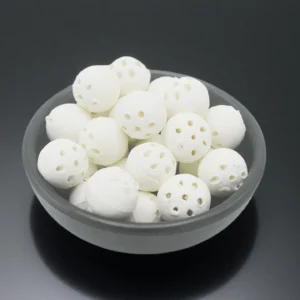
Type 3: alumina ceramic 7 holes bead
| Item | Diameter(mm) |
| AT-YM-DK1001 | 6 |
| AT-YM-DK1002 | 8 |
| AT-YM-DK1003 | 10 |
| AT-YM-DK1004 | 13 |
| AT-YM-DK1005 | 15 |
| AT-YM-DK1006 | 19 |
| AT-YM-DK1007 | 25 |
| AT-YM-DK1008 | 38 |
| AT-YM-DK1009 | 50 |
Recommended Bead Size by Application
| Reactor Type | Bottom Support Layer | Transition Layer | Top Hold-Down |
|---|---|---|---|
| Hydrotreating (small catalyst) | 25-50mm | 13-19mm | 6-10mm |
| Hydrocracking | 38-50mm | 19-25mm | 10-13mm |
| Reforming | 25-38mm | 13-19mm | 6-10mm |
| CO Shift / Ammonia | 25-38mm | 15-19mm | 8-13mm |
| Adsorbent Beds (Mole Sieve) | 19-25mm | 10-15mm | 6-8mm |
Note: Final sizing depends on catalyst particle size, grid opening, and bed design. Contact engineering for detailed recommendations.
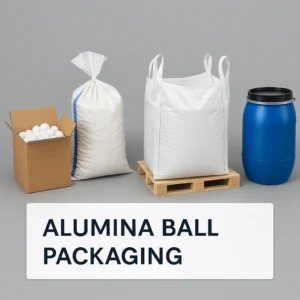
Alumina Ceramic Multi Bores Beads Packaging
- High alumina grinding beads are packaged in 25 kg heavy-duty plastic bags, which are then placed inside 1-ton jumbo bags with inner waterproof liners. The jumbo bags are palletized and shrink-wrapped for secure, moisture-free international transport.