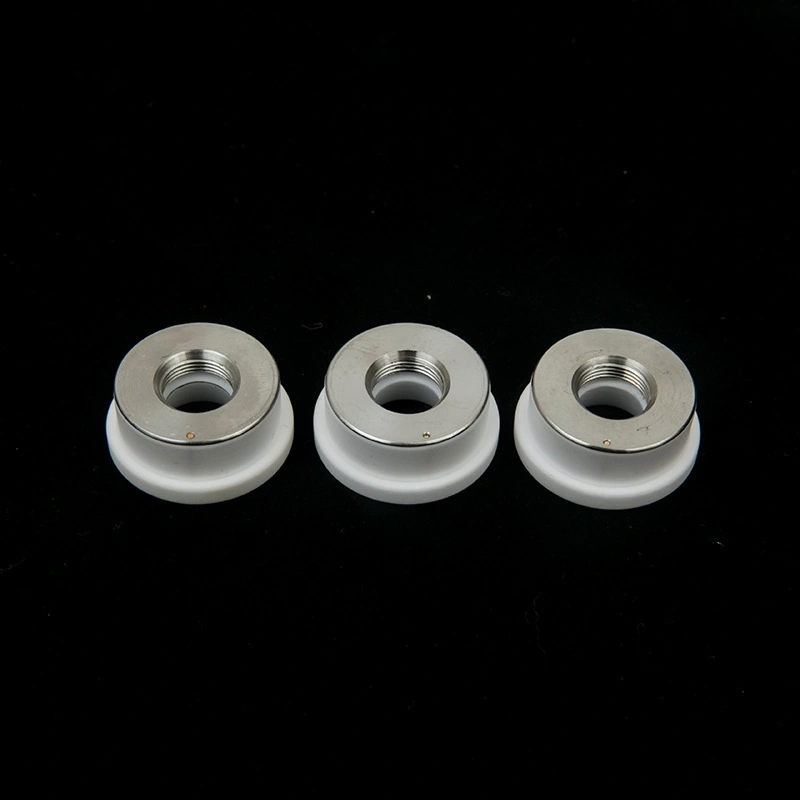
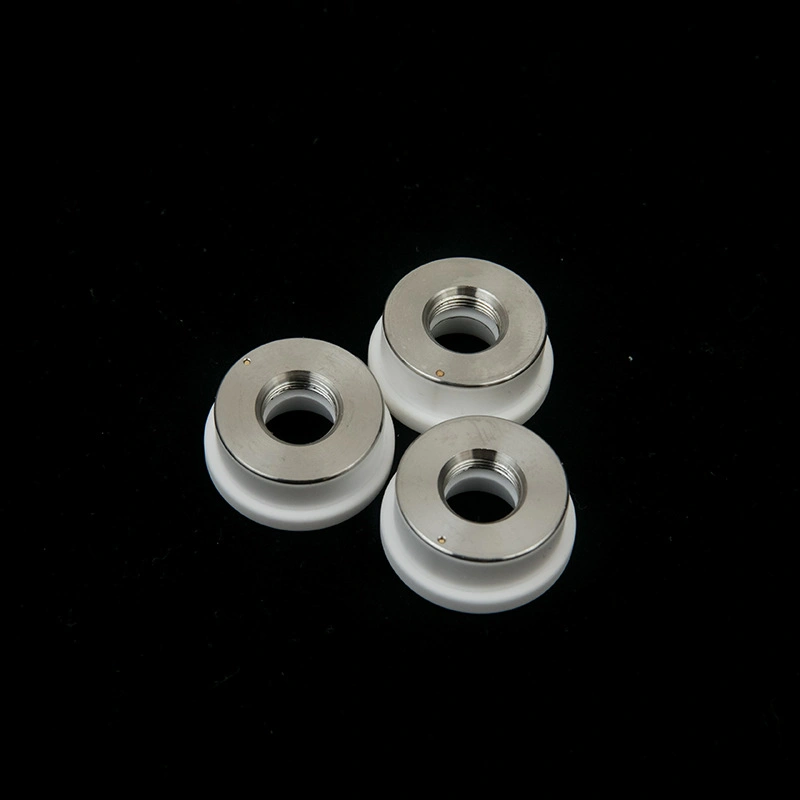
Ceramic Ring for Fiber Laser Cutting Head — Stable Triggering and Nozzle Alignment

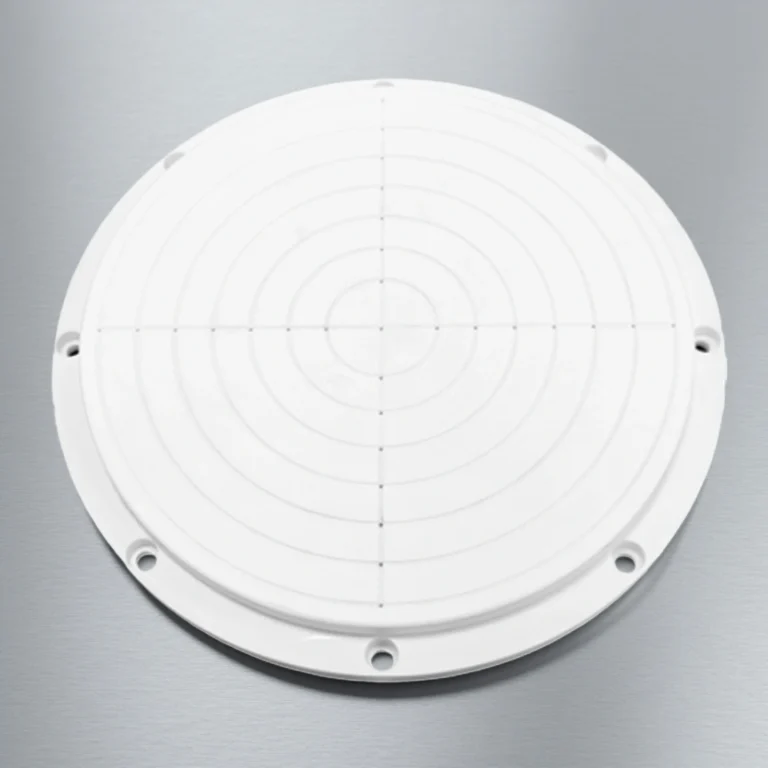
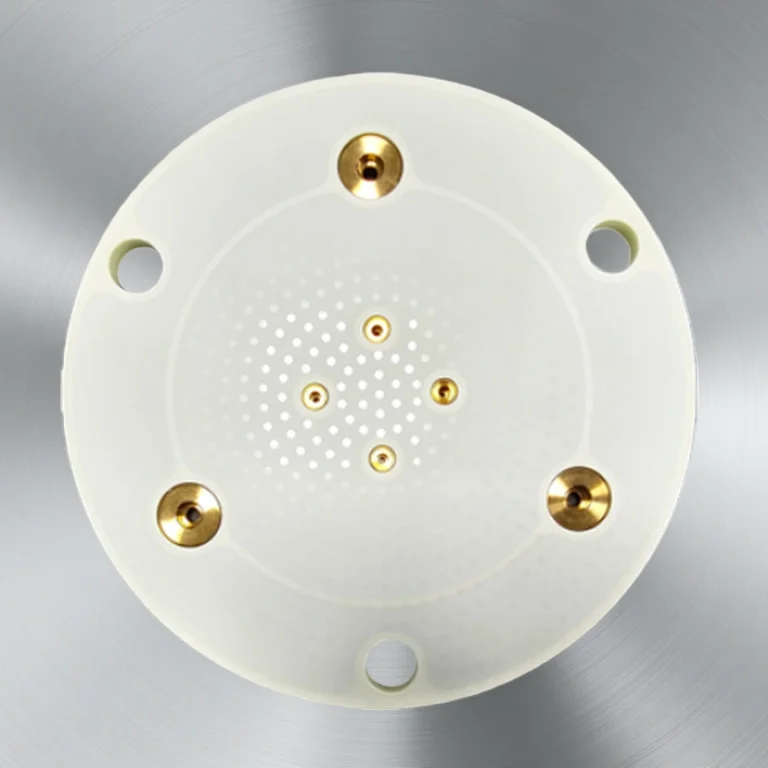
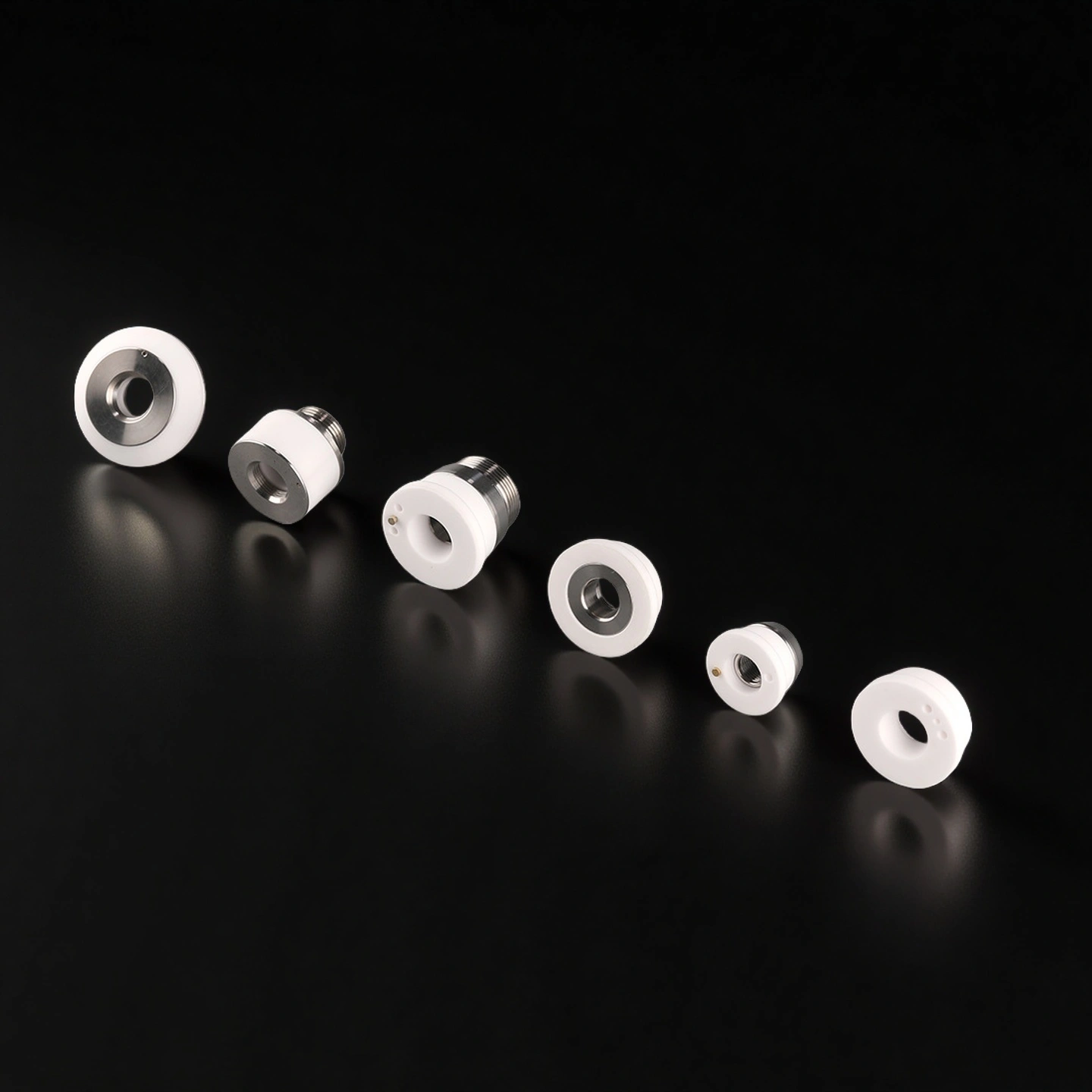
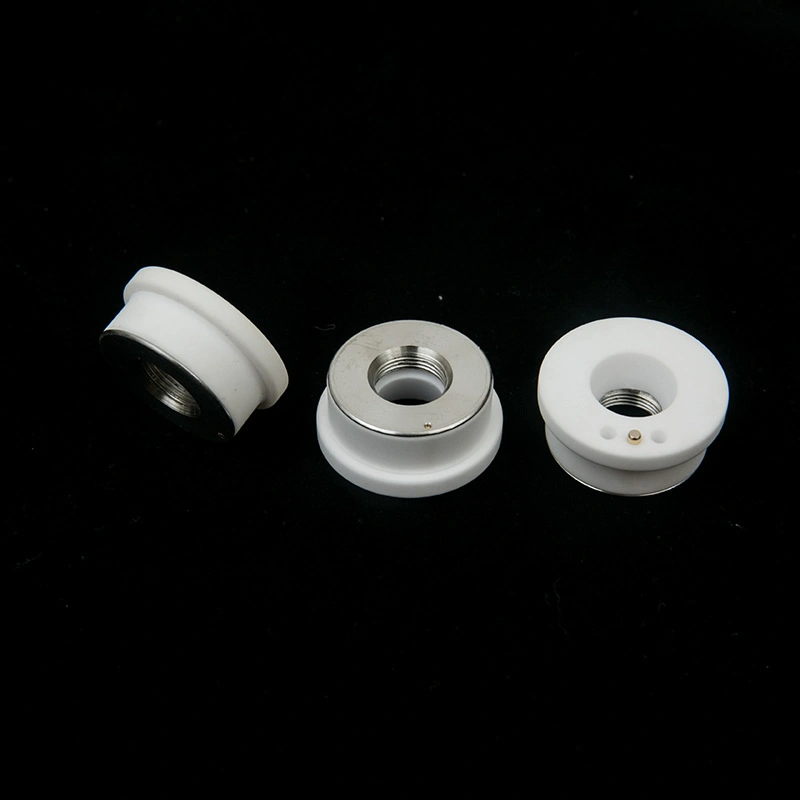
This ceramic ring for laser cutting machine centers the nozzle and insulates the contact assembly in fiber-laser heads. Standard D28/M11, D32/M14, and D41/M11 sizes are available, with custom rings for alternate threads and contact layouts. Stock covers D28–D41 rings with M11/M14 threads and defined seating faces; custom rings support target concentricity, specific thickness, chamfer, and Al₂O₃ or ZTA material choices.

Catalogue No. AT-D32M14
Material Al₂O₃ 95–99%, ZTA, Zro2+Stainless steel
Dimensional Tolerance ±0.05mm (OD/ID), ±0.1mm (thickness)
Dielectric Strength >15kV/mm
Dimensions/Sizes Download PDF
24H Standard Dispatch
Small Batch Support OEM
Factory Direct
Expert Engineering Support

Ceramic ring for a laser cutting machine is a small insulating and positioning component installed between the nozzle and the contact/sensing assembly of the laser cutting head. Its job is to isolate the contact pin electrically, keep the nozzle coaxial with the optical axis, and maintain a consistent sensor gap so the head can trigger correctly during piercing and cutting.

Ceramic Ring for Laser Cutting Machine Benefits

  • Low runout interface — nozzle coaxiality supported by concentricity targets (≤0.10 mm).
  • Defined thickness stack-up — ring thickness tolerance (±0.05–±0.10 mm) stabilizes sensor gap.
  • Material fit for duty — Al₂O₃ for standard use; ZTA option for impact-prone changeovers.
  • Thread/model mapping — D28/M11, D32/M14, D41/M11 options reduce compatibility errors.
  • Edge integrity — controlled chamfers to lower chip initiation during nozzle swaps.


Ceramic Ring for Laser Cutting Machine Specifications
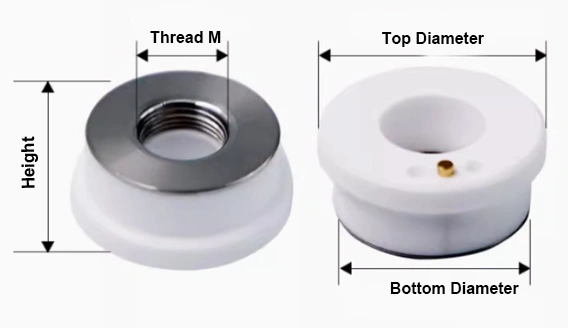
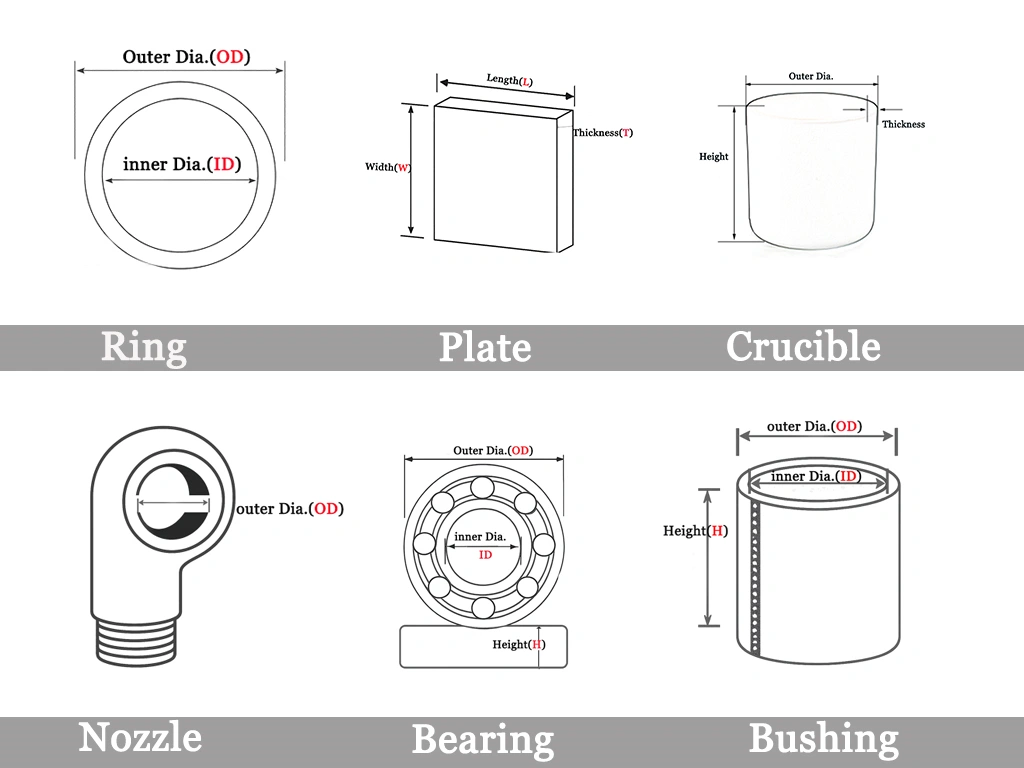
ceramic ring for laser cutting machine size

Ceramic Ring for Laser Cutting Machine
Item NO. Name Maximum Outer Dia.(mm) Lower Outer Dia.(mm) Height(mm) M(Thread)
AT-D32M14 Ceramic Rings 32 28 12 M14
AT-D28M11 Ceramic Rings 28 24.5 12 M11
AT-D25M10 Ceramic Rings(OSPR) 25 18 19 M10
AT-D21.5M8 Ceramic Rings(OSPR-3D) 21.5 14 M8
AT-D24M8 Ceramic Rings(WSX-Mini) 24 20 12 M8
AT-D17.8M8 Ceramic Rings(OSPR-3D) 17.8 15 12.6 M8
AT-D19.5M8 Ceramic Rings(JQ-3D) 19.5 16 12.5 M8
AT-D31M11 Ceramic Rings(PLST) 31 26 13.5 M11
AT-D28.7M11 Ceramic Rings(IPG) 28.7 23.3 10.5 M11
AT-D32M12 Ceramic Rings(TL) 32 28 12 M12
AT-D28M12 Ceramic Rings(TL) 28 24.5 12 M12


Ceramic Ring for Laser Cutting Machine Packaging

  • Each ceramic ring is individually packed in anti-static foam trays.
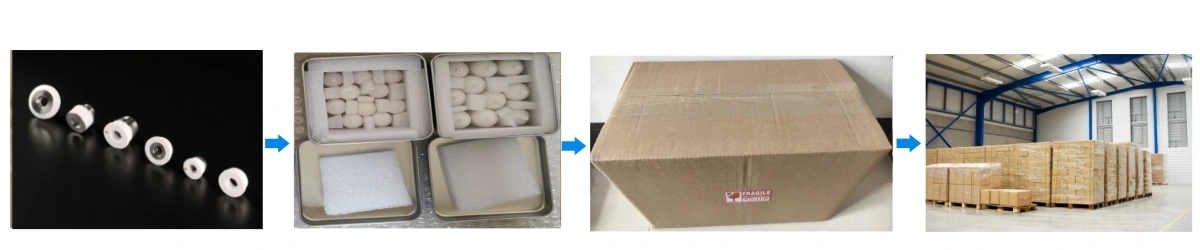
Ceramic Ring for Laser Cutting Machine Packaging


Laser Head Ceramic Ring Applications

  • Sheet-Metal Job Shops

    ✅Key Advantages

    1. Concentric seating — measured runout ≤0.10 mm supports consistent kerf on multi-shift work.
    2. Stable sensor gap — thickness tolerance holds focus repeatability across nozzle swaps.
    3. Reduced chip risk — edge design lowers micro-chips that trigger contact fault alarms.

    ✅ Problem Solved

    A job shop running 6–8 nozzle changes per shift cut setup time by ~20% after adopting D32/M14 rings with controlled thickness and chamfer, reducing contact-fault stoppages and re-touch cycles on 3–8 mm steel.

  • Automotive/Machinery Tiers

    ✅Key Advantages

    1. Repeatable alignment — concentricity target keeps variance low across multi-plant lines.
    2. Defined tolerance window — identical thickness reduces calibration drift between cells.
    3. Traceable parts — etched IDs support maintenance intervals and audit requirements.

    ✅ Problem Solved

    A Tier supplier locked a D28/M11 spec into its head kit; line changeovers saw fewer kerf offsets and fewer re-cuts per lot, supporting PPAP metrics and reducing scrap on stainless brackets.

  • Laser OEM/After-Sales

    ✅Key Advantages

    1. Model-mapped sizing — D28/M11, D32/M14, D41/M11 align with common head families.
    2. Material choice — ZTA for high-power heads prone to impact during frequent swaps.
    3. Orientation cues — marking reduces assembly errors in service channels.

    ✅ Problem Solved

    An OEM added ID-marked ZTA rings for high-power models; warranty claims for mis-trigger events declined over the next quarter as dealers installed the mapped spare set with orientation marks.

Ceramic Ring for Laser Cutting Machine Usage Instructions

  • Installation Guidelines

    1. Confirm Compatibility
    Verify the laser head model and thread type (M11 or M14) before installation. Ensure that the ring’s seat geometry, counterbore depth, and alignment face match the head drawing.
    2. Inspect Before Assembly
    Check both faces for micro-cracks, edge chips, or warpage under adequate lighting. Even small surface defects may cause sensor mis-triggering or focus drift.
    3. Correct Positioning
    Place the ceramic ring firmly on the designated seating face; verify contact pin clearance and sensor gap based on the cutting-head manual. Avoid excessive torque that may distort the seat or crack the ring.
    4. Torque & Alignment Check
    Tighten gradually to the manufacturer’s torque recommendation (commonly 1.0–1.5 N·m depending on head model). After seating, verify nozzle alignment using a feeler gauge or optical coaxial tool.
    5. ESD & Handling Note
    When handling ZTA or high-purity Al₂O₃ rings, wear clean gloves to prevent contamination of the sensor surface and thread interface.

  • Operation Recommendations

    1. Alignment Verification
    After every nozzle or ring replacement, perform a quick alignment cut on a standard 1 mm stainless coupon to confirm beam centering.
    2. Monitor Cutting Stability
    Watch for contact-fault alarms or arc detection signals. Repeated false triggers can indicate a bent pin, contaminated seat, or chipped ceramic edge.
    3. Preventive Maintenance
    Schedule a visual inspection every 2–3 weeks (or 10000 piercings) to detect early wear, contamination, or micro-chipping before failure occurs.
    4. Environmental Control
    Avoid operating in areas with high vibration or airborne metal dust, as fine debris can accumulate around the sensor face and cause false readings.

  • Storage & Handling

    1. Individual Protection
    Store each ring in foam-cell trays or anti-static blister packaging to avoid metal contact and edge impact.
    2. Environmental Conditions
    Keep in a dry, dust-free environment, 10–40 °C ambient range, relative humidity below 60%.
    3. Transport Precautions
    During shipment or plant transfer, secure trays to prevent vibration. Do not mix Al₂O₃ and ZTA types in the same container to prevent color/grade confusion.
    4. Shelf Life Guidance
    While ceramic materials are stable, mechanical seals and plated contact surfaces should ideally be used within 24 months of receipt.

  • Cleaning & Maintenance

    1. Use a lint-free, non-abrasive cloth to remove dust before installation.
    2. Avoid metal brushes, ultrasonic baths, or solvents that leave residue on the sensor face.
    3. For carbonized deposits, apply isopropyl alcohol (IPA) lightly, followed by dry compressed air.
    4. Never sand or polish the seating surface; doing so can alter flatness and Ra values, causing sensing instability.

Ceramic Ring for Laser Cutting Machine FAQ

  1. Q: How do I choose the right ceramic ring size for my laser cutting head?

    A: Match both diameter (D28, D32, or D41) and thread type (M11 or M14) to your cutting head model—Raytools, Precitec, WSX, or Bodor types differ slightly. Measure the old ring or check your head’s drawing; even a 0.2 mm mismatch in thickness can shift the sensor gap and affect piercing.

  2. Q: What’s the difference between Al₂O₃ and ZTA ceramic rings for laser cutting machines?

    A: Al₂O₃ (95–99%) offers strong insulation and high temperature stability, suitable for most heads.
    ZTA (Zirconia-Toughened Alumina) improves impact resistance by 2–3 ×, making it ideal for high-power or frequent-change environments where chipping or shock occurs during nozzle swaps.

  3. Q: Why does concentricity matter for a laser head ceramic ring?

    A: Because any runout beyond 0.10 mm can tilt the nozzle, causing uneven kerf width, beam reflection, or inconsistent piercing. Precision-ground rings keep alignment stable, reducing setup and calibration time after each nozzle change.

  4. Q: Can I request custom thickness or chamfer design for the ceramic insulator ring?

    A: Yes. Manufacturers like ADCERAX can customize thickness, edge chamfer, counterbore depth, sensor gap, and etched ID marks according to drawings. This ensures compatibility with modified or legacy cutting heads no longer supported by OEMs.

  5. Q: What are the common failure modes of a ceramic ring for laser cutting machines?

    A: The most frequent issues are edge chipping, sensor contamination, and thread wear from overtightening. These cause contact-fault alarms or focus drift. Regular inspection every 2–3 weeks and proper torque control (≈1 N·m) help prevent downtime.

  6. Q:  How long does a ceramic ring typically last in production?

    A: Lifespan depends on usage cycles and environment. In a job shop running moderate duty, a standard Al₂O₃ ring lasts 4–6 months, while a ZTA version may exceed 9–12 months under identical conditions. High-power lines with frequent nozzle changes shorten service life proportionally.

Ceramic Ring for Laser Cutting Machine Reviews

  • ⭐️⭐️⭐️⭐️⭐️
    Switching to D32/M14 laser head ceramic rings with etched IDs cut our false-trigger stops. Nozzle changes are quicker and the sensor gap stays consistent.
    -- Daniel Ortiz — Maintenance Lead, MetroFab Laser (USA)
  • ⭐️⭐️⭐️⭐️⭐️
    We buy standard ceramic rings for laser cutting machines in bulk and add a small batch of ZTA for high-power lines. The sizes match our Raytools-type heads.
    -- Marta Galli — Purchasing Manager, Officine Nord (Italy)
  • ⭐️⭐️⭐️⭐️⭐️
    The D28/M11 ceramic ring with controlled thickness reduced kerf offset after service. Focus checks are faster across two shifts.
    -- Kenji Sato — Production Engineer, K-Metal Works (Japan)
  • ⭐️⭐️⭐️⭐️⭐️
    ADCERAX provided model-mapped laser head ceramic insulator rings that fit our dealer kits. Inventory is simpler and field installs are more consistent.
    -- Omar Rahman — Spare Parts Buyer, EuroCut Systems (Poland)
customize size

Customize Ceramic Ring for Laser Cutting Machine

For non-standard heads or demanding duty cycles, specify a ring to your drawing. The options below cover geometry, interfaces, and surface features required by OEMs and high-duty job shops. What you can specify:

  • Outer / Inner Diameters & Thickness
    Define precise D/ID/T targets with concentricity control down to ≤0.05–0.10 mm, ensuring the nozzle and optical axis remain perfectly aligned during high-speed cutting.
  • Thread / Interface Type
    Select from M11, M14, or custom thread designs per drawing. Specify seat geometry, counterbore, or relief features to guarantee compatibility with Raytools, Precitec, WSX, or OEM laser heads.
  • Material Selection
    Choose between Al₂O₃ 95–99 % for standard duty, ZTA (Zirconia-Toughened Alumina) or Zro2 for high-impact and thermal-shock conditions. Optional targets include Vickers hardness or dielectric strength for design validation.
  • Edge Design Options
    Request chamfer, radius, or break-edge forms to minimize micro-chipping during nozzle replacement and extend tool-life cycles in multi-shift production.
  • Contact/Sensor Features
    Customize pin-recess geometry, conductive-insert clearance, and sensor-face offset to achieve consistent trigger signals and maintain precise focus detection under vibration.
  • Surface Finish Control
    Specify Ra ≤ 0.8–1.6 µm on the seating face for repeatable contact and uniform torque response; polished or matte options available per assembly requirement.

Related Products

ADCERAX - Your Trusted Advanced Ceramics Manufacturing Partner

Direct factory manufacturing with comprehensive ceramic materials expertise and global supply capabilities

Direct Factory Manufacturing

China-based ceramic materials production facility with state-of-the-art equipment

Engineering Team

Experienced professionals in advanced ceramics applications and custom design

Quality Control

Strict quality control standards for technical ceramics manufacturing and quality management

Global Supply Chain

Serving customers worldwide with technical ceramics and rapid response

24/7 Technical Support

Round-the-clock support for ceramic components inquiries and technical assistance

500+ Satisfied Customers

Trusted by global customers for advanced ceramic materials and precision components

Get in touch with us

Our team will be happy to respond to you in less than 24 hours.

Adcerax's factory

Quick Quotation

*Our team will answer your inquiries within 24 hours.

*Your information will be kept strictly confidential.

Ready to Solve Your Engineering Challenge?

Partner with ADCERAX for reliable, high-performance advanced ceramic solutions. Our engineers are ready to discuss your project.

E-mail

info@adcerax.com

Phone

+(86) 0731-74427743 | WhatsApp: +(86) 19311583352

Response Time

Within 24 hours

Quick Quote

The more details you provide, the faster we can quote.

*We respond within 24 hours. All inquiries are confidential.

Download Catalog

Get Your Custom Sulution

The more details you provide, the faster we can respond.

customize size

*We respond within 24 hours. All inquiries are confidential.

Download Catalog