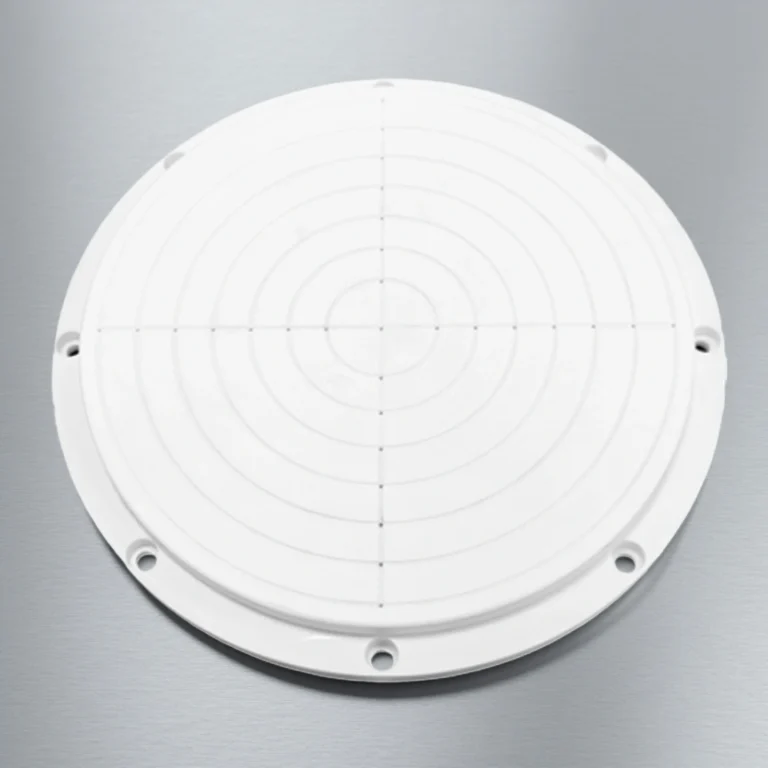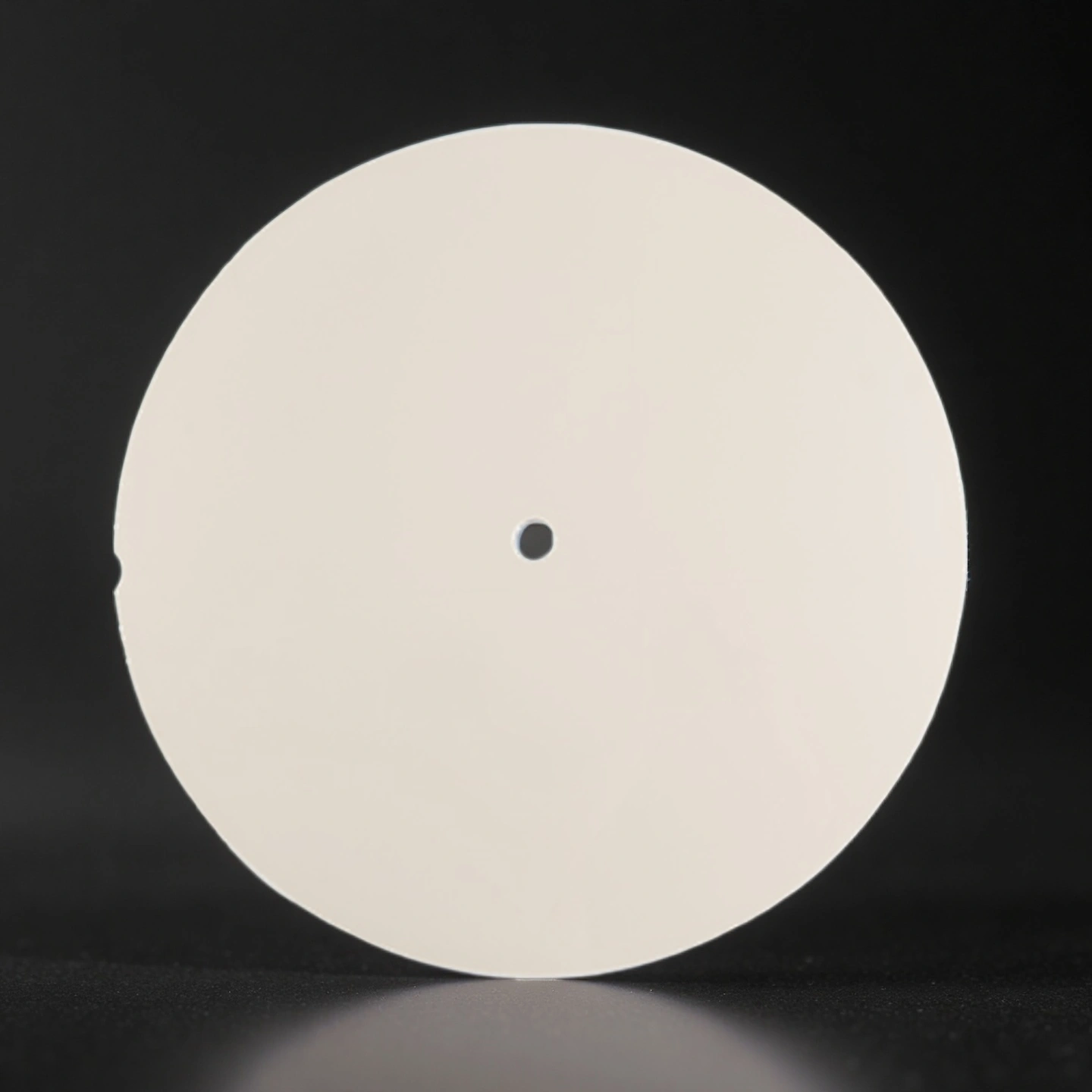
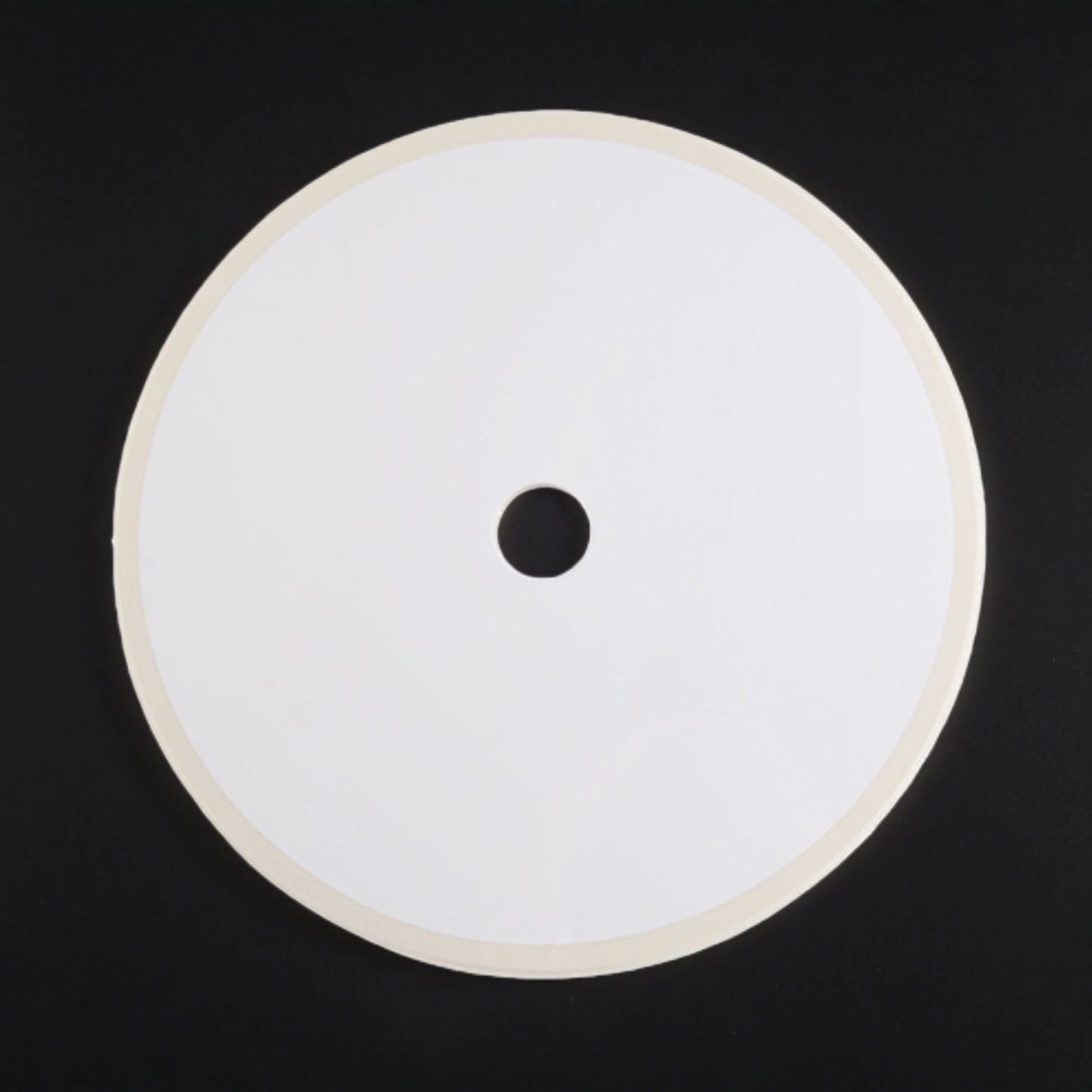
High Purity Alumina Ceramic Window for Vacuum Plasma Energy Coupling (Custom OD up to Ø600 mm)

ADCERAX provides High Purity Alumina Ceramic Windows in custom OD/ID, thickness, and bolt patterns, including large-format designs up to Ø600 mm depending on geometry and handling requirements.

Catalogue No. AT-HP-Q01
Material Al₂O₃
Purity  99%-99.7%
Coefficient of thermal expansion (CTE) ~7.0–8.5 ×10⁻⁶/K (temperature range & grade dependent)
Relative permittivity ~9–10 (frequency & grade dependent)
24H Standard Dispatch
Small Batch Support OEM
Factory Direct
Expert Engineering Support

A High Purity Alumina Ceramic Window is a precision dielectric component made from high-purity Al₂O₃ ceramic, used in vacuum and plasma equipment to transmit RF or microwave energy into a chamber while mechanically and vacuum-sealing the process space.

High Purity Alumina Ceramic Window Benefits

  • Sealing-face controlled geometry
    Each High Purity Alumina Ceramic Window is machined with defined flatness and Ra values on the sealing band so it can seat directly against metal or elastomer seals without local rocking, reducing the risk of vacuum leaks and minimizing rework during chamber assembly.

  • Edge condition designed for plasma tools
    The window perimeter is finished with specified chamfer or radius dimensions, limiting stress concentration and chipping at clamp points and handling areas, which helps maintain usable lifetime across repeated vent, clean, and re-install cycles in plasma equipment.

  • Thickness strategy for energy coupling
    Window thickness and thickness variation are controlled within drawing limits so the dielectric path length remains consistent across the active area, supporting predictable RF or microwave coupling behavior and avoiding unplanned shifts in power delivery after replacement.

  • Batch-to-batch dielectric consistency approach
    High Purity Alumina Ceramic Windows are produced from controlled alumina grades with documented density and dielectric properties, allowing buyers to align their specifications with measured ranges and reducing variation in impedance and matching conditions between production lots.

  • Plasma-exposed surface options
    The plasma-facing side of the High Purity Alumina Ceramic Window can be supplied as-fired, ground, or polished according to the customer’s cleaning method and film-deposition behavior, helping balance contamination control, coating adhesion, and ease of maintenance for different tools.


High Purity Alumina Ceramic Window Properties

Property Unit 99.7% Al₂O₃ 99.5% Al₂O₃ 99% Al₂O₃ 96% Al₂O₃
Color   Ivory White Ivory White Ivory White Ivory White
Density g/cm³ 3.94 3.9 3.83 3.6-3.75
Water Absorption % 0 0 0 0
Hardness Mohs Hardness 9.1 9 9 8.8
Flexural Strength (20°C) Mpa 330 320 300 260
Compressive Strength (20°C) Mpa 2300 2300 2210 1910
Maximum Operating Temperature °C 1730 1700 1680 1450
Thermal Expansion Coefficient(25°C to 800°C) 10⁻⁶/°C 7.6 7.6 7.6 7.6
Thermal Conductivity (25°C) W/(m·K) 29 27 24 22
Dielectric Strength (5mm thickness) AC-kv/mm 22 21 19 15
Dielectric Loss at 25°C@1MHz --- < 0.0001 < 0.0001 0.0003 0.0004
Dielectric Constant at 25°C@1MHz --- 9.8 9.7 9.5 9.2
Volume Resistivity (20°C) Ω·cm³ >10¹⁴ >10¹⁴ >10¹⁴ >10¹⁴
Volume Resistivity (300°C) Ω·cm³ 2*10¹² 2*10¹² 4*10¹¹ 2*10¹¹


High Purity Alumina Ceramic Window Specifications

High Purity Alumina Ceramic Window
Item No. Diameter (mm) Thickness (mm)
AT-HP-Q01 Customize


High Purity Alumina Window Packaging

  • Individual protective wrap for each ceramic window to prevent edge contact during transit
  • Foam cavity support to avoid point loads on thin sections and sealing faces
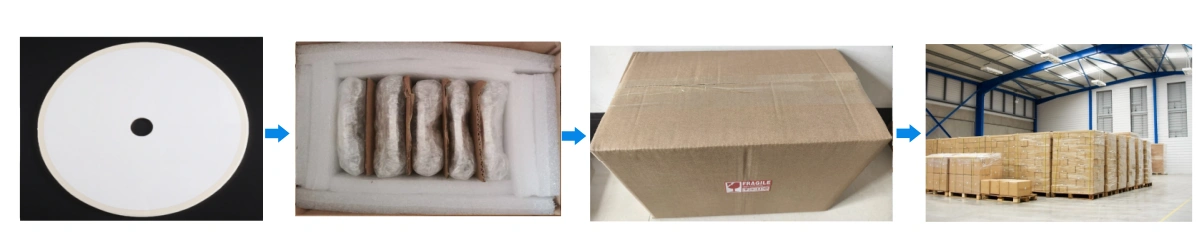
High Purity Alumina Window Packaging

Application Scenarios — High Purity Alumina Ceramic Window

  • Vacuum Thin-Film Deposition Systems (PVD / PECVD / Sputtering)

    ✅Key Advantages

    1. Sealing-face readiness: supports drawings that specify flatness (e.g., ≤0.05 mm) and sealing Ra (e.g., Ra ≤0.8 μm).

    2. Geometry repeatability: maintains coupling gap and window alignment by controlling thickness variation across the active area.

    3. Plasma-facing edge control: chamfer/radius options reduce handling-related edge break risk during maintenance cycles.

    ✅ Problem Solved

    A coating chamber refurbishment often fails acceptance when a replacement window changes the interface stack-up or arrives with edge damage. A typical customer requirement set includes flatness ≤0.05 mm on the sealing face, Ra ≤0.8 μm, and a defined maximum edge break at handling edges. When the window matches the interface geometry and the sealing face is controlled as a CTQ surface, the chamber can return to operation without repeating multiple mechanical rework loops. For maintenance-driven replacement, a build-to-print window reduces the risk of unplanned vent/rework that can add one extra maintenance shift to the schedule.

  • Industrial Plasma Surface Treatment Lines (Corona / Atmospheric Plasma / Low-Pressure Plasma)

    ✅Key Advantages

    1. Coupling consistency: thickness is controlled to match the RF/microwave coupling design used in plasma sources.

    2. Arc-risk management: controlled edge condition and defined allowable edge break reduce arc-initiation sensitivity at sharp defects.

    3. Cleaning compatibility: surface finish options help align with your cleaning method and residue control plan.

    ✅ Problem Solved

    Industrial plasma tools often run frequent changeovers, and windows can be handled repeatedly by technicians. Buyers commonly set incoming acceptance rules such as maximum chip size (e.g., ≤0.2 mm), no cracks under defined inspection lighting, and minimum chamfer/radius on exposed edges. When a High Purity Alumina Ceramic Window is produced to those acceptance rules, the window is less likely to be rejected at receiving and less likely to trigger unexpected arcing linked to edge defects. This reduces rework loops and stabilizes preventive maintenance scheduling.

  • R&D Vacuum Plasma Platforms and Pilot Tools (Labs, Institutes, Prototype Equipment)

    ✅Key Advantages

    1. Defined CTQ surfaces: supports drawings that prioritize a few measurable surfaces (sealing face, thickness, alignment features).

    2. Repeatable experiment geometry: batch windows can be built with tight thickness uniformity targets for comparable coupling behavior.

    3. Revision-friendly design: stepped and shouldered geometries can be iterated without changing the full assembly concept..

    ✅ Problem Solved

    R&D teams often change window geometry during early coupling and contamination studies. A typical pilot-tool drawing may specify thickness tolerance, alignment notch location, and sealing-face flatness as the key pass/fail items, while leaving non-critical surfaces wider. When these CTQ features are documented and inspected, teams avoid repeating experimental baselines due to geometry drift between revisions. This reduces the risk of losing an experiment cycle to mechanical mismatch, especially when multiple window revisions are being evaluated in parallel.

Use Guide — High Purity Alumina Ceramic Window

  • Installation

    1. Verify part revision matches the assembly drawing and the chamber interface revision.
    2. Inspect the sealing face under consistent lighting; confirm no scratches on the functional sealing band.
    3. Check edge condition at handling points; do not install a window with visible cracks or uncontrolled chips.
    4. Use clean gloves and avoid point loading; support the window evenly during placement.
    5. Tighten fasteners using a cross-pattern torque sequence to reduce local bending on the ceramic window.

  • Operation

    1. Ramp power according to your tool recipe to avoid abrupt thermal gradients near the window edge.
    2. Monitor for abnormal signs linked to window condition: unexpected arcing events, unstable plasma, or visible localized heating.
    3. If the tool uses RF (commonly 13.56 MHz) or microwave (commonly 2.45 GHz), keep the window thickness and coupling gap aligned with the original coupling design.

  • Storage

    1. Store in the original packaging or a foam-supported tray to avoid edge contact.
    2. Keep in a dry environment; avoid stacking without separators.
    3. Record receiving inspection status to prevent mixed inventory of different revisions.

  • Cleaning

    1. Follow your site’s contamination control plan; avoid abrasive methods on sealing faces.
    2. Use non-shedding wipes; keep the sealing face protected during transport to the chamber.
    3. After cleaning, re-check the sealing band for handling marks before installation.

  • common “help needed” points + suggested actions

    1. Issue: Vacuum seal instability after replacement
    Check sealing-face flatness/cleanliness and fastener torque pattern; confirm gasket/O-ring seating.

    2. Issue: Increased arcing events after maintenance
    Inspect for edge chips, sharp corners, or contamination spots; confirm chamfer/radius requirement is met.

    3. Issue: Hairline cracks after thermal cycling
    Review ramp rate and local hot spots; confirm window support is even and not inducing bending stress.

FAQ — High Purity Alumina Ceramic Window

  1. Q: What is a High Purity Alumina Ceramic Window used for in vacuum plasma systems?
    A: A High Purity Alumina Ceramic Window is used to isolate the chamber while supporting RF/microwave energy coupling and controlled vacuum interfaces.
  2. Q: How do I specify the critical surfaces on a High Purity Alumina Ceramic Window drawing?
    A: Most buyers define sealing-face flatness, sealing Ra, thickness variation, and allowable edge break as CTQ items for the High Purity Alumina Ceramic Window.
  3. Q: What alumina purity grade should I choose for a High Purity Alumina Ceramic Window?
    A: Choose the grade based on dielectric stability, contamination risk, and plasma exposure level; 99.7%–99.9% Al₂O₃ classes are commonly specified for High Purity Alumina Ceramic Windows.
  4. Q: How do I reduce chipping risk during the installation of a High Purity Alumina Ceramic Window?
    A: Use foam-supported handling, avoid point loads, and ensure the chamfer/radius is defined on the High Purity Alumina Ceramic Window drawing.
  5. Q: What are common failure modes for a High Purity Alumina Ceramic Window?
    A: Typical failure modes include edge chipping, micro-cracks from thermal shock, and sealing-face damage that affects the High Purity Alumina Ceramic Window interface.
  6. Q: Can a High Purity Alumina Ceramic Window replace quartz or sapphire windows?
    A: Sometimes, but material changes can affect coupling and thermal behaviour; treat High Purity Alumina Ceramic Window substitution as a design and validation decision.

High Purity Alumina Ceramic Window Reviews

  • ⭐️⭐️⭐️⭐️⭐️
    We replaced a worn dielectric window with an ADCERAX High Purity Alumina Ceramic Window. The sealing face matched the drawing CTQ band and the edge condition passed receiving without rework.
    -- Daniel Wright | HelioVac Coating Systems | Maintenance Engineering Manager
  • ⭐️⭐️⭐️⭐️⭐️
    As a supplier comparison, ADCERAX factory communication was direct and the High Purity Alumina Ceramic Window quote was easy to map to our drawing. Price-to-inspection-report ratio fit our refurbishment budget.
    -- Sophie Martin | Kestrel Vacuum Services | Spare Parts Buyer
  • ⭐️⭐️⭐️⭐️⭐️
    Our tool needed a custom High Purity Alumina Ceramic Window with an alignment notch and a revised bolt pattern. The window revision controlled the sealing flatness and reduced the number of fit-check loops.
    -- Kevin Patel | Asterion Plasma Integration | System Integration Engineer
  • ⭐️⭐️⭐️⭐️⭐️
    For a pilot vacuum plasma platform, the High Purity Alumina Ceramic Window geometry was consistent across the small batch, which helped us compare coupling behavior without changing the mechanical stack.
    -- Laura Chen | NorthBridge Materials Lab | Research Engineer
customize size

Custom High Purity Alumina Ceramic Window

High Purity Alumina Ceramic Windows are typically defined by drawing-controlled interfaces and functional surfaces. Below are the most common specifications buyers provide to finalize a build-to-print window.

  • Outer/inner diameter (OD / ID)
    Target dimensions and tolerances (for example ±0.10 mm, tighter on request) to match the existing metal frame or chamber lid.

  • Thickness (T) and thickness variation
    Nominal thickness plus maximum allowed variation across the active area so RF/microwave coupling and mechanical stiffness stay within your design window.

  • Sealing-face flatness and parallelism
    Flatness band on the sealing ring (for example ≤0.05 mm) and parallelism between faces to support gasket or metal seal performance.

  • Surface roughness (Ra)
    Ra limits for the sealing band (for example Ra ≤0.8 μm) and separate Ra targets for plasma-facing and non-critical faces if required.

  • Edge details
    Chamfer or radius size, edge-break definition, and allowable chip size/quantity on non-functional edges to control handling risk.

  • Mounting and alignment features
    Bolt-hole diameter, quantity and PCD, slot geometry, counterbore/countersink, keyways, and alignment notches for repeatable positioning.

  • Cross-section and overall form
    Disc window, window plate with shoulder, stepped or recessed geometry, or integrated flange forms to suit your chamber interface.

  • Material grade and impurity control
    High purity alumina class (such as 99.7%, 99.8%, 99.9% Al₂O₃) plus any specific limits on trace elements or density range.

  • Surface finish options
    As-fired, ground, lapped, or polished finishes, defined per side (sealing face, plasma face, non-critical face) according to cleaning and process needs.

Related Products

ADCERAX - Your Trusted Advanced Ceramics Manufacturing Partner

Direct factory manufacturing with comprehensive ceramic materials expertise and global supply capabilities

Direct Factory Manufacturing

China-based ceramic materials production facility with state-of-the-art equipment

Engineering Team

Experienced professionals in advanced ceramics applications and custom design

Quality Control

Strict quality control standards for technical ceramics manufacturing and quality management

Global Supply Chain

Serving customers worldwide with technical ceramics and rapid response

24/7 Technical Support

Round-the-clock support for ceramic components inquiries and technical assistance

500+ Satisfied Customers

Trusted by global customers for advanced ceramic materials and precision components

Get in touch with us

Our team will be happy to respond to you in less than 24 hours.

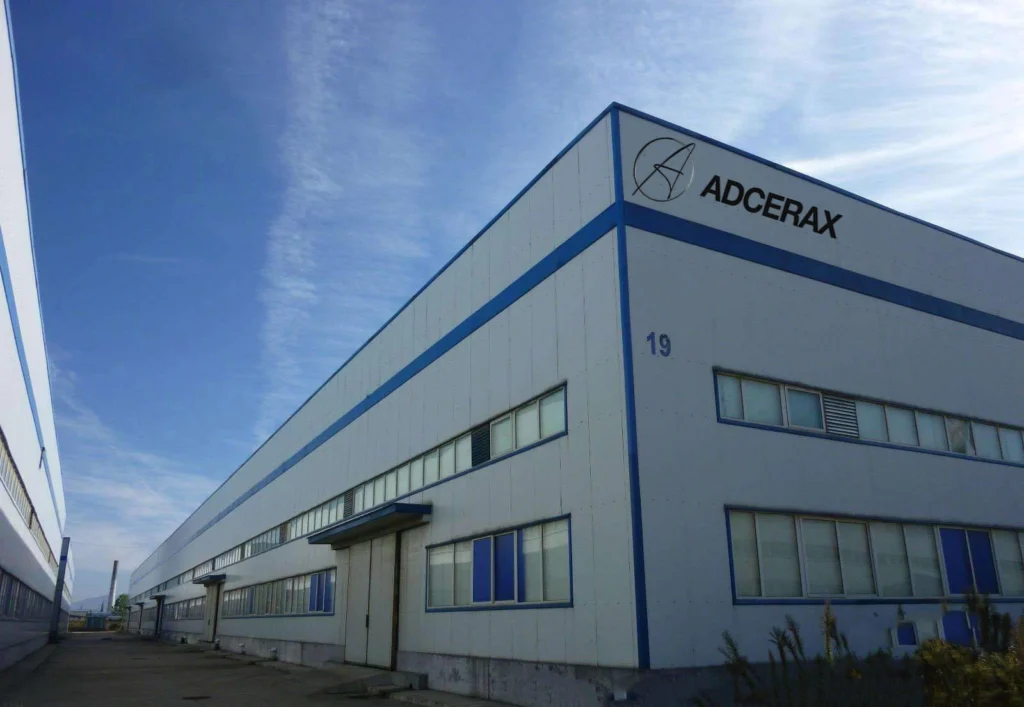
Adcerax's factory

Quick Quotation

*Our team will answer your inquiries within 24 hours.

*Your information will be kept strictly confidential.

Ready to Solve Your Engineering Challenge?

Partner with ADCERAX for reliable, high-performance advanced ceramic solutions. Our engineers are ready to discuss your project.

E-mail

info@adcerax.com

Phone

+(86) 0731-74427743 | WhatsApp: +(86) 19311583352

Response Time

Within 24 hours

Quick Quote

The more details you provide, the faster we can quote.

*We respond within 24 hours. All inquiries are confidential.

Download Catalog

Get Your Custom Sulution

The more details you provide, the faster we can respond.

customize size

*We respond within 24 hours. All inquiries are confidential.

Download Catalog