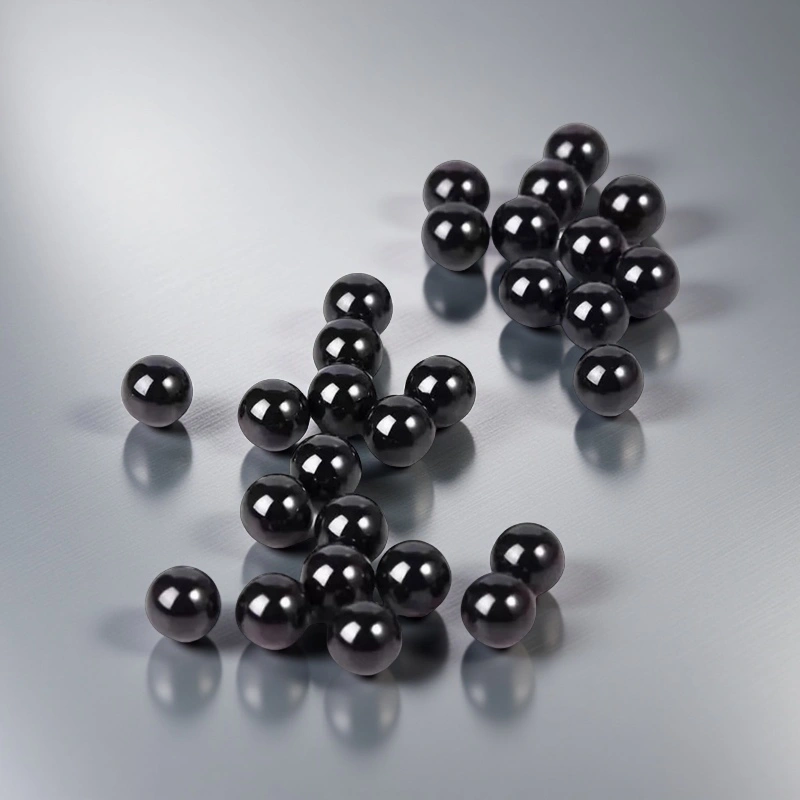
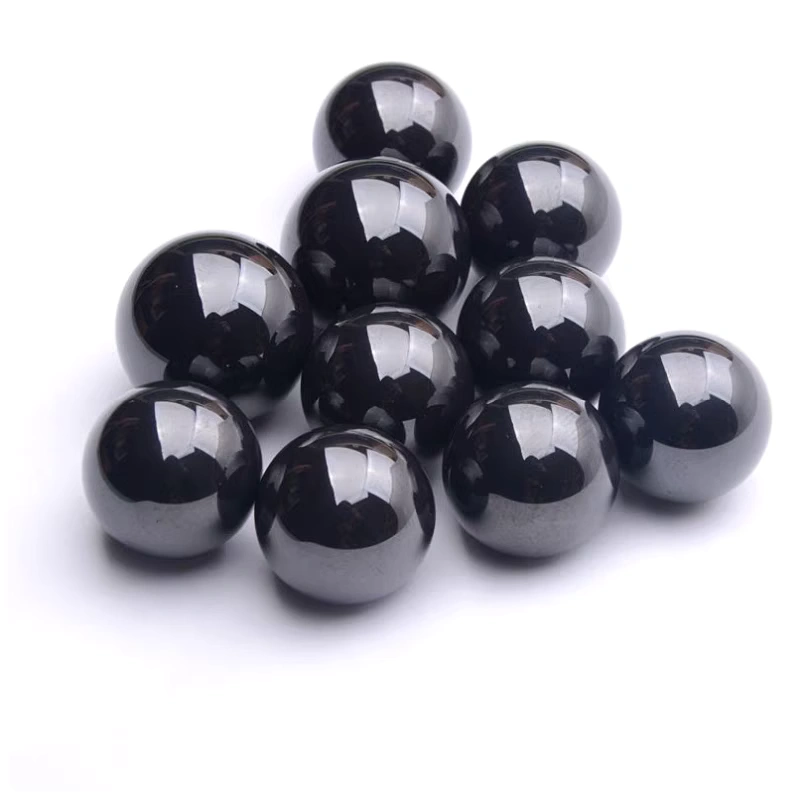
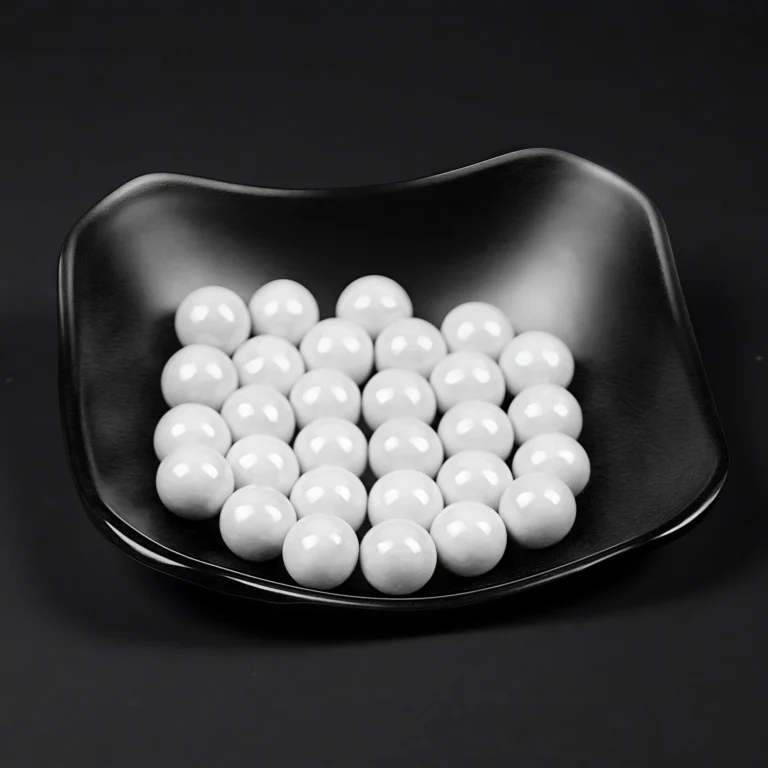
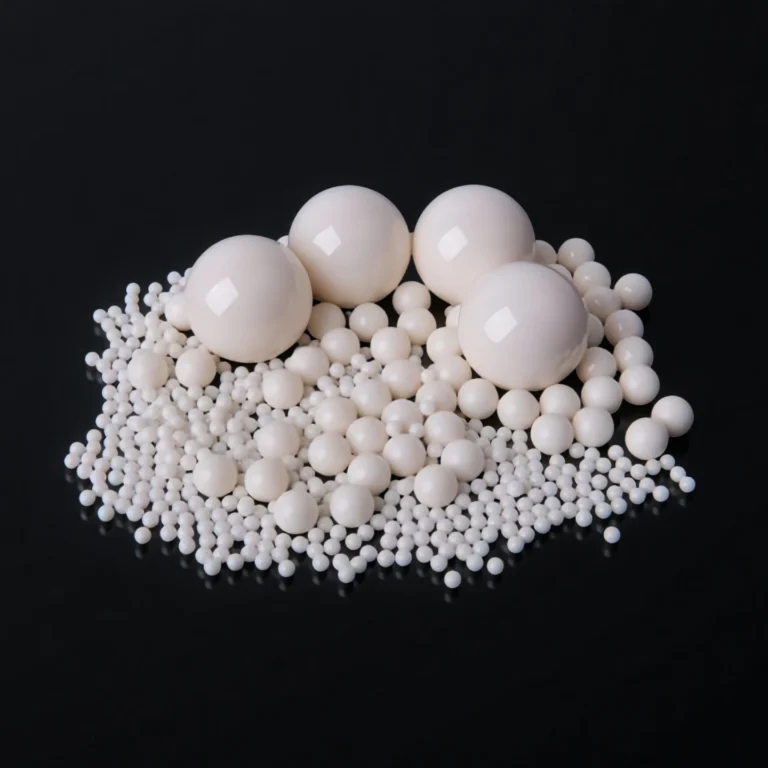
ADCERAX® SiC Bearing Balls are engineered for bearing manufacturers requiring stable geometry, low thermal expansion, and reliable rolling behavior under demanding mechanical and thermal loads. Their high-purity silicon carbide composition and fine microstructure support consistent roundness and surface quality, enabling smooth rotation even in high-speed or high-temperature environments. These properties allow SiC Bearing Balls to maintain performance where metallic and oxide-based balls experience deformation, vibration escalation, or reduced service life.
Advanced Performance Characteristics of SiC Bearing Balls
- Flexural Strength 320–450 MPa suppresses crack propagation caused by cyclic loading; this performance contrasts with alumina ceramics typically limited to <300 MPa. The increased flexural resistance improves reliability in bearings subjected to rapid acceleration and deceleration cycles.
- Service Temperature 1100–1400°C retains microstructural integrity far beyond the softening point of steels and zirconia; this helps bearings avoid geometry drift during exposure to furnace or hot-end equipment. The extended thermal limit significantly reduces distortion during heating ramps.
- High Hardness >2200 HV improves resistance to micro-spall initiation under Hertzian load; this prevents early surface fatigue where steel balls typically fail at <900 HV. The consistently high hardness also supports longer L10 life in spindle and instrument bearings.
- Compressive Strength >2200 MPa ensures stable geometry under sustained rolling stress; this stability remains even when dynamic radial load increases during high-speed operation. The high strength prevents deformation that would otherwise increase vibration signatures.
- Roundness ≤0.02–0.05 mm enables consistent load distribution across all rolling elements; this uniformity directly reduces bearing temperature rise during prolonged operation. The controlled geometry helps maintain predictable bearing stiffness.
Technical Specifications of SiC Bearing Balls
ADCERAX® SiC Bearing Balls exhibit stable mechanical, thermal, and chemical behavior supported by a high-density silicon carbide microstructure, enabling reliable performance in high-speed, high-temperature, and corrosion-exposed precision bearing systems.
| Property |
Specification |
| Material Purity |
≥98–99% SiC |
| Density |
3.05–3.15 g/cm³ |
| Hardness |
>2200 HV |
| Compressive Strength |
>2200 MPa |
| Flexural Strength |
320–450 MPa |
| Elastic Modulus |
380–420 GPa |
| Thermal Expansion Coefficient |
4.2–4.5×10⁻⁶/K |
| Thermal Conductivity |
80–120 W/m·K |
| Electrical Resistivity |
10⁵–10⁷ Ω·m |
| Porosity |
<1% closed porosity |
| Surface Roughness (Ra) |
0.02–0.03 μm |
| Chemical Resistance |
Stable in acids/alkalis |
| Microstructure |
Fine interlocked SiC grains |
| Service Temperature Limit |
1100–1400°C |
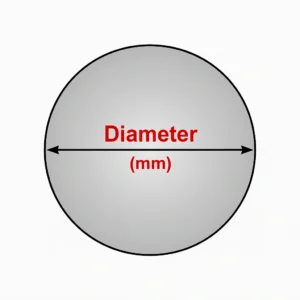
Dimensions of SiC Bearing Balls
|
SiC Bearing Balls |
|
Model No. |
Diameter(mm) |
|
AT-SIC-Q1004 |
1.588 |
|
AT-SIC-Q1006 |
2.381 |
|
AT-SIC-Q1007 |
3.175 |
|
AT-SIC-Q1008 |
3.969 |
|
AT-SIC-Q1009 |
4.763 |
|
AT-SIC-Q1011 |
5.556 |
|
AT-SIC-Q1012 |
5.953 |
|
AT-SIC-Q1013 |
6.35 |
|
AT-SIC-Q1014 |
6.747 |
|
AT-SIC-Q1015 |
7.144 |
|
AT-SIC-Q1016 |
7.938 |
|
AT-SIC-Q1018 |
8.731 |
|
AT-SIC-Q1019 |
9.525 |
|
AT-SIC-Q1024 |
12.7 |
|
AT-SIC-Q1022 |
11.113 |
|
AT-SIC-Q1026 |
13.494 |
|
AT-SIC-Q1028 |
14.288 |
|
AT-SIC-Q1030 |
15.081 |
|
AT-SIC-Q1031 |
15.875 |
|
AT-SIC-Q1033 |
16.669 |
|
AT-SIC-Q1035 |
17.463 |
|
AT-SIC-Q1037 |
18.256 |
|
AT-SIC-Q1039 |
19.05 |
|
AT-SIC-Q1040 |
19.844 |
|
AT-SIC-Q1042 |
20.638 |
|
AT-SIC-Q1044 |
22.225 |
|
AT-SIC-Q1045 |
23.813 |
|
AT-SIC-Q1047 |
25.4 |
|
AT-SIC-Q1049 |
26.988 |
|
AT-SIC-Q1052 |
28.575 |
|
AT-SIC-Q1055 |
30.163 |
|
AT-SIC-Q1056 |
31.75 |
|
AT-SIC-Q1058 |
33.337 |
|
AT-SIC-Q1059 |
34.925 |
|
AT-SIC-Q1060 |
36.513 |
|
AT-SIC-Q1062 |
38.1 |
|
AT-SIC-Q1064 |
41.275 |
|
AT-SIC-Q1066 |
42.8625 |
|
AT-SIC-Q1067 |
44.45 |
|
AT-SIC-Q1068 |
47.625 |
|
AT-SIC-Q1069 |
48.419 |
|
AT-SIC-Q1071 |
50.8 |
|
AT-SIC-Q1072 |
53.975 |
|
AT-SIC-Q1073 |
57.15 |
|
AT-SIC-Q1075 |
63.5 |
|
AT-SIC-Q1078 |
76.2 |
|
AT-SIC-Q1079 |
79.375 |
|
AT-SIC-Q1080 |
81.788 |
|
AT-SIC-Q1081 |
82.55 |
|
AT-SIC-Q1082 |
85.725 |
|
AT-SIC-Q1083 |
88.9 |
Packaging & Logistics Assurance for SiC Bearing Balls
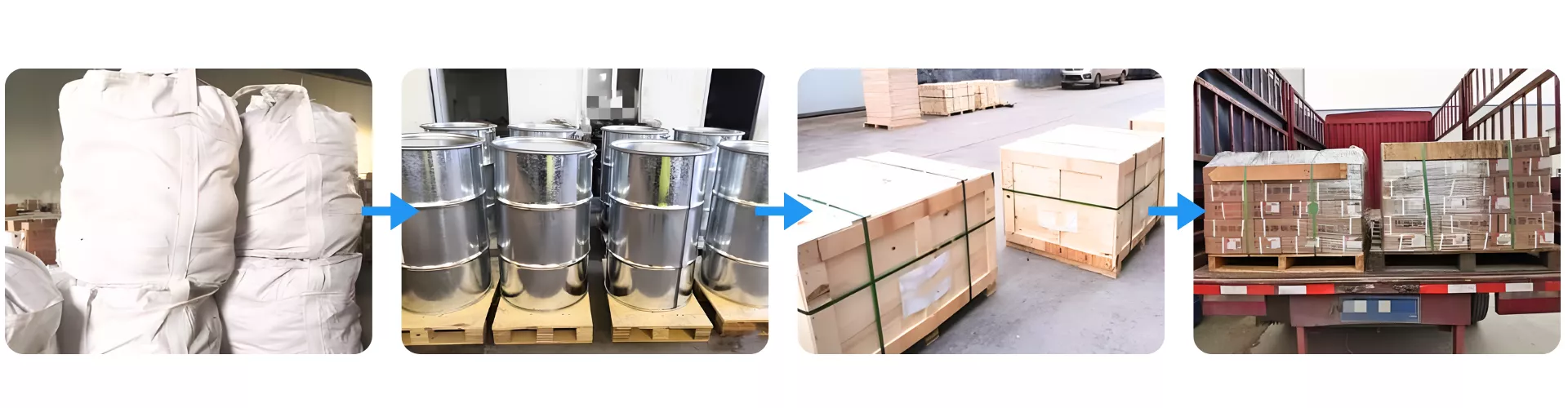
SiC Bearing Balls are secured using industrial-grade packaging formats designed to protect rolling elements during global transport. Each shipment is prepared with reinforced options such as woven bulk bags, sealed metal drums, or export-ready wooden crates to ensure stability under long-distance handling. Palletized loading and strapping are applied to maintain container integrity and prevent vibration or impact-related surface defects throughout transit.
ADCERAX® SiC Bearing Balls Overcome Critical Challenges in High-Performance Bearing Applications
ADCERAX® SiC Bearing Balls enable bearing manufacturers to address core mechanical, thermal, and environmental challenges seen in high-speed machinery, furnace-driven processes, and chemical-duty rotating equipment. These challenges originate from material instability, friction-induced heat, and corrosive atmospheres, all of which degrade steel and oxide-based ceramics in ways that silicon carbide inherently avoids.
-
High-Speed Machine Tool Spindles Requiring Ultra-Stable Rolling Elements
✅Key Advantages
1. Stable Thermal Geometry at High RPM
SiC bearing balls retain their spherical geometry under rapid acceleration because the CTE is only 4.2–4.5×10⁻⁶/K, preventing running-clearance drift. This stability suppresses heat-induced deformation that typically amplifies vibration signatures in high-rpm tool spindles.
2. High Stiffness for Vibration Control
The elastic modulus of 380–420 GPa provides superior rigidity, reducing micro-deflection during dynamic loading. This stiffness minimizes chatter initiation in demanding milling or grinding operations.
3. Ultra-Low Ra for Reduced Torque Rise
A lapped surface finish of Ra 0.02–0.03 μm decreases boundary friction, helping the spindle maintain smooth rotation during extended high-speed cycles. The enhanced surface integrity mitigates torque variations that lead to tool-marking defects.
✅ ️Problem Solved
A precision machining plant using high-speed spindles reported chronic vibration escalation after prolonged operation, traced to thermal drift in conventional steel rolling elements. During extended high-rpm cycles, steel balls experienced geometric deviation that caused irregular torque and cumulative spindle chatter. After switching to ADCERAX® SiC Bearing Balls, the spindle maintained stable running conditions throughout long production intervals due to the low CTE and high stiffness of the SiC microstructure. The improved thermal stability eliminated chatter onset and reduced surface defect frequency, enabling the spindle to run consistently through full machining cycles without performance degradation.
-
High-Temperature Conveyor and Hot-End Bearings Operating Above 800–1200°C
✅Key Advantages
1. No Softening or Structural Drift Under Heat
SiC maintains mechanical integrity up to 1100–1400°C, preventing softening that commonly occurs in metallic rolling elements. This allows bearings to sustain thermal loads without deformation across repeated heating stages.
2. Superior Thermal Shock Resistance
The combination of low porosity (<1%) and high thermal conductivity (80–120 W/m·K) reduces microcrack formation during rapid temperature transitions. This structural stability preserves rolling accuracy even under aggressive heat cycling.
3. Oxidation-Resistant Surface Stability
SiC’s oxidation-resistant surface prevents scale formation that disrupts rolling torque, unlike steels that oxidize under furnace conditions. This smooth-surface retention supports consistent torque over long hot-end duty cycles.
✅ ️Problem Solved
A furnace conveyor manufacturer experienced bearing torque instability during temperature transitions, caused by softening and oxidation of metal ball elements. Over consecutive thermal cycles, the metal balls developed microcracks that distorted rolling behavior and reduced the predictability of conveyor movement. Implementing ADCERAX® SiC Bearing Balls eliminated these distortions due to their high-temperature structural stability and resistance to oxidation. Bearings maintained consistent torque and rotational uniformity throughout repeated high-temperature cycles, allowing hot-end equipment to operate continuously without geometric drift or surface degradation.
-
Chemical-Duty and Moisture-Exposed Bearings in Pumps, Mixers, and Plant Equipment
✅Key Advantages
1. Complete Immunity to Acid/Alkali Attack
SiC maintains chemical stability in strong acids and bases such as H₂SO₄, HCl, NaOH, and KOH, preventing surface pitting that commonly initiates rolling noise. Its inertness preserves uniform rotation in moisture-rich or corrosive atmospheres.
2. Hydrothermal Stability Superior to Oxide Ceramics
Unlike oxide-based ceramics susceptible to hydrothermal surface changes, SiC retains surface integrity due to its covalent-bonded lattice and ≥98–99% purity. This stability maintains long-term Ra values required for smooth bearing operation.
3. No Corrosion-Induced Roughness Growth
SiC’s non-metallic composition eliminates oxidation-driven roughness growth, ensuring consistent friction behavior. This helps maintain predictable rolling torque even under continuous exposure to chemical vapor or damp environments.
✅ ️Problem Solved
A chemical-processing facility operating mixers and rotating plant equipment encountered persistent bearing noise and shortened service intervals caused by surface oxidation on steel rolling elements. Even when replaced with oxide-based ceramics, moisture-induced surface roughening gradually increased friction and compromised smooth rotation. After adopting ADCERAX® SiC Bearing Balls, the bearings demonstrated long-term dimensional and surface stability due to SiC’s resistance to acidic vapors and hydrothermal conditions. Rolling behavior remained consistent without pitting or roughness escalation, enabling the equipment to operate through extended chemical exposure cycles without rotational degradation.
Practical User Guide for ADCERAX® SiC Bearing Balls in Precision Bearing Systems
SiC Bearing Balls require careful handling, inspection, and assembly practices to fully leverage their mechanical stability and thermal behavior in demanding bearing environments. A structured approach to lubrication, contamination control, storage, and installation helps maintain rotational consistency and prevents performance degradation. This guide outlines essential engineering recommendations that support repeatable bearing quality and long-term functional reliability.
-
Handling & Cleanliness Requirements Before Assembly
1. Contamination Prevention
Any particulate contamination may alter rolling smoothness, so all contact surfaces must be kept particle-free prior to assembly. Cleaning should be performed using filtered solvents rated for precision bearing components. Assembly areas should maintain controlled dust levels to avoid trapped debris.
2. Surface Integrity Protection
Although SiC exhibits high hardness, improper handling can introduce micro-abrasion, affecting long-term rotation uniformity. Balls should be handled with non-abrasive tools or gloves to avoid direct impact. Avoid dragging or sliding balls on metallic trays that could mark their surface.
3. Inspection Prior to Use
A pre-installation check ensures no foreign material or residue is present on the rolling elements. Visual inspection should be performed under sufficient illumination. Troublesome residues must be removed using non-reactive cleaning agents.
-
Lubrication Compatibility and Application Guidance
1. Lubricant Selection
For consistent rotational behavior, lubricants must match the operating temperature range and intended bearing load. Synthetic oils or greases with stable viscosity under heat fluctuations are recommended. Lubricants containing particulates or aggressive additives should be avoided.
2. Application Method
Lubrication must be uniformly distributed to prevent localized friction rise during startup or extended operation. Controlled dispensing tools ensure consistent coating and reduce the risk of over-lubrication. Avoid manual smearing that may introduce fibers or airborne contaminants.
3. Re-Lubrication Interval
Under high-speed or elevated-temperature scenarios, lubricant stability diminishes faster, requiring periodic replenishment. Maintenance schedules should follow equipment duty cycles to maintain rolling stability. Any sign of lubricant discoloration warrants immediate replacement.
-
Storage, Transport, and Environmental Control
1. Humidity and Corrosion Resistance
While SiC itself is inert, improper storage can expose bearings to contaminants that affect installation quality. Storage areas should maintain low humidity to protect associated metal bearing components. Use sealed containers to prevent airborne particle adsorption.
2. Vibration-Free Transport
During transport, excessive vibration can cause impact clustering, leading to minor surface markings on SiC balls. Packed units should be cushioned inside rigid crates or metal drums. Palletized bases ensure stable stacking and reduce handling shocks.
3. Temperature Stability
Extreme thermal cycling during storage may alter lubricant condition when balls are delivered pre-lubricated. Storage temperatures should remain within stable indoor ranges. Rapid transitions should be minimized to maintain assembly readiness.
-
Installation, Alignment, and Post-Assembly Verification
1. Cage and Raceway Alignment
Proper alignment ensures uniform load distribution across all rolling elements during rotation. Misalignment can introduce vibration signatures that undermine the stability advantage of SiC balls. Precision jigs or fixtures are recommended during assembly.
2. Torque and Preload Setting
Preload must be set carefully to avoid excessive stress concentration on the rolling elements. Automated torque controls help maintain consistency across production batches. Incorrect preload settings may reduce the benefits of SiC’s rigidity and dimensional stability.
3. Operational Verification
After assembly, functional testing confirms no irregular friction or unexpected noise within the bearing system. Short-duration rotation tests simulate warm-up behavior and identify anomalies early. Any abnormal readings require immediate disassembly for root-cause evaluation.