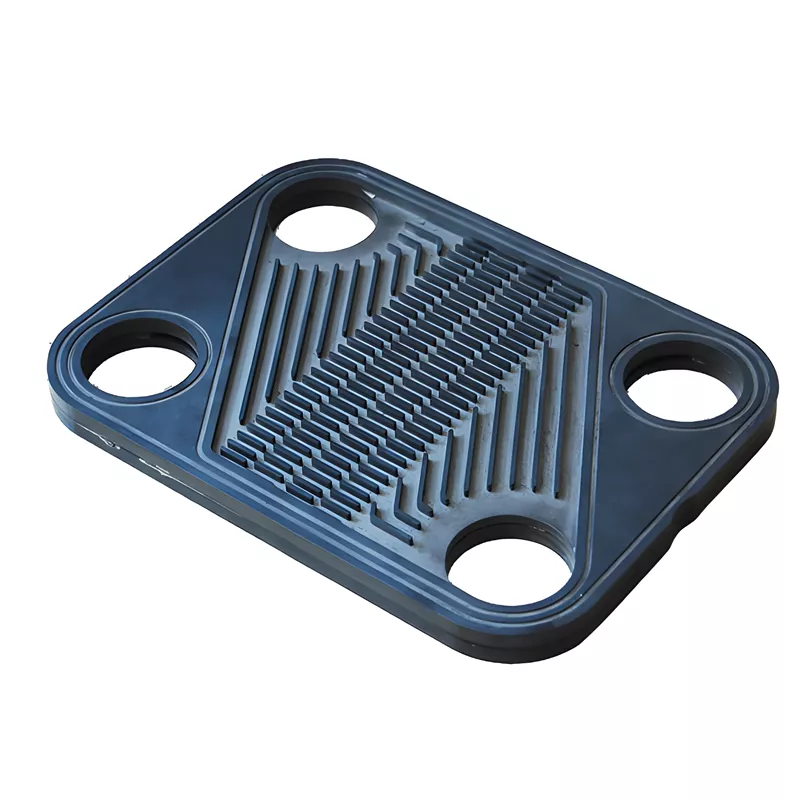
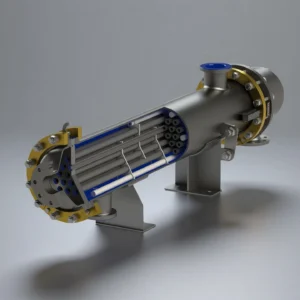
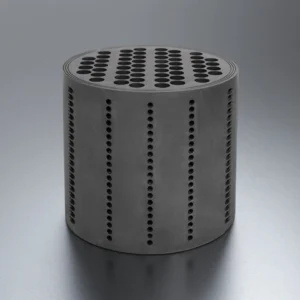
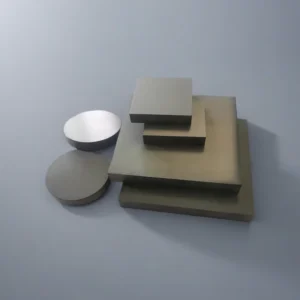
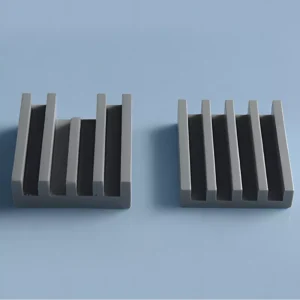
A silicon carbide heat exchanger plate is a SiC ceramic plate component used in heat-transfer equipment that handles corrosive, high-temperature or contamination-sensitive process media. Compared with many metal plates, silicon carbide offers higher chemical stability and strong thermal conductivity, making it suitable for acid recovery, solvent condensation, evaporation, waste-heat recovery and other harsh-service thermal systems. ADCERAX supports custom SiC heat exchanger plates based on flow-channel design, plate thickness, sealing interface, port layout and assembly requirements.
Engineering Performance Features of Silicon Carbide Heat Exchanger Plates
- High Heat Transfer Efficiency
Silicon carbide has high thermal conductivity compared with many corrosion-resistant ceramic materials. This helps heat exchanger plates transfer heat quickly and supports more compact thermal-system design when space, response speed and energy efficiency are important.
- Stable Performance in Corrosive Media
SiC heat exchanger plates are suitable for many acid, solvent and corrosive condensate environments. This makes them useful in chemical concentration, solvent recovery, evaporation and condensation systems where metal plates may face corrosion, pitting or process contamination.
- Resistance to Halide and Solvent-Rich Environments
Silicon carbide maintains strong chemical stability in many chloride-containing, halogenated and solvent-processing conditions. This helps reduce material degradation risk in harsh thermal systems and supports longer inspection planning compared with less corrosion-resistant materials.
- High Mechanical Strength for Plate Assemblies
Dense SiC ceramic offers high hardness and strong mechanical strength, which helps the plate maintain dimensional stability under clamping, fluid flow and thermal stress. Proper design of thickness, sealing area, edge profile and support structure is still important for safe installation.
- Thermal Shock Resistance
Silicon carbide has low thermal expansion and good thermal-shock resistance. This helps reduce stress during heating, cooling and temperature fluctuation, especially in systems where process loads change frequently.
- Surface Stability for Cleaner Heat Transfer
A dense and stable SiC surface can help reduce corrosion-related contamination and surface degradation. For applications involving high-purity chemicals, solvents or aggressive condensates, surface finish and cleaning method should be reviewed together before final selection.
Technical Specifications of Silicon Carbide Heat Exchanger Plate
The Silicon Carbide Heat Exchanger Plate is defined by its thermal conduction capability, chemical durability and structural stability. These properties support use in high-temperature and corrosive industrial heat-transfer systems where material selection, sealing design and operating conditions must be reviewed together.
| Engineering Parameter |
Typical Reference Value |
Why It Matters for Heat Exchanger Design |
| Material System |
Silicon Carbide Ceramic, SiC |
SiC is selected when corrosion resistance, thermal conductivity and dimensional stability are required in aggressive heat-transfer systems. |
| Thermal Conductivity |
Typically 120–150 W/m·K, depending on grade |
Higher thermal conductivity helps improve heat-transfer response and may reduce the required heat-exchange area in compact equipment. |
| Service Temperature |
Application-dependent, commonly used in high-temperature thermal systems |
Temperature suitability should be confirmed with media, pressure, sealing material and thermal cycling conditions. |
| Chemical Resistance |
Suitable for many acids, solvents and corrosive media |
This is important for acid concentration, solvent recovery and chemical processing where metallic plates may corrode or contaminate the process stream. |
| Flexural Strength |
Typically 350–400 MPa, depending on material grade |
Mechanical strength supports plate stability under clamping, flow pressure and thermal stress. |
| Thermal Expansion |
Around 4.0 × 10⁻⁶/K |
Low thermal expansion helps reduce dimensional stress during heating and cooling cycles. |
| Porosity |
Low-porosity or dense SiC options available |
Dense structure helps reduce contamination risk and improves resistance to fluid penetration. |
| Surface Finish |
Ground or machined surface available by requirement |
Surface condition affects sealing contact, fouling tendency and cleaning behavior. |
| Custom Geometry |
Channels, ports, edge profiles and sealing zones can be reviewed |
Custom geometry helps match existing heat exchanger frames, flow paths and gasket interfaces. |
| Inspection Focus |
Dimensions, surface condition and assembly interface |
Inspection helps reduce installation risk before shipment and supports repeat purchasing. |
Dimensions of Silicon Carbide Heat Exchanger Plate
|
Silicon Carbide Heat Exchanger Plate |
|
Item No. |
Diameter(mm) |
Height (mm) |
|
AT-THG-HRB1001 |
Customize |
Silicon Carbide Heat Exchanger Plate vs Graphite, Metal and Other Ceramic Options
| Material Option |
Main Advantage |
Common Limitation |
When SiC Plate Is a Better Fit |
| Graphite Heat Exchanger Plate |
Good chemical resistance and mature heat-exchanger use |
Lower mechanical strength and possible permeability concerns in some conditions |
When higher mechanical stability, lower contamination risk or stronger erosion resistance is required. |
| Stainless Steel or Alloy Plate |
Easy fabrication and common equipment compatibility |
May suffer pitting, corrosion or metallic contamination in strong acids and halides |
When corrosive media or purity requirements make metal unsuitable. |
| Titanium or Nickel Alloy Plate |
Stronger corrosion resistance than common steels |
Higher cost and still limited in some chemical environments |
When SiC offers better chemical stability for the target media. |
| Alumina Ceramic Plate |
Good insulation and wear resistance |
Lower thermal conductivity than SiC |
When heat-transfer efficiency is a primary requirement. |
| Silicon Carbide Heat Exchanger Plate |
Strong thermal conductivity, corrosion resistance and hardness |
Requires careful design and handling due to ceramic brittleness |
When the system needs corrosion resistance, heat-transfer efficiency and custom ceramic plate geometry. |
Packaging of Silicon Carbide Heat Exchanger Plate
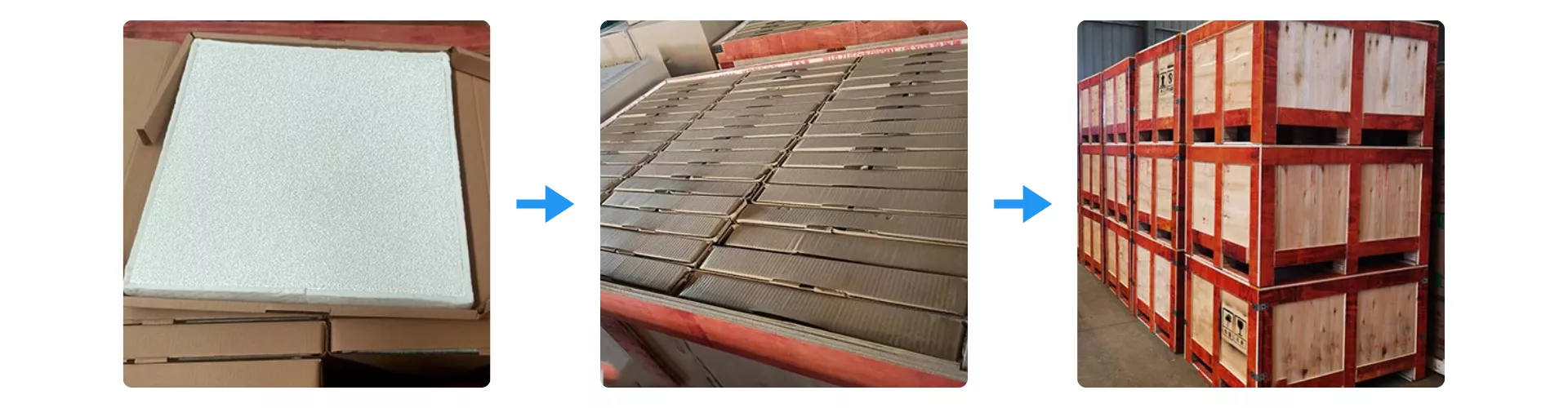
Each silicon carbide heat exchanger plate is packed with surface separation, cushioning protection and reinforced outer packaging to reduce impact, edge damage and vibration during transport. For precision-machined or polished sealing surfaces, individual separation and edge protection are recommended. Wooden cases can be used for long-distance or heavy shipments according to plate size, quantity and shipping route.
Application Scenarios for Custom SiC Heat Exchanger Plates
The Silicon Carbide Heat Exchanger Plate supports continuous thermal processing in corrosive, high-temperature, and particle-laden industrial environments where stability, material integrity, and predictable heat-transfer performance determine production efficiency and plant uptime.
-
Chemical Acid Recovery and Concentration
Silicon carbide heat exchanger plates are used in acid recovery and concentration systems where metallic plates may suffer from corrosion, pitting, stress-corrosion cracking or process contamination. In sulfuric acid, hydrochloric acid, mixed acid and corrosive condensate environments, SiC provides strong chemical stability and high thermal conductivity, helping the heat exchanger maintain stable heat-transfer performance under aggressive operating conditions.
For these applications, the plate design should be reviewed together with acid type, concentration, temperature, pressure, flow velocity, sealing material and cleaning method. ADCERAX® can support custom SiC heat exchanger plates with reviewed flow channels, port layout, sealing zones and surface finish according to the equipment drawing and process requirements.
-
Solvent Recovery and Pharmaceutical Processing
In solvent recovery and pharmaceutical thermal processing, heat exchanger plates must support efficient condensation, evaporation and heat recovery while reducing the risk of corrosion-related contamination. Dense silicon carbide ceramic is suitable for many solvent-rich and chemically aggressive environments where process cleanliness, thermal response and material stability are important.
SiC heat exchanger plates can be reviewed for systems handling organic solvents, halogenated media, process vapors and corrosive condensates. For pharmaceutical or fine chemical use, buyers should confirm the solvent type, cleaning procedure, surface finish requirement, sealing interface and allowable pressure drop before finalizing the plate design.
-
High-Temperature Waste Heat Recovery
Silicon carbide heat exchanger plates can be used in industrial waste-heat recovery systems where hot gas, corrosive vapor, abrasive particles or rapid temperature changes challenge conventional metal components. SiC offers high thermal conductivity, low thermal expansion and strong resistance to oxidation and chemical attack, making it suitable for harsh thermal environments that require stable heat transfer.
In these systems, the main design concerns are thermal shock, particle erosion, plate thickness, flow-channel geometry and installation stress. ADCERAX® can review custom plate structures for chemical plants, metallurgical processes, environmental systems and thermal recovery equipment where both heat-transfer efficiency and corrosion resistance are required.
-
Corrosive Condensation and Evaporation Systems
For condensation and evaporation systems, the heat exchanger plate must maintain uniform heat transfer while resisting corrosion, scaling and thermal stress. Silicon carbide is often selected when graphite is too fragile, metal corrosion is unacceptable, or the process requires a cleaner and more stable ceramic surface.
SiC heat exchanger plates are suitable for corrosive vapor condensation, acid evaporation, solvent evaporation and chemical concentration processes. Plate size, channel depth, sealing area, port position and surface finish should be reviewed together to reduce leakage risk, improve flow distribution and support easier maintenance during repeated operation.
For each application, ADCERAX® does not recommend selecting the SiC plate only by material name. The actual performance depends on the process media, temperature range, pressure condition, flow velocity, gasket material, cleaning method and equipment assembly design. By reviewing these factors before production, ADCERAX® helps buyers match the silicon carbide heat exchanger plate to the real operating environment instead of relying on a general ceramic plate specification.
Safe Handling and Installation Notes for SiC Heat Exchanger Plates
Silicon carbide heat exchanger plates should be handled as precision ceramic components. Although SiC offers high hardness, corrosion resistance and thermal stability, improper handling, uneven clamping or sudden thermal stress may still create edge damage, sealing problems or installation risk. Proper inspection, alignment and cleaning procedures help protect the plate surface and support stable operation in corrosive heat-transfer systems.
-
Before Installation
Before installation, check the plate surface, edge condition, port alignment and sealing area. The gasket contact surface should be clean and free from visible chips, particles or uneven contact marks.
Confirm that the plate size, port layout, flow-channel direction and sealing interface match the equipment drawing. If the plate is used as a replacement part, compare it with the original component before assembly to avoid misalignment during installation.
-
During Installation
During installation, support the SiC heat exchanger plate evenly and avoid point loading on the corners, edges or machined grooves. The plate should not be struck, twisted or forced into position.
Clamping force should be applied gradually and evenly according to the equipment design. Uneven tightening may create local stress on the sealing area or plate body. Non-metallic protection pads or suitable handling tools are recommended when positioning precision-machined ceramic surfaces.
-
During Operation
During operation, avoid sudden flow surges, dry running, severe vibration and rapid temperature changes beyond the equipment design condition. These factors may increase thermal stress or mechanical load on the ceramic plate.
For media containing abrasive particles, flow velocity and particle concentration should be reviewed carefully. Excessive particle impact may affect channel surfaces, sealing areas or long-term heat-transfer performance. Pressure drop, leakage points and temperature response should be monitored during commissioning and routine operation.
-
Cleaning and Maintenance
Cleaning methods should be selected according to the process media, scaling condition and gasket material. Compatible chemical cleaning agents, soft tools and controlled flushing are preferred. Hard metal scraping or direct impact on the ceramic surface should be avoided.
After cleaning, inspect the flow channels, ports, sealing surface and plate edges before reinstalling the component. If deposits, cracks, edge chips or abnormal leakage marks are found, the plate should be reviewed before continued use. For critical systems, keeping a maintenance record can help evaluate cleaning frequency, scaling behavior and replacement planning.