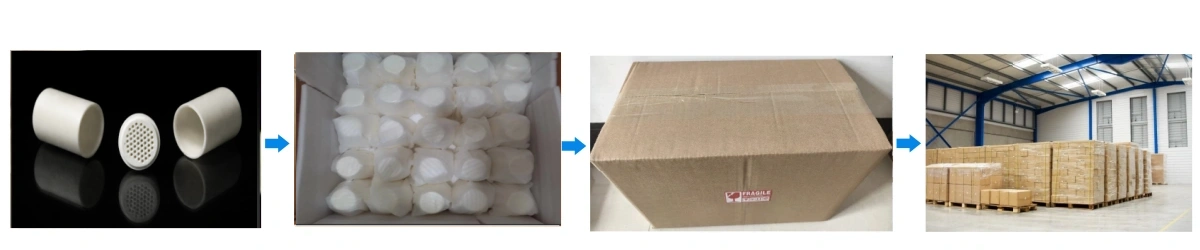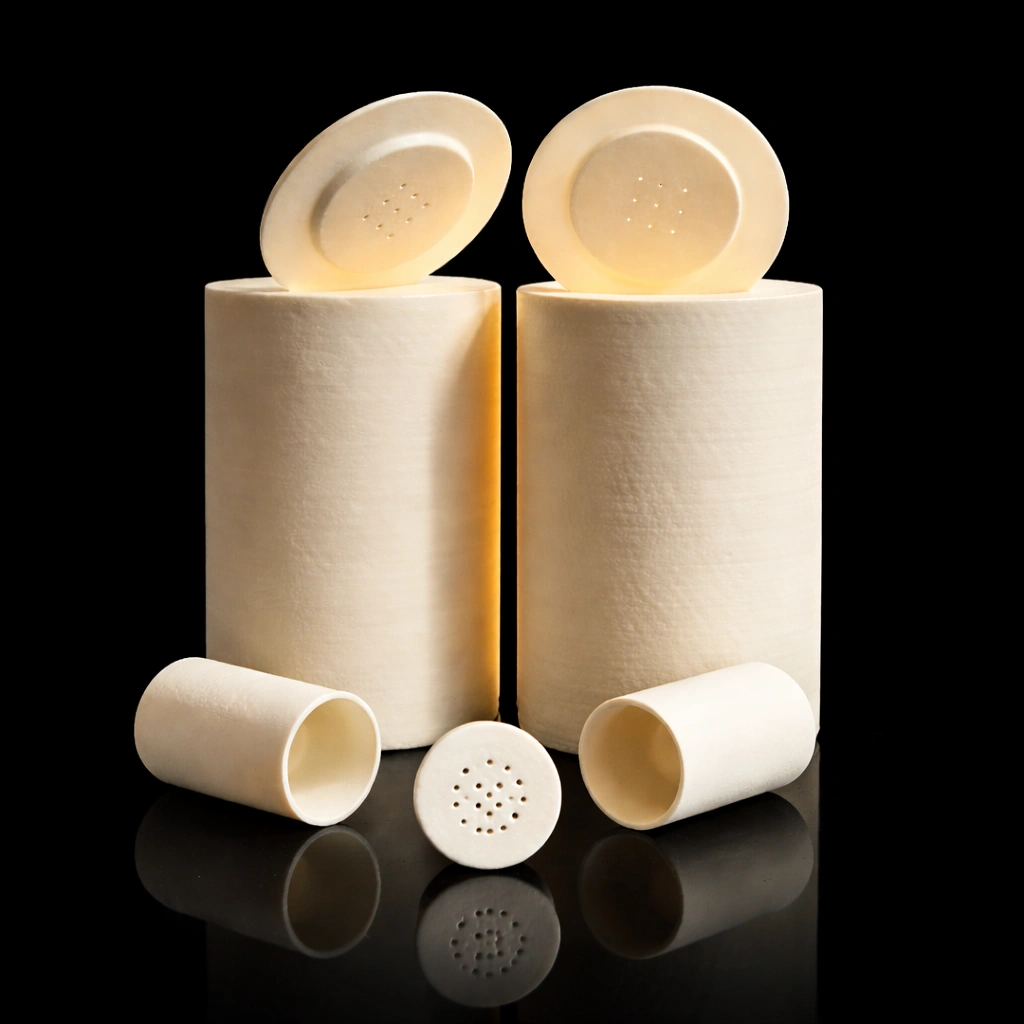
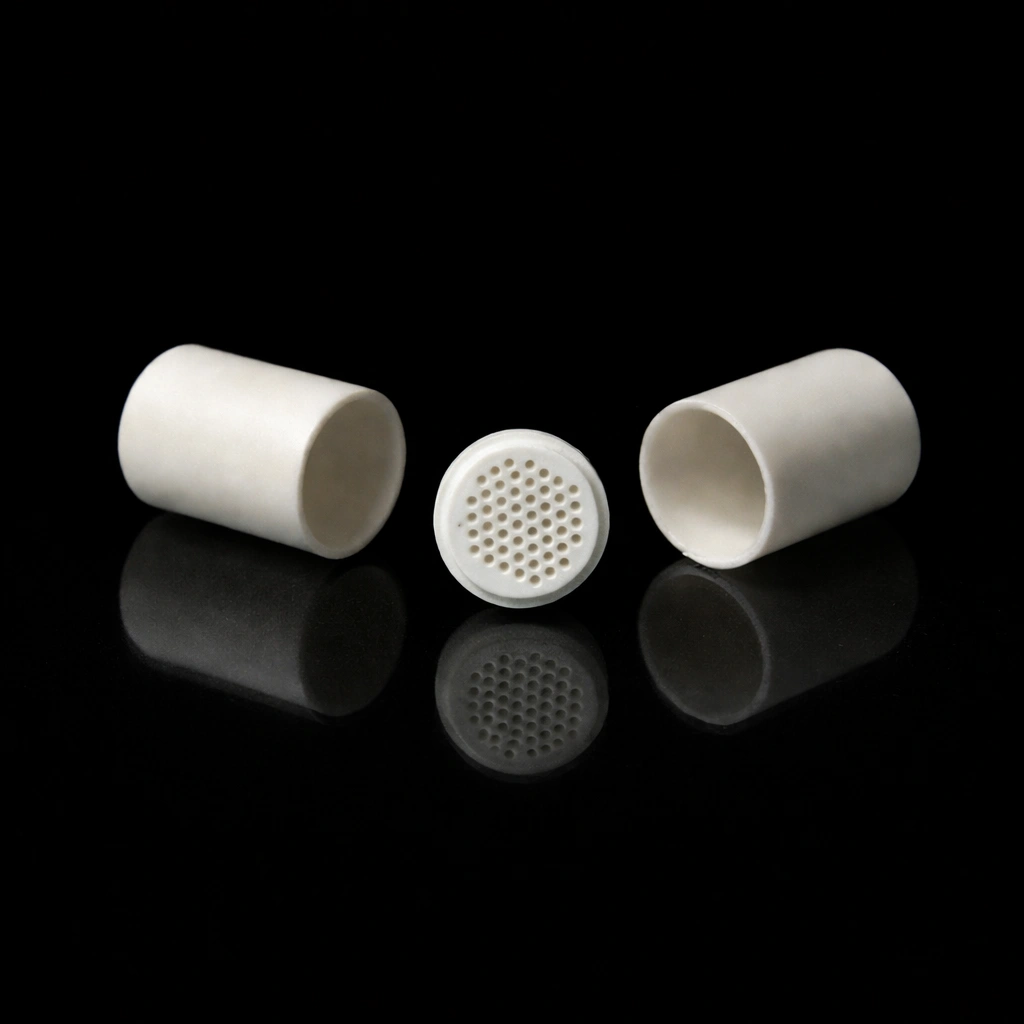
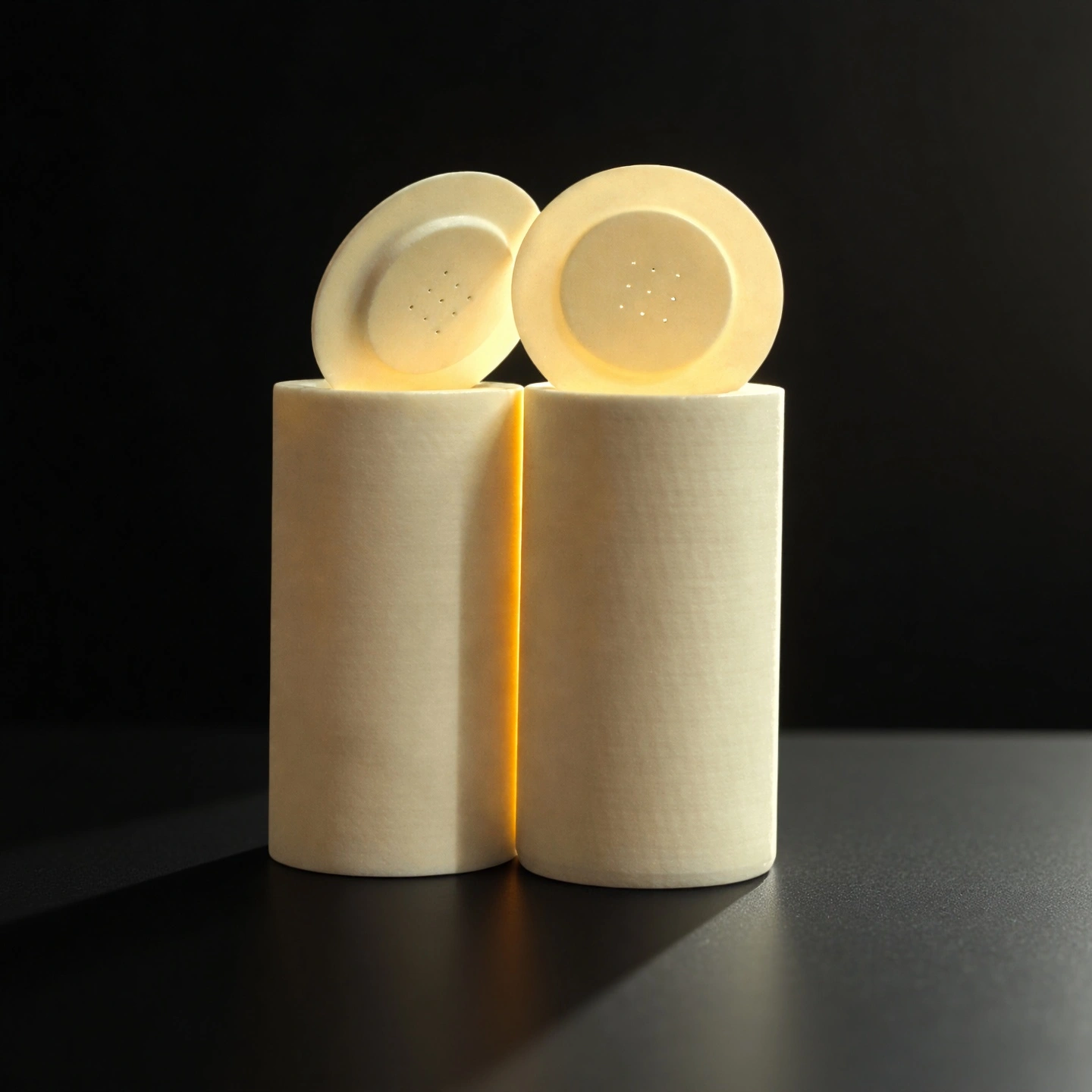
A Canfield Crucible Set (CCS) is a two-crucible alumina assembly with a perforated frit disc between them, used for high-temperature solution/flux crystal growth where a solid crystal must be separated from the remaining liquid melt.
How CCS is built
- Growth crucible (top): holds the charge and is where crystals form.
- Catch crucible (bottom): collects the liquid after separation.
- Frit disc (between): a ceramic disc with holes that acts like a rigid “filter interface.”
Canfield Crucible Sets Benefits
- Frit-disc separation interface
The integrated frit disc forms a defined separation layer between the growth crucible and catch crucible. Molten flux passes through the holes while solid crystals remain above, enabling controlled liquid–solid separation during decanting. - Cleaner recovery of the liquid phase
Because separation occurs through a rigid ceramic frit disc rather than fiber filters, the recovered melt remains free of external fiber contamination. This allows the liquid phase to be reused for additional growth experiments or compositional analysis. - Stable stacked crucible structure
The frit disc is positioned between two matched crucibles, forming a stable stacked assembly. This configuration helps maintain alignment during high-temperature heating, handling, and decanting operations. - Optional threaded containment design
A threaded CSCS-style interface can be specified for processes requiring improved containment of liquids or vapors. This structure provides additional stability during synthesis and separation steps. - Designed for sealed-tube growth workflows
Canfield Crucible Sets are commonly used inside quartz or fused-silica ampoules under inert gas conditions. The compact assembly fits typical sealed-tube crystal growth setups used in many research laboratories.
Canfield Crucible Sets Properties
| Property | Unit | 96% Al₂O₃ | 99% Al₂O₃ | 99.5% Al₂O₃ | 99.6% Al₂O₃ | 99.7% Al₂O₃ | 99.8% Al₂O₃ | 99.9% Al₂O₃ | 99.99% Al₂O₃ |
| Alumina content | % | 96 | 99 | 99.5 | 99.6 | 99.7 | 99.8 | 99.9 | 99.99 |
| Density | g/cm³ | 3.6-3.75 | 3.83 | 3.89 | 3.91 | 3.92 | 3.93 | 3.94 | 3.98 |
| Color | – | white | Ivory | Ivory | Ivory | Ivory | Ivory | Ivory | Ivory |
| Water absorption | % | 0 | 0 | – | 0 | 0 | 0 | 0 | 0 |
| Young’s modulus (Elastic modulus) | GPa | 300 | 350 | 375 | 356 | 357 | 358 | 359 | 362 |
| Shear modulus | GPa | – | – | 152 | – | – | – | – | – |
| Bulk modulus | GPa | – | – | 228 | – | – | – | – | – |
| Poisson’s ratio | – | – | – | 0.22 | – | – | – | – | – |
| Compressive strength | MPa | 1910 | 2210 | 2500 | 2552 | 2554 | 2556 | 2558 | 2570 |
| Flexural strength | MPa | 260 | 300 | 340 | 345 | 346 | 347 | 348 | 365 |
| Fracture toughness | MPa·m¹ᐟ² | – | – | 4 | – | – | – | – | – |
| Hardness | GPa | 14.5 | 17 | 17 | 23 | 24 | 25 | 26 | 30 |
| Thermal conductivity | W/m·K | 20 | 31 | 31 | 31-33 | 31-33 | 31-33 | 31-35 | 31-35 |
| Thermal shock resistance ΔT | °C | – | – | – | 222 | 223 | 224 | 225 | 228 |
| Maximum use temperature (no load) | °C | 1450 | 1680 | ≤1750 | 1755 | 1760 | 1765 | 1770 | 1800 |
| Coefficient of thermal expansion | 10⁻⁶/°C | 7.6 | 7.6 | 7.6 | 7.6 | 7.5 | 7.5 | 7.4 | 7.4 |
| Volume resistivity | Ω·cm | >1×10¹⁴ | >1×10¹⁴ | >1×10¹⁴ | >1×10¹⁴ | >1×10¹⁴ | >1×10¹⁴ | >1×10¹⁴ | >1×10¹⁴ |
| Dielectric constant (relative permittivity) | – | 9.2 | 9.5 | 9.8 | 9.83 | 9.84 | 9.85 | 9.86 | 9.92 |
| Dielectric strength | kV/mm | 15 | 19 | 16.9 | 23.2 | 23.4 | 23.6 | 23.8 | 24 |
| Dissipation factor (loss factor @ 1 kHz) | – | – | – | 0.0002 | – | – | – | – | – |
Common Canfield Crucible Set Reference Sizes
Use these common reference sizes as a starting point for CCS selection. Final dimensions and frit geometry should be reviewed against your ampoule ID, centrifuge fixture clearance and process requirements.
| Model | Nominal Capacity | Reference Size (OD × H) | Frit-Disc Reference |
|---|---|---|---|
| AT-ACP-CCS-1.7 | 1.7 mL | 10.5 mm × 25 mm | 25 holes |
| AT-ACP-CCS | 2 mL | 13 mm × 25 mm | 25 holes |
| AT-ACP-CCS-5 | 5 mL | 18 mm × 25 mm | 50 holes |
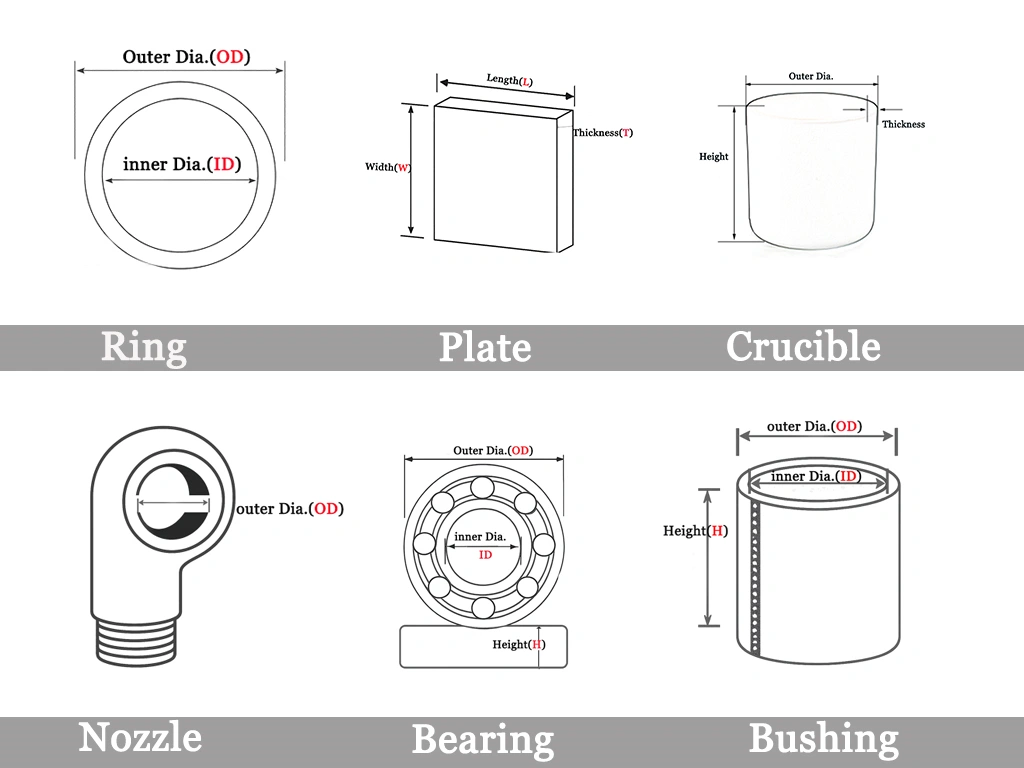
| Custom by drawing | To be reviewed | OD, ID, height and wall thickness to be reviewed | Hole count, diameter and open area to be reviewed |
Engineering note: These values are common reference sizes, not a stock, certified-dimension or availability guarantee. Final dimensions, tolerances, frit geometry and assembly fit are confirmed during engineering review.
Canfield Crucible Sets (CCS) Packaging
- Individual compartment protection: each crucible and frit-disc is separated to prevent edge chipping during transit
- Set integrity control: components packed as matched sets to avoid mixing interfaces between batches
- Shock management: foam + rigid outer carton to reduce impact transmission to the frit edge