3D Printed Ceramic | Additive Manufacturing for Complex Geometries & Rapid Prototyping
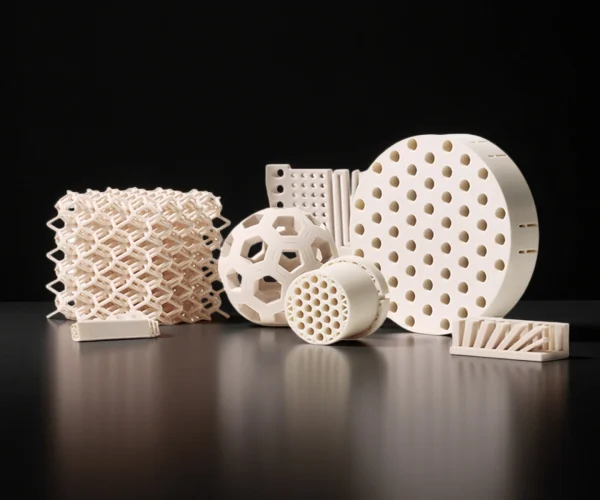
ADCERAX is a factory-direct supplier of custom 3D printed ceramic parts for industrial applications. We produce complex components in alumina, zirconia, silicon carbide, silicon nitride, aluminum nitride, and other advanced ceramic materials for prototyping, engineering validation, and low-volume production.
From CAD to ceramic part in days, not weeks. Achieve complex internal channels, lattice structures, and custom geometries impossible with traditional machining.
Fast prototyping. Greater design freedom. Lower tooling constraints.
What is 3D Printed Ceramic?
3D Printed Ceramic is a manufacturing technology that builds ceramic components layer by layer directly from digital CAD files.
Unlike traditional subtractive machining, 3D printing enables complex internal geometries, lattice structures, and organic shapes that are impossible or cost-prohibitive with conventional methods.
ADCERAX offers multiple ceramic 3D printing technologies including Stereolithography (SLA/DLP), Binder Jetting, and Direct Ink Writing (DIW).
High-precision, fine-detail parts · 25-100µm resolution
No tooling investment · Ideal for prototypes & small batches
Larger components and porous structures · 100-300µm
Controlled porosity and gradient materials · 200-500µm
3D Printing Ceramic Technologies
Different 3D ceramic printing technologies offer distinct advantages in precision, efficiency, geometry freedom, and part size. This comparison helps you identify the right process for your application needs.
| Technology | Resolution | Materials | Best For | Limitations |
|---|---|---|---|---|
| SLA/DLP (Stereolithography) | 25-100 μm | Alumina, Zirconia, Silica | High precision, fine details, smooth surfaces, dental/medical | Limited part size, requires supports |
| Binder Jetting | 100-300 μm | Alumina, SiC, Si₃N₄, Zirconia | Larger parts, porous structures, complex geometries | Lower density, requires sintering |
| DIW (Direct Ink Writing) | 200-500 μm | Most ceramic slurries | Gradient materials, controlled porosity, large parts | Lower resolution, limited overhangs |
| SLS (Selective Laser Sintering) | 100-200 μm | Alumina, SiC composites | Functional prototypes, no support needed | Surface roughness, limited materials |
SLA/DLP Ceramic 3D Printing
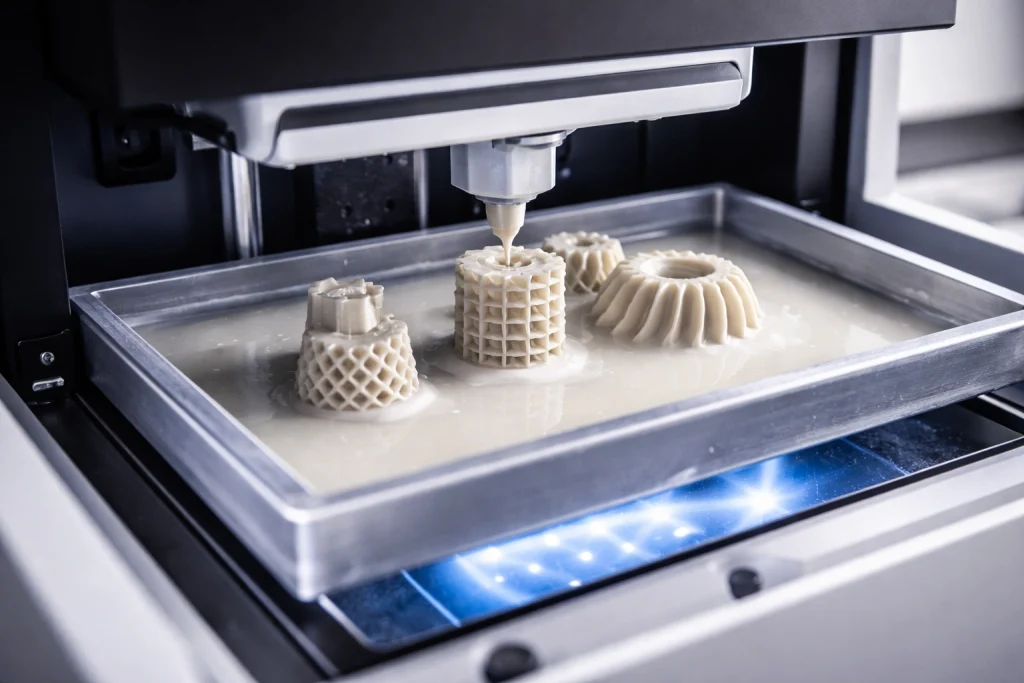
SLA/DLP ceramic 3D printing is a light-based additive manufacturing technology that builds complex ceramic parts layer by layer from a photosensitive ceramic slurry, followed by debinding and sintering.
| Specification | Value |
|---|---|
| Layer thickness | 25-100 μm |
| XY resolution | 50-100 μm |
| Surface roughness (Ra) | 1-5 μm (as-printed), <0.5 μm (polished) |
| Max part size | 200 × 200 × 300 mm |
| Typical tolerance | ±0.1-0.2 mm or ±0.5% |
| Density after sintering | >99% theoretical |
| Lead time | 5-15 days (prototype) |
Binder Jetting Ceramic
Binder jetting ceramic is a powder-based additive manufacturing technology that forms ceramic parts by selectively depositing a liquid binder onto layers of ceramic powder, followed by debinding and sintering.
| Specification | Value |
|---|---|
| Layer thickness | 100-300 μm |
| XY resolution | 100-400 μm |
| Surface roughness (Ra) | 5-20 μm |
| Max part size | 400 × 300 × 200 mm |
| Typical tolerance | ±0.2-0.5 mm or ±1% |
| Density after sintering | 95-99% |
| Lead time | 7-20 days |
DIW (Direct Ink Writing) Ceramic
DIW (Direct Ink Writing) ceramic is an extrusion-based additive manufacturing technology that builds ceramic parts layer by layer by depositing a highly loaded ceramic paste or ink, followed by drying, debinding, and sintering.
| Specification | Value |
|---|---|
| Layer thickness | 200-500 μm |
| XY resolution | 200-1000 μm |
| Surface roughness (Ra) | 10-50 μm |
| Max part size | 500 × 500 × 300 mm |
| Typical tolerance | ±0.3-1 mm |
| Special capability | Gradient porosity, multi-material |
| Lead time | 10-25 days |
Why Choose 3D Printed Ceramic?
AM Ceramic offers a practical solution for complex geometries, rapid prototyping, and custom low-volume parts. It reduces tooling constraints while supporting high precision, material flexibility, and faster product development.
Create internal channels, lattice structures, undercuts, and organic shapes impossible with traditional machining. No tooling limitations.
From CAD to ceramic part in 5-15 days. Iterate designs quickly without expensive tooling or mold changes.
Eliminate mold and tooling investment. Economical for prototypes and small batches (1-100 pieces).
Optimize part geometry for function, not manufacturability. Consolidate assemblies into single parts.
SLA technology achieves ±0.1mm tolerance and Ra <5μm surface finish. Suitable for precision applications.
Alumina, zirconia, silicon carbide, silicon nitride, and specialty ceramics available. Match material to application.
3D Printable Ceramic Materials
Additive Manufacturing ceramic materials offer different balances of strength, insulation, wear resistance, thermal performance, and chemical stability. This helps you compare the main material options and choose the right ceramic for your application.
Key Properties:High hardness, electrical insulation, biocompatible
Typical Applications: Electrical insulators, wear parts, medical implants
Key Properties: High strength, fracture toughness, biocompatible
Typical Applications: Dental prosthetics, cutting tools, pump components
Key Properties: Extreme hardness, thermal conductivity, wear resistance
Typical Applications: Heat exchangers, armor, semiconductor equipment
Key Properties: High strength at temperature, thermal shock resistance
Typical Applications: Turbine components, bearings, cutting tools
Key Properties: High thermal conductivity, electrical insulation
Typical Applications: Heat sinks, substrates, LED packages
Key Properties: Low thermal expansion, optical transparency
Typical Applications: Optical components, semiconductor fixtures
3D Printing Ceramic Applications
3D printing ceramic is used in industries that require complex geometry, functional performance, and faster development. From prototyping to high-temperature and precision electronic applications, it helps engineers create parts beyond conventional ceramic manufacturing.
Compared with traditional ceramic manufacturing, 3D printed ceramic enables faster iteration, lower upfront cost, and greater flexibility during product development. It is especially valuable for prototypes, functional testing, and low-volume pre-production parts.
Ideal for: Engineering prototypes, functional testing, form-fit verification, trade show samples
3D printed ceramic enables complex internal channels and engineered structures with greater design freedom and lower development constraints. This creates new opportunities for industrial parts that require performance-driven geometry rather than standard shapes.
Key benefit: Geometries impossible or prohibitively expensive with traditional machining
3D printed ceramic is well suited for aerospace and high-temperature applications where low weight, thermal stability, and application-specific geometry are critical. It enables advanced ceramic parts for demanding environments that require both structural performance and design flexibility.
3D printed ceramic supports electronics and semiconductor applications that require electrical insulation, thermal management, and highly customized geometries. It enables functional ceramic parts with integrated features for more compact, precise, and application-specific designs.
Custom 3D Printed Ceramic Solutions for Industrial
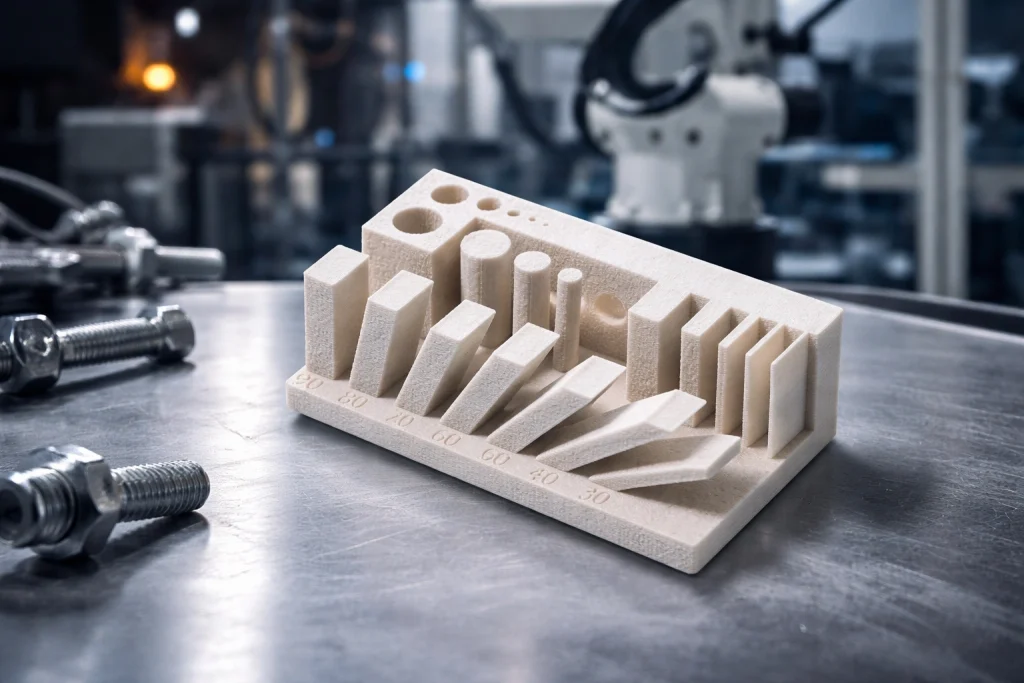
Custom 3D printed ceramic solutions help engineers turn complex designs into manufacturable parts with clear design rules, process limits, and material-specific guidance.
Design Rules for 3D Printed Ceramics
ADCERAX works with industrial customers on custom 3D printed ceramic parts, from design evaluation and material selection to prototype support and production planning.
| Parameter | SLA/DLP | Binder Jetting | DIW |
|---|---|---|---|
| Min wall thickness | 0.3-0.5 mm | 0.8-1.5 mm | 1.0-2.0 mm |
| Min hole diameter | 0.5 mm | 1.0 mm | 1.5 mm |
| Min feature size | 0.2 mm | 0.5 mm | 0.8 mm |
| Max overhang angle | 45° (with supports) | Self-supporting | 30-45° |
| Shrinkage (sintering) | 15-25% | 15-20% | 15-25% |
| Aspect ratio (height:width) | <10:1 | <5:1 | <3:1 |
Design Tips for 3D Ceramic
- Account for shrinkage: Parts shrink 15-25% during sintering. Design oversized or provide final dimensions for scaling.
- Uniform wall thickness: Avoid sudden thickness changes to prevent warping and cracking during sintering.
- Fillets and radii: Add fillets (R ≥ 0.5mm) at internal corners to reduce stress concentration.
- Drainage holes: For hollow parts, include holes (≥2mm) to drain uncured resin or remove powder.
- Support surfaces: Design flat surfaces or support features for stable sintering.
- File format: Submit STL, STEP, or native CAD files. Minimum 0.01mm resolution for STL.
Custom 3D Ceramic Workflow
Total lead time: 5-15 days (prototype) · 10-25 days (production batch)
24 hours
Upload CAD file, specify material and quantity.Quotation with DFM feedback
1-2 days
Engineering review for printability, shrinkage compensation.Confirmed design, print parameters
1-3 days
Layer-by-layer fabrication of the ceramic green body. Green ceramic part formation.
2-5 days
Remove binder, high-temperature sintering to densify.Dense ceramic part
1-5 days
Machining, polishing, inspection, and packaging. Finished part with inspection report
What ceramic materials can be 3D printed?
Alumina, zirconia, silicon carbide, silicon nitride, aluminum nitride, silica, hydroxyapatite, and various specialty ceramics. Material selection depends on application requirements.
What is the typical accuracy of 3D printed ceramics?
SLA/DLP: ±0.1-0.2mm or ±0.5%. Binder jetting: ±0.2-0.5mm or ±1%. Final accuracy depends on part size, geometry, and post-sintering machining.
How does 3D printed ceramic compare to traditionally manufactured ceramic?
After proper sintering, 3D printed ceramics achieve 95-99%+ of theoretical density with mechanical properties comparable to traditional methods. The main advantage is geometric freedom.
What is the minimum order quantity?
1 piece. 3D printing is ideal for prototypes and small batches (1-100 pieces). For larger quantities, traditional manufacturing may be more cost-effective.
How long does it take to get a prototype?
Typically 5-15 days from approved design to delivered part. Rush service available for urgent projects.
What file formats do you accept?
STL, STEP, IGES, and native CAD formats (SolidWorks, Fusion 360, etc.). STL files should have minimum 0.01mm resolution.
What is the maximum part size?
Depends on technology: SLA up to 200×200×300mm, Binder Jetting up to 400×300×200mm, DIW up to 500×500×300mm. Larger parts possible with assembly.
Can you achieve tight tolerances on 3D printed ceramics?
Yes. Post-sintering grinding and machining can achieve tolerances to ±0.01mm and surface finish Ra <0.2μm on critical features.
Why do ceramic parts shrink during sintering?
Green parts contain binder that is removed during debinding. Sintering then densifies the ceramic, causing 15-25% linear shrinkage. This is compensated in the design phase.
Is 3D printed ceramic suitable for high-temperature applications?
Yes. Once sintered, the ceramic has the same high-temperature properties as traditionally manufactured material. Alumina to 1700°C, SiC to 1600°C, Si₃N₄ to 1400°C.
Get in touch with us
We believe that Adcerax will become your best partner!
Please fill in your contact information in the form or call us.
info@adcerax.com
Telephone: +(86) 0731-74427743
WhatsApp: +(86) 19311583352
Within 24 hours
*Our team will answer your inquiries within 24 hours.
*Your information will be kept strictly confidential.