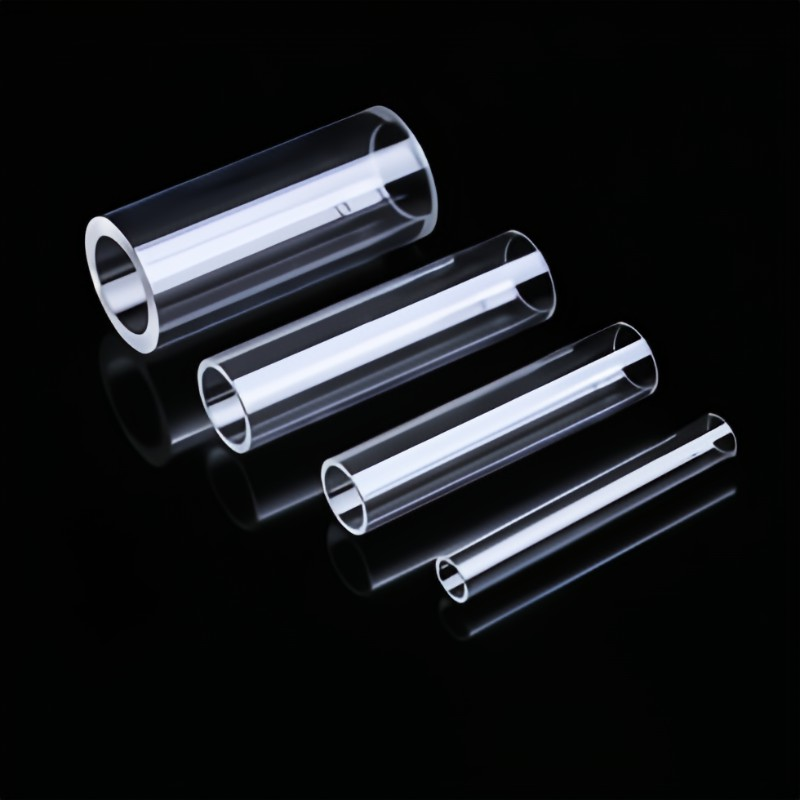
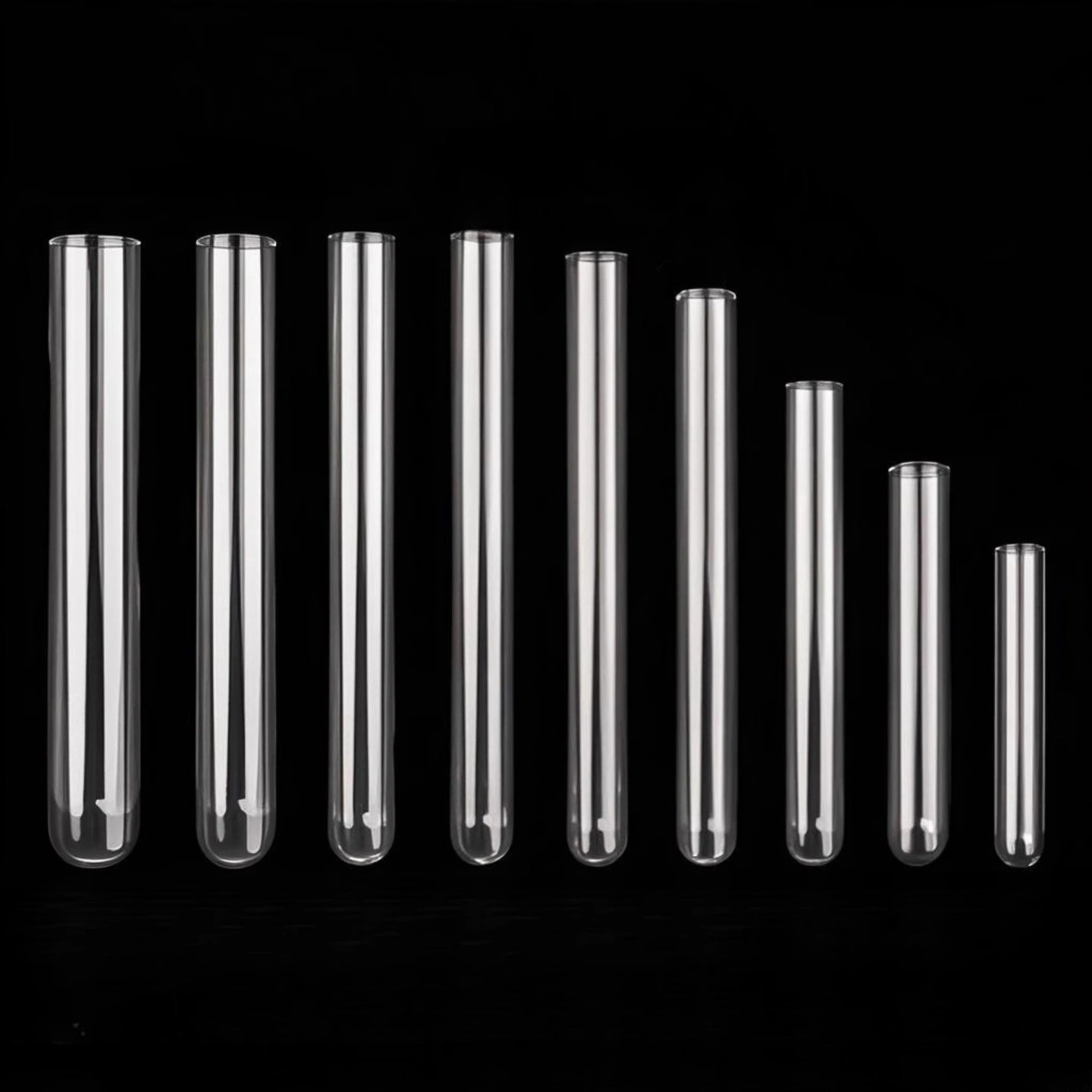
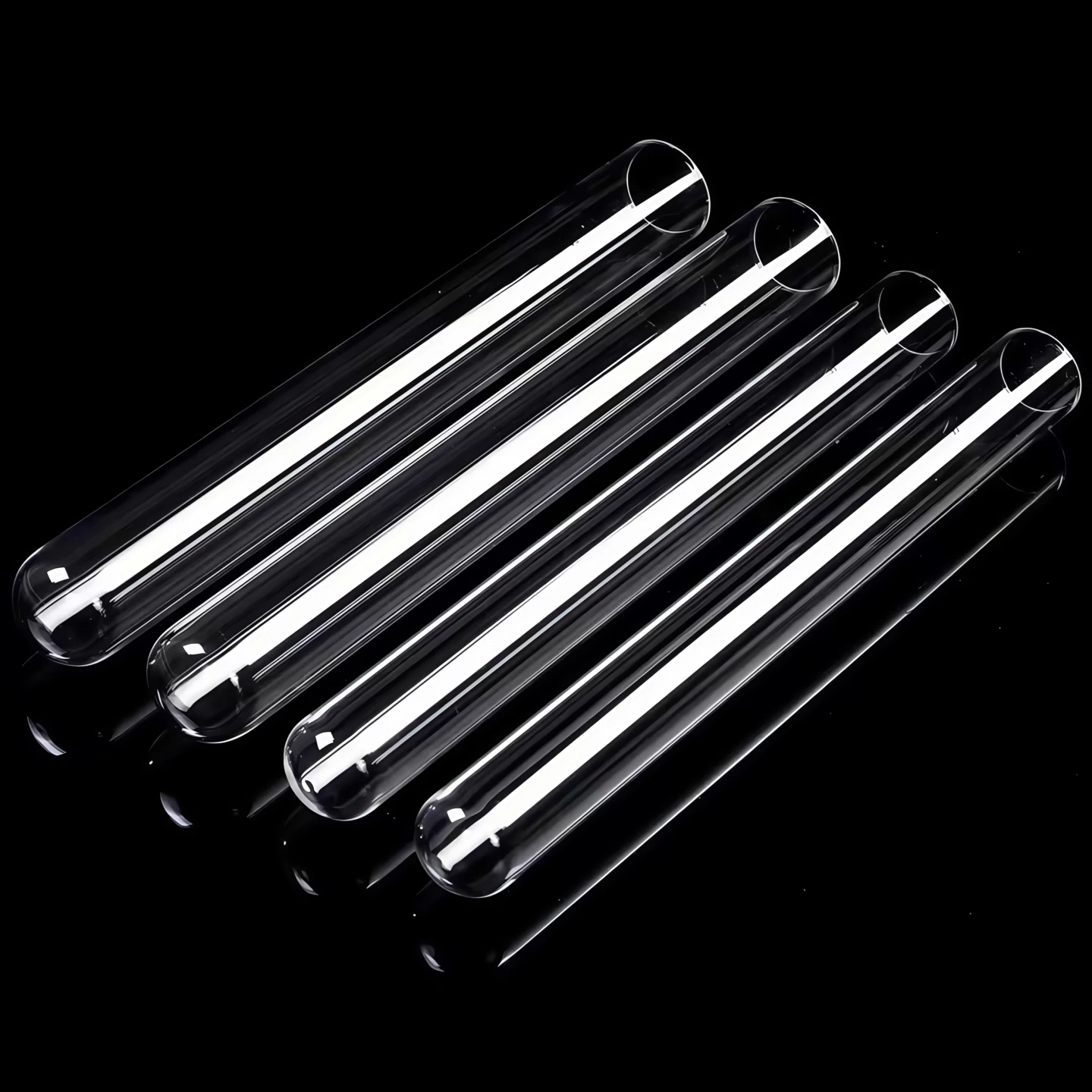
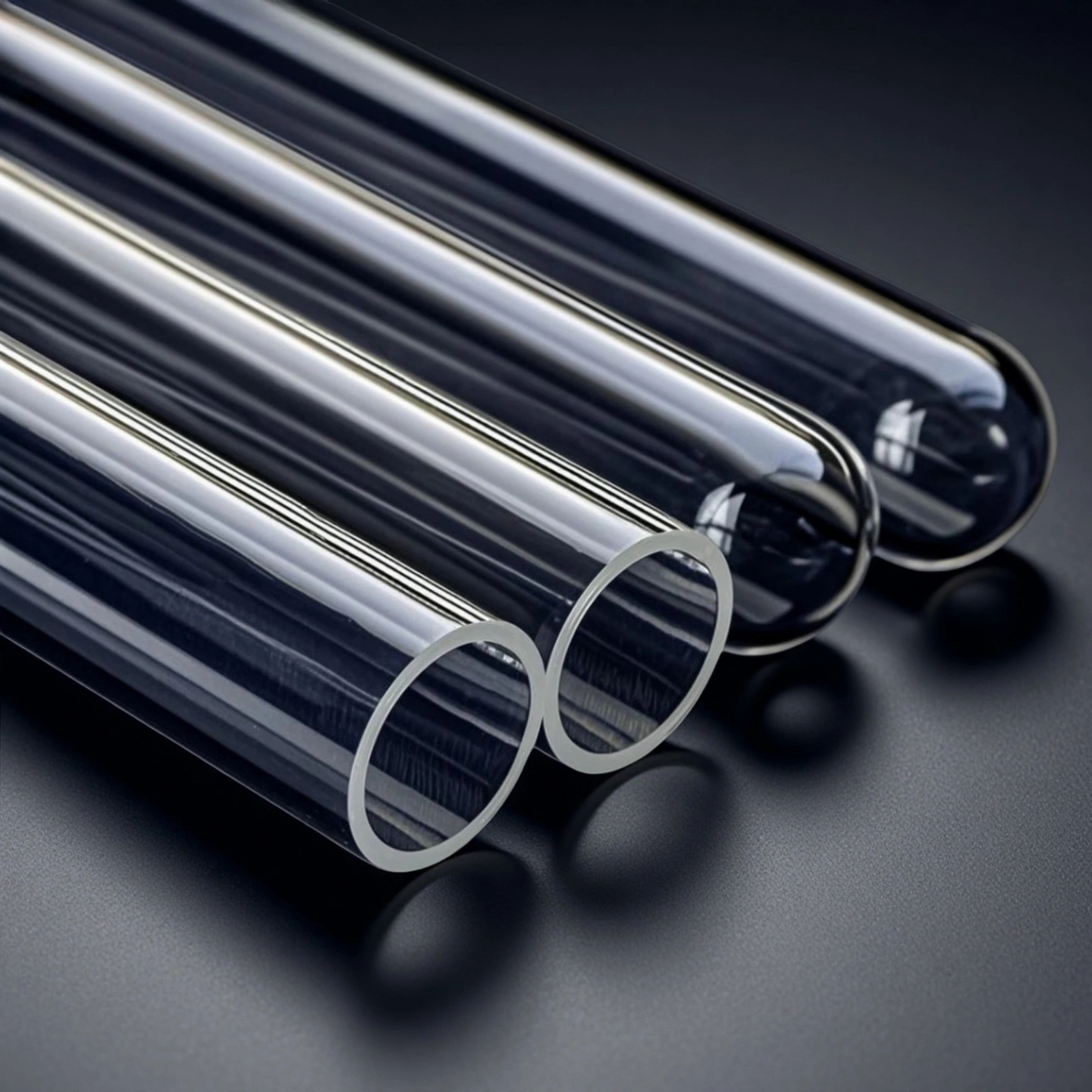
A sapphire tube is a transparent tube grown from single-crystal aluminum oxide (Al₂O₃) — not ordinary polycrystalline alumina ceramic and not quartz or glass. It is produced by EFG (edge-defined film-fed growth, near-net-shape tubing) or KY (Kyropoulos) growth, then machined and polished to the required OD/ID, wall thickness, straightness and end-face geometry. Being a single crystal, it combines deep-UV to near-IR transparency, very high hardness (Mohs 9), chemical/plasma stability and dimensional stability at high temperature.
Sapphire Tube Benefits
- Concentricity over length — stable OD/ID axis alignment to reduce lamp fit and seal stress.
- End-face geometry options — square, bevel, or micro-chamfer to lower chipping risk and improve sealing.
- Thin-wall capability — enables lower optical loss and weight without compromising straightness.
- Low-scatter finish — optional end polishing to improve UV throughput and imaging consistency.
- Dimensional repeatability — drawing-matched batches for easier replacement and interchange.
When Should You Choose a Sapphire Tube?
A sapphire tube is usually selected when the application requires optical transmission, high surface hardness, chemical stability, and dimensional control in a harsh environment. Compared with quartz or borosilicate glass, sapphire is more suitable for systems exposed to abrasion, plasma, repeated handling, or elevated temperature near optical or sensing paths.
- Single-crystal sapphire tube — when you need transparency + high hardness + high-temperature dimensional stability + chemical/plasma resistance in a tube form (thermocouple sheaths, UV lamp envelopes, plasma/vacuum sight tubes, capillaries).
- Polycrystalline alumina ceramic tube — opaque; use where an optical path is not needed (separate product, different properties — sapphire's single-crystal data does not apply).
- Quartz/borosilicate glass tube — lower cost for low-temperature, low-wear, non-critical use; softens earlier and is less resistant to strong alkali and plasma.
Sapphire Tubing Typical Reference Properties
|
Property |
Value |
|
Material |
Al2O3 (monocrystalline structure) |
|
Purity |
99.999% |
|
Max. Working Temperature |
1950℃ |
|
Transmissivity |
>86% (280-3500nm) |
|
Refractive Index (λ ≈ 546 nm) |
1.76 |
|
Density |
3.98-4.1g/cm3 |
|
Hardness |
1700Hv |
|
Compressive Strength |
2100MPa |
|
Tensile Strength |
200MPa |
|
Bending Strength |
445MPa |
|
Elasticity Modulus |
380GPa |
|
Poisson's Ratio |
0.28 |
|
Thermal Conductivity |
28-32W/m*K |
|
Thermal Expansion Coefficient |
6 × 10⁻⁶ /K |
|
Volume Resistivity |
>1.5 × 10¹⁶ Ω·cm |
|
Dielectric Strength |
48KV/mm |
|
Lattice Constant (a, c) |
a = 4.758 Å, c = 12.991 Å |
|
Double-Side Polished Surface |
Ra < 0.5 nm |
The values below are typical reference properties for single-crystal sapphire material. Final values may vary by grade, geometry, surface finish, orientation, and inspection method. Project-specific data should be confirmed during engineering review.
Sapphire Tube Specifications
|
Type 1 ——Sapphire Tube Open at Both Ends |
|
Item No. |
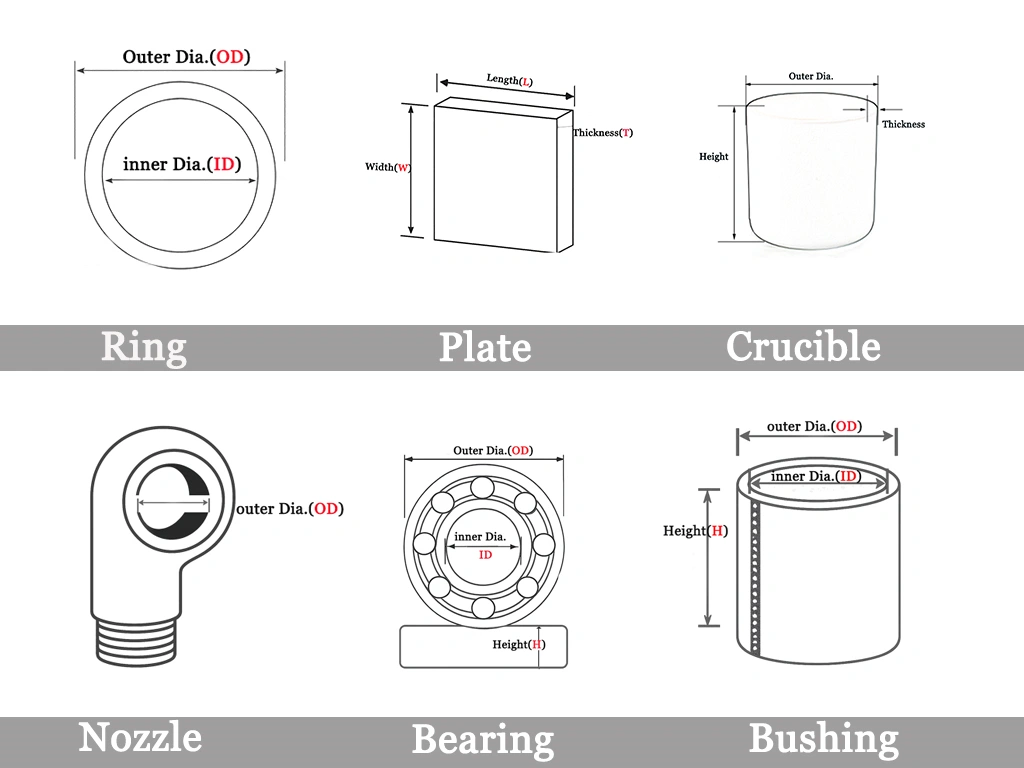
Outer Diameter(mm) |
Thickness(mm) |
Length (mm) |
|
AT-BS-G2001 |
5~10mm |
1~4mm |
0~1400mm |
|
AT-BS-G2002 |
10~20mm |
1~8mm |
0~1400mm |
|
AT-BS-G2003 |
20~30mm |
1~10mm |
0~1400mm |
|
AT-BS-G2004 |
30~50mm |
1~15mm |
0~1400mm |
|
AT-BS-G2005 |
50~70mm |
1~15mm |
0~400mm |
|
AT-BS-G2006 |
1~3mm |
Inner hole 0.3~1mm |
0~150mm |
|
AT-BS-G2007 |
5-200mm |
Inner hole0.3-180mm |
5-1400mm (Customize) |
|
Type 2 ——Sapphire Tube One End Sealed |
|
Item No. |
Outer Diameter(mm) |
Inner Diameter(mm) |
Length (mm) |
|
AT-BS-G2008 |
20-70 |
16 |
800 |
|
AT-BS-G2009 |
20-70 |
16 |
900 |
|
AT-BS-G2010 |
20-70 |
16 |
1000 |
|
AT-BS-G2011 |
20-70 |
16 |
1450 |
|
Type 3 ——Sapphire Thermocouple Protection Tubes |
|
Item No. |
Outer Diameter(mm) |
Inner Diameter(mm) |
Length (mm) |
|
AT-BS-G2012 |
6 |
4 |
5-1500 |
|
AT-BS-G2013 |
8 |
5 |
5-1500 |
|
AT-BS-G2014 |
10 |
5 |
5-1500 |
|
AT-BS-G2015 |
5-80 |
2-70 |
5-1500 (Customize) |
|
Type 4 ——Sapphire Capillary Tube |
|
Item No. |
Outer Diameter(mm) |
Inner Diameter(mm) |
Length (mm) |
|
AT-BS-G2016 |
1.57 |
0.5 |
280 |
Sapphire Tube vs. Quartz/Borosilicate
- Durability: Sapphire outperforms in hardness and abrasion resistance; quartz/borosilicate are more prone to scratching.
- Optics: Sapphire supports deep-UV and high-energy environments with polished, low-scatter ends; quartz also transmits UV but scratches more easily.
- Temperature & strength: Sapphire maintains geometry at heat with lower CTE; borosilicate is cheapest but least suitable for harsh UV/thermal duty.
- Cost & machining: Sapphire is higher cost and requires diamond machining; quartz/borosilicate are easier to form and cheaper for non-critical use.
| Property |
Sapphire Tube |
Quartz Tube |
| Hardness |
Mohs 9 (very high) |
Mohs 7 |
| Thermal Shock Resistance |
Excellent (up to 1000 °C ramp tolerance) |
Moderate (≤800 °C) |
| UV Transmission |
Deep-UV (190 nm) |
UV (220 nm limit) |
| Chemical Resistance |
Excellent to acids/alkalis/plasma |
Limited in fluorine/chlorine plasma |
| Cost |
Higher, but longer service life |
Lower initial cost |
In summary: sapphire is chosen where lifetime stability, deep UV throughput, or dimensional precision is critical.
Sapphire Sleeves Packing
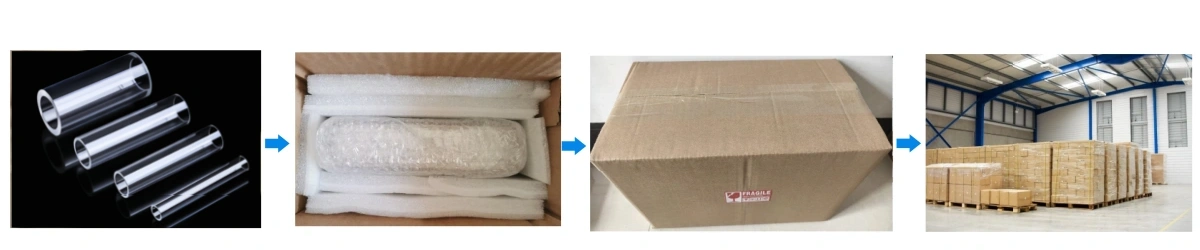
- Each sapphire tube is individually packed in anti-static foam-lined boxes
Application Scenarios – Sapphire Tube Use
Sapphire tubes combine optical transmission, high surface hardness, electrical insulation, chemical stability and dimensional integrity in a single-crystal Al₂O₃ component.
-
Thermocouple and Sensor Protection
Sapphire tubes can be evaluated as protective sheaths for thermocouples, temperature sensors and optical probes used in high-temperature or chemically demanding equipment. Open-ended and one-end-closed structures can protect the sensing element while providing electrical insulation and a stable installation geometry.
They are particularly relevant when the application requires a combination of surface hardness, chemical stability, electrical insulation and visual access that a conventional metal or opaque ceramic sheath cannot provide.
-
Plasma & Vacuum Equipment
Sapphire tubing can be used for selected plasma observation, diagnostic protection, electrical isolation and vacuum equipment applications. Its single-crystal structure, surface hardness and chemical stability make it suitable for engineering review where transparent access and resistance to process exposure are required.
Plasma compatibility and assembly sealing cannot be determined from the material name alone. Gas chemistry, exposure direction, temperature, pressure and cleaning procedure must be reviewed for each design.
-
Analytical Instruments, NMR and Spectroscopy
Sapphire tubes and small-bore sleeves can be evaluated for analytical instruments, NMR-related assemblies, spectroscopy systems and optical diagnostic equipment. They may serve as sample tubes, protective channels, optical paths or chemically stable sleeves where dimensional control and a durable polished surface are important.
Transmission and measurement performance depend on wavelength, wall thickness, crystal orientation, bore quality, surface finish and allowable optical defects. These requirements should be defined before manufacturing.
-
UVC, UV Curing and Specialty Lamps
Sapphire tubes can be used as protective sleeves, lamp envelopes or optical channels in selected UVC, UV curing and specialty-light applications. They are considered where the design requires UV transmission together with high surface hardness, resistance to scratching and dimensional stability around the lamp or optical assembly.
Actual transmission depends on wavelength, wall thickness, surface condition and material quality. Lamp temperature, internal atmosphere and end-sealing design must also be reviewed before the tube is approved for use.
-
High-Temperature Viewports, Optical Paths and Capillary Applications
Sapphire tubes can provide a transparent viewing or diagnostic path in selected furnaces, reactors and high-temperature process equipment. Small-bore sapphire capillary tubes and sleeves can also be evaluated for compact optical channels, sensor protection and precision fluid or gas paths.
For viewport applications, the complete assembly must account for the temperature gradient, mounting stress, pressure differential and sealing method. For capillary applications, bore consistency, straightness, surface condition and media compatibility become the primary design factors.
Information Needed for Sapphire Tube Quotation
To help our engineering team evaluate manufacturability and quote accurately, please provide the following information when requesting a sapphire tube or sleeve.
| Required Information |
Why It Matters |
| OD, ID, wall thickness, and length |
These dimensions define the fit-up, machining route, and tube stability. |
| Open end, closed end, chamfer, bevel, or polished end |
End geometry affects sealing, installation safety, and optical performance. |
| Surface finish and optical requirement |
Ground, lapped, or polished surfaces should match the transmission or viewing requirement. |
| Concentricity, straightness, and runout requirement |
These items are critical for lamp sleeves, vacuum feedthroughs, and long tubes. |
| Operating environment |
UV, plasma, vacuum, chemical media, temperature, and thermal cycling should be reviewed before production. |
| Quantity and repeat order expectation |
This helps evaluate tooling, batch control, packaging, and cost structure. |