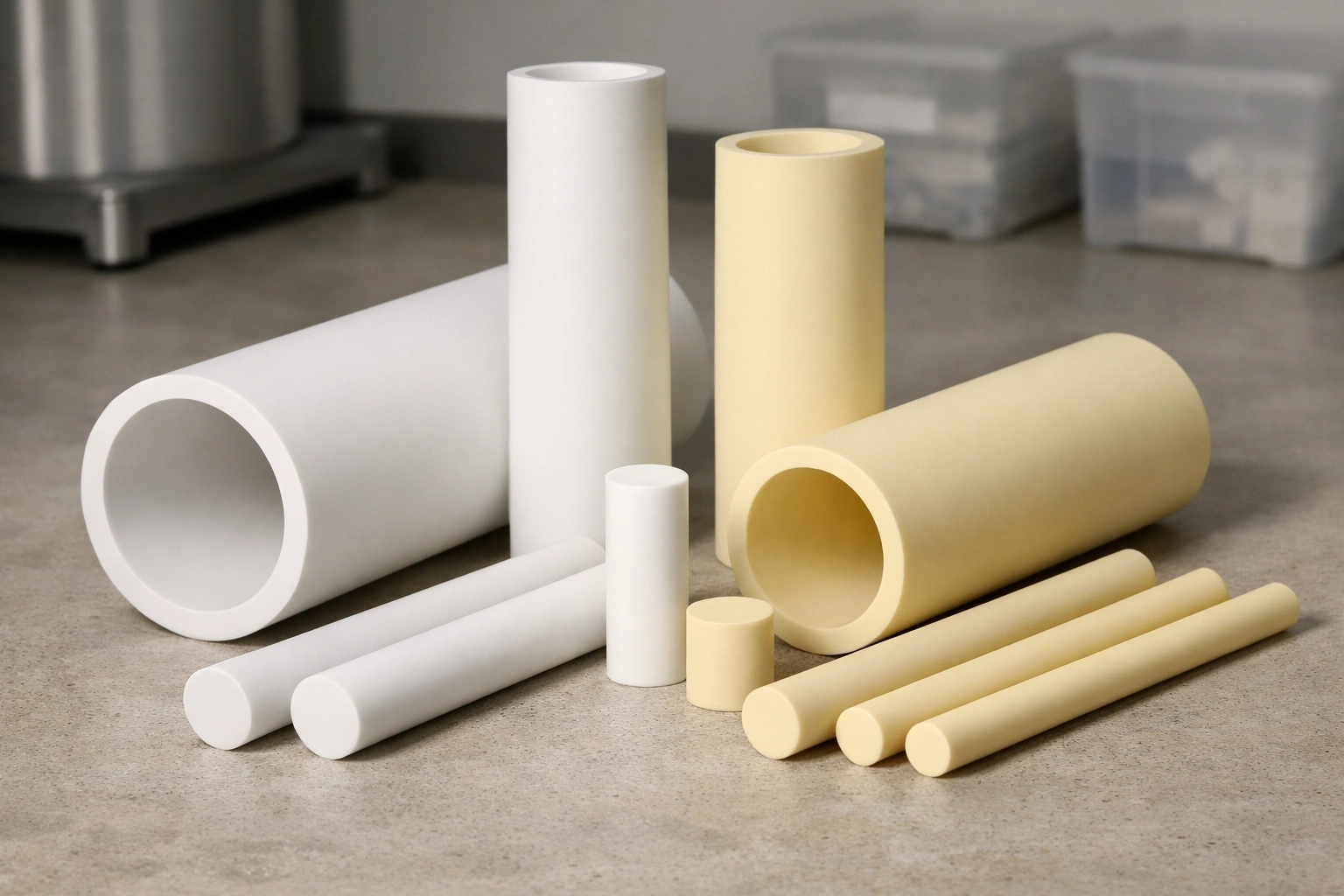
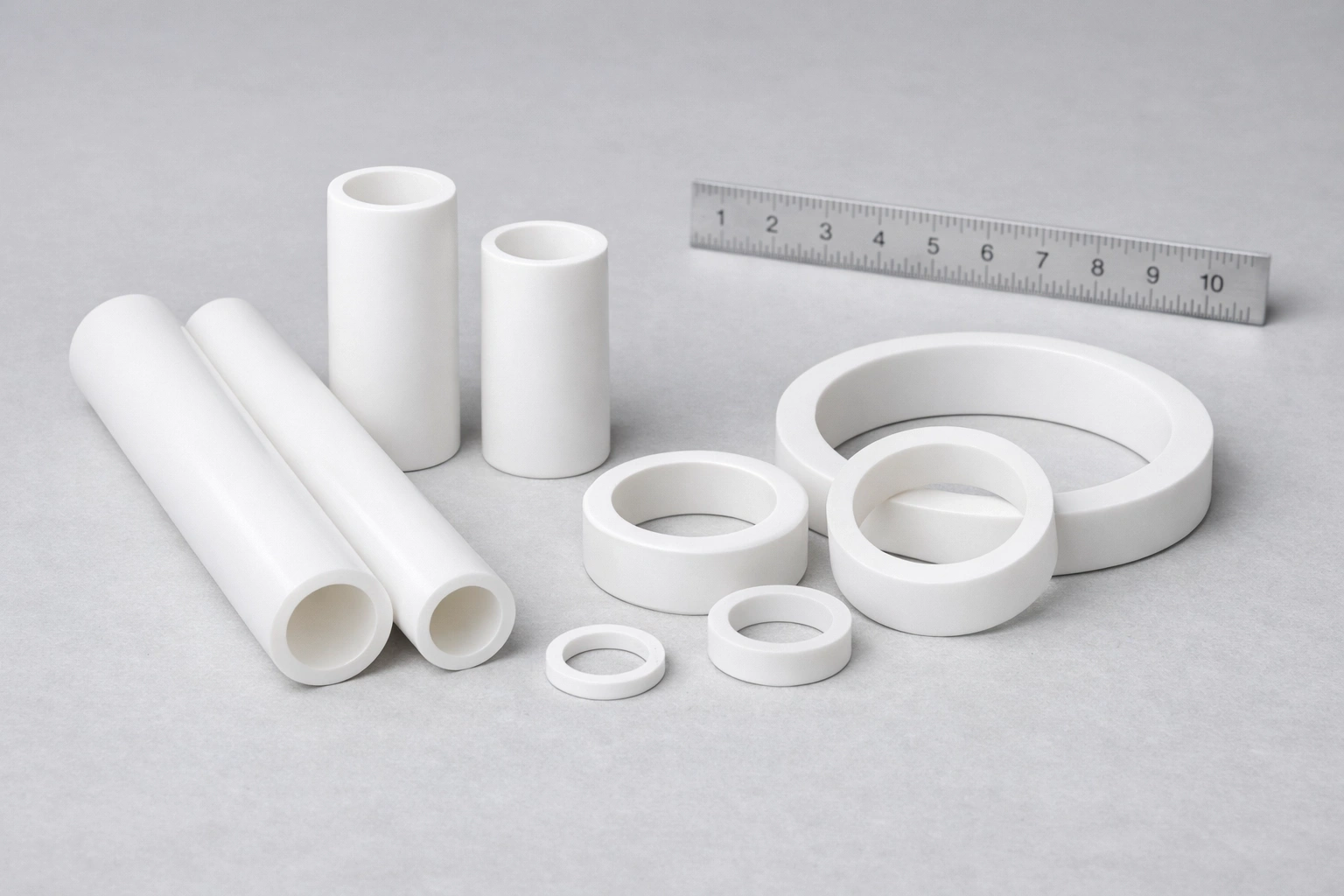
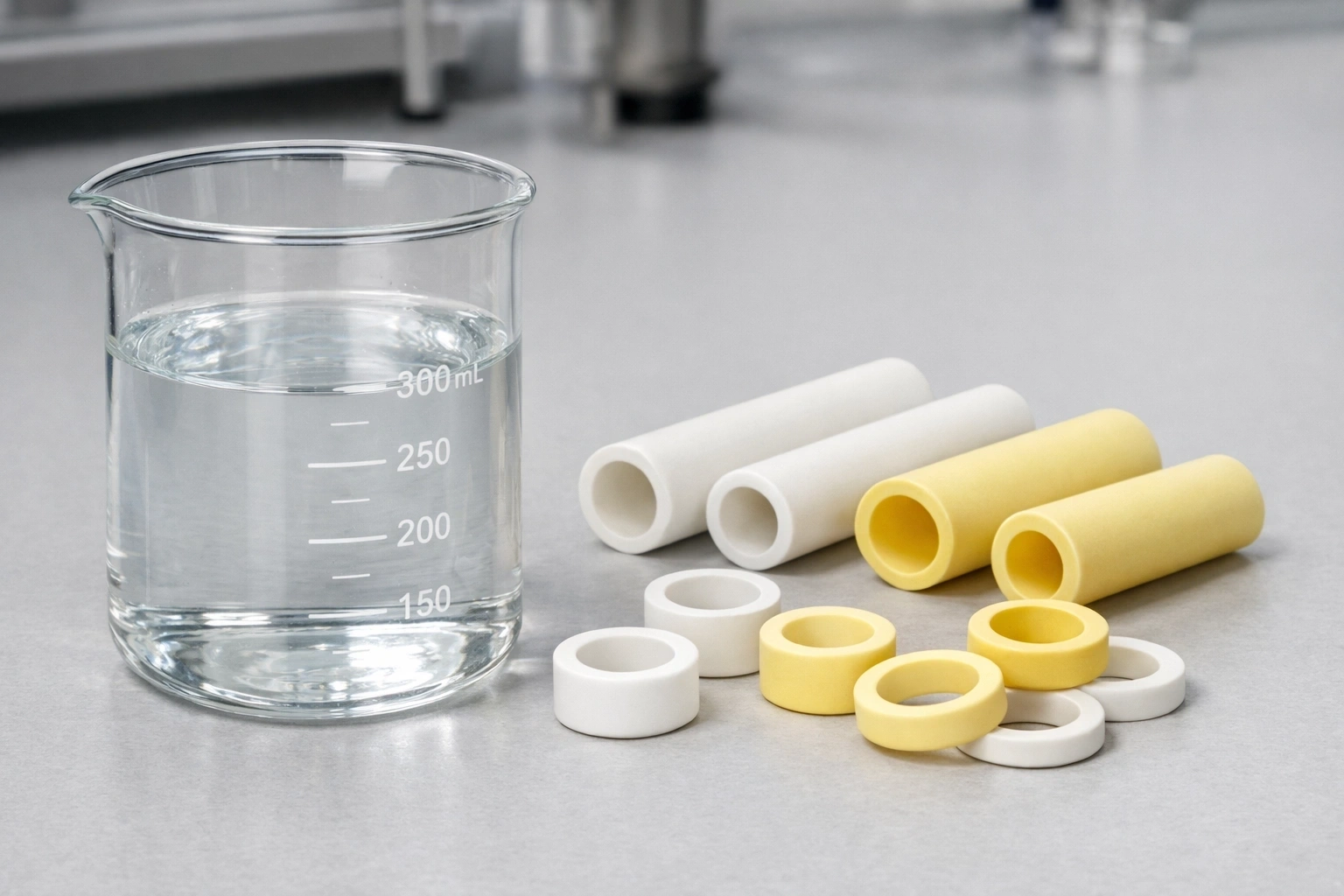
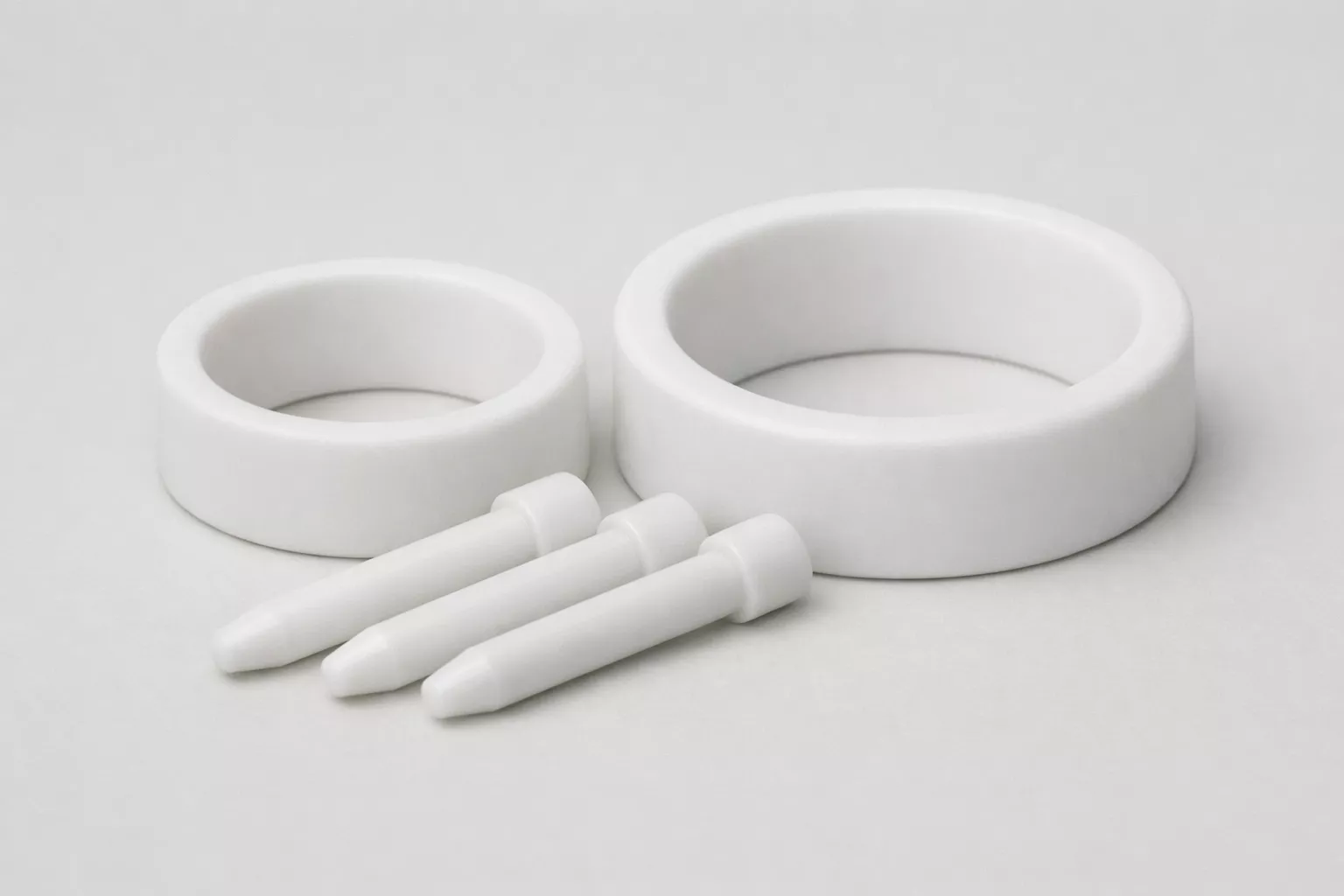
Precision-ground alumina tubes face seal leakage, runout, and assembly drift when left as-sintered; grinding stabilizes size, geometry, and surface for reliable interfaces.
Precision-ground alumina tubes consistently meet ±0.02–0.10 mm tolerance, <0.05 mm TIR, and 0.4–0.8 µm Ra (0.1–0.3 µm with lapping) by pairing the right process, diamond wheel, and SPC controls.
Below, precision-ground alumina tubes are mapped to OD, ID, and end-face methods, parameter windows, and QA signals so engineering teams can choose with confidence.
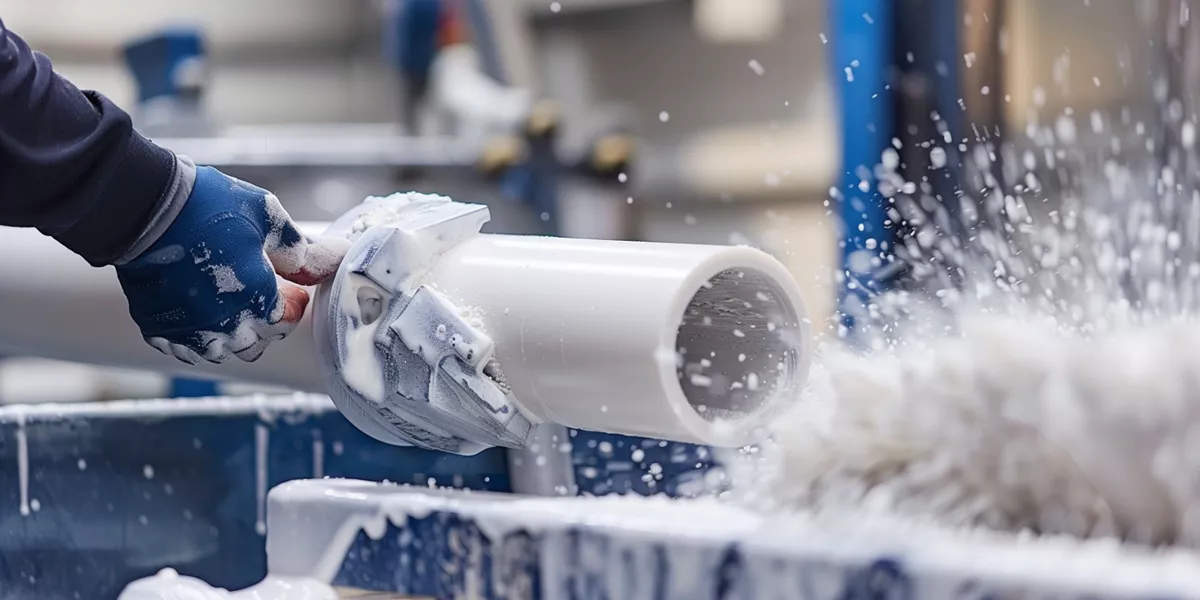
Why Post-Sintering Grinding Is Essential for Precision-Ground Alumina Tubes?
Dimensional scatter wastes seals and bearings; grinding aligns real parts to design intent.
As-sintered control sits at ±0.5–1.0% with 1.6–3.2 µm Ra, while precision-ground alumina tubes deliver ±0.02–0.10 mm, <0.05 mm TIR, and 0.4–0.8 µm Ra (0.1–0.3 µm via lapping). These gaps arise from 15–18% shrinkage and ±0.3–0.8% variability driven by green density and ±5–10 °C furnace gradients. Grinding removes 0.3–2.0 mm per surface to recover cylindricity and perpendicularity. Although grinding adds 40–120% part cost, precision-ground alumina tubes cut assembly rejects from 8–15% to <2% where system costs are dominant.
Sintering shrinkage variability limiting dimensional precision
Local packing, burnout, and thermal fields shift densification; on Ø50 mm, ±0.25–0.50 mm drift is typical and exceeds seal windows.
Surface finish requirements driving seal and bearing performance
As-sintered 1.6–3.2 µm Ra retains porosity; precision-ground alumina tubes at 0.4–0.8 µm Ra reduce leakage and friction, while lapping to 0.1–0.3 µm Ra supports vacuum-grade mating.
Geometric control achievable only after material removal
Targets like <0.05 mm TIR and ≤0.02 mm/25 mm end-face perpendicularity need datum-based grinding to correct sag and fixture imprint.
Process scope summary for precision-ground alumina tubes
| Attribute (units) | As-Sintered | Precision Grinding | Lapping (post-grind) |
|---|---|---|---|
| Diameter tolerance (mm) | ±0.25–0.50 on Ø50 | ±0.02–0.10 | ±0.01–0.03 |
| Cylindricity TIR (mm) | 0.10–0.30 | <0.05 | <0.01 |
| Surface roughness Ra (µm) | 1.6–3.2 | 0.4–0.8 | 0.1–0.3 |
| End-face perpendicularity (mm/25 mm) | 0.05–0.20 | ≤0.02 | ≤0.01 |
| Typical removal (mm per surface) | — | 0.3–2.0 | 0.02–0.10 |
How Centerless Grinding Ensures OD Accuracy in Precision-Ground Alumina Tubes?
Runout is eliminated at the source; the wheels define the axis, not centers.
Centerless through-feed or in-feed achieves ±0.02–0.05 mm OD and <0.02 mm TIR with 0.4–0.8 µm Ra in 1–3 minutes per tube. Precision-ground alumina tubes benefit from 20–25 m/s wheel speed, 0.5–1.5 m/min feed, and 15–25 L/min flood coolant at 5–8% emulsion to keep the zone <150 °C and maintain flexural strength. Medium 120–180 grit vitrified wheels balance MRR and finish; 220–400 grit refines at longer cycles. Thin walls (<2 mm, OD/wall >20:1) and features like shoulders favor cylindrical OD grinding.
Centerless mechanism suppressing fixturing runout
The regulating wheel sets rotation while the grinding wheel sets diameter; datum comes from wheel geometry, enabling <0.02 mm TIR.
Diamond wheel selection balancing removal and finish
Medium grit supports ±0.05 mm work efficiently; finer grit pursues 0.2–0.4 µm Ra with 40–60% time penalty.
Thermal management maintaining dimensional consistency
Stable wheel speed, generous coolant, and disciplined dressing prevent thermal drift and microcrack fields.
Centerless performance map for precision-ground alumina tubes
| Setting | Typical Range | Effect on Result |
|---|---|---|
| Wheel speed (m/s) | 20–25 | Lower heat, stable size |
| Feed rate (m/min) | 0.5–1.5 | Throughput vs. chatter |
| Depth of cut (mm/pass) | 0.015–0.025 | MRR vs. damage depth |
| Grit (FEPA) | 120–180 | 0.4–0.8 µm Ra finish |
| Coolant flow (L/min) | 15–25 | Temp <150 °C |
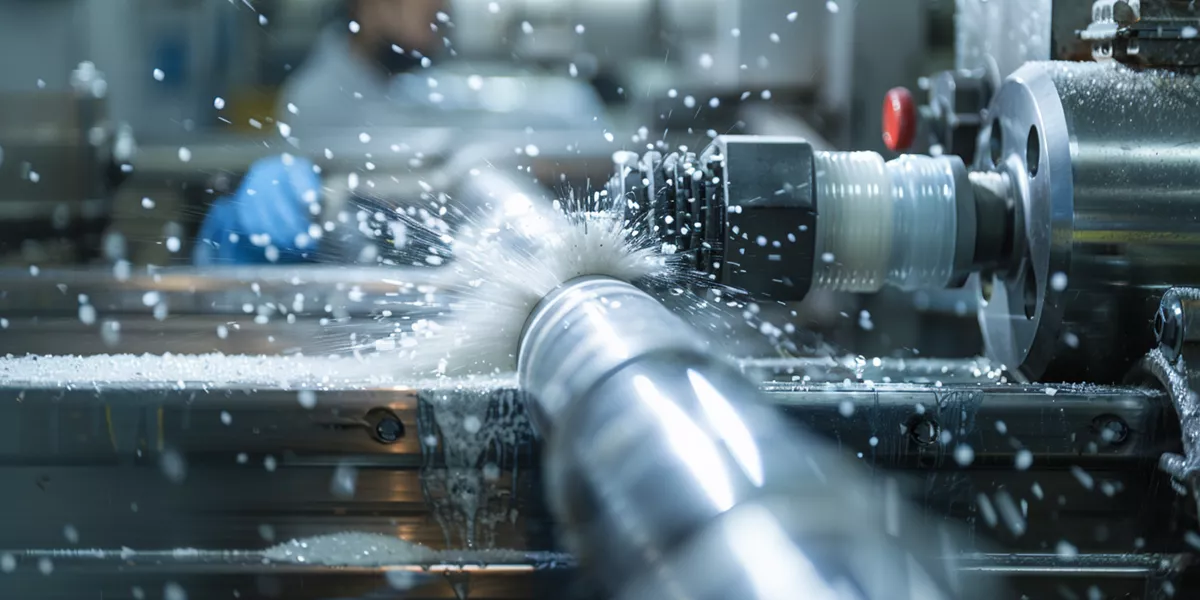
How ID Grinding Processes Maintain Bore Precision in Precision-Ground Alumina Tubes?
Small wheels, stiff mandrels, and high-pressure coolant set the tone.
ID traverse grinding at 50–200 mm/min and 0.005–0.015 mm radial infeed reaches ±0.05–0.10 mm and 0.8–1.6 µm Ra with uniformity in long bores. Plunge cycles speed local features. Through-spindle coolant at 5–15 L/min and 40–80 bar prevents wheel loading and wall-thickness variation. Datum transfer from OD to ID via low-runout collets (<0.01 mm TIR) keeps concentricity within ±0.03–0.08 mm. Dress every 20–50 parts to stop drift. Use ID grinding when flow, bearing fits, or cleanliness require <0.8 µm Ra.
Traverse and plunge modes serving different geometries
Traverse favors long, uniform sections; plunge accelerates seats and short bores with indexing for full coverage.
Coolant delivery controlling force and temperature
Focused high-pressure jets clear debris, maintain cutting, and avoid thermal bowing of thin walls.
Datum transfer methods protecting concentricity
OD-first then ID with precision collets or fixtures preserves axis alignment for bearing-class assemblies.
ID grinding quick reference for precision-ground alumina tubes
| Factor | Traverse Mode | Plunge Mode |
|---|---|---|
| Axial feed (mm/min) | 50–200 | — |
| Radial infeed (mm/pass) | 0.005–0.015 | 0.01–0.03 |
| Cycle time (min) | 10–30 | 3–10 (local features) |
| Best use | Long uniform bores | Seats, short bores |
Which Specialized Grinding Methods Define Form and End-Face Accuracy in Precision-Ground Alumina Tubes?
End faces, complex profiles, heavy stock, and threads require matched setups.
Surface grinding achieves <0.01 mm flatness and ≤0.02 mm/25 mm perpendicularity while holding length ±0.05–0.15 mm. Profile grinding with CNC form-dressed wheels produces shoulders, tapers, and radii at ±0.08–0.15 mm. Creep-feed removes 0.5–2.0 mm in one slow pass with 30–60 L/min high-pressure coolant; fixtures must absorb 50–150 N forces. Thread grinding forms M6–M30 ceramic threads at ±0.10–0.20 mm for insulated or hot-zone attachments. Fixtures use elastomer pads or wax bonds to avoid edge chipping at 20–50 N while keeping ±0.02 mm positional control.
Surface methods delivering flatness and squareness
Cup wheels on vacuum fixtures prevent bruise marks that would imprint seals and affect length.
Profile capabilities enabling functional features
Form-dressed wheels and multi-axis positioning maintain feature fidelity across dressing cycles.
Fixture design preventing brittle damage
Load-spreading pads and anti-chip chamfers reduce tensile spikes at edges and ports.
Specialized grinding matrix for precision-ground alumina tubes
| Method | Primary Target | Typical Tolerance | Notes |
|---|---|---|---|
| Surface (end faces) | Flatness, perpendicularity, length | <0.01 mm flatness; ≤0.02 mm/25 mm | Cup wheels, vacuum/rotary fixtures |
| Profile/form | Shoulders, tapers, radii | ±0.08–0.15 mm | CNC form-dress, multi-axis |
| Creep-feed | Heavy stock removal | ±0.05–0.10 mm | 0.5–2.0 mm in one pass |
| Thread | M6–M30 threads | ±0.10–0.20 mm PD | Single/multi-rib wheels |
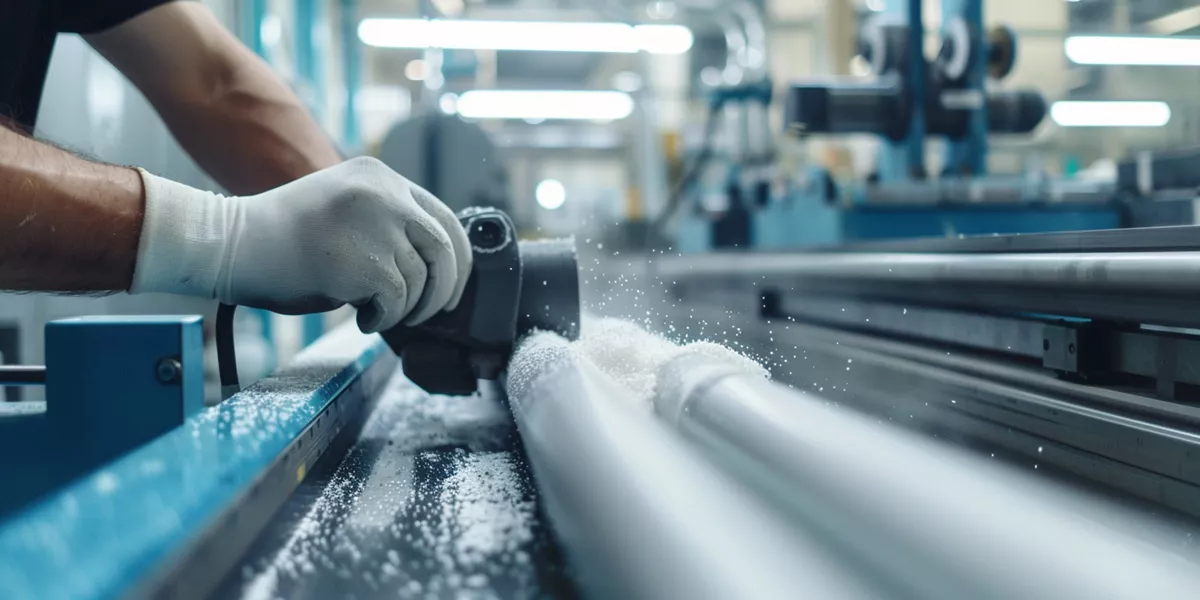
How Quality Control Processes Secure Tight Tolerances in Precision-Ground Alumina Tubes?
Measure during the cut, verify after, and stabilize the room.
SPC with X-bar1/R tracks OD means and ranges with ±3σ sized to the job (±0.015–0.020 mm for ±0.05 mm parts), targeting Cpk ≥1.33 on ≥100-piece runs. In-process lasers at ±0.002 mm and 1 kHz close the loop on wheel loss (≈0.005–0.010 mm per 100 parts) and spindle drift (≈0.010–0.015 mm per shift). CMM five-station checks record actuals at 0/25/50/75/100% length using low-force ruby probes and tie results to machine, dress number, and operator in FAIRs. Environmental control of ±1–2 °C and 45 ± 5% RH limits CTE bias (~0.015 mm on Ø50 mm per 5 °C). Destructive sampling confirms <15 µm subsurface damage and ≥90% strength retention. Documentation covers wheels, speeds, feeds, DOC, coolant, dress logs, stats, and CAPA under ISO 9001.
SPC implementation maintaining dimensional consistency
Capability indexes and control charts reveal drift linked to dress intervals and temperature cycles.
In-process measurement enabling closed-loop compensation
Laser feedback trims offsets before parts leave spec, stabilizing precision-ground alumina tubes across long batches.
Post-grind inspection providing traceability
FAIRs and CMM datasets support rapid root cause analysis and customer audits.
QA checklist for precision-ground alumina tubes
| QA Element | Target/Method | Frequency |
|---|---|---|
| Capability | Cpk ≥1.33 (key dims) | Each product family |
| Laser monitoring | ±0.002 mm, 1 kHz | 100% in-process |
| CMM sampling | 5 axial stations | First-article + periodic |
| Environment | ±1–2 °C; 45 ± 5% RH | Continuous |
| Integrity | <15 µm damage; ≥90% strength | 1/500 parts |
| Dress control | Auto or rule-based triggers | By trend slope |
How to Select the Optimal Grinding Process for Precision-Ground Alumina Tubes?
Start with geometry and tolerance, then layer ID/OD coupling, wall limits, and volume.
Decision framework for process selection
| Requirement | Preferred Route | Rationale |
|---|---|---|
| Simple cylinder, >500/yr, ±0.02–0.10 mm OD | Centerless OD | High throughput, best TIR |
| Shoulders/steps/tapers, ±0.10 mm OD | Cylindrical OD | Feature access, rigid support |
| ID ±0.05–0.10 mm, Ra <0.8 µm | ID grinding | Flow/fit cleanliness |
| End-face ≤0.02 mm/25 mm | Surface grind ends | Seal and length control |
| ≤±0.02 mm and Ra <0.4 µm, low volume | Centerless + lapping | Ultra-precision |
| Wall <2 mm, OD/wall >20:1 | Cylindrical with supports | Minimize deflection |
| OD+ID ≤0.05 mm TIR concentricity | OD then ID with datum transfer | Axis integrity |
Conclusion
Precision-ground alumina tubes stay in spec when process choice matches geometry, parameters protect integrity, and QA closes the loop.
FAQ
What OD and ID processes best maintain concentricity in precision-ground alumina tubes?
OD grinding first establishes a stable datum; ID grinding then references that axis using precision collets or custom fixtures. This sequence maintains ≤0.05 mm TIR concentricity, critical for bearing or vacuum feedthrough assemblies in precision-ground alumina tubes.
How does precision grinding affect the mechanical strength of precision-ground alumina tubes?
Controlled parameters—20–25 m/s wheel speed, ≤0.015 mm depth, flood coolant below 150 °C—retain ≥90% flexural strength from the as-sintered baseline per ASTM C1161. Excessive wheel speed or dry cuts introduce subsurface cracks up to 50 µm deep, reducing strength by 15–25%.
Which grinding method provides the best surface finish for precision-ground alumina tubes?
Lapping after centerless grinding achieves 0.1–0.3 µm Ra, suitable for optical or vacuum interfaces. For production volumes, fine-grit (220–320) vitrified wheels yield 0.4–0.6 µm Ra while balancing cycle time and surface integrity.
What purchasing details should buyers specify when sourcing precision-ground alumina tubes?
Include OD/ID/length targets, tolerance class, Ra requirement, concentricity, perpendicularity, wall limits, and inspection method. Specify documentation such as Cpk ≥ 1.33 SPC charts, FAIRs, and surface integrity reports confirming <15 µm damage and ≥90% strength retention.
How do precision-ground alumina tubes compare with metal or as-sintered alternatives?
Metals achieve tolerance but lack alumina’s corrosion and heat resistance. As-sintered tubes exceed 1 µm Ra and ±0.25–0.50 mm error. Precision-ground alumina tubes combine high-temperature stability, chemical inertness, and repeatable tolerances for demanding sealing and motion systems.
References:
-
Learn how SPC with X-bar charts helps monitor process means and maintain quality in manufacturing, ensuring consistent and reliable production results ↩