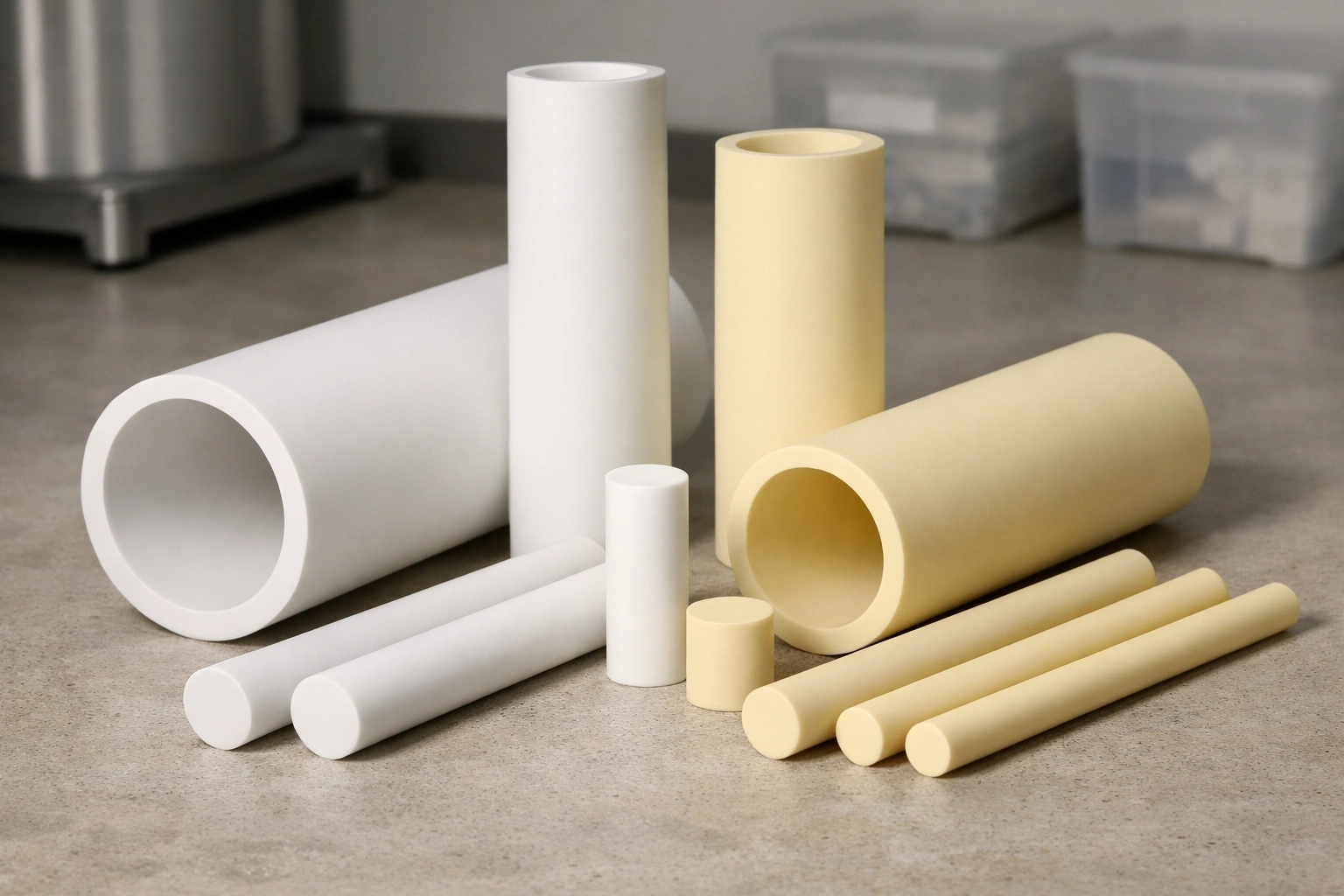
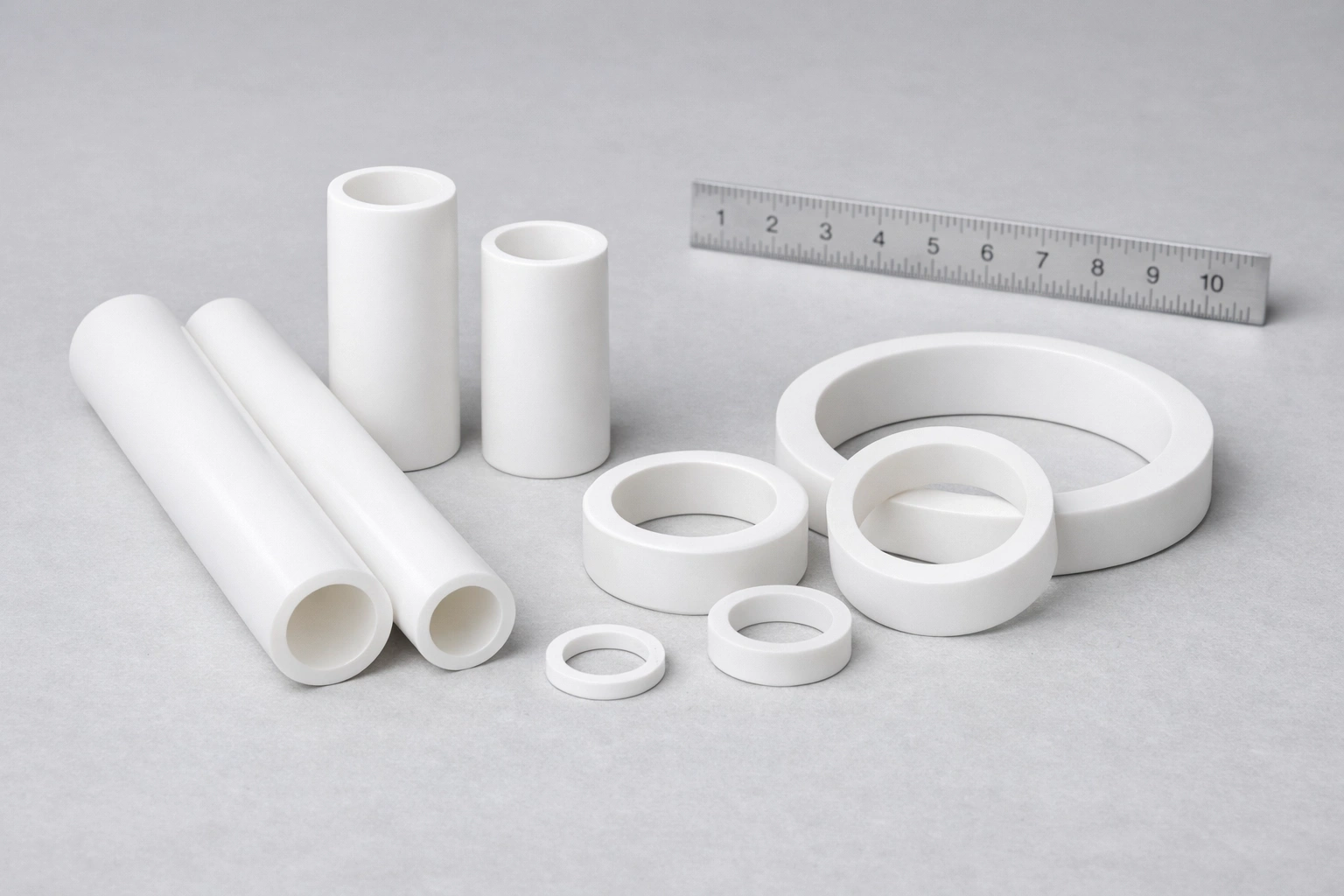
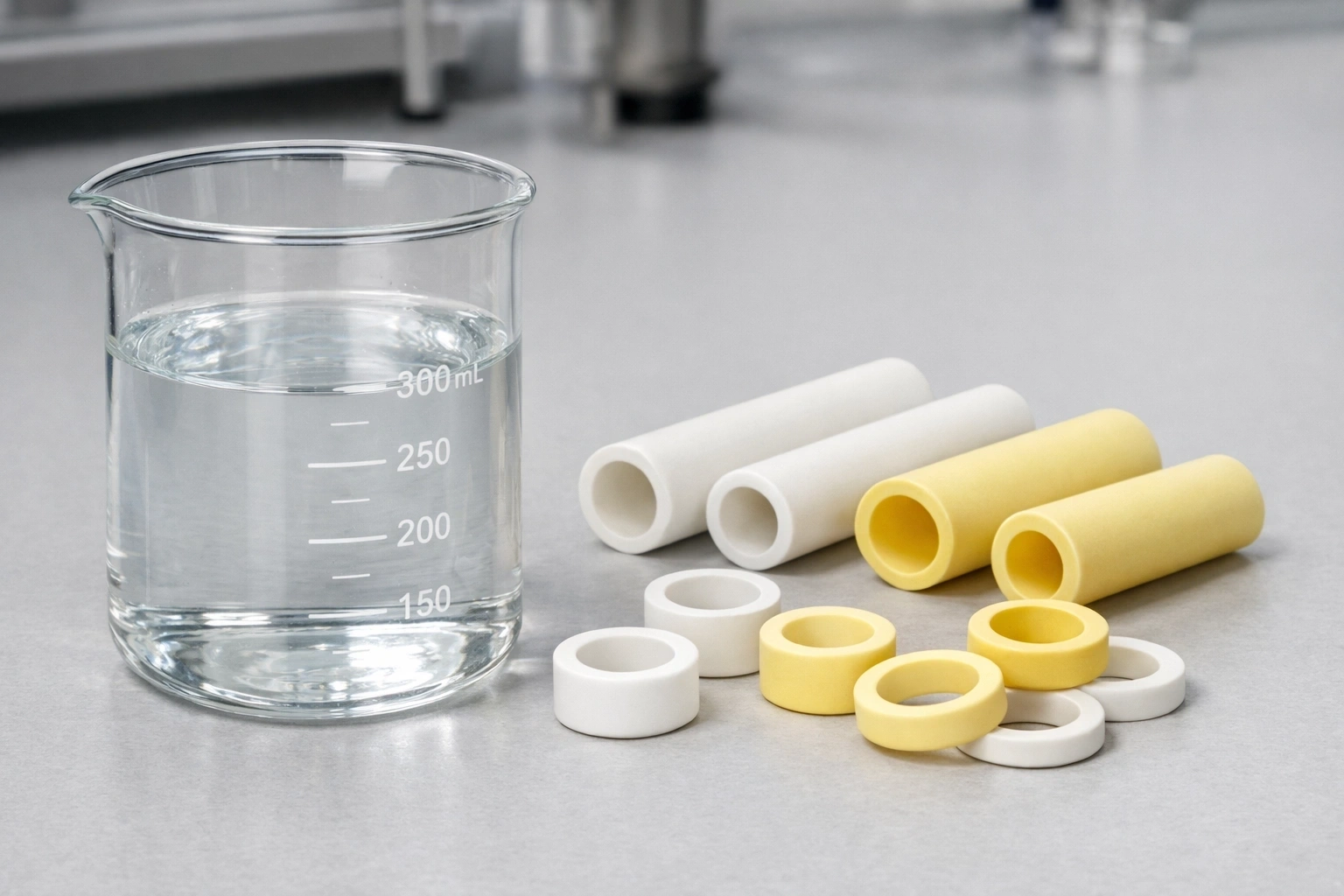
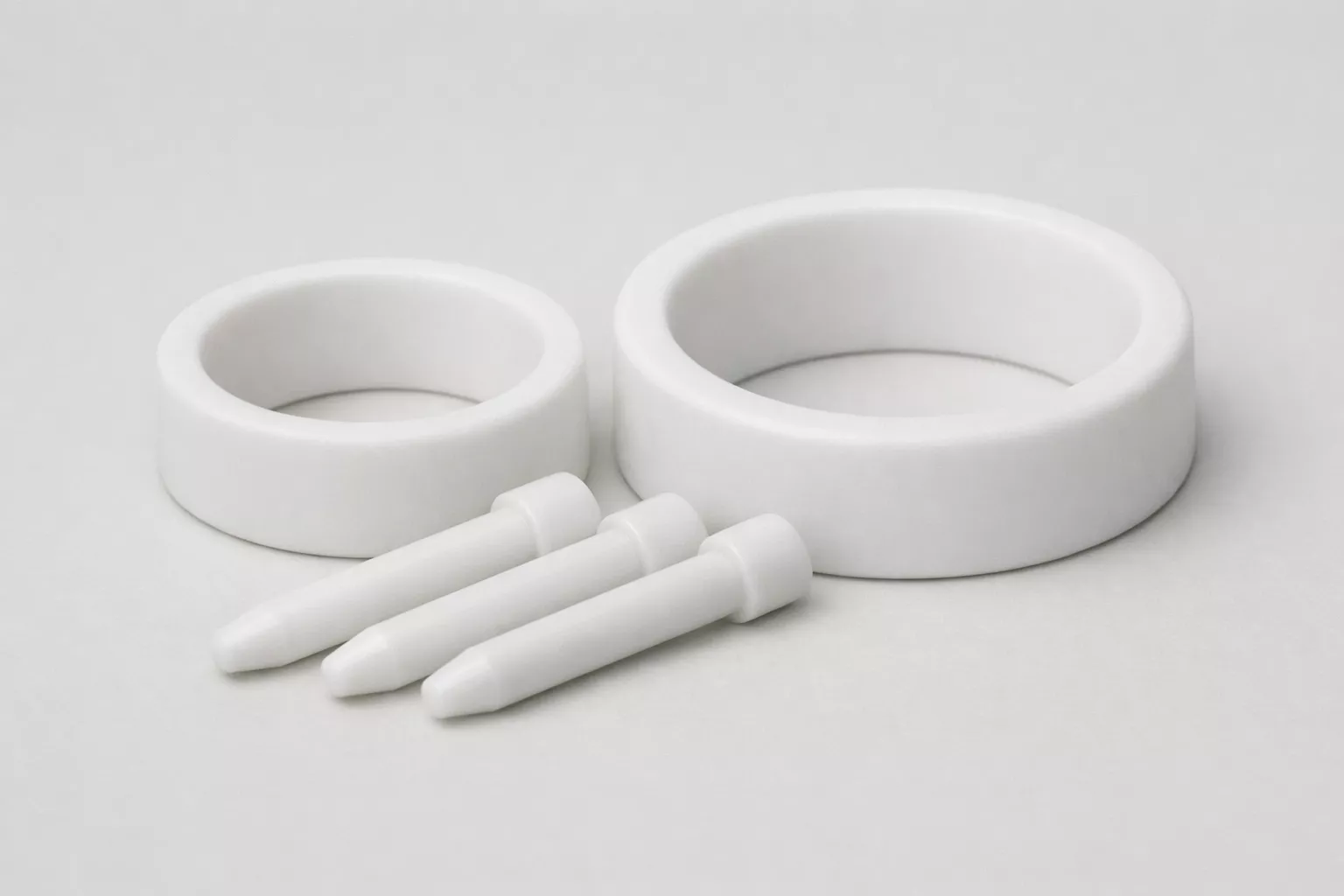
Alumina tubes for high-temperature applications require explicit hot-dimension planning. Clearances close, seals over-compress, and constrained mounts translate thermal strain into fracture risk unless movement and compliance are designed in from the start.
Alumina tubes for high-temperature applications expand at ~8.1×10⁻⁶/°C. A 500 mm tube gains ~4 mm by 1000 °C, so assemblies must include axial freedom, expansion joints, and compliant seals sized from the correct temperature span. The sections below quantify coefficients, stress modes, and mitigation strategies with tables for quick selection.
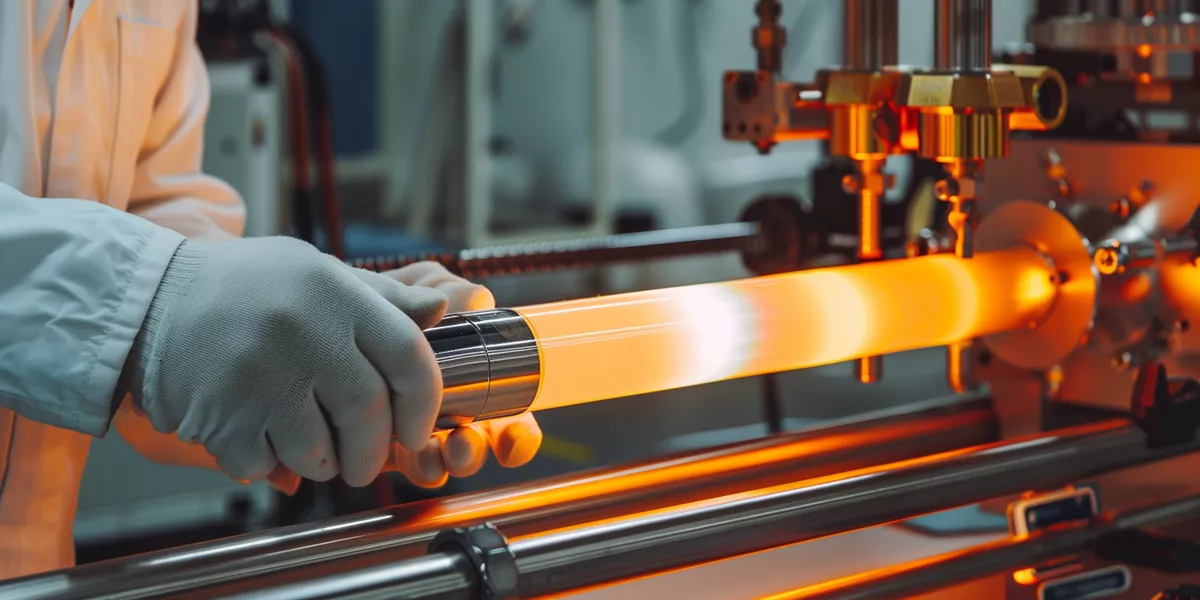
Thermal Expansion Fundamentals and CTE for alumina tubes for high-temperature applications
Alumina tubes for high-temperature applications operate across wide ΔT. Without axial travel, compressive stress surges at supports and then flips to tensile on cooldown where ceramics are weakest.
Alumina tubes for high-temperature applications use linear CTE to predict hot geometry. Multiply the average CTE by length and temperature rise to set groove, stroke, and travel. Always request full dilatometry curves rather than a single number to capture slope changes above 1200 °C.
CTE definition and significance for dimensional prediction in thermal cycling
CTE is fractional length change per degree. It links room-temperature drawings to hot running size. Use the correct temperature span, not a handbook value with different limits.
Temperature-dependent CTE behavior across alumina’s operating range
CTE rises mildly with temperature due to anharmonicity. Alumina stays near 8.1–8.4×10⁻⁶/°C over common ranges, enabling accurate hot-dimension estimates for long tubes and thick walls.
Material purity and grain-boundary phase effects on expansion
Lower-purity alumina includes glassy phases with higher CTE than α-Al₂O₃. That raises overall expansion and can add permanent growth after long, hot soaks. Specify purity and request CTE tolerance bands.
Linear expansion inputs used for design
| Parameter | Unit | Typical value |
|---|---|---|
| Linear CTE (99.5% alumina, 20–1000 °C) | ×10⁻⁶/°C | 8.1–8.4 |
| Example ΔL (500 mm, ΔT=980 °C) | mm | 3.97–4.12 |
| Volumetric CTE (isotropic approximation) | — | ≈3× linear |
| Recommended data package | — | Full dilatometry curve with uncertainty |
Alumina’s mechanisms and hot behavior in alumina tubes for high-temperature applications
Alumina tubes for high-temperature applications benefit from the stable α-Al₂O₃ lattice. That stability produces linear, reversible expansion and minimal hysteresis in standard cycling windows.
Alumina tubes for high-temperature applications made by isostatic pressing average grain orientation. Directional variation is small compared with extrusion-aligned bodies, which reduces fit drift and flange distortion.
Atomic vibration and reversible spacing increase
Thermal energy increases vibrational amplitude in an anharmonic potential, biasing mean interatomic distance upward. The macroscopic result is linear expansion captured by the measured CTE.
Random grain orientation to suppress anisotropy
Cold isostatic pressing1 followed by uniform sintering yields near-isotropic tubes. This stabilizes diameters and lengths at temperature and simplifies seal design.
Permanent dimensional change after extreme soaks
Prolonged exposure above ~1400 °C can create small permanent growth from grain-boundary motion. Validate with pre/post measurements and include the effect in maintenance plans.
Representative thermal expansion context by ceramic family
| Material | Linear CTE (×10⁻⁶/°C, 20–1000 °C) | Notes relevant to alumina tubes for high-temperature applications |
|---|---|---|
| 99.5% Alumina | 8.1–8.4 | Baseline for tube design and seal sizing |
| 95% Alumina | 8.6–9.2 | Higher due to boundary phases; confirm batch CTE |
| Silicon Nitride | 2.5–3.5 | Low CTE; stronger thermal-shock tolerance |
| Silicon Carbide | 2.3–4.5 | Low CTE; passive oxidation limits shape selection |
| 3Y-TZP Zirconia | 9.6–10.5 | Higher CTE; monitor phase stability near upper temps |
Stress modes and failure risks in alumina tubes for high-temperature applications
Alumina tubes for high-temperature applications accumulate stress in three ways: axial constraint, thermal gradients across the wall, and CTE mismatch at joints to metals or other materials.
Alumina tubes for high-temperature applications see compressive stress during heat-up if both ends are fixed. On cooldown, tension develops and cracks initiate at geometric discontinuities. Joints with 304 SS or Ni-alloys add mismatch-driven shear and peel.
Compressive stress buildup in fully constrained spans
σ≈E·α·ΔT under full constraint. Because E remains hundreds of GPa at temperature, stress approaches strength limits quickly as ΔT rises.
Cooldown tensile conditions as the governing fracture driver
Ceramics exhibit far lower tensile than compressive strength. Stress concentrates at steps and holes, so cracked edges after several cycles indicate insufficient axial freedom.
Interfacial shear from CTE mismatch in metal–ceramic joints
Alumina at ~8.1×10⁻⁶/°C versus 304 stainless at ~17.3×10⁻⁶/°C produces large differential strain. Without bellows or sliding sleeves, brazes lift and edges chip under cycling.
Stress drivers and immediate mitigations
| Driver in alumina tubes for high-temperature applications | Trigger | Symptom | Primary lever |
|---|---|---|---|
| Axial constraint | Both ends fixed | End-face spall, axial cracks | Float one end; add axial travel |
| Wall gradient | Rapid ramp, thick walls | Ovality, radial craze | Cap ramp rate; uniform heat |
| CTE mismatch | Alumina-to-SS/NI joint | Braze lift, edge chips | Bellows, sleeves, CTE-match |
| Cooldown tension | Rigid supports | Brittle fracture on cooldown | Compliant mounts, hot clearances |
Design tactics that stabilize alumina tubes for high-temperature applications
Alumina tubes for high-temperature applications benefit most from one-end floating supports, correctly sized expansion devices, compliant seals at metal interfaces, and controlled ramps through gradient-sensitive ranges.
Alumina tubes for high-temperature applications can also use CTE-matched alloys or graded interfaces when hermetic, rigid joints are unavoidable. Verify atmosphere limits for Mo and specify Kovar in appropriate bands.
Floating supports to allow unconstrained axial growth
Guide radially, free axially at one end. Provide 0.3–1.0 mm radial clearance and ≥3–10 mm axial travel based on hot-length predictions. This removes the dominant constraint term.
Expansion joint sizing and high-temperature material choices
Use ΔL=L₀·α·ΔT·SF, with SF 1.3–1.5. For sealed systems, integrate bellows in 316 SS up to ~1200 °C or use Inconel 600 for higher oxidation resistance. Ceramic sliding sleeves suit ultra-hot dry service.
Compliant seals to maintain leak integrity during cycling
Use spring-loaded compression, graphite ribbon at higher temperatures, or perfluoroelastomers for moderate temperatures. Always size grooves from hot dimensions: D_hot=D_cold·(1+αΔT).
Thermal expansion management options for alumina tubes for high-temperature applications
| Strategy | Typical temperature range (°C) | Axial travel (mm) | Leak performance | Relative cost | Notes |
|---|---|---|---|---|---|
| One-end floating support | up to 1800 | 3–10 | N/A | 1× | Default for open-ended tubes |
| Metal bellows, 316 SS | ≤1200 | 10–25 | ~1×10⁻⁸ mbar·L/s | 3–5× | Vacuum and process lines |
| Metal bellows, Inconel 600 | ≤1200–1400 | 10–25 | ~1×10⁻⁸ mbar·L/s | 4–6× | Higher oxidation resistance |
| Spring-loaded compression seal | ≤325 (FFKM) / 500 (graphite) | 0.5–2.0 | ~1×10⁻⁷ mbar·L/s | 2–4× | With metal housings |
| CTE-matched flanges (Kovar, Mo) | ≤800 in air | Minimal | ~1×10⁻⁶ mbar·L/s | 8–12× | Check atmosphere limits |
| Ceramic sliding sleeve | ≤1600 | 5–15 | ~1×10⁻⁵ mbar·L/s | 3–6× | Protective tubes and barriers |
Advantages that favor alumina tubes for high-temperature applications
Alumina tubes for high-temperature applications exhibit lower growth than steels and high-Ni alloys, simplifying allowance budgets. They also retain useful strength at temperature and resist oxidation where many metals fail.
Alumina tubes for high-temperature applications show predictable, low-hysteresis expansion, which enables accurate FEA predictions and reliable seal and joint sizing when boundary conditions are modeled correctly.
Comparative expansion and service envelope across tube materials
| Material | CTE (×10⁻⁶/°C, 20–1000 °C) | 500 mm growth at ΔT=980 °C (mm) | Expansion vs alumina | Typical oxidation/use limit |
|---|---|---|---|---|
| 99.5% Alumina | 8.1 | 3.97 | Baseline | ~1700–1800 °C (air, no load) |
| 95% Alumina | 8.8 | 4.31 | +8.6% | ~1700–1750 °C (air) |
| 3Y-TZP Zirconia | 10.5 | 5.15 | +29.6% | ~1600 °C (phase stability limit) |
| Silicon Carbide | 4.5 | 2.21 | −44.4% | ~1400 °C (passive oxidation) |
| Silicon Nitride | 3.2 | 1.57 | −60.5% | ~1200–1300 °C (oxidation onset) |
| Stainless Steel 304 | 17.3 | 8.48 | +113.6% | ~900 °C (rapid oxidation) |
| Inconel 600 | 13.3 | 6.52 | +64.2% | ~1200 °C (oxidation resistant) |
| Molybdenum | 5.4 | 2.65 | −33.3% | ~600–700 °C (oxidizes in air) |
Decision framework for alumina tubes for high-temperature applications
Alumina tubes for high-temperature applications need a consistent, rules-based approach so hot fits are correct on the first installation.
Operating thresholds mapped to actions
| Condition in alumina tubes for high-temperature applications | Threshold | Action |
|---|---|---|
| ΔT < 200 °C and T<600 °C | Growth < ~2 mm (L=500 mm) | Fixed mounting acceptable |
| T=600–1200 °C and L>300 mm | Significant axial growth | Float one end with ≥3 mm travel |
| Metal–ceramic sealed interface | ΔT > 200 °C | Use bellows 10–25 mm stroke or CTE-matched metal |
| Both ends constrained | T>800 °C | Redesign with expansion joint to cap σ≈E·α·ΔT |
| Ramp rate >100 °C/min and wall >5 mm | Wall ΔT spikes | Limit to 50–100 °C/h through 500–1200 °C |
| Hot tolerance target <±0.1 mm | Tight fit at temp | Start ±0.03 mm, request CTE curve, run hot stack-ups |
Conclusion
Account for thermal growth at the design stage and alumina tubes for high-temperature applications operate reliably for long cycles.
FAQs on alumina tubes for high-temperature applications
How does the thermal expansion of alumina tubes for high-temperature applications compare with stainless steel or Inconel?
Alumina expands ~8.1×10⁻⁶/°C, stainless steel 17.3×10⁻⁶/°C, and Inconel 13.3×10⁻⁶/°C. This means alumina’s growth is 40–60% lower, minimizing stress at joints and maintaining alignment in furnace assemblies.
What design clearances are recommended for alumina tubes for high-temperature applications?
Allow at least 3–10 mm axial movement for 500–1000 mm tube lengths operating up to 1200 °C. Radial clearances of 0.3–1.0 mm prevent binding during thermal growth and support sliding seals or sleeves.
Which sealing materials remain effective for alumina tubes for high-temperature applications?
Viton handles 200 °C, FFKM up to 325 °C, and graphite ribbon or ceramic gaskets to 500 °C and beyond. Always design compression ratios for hot conditions; over-compression at temperature accelerates degradation.
Why specify CTE certification for alumina tubes for high-temperature applications?
Each production batch can vary ±5% in measured CTE. Supplier-provided ASTM E228 curves ensure accurate FEA input and hot dimension calculation, preventing seal leakage or structural failure in real use.
When should engineers choose alumina instead of zirconia for high-temperature applications?
Alumina’s linear expansion and oxidation stability up to 1800 °C favor continuous furnace and process environments, while zirconia’s higher CTE and toughness fit shock or mechanical loading at lower peak temperatures.
References:
-
Understanding Cold isostatic pressing can enhance your knowledge of advanced manufacturing techniques and their applications. ↩