Alumina crucible performance becomes inconsistent when material preparation or forming steps lack precision, creating defects that compromise thermal reliability. This guide provides a structured process to ensure stable and repeatable crucible quality across industrial manufacturing.
Alumina crucible production requires engineered raw materials, controlled shaping methods, and optimized thermal processing to achieve dense and contamination-resistant ceramic structures. This article outlines each stage with practical parameters that support consistent outcomes for laboratory and industrial users.
Alumina crucible manufacturing follows a sequential workflow, transitioning from material selection to forming, drying, firing, machining, and final inspection to achieve reliable high-purity crucible performance.
Key Raw Materials Required for Manufacturing Alumina Crucibles
Alumina crucible manufacturing begins with selecting engineered raw materials that determine the final ceramic’s density, purity, and thermal stability. These materials serve specific structural and processing functions that directly influence flaw formation and sintering behavior. Therefore, the quality and consistency of each material input must be tightly controlled from the start.
Alumina crucible production relies on three core material categories: high-purity alumina powder, organic binders, and plasticizers or lubricants. Each category contributes to forming strength, green-body integrity, and final ceramic performance, establishing the foundation for a stable manufacturing sequence.
Alumina crucible performance originates from balanced material formulation, ensuring strength during forming, predictable shrinkage during firing, and reliable mechanical properties after sintering.
High-purity alumina powder as the primary structural material
High-purity alumina powder provides the crystalline framework of the crucible, and its purity level directly influences thermal shock resistance and corrosion stability. Moreover, alumina powders with 95–99.5% purity show consistent grain growth during sintering, supporting dense final microstructures. Consequently, maintaining powder purity variation within ±0.2% is essential for stable thermal performance.
Alumina powder must exhibit controlled morphology, as irregular particle shapes create voids that weaken mechanical integrity. In addition, powders with average particle sizes between 0.5–3 µm typically yield uniform packing behavior during compaction. Therefore, precision in powder selection directly shapes final density values exceeding 3.7 g/cm³.
Thus, alumina powder quality establishes the most critical basis for crucible strength, dimensional stability, and long-term high-temperature durability.
Organic binders providing green-body strength during forming
Organic binders1 support green-body cohesion before firing, ensuring that shaped crucibles maintain structural integrity during handling. Furthermore, binders in the range of 1–4 wt% typically generate the compressive strength required to avoid chipping or deformation. Consequently, binder distribution uniformity must reach at least 95% to prevent localized weakness.
Organic binders must decompose cleanly during pre-firing steps, avoiding carbon residues that interfere with alumina’s sintering behavior. Additionally, controlled binder burnout reduces internal stresses that could produce cracks. Therefore, the binder system directly influences early-stage defect rates during biscuit firing.
Hence, precise control of binder content and dispersion ensures predictable forming behavior and stable pre-firing performance.
Plasticizers or lubricants enabling smooth compaction and shaping
Plasticizers or lubricants2 improve powder flow and reduce friction during pressing, enabling more uniform density across the green body. Additionally, a plasticizer content of 0.5–2 wt% typically enhances compaction uniformity by more than 15% compared to unmodified powders. Consequently, this uniformity helps limit density gradients that later produce warping during sintering.
Plasticizers also reduce forming pressure requirements, supporting stable shaping of thin-wall crucibles and deep profiles. Furthermore, improved lubrication lowers tooling wear rates and enhances surface quality. Therefore, plasticizers serve as an essential aid for achieving dimensional repeatability in large production runs.
Thus, appropriate use of plasticizers contributes directly to forming efficiency and final crucible precision, especially in complex geometries.
Raw Material Specification Summary (g/cm³, wt%, µm)
| Material Category | Typical Value Range | Key Performance Influence |
|---|---|---|
| Alumina powder purity (wt%) | 95–99.5 | Determines density and corrosion resistance |
| Mean particle size (µm) | 0.5–3 | Controls packing behavior and shrinkage |
| Organic binder content (wt%) | 1–4 | Provides green-body strength |
| Plasticizer content (wt%) | 0.5–2 | Improves compaction uniformity |
| Target fired density (g/cm³) | ≥3.70 | Ensures mechanical stability |
Powder Preparation and Mixing Process
Alumina crucible consistency depends heavily on how uniformly the raw powder blend is prepared before forming. Proper mixing stabilizes shrinkage behavior, reduces internal stress, and supports predictable densification during firing. Therefore, powder preparation must follow a controlled workflow that balances moisture, dispersion, and blend uniformity.
Alumina crucible manufacturing uses both dry and wet mixing approaches, each chosen according to the forming method and crucible geometry. These mixing processes influence packing behavior, green-body strength, and the occurrence of defects during later steps. Consequently, precision at this stage ensures stable shaping and reliable sintering outcomes.
Alumina crucible quality improves significantly when powder mixtures achieve homogeneity levels above 95%, resulting in uniform density distribution across the green body and reducing common defects such as lamination.
Dry blending techniques for achieving uniform powder composition
Dry blending is used when forming requires press-ready powder with controlled particle interactions. Additionally, dry mixing cycles lasting 20–40 minutes typically increase homogeneity by at least 10% compared to shorter intervals. Consequently, this level of homogeneity supports consistent compaction during uniaxial or isostatic pressing.
Dry blending also preserves powder flow properties, as excessive moisture can cause agglomeration that disrupts forming behavior. Furthermore, controlled mixing speed ensures that particle distribution remains uniform without generating heat that alters binder performance. Therefore, dry blending is essential for applications requiring high-density, structurally consistent crucibles.
Thus, proper dry blending establishes a stable foundation for predictable shaping and shrinkage during early firing stages.
Wet mixing approaches for improved particle dispersion
Wet mixing is applied when improved particle dispersion or binder activation is required to achieve uniform powder packing. Additionally, wet mixing can reduce agglomerates by up to 30%, increasing the uniformity of resulting microstructures. Consequently, this method supports thin-walled or complex crucible geometries where even distribution is critical.
Wet mixing also stabilizes additive integration, ensuring that binders and plasticizers activate uniformly throughout the batch. Moreover, controlled moisture content in the range of 8–14% typically enhances flowability for shaping processes that require smoother powder movement. Therefore, wet mixing is especially beneficial when forming methods demand high flexibility and particle mobility.
Thus, the wet mixing process creates more cohesive powder systems that improve green-body performance before drying.
Moisture content adjustment to obtain stable press-ready powder
Moisture adjustment is necessary to maintain powder consistency during forming, especially when shaping methods depend on predictable compaction behavior. Additionally, press-ready powder with moisture variations limited to ±0.5% demonstrates significantly higher dimensional repeatability during forming. Consequently, this stability reduces deformation risks in green bodies.
Moisture also influences powder lubrication, affecting friction and pressure distribution during compaction. Furthermore, appropriate moisture levels prevent powder bridging that disrupts density uniformity by more than 5%. Therefore, careful calibration of moisture ensures smooth forming performance across different crucible sizes.
Thus, moisture control plays a decisive role in ensuring the powder behaves uniformly during shaping and achieves stable green-body density.
Powder Preparation Specification Summary (%, minutes)
| Parameter | Typical Value Range | Key Influence |
|---|---|---|
| Dry blending duration (minutes) | 20–40 | Improves powder homogeneity |
| Agglomerate reduction (%) | ≤30 via wet mixing | Enhances particle distribution |
| Moisture tolerance (%) | ±0.5 | Maintains forming stability |
| Optimal wet-mix moisture (%) | 8–14 | Supports smooth shaping |
| Homogeneity target (%) | ≥95 | Ensures uniform density |
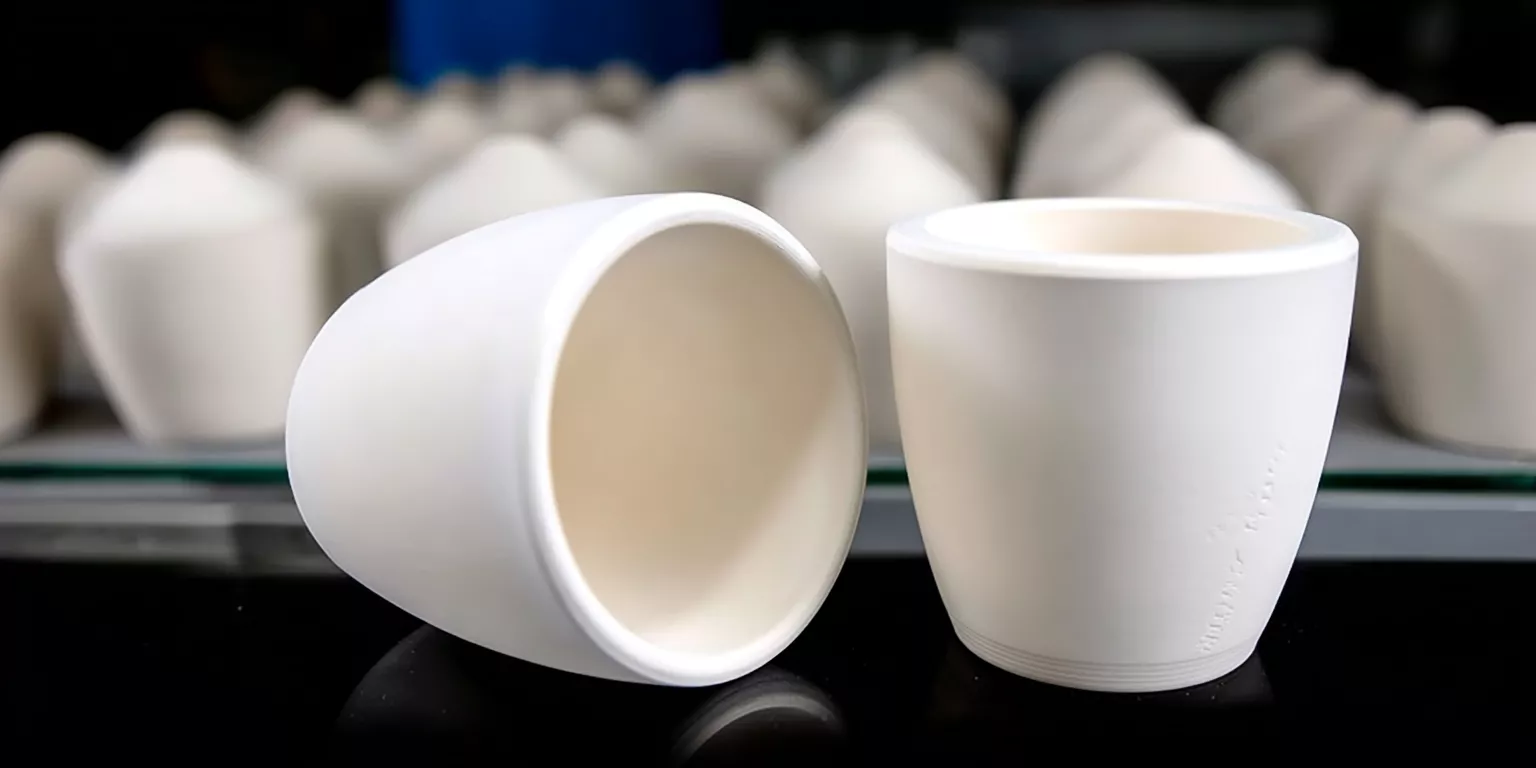
Forming Methods for Alumina Crucibles
Alumina crucible forming methods determine how uniformly the green body carries stress through drying, firing, and service. Consequently, each technique must be matched to crucible size, wall thickness, and required dimensional control before any further processing.
Dry pressing for simple cylindrical alumina crucibles
Alumina crucible production often uses uniaxial dry pressing for small to medium cylinders with relatively simple geometry. Consequently, this method is widely adopted when diameters up to 80–100 mm and moderate heights are required.
In a typical dry pressing cycle, granulated alumina powder with controlled moisture and flowability is fed into steel dies and compacted at pressures around 100–200 MPa. Because pressure is applied primarily along one axis, density variation of 3–5% can appear between upper and lower regions if fill and venting are not optimized. Tooling design, including punch clearance and die wall finish, helps maintain roundness and wall thickness variation within approximately 0.2–0.3 mm. Therefore, dry pressing offers efficient production for high-volume, standardized crucible sizes.
Alumina crucible batches formed by dry pressing achieve a good balance between output rate and dimensional repeatability when geometries remain straightforward.
Cold isostatic pressing for thicker-section alumina crucibles
Alumina crucible components with thicker walls or larger volumes benefit from cold isostatic pressing, which applies pressure uniformly from all directions. As a result, density gradients fall significantly compared with uniaxial pressing for the same target geometry.
During cold isostatic pressing3, pre-compacted or loosely filled rubber molds are subjected to hydrostatic pressures typically between 200–300 MPa inside a pressure vessel. This omnidirectional loading can reduce density variation to below 1–2% across wall sections thicker than 10–15 mm. After depressurization, the green body maintains dimensional consistency, with shrinkage differences during sintering limited to about 0.2–0.4% across the height. Because stress concentrations are minimized in the green state, large crucibles with diameters over 150 mm remain less prone to warpage.
Alumina crucible designs that demand robust mechanical behavior and tight geometry on heavy-walled shapes therefore favor cold isostatic pressing routes.
Slip casting for complex or thin-wall alumina crucibles
Alumina crucible designs with intricate contours, spouts, or thin-wall regions often rely on slip casting1 into porous molds.
Consequently, this method is particularly effective when wall thicknesses fall in the 2–6 mm range and sharp transitions must remain defect-free.
In slip casting, a fluid alumina slurry with solids loading typically between 60–70 wt% is poured into plaster or porous resin molds, where capillary suction draws water from the slip to build a consolidated layer. Casting times of 20–60 minutes can produce stable walls depending on thickness and pore structure of the mold, while green density uniformity remains within 2–3% along the height. After the required thickness is achieved, excess slip is drained and the part is demolded for controlled drying. This gentle consolidation route reduces mechanical stresses in fragile thin-wall regions.
Alumina crucible geometries that cannot be achieved by direct pressing often reach stable, complex forms through carefully controlled slip casting.
Extrusion forming for tubular alumina crucibles
Alumina crucible tubes and elongated shapes can be efficiently manufactured via extrusion, where plasticized bodies are forced through shaped dies. Therefore, extrusion is well suited for lengths above 200–300 mm and continuous tubular production.
In this process, alumina powder mixed with plasticizers and water to a controlled consistency is driven through a die using pressures that commonly reach 10–30 MPa depending on body stiffness and die resistance. The emerging tube can maintain wall thickness variation within 0.2–0.4 mm over lengths exceeding 500 mm when die design and vacuum deaeration are properly controlled. Line speeds are selected so that deformation and surface cracking remain minimal, often in the range of a few centimeters per second. Subsequent supporting fixtures keep the tube straight during drying and firing to limit bowing to less than 1–2 mm per 500 mm length.
Alumina crucible tubes produced by extrusion therefore combine continuous manufacturing efficiency with acceptable dimensional stability for many thermal process applications.
Drying Techniques Before Firing
High-quality alumina crucibles depend on controlled drying procedures that stabilize the green body before thermal treatment. Proper moisture removal prevents internal stress gradients and reduces deformation risk during the early stages of firing.
A balanced drying schedule allows water to escape from the compacted structure without generating localized shrinkage. Consistent airflow, moderate heat, and humidity regulation create uniform drying conditions that preserve dimensional accuracy.
Controlled moisture removal during early drying
Initial drying requires a gentle moisture-release phase because rapid evaporation induces surface hardening. When this hardened shell forms too quickly, internal moisture becomes trapped and produces tensile stress. Therefore, early-stage drying emphasizes slow, even moisture diffusion.
Controlled drying chambers commonly operate between 30–45°C to maintain stable evaporation rates. Airflow velocity is often kept below 1.0 m/s to avoid differential drying patterns across complex crucible geometries. As moisture content decreases, evaporation becomes more uniform, reducing crack propagation risk. Thus, maintaining constant temperature and airflow profiles is critical.
As drying progresses, operators gradually extend exposure time rather than increasing temperature abruptly. This controlled escalation allows the green body to remain structurally balanced while moisture gradients dissipate naturally.
Temperature and humidity stabilization for uniform drying
Stable environmental conditions ensure moisture leaves the green body at predictable rates. Because alumina develops differential shrinkage when the humidity drops too quickly, drying-room conditions must remain consistent. Consequently, humidity management becomes equally important as temperature regulation.
Drying enclosures typically maintain relative humidity between 40–55% to ensure the evaporation rate stays within a safe range. Automated control systems frequently adjust airflow direction every 20–40 minutes to prevent moisture stagnation zones. These adjustments help maintain isotropic shrinkage, especially for crucibles exceeding 50 mm wall height. Furthermore, sensors monitor green-body weight loss to verify drying uniformity.
With consistent humidity and temperature, the alumina structure dries without warping or internal void formation. As a result, the green body becomes mechanically stable enough for pre-firing handling.
Extended drying time scheduling for stable green-body strength
The final drying stage emphasizes prolonged exposure under mild, constant heat to fully eliminate residual moisture. Because water trapped near thickened regions can cause blistering during firing, extended drying time must be incorporated. Hence, the schedule prioritizes time rather than aggressive heating.
Extended drying cycles often last 8–20 hours depending on crucible size, allowing moisture to diffuse outward without steep gradients. Thicker-walled crucibles larger than 80 mm height benefit from segmented drying phases, where airflow and temperature are reviewed at preset intervals. These phased adjustments reduce the likelihood of micro-crack formation. Additionally, gradual moisture reduction promotes homogeneous shrinkage before kiln loading.
By ensuring full moisture removal under mild thermal conditions, the crucible enters pre-sintering with adequate handling strength and minimal internal stress.

Pre-Sintering and High-Temperature Sintering of Alumina Crucibles
Thermal treatment governs the final density, mechanical stability, and microstructural development of alumina crucibles. Both pre-sintering and full sintering must follow controlled heating profiles to prevent thermal gradients, cracking, or abnormal grain growth.
A properly sequenced firing schedule begins with low-temperature binder burnout, followed by intermediate densification stages, and ends with high-temperature sintering above 1550°C. Each stage influences pore removal, grain boundary evolution, and dimensional stability.
Pre-sintering burnout phase for organic binder removal
The pre-sintering phase focuses on eliminating binders and plasticizers introduced during forming. Because these organics decompose between 200–600°C, the temperature ramp must remain slow to avoid internal gas pressure. Thus, gradual heat introduction protects the green body from internal stresses.
Heating rates of 1–3°C/min are commonly applied as the crucible reaches the 300–500°C range, enabling controlled binder volatilization. Oxygen levels in the furnace are monitored because insufficient airflow slows decomposition and may leave carbon residues. As the temperature surpasses 600°C, structural rigidity increases while pore channels begin stabilizing. Hence, uniform thermal exposure becomes essential.
Once binders have fully decomposed, the crucible transitions into a mechanically stronger pre-sintered state. At this stage, dimensional accuracy can still shift slightly, but the risk of cracking drops significantly.
Intermediate densification stage for microstructure consolidation
The intermediate firing stage enhances particle bonding and initiates the densification mechanisms that lead to final strength. Alumina particles rearrange, neck formation intensifies, and interconnected pore networks begin to shrink. Therefore, temperature control directly shapes microstructural evolution.
Intermediate holding temperatures often fall between 900–1200°C for 1–3 hours to allow uniform energy distribution. Grain boundary mobility increases measurably in this range, facilitating shrinkage rates of 4–8% depending on powder fineness. Controlled atmosphere circulation ensures consistent heat penetration into crucible walls thicker than 10 mm. As densification progresses, thermal conductivity and mechanical stiffness rise steadily.
A stable microstructural base formed in this stage prepares the crucible for the extreme conditions of final sintering, minimizing abrupt shrinkage and warping.
High-temperature sintering for full densification and strength development
Final sintering completes the transformation from a porous pre-form into a dense, high-strength alumina ceramic. Because alumina densifies most effectively between 1550–1750°C, achieving this range with uniform heat distribution is essential. Consequently, sintering furnaces must maintain precise thermal gradients.
Peak sintering often involves holding at 1600–1700°C for 2–5 hours, depending on crucible size and geometry. Grain growth accelerates in this temperature region, producing average grain diameters of 2–5 μm that correlate with improved fracture toughness. Shrinkage rates stabilize as pores close, raising final density to 3.80–3.90 g/cm³. Moreover, uniform heat exposure prevents distortion in tall crucibles exceeding 100 mm height. Clean atmospheres (air or controlled oxygen) also limit impurity incorporation.
Upon completion, controlled cooling prevents thermal shock, preserving the sintered microstructure. With full densification achieved, the crucible gains its characteristic high-temperature strength and corrosion resistance.
Optional Surface Modifications: Glazing vs. Polishing
Alumina crucible surfaces can be tailored by glazing or polishing so that corrosion behavior, wetting characteristics, and contamination control align with the target application. Therefore, manufacturers decide between a thin glassy coating and a mechanically refined surface finish based on temperature, chemistry, and cleanliness requirements.
Choosing glazing for chemically aggressive melts
Alumina crucible glazing adds a thin, impervious layer over the porous ceramic surface to improve resistance against corrosive slags or reactive melts. Consequently, glazed crucibles are often preferred when liquid phases attack grain boundaries or open pores at elevated temperatures.
Glaze layers typically range from 50–150 μm in thickness after firing and are formulated from aluminosilicate compositions that soften above 900–1000°C while remaining stable up to 1400–1500°C. During application, the glaze slurry is adjusted to solids contents around 50–60 wt% so that coating thickness remains consistent over vertical and horizontal surfaces. After firing, open porosity at the exposed surface may fall below 1–2%, limiting penetration of aggressive oxide or fluoride melts during long cycles. These numerical targets make glazing particularly effective in environments where corrosion depth per cycle must be minimized.
Because glazing modifies surface chemistry and wetting behavior, it is best suited for applications where melt interaction, rather than ultra-low contamination, is the primary constraint.
Choosing polishing for low-contamination and analytical applications
Alumina crucible polishing removes surface asperities without introducing a foreign glassy phase, which is important where contamination must stay at trace levels. Therefore, polished crucibles are commonly selected for analytical laboratories, high-purity oxide melts, or processes sensitive to leached ions.
Mechanical polishing after diamond grinding can reduce surface roughness from Ra 1.2–1.6 μm down to approximately Ra 0.2–0.6 μm using progressively finer abrasives. In many cases, final finishing employs 600–1200 grit diamond or alumina-based compounds to smooth local peaks while preserving the underlying microstructure. Because no additional glaze layer is fired on, diffusion of alkali or silica species into the process environment remains extremely low, helping keep contamination below a few parts per million for critical analytes. This performance level is especially valuable in repeatable analytical workflows.
When minimal chemical interference is more important than maximum corrosion barrier thickness, a well-polished alumina surface becomes the preferred solution.
Comparing performance outcomes of glazed and polished surfaces
Alumina crucible performance changes measurably depending on whether its surface is glazed or polished, and these differences guide process selection. As a result, engineers compare corrosion depth, contamination levels, and surface stability across repeated cycles.
In corrosive slag tests at 1300–1400°C, glazed crucibles may show corrosion penetration rates reduced by 30–50% compared with unglazed equivalents due to lower open porosity. However, trace-element leach tests sometimes reveal that glazed surfaces introduce slightly higher concentrations of alkali or silica species than polished alumina, especially in acidic or high-purity environments. Surface roughness comparisons often show glazed surfaces near Ra 0.5–1.0 μm and polished surfaces near Ra 0.2–0.6 μm, which affects melt wetting and residue removal after cooling. These quantified trends provide a practical basis for method selection.
By analyzing these comparative metrics, decision-makers can align glazing with severe corrosion scenarios and reserve polishing for ultra-clean or analytical processes where contaminant control is critical.
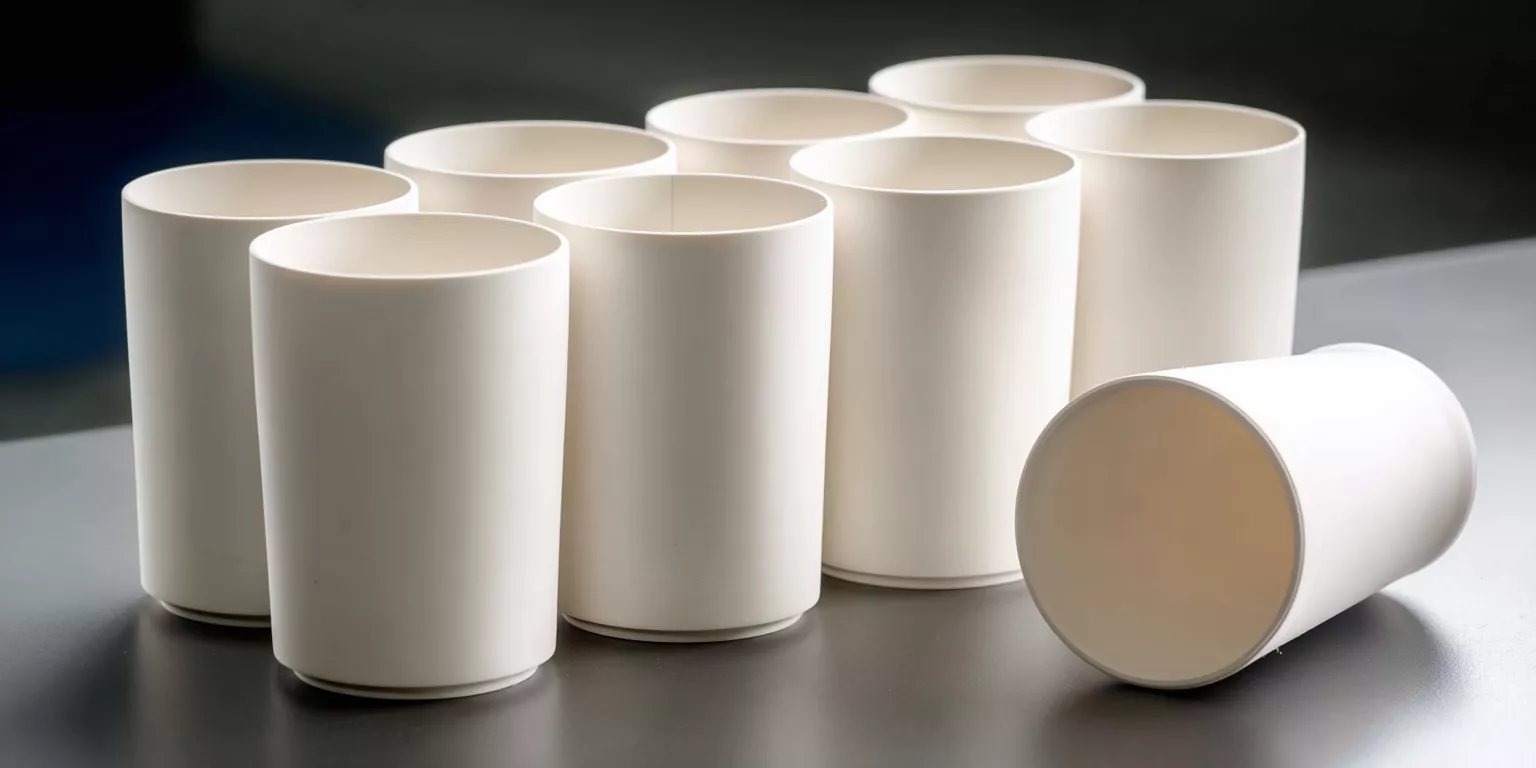
Final Dimensional Machining and Tolerance Adjustment
Post-sintering machining refines the crucible geometry and ensures the dimensional accuracy required for repeatable thermal and chemical performance. Because alumina reaches hardness levels above 9 on the Mohs scale after sintering, only diamond-based tooling can achieve precise surface modification.
Dimensional correction focuses on rims, bases, sealing edges, and contact areas where flatness or perpendicularity influences compatibility with laboratory or industrial equipment.
Diamond grinding methods for achieving final geometry
Diamond grinding provides controlled material removal on fully densified alumina surfaces. Since post-sintered alumina exhibits compressive strength above 250 MPa, machining must rely on abrasives that maintain cutting efficiency under high load. Therefore, grinding speed, coolant flow, and grit size directly influence machining stability.
Typical grinding operations use diamond wheels in the 80–220 grit range depending on required removal rate. Coolant flow rates of 1–3 L/min help dissipate heat and prevent microcrack formation as wheel speeds reach 20–30 m/s. These controlled conditions maintain geometric stability on crucibles up to 120 mm diameter. Gradual passes are preferred to limit residual stress. Additionally, precision fixturing keeps the part aligned through multi-axis adjustments.
Through incremental grinding, the crucible obtains a smooth, stable geometry that meets fixture compatibility standards.
Precision adjustment of walls, rims, and sealing interfaces
Machining of sealing zones and load-bearing sections enhances fit consistency and reduces stress concentrations during use. Because slight deviations can propagate cracks under thermal cycling, tolerance control becomes essential for scientific or industrial applications.
Rim flatness is often maintained within 0.05–0.10 mm, achieved by fine grinding stages using 240–400 grit diamond tools. Wall thickness uniformity for crucibles taller than 100 mm may be reviewed at three vertical checkpoints to maintain deviation under 3–5%. Multi-axis grinders allow synchronized rotation and vertical feed, helping preserve symmetry. Coolant-assisted polishing reduces surface roughness to Ra 0.4–0.8 μm, improving thermal cycling endurance.
As these features reach stability, handling and sealing reliability improve significantly.
Inspection parameters for verifying final tolerances
Final inspection ensures the machined crucible meets the strict dimensional requirements necessary for repeated furnace loading. Since sintering shrinkage varies with powder characteristics and forming methods, verification becomes a critical final step.
Inspection typically employs digital calipers with 0.01 mm resolution to measure key dimensions. Roundness deviations for circular crucibles often remain under 0.15 mm after machining. Coordinate measuring systems can evaluate perpendicularity errors under 0.1–0.2 degrees for taller crucibles exceeding 120 mm height. Profile scanners also record linearity variations across wall sections where tolerance drift may occur. These metrics confirm uniform stress distribution during thermal cycling.
Once inspection data aligns with specifications, the crucible is qualified for laboratory or industrial use.
How Manufacturing Methods Influence Final Crucible Performance
Manufacturing choices directly shape the thermal, mechanical, and chemical behavior of an alumina crucible. Because each forming or firing parameter changes density, microstructure, and internal stress distribution, the final properties always reflect the upstream method.
Proper matching between process route and performance requirement ensures the crucible behaves predictably under repeated high-temperature cycles.
Effect of powder preparation on thermal shock resistance
Powder preparation determines the pore structure that governs heat dissipation and stress development. When powder homogenization exceeds 95% uniformity based on particle distribution tests, the resulting sintered body achieves more consistent thermal gradients. Consequently, thermal shock performance improves because fewer weak interfaces exist between particle clusters.
If particle agglomerates larger than 50–80 µm remain in the mixture, stress points can develop during heating at rates above 5–8°C/min. This leads to localized crack initiation under rapid temperature change. Well-prepared powder with narrow distribution reinforces crack resistance by allowing more uniform heat flow. As these improvements align, the crucible withstands more temperature cycles before fracture.
Although powder preparation appears early in the process, it strongly influences high-temperature durability.
Impact of forming pressure on dimensional stability during firing
Forming pressure controls green density, which influences how much the crucible shrinks during sintering. When dry pressing is conducted at pressures above 150–200 MPa, density variations drop below 3%, creating uniform shrinkage across all wall sections. Therefore, dimensional stability becomes predictable during the sintering cycle.
If pressure inconsistencies exceed 10%, sintering shrinkage may differ by 0.3–0.6% across a single crucible, causing wall distortion as temperatures surpass 1400°C. Consequently, the crucible may lose roundness or vertical alignment. Isostatic pressing, by applying pressure from all directions, typically keeps density variation under 1%, improving geometric accuracy. Once shrinkage patterns stabilize, machining requirements are reduced.
Dimensional reliability originates from the uniformity established during forming.
Influence of sintering temperature profile on final mechanical strength
Sintering temperature gradients dictate grain growth, bonding strength, and remaining porosity. When the temperature soak exceeds 1600–1650°C for controlled durations, mechanical strength rises because porosity decreases below 5%. Consequently, modulus of rupture values can surpass 250 MPa for well-designed alumina batches.
If ramp rates exceed 10–12°C/min without proper binder burnout, retained carbon increases pore clustering, reducing strength by 10–15%. Controlled sintering, where the final soak holds for 2–4 hours, creates uniform grain boundaries and higher fracture toughness. This improves reliability during high-temperature melting and extended furnace exposure. Once grain structure stabilizes through proper thermal management, the crucible performs consistently in demanding environments.
Mechanical strength directly reflects the precision of the sintering profile.
Conclusion
Alumina crucible manufacturing benefits from precise control of materials, forming, drying, firing, and machining to achieve stable high-temperature performance.
FAQ
Why does alumina purity affect crucible behavior at high temperature?
Higher alumina purity reduces impurity-driven glassy phases that soften above 1200°C, and therefore the crucible maintains rigidity under prolonged furnace cycles. Additionally, purity above 95% increases corrosion resistance in oxide-rich melts. As these effects combine, high-purity grades achieve longer service life in demanding environments.
What forming method provides the best dimensional consistency for tall crucibles?
Isostatic pressing provides the most uniform green density because pressure is applied from all directions during compaction. This reduces density variation to under 1%, resulting in predictable shrinkage during sintering. Consequently, tall crucibles maintain roundness and vertical alignment more reliably than those formed by single-axis pressing.
How does drying speed influence final strength?
Slow and uniform drying prevents internal moisture gradients that create tensile stresses during evaporation. If drying exceeds safe rates, microcracks may appear before firing and reduce final mechanical strength by up to 10–15%. Controlled humidity and gradual temperature steps maintain structural integrity before the first firing stage.
Why is controlled sintering necessary for high mechanical strength?
Controlled sintering minimizes porosity and aligns grain boundaries as temperature ramps follow a stable profile. When the soak temperature stays between 1600–1650°C for sufficient duration, final porosity can fall below 5%. This results in improved fracture toughness and greater reliability under repeated thermal cycling.
References:
-
Explore this link to understand how organic binders enhance product quality and sustainability in manufacturing processes. ↩ ↩
-
Learn about the role of lubricants in reducing friction and improving efficiency in powder pressing. ↩
-
Understanding cold isostatic pressing can enhance your knowledge of advanced manufacturing techniques. ↩