Alumina Crucible with Spout for Controlled Pouring & High-Temperature Transfer (99.7% Al₂O₃, Up to 1730°C)

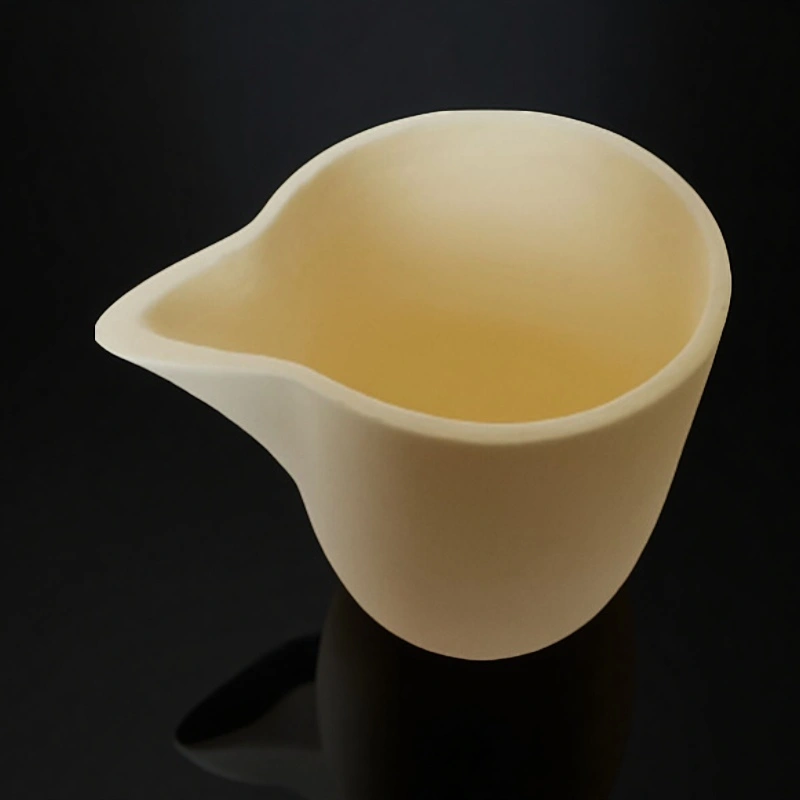
An alumina crucible with spout is a high-alumina ceramic vessel for high-temperature heating and controlled pouring, enabling predictable transfer of molten or liquid-phase materials. ADCERAX offers standard sizes and customizes spout geometry and key dimensions to fit furnace clearance, fixtures, and pour targets.

Catalog No. TE-OEM-124
Material Al2O3
Purity 99%-99.7%
Density 3.8~3.9 g/cm3
Dimensions/Sizes Download PDF
24H Standard Dispatch
Small Batch Support OEM
Factory Direct
Expert Engineering Support

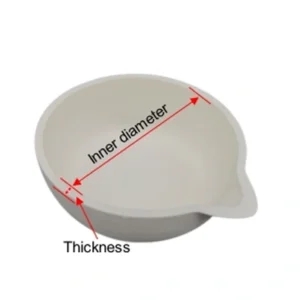
An Alumina Crucible with Spout is a high-alumina ceramic crucible designed for high-temperature heating and controlled pouring/decanting. The built-in spout (pouring lip) guides molten or liquid-phase material into a predictable stream, which helps reduce random dripping, rim overflow, and transfer loss when moving hot contents into a mold, plate, beaker, or another crucible.

Advantages of Alumina Crucible with Spout

  • Defined spout geometry for controlled decanting
    The alumina crucible with spout features a precisely formed pouring lip that concentrates the melt flow at a single exit point, minimizing rim overflow, side dripping, and material loss during high-temperature transfer operations.

  • Optimized rim-to-spout transition for stable flow initiation
    A smooth, engineered transition between the rim and spout stabilizes the initial pour, preventing unpredictable flow break-out around the crucible edge and improving pouring consistency between repeated heating cycles.

  • Consistent form factor across production batches
    Tight control of overall geometry, spout position, and rim height ensures repeatable clamp or tong engagement, enabling operators to maintain a consistent pouring angle and handling motion across multiple crucibles and replacement cycles.

  • Selectable spout opening designs for different melt behaviours
    Multiple spout opening widths and profiles are available to accommodate variations in melt viscosity and particle loading, allowing thicker melts to discharge without clogging while enabling finer control for low-viscosity or precision pours.

  • Edge handling options at high-contact zones
    Chamfered or reinforced lip designs are applied at the rim and spout area to reduce edge chipping caused by frequent tong contact, improving durability in repeated heating, lifting, and pouring workflows.


Alumina Ceramic Crucible with Spout Properties

Property Unit 99.5% Al₂O₃ 99.6% Al₂O₃ 99.7% Al₂O₃ 99.8% Al₂O₃ 99.9% Al₂O₃ 99.99% Al₂O₃
Alumina content % 99.5 99.6 99.7 99.8 99.9 99.99
Density g/cm³ 3.89 3.91 3.92 3.93 3.94 3.98
Open porosity % 0
Color Ivory Ivory Ivory Ivory Ivory Ivory
Water absorption % 0 0 0 0 0
Young’s modulus (Elastic modulus) GPa 375 356 357 358 359 362
Shear modulus GPa 152
Bulk modulus GPa 228
Poisson’s ratio 0.22
Compressive strength MPa 2600 2552 2554 2556 2558 2570
Flexural strength MPa 379 312 313 314 315 320
Fracture toughness MPa·m¹ᐟ² 4
Hardness GPa 14.1 (≈1440 kg/mm²) 23 24 25 26 30
Thermal conductivity W/m·K 35 32–37 33–38 34–39 35–40 36–42
Thermal shock resistance ΔT °C 222 223 224 225 228
Maximum use temperature (no load) °C ≤1750 1755 1760 1765 1770 1800
Coefficient of thermal expansion 10⁻⁶/°C 8.4
Specific heat J/kg·K 880
Volume resistivity Ω·cm >1×10¹⁴ >1×10¹⁴ >1×10¹⁴ >1×10¹⁴ >1×10¹⁴ >1×10¹⁴
Dielectric constant (relative permittivity) 9.8 9.83 9.84 9.85 9.86 9.92
Dielectric strength kV/mm 16.9 23.2 23.4 23.6 23.8 24
Dissipation factor (loss factor @ 1 kHz) 0.0002


Standard Specifications for Alumina Crucibles with Spout
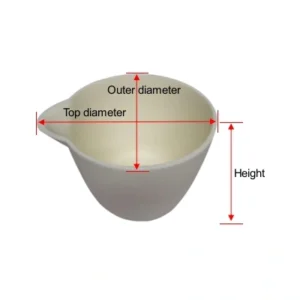
Item NO. Outer diameter(mm) Thickness (mm) Inner diameter (4mm Thickness) Inner diameter(8mm Thickness) TOP diameter(mm) Height(mm) Purity(%)
TE-OEM-124 30 4-8 22 14 40 15 99-99.6
TE-OEM-125 30 4-8 22 14 40 28 99-99.6
TE-OEM-126 30 4-8 22 14 40 35 99-99.6
TE-OEM-127 40 4-8 32 24 50 30 99-99.6
TE-OEM-128 44 4-8 36 28 54 27 99-99.6
TE-OEM-129 50 4-8 42 34 60 35 99-99.6
TE-OEM-130 50 4-8 42 34 60 47 99-99.6
TE-OEM-131 50 4-8 42 34 60 60 99-99.6
TE-OEM-132 50 4-8 42 34 60 75 99-99.6
TE-OEM-133 60 4-8 52 44 70 80 99-99.6
TE-OEM-134 68 4-8 60 52 78 92 99-99.6
TE-OEM-135 75 4-8 67 59 85 46 99-99.6
TE-OEM-136 80 4-8 72 64 90 75 99-99.6
TE-OEM-137 85 4-8 77 69 95 90 99-99.6
TE-OEM-138 90 4-8 82 74 100 80 99-99.6
TE-OEM-139 94 4-8 86 78 104 76 99-99.6
TE-OEM-140 100 4-8 92 84 110 65 99-99.6
TE-OEM-141 190 4-8 182 174 200 70 99-99.6
TE-OEM-142 190 4-8 182 174 200 65 99-99.6
TE-OEM-143 100 4-8 92 84 110 70 99-99.6
TE-OEM-144 150 4-8 142 134 160 80 99-99.6
TE-OEM-145 270 8 / 254 280 55 99-99.6
TE-OEM-146 340 8 / 324 350 120 99-99.6
TE-OEM-147 400 8 / 384 410 90 99-99.6
TE-OEM-148 450 8 / 434 460 85 99-99.6

Alumina Crucibles with Spout Packaging

  • Individual unit protection: each crucible is separated to prevent rim-to-rim contact
  • Shock absorption: foam + inner carton to reduce micro-crack risk during transit
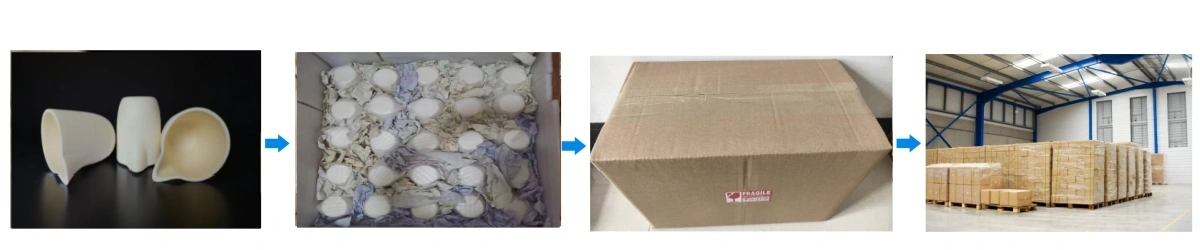
Alumina Crucibles with Spout Packaging

Applications for Alumina Crucibles with Pouring Spouts

  • Analytical Labs — Ashing / Gravimetric Prep / Melt Transfer

    ✅Key Advantages

    1. Thermal-shock risk control — Published handling guidance recommends ~150°C/hour initial ramp to reduce cracking drivers in alumina parts.

    2. Furnace clearance discipline — Best-practice guides recommend ≥25 mm clearance from heating elements (50 mm preferred) to reduce expansion stress.

    3. High-temperature compatibility — High-alumina crucibles are commonly specified up to 1750°C max use temperature in lab supply specs.

    ✅ Problem Solved

    A lab running repeated heating cycles often cracks crucibles when ramping too fast or placing them too close to heating elements. Public guidance recommends using an initial heating rate around 150°C/hour for the first 1–1.5 hours, and maintaining at least 25 mm clearance from heating elements (often 50 mm preferred) to reduce stress concentrations. When these limits are built into SOPs, labs stabilize replacement planning and reduce unplanned downtime caused by unexpected crucible failure. The spout then improves the consistency of the final transfer step, reducing reliance on scraping at the rim.

  • Glass / Glaze / Ceramic Color R&D — Controlled Pour Into Molds or Plates

    ✅Key Advantages

    1. Repeatable pour start point — the spout defines the flow exit location, improving run-to-run handling consistency.

    2. Temperature-program planning — recommended temperature change limits such as ≤150°C/hour support safer ramp schedules for repeated trials.

    3. High-temperature margin — common published specs list alumina crucibles up to 1750°C, covering many glaze/frit melt programs.

    ✅ Problem Solved

    Formulation teams iterate quickly, so they need a crucible that behaves consistently across multiple trials. When a melt reaches target temperature, transfer is where many losses occur: unpredictable rim flow, drip trails, and residue that must be scraped. A spout geometry addresses the handling side, while published operating limits—like ≤150°C/hour change rate guidance—help define heating profiles that reduce crack-related interruptions. With clear clearance rules (e.g., ≥25 mm to heating elements), teams also reduce mechanical stress that can shorten service life.

  • Small-Scale Metal / Materials Pilot Tests — Decanting Without Rim Overflow

    ✅  Key Advantages

    1. Controlled decant path — spout guides flow to a single outlet for safer handling and cleaner transfer.

    2. Clearance-based crack prevention≥25 mm furnace clearance guidance helps prevent expansion-constraint cracking.

    3. Temperature capability reference — published specs commonly list 1750°C max use temperature for high-alumina crucibles.

    ✅  Problem Solved

    In small pilot tests, the transfer step is a risk point because handling is manual and timing matters. General alumina crucible guidance emphasizes minimizing thermal shock with controlled ramps and ensuring physical clearance in the furnace—≥25 mm minimum spacing is commonly recommended, with 50 mm preferred in some guides. These quantified constraints can be integrated into work instructions so operators avoid the failure modes that cause sudden cracking during heating or removal. A spout then improves the predictability of the pour when transferring hot contents into the next container.

Usage Instructions for Alumina Crucible with Spout

  • Installation /Setup

    1. Place the crucible on a stable refractory or compatible support plate; avoid point contact that concentrates stress.
    2. Keep ≥25 mm clearance from heating elements; 50 mm preferred where space allows (published care guides).
    3. Orient the spout toward the intended pour direction before heating to avoid repositioning at high temperature.

  • Use

    1. Use a controlled ramp, especially at the beginning: published guidance recommends around 150°C/hour for the first 1–1.5 hours to reduce thermal shock drivers.
    2. Avoid direct flame contact and avoid sudden insertion into an already-hot zone without preheating.
    3. Do not overfill; uneven heating and thermal gradients increase cracking risk.

  • Storage

    1.  Store dry; moisture can create thermal shock during heat-up.
    2. Avoid stacking rim-to-rim; keep separators to prevent micro-chips at the lip/spout.

  • Cleaning

    1. Let the crucible cool gradually; do not quench.
    2. Remove residues using non-impact methods first; avoid hard strikes on the spout/lip region.
    3.  If chemical cleaning is used, confirm compatibility with your residue chemistry and rinse/dry fully before reuse.

  • Common Misuse Points

    1. Issue: Cracking during early heat-up
    Likely cause: Heating too fast
    Fix: Follow published guidance of ~150°C/hour initial ramp and avoid abrupt insertion into a hot zone.

    2. Issue: Sidewall crack after several cycles
    Likely cause: Insufficient furnace clearance causing constrained expansion
    Fix: Keep ≥25 mm from heating elements (50 mm preferred) and avoid tight fixtures.

    3. Issue: Drip trails during pour
    Likely cause: Spout not aligned or opening not matched to viscosity/particle load
    Fix: Set spout orientation before heating; choose a spout opening that matches melt behaviour (wider for thicker melt, narrower for slower stream).

Alumina Ceramic Crucible with Spout FAQ

  1. Q: What is the main advantage of an alumina crucible with spout compared to a standard alumina crucible?
    A: An alumina crucible with a spout provides a defined and repeatable pouring outlet, which reduces uncontrolled rim overflow, dripping, and material loss during transfer. This is especially important when handling molten materials that must be poured accurately into molds, plates, or secondary containers.

  2. Q: Does the spout affect the thermal performance of an alumina crucible?
    A: The spout does not reduce the maximum operating temperature of the alumina crucible when properly designed. However, spout geometry and localized wall thickness influence thermal gradients, which is why controlled heating and cooling rates are recommended to minimize thermal shock at the spout transition area.

  3. Q: What alumina purity is typically used for alumina crucibles with a spout?
    A: Most alumina crucibles with spouts are manufactured from 99.5%–99.7% Al₂O₃, which offers a balance between high-temperature capability, chemical stability, and mechanical strength. Higher purities may be selected for contamination-sensitive analytical or materials research applications.

  4. Q: Can an alumina crucible with a spout be used for repeated heating and pouring cycles?
    A: Yes, alumina crucibles with a spout are commonly used in repeated cycles. Long service life depends on maintaining appropriate temperature ramp rates, sufficient furnace clearance, and avoiding mechanical impact at the spout and rim during handling.

  5. Q: What are the most common causes of cracking in an alumina crucible with a spout?
    A: Cracking is usually caused by thermal shock, uneven heating, or constrained expansion rather than exceeding the temperature rating. Rapid heating, direct contact with heating elements, or tight fixture confinement near the spout area are typical contributing factors.

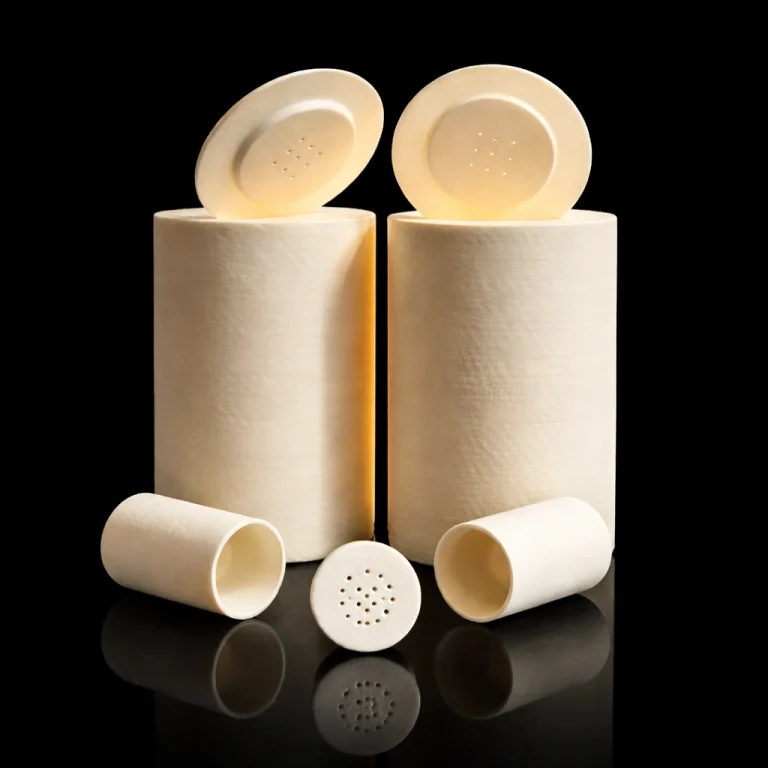
  6. Q: Is a lid recommended when using an alumina crucible with a spout?
    A: A lid may be used when evaporation control, atmosphere protection, or contamination reduction is required. When using a lid, adequate clearance must be maintained to avoid binding during thermal expansion, especially near the spout region.

Alumina Crucible with Spout Reviews

  • ⭐️⭐️⭐️⭐️⭐️
    We replaced our previous pouring setup with an alumina crucible with spout to improve transfer consistency. The spout location is consistent across units, which reduced handling variation between technicians. ADCERAX pricing was workable for our quarterly replenishment.
    -- Maria S. — Procurement Manager, NorthRiver Analytical Services
  • ⭐️⭐️⭐️⭐️⭐️
    The spout makes it easier to decant without scraping the rim area. We also appreciated that the batch we received matched the form factor of our older crucibles, so our tongs and furnace placement did not need changes.
    -- Daniel K. — Lab Manager, BrightCore Materials Lab
  • ⭐️⭐️⭐️⭐️⭐️
    We requested a custom spout opening to fit our pour target. The customized alumina crucible with spout arrived with the geometry we specified, and the pour path was easier to control in repeated trials.
    -- A. Chen — R&D Engineer, GlazeTech Formulation Team
  • ⭐️⭐️⭐️⭐️⭐️
    For customers requiring non-standard pouring geometry, ADCERAX was able to adjust the alumina crucible with spout dimensions and spout profile based on our technical notes. Communication on drawings and tolerances was clear, which simplified approval on our side before placing repeat orders.
    -- Sophie L. — Purchasing Specialist, Westmount Lab Supplies (Distributor)
customize size

Alumina Ceramic Crucible with Spout Customized

If your process requires precise and repeatable pouring into a mold, onto a plate, or into a secondary container, the alumina crucible with spout can be customized to match your furnace setup, handling tools, and material flow behavior.

  • Capacity & form
    Low-form, high-form, or conical profiles can be specified based on melt volume, furnace height limitations, and thermal stability requirements during heating and pouring.

  • Outer diameter/inner diameter/overall height
    Dimensions can be adjusted to fit furnace tubes, chamber furnaces, or dedicated ceramic holders, helping maintain consistent clearance from heating elements and support fixtures.

  • Spout geometry
    Spout length, opening width, and spout wall thickness can be tailored to control discharge speed, reduce dripping at the lip, and prevent clogging when handling higher-viscosity melts or particle-loaded materials.

  • Pour behavior controls
    The spout angle relative to the rim, along with localized rim thickness near the spout, can be engineered to stabilize flow initiation and ensure predictable pouring direction during repeated handling cycles.

  • Lip design options
    Standard rims, reinforced rims, or chamfered rims are available to improve resistance to chipping at high-contact zones where tongs or clamps engage most frequently.

  • Bottom design
    Flat-bottom or slightly rounded-bottom configurations can be selected to match heating plates, setters, or furnace supports, improving thermal contact and mechanical stability during heating.

  • Wall thickness configuration
    Standard or reinforced wall thicknesses can be specified to balance thermal response and mechanical robustness, depending on handling frequency and operating temperature profile.

  • Surface condition
    As-fired surfaces or ground contact areas can be defined for improved seating on fixtures, reducing rocking or point-loading during high-temperature operation.

Related Products

ADCERAX - Your Trusted Advanced Ceramics Manufacturing Partner

Direct factory manufacturing with comprehensive ceramic materials expertise and global supply capabilities

Direct Factory Manufacturing

China-based ceramic materials production facility with state-of-the-art equipment

Engineering Team

Experienced professionals in advanced ceramics applications and custom design

Quality Control

Strict quality control standards for technical ceramics manufacturing and quality management

Global Supply Chain

Serving customers worldwide with technical ceramics and rapid response

24/7 Technical Support

Round-the-clock support for ceramic components inquiries and technical assistance

500+ Satisfied Customers

Trusted by global customers for advanced ceramic materials and precision components

Get in touch with us

Our team will be happy to respond to you in less than 24 hours.

Adcerax's factory

Quick Quotation

*Our team will answer your inquiries within 24 hours.

*Your information will be kept strictly confidential.

Ready to Solve Your Engineering Challenge?

Partner with ADCERAX for reliable, high-performance advanced ceramic solutions. Our engineers are ready to discuss your project.

E-mail

info@adcerax.com

Phone

+(86) 0731-74427743 | WhatsApp: +(86) 19311583352

Response Time

Within 24 hours

Quick Quote

The more details you provide, the faster we can quote.

*We respond within 24 hours. All inquiries are confidential.

Download Catalog

Get Your Custom Sulution

The more details you provide, the faster we can respond.

customize size

*We respond within 24 hours. All inquiries are confidential.

Download Catalog