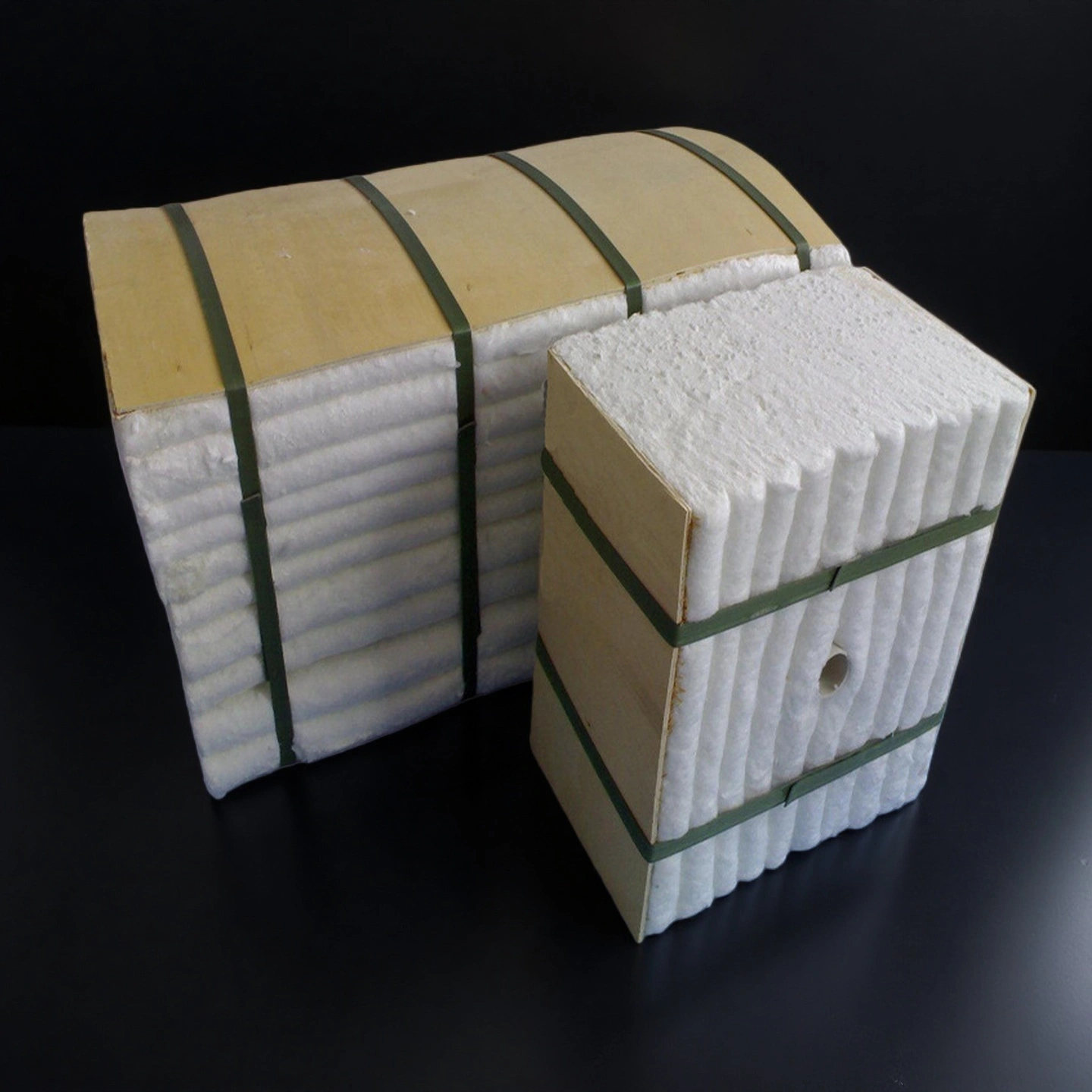
Customized Aluminum Silicate Fiber Modules for Steel Reheating Furnaces and Soaking Pits

Aluminum silicate fiber modules from ADCERAX are available in standard footprints such as 300 × 300 mm and 300 × 450 mm, with typical thicknesses from 100 to 300 mm. Both module dimensions and anchor layouts can be customized around the customer’s furnace lining drawing, while keeping the core aluminum silicate fiber module structure and density unchanged.

Catalogue No. T-GSL-MK1001
Material Al2O3+SiO₂
Classification temperature (°C) 1050–1430°C
Bulk density (kg/m³) 160–220 kg/m³ for compressed modules
Thermal conductivity at 1000°C (W/m·K) Approx. 0.26–0.28 W/m·K at 160 kg/m³
24H Standard Dispatch
Small Batch Support OEM
Factory Direct
Expert Engineering Support

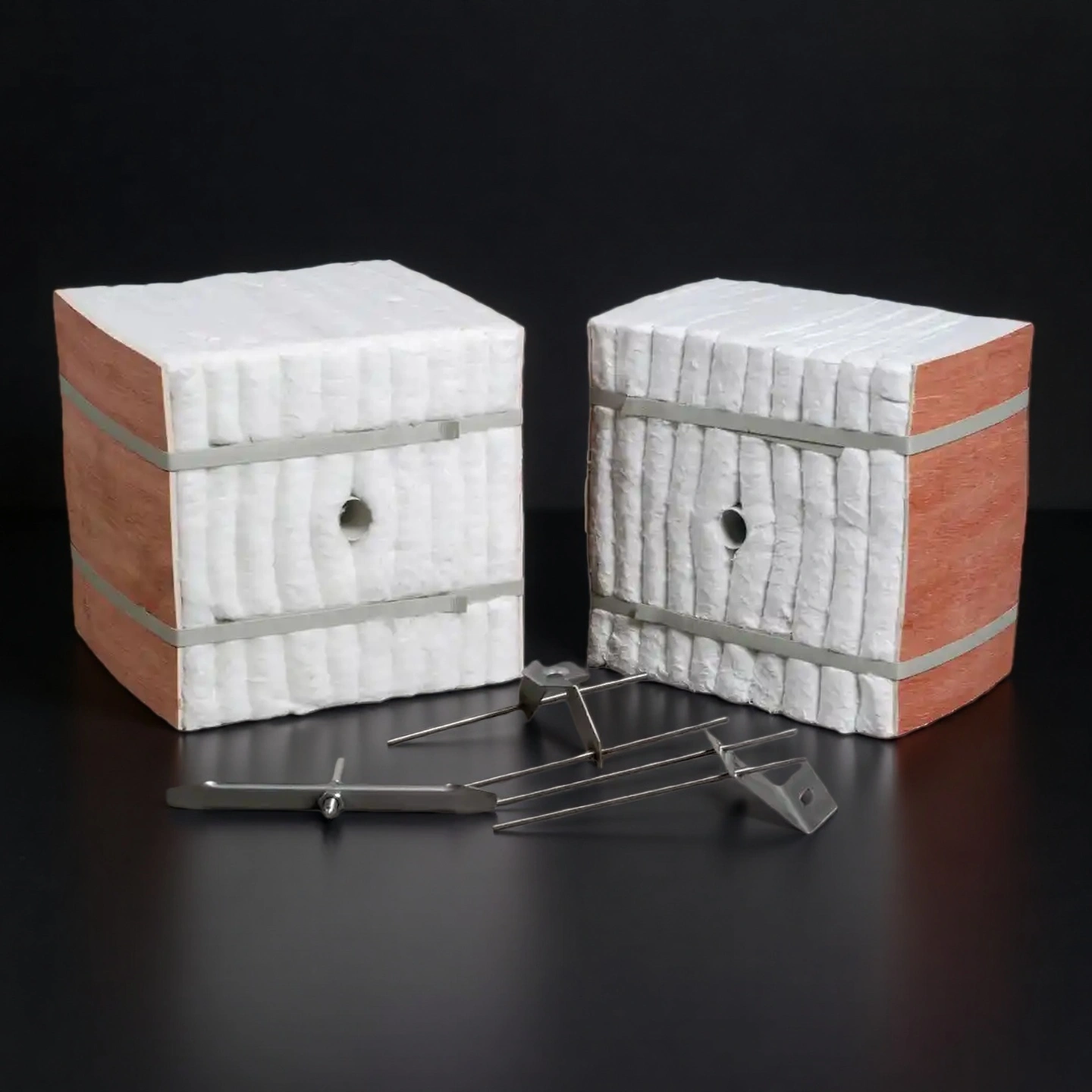
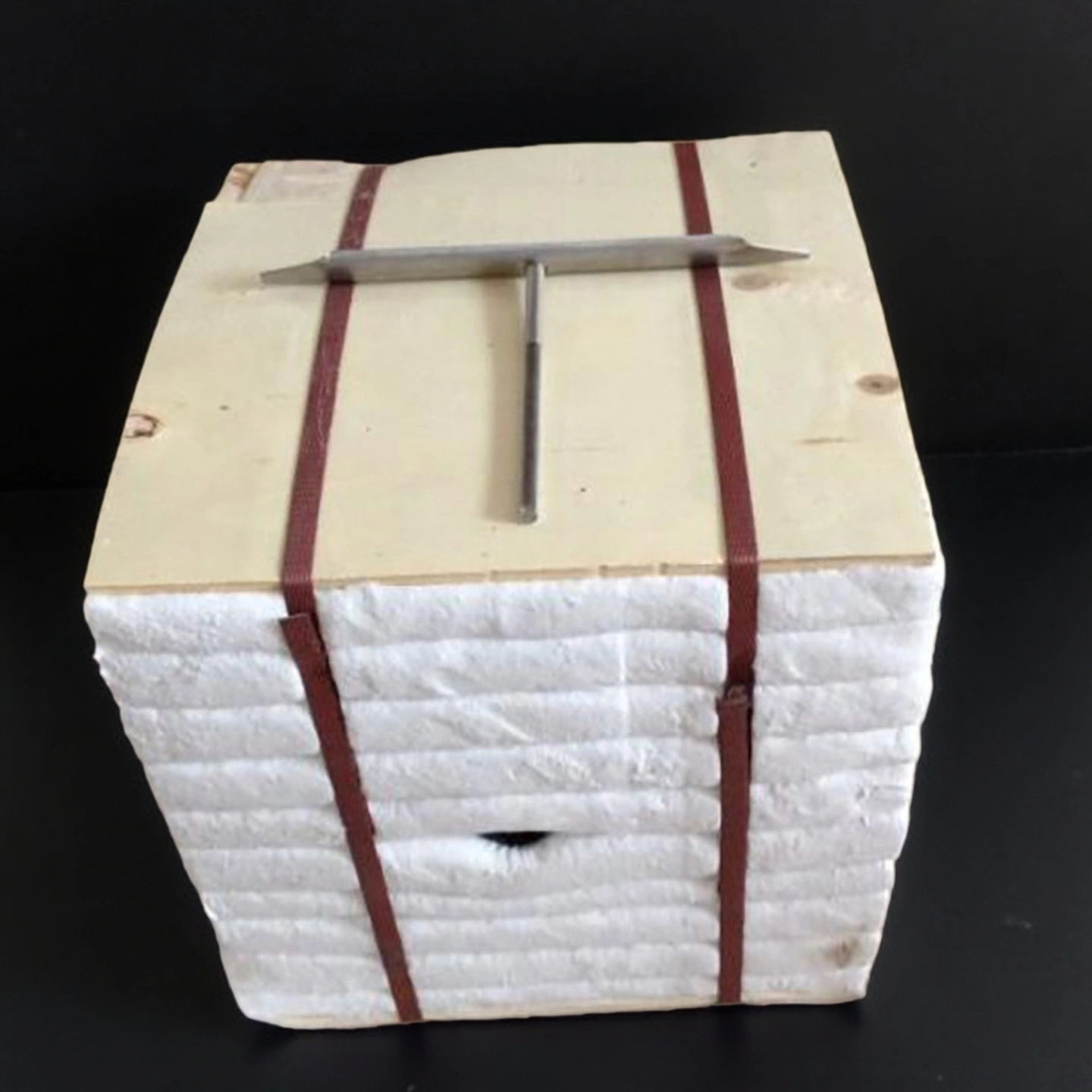
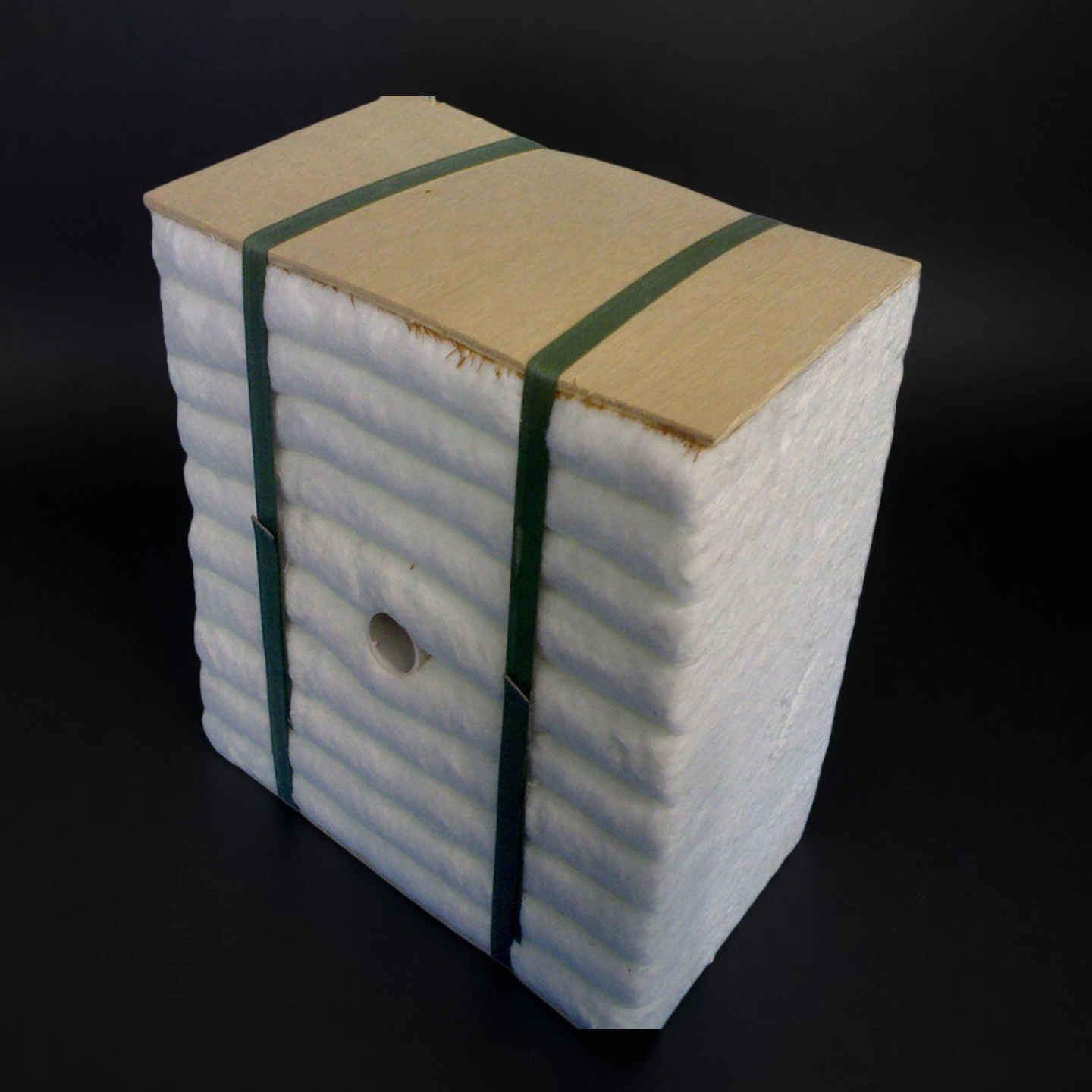
Aluminum silicate fiber modules are prefabricated, high-temperature insulation blocks made by folding or stacking aluminum silicate ceramic fiber blankets into compressed modules and securing them with built-in anchors. The fiber itself is a synthetic alumina–silica material, designed for continuous operation in the medium to high temperature range, typically around 1000–1350°C depending on the grade.


Aluminum Silicate Fiber Modules: Benefits

  • Stable high-temperature insulation – Aluminum silicate fiber modules maintain low heat flow up to their classification temperature range of 1050–1430°C, supporting service temperatures around 1000–1350°C for many industrial furnaces.

  • Low heat storage and fast heat-up – The low mass and porous microstructure of aluminum silicate ceramic fiber reduce thermal storage, helping furnace linings reach operating temperature faster and lowering fuel or power consumption per batch.

  • Compressed modular construction – Pre-compressed modules expand slightly after untying, helping to close joints between blocks and reduce hot spots and through-gaps in the aluminum silicate fiber module lining.

  • Integrated anchor design – Built-in metallic anchoring systems allow aluminum silicate fibre modules to be fixed directly to the furnace shell, improving installation speed and making thick linings easier to build in confined spaces.

  • Good thermal shock resistance – The fiber-based structure tolerates frequent heating and cooling cycles better than many brick or monolithic linings in comparable conditions, reducing cracking and spalling risk in repeated cycling.


Aluminum Silicate Ceramic Fiber Modules Properties

Item General Grade Standard Grade High Purity Grade High Alumina Grade Zirconia-Containing Grade
Classification Temperature (°C) 1100 1260 1260 1360 1430
Service Temperature (°C) <1000 1050 1100 1200 1350
Color White Off-white Off-white Off-white Off-white
Bulk Density (kg/m³) 260–320 260–320 260–320 260–320 260–320
Permanent Linear Shrinkage (%) (24 h holding; based on 128 kg/m³) <2.5 (1000°C) <2.5 (1050°C) <2.5 (1100°C) <2.5 (1100°C) <2.5 (1350°C)
Thermal Conductivity (W/m·K) (bulk density 128 kg/m³) 0.085 (400°C) 0.085 (400°C) 0.085 (400°C) 0.085 (400°C) 0.085 (400°C)
0.132 ( 800°C) 0.132 ( 800°C) 0.132 ( 800°C) 0.132 ( 800°C) 0.132 ( 800°C)
0.180 (1000°C) 0.180 (1000°C) 0.180 (1000°C) 0.180 (1000°C)
Tensile Strength (MPa) (bulk density 128 kg/m³) 0.5 0.5 0.5 0.5 0.5
Chemical Composition (wt%)
Al₂O₃ 44 46 47–49 52–55 39–40
Al₂O₃ + SiO₂ 96 97 99 99
Al₂O₃ + SiO₂ + ZrO₂ 99
ZrO₂ 15–17
Fe₂O₃ <1.2 <1.0 0.2 0.2 0.2
Na₂O + K₂O ≤0.5 ≤0.5 0.2 0.2 0.2


Aluminum Silicate Fiber Modules Specifications
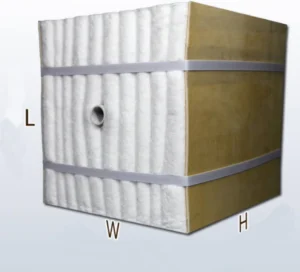
Aluminum Silicate Fiber Modules size

Item L*W*H(mm) Classification Temperature(℃) Note
AT-GSL-MK1001 300*300*150 1260 standard
AT-GSL-MK1002 300*300*200 1260 standard
AT-GSL-MK1003 300*300*250 1260 standard
AT-GSL-MK1004 300*300*300 1260 standard
AT-GSL-MK1005 300*300*150 1300 High aluminum
AT-GSL-MK1006 300*300*200 1300 High aluminum
AT-GSL-MK1007 300*300*250 1300 High aluminum
AT-GSL-MK1008 300*300*300 1300 High aluminum
AT-GSL-MK1009 300*300*300 1430 Zirconium-containing
AT-GSL-MK1010 600*300*200 1430 Zirconium-containing
AT-GSL-MK1011 600*300*250 1430 Zirconium-containing
AT-GSL-MK1012 600*300*300 1430 Zirconium-containing


Aluminum Silicate Fiber Modules Packaging

  • Each aluminum silicate fiber module is strapped or film-wrapped in its compressed state to maintain pre-compression during transport.
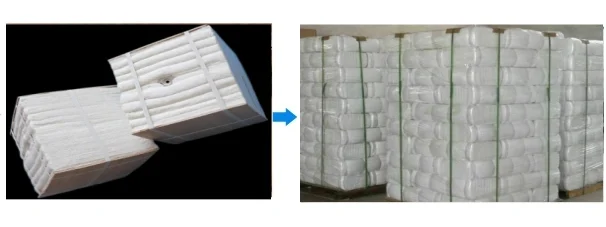

Aluminum Silicate Fiber Modules Packaging

Aluminum Silicate Fiber Modules Applications

  • Steel and Heat-Treatment Furnaces

    ✅Key Advantages

    1. Reduced fuel consumption in reheating furnaces – Aluminum silicate fiber modules provide lower thermal conductivity than many lightweight brick linings at 1000°C, which can cut heat loss through the furnace shell.

    2. Shorter heat-up and cooldown times – The low heat capacity lining helps batch or semi-continuous furnaces reach setpoint faster and cool down faster for maintenance.

    3. Ease of repair in localized damage zones – Individual modules in high-wear roof or door areas can be replaced without dismantling large sections of the lining.

    ✅ Problem Solved

    A heat-treatment furnace operator replacing a 230 mm light insulating brick lining with a 200 mm aluminum silicate fiber module lining reported a thermal conductivity drop from around 0.45 W/m·K to roughly one-third of that at 1000°C, consistent with typical ceramic fiber board data. This reduced shell losses and allowed the furnace to reach soaking temperature 20–30 minutes faster per cycle, lowering gas usage and freeing additional operating hours per week. Unplanned stops due to lining cracking were also reduced after switching to modular fiber construction.

  • Petrochemical Heaters and Incinerators

    ✅Key Advantages

    1. Stable performance under continuous high-temperature operation – Aluminum silicate fiber modules maintain acceptable shrinkage levels after 24 hours at 1000–1200°C when correctly selected by grade.

    2. Improved lining integrity in convection and radiant sections – Pre-compressed modules help control joint opening in areas exposed to strong hot gas flow.

    3. Lower lining weight on tall vertical shells – Module linings can be more than 75% lighter than some traditional brick or castable systems, easing load on support structures.

    ✅ Problem Solved

    In a process heater retrofit, replacing a heavy brick-and-castable lining with aluminum silicate fiber modules reduced lining weight by over 70% and cut outer shell temperatures, allowing operators to meet updated efficiency targets without changing the heater steelwork. The project team reported shorter shutdown duration due to faster module installation and fewer welds than expected for a full castable relining.

  • Glass and Ceramic Kilns

    ✅  Key Advantages

    1. Uniform kiln temperature profile – Aluminum silicate fiber modules can be arranged with consistent thickness and density to minimize hot and cold spots along the kiln length.

    2. Reduced energy use per firing cycle – The lower thermal mass lining decreases preheat time, supporting cycle time and specific energy consumption targets.

    3. Flexible layout for roof and car decks – Modules can be cut and shaped to fit kiln roofs, sidewalls and car areas with fewer joints than many board or brick solutions.

    ✅  Problem Solved

    A roller kiln used for ceramic components changed its mixed board-and-brick lining to a full aluminum silicate fiber module system. Kiln start-up time was shortened, and energy monitoring indicated a noticeable drop in kWh per tonne of fired product, aligning with the expected benefit of replacing heavier linings with low-conductivity, low-mass fiber materials.


Aluminum Silicate Fiber Modules Usage Guide

  • Installation

    1. Verify that furnace shell surfaces are clean, dry and structurally sound before fixing anchors.
    2. Weld or fasten anchor systems according to the module layout drawing and manufacturer spacing recommendations.
    3. Install aluminum silicate fiber modules in a pre-defined sequence, untying compression bands only after the module is positioned on the anchors.
    4. Stagger vertical and horizontal joints between module rows to reduce continuous straight through-joints.
    5. For hot-face coatings, apply the recommended coating after the full module lining is in place and inspected.

  • Operation

    1. Follow controlled heat-up schedules for new linings, respecting maximum temperature rise per hour to avoid thermal shock.
    2. Avoid exposing aluminum silicate fiber modules to liquid slag, direct flame impingement at extreme velocities, or heavy mechanical impact unless the design accounts for these conditions.
    3. Monitor shell temperatures and flue gas composition during early runs to confirm that the new lining behaves as expected.

  • Storage

    1. Store aluminum silicate fiber modules in their original packaging, in a dry indoor area protected from rain and condensed moisture.
    2. Keep pallets off the floor using dunnage, especially for long-term storage.
    3. Avoid stacking pallets above recommended limits to prevent compression damage beyond designed pre-load.

  • Cleaning and inspection

    1. During planned shutdowns, visually inspect the hot face of the aluminum silicate fiber modules for erosion, mechanical damage or localized shrinkage.
    2. Remove loose debris with a vacuum or soft brush rather than high-pressure air jets that may disturb fibers.
    3. Mark and replace individual modules showing visible fiber loss down to the anchor or significant hot-face deformation.

  • Common misuse points and corrective actions

    1. Over-firing above classification temperature
    Issue: Running long periods above the selected aluminum silicate fiber grade can increase shrinkage and reduce lining life. Zhengzhou Kerui+2zzrsnc.en.made-in-china.com+2
    Fix: Re-select module grade to match peak operating conditions or protect hot spots with an additional refractory layer.

    2. Insufficient anchor density or incorrect anchor alloy
    Issue: Modules may loosen or deform where anchor spacing is too wide or alloys soften at service temperature. ceceramicfiber.com+2PTI Thermal+2
    Fix: Increase anchor count in high-load zones and specify appropriate stainless steel or alloy anchors.

    3. Poor joint compression between modules
    Issue: Large open joints create hot spots, local overheating and shorter module life.
    Fix: Ensure correct pre-compression and installation pattern; consider re-tightening adjacent modules or replacing damaged pieces.

Aluminum Silicate Ceramic Fiber Modules FAQ

  1. Q: What is the typical working temperature range of aluminum silicate fiber modules?
    A: Aluminium silicate fiber modules are usually selected from grades with classification temperatures between 1050°C and 1430°C, and they are commonly used at continuous working temperatures around 1000–1350°C depending on the process.
  2. Q: How do aluminium silicate fiber modules compare with lightweight bricks in thermal conductivity?
    A: At around 1000°C, ceramic fibre products including aluminium silicate fibre module can show thermal conductivity around 0.16–0.28 W/m·K depending on density and grade, which is often close to one-third of some light insulating brick values in similar conditions.
  3. Q: Can aluminum silicate fiber modules be used in direct-flame zones?
    A: Aluminum silicate fiber modules can be used in many direct-flame zones if the selection matches temperature and gas velocity, but high-velocity flames, chemical attack or slag contact may require additional hot-face refractories or higher-grade fibers.
  4. Q: What densities are common for aluminum silicate fiber modules?
    A: Typical aluminum silicate ceramic fiber module densities fall between 160 and 220 kg/m³, providing a balance of strength, spring-back compression and low thermal conductivity for furnace linings.
  5. Q: Do aluminum silicate fiber modules shrink over time?
    A: All ceramic fiber modules show some linear shrinkage when heated near their classification temperature; typical permanent shrinkage values may be ≤2.0–3.0% after 24 hours at the specified test temperature if the correct grade is chosen.
  6. Q: Can aluminium silicate fiber modules be repaired locally?
    A: Yes, damaged modules can often be removed and replaced individually, which is one of the advantages of modular fiber linings over monolithic castable or brick constructions in maintenance scenarios.
  7. Q: Are aluminium silicate fiber modules suitable for waste incinerators?
    A: Aluminum silicate fiber modules are used in many waste incinerators for certain zones; however, highly corrosive or extremely high-temperature sections may require higher-specification fibers or a composite lining design.

Customer Reviews for Aluminum Silicate Fiber Modules

  • ⭐️⭐️⭐️⭐️⭐️
    We installed aluminum silicate fiber modules from ADCERAX in a walking beam reheating furnace. The new ceramic fiber module lining shortened heat-up time and helped us reach our fuel reduction targets without changing the burners.
    -- Michael Turner, Furnace Project Manager, Heatline Engineering GmbH
  • ⭐️⭐️⭐️⭐️⭐️
    Our maintenance team appreciated the way the aluminum silicate fiber modules were pre-compressed and anchored. Replacing a few damaged blocks during shutdown was straightforward, and ADCERAX as the factory supplier supported the module layout drawing quickly.
    -- Soo-jin Park, Maintenance Supervisor, Hanseong Steel Processing Co.
  • ⭐️⭐️⭐️⭐️⭐️
    For our roller kilns we selected customized aluminum silicate fiber modules with different thickness zones. The uniform surface temperature and lighter kiln structure allowed us to run tighter firing curves with fewer temperature deviations across the products.
    -- Carlos Ramirez, Operations Director, ThermoCer Kiln Systems S.A.
  • ⭐️⭐️⭐️⭐️⭐️
    We specified aluminum silicate ceramic fibre modules for several sections of the incinerator. ADCERAX provided modules with matching density and anchor types, and after one heating season the lining still shows stable surface temperatures and no visible module loosening.
    -- Emily Ward, Plant Engineer, North Coast Waste-to-Energy Plant
customize size

Custom Aluminum Silicate Ceramic Fiber Modules

Aluminum silicate fiber modules are often configured around a specific furnace or kiln shell, so ADCERAX manufactures modules to match both standard sizes and fully custom lining designs while keeping the core ceramic fiber chemistry and quality stable.


1. Module footprint options

  • Standard sizes such as 300 × 300 mm, 300 × 450 mm, 600 × 300 mm
  • Special footprints for arched roofs, vertical shells, door frames, burner zones
  • Fully drawing-based layouts for multilayer linings and non-rectangular furnace sections

2. Thickness /height selections

  • Common thickness range: 100–300 mm
  • Step increments available to satisfy thermal design (e.g., 110/150/200/250 mm)
  • Capability to mix multiple thickness zones within the same lining structure

3. Fibre grade configuration

  • 1050°C, 1260°C, 1350°C, 1430°C aluminum silicate ceramic fiber
  • Optional zirconia-enhanced grades for high-radiant or high-velocity zones
  • Matching grade selection according to continuous vs. peak temperature requirements

4. Target density customization

  • Density range 160–220 kg/m³
  • Higher density for mechanical strength and gas flow resistance
  • Lower density for lighter shell loads or reduced heat storage

5. Anchor system specification

  • Choice of Y-anchors, V-anchors, multi-point plates, or back-mounted anchor blocks
  • Compatible materials: SS304, SS310S, 330 alloy, or other high-temperature alloys
  • Ability to align anchor metals with process chemistry (reducing/oxidizing gas)

6. Anchor layout design

  • Adjustable number of anchors per module (typically 2–5 points)
  • Custom spacing to match shell rigidity, gas velocity, and vibration zones
  • Reinforced anchoring for roof modules and burner-adjacent areas

7. Folding direction & fiber layering

  • Orientation of folds toward hot face for higher erosion resistance
  • Layer configuration adjustable for convection vs. radiant sections
  • Multi-direction folded patterns to minimize straight-through fiber paths

8. Edge geometry options

  • Straight edges for standard wall lining
  • Chamfered edges to reduce joint gap exposure
  • Stepped / interlocking edges for kiln roofs, domes and circular structures

9. Joint allowance control

  • Pre-compression level adjustable for optimal spring-back expansion
  • Installed joint clearance customized by furnace size and thermal expansion rate
  • Tight-joint design for high-efficiency insulation and reduced hot spotting

10. Hot-face surface variations

  • Plain fiber hot face for general-purpose linings
  • Light needle-punched surface for improved hot-face stability
  • Optional thin refractory coating layer for zones requiring better abrasion or flame resistance

11. Project-specific functional enhancements

  • Optional module locking pins for vertical or inverted surfaces
  • Pre-slotted back panels for curved or tapered furnace shells
  • Segmented module sets for doors, burners, sight ports and flues

Related Products

ADCERAX - Your Trusted Advanced Ceramics Manufacturing Partner

Direct factory manufacturing with comprehensive ceramic materials expertise and global supply capabilities

Direct Factory Manufacturing

China-based ceramic materials production facility with state-of-the-art equipment

Engineering Team

Experienced professionals in advanced ceramics applications and custom design

Quality Control

Strict quality control standards for technical ceramics manufacturing and quality management

Global Supply Chain

Serving customers worldwide with technical ceramics and rapid response

24/7 Technical Support

Round-the-clock support for ceramic components inquiries and technical assistance

500+ Satisfied Customers

Trusted by global customers for advanced ceramic materials and precision components

Get in touch with us

Our team will be happy to respond to you in less than 24 hours.

Adcerax's factory

Quick Quotation

*Our team will answer your inquiries within 24 hours.

*Your information will be kept strictly confidential.

Ready to Solve Your Engineering Challenge?

Partner with ADCERAX for reliable, high-performance advanced ceramic solutions. Our engineers are ready to discuss your project.

E-mail

info@adcerax.com

Phone

+(86) 0731-74427743 | WhatsApp: +(86) 19311583352

Response Time

Within 24 hours

Quick Quote

The more details you provide, the faster we can quote.

*We respond within 24 hours. All inquiries are confidential.

Download Catalog

Get Your Custom Sulution

The more details you provide, the faster we can respond.

customize size

*We respond within 24 hours. All inquiries are confidential.

Download Catalog