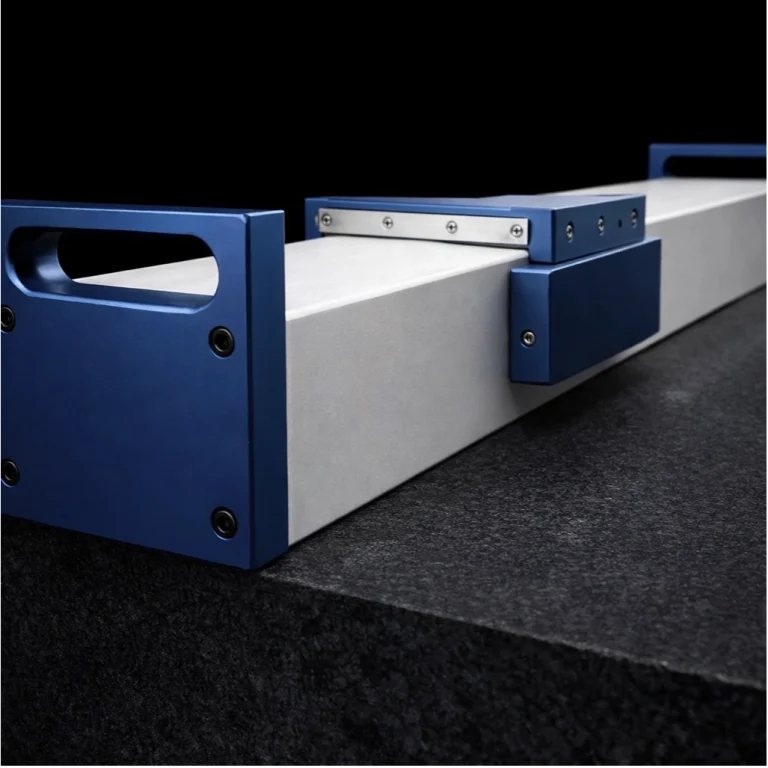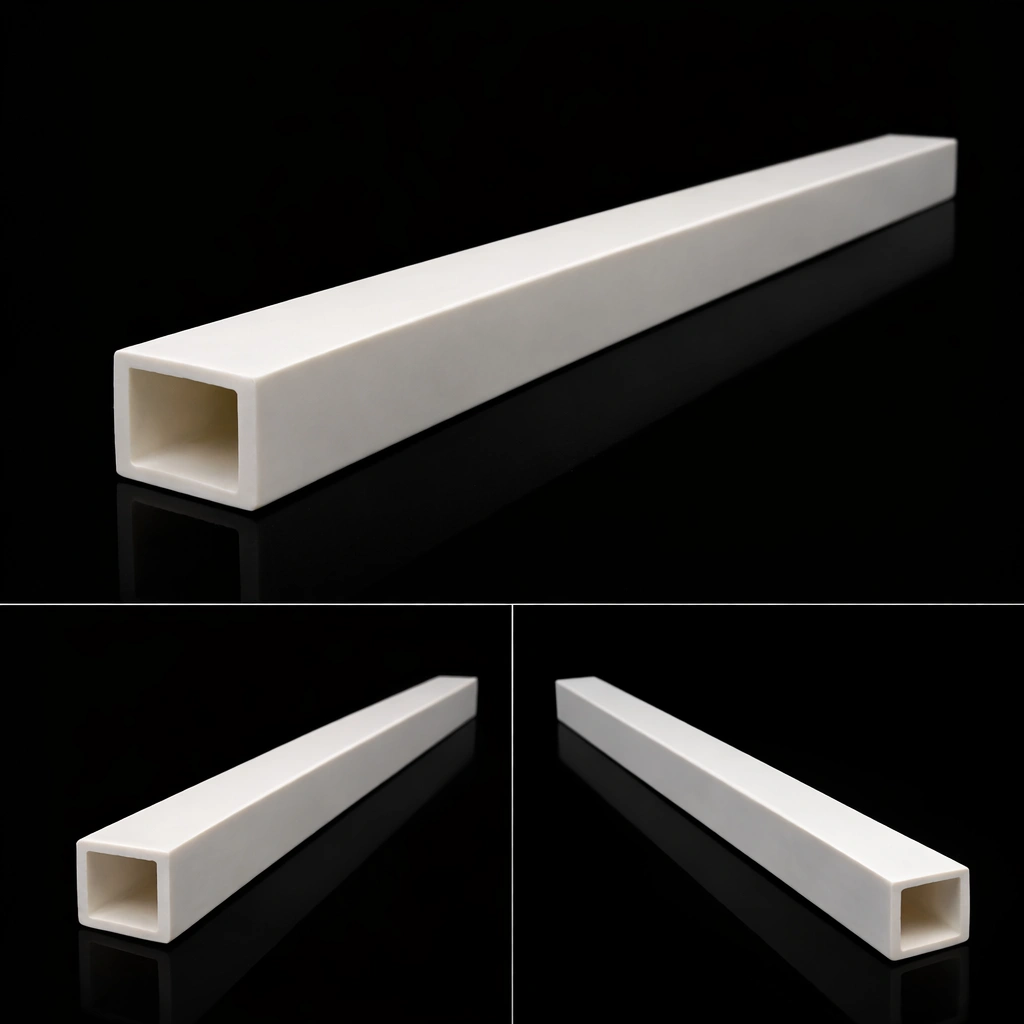
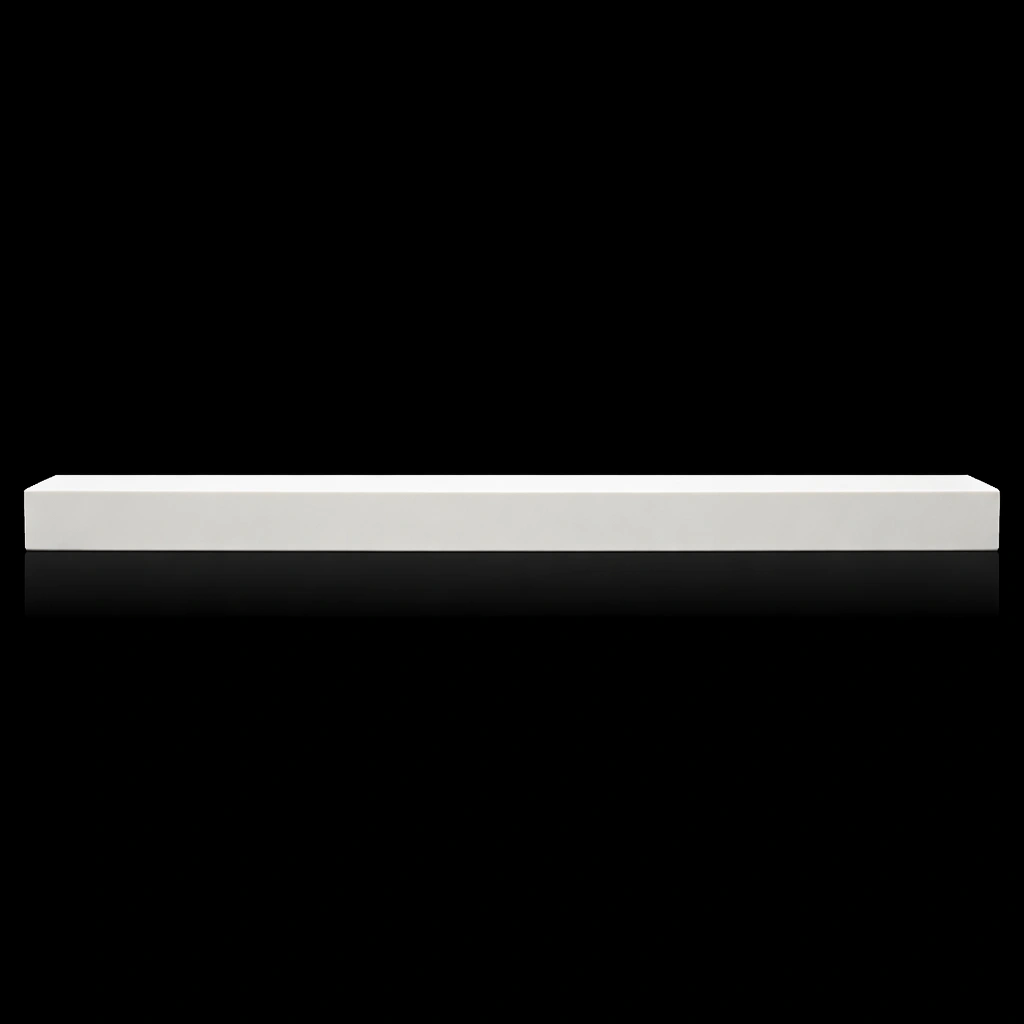
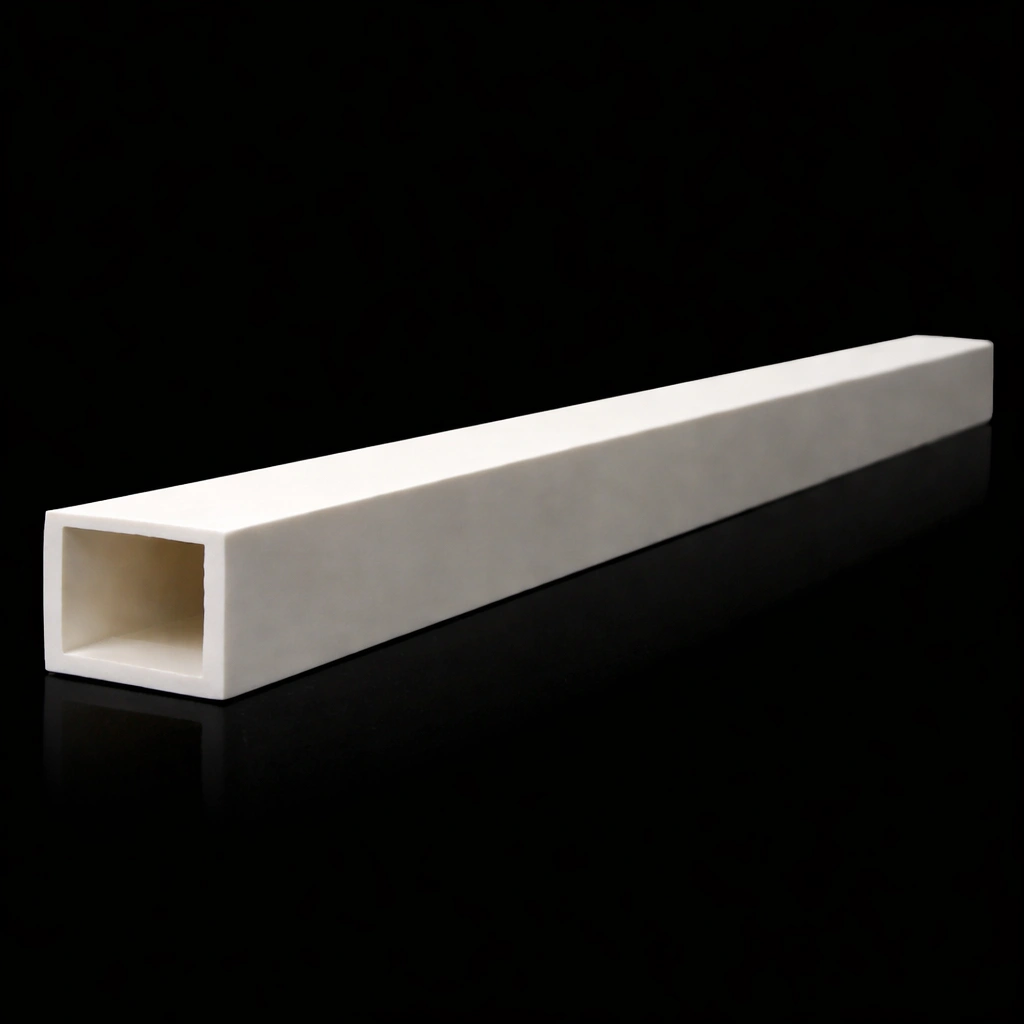
A Ceramic Straightedge Gauge is a lapped reference tool used with dial indicators, comparators, or alignment fixtures to verify straightness of machine ways, linear guide mounting surfaces, and inspection stages during setup, maintenance, and acceptance checks.
Benefits of the Ceramic Straightedge Gauge
• Reference-face stability for long sweeps:
The Ceramic Straightedge Gauge uses a lapped reference face designed to maintain stable contact with dial indicators during long measurement strokes. This helps reduce measurement drift when checking machine beds, guide rails, or linear stages over extended distances.
• Handling-oriented geometry:
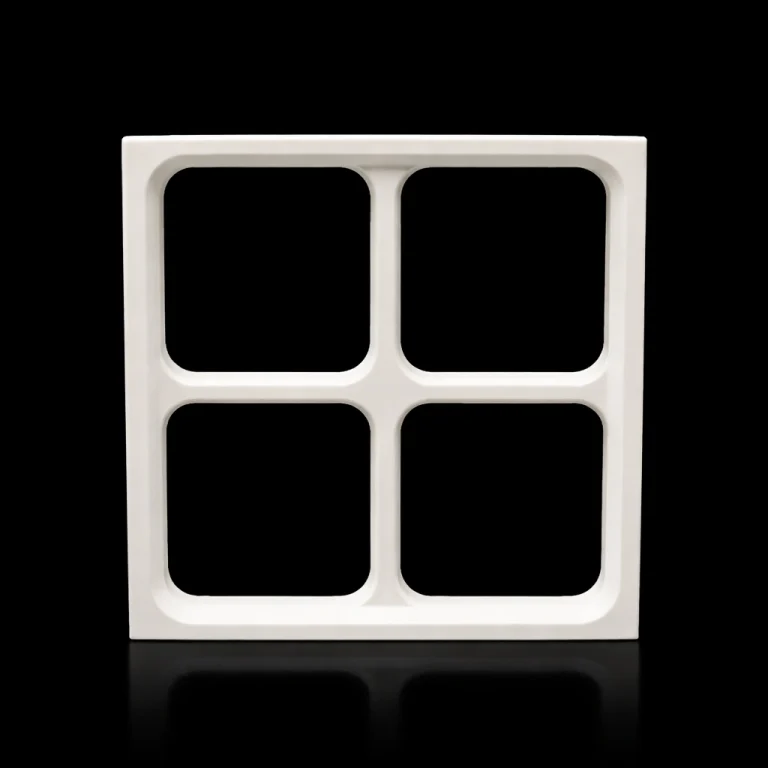
The cross-section of the Ceramic Straightedge Gauge can be engineered to maintain structural balance while remaining manageable during manual positioning. This geometry helps operators place and reposition the gauge accurately during repeated straightness checks.
• Low sensitivity to corrosion and coolant residue:
Unlike steel straightedges, a Ceramic Straightedge Gauge is not prone to rust formation when exposed to coolant mist, humidity, or chemical residues commonly found in machining environments. This characteristic helps maintain surface integrity during long-term shop-floor use.
• Repeatable contact behaviour:
The precision lapped surface of the Ceramic Straightedge Gauge supports consistent stylus contact when used with dial indicators or lever gauges. Stable contact conditions help maintain repeatable readings during multiple measurement passes along the reference edge.
• Long-length capability:
Ceramic straightedge gauges are often selected for long-span straightness verification where higher reference accuracy is required. Industry product data reports ceramic straightedges achieving ≤2 μm straightness over 3 m length, enabling higher-resolution straightness verification on large machine assemblies.
Ceramic Straightedge Gauge Properties
| Property | Unit | 99.5% Al₂O₃ | 99.6% Al₂O₃ | 99.7% Al₂O₃ | 99.8% Al₂O₃ | 99.9% Al₂O₃ | 99.99% Al₂O₃ |
| Alumina content | % | 99.5 | 99.6 | 99.7 | 99.8 | 99.9 | 99.99 |
| Density | g/cm³ | 3.89 | 3.91 | 3.92 | 3.93 | 3.94 | 3.98 |
| Open porosity | % | 0 | – | – | – | – | – |
| Color | – | Ivory | Ivory | Ivory | Ivory | Ivory | Ivory |
| Water absorption | % | – | 0 | 0 | 0 | 0 | 0 |
| Young’s modulus (Elastic modulus) | GPa | 375 | 356 | 357 | 358 | 359 | 362 |
| Shear modulus | GPa | 152 | – | – | – | – | – |
| Bulk modulus | GPa | 228 | – | – | – | – | – |
| Poisson’s ratio | – | 0.22 | – | – | – | – | – |
| Compressive strength | MPa | 2600 | 2552 | 2554 | 2556 | 2558 | 2570 |
| Flexural strength | MPa | 379 | 312 | 313 | 314 | 315 | 320 |
| Fracture toughness | MPa·m¹ᐟ² | 4 | – | – | – | – | – |
| Hardness | GPa | 14.1 (≈1440 kg/mm²) | 23 | 24 | 25 | 26 | 30 |
| Thermal conductivity | W/m·K | 35 | 32–37 | 33–38 | 34–39 | 35–40 | 36–42 |
| Thermal shock resistance ΔT | °C | – | 222 | 223 | 224 | 225 | 228 |
| Maximum use temperature (no load) | °C | ≤1750 | 1755 | 1760 | 1765 | 1770 | 1800 |
| Coefficient of thermal expansion | 10⁻⁶/°C | 8.4 | – | – | – | – | – |
| Specific heat | J/kg·K | 880 | – | – | – | – | – |
| Volume resistivity | Ω·cm | >1×10¹⁴ | >1×10¹⁴ | >1×10¹⁴ | >1×10¹⁴ | >1×10¹⁴ | >1×10¹⁴ |
| Dielectric constant (relative permittivity) | – | 9.8 | 9.83 | 9.84 | 9.85 | 9.86 | 9.92 |
| Dielectric strength | kV/mm | 16.9 | 23.2 | 23.4 | 23.6 | 23.8 | 24 |
| Dissipation factor (loss factor @ 1 kHz) | – | 0.0002 | – | – | – | – | – |
Ceramic Straightedge Gauge Specifications

| Model No. | Size (W×H×L) mm | Straightness μm | Flatness μm | Weight kg |
| AT-JYI757570-SG | 75×75×700 | < 1 | 6.8 | |
| AT-JYI757512-SG | 75×75×1200 | 11.6 | ||
| AT-JYI757514-SG | 75×75×1400 | < 1.5 | 13.5 | |
| AT-JYI808010-SG | 80×80×1000 | < 1 | 12.6 | |
| AT-JYI808012-SG | 80×80×1200 | < 1.5 | 15.2 | |
| AT-JYI808014-SG | 80×80×1400 | 17.7 | ||
| AT-JYI859715-SG | 85×97×1500 | < 2 | 18.5 | |
| AT-JYI909018-SG | 90×90×1800 | 21 | ||
Ceramic Straightedge Gauge Packaging
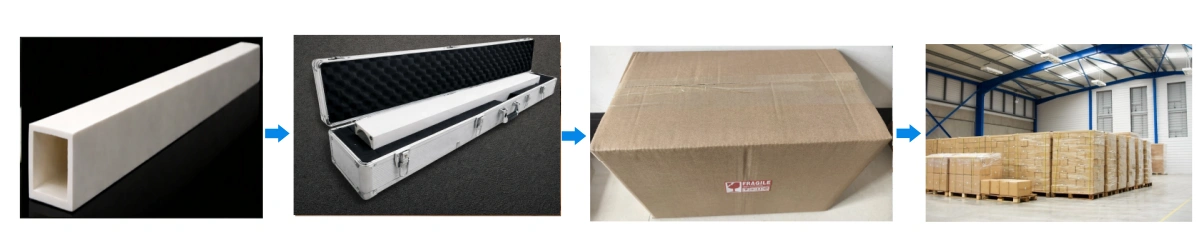
- Rigid protective case with internal supports to prevent bending loads during transport
- Non-abrasive face protection to prevent lapped surface scuffs
- Shock-buffer corners to reduce edge-chipping risk at drop points