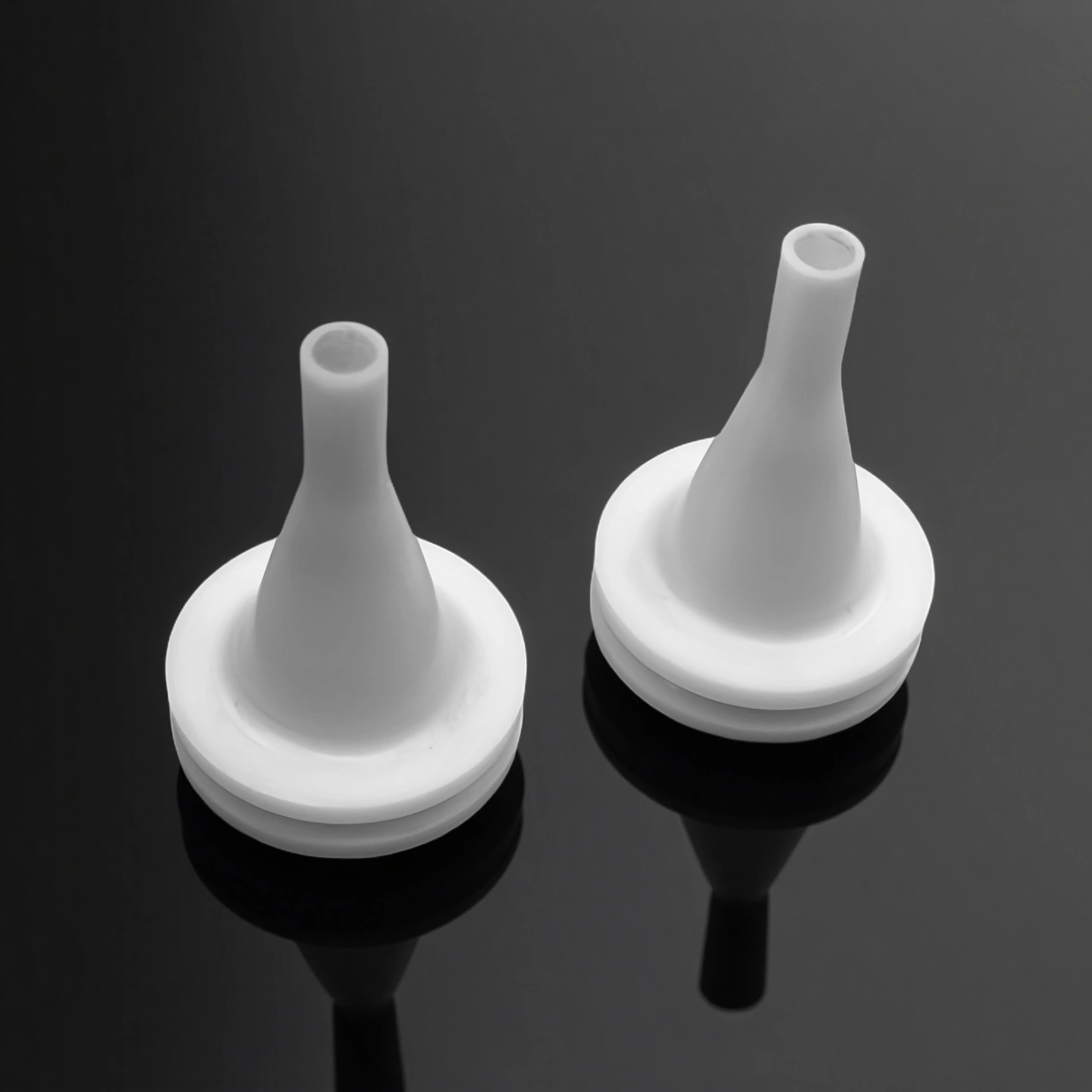
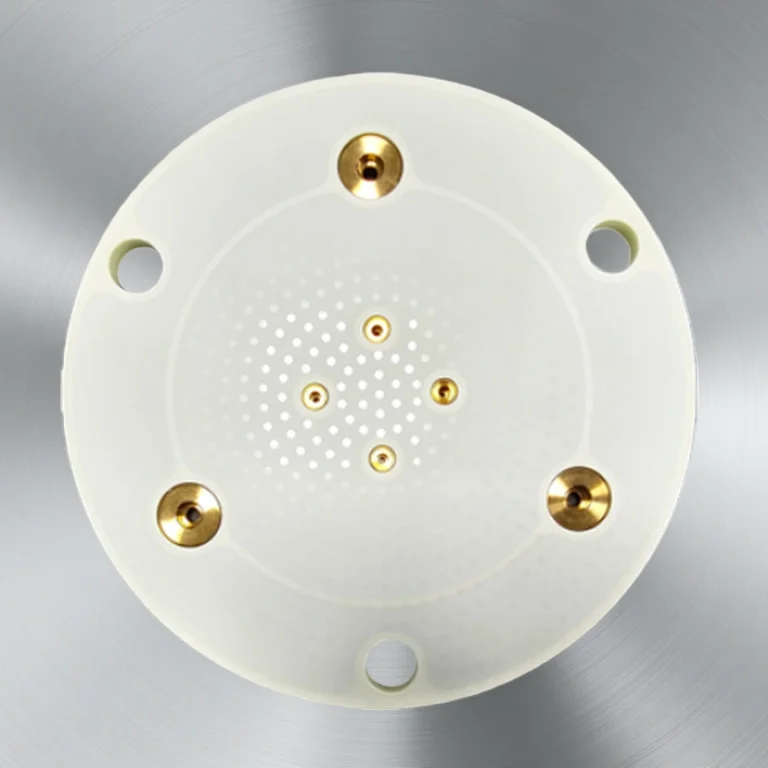
ADCERAX® Zirconia Nozzles are advanced ceramic components engineered to transform fluid pressure into controlled kinetic energy for precision spray applications. By altering internal geometry and orifice design, they regulate flow velocity, spray direction, and atomization pattern to match specific industrial requirements. Their high mechanical strength and chemical inertness make them suitable for demanding environments involving abrasion, heat, or corrosive media.
Performance Features of Zirconia Nozzles
- Withstands pH 1–14 exposure
Zirconia Nozzles remain chemically stable in both strong acid and alkali environments, with no structural degradation after 72-hour immersion in HCl and NaOH.
- No chemical interaction with aggressive media
In applications involving sodium hypochlorite, ammonia, and sulfuric acid, the nozzle surface shows <0.1% mass change, even after prolonged exposure.
- Extended life in corrosive systems
Field tests in chemical scrubbing operations show 2.5× longer service intervals than PTFE-lined steel nozzles.
- 12× longer lifespan vs. steel
Wear tests under slurry flow (SiO₂ 30% at 5 bar) demonstrate Zirconia Nozzles lose only <0.03 mm³/1000 rev, outperforming hardened steel by over 10×.
- Stable orifice geometry under erosion
After 2000 hours in abrasive blasting conditions, spray angle deviation is <2°, maintaining consistent droplet distribution.
- Reduced downtime and replacement
In production lines using abrasive chemicals or powders, zirconia replacements occur at 50% lower frequency than alumina-based or metal counterparts.
- No oxidation under humid or wet conditions
Unlike stainless nozzles, Zirconia Nozzles show zero surface oxidation after 30-day exposure to 95% humidity at 40°C.
- Stable in marine or condensate-rich environments
Salt spray testing per ASTM B117 revealed no surface pitting or corrosion after 500 hours.
- No degradation from UV or chemical vapors
Tested in environments containing VOCs and ozone, zirconia material maintains >99.5% mechanical integrity with no visual surface aging.
Technical Properties of Zirconia Nozzles
Zirconia Nozzles are engineered to deliver long-term reliability under aggressive thermal, chemical, and abrasive service conditions. Their performance is defined by a combination of high mechanical strength, corrosion resistance, and dimensional stability under pressure and heat.
| Property |
Specification |
| Density |
6.05 g/cm³ |
| Hardness |
HRA 88–90 |
| Flexural Strength |
900–1200 MPa |
| Compressive Strength |
>2000 MPa |
| Fracture Toughness |
7–10 MPa·m¹/² |
| Thermal Conductivity |
2.5 W/m·K @ 25°C |
| Maximum Operating Temperature |
1000°C (continuous) |
| Thermal Expansion Coefficient |
10.5 × 10⁻⁶ /K |
| Dielectric Strength |
>12 kV/mm |
| Chemical Stability Range |
pH 1–14, inert to acids/alkalis |
| Surface Roughness (Ra) |
< 0.2 µm |
| Corrosion Rate (acid test) |
< 0.1% mass loss (72h) |
| Wear Resistance (slurry test) |
< 0.03 mm³/1000 rev |
Specifications of Zirconia Nozzles
|
Zirconia Nozzles |
|
Item No. |
Diameter(mm) |
Height (mm) |
|
AT-YHG-ZZ1001 |
Customize |
Packaging of Zirconia Nozzles
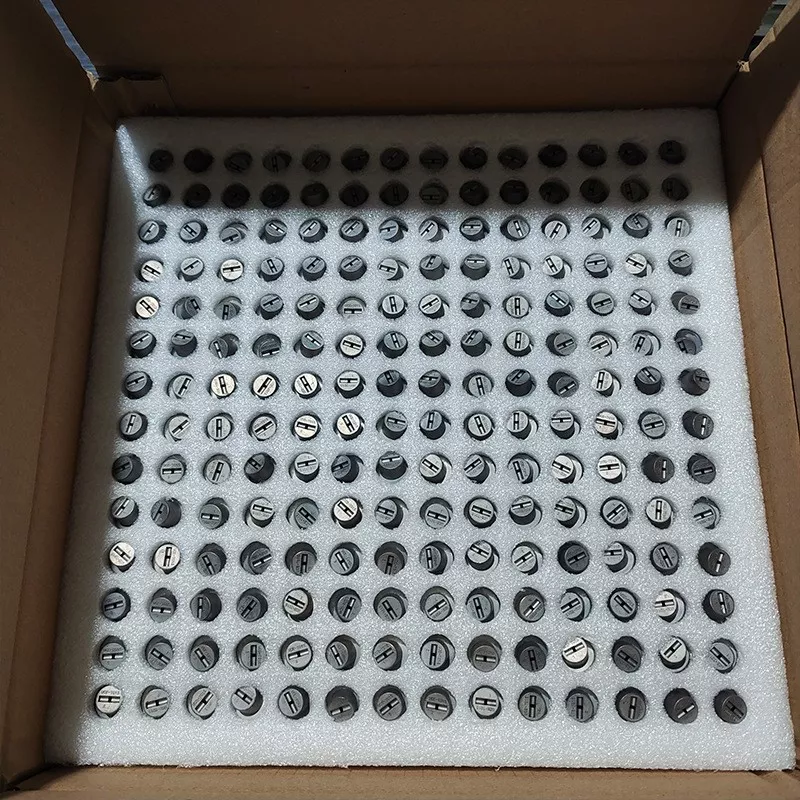
Zirconia Nozzles are individually secured in precision-cut foam trays to prevent movement and impact during transport. Each nozzle is aligned with orientation stability to maintain surface integrity and dimensional accuracy. The inner box is shock-resistant and moisture-buffered for international logistics.
How ADCERAX® Zirconia Nozzles Overcome Industrial Spray System Challenges Across Critical Applications
Zirconia Nozzles from ADCERAX® are built to solve fluid delivery challenges where conventional metal or polymer nozzles fail. By combining wear resistance, chemical inertness, and thermal durability, these engineered components improve process stability and reduce failure rates in demanding coating, cleaning, and combustion environments.
-
High‑Viscosity Paint Application in Automotive Chassis Coating
✅Key Advantages
1. Stable Spray Geometry Under High Viscosity Flow
ADCERAX® Zirconia Nozzles maintain spray cone angle deviation within <2° after continuous operation with high‑viscosity primer at elevated pressures. This stability minimizes bead edge distortion and ensures consistent film thickness across complex chassis geometries.
2. Anti‑Buildup Internal Surface Finish
The polished internal flow channel achieves Ra < 0.2 μm, significantly reducing pigment and binder accumulation. This helps maintain atomization efficiency over long production runs and reduces cleaning intervals during multi‑shift operation.
3. Wear‑Resistant Orifice for Long‑Cycle Production Lines
Zirconia’s abrasion resistance delivers <0.03 mm³/1000 rev wear loss under slurry‑based coating media. This performance directly supports extended uptime in automated robotic spray lines without nozzle tip reshaping or replacement.
✅ ️Problem Solved
In one automotive underbody coating line, steel nozzles required replacement every 3–5 production shifts due to edge erosion and spray pattern drift. This led to overspray and inconsistent film thickness, increasing coating material usage and causing periodic rework. After switching to ADCERAX® Zirconia Nozzles, spray cone deviation remained below 2° after 1000+ operating hours, material waste decreased by 12–18%, and maintenance changeover frequency was reduced from weekly to monthly intervals, improving overall line stability.
-
High‑Pressure CIP Cleaning in Food and Chemical Mixing Equipment
✅Key Advantages
1. Chemical Inertness Across Cleaning Media Cycles
Zirconia structure remains stable in pH 1–14 environments, even under repeated thermal and chemical CIP treatments. This eliminates surface pitting or leaching observed in stainless steel and polymer‑lined nozzles.
2. Consistent Jet Force Under Pulsating Pressure
With compressive strength >2000 MPa, ADCERAX® Zirconia Nozzles maintain jet velocity and spray uniformity under repeated high‑pressure pump cycling. This is critical for achieving validated cleaning coverage within regulated hygiene workflows.
3. Long‑Term Surface Integrity for Hygiene Compliance
Nozzle wet‑surface exhibits <0.1% mass change after 72‑hour acid exposure, preventing micro‑surface damage that could harbor residue. This supports reliable cleaning validation in daily sanitation routines.
✅ ️Problem Solved
A food emulsification facility performing twice‑daily CIP cycles reported recurring spray non‑uniformity due to corrosion and micro‑cracking in PTFE‑lined metal nozzles. This inconsistency led to incomplete cleaning zones and required manual intervention, causing downtime and compliance audit concern. After transitioning to ADCERAX® Zirconia Nozzles, CIP spray uniformity remained stable over 80+ cleaning cycles, eliminating manual rinse steps and increasing OEE by reducing sanitation‑related production delays.
-
Fuel–Air Atomization in Biomass Burner Injection Systems
✅Key Advantages
1. Thermal Stability Under Continuous Burner Exposure
ADCERAX® Zirconia Nozzles maintain structural integrity at up to 1000°C, preventing deformation or tip widening under direct flame and radiant heat. This enables stable droplet formation during long burner cycles.
2. Erosion Resistance Against Particulate‑Rich Fuels
Fracture toughness of 7–10 MPa·m¹/² protects the orifice from edge chipping caused by abrasive biomass particulates. This ensures consistent atomization of viscous or slurry‑based fuels.
3. Controlled Droplet Distribution for Cleaner Combustion
Stable internal flow geometry maintains droplet distribution uniformity, reducing flame instability. Field use correlates with up to 8% fuel efficiency improvement due to more complete combustion.
✅ ️Problem Solved
In a biomass combustion plant using high‑ash fuel slurries, metal nozzles experienced tip erosion within 2–4 weeks, causing poor fuel atomization and unstable burner flame profiles that increased CO and NOx emissions. After deploying ADCERAX® Zirconia Nozzles, spray pattern stability was preserved over 6‑month burner duty cycles. Combustion efficiency improved measurably, fuel consumption stabilized, and emission fluctuations were reduced, supporting more predictable burner control.
ADCERAX® Zirconia Nozzles Usage Instructions for Long-Term Precision and Reliability
Proper implementation of Zirconia Nozzles from ADCERAX® is essential to ensure consistent spray performance, system integrity, and lifecycle stability across complex industrial environments.
-
Installation Protocols for Spray System Integration
1. Alignment Checkpoints
Ensure nozzles are seated flush within the fixture and aligned to the spray vector. Misalignment over 1.5° can result in uneven coating distribution.
2. Thread Torque Regulation
Apply standardized torque levels as defined in technical datasheets to avoid ceramic fracture. Overtightening is a leading cause of premature nozzle failure.
3. Seal Compatibility
Verify O-ring or gasket materials are chemically compatible with adjacent fluids and Zirconia. Mismatch can lead to leaks or degradation under thermal cycling.
-
Cleaning Methods and Maintenance Scheduling
1. Debris Prevention
Pre-filter liquids to remove particulates >50μm, minimizing clogging risk and internal erosion.
2. Non-Abrasive Cleaning
Use pH-neutral solutions and nylon brushes only during manual cleaning. Avoid ultrasonic baths that induce microcrack formation.
3. Routine Inspection
Inspect orifice wear and edge rounding every 1000 operating hours, replacing any nozzle with ±5% deviation in flow rate.
-
Spray Pattern Stability Across Operating Conditions
1. Temperature Management
Operate within continuous temperature limits <950 °C, and allow for controlled cool-down to prevent thermal shock.
2. Pressure Consistency
Fluctuations exceeding ±10% of nominal PSI degrade spray angle and droplet uniformity. Stabilize pump output accordingly.
3. Jet Profile Monitoring
Use imaging or laser diffraction to confirm cone angle, impact zone, and droplet size remain within process tolerances.
-
Safe Handling, Storage, and Logistics Considerations
1. Contact Surface Protection
Never allow nozzle orifice to contact metal surfaces during unpacking or assembly. Use gloves and soft-tipped tools.
2. Storage Conditions
Keep in dry, vibration-free environments, ideally within 10–40 °C and <60% humidity. Avoid stacking trays to prevent compression stress.
3. Repackaging Protocol
When reshipping, use original foam trays to maintain nozzle orientation and spacing. Replace trays if cell deformation is observed.