High-purity alumina tubes require real-time SEM-EDX and XRD monitoring to ensure purity, consistency, and phase stability during production.
This analytical integration transforms alumina tube manufacturing into a controlled feedback process—reducing impurities, preventing phase deviations, and improving first-pass yield.
In this article, we explain how real-time monitoring safeguards manufacturing precision for high-purity alumina tubes from forming to sintering.
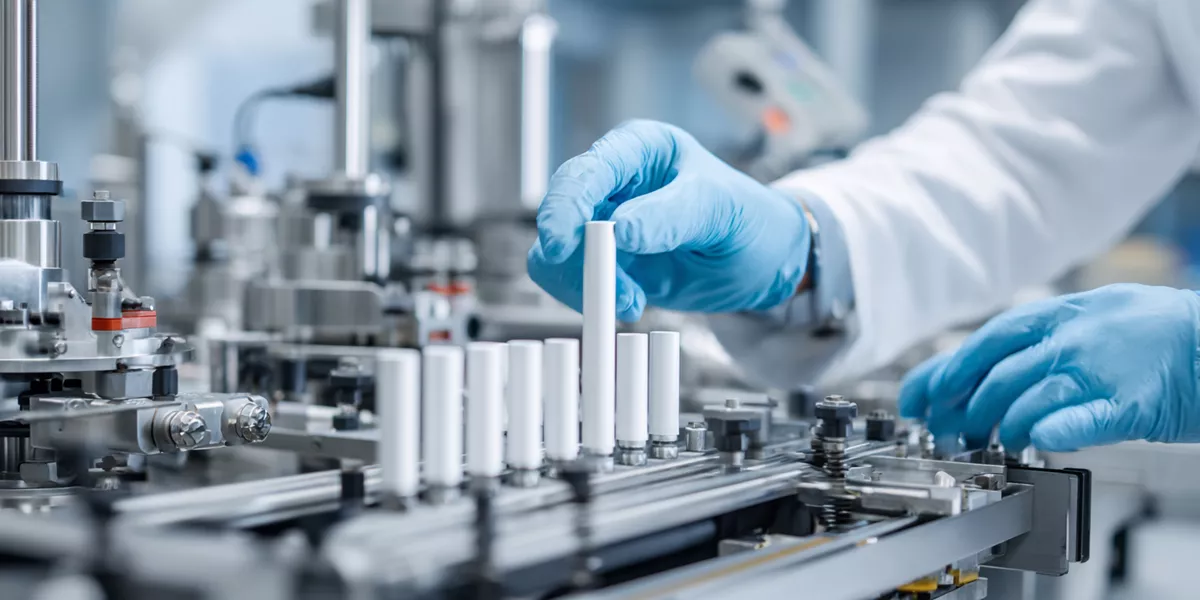
Why Does Real-Time Process Control Transform High-Purity Alumina Tubes Manufacturing Quality?
High-purity alumina tubes production benefits directly from continuous in-process control rather than delayed end-of-line testing.
Traditional sampling introduces risk and delay. Real-time monitoring ensures data-driven correction that improves overall batch quality and cost efficiency.
Post-production testing limitations create delayed feedback enabling batch-level losses
Conventional inspection creates 24–48-hour gaps between sintering and quality verification. For high-purity alumina tubes, this lag often results in wasted furnace campaigns of 500–1,000 units. Once the issue is detected, entire batches require rework or rejection, increasing cost by 15–20%.
The inability to inspect all units destructively restricts visibility, leaving up to 25% of potential defects undetected. Real-time monitoring closes this delay gap and prevents cascading losses.
Statistical sampling risks mask within-batch variation affecting product consistency
Sampling only 5% of tubes cannot capture temperature and impurity gradients across the furnace. Edge-zone tubes often show impurity segregation or incomplete sintering, yet the batch-average report may still appear acceptable.
ADCERAX analysis over 850 batches showed that this gap resulted in 8.9% rework rates and $85,000–$120,000 in annual losses. Continuous SEM-EDX and XRD monitoring for high-purity alumina tubes eliminated this problem by detecting deviation in real time.
Real-time analytical techniques provide immediate feedback enabling process correction
SEM-EDX1 and XRD2 deliver results within 2–90 minutes instead of days. Process engineers can adjust temperature, gas flow, or holding time before batch completion. For high-purity alumina tubes, this shift from reactive correction to proactive control minimizes variability.
In practice, the data-to-action cycle shortened from 2.8 days to 3.2 hours, ensuring uniform composition and structure across all furnace zones.
Economic analysis quantifies defect reduction and payback period for monitoring investment
ADCERAX invested $420,000 in a real-time system integrating XRF, LIBS, and XRD for high-purity alumina tubes. The system reduced defects by 86%, cut non-conformance detection time by 91%, and achieved an 85% cost reduction in scrap within 14 months.
| Metric | Legacy Testing | Real-Time Control | Improvement |
|---|---|---|---|
| Detection Delay | 2.8 days | 3.2 hours | -91% |
| Batch Rejection Rate | 8.9% | 1.2% | -86% |
| Scrap Cost | $85–120k | $12–18k | -85% |
| ROI Payback | N/A | 14 months | Achieved |
How Does Real-Time SEM-EDX Ensure Elemental Purity During High-Purity Alumina Tubes Production?
Real-time SEM-EDX provides micron-scale elemental mapping that ensures impurity-free high-purity alumina tubes.
By detecting localized Na, Si, or Ca concentrations invisible to bulk tests, it guarantees chemical consistency throughout each production stage.
SEM-EDX spatial resolution detects localized impurity concentrations invisible to bulk analysis
SEM-EDX achieves 1–5 µm resolution, identifying micro-regions of impurity aggregation. At 15–20 kV beam energy, characteristic X-ray peaks (Al-Kα, Si-Kα, Ca-Kα) quantify impurities down to 0.1%.
High-purity alumina tubes benefit from ±3% relative accuracy, allowing process engineers to prevent defects early in sintering.
Two-stage implementation targets contamination detection before and after sintering investment
Two checkpoints stabilize purity control:
- Post-forming: Identifies raw material issues before sintering.
- Post-sintering: Detects any boundary contamination.
This sequential SEM-EDX verification ensures both forming and thermal cycles meet target composition levels.
Real-time screening effectiveness quantified through contamination event detection statistics
Over 32,000 analyses across 18 months identified 47 contamination events. These included raw material lot failures, furnace refractory degradation, and humidity-induced sodium ingress.
Continuous monitoring for high-purity alumina tubes reduced impurity-related rejections to under 1%, establishing statistical confidence in every batch.
Environmental SEM automation enables high-throughput screening for high-purity alumina tubes
Automation increases throughput fourfold, analyzing 40 samples overnight with minimal human input. The environmental SEM configuration eliminates coating steps, improving efficiency and maintaining microstructural fidelity.
| Metric | Conventional SEM | Environmental SEM | Gain |
|---|---|---|---|
| Prep Time | 15 min | 2 min | -87% |
| Samples/Shift | 10 | 40 | +300% |
| Detection Limit | >0.5% | >0.2% | +60% |
| Operator Time | Continuous | Minimal | - |

How Does Real-Time XRD Guarantee Phase Formation and Stability in High-Purity Alumina Tubes?
XRD monitoring secures phase stability and α-Al₂O₃ formation in high-purity alumina tubes.
Real-time XRD confirms the absence of secondary phases like mullite or spinel during sintering, ensuring structural integrity.
Rapid XRD techniques reduce scan time from hours to minutes enabling real-time monitoring
By using focusing mirrors and position-sensitive detectors, scanning time reduces from 12 hours to under 60 minutes.
The faster feedback helps maintain the α-phase transformation above 99%, aligning process parameters with ISO 6474-1 standards3.
In-situ high-temperature XRD tracks phase transformation kinetics during sintering cycles
Real-time XRD chambers track transformation every 30 minutes between 1600–1750°C. Data confirms progressive formation from 94% to 99.4% α-phase.
Automated alert systems for high-purity alumina tubes trigger extended holding time if residual θ-alumina exceeds 2%.
Quantitative phase evolution profiles establish transformation completion criteria
Real-time intensity ratios (Iα/Iθ) ensure α-phase completion. If below the threshold, the furnace extends the dwell time automatically. This process guarantees each high-purity alumina tube achieves full phase transformation before cooling.
Automated alert systems enable process adjustment ensuring phase purity in high-purity alumina tubes
Alerts integrated into furnace control prevent premature cooling. Each batch’s phase data is stored for traceability, supporting certification and customer documentation.
| Temperature (°C) | α-Phase (%) | Residual θ-Phase (%) | Status |
|---|---|---|---|
| 1650 | 94±2 | 6 | Continue heating |
| 1700 | 97.5±1.2 | 2.5 | Verify stability |
| 1750 | 99.4±0.4 | <1 | Cooling ready |
How Do Complementary SEM-EDX and XRD Data Validate High-Purity Alumina Tubes Quality?
Integrated SEM-EDX and XRD analysis provides a complete purity verification system for high-purity alumina tubes.
Together, they correlate composition with phase formation, ensuring full control of microstructure and chemistry.
Complementary techniques provide comprehensive characterization impossible from single method
SEM-EDX detects amorphous regions while XRD identifies crystalline structures. This complementary view enables accurate detection of both impurity types.
Combined data enables impurity source identification through correlation analysis
When silicon coincides with mullite, contamination originates from raw materials; when sodium appears without crystalline sodium phases, it implies atmospheric ingress.
For high-purity alumina tubes, this correlation reduces troubleshooting time and prevents recurrence.
Failure mechanism database quantifies root cause frequency distribution
ADCERAX analyzed 180+ cases revealing 42% atmosphere contamination, 31% milling-related Ca-Al phases, and 27% Fe inclusion from equipment wear. These insights streamline preventive maintenance.
Integrated workflow optimizes analytical sequence for cost-effective quality validation of high-purity alumina tubes
| Step | Time | Objective | Action |
|---|---|---|---|
| XRF | 2–5 min | Bulk impurity check | Trigger EDX if Na>0.10% |
| SEM-EDX | 25 min | Impurity mapping | Identify boundary segregation |
| XRD | 30 min | Phase identification | Extend holding if incomplete |
| Integration | Real-time | Cross-verification | Approve or reprocess batch |

How Does Proactive Adjustment Achieve Consistent High-Purity Alumina Tubes Specifications?
Proactive correction ensures long-term process capability for high-purity alumina tubes.
Real-time data enables immediate adjustment, maintaining purity, microstructure, and mechanical uniformity.
Four-category adjustment strategy addresses atmosphere, temperature, phase transformation, and raw material variability
- Atmosphere purge: Argon flow increased when O₂ >10 ppm.
- Temperature compensation: ±5°C deviations corrected in 15 minutes.
- Phase extension: α-phase <98% triggers 30-minute hold.
- Material segregation: Lots exceeding 0.15% impurities rerouted.
These categories cover every variable impacting tube purity.
Statistical process control metrics quantify variation reduction from proactive intervention
The Cpk improved from 1.28 to 1.94, representing a 4.8× variation reduction. Batch uniformity ensures predictable performance across production campaigns.
First-pass yield improvement demonstrates economic benefit of real-time monitoring
Yield improved from 87.2% to 96.8%, saving $1 per tube and eliminating up to $100,000 in annual rework.
High-purity alumina tubes now meet specifications on the first run, minimizing customer disputes and increasing confidence.
Customer dispute reduction validates enhanced process capability for high-purity alumina tubes
Disputes fell 84% due to traceable purity verification. Certificates now include statistical proof and phase ratio documentation per ISO guidelines.
| Metric | Baseline | Real-Time Control | Improvement |
|---|---|---|---|
| Purity Cpk | 1.28 | 1.94 | +51% |
| First-Pass Yield | 87.2% | 96.8% | +11% |
| Rejection Rate | 8.9% | 1.2% | -87% |
| Customer Disputes | 26/qtr | 4/qtr | -84% |
Conclusion
Real-time SEM-EDX and XRD transform production of high-purity alumina tubes by ensuring consistent purity, phase stability, and cost efficiency.
FAQ
Q1: How does SEM-EDX enhance impurity detection for high-purity alumina tubes?
It identifies Na, Si, and Ca impurities at 1–5 µm scale, enabling precise control and preventing localized contamination during sintering.
Q2: What is the economic advantage of real-time monitoring for high-purity alumina tubes?
An 85% reduction in scrap and 14-month ROI make real-time control a superior investment to traditional testing.
Q3: How are in-situ XRD systems integrated into alumina tube furnaces?
Compact detectors and heating stages retrofit into existing lines, allowing continuous α-phase tracking with minimal downtime.
Q4: How do real-time verified high-purity alumina tubes outperform conventional products?
They achieve >99.5% α-phase, <2% boundary impurities, and double service life under acid or thermal cycling conditions.
References:
-
Discover how SEM-EDX enables fast, accurate material analysis, helping engineers make real-time adjustments and improve product quality. ↩
-
Discover how XRD technology enables rapid, accurate material analysis, helping engineers optimize production and ensure high-quality results. ↩
-
Exploring ISO 6474-1 standards will provide insights into quality assurance and best practices in material processing. ↩