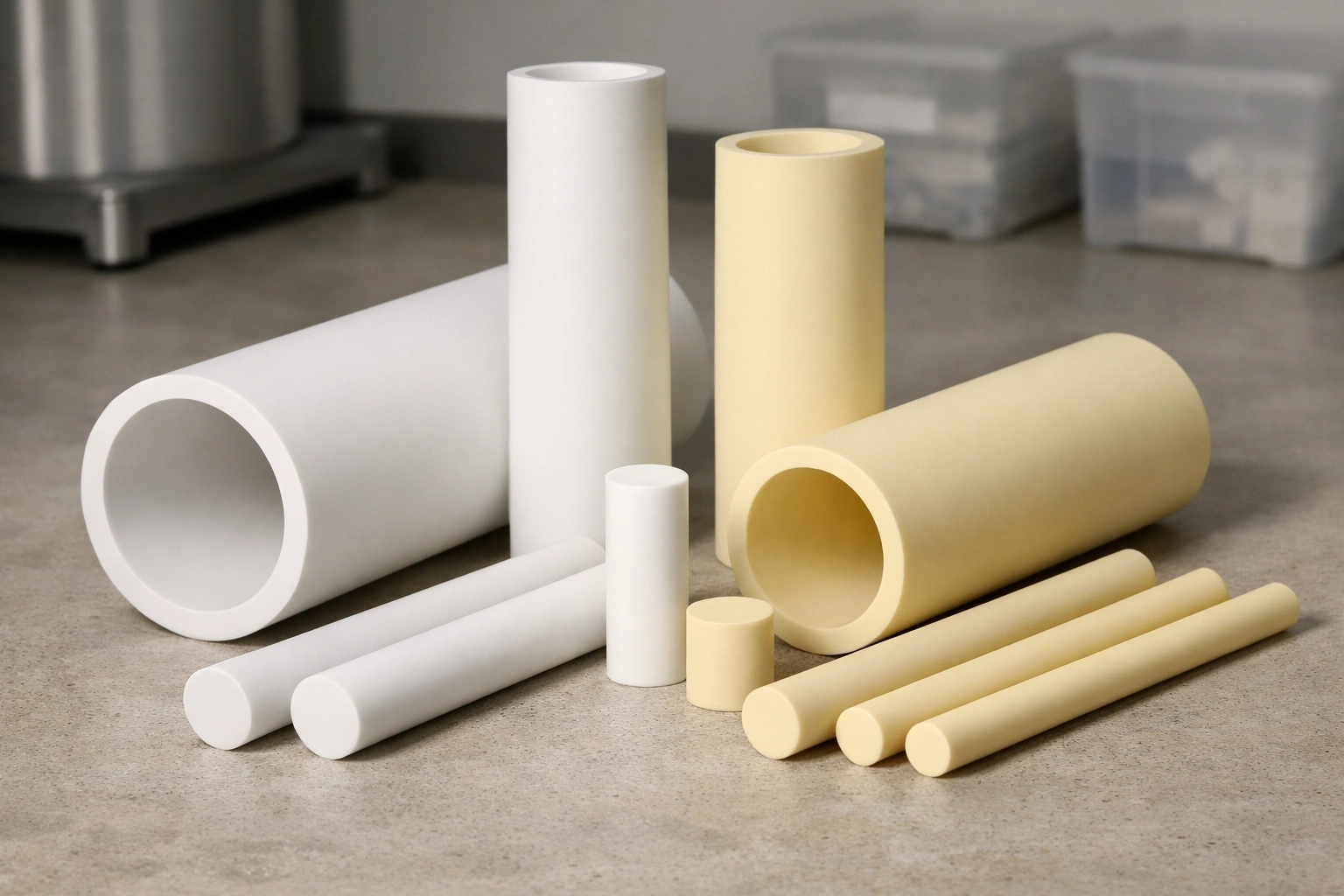
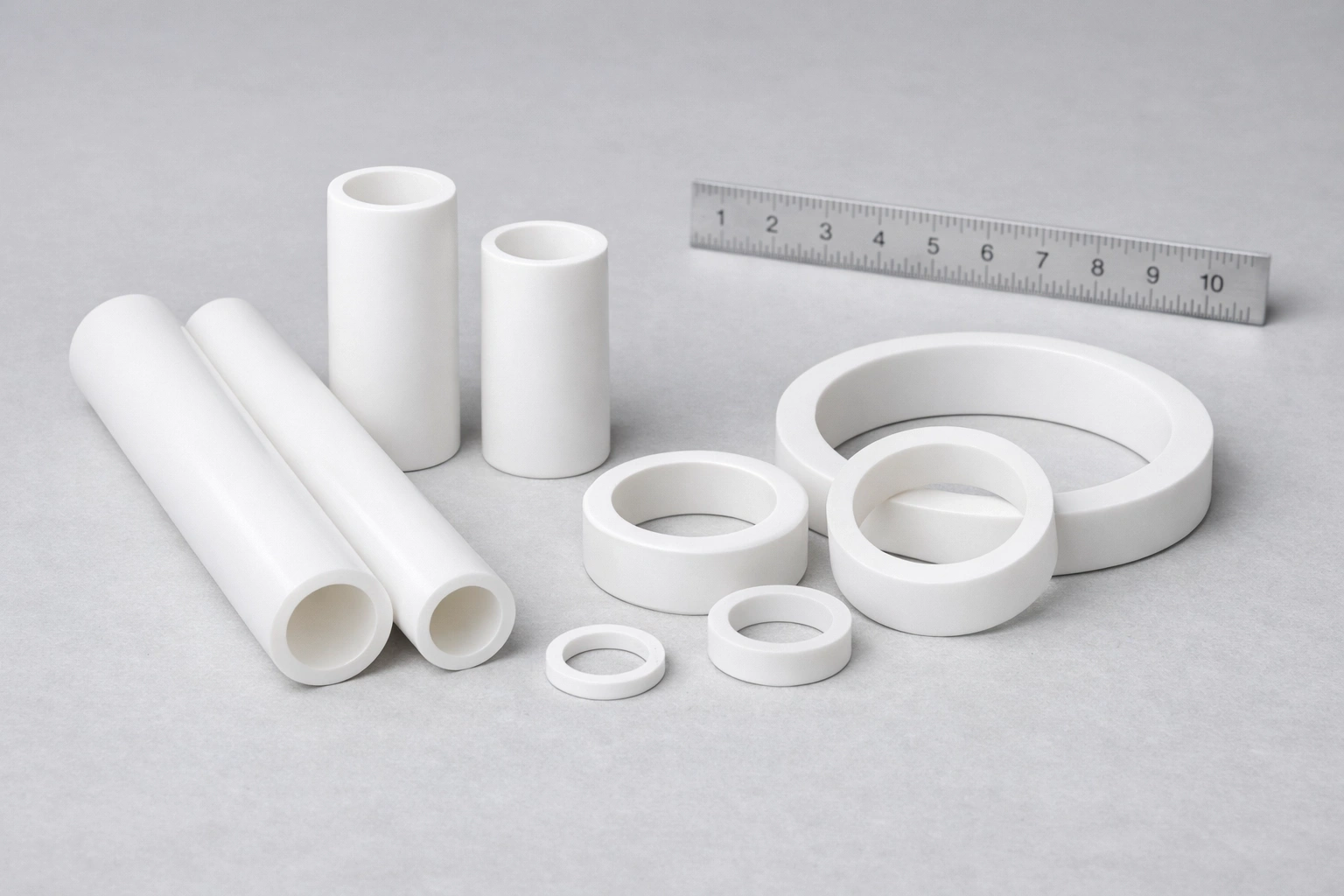
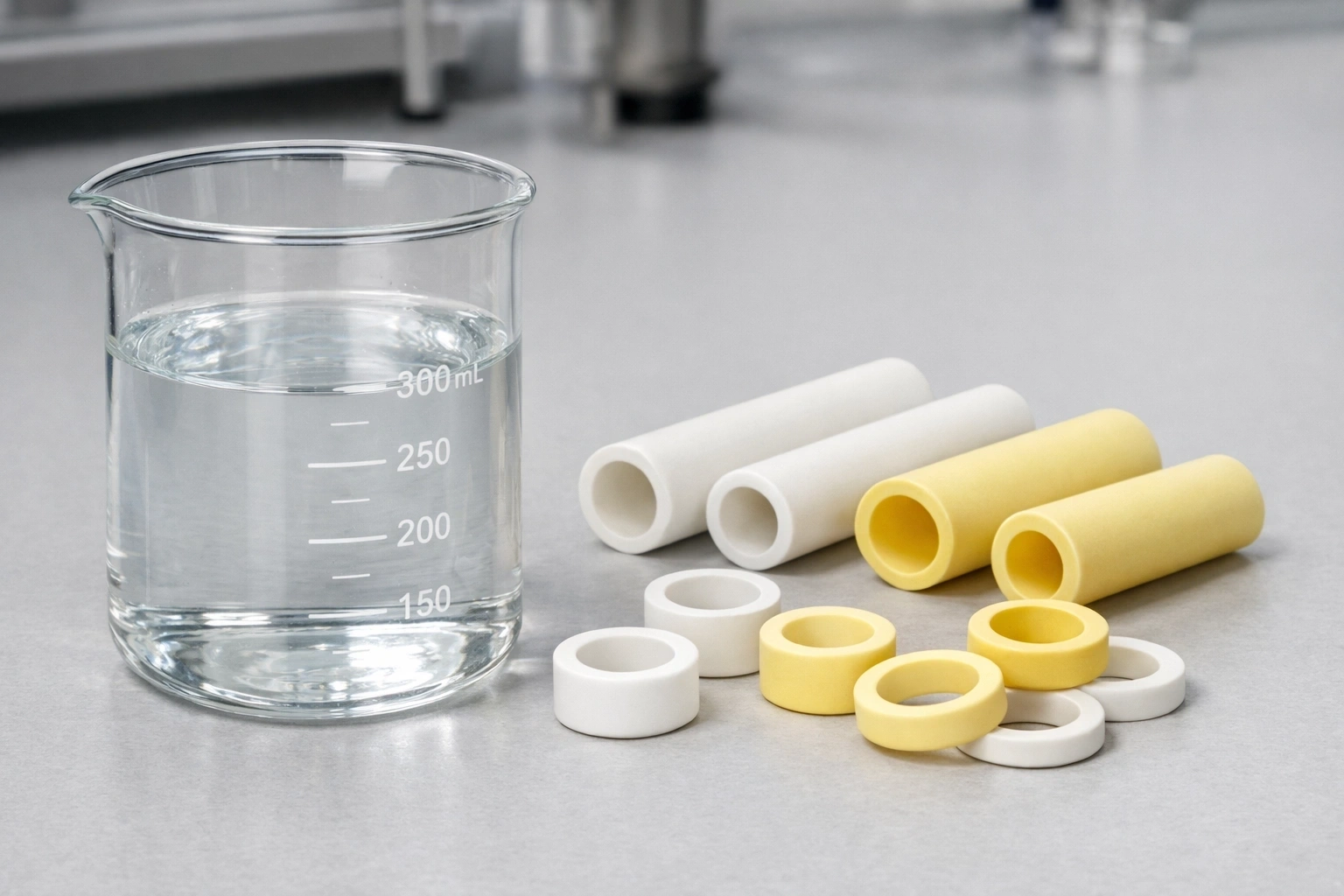
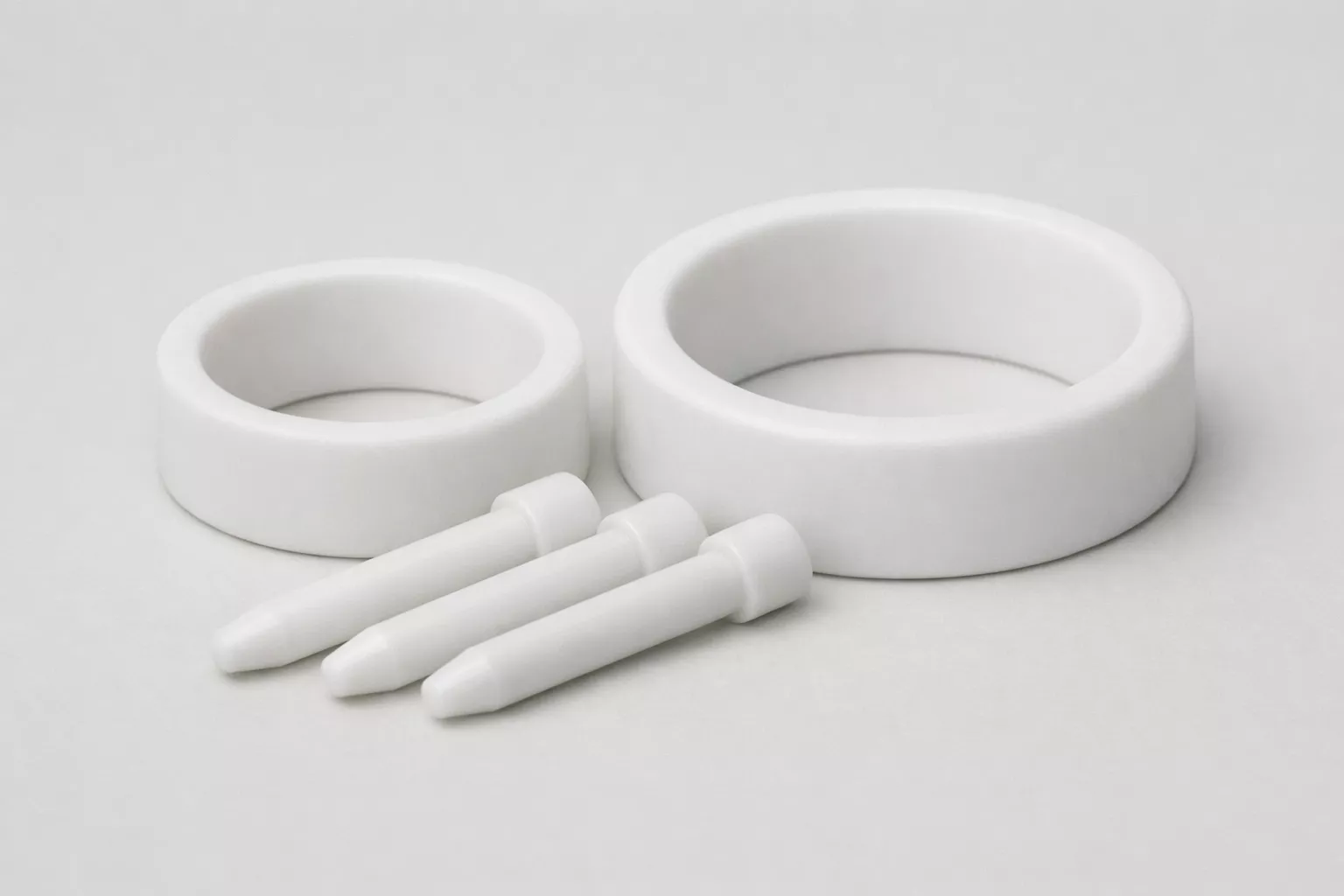
Alumina tubes for reactors experience high thermal gradients that generate tensile stresses, leading to circumferential cracks and premature failure in catalytic systems.
Thermal gradient failures in alumina tubes for reactors are driven by heat flux imbalance, mechanical stiffness, and constrained geometries that together exceed the fracture strength of alumina under extreme temperature conditions.
Understanding how alumina tubes for reactors fail enables engineers to apply design controls such as finite element analysis (FEA), multi-zone heating, and wall thickness optimization to prevent structural breakdown and extend service life.
How Do Thermal Stresses Develop in Cylindrical Alumina Tubes for Reactors Under Radial Heat Flux?
Differential temperature distribution1 in alumina tubes for reactors creates tensile hoop stresses2 that trigger cracking.
The temperature difference between inner and outer tube walls produces internal expansion mismatch and stress accumulation.
When the inner wall reaches 1400°C and the outer wall remains at 1150°C, the resulting 250°C differential can produce up to 220 MPa of hoop stress—nearly two-thirds of alumina’s fracture strength.
Mathematical stress modeling for radial temperature differentials
The thermal stress model for alumina tubes for reactors follows:
σ_thermal = [E × α × (ΔT)] / [2(1 – ν)]
where E = 380 GPa, α = 8×10⁻⁶/°C, and ν = 0.22.
Under these parameters, ΔT = 250°C creates 190–220 MPa stress, representing 55–65% of fracture strength. Finite element studies reveal that local stress amplifications around joints elevate these values to critical failure thresholds.
Heat flux calculations determining gradient magnitude
The radial heat flux equation
q = k × (T_inner – T_outer) / [r_outer × ln(r_outer / r_inner)]
defines heat transfer within alumina tubes for reactors. With k = 25–35 W/(m·K) and 4 mm wall thickness, flux levels of 350–450 kW/m² cause 200–250°C gradients.
Key findings:
- Flux above 400 kW/m² leads to >40% higher failure rates.
- Wall thickness >5 mm doubles stress accumulation rate.
Stress concentration amplification at geometric discontinuities
Thermowells, flange transitions, and step junctions in alumina tubes for reactors increase nominal stresses 2.8–3.5×, reaching 530–770 MPa.
These peaks exceed alumina’s fracture strength, initiating circumferential cracks that propagate radially until reaching 40–60% wall depth, resulting in catastrophic breakage.
Why Do Wall Thickness Inconsistencies Create Hotspot Origins in Alumina Tubes for Reactors?
Even minor wall variations within alumina tubes for reactors cause uneven heat flow and localized overheating.
A 15% thickness deviation can raise inner wall temperatures by 180–250°C in catalytic operation, leading to accelerated creep and oxidation.
This behavior directly correlates with poor extrusion uniformity or abrupt design transitions.
Thermal resistance calculations for variable wall sections
The thermal resistance equation R_thermal = t / (k × A) indicates that reducing thickness from 4.0 mm to 3.4 mm cuts resistance by 15%.
For alumina tubes for reactors under 400–500 kW/m² flux, this leads to local temperature spikes exceeding 200°C.
Observations:
- Hotspots reduce mechanical strength by 30–40%.
- Recrystallized microstructures delay creep damage onset.
Heat flux concentration mechanisms at thickness transitions
CFD analysis3 of alumina tubes for reactors shows hotspots forming 50–80 mm from wall transitions, peaking 20–35 mm downstream.
Smooth gradients lower the risk, while abrupt thickness changes amplify heat flux by up to 18%.
ADCERAX studies found that controlled wall tolerance ±0.2 mm reduces stress amplitude by 60%.
CFD simulation results quantifying temperature elevation patterns
Simulation of 4 mm walls under 450 kW/m² flux demonstrates temperature elevation from 1300°C to 1550°C in thinned sections.
Temperature asymmetry increases local tensile stress beyond 250 MPa, initiating crack networks.
Preventive actions:
- Control extrusion precision within ±0.2 mm.
- Apply transition zones >50 mm in length.
- Use secondary surface coatings to equalize flux distribution.
How Do Different Failure Modes Manifest in Alumina Tubes for Reactors from Quenching Versus Asymmetric Heating?
Alumina tubes for reactors display distinct failure morphologies depending on whether damage originates from quenching or asymmetric heating.
Quenching forms fine, dense outer-surface crack networks, while asymmetric heating causes large inner-surface longitudinal cracks.
Understanding these patterns assists in diagnosing process deviations and optimizing thermal management.
Quench-induced crack network characteristics and propagation velocities
Cold gas (20–150°C) contacting 1200–1600°C walls in alumina tubes for reactors produces ΔT > 1000°C, generating 450–700 MPa tensile stress.
Cracks spaced 3–8 mm apart propagate at 8–15 mm/s with transgranular fracture surfaces.
Fractography reveals hackle and mirror zones typical of rapid thermal shock fractures.
Asymmetric heating stress distribution creating bending moments
In catalytic reactors, misaligned burners create 200–350°C temperature differences between quadrants of alumina tubes for reactors.
Resulting bending moments (45–85 N·m) induce longitudinal cracks along the hot side.
Slow propagation over 2,000–5,000 hours forms intergranular oxidation paths.
Fractography analysis differentiating rapid versus slow crack growth modes
Microscopic imaging shows quench fractures are transgranular, while asymmetric heating causes intergranular cracks with oxide infill.
Such contrasts allow root-cause identification and enable early corrective maintenance.
What Grain Boundary Weaknesses Amplify Thermal Cycling Stress in Alumina Tubes for Reactors?
Microstructural impurities drastically reduce the cyclic strength of alumina tubes for reactors.
Amorphous silicates and pores amplify stress by 2.5–4.0× under cyclic gradients, promoting microcrack formation and propagation.
Repeated cycles lead to cumulative 50–65% strength loss before visible fracture.
Stress concentration mechanisms at grain boundary triple points
At 1200–1600°C, shear stress across grain boundaries of alumina tubes for reactors reaches 200–280 MPa.
Microcracks form preferentially at triple junctions.
Reducing impurity phases from 0.5 wt% to 0.3 wt% cuts microcrack density from 15 to <5 per mm² after 150 cycles.
Elastic modulus mismatch effects in glassy phase regions
Residual silicate glass (E ≈ 70 GPa) contrasts with alumina (E = 380 GPa).
This mismatch magnifies local stress by 3.2–4.8×, elevating tolerable stresses to damaging levels.
Controlled sintering minimizes these phases, improving fatigue resistance by >40%.
Porosity-induced stress amplification factors
Closed pores <2 μm within alumina tubes for reactors act as stress risers.
Porosity >0.3% doubles stress concentrations, accelerating grain boundary cracking.
Mitigation:
- Maintain porosity below 0.2%.
- Ensure grain size ≥2× pore diameter.
- Use hot isostatic pressing for densification.
What Mitigation Strategies Prevent Thermal Gradient Failures in Alumina Tubes for Reactors Using FEA and Controlled Heating?
Finite element analysis (FEA) and ASME design validation improve the performance of alumina tubes for reactors by predicting stresses and enabling control-based mitigation.
ADCERAX testing confirms FEA predictions match experimental strain readings within ±12%, ensuring accurate modeling and preventive design.
Finite element analysis validation against experimental measurements
FEA simulations4 for alumina tubes for reactors integrate boundary conditions—convection 80–150 W/m²·K, radiation 50–120 kW/m², and pressure 20–40 bar.
Comparison with instrumented data shows thermal stress within ±10 MPa deviation.
This correlation enables confident pre-installation stress verification.
Multi-zone thermal control system implementation strategies
Three-zone heating controls reduce axial gradients from 700°C/m to below 300°C/m.
Stress falls from 280 MPa to 140 MPa.
Controlled heating ramps under 200°C per cycle avoid thermal shock.
Performance outcomes:
- Life extended beyond 20,000 hours.
- Failure rates reduced from 22% to 4%.
ASME fracture mechanics design criteria application protocols
ASME BPVC VIII-2 Part 5 sets stress intensity K_I < K_Ic/2.5 (K_Ic = 4.0–4.5 MPa·m^0.5).
Validated alumina tubes for reactors maintain subcritical crack sizes (30–100 μm) per ASTM C1322 and show <10% fatigue degradation after 500 thermal cycles.
Thermal Gradient Failure Mechanism Comparison for Alumina Tubes for Reactors
| Failure Mode | Thermal Gradient | Stress Type | Time to Failure | Crack Form | Fractography | Cause | Prevention |
|---|---|---|---|---|---|---|---|
| Quench-induced cracking | 1000–1500°C rapid | Surface tensile 450–700 MPa | 1–20 cycles | Circumferential outer surface, 3–8 mm spacing | Transgranular hackle | Cold gas intrusion | Controlled cooldown |
| Asymmetric heating | 200–350°C sustained | Bending 120–250 MPa | 2,000–5,000 h | Longitudinal, >15 mm width | Intergranular oxidation | Burner misalignment | Multi-zone control |
| Radial gradient stress | 100–250°C across wall | Hoop 180–280 MPa | 8,000–15,000 h | Circumferential mid-wall | Mixed striations | High flux, thick wall | Optimize wall 3–4 mm |
| Thermal cycling fatigue | 150–400°C cyclic | ±180 MPa alternating | 100–500 cycles | Grain boundary microcracks | Intergranular pullout | Load cycling | Use 99.7% purity alumina |
Thermal Gradient Mitigation Decision Framework for Alumina Tubes for Reactors
| Condition | Recommended Action | Expected Outcome |
|---|---|---|
| ΔT >150°C across wall & wall >5 mm | Reduce to 3–4 mm and add convective cooling (150–200 W/m²·K) | Gradient <100°C |
| Axial ΔT >400°C/m, tube >2 m | Install ≥3 heating zones maintaining <250°C/m gradients | Uniform heating |
| >50 thermal cycles/year, Tmax >1400°C | Use recrystallized alumina (ΔTc >400°C) per ASTM C1525 | Crack resistance ↑60% |
| Hotspot risk high | Real-time FEA feedback ±30°C uniformity | 80% fewer failures |
| Rigid supports restrict expansion | Use fiber supports allowing ≥20 mm movement/m | Stress neutralized |
Expert Insight
Thermal gradient failures represent 58–68% of early alumina tube replacements in catalytic reactors.
ADCERAX studies show microcracks nucleate after 2,000–4,000 hours under 250°C gradients, spreading invisibly until 70% of life is consumed.
Critical parameters include optimized 3–4 mm wall thickness, ΔTc >350°C, and <0.4 wt% impurity content.
A three-tier mitigation system—gradient control, real-time monitoring, and material upgrade—achieves 85–92% reduction in gradient failures.
For sustained life, maintain thermal stress parameter (E × α × ΔT)/(1 – ν) < 140 MPa for infinite service, or validate using FEA and ASTM C1576 for cyclic performance.
Conclusion
Thermal gradient management defines reliability and longevity in alumina tubes for reactors.
FAQ
Q1: How does FEA improve the reliability of alumina tubes for reactors?
Finite element analysis models heat transfer and mechanical stress precisely, identifying potential weak points before production and preventing premature thermal failures.
Q2: What manufacturing controls prevent wall-thickness variation in alumina tubes for reactors?
Using precision extrusion dies, multi-point dimensional inspection, and controlled sintering atmospheres keeps tolerance within ±0.2 mm, eliminating hotspot risks.
Q3: How does purity affect long-term thermal cycling resistance of alumina tubes for reactors?
Higher purity (≥99.7%) reduces glassy phase content and microcrack density, improving strength retention by up to 40% after 500 thermal cycles.
Q4: Why choose ADCERAX over standard suppliers for alumina tubes for reactors?
ADCERAX provides factory-direct supply, engineer-led FEA optimization, and fast delivery—ensuring reliable performance and reduced failure rates in catalytic systems.
References:
-
Understanding temperature distribution helps prevent cracking in alumina tubes, ensuring reactor safety and longevity. Learn more about its impact here. ↩
-
Exploring this topic can provide insights into material failure and improve reactor design. ↩
-
Understanding CFD analysis can enhance your knowledge of fluid dynamics and its applications in engineering. ↩
-
Understanding FEA simulations can enhance your knowledge of engineering analysis and design. ↩