Ceramics Across EV System Requirements

EV Industrial Ceramics are used in electric vehicle systems where insulation stability, structural strength, and thermal control must remain consistent under continuous electrical load.

As operating voltage increases and component spacing becomes tighter, electric vehicle ceramic components are widely applied in power electronics assemblies, high-voltage interfaces, and thermal transfer paths where metals and polymers lose reliability.

Material systems such as alumina, ZTA, boron nitride, and aluminum nitride are selected to provide electrical isolation, mechanical support, and controlled heat flow across different EV applications.

In electric vehicles, engineering ceramics for EV systems function as load-bearing and insulating components rather than secondary or auxiliary materials.

Electrical insulation:

resists leakage at elevated voltage levels

Chemical inertness:

remains stable against coolant and vapor contact

Electrical behavior:

Supports insulation or controlled heating functions

Mechanical integrity

supports load without deformation or creep

Ceramics Across EV System Requirements

ADCERAX® Material Properties Supporting EV Ceramic Performance

Material behavior in EV Industrial Ceramics determines whether insulation, load support, and heat control remain stable throughout long operating cycles in electric vehicle systems.

Thermal Properties

MaterialThermal Conductivity (W/m·K)Max Continuous Service Temp (°C)Thermal Expansion (10⁻⁶/K)Test Conditions
Alumina (96–99.5%)24–3016007.5–8.0Measured at 25–1000 °C, air
ZTA Ceramic18–2215007.8–8.2Measured at 25–1000 °C, air
Boron Nitride (Hexagonal)25–60 (anisotropic)9001.0–2.0Basal plane, inert atmosphere
Aluminum Nitride160–18014004.5–5.3Measured at 25 °C, air

Electrical Properties

MaterialDielectric Strength (kV/mm)Volume Resistivity (Ω·cm)Dielectric Constant (1 MHz)Test Conditions
Alumina12–15≥10¹⁴9.5–10.025 °C, dry condition
ZTA Ceramic10–13≥10¹³10.0–10.525 °C, dry condition
Boron Nitride3–4≥10¹²3.5–4.025 °C, dry condition
Aluminum Nitride10–15≥10¹³8.5–9.025 °C, dry condition

Chemical Stability

MaterialAcid ResistanceAlkali ResistanceOxidation BehaviorTest Conditions
AluminaStable in most acidsStable except strong alkaliStable up to 1000 °CImmersion tests, 25 °C
ZTA CeramicStable in weak acidsLimited resistanceStable up to 900 °CImmersion tests, 25 °C
Boron NitrideInert to most chemicalsReacts with strong alkaliOxidizes above 850 °CStatic exposure tests
Aluminum NitrideHydrolysis sensitiveLimited alkali resistanceOxidizes above 700 °CControlled humidity tests

Mechanical Properties

MaterialFlexural Strength (MPa)Fracture Toughness (MPa·m¹ᐟ²)Elastic Modulus (GPa)Test Conditions
Alumina300–3803.5–4.0320–3803-point bending, RT
ZTA Ceramic600–8005.5–7.0300–3303-point bending, RT
Boron Nitride30–502.0–2.530–40Machined specimen, RT
Aluminum Nitride320–3603.0–3.5310–3303-point bending, RT

Application Areas of EV Industrial Ceramics

In electric vehicle systems, EV industrial ceramics are applied according to how different materials address insulation performance, structural loading, and thermal control requirements within specific operating environments.

High Voltage Switching Assemblies

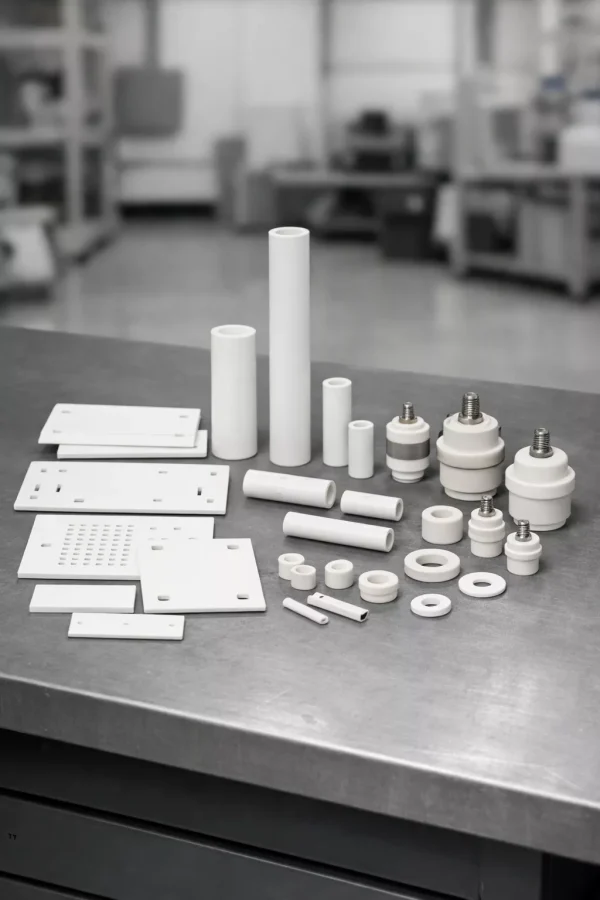
Alumina-based ceramic structures are widely used in EV high voltage switching systems where insulation stability and dimensional control directly affect electrical safety.

Provides insulation stability for compact EV high voltage relay assemblies

Structural Support Interfaces

Zirconia Toughened Alumina materials are selected for EV components exposed to mechanical load and thermal fluctuation within constrained system layouts.

Supports load-bearing structures in EV power and control assemblies

Thermal Isolation Components

Boron nitride materials are applied in EV systems where controlled heat flow and electrical isolation must coexist in confined thermal environments.

Manages localized heat while maintaining insulation in EV systems

Power Module Heat Dissipation

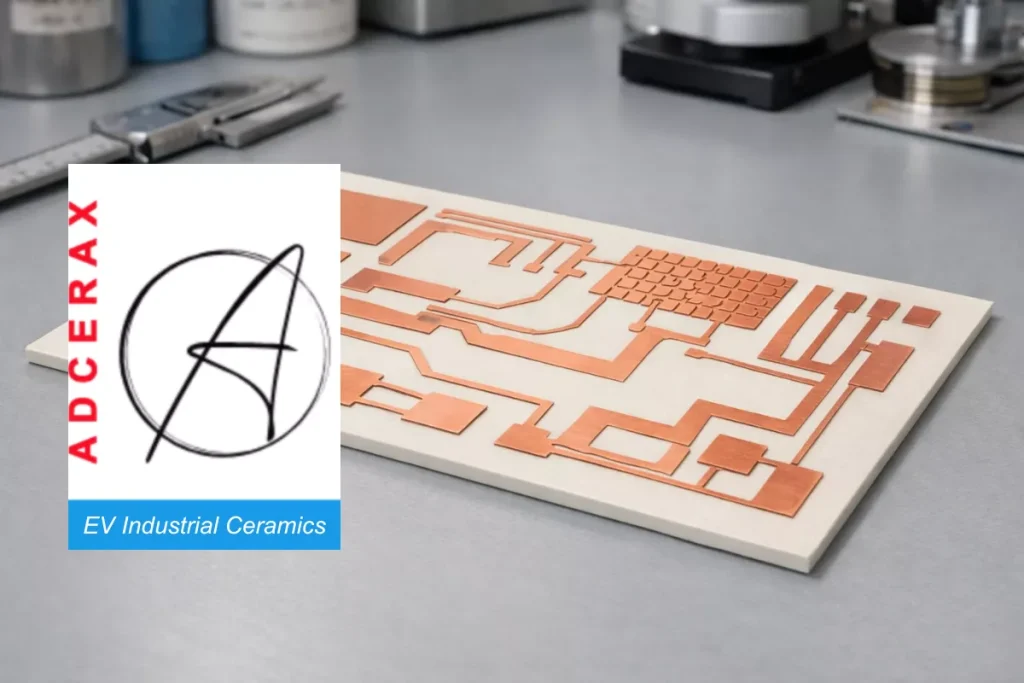
Aluminum nitride substrates are specified in EV power electronics where heat dissipation efficiency directly influences module reliability.

Enhances heat dissipation in EV power electronic modules

EV Ceramic Selection Aligned With System Requirements

EV Industrial Ceramics are specified according to insulation limits, mechanical loading, and thermal behavior within electric vehicle systems.
Engineering evaluation at the material and geometry level helps reduce qualification risk across power electronics and high-voltage assemblies.

ADCERAX® Industrial Ceramic Categories for EV Applications

Material selection in EV Industrial Ceramics is guided by insulation demands, structural loading conditions, and thermal management requirements across different electric vehicle systems.

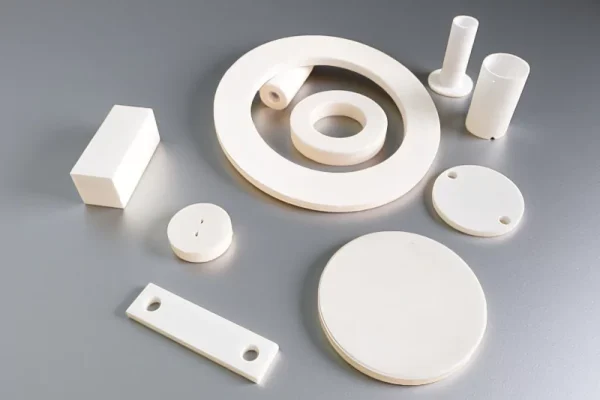
alumina ceramic parts 99.7% purity

Aluminum Oxide

Alumina-based components are commonly used where electrical insulation and dimensional stability are required in EV assemblies.

- High voltage insulation reliability
- Metallization compatibility stability
- Consistent dimensional tolerance
View Alumina Ceramics
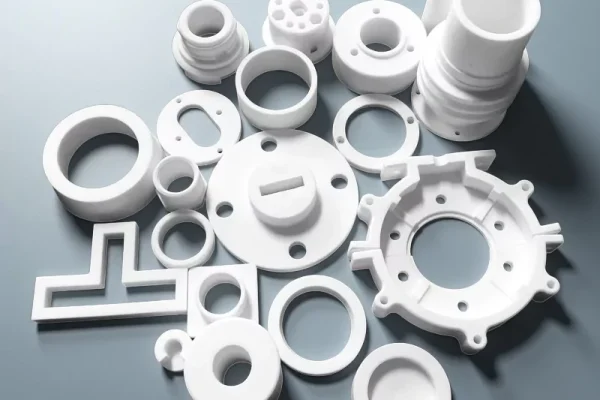
ZTA ceramic

ZTA

Zirconia Toughened Alumina materials are specified for EV components exposed to mechanical load and thermal variation.

- Improved fracture resistance
- Structural load stability
- Thermal shock tolerance
View ZTA Ceramics
adcerax boron nitride ceramic for sale

Boron Nitride

Boron nitride components are selected for EV environments requiring thermal control combined with electrical isolation.

- Controlled heat transfer paths
- Electrical insulation performance
- Chemical stability in service

View BN Ceramics
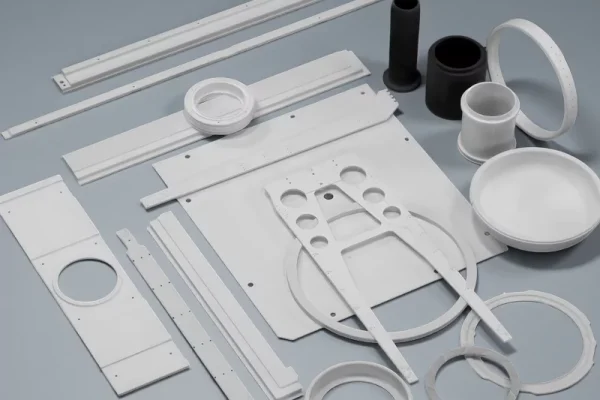
Aluminium nitride ceramic substrates, plates, rings and custom-machined parts displayed for high-power and thermal management applications

Aluminum Nitride

Aluminum nitride substrates are applied in EV power electronics where heat dissipation and insulation must coexist.

- High thermal conductivity
- Electrical insulation integrity
- Power module integration
View AlN Ceramics

Integrated Manufacturing Services for EV Ceramic Components

Integrated Manufacturing Services for Kiln Ceramic Components

ADCERAX® provides integrated manufacturing support for EV ceramic components used in high-voltage switching, structural support, thermal isolation, and power module assemblies across electric vehicle systems.

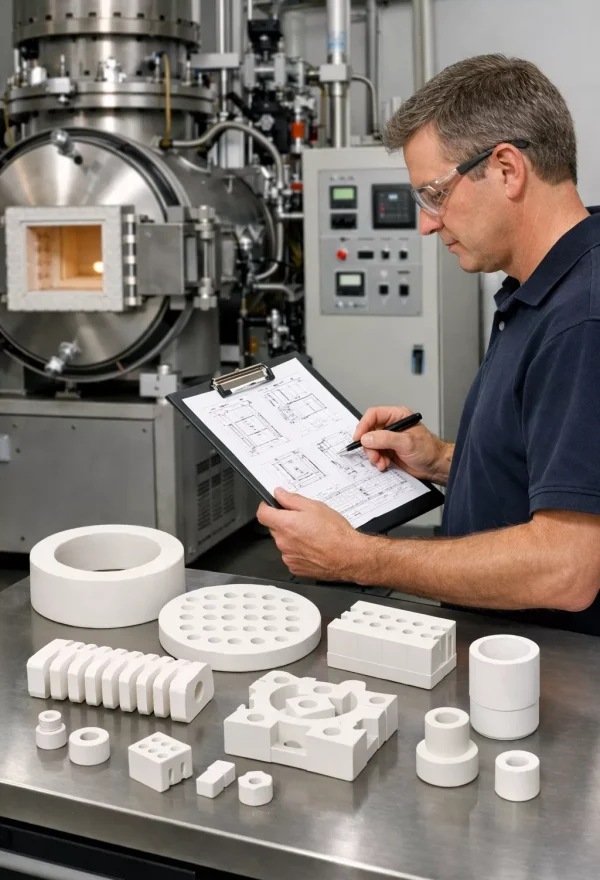
For electric vehicle industrial ceramics, manufacturing capability directly determines whether material performance can be realized at component level.
End-to-end control across forming, machining, joining, and surface preparation enables ceramic components to meet electrical, thermal, and mechanical requirements defined at application level.

Material Selection:

align ceramic grade with electrical and thermal requirements

Forming Control:

achieve near-net shapes with controlled shrinkage behavior

Precision Machining:

hold critical dimensions within ±0.02–0.05 mm range

Metallization Processing:

apply uniform Mo-Mn layers for ceramic-metal joining

Bonding Integration:

support brazing or copper bonding for EV assemblies

Surface Preparation:

deliver defined roughness for sealing or contact interfaces

ADCERAX® Advanced Processing of EV Industrial Ceramics

Dimensional Control Machining

Precision machining enables complex ceramic geometries to meet tight dimensional and surface requirements within EV assemblies.

CNC Platforms:

multi-axis ceramic machining centers, ≤0.02 mm tolerance

Tool Control:

diamond tooling optimized for brittle ceramic cutting

Surface Finish:

Ra 0.4–0.8 μm on functional interfaces

Ceramic-to-Metal Interface Formation

Metallization processing creates reliable ceramic-to-metal interfaces required in EV high-voltage and power electronics applications.

Coating Systems:

Mo–Mn metallization with controlled layer thickness

Firing Control:

hydrogen or controlled atmosphere furnaces up to 1500 °C

Bond Strength:

shear strength typically ≥120 MPa after brazing

Ceramic Bonded Assembly Integration

Bonding integration connects ceramic components with metal or copper structures for electrical and thermal functionality.

Brazing Equipment:

vacuum brazing furnaces below 10⁻⁴ Pa

DBC Integration:

copper bonding on AlN substrates up to 300 μm

Thermal Contact:

low interface resistance for heat transfer efficiency

Custom Engineering for EV Ceramic Components

Custom ceramic components for EV programs are defined by application-specific electrical, thermal, and mechanical constraints rather than standard part catalogs.
For EV Industrial Ceramics, effective customization requires early alignment on material selection, geometry tolerance, and interface conditions across high-voltage, structural, and power electronics systems.

Engineering discussions initiated at the drawing or application stage help ensure ceramic components are manufacturable and compatible with EV system requirements.

ADCERAX® EV Industrial Ceramics Addressing Engineering Constraints in EV Systems

Industrial ceramic components provide stable dielectric strength that is inherently insensitive to temperature and aging. In EV engineering systems, insulation failure often occurs under coupled thermal and electrical stress rather than voltage alone. Ceramic materials for EV high voltage systems maintain predictable insulation behavior across long operating cycles.

Alumina-based industrial ceramic components combine electrical insulation with mechanical rigidity and dimensional stability. Relay housings require fixed insulation spacing under heat and vibration, which polymers and metals cannot maintain consistently. Engineering ceramics for EV systems preserve geometry and insulation integrity throughout service life.

Industrial ceramics offer a unique balance between electrical insulation and controlled thermal conductivity. Power electronics require heat dissipation without creating conductive paths. Ceramic components for EV power electronics satisfy both constraints within compact assemblies.

Rising EV system voltages reduce insulation margins and increase electric field intensity. Industrial ceramic materials exhibit high dielectric strength independent of humidity or aging mechanisms. This property allows ceramic materials for EV high voltage systems to support higher voltage architectures safely.

Thermal cycling introduces internal stress due to material expansion mismatch. Engineering ceramics for EV systems resist microcrack initiation through stable crystal structures and controlled grain boundaries. This supports long-term reliability in dynamic EV operating conditions.

Many EV components require both insulation and mechanical attachment to metal structures. Industrial ceramic components support metallization and brazing to form stable ceramic-to-metal interfaces. These interfaces maintain electrical isolation while tolerating thermal and mechanical loads.

Certain engineering ceramics exhibit high flexural strength and fracture toughness. In EV systems, this allows ceramic components to carry mechanical loads while remaining electrically insulating. Such dual functionality reduces part count and assembly complexity.

Compact EV architectures demand thinner insulation and tighter spacing. Industrial ceramic components provide high dielectric strength even at reduced thickness. This enables higher integration density without compromising electrical safety.

Metals can soften, oxidize, or creep under heat and electrical fields. Industrial ceramic components retain mechanical and electrical properties under combined thermal, electrical, and mechanical stress. This behavior aligns with long-life requirements in EV engineering systems.

EV environments introduce vibration from road and drivetrain dynamics. Properly engineered industrial ceramic components resist fatigue and crack propagation. This ensures stable performance in mobile EV systems.

Get in touch with us

We believe that Adcerax will become your best partner!
Please fill in your contact information in the form or call us.

*Our team will answer your inquiries within 24 hours.

*Your information will be kept strictly confidential.


Quick Quote

The more details you provide, the faster we can quote.

*We respond within 24 hours. All inquiries are confidential.

Download Catalog

Get Your Custom Sulution

The more details you provide, the faster we can respond.

customize size

*We respond within 24 hours. All inquiries are confidential.

Download Catalog