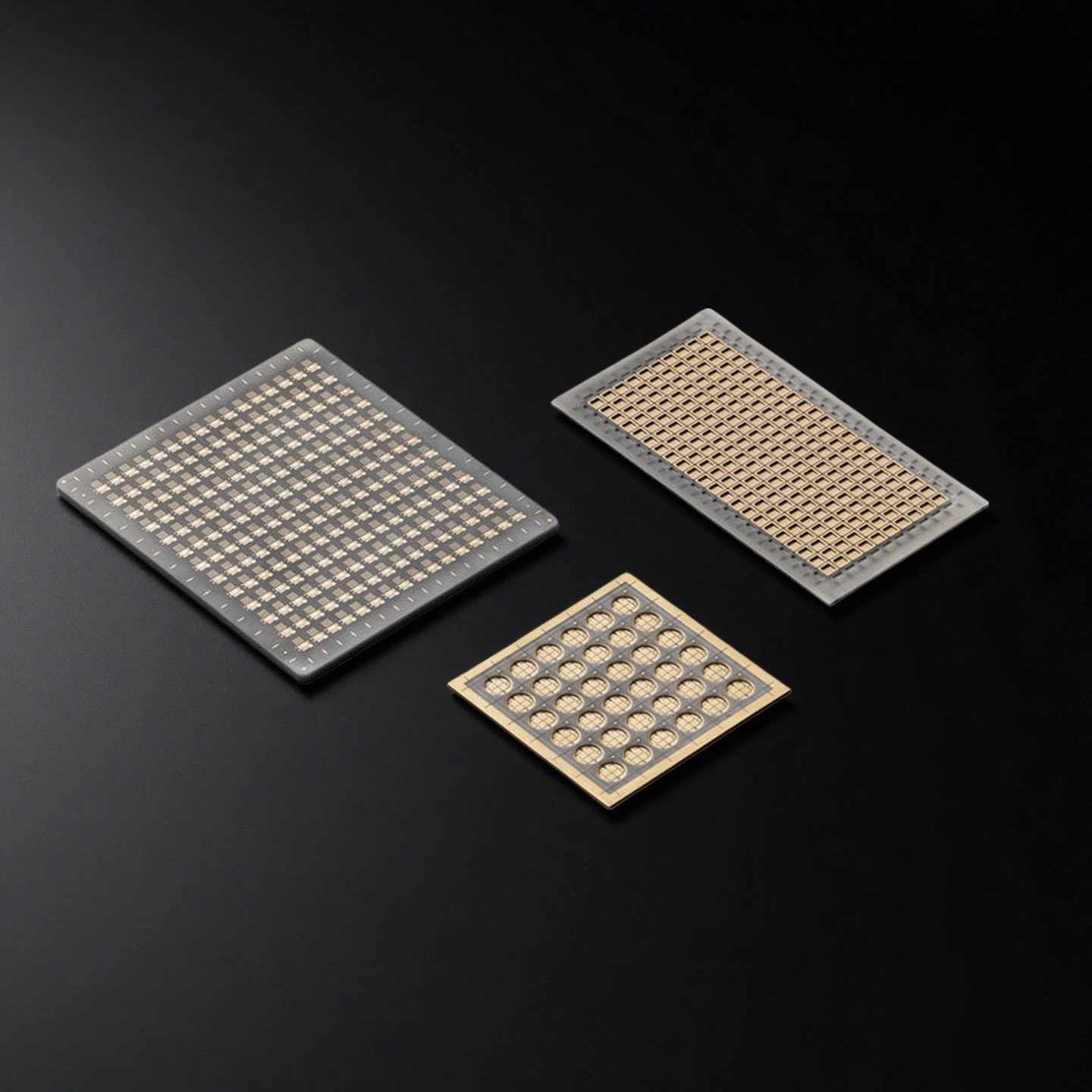
Custom Aluminum Nitride Ceramic Support for UV LED and VCSEL Packages

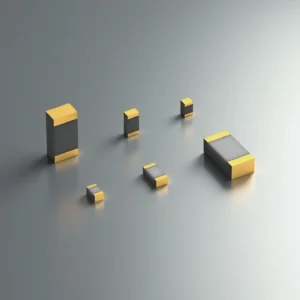
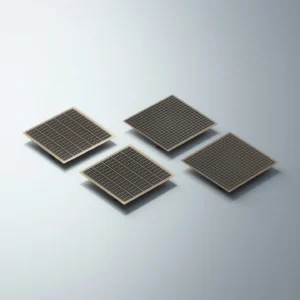
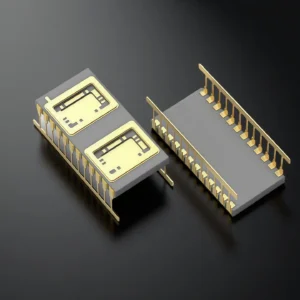
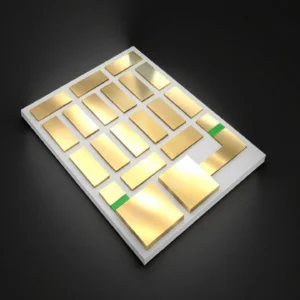
ADCERAX supplies custom aluminum nitride ceramic supports for UV LED, VCSEL, IR emitter and laser package assemblies where fast heat spreading, electrical insulation, flatness control and stable die alignment are important. Each AlN support can be reviewed according to package outline, chip size, pad layout, metallization requirement, thickness, flatness, surface finish and assembly process before quotation.

Catalogue No. AT-3535-01
Material Aluminum Nitride
Thermal Conductivity ≥170 W/m·K
Critical Dimension Tolerance ±0.05 mm
Coefficient of Thermal Expansion Approx. 4.5–5.5 ×10⁻⁶ /K
Engineering RFQ Review
Small-Batch Custom Support
Factory-Direct Manufacturing
Drawing & Process Review

What Is an Aluminum Nitride Ceramic Support?

An aluminum nitride ceramic support is a high-thermal-conductivity insulating ceramic carrier used to support UV LED chips, VCSEL arrays, IR emitters and compact optoelectronic packages. Compared with alumina, AlN can spread heat more efficiently while maintaining electrical insulation, making it suitable for packages where junction temperature, flatness, pad layout and die alignment affect long-term performance.

Aluminum Nitride UVLED /VCSEL Ceramic Support Benefits

  • Optimized for heat flow under UVLED / VCSEL dies
    The AlN UVLED VCSEL support spreads heat quickly away from the active junction, helping to control junction temperature in compact high-power packages.

  • Geometry tailored to chip layout and array pitch
    Edge length, thickness and pad window positions can be machined around specific UV LED chip sizes, VCSEL array patterns and optical apertures, reducing rework on the assembly line.

  • Stable CTE matching with GaN / GaAs / Si-based dies
    The Aluminum Nitride ceramic support keeps thermal expansion close to common semiconductor materials, which helps maintain solder and epoxy interfaces over long thermal cycling.

  • Fine-feature metallization compatibility
    The support surface can be prepared for thin-film or thick-film metallization patterns that follow your pad layout, bond finger routing and common-cathode / common-anode schemes.

  • Flatness control for precise optical alignment
    Tight control of submount thickness and flatness supports accurate optical height and tilt of UVLED or VCSEL arrays inside lens barrels or optical windows.

Why Engineers Choose AlN Ceramic Supports for UV LED and VCSEL Packages

Heat must leave the chip without adding electrical risk.

In UV LED and VCSEL packages, the ceramic support is not only a mechanical base. It also affects heat flow, chip position, bonding stability and package reliability. When alumina, FR-4 or metal-core carriers cannot control junction temperature or electrical isolation well enough, aluminum nitride becomes a practical upgrade.

The support must match the real package design.

For most projects, the key question is not only material selection. Engineers also need to confirm whether the ceramic can match the package outline, die area, pad geometry, cavity structure, metallization stack and optical height. ADCERAX reviews these details before quotation so the AlN support can fit the customer’s existing fixture, assembly route and performance target.

AlN Ceramic Support Material Properties

Property Content Property Unit ALN-170 ALN-200 ALN-230
Basic Properties Color gray light yellow light yellow
Density g/cm³ 3.2-3.3 3.2-3.3 3.2-3.3
Surface Roughness μm 0.2-0.75 0.2-0.75 0.2-0.8
Camber length ‰ ≤3‰ ≤3‰ ≤3‰
Hardness HV 1100 1100 1100
Thermal Properties Max Operating Temperature °C 1100 1100 1100
Thermal Conductivity W/m·K 170-190 190-220 220-230
Coefficient of Thermal Expansion 10⁻⁶/K(20-400°c) 4-5 4-5 4-5
Coefficient of Thermal Expansion 10⁻⁶/K(400-800°c) 5-6 5-6 5-6
Mechanical Properties Flexural Strength MPa 300-400 350-450 400-500
Tensile Strength MPa 200-300 250-350 280-380
Compressive Strength MPa 2000-3000 2200-3200 2500-3500
Electrical properties Dielectric Constant at 1MHz 8-9 8-9 8-9
Dielectric strength KV/mm ≥15 ≥15 ≥15
Volume resistivity 20℃ Ω.cm ≥1014 ≥1014 ≥1014


AlN UVLED and VCSEL Ceramic Support Specifications

AlN UVLED and VCSEL Ceramic Support
Item no. Model Overall substrate size Product size Cavity size Cavity shape Cavity depth Metallization of the seal
AT-3535-01 3535-01 88.9*45.5*0.8 SQ3.5 SQ2.4 square 0.4 yes
AT-3535-02 3535-02 88.9*45.5*0.8 SQ3.5 SQ2.4 square 0.4 no
AT-3535-03 3535-03 88.9*45.5*1.0 SQ3.4 SQ2.4 square 0.5 yes
AT-6868-01 6868-01 48*48*1.0 SQ6.8 4.9 circle 0.2+0.4 no
AT-V3535-04 V3535-04 88.9*45.5*2.0 SQ3.5 SQ2.4 square 0.45+1.0 no

The final AlN grade should be selected according to power density, package thickness, die attach material, metallization route, flatness requirement and cost target. For replacement projects, ADCERAX can compare your existing alumina, metal-core or AlN support drawing and recommend a practical production route.

AlN UVLED /VCSEL Support Packaging

  • Submounts are first cleaned and inspected, then loaded into anti-static trays or vacuum-sealed pockets, keeping each Aluminum Nitride UVLED VCSEL Support separated to avoid edge chipping.
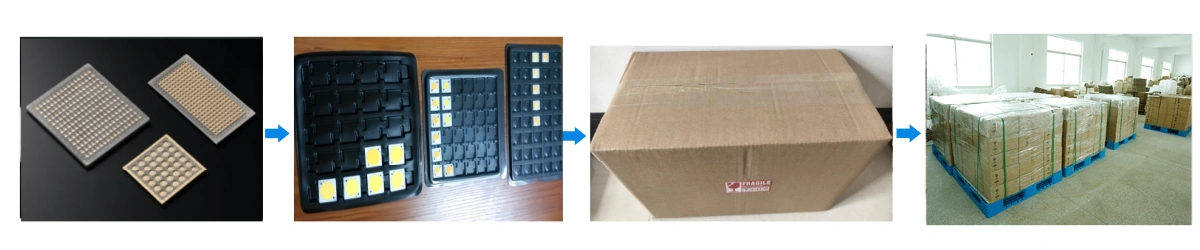

AlN UVLED VCSEL Support Packaging

Application Fit for AlN Ceramic Supports

  • UV-C LED Disinfection and Sterilization Modules

    Key Advantages

    1. Lower junction temperature under high UV output – AlN ceramic supports help spread heat away from UV-C LED chips, supporting more stable output at the same drive current.
    2. Stable lifetime under continuous operation – High thermal conductivity and electrical insulation help the package maintain performance during long operating cycles.
    3. Compact multi-chip package design – Thin AlN ceramic supports allow dense chip layouts while maintaining mechanical strength and insulation.

    Engineering Concern Solved

    UV-C modules often suffer from heat concentration when compact chip arrays are mounted on epoxy-based or lower-conductivity carriers. By switching to a custom AlN ceramic support with a similar outline and higher thermal conductivity, the package can reduce hot spots, improve output stability and support longer operating life under continuous use.

  • VCSEL Arrays for 3D Sensing and ToF Cameras

    Key Advantages

    1. More uniform thermal distribution across the array – AlN ceramic supports help reduce temperature differences between the center and edge of the VCSEL array.
    2. Precise package height and flatness control – Custom AlN supports can be reviewed for thickness, flatness and cavity design to support compact optical modules.
    3. Stable performance under pulsed operation – Dense AlN ceramic carriers can support repeated high-current pulses used in 3D sensing applications.

    Engineering Concern Solved

    VCSEL arrays mounted on FR-4 or other low-conductivity carriers may show uneven beam pattern, dot non-uniformity or local temperature rise. A custom AlN VCSEL support with defined flatness, thermal conductivity and pad layout helps reduce thermal gradients across the active area, supporting more consistent optical performance during cycling tests.

  • LiDAR and Industrial Laser Emitter Modules

    Key Advantages

    1. Reliable operation near high-power laser emitters – AlN ceramic supports provide a thermally conductive and electrically insulating base for compact laser modules.
    2. Compatibility with high-voltage and pulsed-current designs – The ceramic support helps maintain insulation around drivers, electrodes and emitter structures.
    3. Mechanical stability in vehicle and industrial environments – Dense AlN structures can support vibration, thermal cycling and repeated module operation.

    Engineering Concern Solved

    LiDAR and industrial laser modules may face alignment drift, local heat buildup or package stress when metal-core or polymer-based carriers are used near edge-emitting lasers. A custom AlN ceramic support can improve heat spreading, maintain insulation and support stable optical alignment in thermal cycling, vibration and high-power operating conditions.

AlN UVLED VCSEL Ceramic Support Usage Instructions

  • Installation

    1. Verify that the Aluminum Nitride UVLED VCSEL Support thickness and outline match the pick-and-place and bonding fixtures before loading into production.
    2. Handle submounts with vacuum nozzles or ceramic-safe tweezers, gripping non-functional zones to avoid damaging pad areas.
    3. Align the submount orientation marks to the line reference to keep the pad layout consistent with the program data.

  • Use in Assembly

    1. Follow the recommended die attach profile for the selected solder or conductive adhesive, taking into account the thermal mass of the AlN support.
    2. Control heating and cooling rates to avoid thermal shock, especially for thin submounts below about 0.3 mm.
    3. Keep contamination away from the pad and bonding areas by limiting handling steps after surface cleaning.

  • Storage

    1. Store Aluminum Nitride UVLED VCSEL Support parts in closed, dry containers away from corrosive gases and dust.
    2. Maintain stable ambient conditions to minimize moisture uptake of adhesives and metallization systems used with the submount.
    3. Use the supports on a first-in-first-out basis to keep traceability straightforward and to avoid mixing old and new versions.

  • Cleaning

    1. If cleaning is required, use non-aggressive solvents validated for the metals and adhesives used with the AlN support.
    2. Avoid abrasive mechanical cleaning on active pad areas to prevent roughness changes and pad thinning.
    3. Dry parts completely before returning them to trays or starting the next assembly step.

  • Common Misuse Points and How to Handle Them

    1. Excessive thermal shock during reflow or die attach
    If cracks or micro-cracks are observed, review heating and cooling ramp rates and reduce temperature gradients across the Aluminum Nitride UVLED VCSEL Support.
    2. Poor wetting or voids under UVLED / VCSEL dies
    Check the flatness of the AlN support, solder paste volume and reflow profile; adjust stencil design or paste type to improve coverage and reduce voids.
    3. Alignment drift during wire bonding or encapsulation
    Ensure fixtures clamp the AlN support in a stable way and verify that adhesive cure conditions do not generate warpage on the submount.

FAQ – Aluminum Nitride UVLED VCSEL Support

  1. Why choose aluminum nitride instead of alumina for UV LED or VCSEL supports?
    Aluminum nitride is selected when the package needs much higher heat spreading than alumina while still requiring electrical insulation. It is especially useful for compact UV LED, VCSEL and laser emitter packages where junction temperature, die alignment and package lifetime are sensitive to thermal resistance.
  2. Can ADCERAX make custom AlN ceramic supports from drawings?
    Yes. ADCERAX can review custom AlN supports according to outline size, thickness, cavity structure, pad layout, metallization requirement, surface finish, flatness and inspection criteria. A drawing or sample is the best starting point for quotation.
  3. Can AlN ceramic supports be supplied with metallization?
    AlN supports can be reviewed for metallization systems used for die attach, wire bonding or soldering. The final metallization route should be confirmed according to the die material, bonding method, process temperature, pad geometry and reliability requirement.
  4. What information is needed for a fast quotation?
    It is helpful to provide the drawing, material grade, length, width, thickness, cavity or pad design, metallization requirement, tolerance, flatness, surface finish, quantity and intended application. If this is a replacement project, the current failure mode is also useful.
  5. How should I choose the thickness of an AlN ceramic support?
    The thickness should be selected by balancing thermal resistance, insulation, mechanical strength and handling risk. A thinner support can shorten the heat path, while a thicker support may improve strength and assembly stability.
  6. What causes AlN ceramic supports to crack during assembly?
    Cracking is usually related to excessive thermal shock, uneven clamping, sharp package stress, poor fixture support or aggressive handling. ADCERAX can review thickness, corner design, mounting structure and heating profile to reduce cracking risk.
  7. How does AlN compare with BeO for thermal management packages?
    AlN provides high thermal conductivity and electrical insulation without the handling concerns associated with beryllium-containing ceramics. Many customers choose AlN when they need strong thermal performance with easier material management and custom ceramic machining.
customize size

AlN UVLED /VCSEL Support Customized

ADCERAX can review aluminum nitride ceramic supports according to your drawing, package outline and assembly process. The goal is to make the ceramic carrier fit the existing device structure instead of forcing the customer to redesign the package.

Custom Item What You Can Specify Why It Matters
Outline geometry You can specify square, rectangular, stepped, notched or custom profiles. This helps the AlN support fit the package cavity, holder or automated fixture.
Thickness You can define thickness according to thermal resistance, insulation and mechanical strength. Thin supports reduce thermal path length, while thicker supports improve handling strength.
Cavity and window design You can specify cavity shape, depth, aperture and die placement area. These features help control chip position, optical path and encapsulation clearance.
Pad layout You can define pad size, spacing, bond finger routing and common electrode design. This helps match the UV LED or VCSEL die pattern and bonding process.
Metallization You can request metallization review for die attach, wire bonding or soldering. The stack must match the process temperature, bonding method and reliability target.
Surface finish You can specify polished, lapped or defined roughness zones. Surface condition affects die attach wetting, bonding stability and inspection.
Inspection points You can define flatness, bow, thickness variation, edge condition and visual criteria. These checks reduce assembly mismatch and batch-to-batch uncertainty.

Related Products

ADCERAX - Your Trusted Advanced Ceramics Manufacturing Partner

Direct factory manufacturing with comprehensive ceramic materials expertise and global supply capabilities

China-Based Manufacturer

ADCERAX supplies ceramic components for overseas OEMs, equipment builders, and labs.

Custom Drawing Support

We review drawings, dimensions, materials, and application conditions before quotation.

Ceramic Process Control

Forming, sintering, machining, grinding, and finishing are arranged by part requirements.

Pre-Shipment Inspection

Dimensional checks, visual inspection, and packaging review help reduce procurement risk.

Get in Touch with Us

Our team will be happy to respond to you in less than 24 hours.

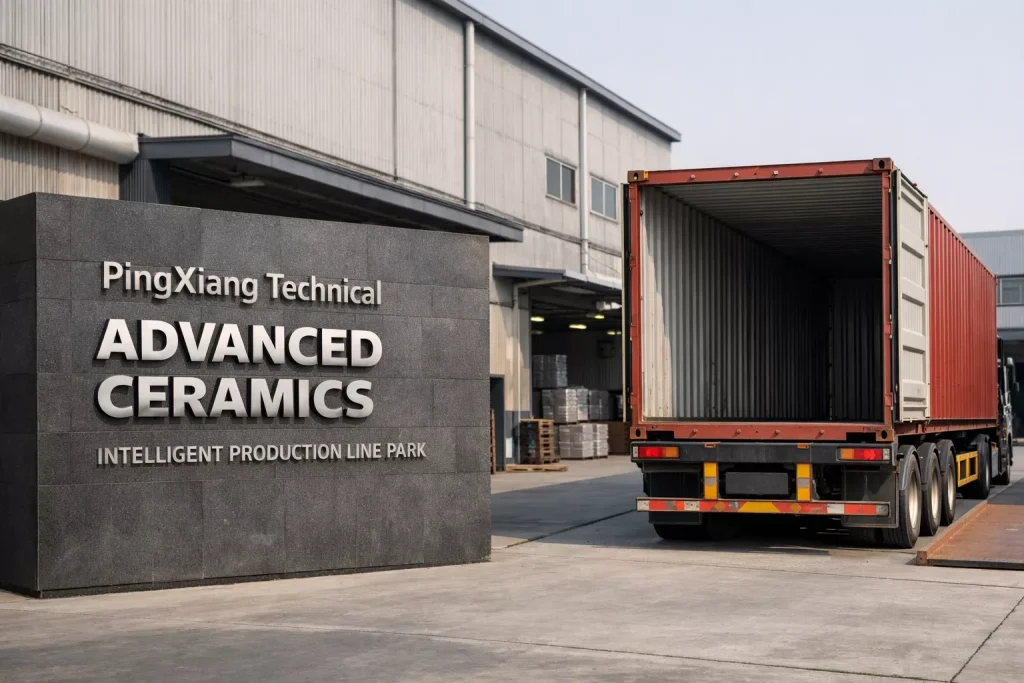
Pingxiang Factory — Silicon carbide, silicon nitride, high-temperature ceramics

Quick Quotation

*Our team will answer your inquiries within 24 hours.

*Your information will be kept strictly confidential.

Ready to Solve Your Engineering Challenge?

Partner with ADCERAX for reliable, high-performance advanced ceramic solutions. Our engineers are ready to discuss your project.

E-mail

info@adcerax.com

Phone

+(86) 0731-74427743 | WhatsApp: +(86) 19311583352

Response Time

Within 24 hours

Quick Quote

The more details you provide, the faster we can quote.

*We respond within 24 hours. All inquiries are confidential.

Get Your Custom Solution

The more details you provide, the faster we can respond.

customize size

*We respond within 24 hours. All inquiries are confidential.

Download Catalog