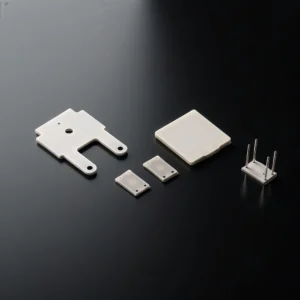
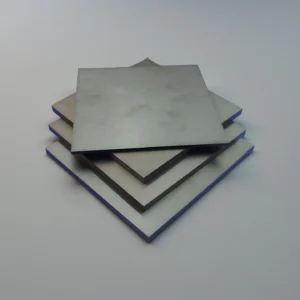
Aluminum Nitride Heat-Spreader Plates are flat, electrically insulating ceramic plates engineered to distribute heat from chips, dies and module assemblies into a larger surface area, lowering thermal resistance between the active device and the system heatsink. They are used in compact power electronics, LED modules, laser diode packages and RF amplifiers where high thermal flux and limited footprint require a stable, high-conductivity ceramic layer.
Aluminum Nitride Heat Spreader Plate Benefits
Lower Thermal Bottlenecks in Compact Packages
Aluminum nitride heat spreader plates help move heat laterally from concentrated chip or die areas before the heat reaches the baseplate, carrier or system heatsink. This is valuable when a compact power module, LED array or RF device cannot increase package size but still needs better thermal balance.
Electrical Insulation Without Giving Up Thermal Transfer
AlN ceramic provides electrical insulation while maintaining much higher thermal conductivity than many conventional oxide ceramics. This allows the plate to work as an insulating thermal path in high-voltage or electrically sensitive assemblies where a metal spreader may create short-circuit or isolation risk.
CTE Compatibility for Power Device Assemblies
The thermal expansion behavior of aluminum nitride is closer to silicon-based device materials than many metal options. This helps reduce thermo-mechanical stress around solder joints, die attach layers and bonded interfaces during repeated power cycling.
Controlled Flatness for Bonding and TIM Contact
Flatness, parallelism and surface finish are important for solder, braze, adhesive and thermal interface material layers. A controlled AlN heat spreader plate can help reduce local gaps, uneven contact pressure and interface resistance during assembly.
Drawing-Based Features for Module Integration
ADCERAX® can review holes, slots, pockets, steps, chamfers, reference edges and metallized areas according to the package layout. This helps engineers integrate the heat spreader into existing mechanical and thermal designs instead of redesigning the whole module around a standard plate.
Aluminum Nitride Heat Spreader Plate Properties
|
Property Content |
Property |
Unit |
ALN-170 |
ALN-200 |
ALN-230 |
|
Basic Properties |
Color |
|
gray |
light yellow |
light yellow |
|
Density |
g/cm³ |
3.2-3.3 |
3.2-3.3 |
3.2-3.3 |
|
Surface Roughness |
μm |
0.2-0.75 |
0.2-0.75 |
0.2-0.8 |
|
Camber |
length ‰ |
≤3‰ |
≤3‰ |
≤3‰ |
|
Hardness |
HV |
1100 |
1100 |
1100 |
|
Thermal Properties |
Max Operating Temperature |
°C |
1100 |
1100 |
1100 |
|
Thermal Conductivity |
W/m·K |
170-190 |
190-220 |
220-230 |
|
Coefficient of Thermal Expansion |
10⁻⁶/K(20-400°c) |
4-5 |
4-5 |
4-5 |
|
Coefficient of Thermal Expansion |
10⁻⁶/K(400-800°c) |
5-6 |
5-6 |
5-6 |
|
Mechanical Properties |
Flexural Strength |
MPa |
300-400 |
350-450 |
400-500 |
|
Tensile Strength |
MPa |
200-300 |
250-350 |
280-380 |
|
Compressive Strength |
MPa |
2000-3000 |
2200-3200 |
2500-3500 |
|
Electrical properties |
Dielectric Constant |
at 1MHz |
8-9 |
8-9 |
8-9 |
|
Dielectric strength |
KV/mm |
≥15 |
≥15 |
≥15 |
|
Volume resistivity |
20℃ Ω.cm |
≥1014 |
≥1014 |
≥1014 |
AlN heat spreader plate Specifications
|
Aluminum Nitride Heat Spreader Plate Specifications |
|
Item no. |
Size |
Thickness |
Metal electrode |
Coated metal |
Side wrapping treatment |
|
AT-AN-SR001 |
Customizable |
Customizable |
tungsten |
Nickel gold or nickel |
yes |
Aluminum Nitride Heat Spreader Plate Packaging
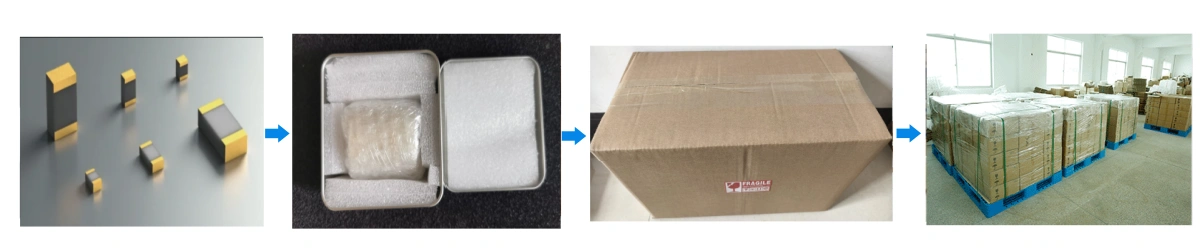
- Aluminum nitride heat-spreader plates are separated by cavity blister trays or rigid plastic separators to avoid edge chipping and surface contact.
- Precision faces, metallized areas and polished or lapped surfaces should not contact each other directly. For custom batches, labels can be used to identify part number, drawing revision, thickness, material grade and quantity, helping customers check incoming parts more efficiently.
Aluminum Nitride Heat Spreader Plate Applications
SiC, GaN and IGBT Power Modules
In power modules, an aluminum nitride heat spreader plate is used between the active device region and the downstream thermal path to spread localized heat while maintaining electrical isolation. Engineers select AlN when alumina insulation creates too much thermal resistance or when metal heat spreaders cannot provide the required dielectric separation.
High-Power LED and UV LED Packages
Dense LED and UV LED arrays often create localized hotspots under the emitter area. An AlN heat spreader plate helps distribute heat across a wider area before it reaches the package carrier or heatsink. This supports more stable thermal balance in compact optical modules where package space is limited.
Laser Diode and Photonics Assemblies
For optical assemblies that also require carrier or patterned ceramic surfaces, ADCERAX can review related AlN substrates for optical communication modules.
Laser diode modules require stable thermal paths because temperature variation can affect optical output, alignment and long-term reliability. Aluminum nitride heat spreader plates can be used as insulating thermal interface components where high thermal conductivity, surface flatness and dimensional stability are required around the active optical area.
RF and Microwave Power Amplifier Modules
RF power devices and microwave amplifier modules can generate concentrated heat under transistors, MMICs or active die regions. AlN ceramic heat spreaders provide a combination of thermal conductivity and dielectric properties that supports compact RF layouts while reducing unwanted electrical conduction through the thermal path.
Custom Electronic Thermal Management Assemblies
If the application requires active heating rather than passive heat spreading, the aluminum nitride heater sheet may be a more suitable product direction.
For custom electronic packages, AlN heat spreader plates can be machined with holes, notches, steps, pockets or metallized areas to match the assembly layout. This is useful when the thermal component must also fit around fasteners, sensors, bonded interfaces or multi-level package structures.
AlN Heat Spreader Plate Usage Instructions
Installation and Surface Preparation
Before assembly, check that the baseplate, carrier, die attach area and thermal interface surfaces are clean, flat and free from burrs or hard particles. Any raised point or contamination can create local stress, uneven bonding thickness or higher thermal resistance.
Alignment and Mounting
Align the aluminum nitride heat spreader plate according to the drawing, using reference edges, orientation marks, holes or notches where specified. Avoid forcing the ceramic into a misaligned pocket or fixture, because side loading can cause edge chipping or hidden micro-cracks.
Clamping and Fastening Control
Do not apply point pressure directly onto the ceramic surface. Use suitable washers, clamps or pressure-distribution structures, and follow torque-controlled assembly procedures when screws are used near the plate. Uneven clamping can crack the plate or distort the bonded interface.
Bonding, Soldering and Metallized Interfaces
When the heat spreader plate is soldered, brazed, bonded or used with a thermal interface material, confirm that the surface finish, metallization stack and heating profile are compatible with the selected process. Excessive heating rates or poor wetting can create voids, stress concentration or unstable thermal contact.
Thermal Cycling and Validation
During prototype validation, monitor junction temperature, case temperature, insulation behavior and interface stability under the intended load profile. Thermal cycling should be reviewed together with the baseplate material, die attach method and package structure to reduce stress from CTE mismatch.
Cleaning and Storage
Handle AlN heat spreader plates with clean gloves or soft tools. Use lint-free wipes, clean air or approved non-aggressive solvents when cleaning is required. Store the plates in separated trays or protective holders to avoid surface scratches, edge contact, mixed thicknesses or contamination before assembly.
Aluminum Nitride Heat Spreader Plate FAQ
- What is an aluminum nitride heat spreader plate used for?
An aluminum nitride heat spreader plate is used to transfer heat away from chips, dies or power devices while keeping the package electrically insulated. It is commonly used in power modules, LED packages, laser diode assemblies, RF devices and compact electronic systems that require both heat dissipation and insulation.
- When should I choose AlN instead of alumina for a heat spreader plate?
AlN is preferred when standard alumina cannot move heat away fast enough. Alumina provides good insulation, but aluminum nitride offers much higher thermal conductivity, making it more suitable for high-power or high-heat-density electronic packages.
- Can aluminum nitride heat spreader plates replace metal heat spreaders?
AlN can replace selected metal heat spreaders when electrical insulation, thermal expansion compatibility and stable ceramic performance are required. Final selection should be reviewed according to heat load, mounting structure, bonding method, operating temperature and mechanical stress.
- Can AlN heat spreader plates be metallized?
Yes. AlN heat spreader plates can be supplied with metallized patterns for soldering, die attach, wire bonding or module assembly. Metallization design should be confirmed according to circuit layout, bonding process, layer structure and final assembly requirements.
- How do I choose the right thickness for an AlN heat spreader plate?
Thickness selection depends on heat spreading distance, mechanical support, package height, flatness target and mounting pressure. Thinner plates may reduce thermal path length, while thicker plates can improve rigidity and handling strength in larger assemblies.
- What information is needed to quote a custom aluminum nitride heat spreader plate?
Please provide the drawing, size, thickness, hole position, flatness requirement, surface finish, metallization requirement, quantity and application condition. If the design is still under review, ADCERAX® can help check material grade, machining feasibility and key tolerances before quotation.
Quality Control for AlN Heat Spreader Plates
Quality inspection for aluminum nitride heat spreader plates should focus on the surfaces and dimensions that affect thermal contact, electrical insulation and assembly fit. ADCERAX® can review inspection points according to the drawing and the critical function of the plate in the module.
Dimensional Inspection
Length, width, thickness, hole position, slot geometry, step height and edge features are checked against the approved drawing. Critical dimensions should be clearly marked when the plate must fit into an existing package or fixture.
Flatness and Surface Review
Die attach surfaces, TIM contact areas and bonded faces can be checked for flatness, parallelism and surface finish. This helps reduce assembly problems related to uneven bonding layers, contact gaps or local thermal resistance.
Visual and Edge Inspection
Edges, corners, holes and machined transitions are inspected for chips, cracks, contamination and handling damage. This is important because small edge defects may become stress points during clamping, soldering or thermal cycling.
Metallization and Functional Areas
For metallized AlN heat spreader plates, metallized area position, coverage, surface condition and pattern separation should be checked according to the drawing. Functional pads and bonding zones should be protected from scratches and contamination before shipment.
Batch Consistency
For repeat orders, material grade, key dimensions, surface condition and packaging method should remain consistent between batches. This helps purchasing and engineering teams reduce requalification work during ongoing production.