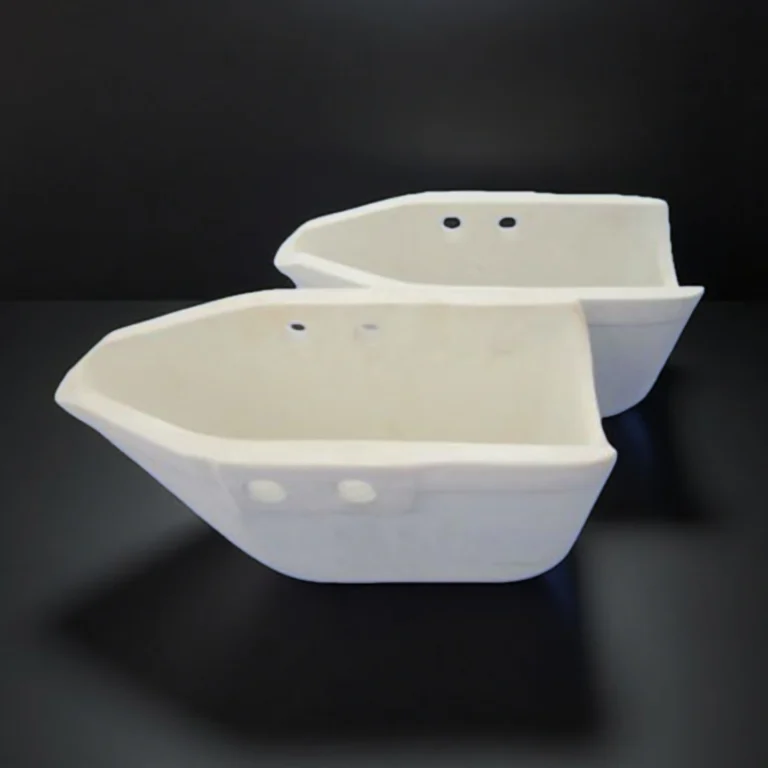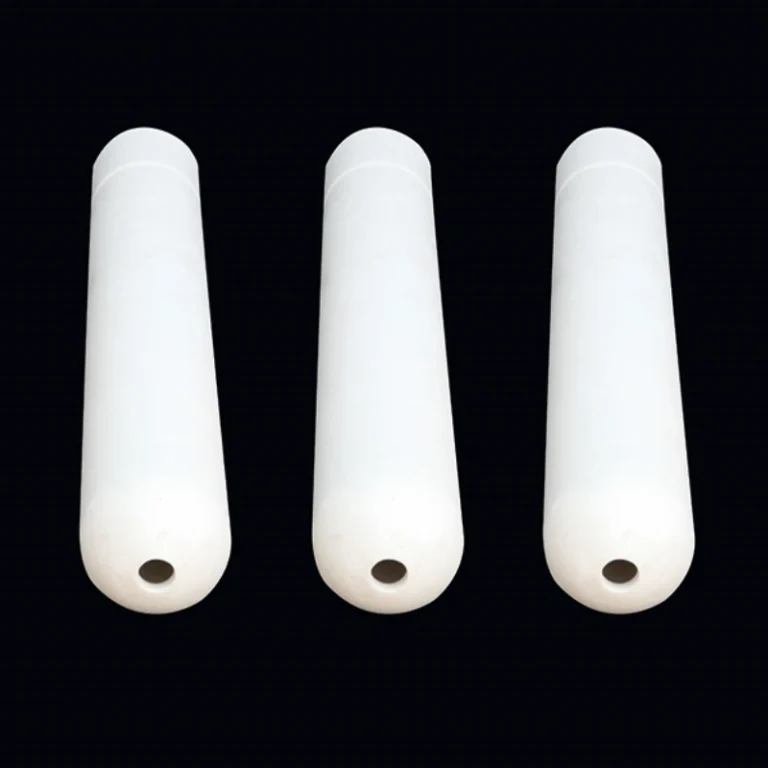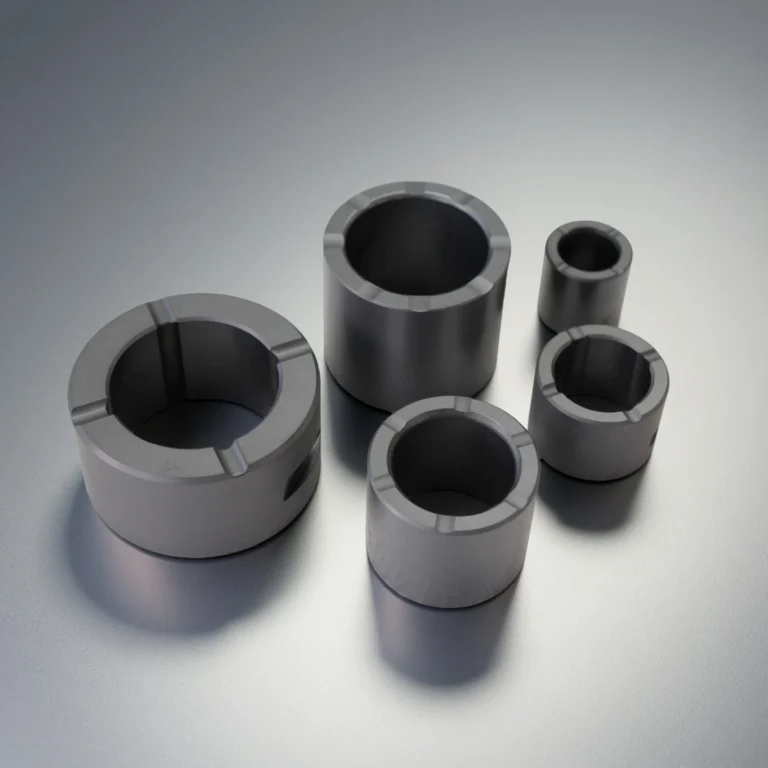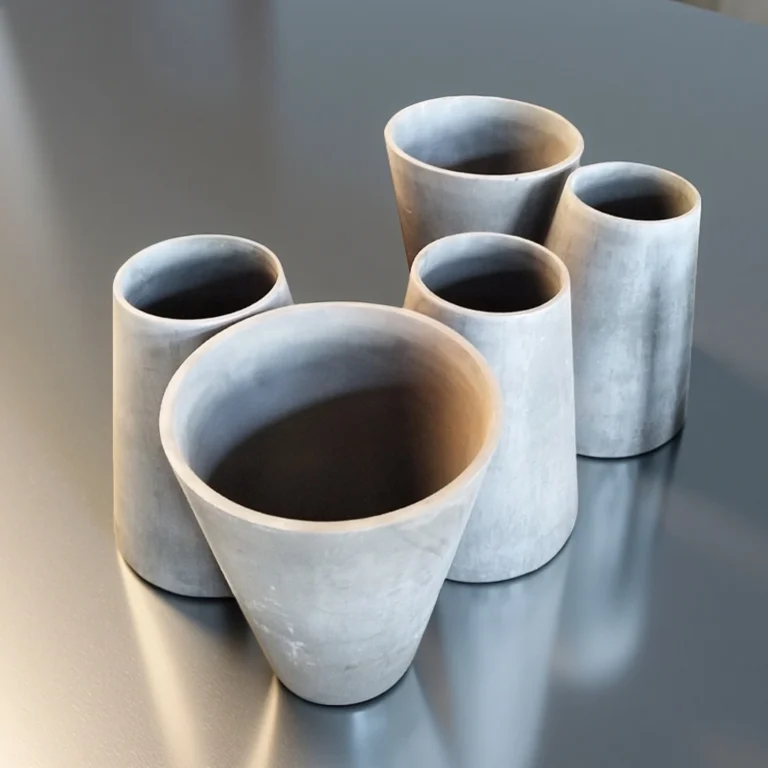
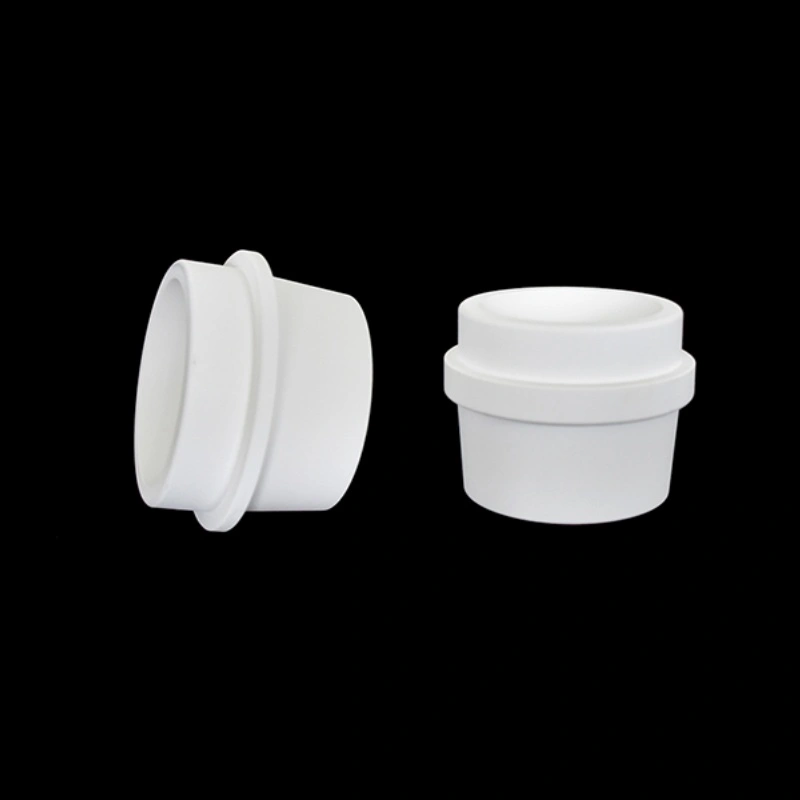
Aluminum Titanate Sprue Bushing for Low Pressure Aluminum Casting Machines

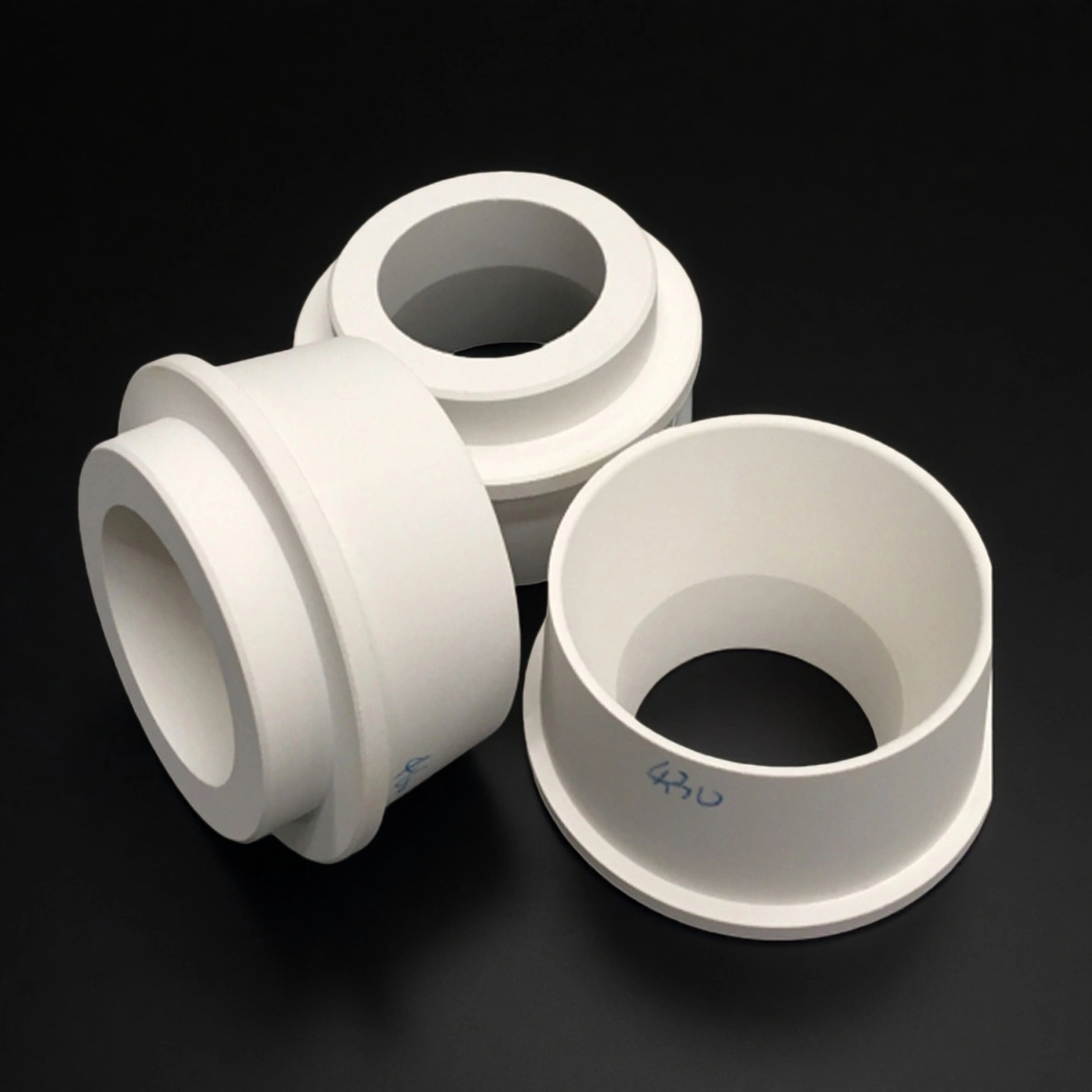
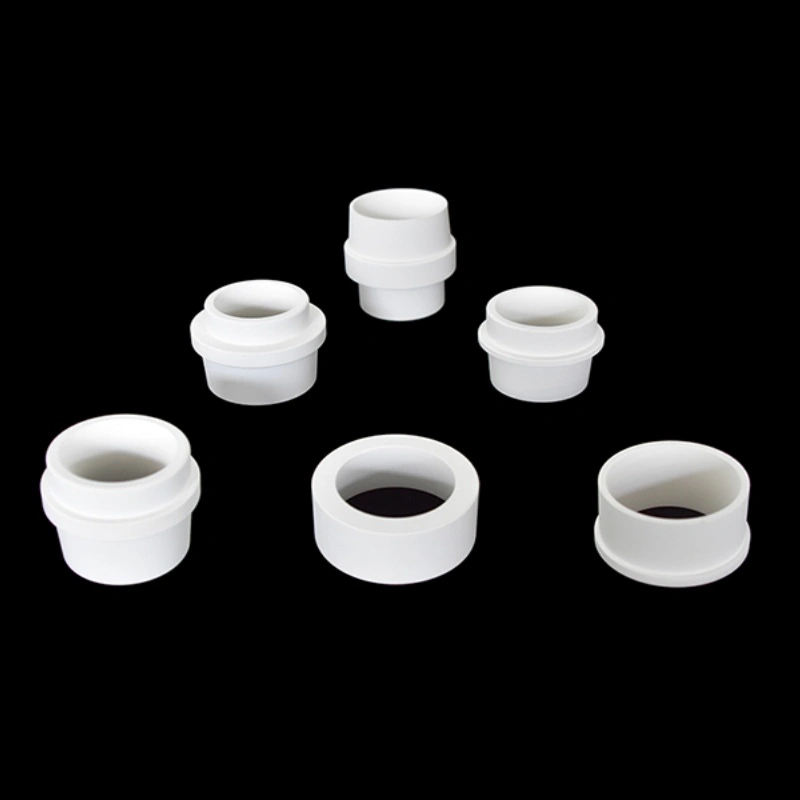
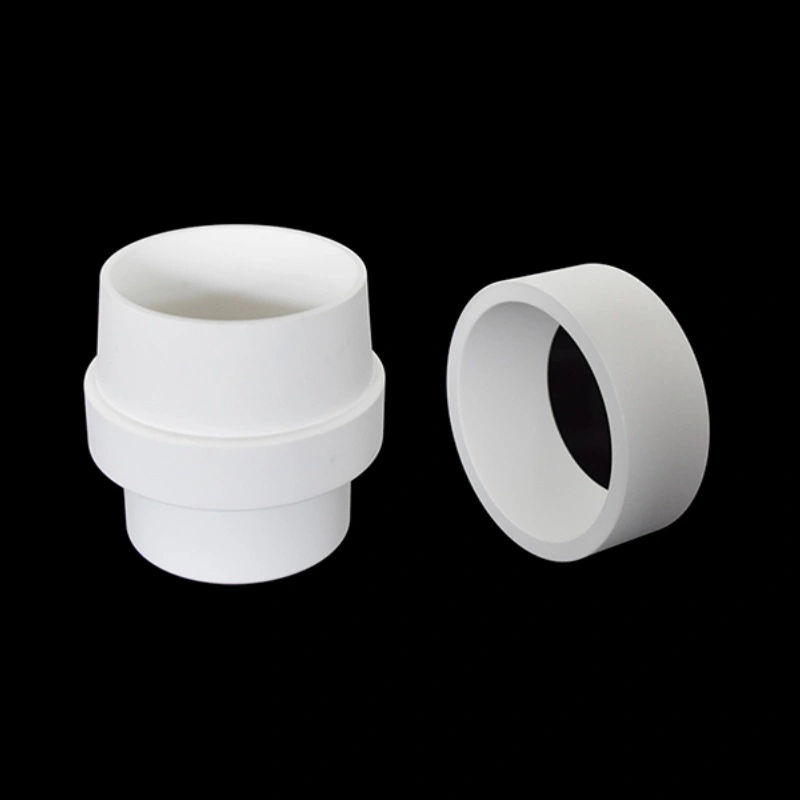
Aluminum titanate sprue bushings are available in standard bore diameters commonly used on low-pressure die casting lines and can be fully customized in inner diameter, flange geometry, overall length, and sealing features according to customer drawings. This Al₂TiO₅ sprue sleeve supports non-standard layouts for automotive wheel foundries and general aluminum casting plants.

Catalogue No. AT-TSL-JK1001
Material Al2O3+TiO₂
Linear thermal expansion (RT–1000 °C) 0.5–1.5 × 10⁻⁶ / °C
Bulk density 3.3–3.5 g/cm³
Thermal conductivity at ~800 °C ≈0.8–1.5 W/m·K
24H Standard Dispatch
Small Batch Support OEM
Factory Direct
Expert Engineering Support

Aluminum Titanate Sprue Bushing is an Al₂TiO₅ ceramic component installed between the riser tube and the down mould in low-pressure aluminum casting machines. It guides molten aluminum into the mold cavity while maintaining stable flow, thermal insulation, and dimensional stability under repeated thermal cycling.

Key Features of Aluminum Titanate Sprue Bushing

  • Low thermal expansion for stable sealing
    Aluminum titanate shows a linear thermal expansion coefficient typically below 1.5 × 10⁻⁶ / °C between room temperature and 1000 °C, reducing stress at the metal-to-ceramic interfaces in the sprue area.

  • High thermal shock resistance for repeated casting cycles
    Microcracked Al₂TiO₅ ceramics combine low CTE and low thermal conductivity, allowing sprue bushings to withstand rapid heating and cooling cycles in low-pressure casting without cracking.

  • Non-wetting behavior with molten aluminum
    The aluminum titanate surface is not easily wetted by molten non-ferrous metals, which limits build-up, reduces inclusion risk, and simplifies maintenance inside the gating system.

  • Controlled apparent porosity and stable mechanical strength
    Typical apparent porosity below about 7–8 % and flexural strength in the 25–35 MPa range provide a good balance between thermal insulation and structural integrity in the sprue region.

  • Service temperature suitable for aluminum alloys
    Aluminum titanate sprue bushings are designed for continuous work around 1000 °C with short-term excursions above this range, matching the molten aluminum temperature window while limiting thermal damage.

Aluminum Titanate Ceramic Sprue Bushing Properties

Parameter Typical Value Description
Coefficient of Thermal Expansion (CTE) 0.5–1.5 ×10⁻⁶ /K Extremely low expansion that maintains dimensional stability under molten aluminum temperatures.
Thermal Shock Resistance Very high Withstands rapid temperature fluctuations without cracking during casting cycles.
Density 2.8–3.0 g/cm³ Medium-density ceramic structure suitable for molten aluminum system components.
Thermal Conductivity 1.5–3.0 W/m·K Helps reduce heat loss along riser tubes, spouts and transfer components.
Maximum Service Temperature 900–1100°C Suitable for typical molten-aluminum environments and transfer systems.
Flexural Strength (MOR) 10–25 MPa Provides sufficient strength for handling, installation and operational load.
Elastic Modulus 20–40 GPa Lower stiffness contributes to excellent thermal shock tolerance.
Porosity 12–25% Supports insulation and limits internal thermal stress accumulation.
Chemical Compatibility Non-wetting to molten aluminum Prevents adhesion, oxide buildup and contamination in casting processes.
Dimensional Stability Stable through long cycles Maintains geometry during prolonged molten-aluminum exposure and thermal cycling.


Aluminum Titanate Ceramic Sprue Bushing Specifications

Item No. Diameter (mm) Thickness (mm) Purity
AT-TSL-JK1001 Customize


Aluminium Titanate Sprue Bushing Packaging

  • Each sprue bushing is wrapped in shock-absorbing soft material to protect edges and sealing faces from impact.
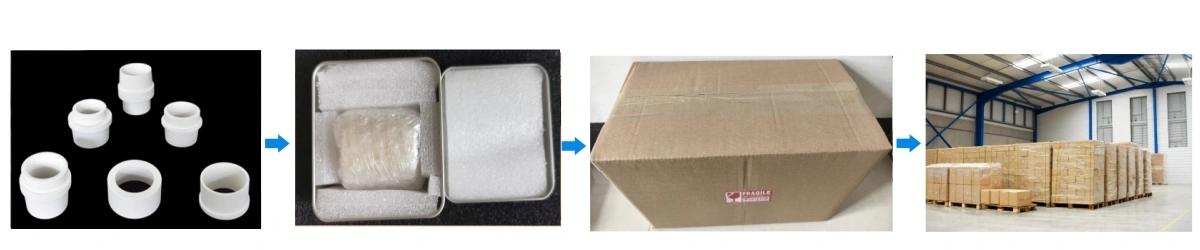

Aluminum Titanate Sprue Bushing Packaging


Aluminum Titanate Sprue Bushing Application Scenarios

  • Automotive Aluminum Wheel Foundries – Aluminum Titanate Sprue Bushing in LPDC Lines

    ✅Key Advantages

    1. Stable gating between the riser tube and mould
    Aluminum titanate sprue bushing maintains consistent bore geometry and low expansion, helping low-pressure aluminum wheel lines keep pouring parameters stable over thousands of cycles.

    2. Reduced inclusion and rework in wheel hubs
    Non-wetting behaviour with molten aluminum and smooth bore design limits oxide build-up and inclusions, supporting lower scrap rates in safety-critical wheel hub regions.

    3. Longer service life under cyclic thermal loading
    Low CTE and high thermal shock resistance allow the sprue bushing to endure repeated furnace-to-ambient cycles without cracking, extending change-out intervals compared to conventional refractory sleeves.

    ✅ Problem Solved

    In a typical aluminum wheel foundry, one low-pressure line may produce 50–100 wheels per hour. If a conventional sprue sleeve cracks or spalls every few weeks, the line may stop for 1–2 hours per replacement, with lost production and re-heating costs easily reaching tens of thousands of dollars over a year. By switching to aluminum titanate sprue bushings with longer thermal shock life and more stable bore geometry, the plant can reduce unplanned stops, cut scrap due to inclusion defects, and keep annual downtime associated with the sprue region significantly lower, making the total cost per casting more predictable.

  • General Aluminum Casting Foundries – Aluminum Titanate Sprue Bushing for Non-Ferrous Alloys

    ✅Key Advantages

    1. Consistent flow for complex non-ferrous castings
    The controlled inner bore and non-wetting surface of the aluminum titanate sprue bushing help regulate metal velocity into molds for complex housings and brackets.

    2. Compatibility with a range of aluminum alloys
    Aluminum titanate’s resistance to molten non-ferrous metals supports use across common casting alloys without significant chemical reaction at standard aluminum casting temperatures.

    3. Lower heat loss in the gating system
    Low thermal conductivity in the sprue region limits metal cooling on the way from riser tube to mold, helping keep filling consistent in multi-cavity tools.

    ✅ Problem Solved

    Jobbing foundries often run multiple part numbers on the same line. Variations in gating geometry and pouring time can lead to incomplete filling or cold shuts if metal cools too quickly inside the sprue. Using aluminum titanate sprue bushings with low thermal conductivity and a controlled bore reduces heat loss and sudden contact angles, helping keep filling behavior consistent across different castings. This reduces scrap on small and medium batches and lowers the engineering time spent continually adjusting process parameters for each job.

  • LPDC Equipment OEMs – Aluminum Titanate Sprue Bushing Integrated into Casting Lines

    ✅  Key Advantages

    1. Matched to riser tubes and molds in complete systems
    Aluminum titanate sprue bushings can be dimensioned to align precisely with OEM riser tubes and mold plates, supporting installation as a standard kit in each machine.

    2. Improved system reliability for project deliveries
    By using Al₂TiO₅ sprue bushings with controlled porosity and strength, OEMs can improve the reliability metrics of new lines in factory acceptance tests.

    3. Standardization across multiple OEM models
    A harmonized aluminum titanate sprue bush family allows machine builders to reduce part variants while supporting different mold sizes and casting heights.

    ✅  Problem Solved

    When an equipment OEM ships a low-pressure casting line, premature failure of sprue bushings during commissioning can delay start-up and trigger warranty discussions. Using a qualified aluminum titanate sprue bushing with documented thermal and mechanical properties allows the OEM to build standard kits that survive factory tests and early production phases. This reduces the risk of site visits and replacement campaigns, and strengthens the OEM’s position when presenting life-cycle cost calculations to end users.


Aluminum Titanate Sprue Bushing – Usage Guide

  • Installation

    1. Check that the mating faces of the riser tube, sprue bushing and mold support are clean, dry, and free from old refractory or metal deposits.
    2. Align the inner bore of the aluminum titanate sprue bushing with the riser tube axis to avoid eccentric flow and mechanical contact.
    3. mechanical fixings gradually in a cross pattern, using recommended torque levels so the ceramic flange is clamped evenly without over-stressing it.

  • Operation

    1. Preheat the surrounding area and gating system gradually according to plant procedures to limit thermal shock on the first heat-up.
    2. Monitor metal temperature and pressure settings; avoid sudden large changes that produce extreme temperature gradients across the sprue bushing.
    3. Periodically inspect the bore through access ports or during scheduled stops to check for buildup, erosion, or cracking.

  • Storage

    1. Store aluminum titanate sprue bushings indoors in a dry, vibration-free area, away from direct sunlight and chemical vapors.
    2. Keep parts in their original packaging or on padded racks to avoid chipping edges and sealing faces.
    3. Record incoming batch numbers and store them by size and drawing number for easy traceability.

  • Cleaning and inspection

    1. Remove minor oxide or inclusion buildup using soft non-metallic tools; avoid impact or scraping with hard metal tools on the ceramic bore.
    2. During planned maintenance, check for hairline cracks, glaze changes, or local spalling, and replace units that show structural damage.
    3. Document operating hours and cycles between replacements to build a data-based service life expectation for each line.

  • Common misuse and how to avoid it

    1. Thermal shock from direct flame impingement
    Avoid positioning burners directly on the ceramic surface during preheating; use shielding or adjust burner angle to warm the area more uniformly.

    2. Mechanical over-tightening of flanges
    If flange bolts are over-torqued, microcracks can form before operation starts. Use calibrated tools and follow torque guidelines that match the steel structure and ceramic strength.

    3. Running with severe buildup inside the bore
    Excessive buildup narrows the flow channel and introduces local hot spots. Schedule cleaning intervals based on alloy cleanliness and observed deposition rate to prevent sudden failure.

FAQ – Aluminum Titanate Sprue Bushing

  1. Q: Why choose aluminum titanate instead of conventional refractory for sprue bushings?
    A: Aluminum titanate offers a low thermal expansion coefficient, low thermal conductivity, and non-wetting behavior with molten aluminum, which together improve thermal shock resistance and reduce inclusion-related defects in the sprue region.
  2. Q: What temperature range can an Aluminum Titanate Sprue Bushing withstand?
    A: Typical aluminum titanate sprue bushings are designed for continuous operation around 1000 °C with short-term excursions above this range, matching common molten aluminum casting temperatures.
  3. Q: How does the low thermal expansion of aluminum titanate help in the sprue area?
    A: Low thermal expansion, often below 1.5 × 10⁻⁶ / °C, reduces differential movement between the sprue bushing, metal parts, and adjacent refractories, which lowers stress and the risk of cracking during repeated cycles.
  4. Q: Can Aluminum Titanate Sprue Bushings be customized for different casting machines?
    A: Yes, Aluminum Titanate Sprue Bushings can be produced to customer drawings, including bore size, flange geometry, total length, tolerances, and end shapes for specific low-pressure casting machines and molds.
  5. Q: What typical lifetime can be expected from an Aluminum Titanate Sprue Bushing?
    A: Lifetime depends on alloy cleanliness, thermal cycling, and mechanical alignment, but aluminum titanate bushings are selected specifically to extend service life compared with many traditional refractories under similar conditions.
  6. Q: Is an Aluminum Titanate Sprue Bushing compatible with different aluminum casting alloys?
    A: Aluminum titanate is commonly used in contact with a wide range of molten aluminum alloys because of its corrosion resistance and non-wetting characteristics at standard aluminum casting temperatures.

Aluminum Titanate Sprue Bushing Reviews

  • ⭐️⭐️⭐️⭐️⭐️
    The Al₂TiO₅ sprue bush and riser system helped reduce temperature drop between furnace and mold, and we observed a clear reduction in casting defects related to filling.
    -- Carlos M., Process Engineer, North American Aluminum Components Inc.
  • ⭐️⭐️⭐️⭐️⭐️
    The customized Aluminum Titanate Sprue Bushings we receive match our drawings closely, and the consistent dimensions simplify installation on our three LPDC machines.
    -- Lucia R., Purchasing Engineer, ADCERAX Customer in Italy
  • ⭐️⭐️⭐️⭐️⭐️
    We integrate Aluminum Titanate Sprue Bushings from ADCERAX into our low-pressure casting lines as standard parts because the material behaviour under thermal cycling supports our performance guarantees to end users.
    -- Jens P., Technical Director, Nordic Foundry Equipment Solutions
  • ⭐️⭐️⭐️⭐️⭐️
    After switching to aluminum titanate sprue bushings, our low-pressure aluminum wheel line runs with fewer unplanned stops, and the bore of each sprue bush stays stable across long casting campaigns.
    -- Mark H., Foundry Manager, EuroCast Wheels GmbH
customize size

Custom Aluminum Titanate Sprue Bushing

Aluminum titanate sprue bushings are typically engineered around each casting line layout. Custom production follows customer drawings, samples, or defined process parameters while maintaining Al₂TiO₅ material performance.

1. Geometry & dimensions

  • Inner diameter and outer diameter of the sprue section
  • Total length and effective immersion length
  • Flange diameter, thickness, and bolt circle dimensions
  • Taper angle or cylindrical design of the working bore
  • Smooth transition radius between riser tube and mould interface

2. Tolerance & fit

  • Bore diameter tolerance for fit with riser tube (down to ±0.1–0.2 mm on critical areas)
  • Flange flatness and parallelism for sealing to the metal structure
  • Concentricity between the bore and the flange face for accurate alignment

3. End and interface details

  • Upper end: fit to riser tube (socket, spigot, or straight joint)
  • Lower end: open, conical seat, or shaped outlet matching the mold sprue
  • Provision for sealing rings or refractory gaskets around the flange

4. Material level

  • Standard aluminum titanate composition for general aluminum casting
  • Stabilized or modified formulations for longer life or special atmospheres

5. Surface and finish

  • As-fired surface for standard applications
  • Light ground bore to improve dimensional precision
  • Chamfered edges at inlet and outlet to reduce local erosion

6. Integration with surrounding components

  • Match to aluminum titanate riser tubes, launder segments or filter boxes
  • Adaptation to customer-specific low-pressure die casting machines and moulds

Related Products

ADCERAX - Your Trusted Advanced Ceramics Manufacturing Partner

Direct factory manufacturing with comprehensive ceramic materials expertise and global supply capabilities

Direct Factory Manufacturing

China-based ceramic materials production facility with state-of-the-art equipment

Engineering Team

Experienced professionals in advanced ceramics applications and custom design

Quality Control

Strict quality control standards for technical ceramics manufacturing and quality management

Global Supply Chain

Serving customers worldwide with technical ceramics and rapid response

24/7 Technical Support

Round-the-clock support for ceramic components inquiries and technical assistance

500+ Satisfied Customers

Trusted by global customers for advanced ceramic materials and precision components

Get in touch with us

Our team will be happy to respond to you in less than 24 hours.

Adcerax's factory

Quick Quotation

*Our team will answer your inquiries within 24 hours.

*Your information will be kept strictly confidential.

Ready to Solve Your Engineering Challenge?

Partner with ADCERAX for reliable, high-performance advanced ceramic solutions. Our engineers are ready to discuss your project.

E-mail

info@adcerax.com

Phone

+(86) 0731-74427743 | WhatsApp: +(86) 19311583352

Response Time

Within 24 hours

Quick Quote

The more details you provide, the faster we can quote.

*We respond within 24 hours. All inquiries are confidential.

Download Catalog

Get Your Custom Sulution

The more details you provide, the faster we can respond.

customize size

*We respond within 24 hours. All inquiries are confidential.

Download Catalog