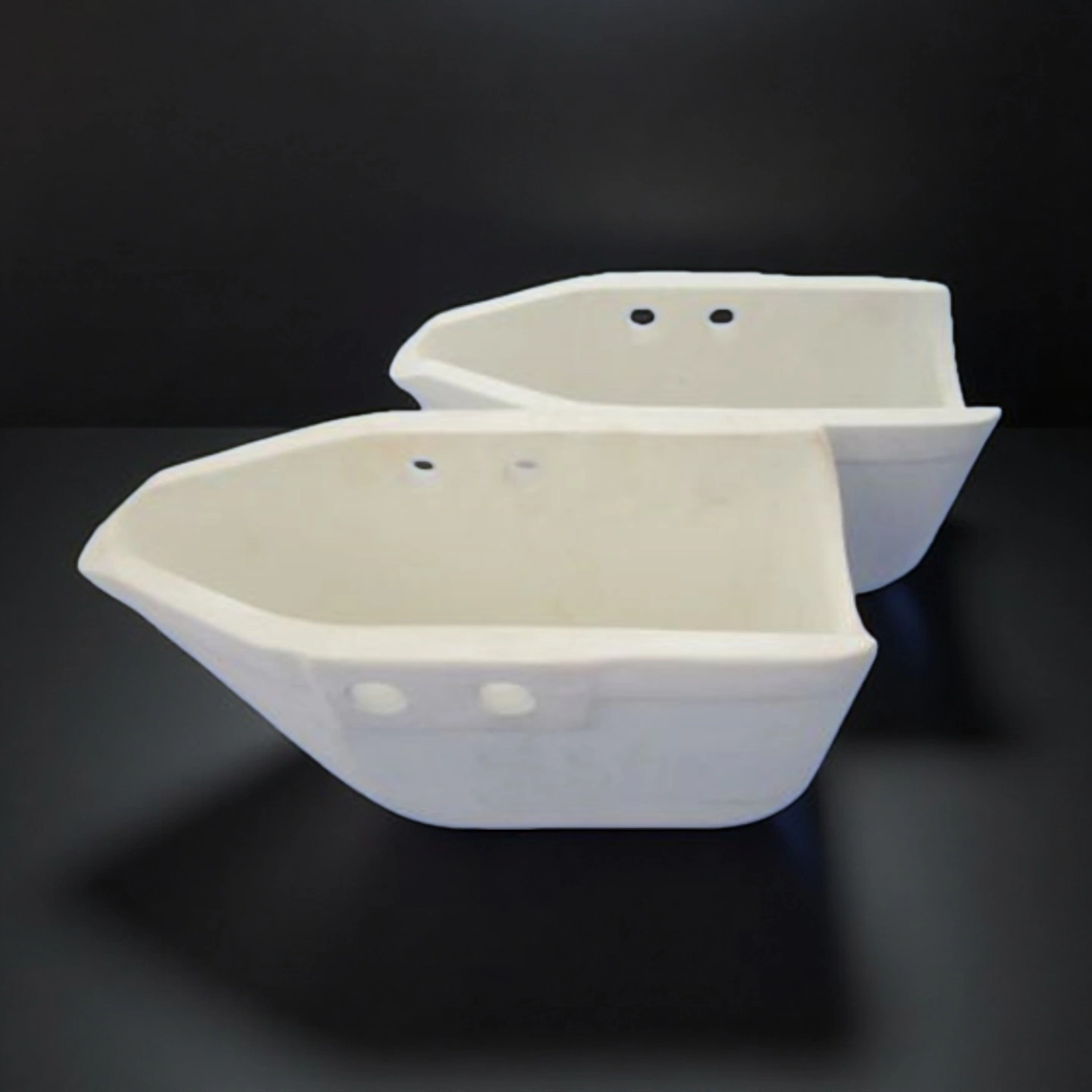
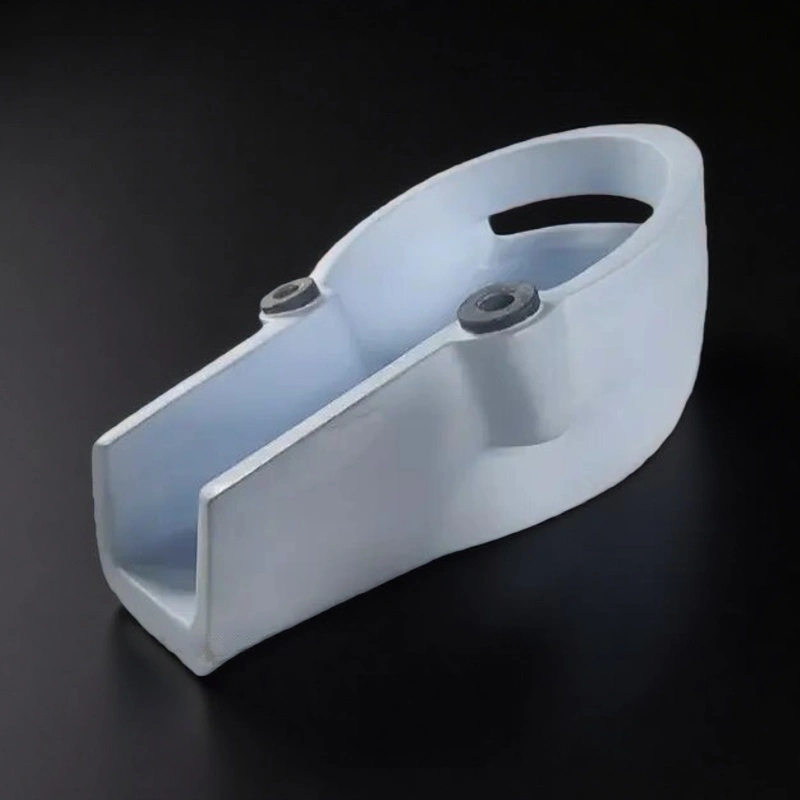
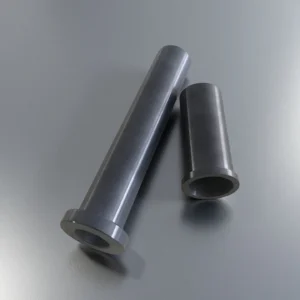
Aluminum titanate pouring ladles are ceramic ladles engineered for molten aluminum transfer and controlled pouring in foundry environments. The ladles combine low thermal expansion, low thermal conductivity and low wettability to aluminum, which helps reduce thermal shock failures and metal contamination while keeping pouring temperature more stable.
Why Foundries Use Aluminum Titanate Pouring Ladles
Aluminum titanate pouring ladles are selected when molten aluminum transfer requires lower metal adhesion, better thermal shock behavior and more stable pouring geometry than steel or conventional refractory ladles. The material is especially useful in casting lines where repeated heating and cooling, metal build-up, unstable stream direction or frequent ladle replacement can affect productivity and casting quality.
Aluminum Titanate Pouring Ladle Properties
|
Parameter |
Typical Value |
Description |
|
Coefficient of Thermal Expansion (CTE) |
0.5–1.5 ×10⁻⁶ /K |
Extremely low expansion that maintains dimensional stability under molten aluminum temperatures. |
|
Thermal Shock Resistance |
Very high |
Withstands rapid temperature fluctuations without cracking during casting cycles. |
|
Density |
2.8–3.0 g/cm³ |
Medium-density ceramic structure suitable for molten aluminum system components. |
|
Thermal Conductivity |
1–2 W/m·K |
Helps reduce heat loss along riser tubes, spouts and transfer components. |
|
Maximum Service Temperature |
Molten-aluminum service typ. 700–900 °C |
Suitable for typical molten-aluminum environments and transfer systems. |
|
Flexural Strength (MOR) |
10–25 MPa |
Provides sufficient strength for handling, installation and operational load. |
|
Elastic Modulus |
20–40 GPa |
Lower stiffness contributes to excellent thermal shock tolerance. |
|
Porosity |
12–25% |
Supports insulation and limits internal thermal stress accumulation. |
|
Chemical Compatibility |
Non-wetting to molten aluminum |
Prevents adhesion, oxide buildup and contamination in casting processes. |
|
Dimensional Stability |
Stable through long cycles |
Maintains geometry during prolonged molten-aluminum exposure and thermal cycling. |
Aluminum Titanate Pouring Ladle Specifications
|
Item No. |
Diameter (mm) |
Thickness (mm) |
Purity |
|
AT-TSL-LS1001 |
Customize |
Aluminum Titanate Ceramic Pouring Ladle Packaging
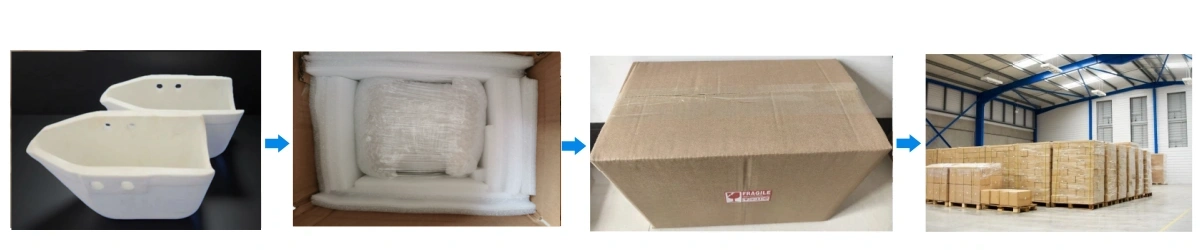
- Each aluminum titanate pouring ladle is wrapped in shock-absorbing material to protect the ceramic bowl and lip.
Application Scenarios of Aluminum Titanate Pouring Ladles
Aluminum titanate pouring ladles are used in molten aluminum handling processes where stable pouring, low metal adhesion and thermal shock resistance are important. They are suitable for manual pouring stations, gravity casting lines, auto-pour systems and selected non-ferrous foundry applications.
-
Automotive Aluminum Foundries – Engine and Chassis Casting
Key Advantages
1. Stable Pouring Geometry
Aluminum titanate ladles help maintain lip shape and pouring accuracy during repeated thermal cycles.
2. Reduced Aluminum Build-Up
Low wettability helps reduce aluminum sticking on the ladle surface, supporting cleaner metal release.
3. Better Thermal Shock Resistance
Low thermal expansion helps reduce cracking risk during repeated heating, pouring and cooling cycles.
Problem Solved
In automotive aluminum casting, steel or conventional refractory ladles may suffer from metal build-up, lip wear and unstable pouring behavior. Aluminum titanate ladles help improve pouring consistency and reduce maintenance caused by surface adhesion or thermal shock damage.
-
General Non-Ferrous Foundries – Aluminum Titanate Pouring Ladle for Pumps, Housings and Valves
Key Advantages
1. Suitable for Mixed Production Batches
One ladle design can be reviewed for different shot weights and casting layouts.
2. Lower Cleaning Demand
The non-wetting ceramic surface helps reduce frequent scraping and recoating work.
3. Compatible with Aluminum and Selected Non-Ferrous Alloys
The material is suitable for molten aluminum handling and selected non-ferrous casting conditions.
Problem Solved
Jobbing foundries often switch between different aluminum parts and production batches. Aluminum titanate pouring ladles help reduce metal adhesion, simplify cleaning and support more stable pouring conditions across repeated casting cycles.
-
Cast Houses and Equipment OEMs – Billet Casting and Auto-Pour Units
Key Advantages
1. Easy Integration with Pouring Equipment
Bowl shape, lip angle and handle interface can be matched to robot grippers, shanks or auto-pour mechanisms.
2. Stable Performance Under Repeated Thermal Cycling
The ceramic structure is designed for repeated contact with molten aluminum and high-temperature operating cycles.
3. Improved Pouring Control
A stable lip and low-adhesion surface help support smoother flow and more consistent metal discharge.
Problem Solved
For automated pouring cells and billet casting equipment, ladle wear, aluminum build-up and inconsistent flow can affect production stability. Aluminum titanate ladles help reduce these issues by maintaining cleaner surfaces, stable geometry and more predictable pouring behavior.
Aluminum Titanate Pouring Ladle – Usage Guide
Proper installation, handling and cleaning help aluminum titanate pouring ladles maintain stable pouring performance and longer service life in molten aluminum applications.
-
Installation
1. Inspect the ladle before use and check for visible cracks, chips or impact damage on the bowl and lip.
2. Mount the ladle securely to the shank, manipulator or robot gripper without concentrated pressure on thin ceramic areas.
3. Confirm alignment between the ladle lip, launder, mold or pouring cup to avoid splashing and uneven flow.
-
Operation
1. Preheat the ladle according to the foundry’s operating procedure before direct molten aluminum contact.
2. Avoid sudden temperature shock, especially when moving from room temperature to full molten-metal service.
3. Keep the molten aluminum within the recommended working range to reduce overflow and spill risk.
4. Maintain a stable pouring angle so the ceramic lip performs as designed.
-
Storage
1. Store idle ladles in a dry area away from steel tools, scrap and direct impact.
2. Avoid stacking ladles directly on each other. Use soft pads or separated supports.
3. Keep stored ladles away from water or liquids that may freeze inside surface pores.
-
Cleaning
1. Remove residual aluminum with non-aggressive mechanical tools. Do not gouge the ceramic surface.
2. Avoid sudden quenching or thermal shock cleaning methods.
3. If coating is used, apply it evenly and avoid thick layers that may peel or contaminate the melt.
-
Common Misuse and How to Correct It
1. Cracks near the lip
Cause: cold ladle contact with molten metal or impact during handling.
Correction: use controlled preheating and avoid striking the ladle against furnace rims or molds.
2. Excessive aluminum build-up
Cause: incorrect temperature, residue accumulation or incompatible coating.
Correction: check operating temperature, cleaning method and coating condition.
3. Poor fit with shank or robot gripper
Cause: mismatch between ladle interface and local hardware.
Correction: provide updated drawings or sample interface dimensions for adjustment.