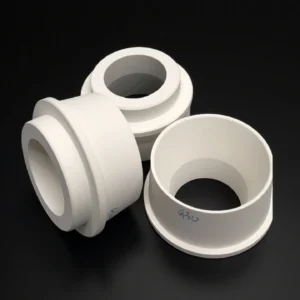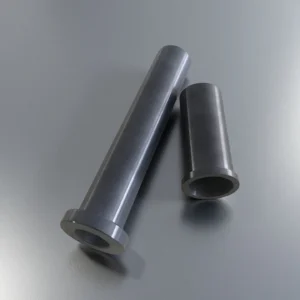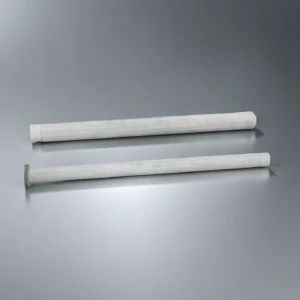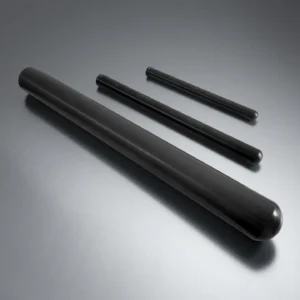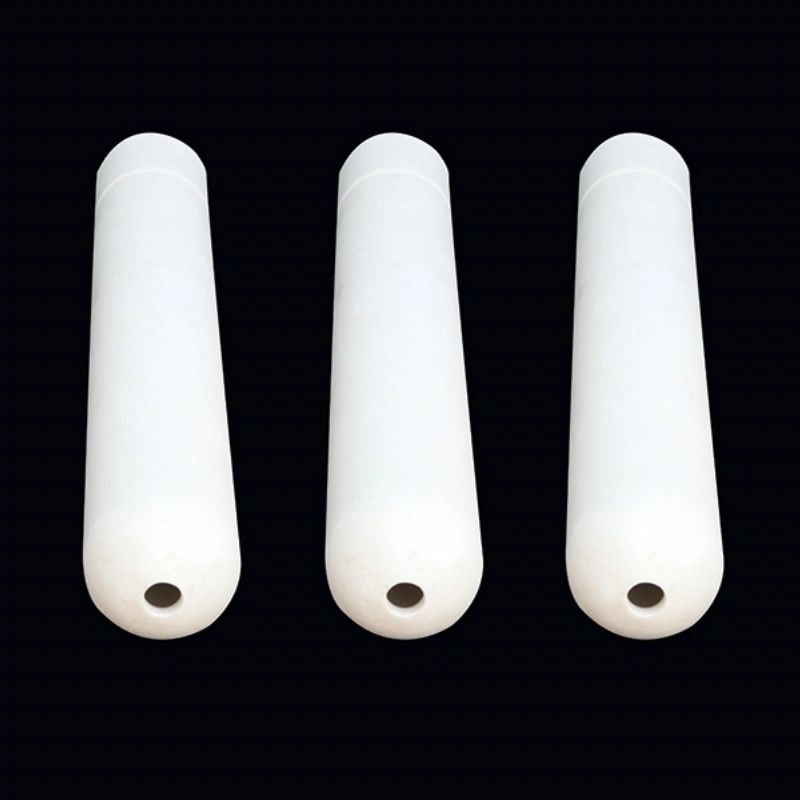
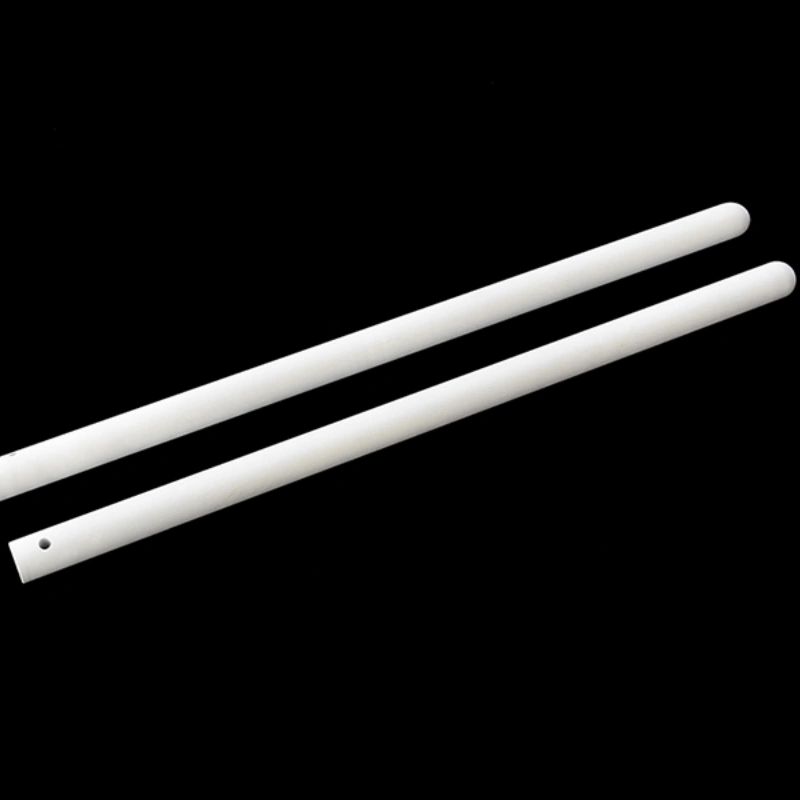

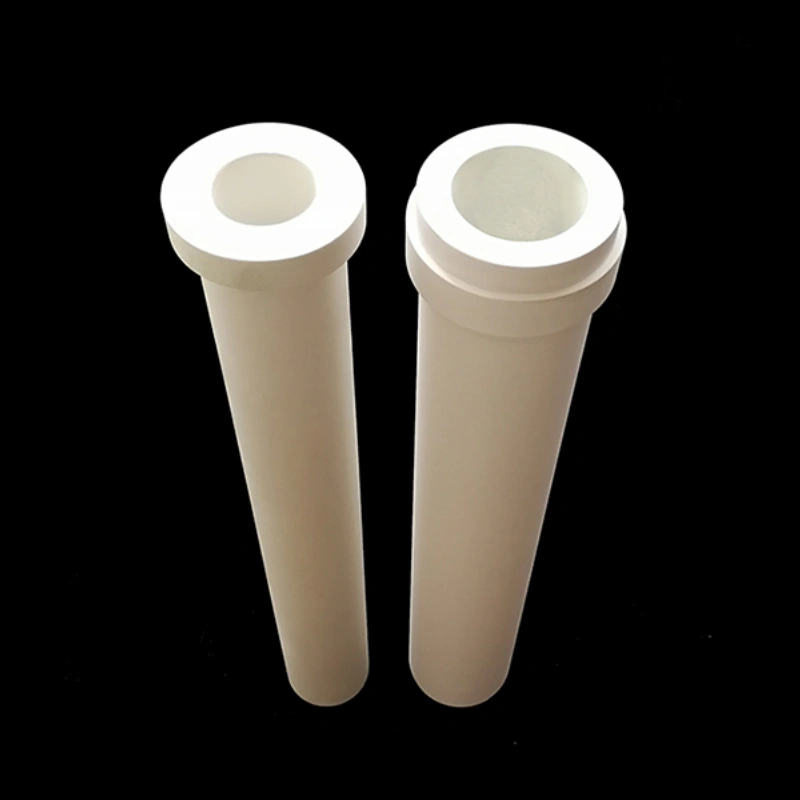
An aluminum titanate (Al2TiO5) riser tube — also called a stalk tube — is the ceramic channel that lifts molten aluminum from a holding or dosing furnace into the die in low-pressure die casting (LPDC). It combines very low thermal expansion, thermal-shock resistance, low thermal conductivity and a surface that molten aluminum does not wet, so it can run repeated 700–900 °C casting cycles with less cracking, less metal sticking and steadier metal flow than steel or cast-iron stalks.
Aluminum Titanate Riser Tube Benefits
- Low thermal expansion for thermal cycling — near-zero CTE helps the tube take repeated room-to-≥700 °C cycles with less thermal-stress cracking.
- Non-wetting to molten aluminum — the bore is not wetted by aluminum, so it resists sticking and dross build-up and helps keep the melt clean.
- Low thermal conductivity — limits heat loss along the metal column, supporting steady melt temperature and mold filling.
- Cleaner metal flow, less slag build-up — low conductivity plus non-wetting help reduce slag at the top of the riser, supporting more consistent casting quality.
- Thermal-shock resistant, often without pre-heating — good thermal-shock behavior can reduce pre-heating effort before installation.
- Service life suited to continuous LPDC — matched to the alloy, furnace temperature and cycle, it can give a useful working life that reduces tube changes.
Aluminum Titanate vs Sialon vs Steel Riser Tubes
Selecting a riser-tube material depends on the molten alloy, furnace temperature, pressure cycle, mechanical loading and current failure mode. The comparison below provides an initial engineering reference.
Aluminum Titanate (Al₂TiO₅)
Key advantages: Very low thermal expansion, low wettability by molten aluminum and low thermal conductivity.
Main consideration: Brittle ceramic requiring careful handling and even flange loading.
Typical fit: LPDC and dosing systems where thermal cycling, aluminum build-up and heat loss are key concerns.
Sialon / Silicon Nitride (Si₃N₄)
Key advantages: Higher mechanical strength with good wear and thermal-shock resistance.
Main consideration: Grade, interface design and project cost require separate evaluation.
Typical fit: Systems where mechanical loading and structural durability are priorities.
Steel or Cast-Iron Stalk
Key advantages: High mechanical strength and familiar fabrication.
Main consideration: May require coatings and maintenance to manage aluminum wetting, corrosion, thermal fatigue and heat loss.
Typical fit: Existing systems where mechanical robustness and conventional replacement practices are preferred.
Aluminum Titanate Riser Tube Properties
| Parameter | Typical Value | Description |
| Coefficient of Thermal Expansion (CTE) | 0.5–1.5 ×10⁻⁶ /K | Extremely low expansion that maintains dimensional stability under molten aluminum temperatures. |
| Thermal Shock Resistance | Very high | Withstands rapid temperature fluctuations without cracking during casting cycles. |
| Density | 2.8–3.0 g/cm³ | Medium-density ceramic structure suitable for molten aluminum system components. |
| Thermal Conductivity | 1–2 W/m·K | Helps reduce heat loss along riser tubes, spouts and transfer components. |
| Maximum Service Temperature | Molten-aluminum service typ. 700–900 °C | Suitable for typical molten-aluminum environments and transfer systems. |
| Flexural Strength (MOR) | 10–25 MPa | Provides sufficient strength for handling, installation and operational load. |
| Elastic Modulus | 20–40 GPa | Lower stiffness contributes to excellent thermal shock tolerance. |
| Porosity | 12–25% | Supports insulation and limits internal thermal stress accumulation. |
| Chemical Compatibility | Non-wetting to molten aluminum | Prevents adhesion, oxide buildup and contamination in casting processes. |
| Dimensional Stability | Stable through long cycles | Maintains geometry during prolonged molten-aluminum exposure and thermal cycling. |
Aluminum Titanate Riser Tube Specifications
| Item | Outer Dia (mm) | Inner Dia (mm) | Length (mm) |
| AT-TSL-SYG1001 | 78 | 58 | 850 |
| AT-TSL-SYG1002 | 90 | 61 | 850 |
| AT-TSL-SYG1003 | 100 | 80 | 400 |
| AT-TSL-SYG1004 | 100 | 60 | 900 |
| AT-TSL-SYG1005 | 100 | 60 | 970 |
| AT-TSL-SYG1006 | 105 | 75 | 1050 |
| AT-TSL-SYG1007 | 110 | 63.5 | 900 |
| AT-TSL-SYG1008 | 114 | 68 | 1100 |
| AT-TSL-SYG1009 | 120 | 100 | 600 |
| AT-TSL-SYG1010 | 120 | 100 | 800 |
| AT-TSL-SYG1011 | 120 | 70 | 1220 |
| AT-TSL-SYG1012 | 120 | 80 | 950 |
| AT-TSL-SYG1013 | 120 | 80 | 930 |
| AT-TSL-SYG1014 | 130 | 110 | 1063 |
| AT-TSL-SYG1015 | 130 | 100 | 750 |
Aluminium Titanate Riser Tube Packaging
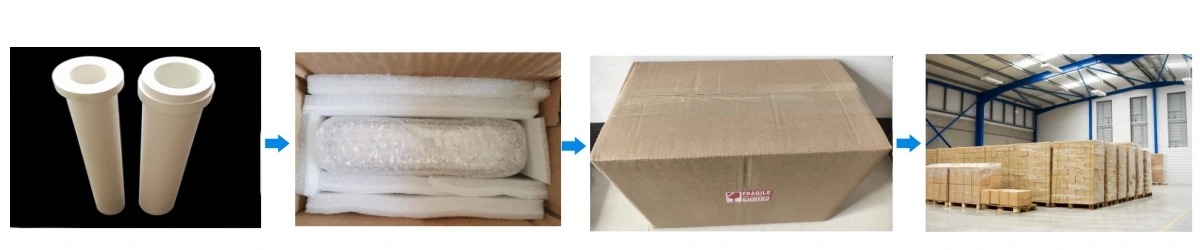
- Each Aluminum Titanate Riser Tube is wrapped in shock-absorbing material (foam or soft padding) to protect ceramic surfaces from impact during transport