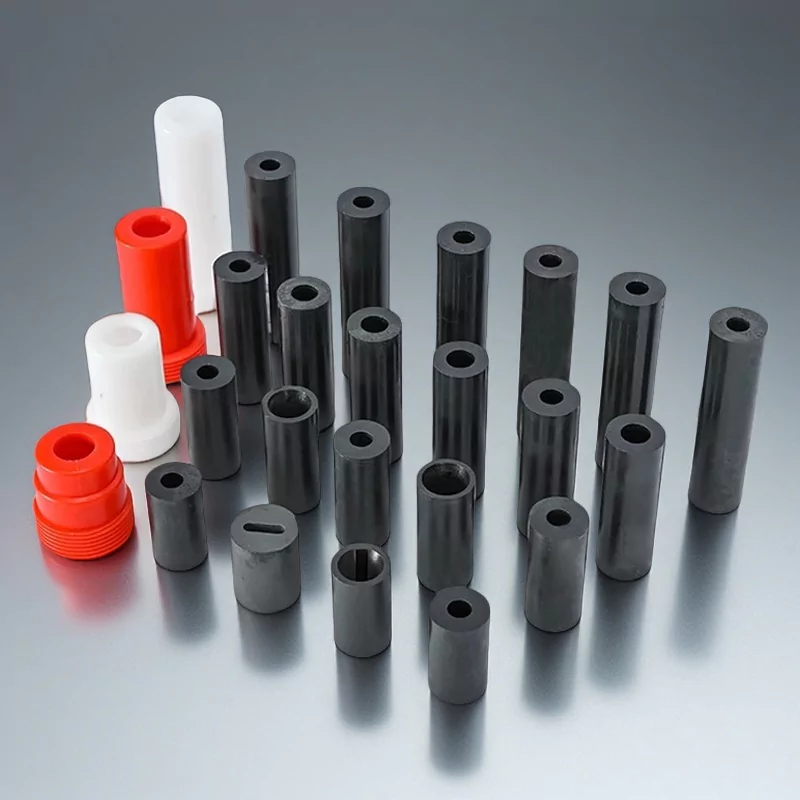
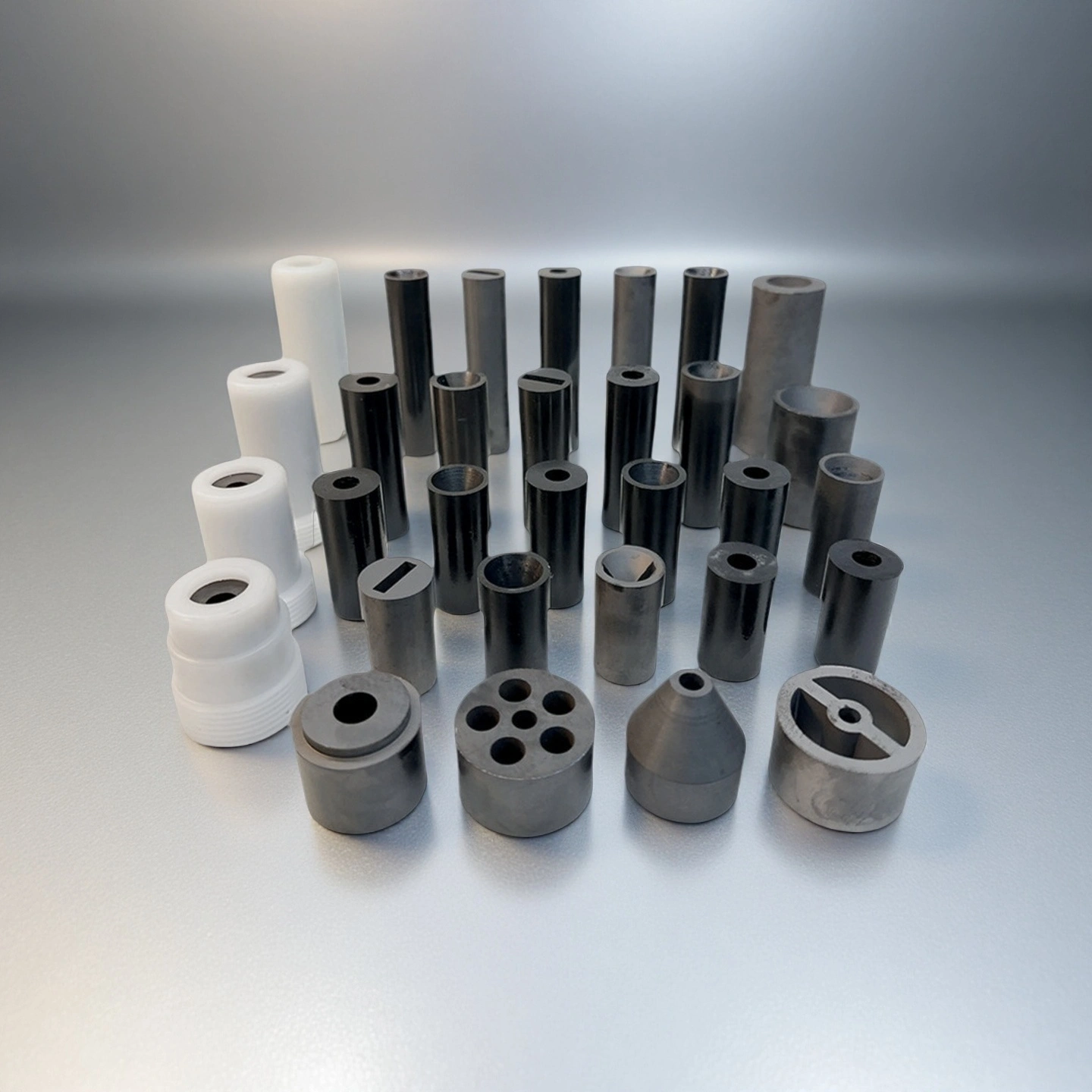
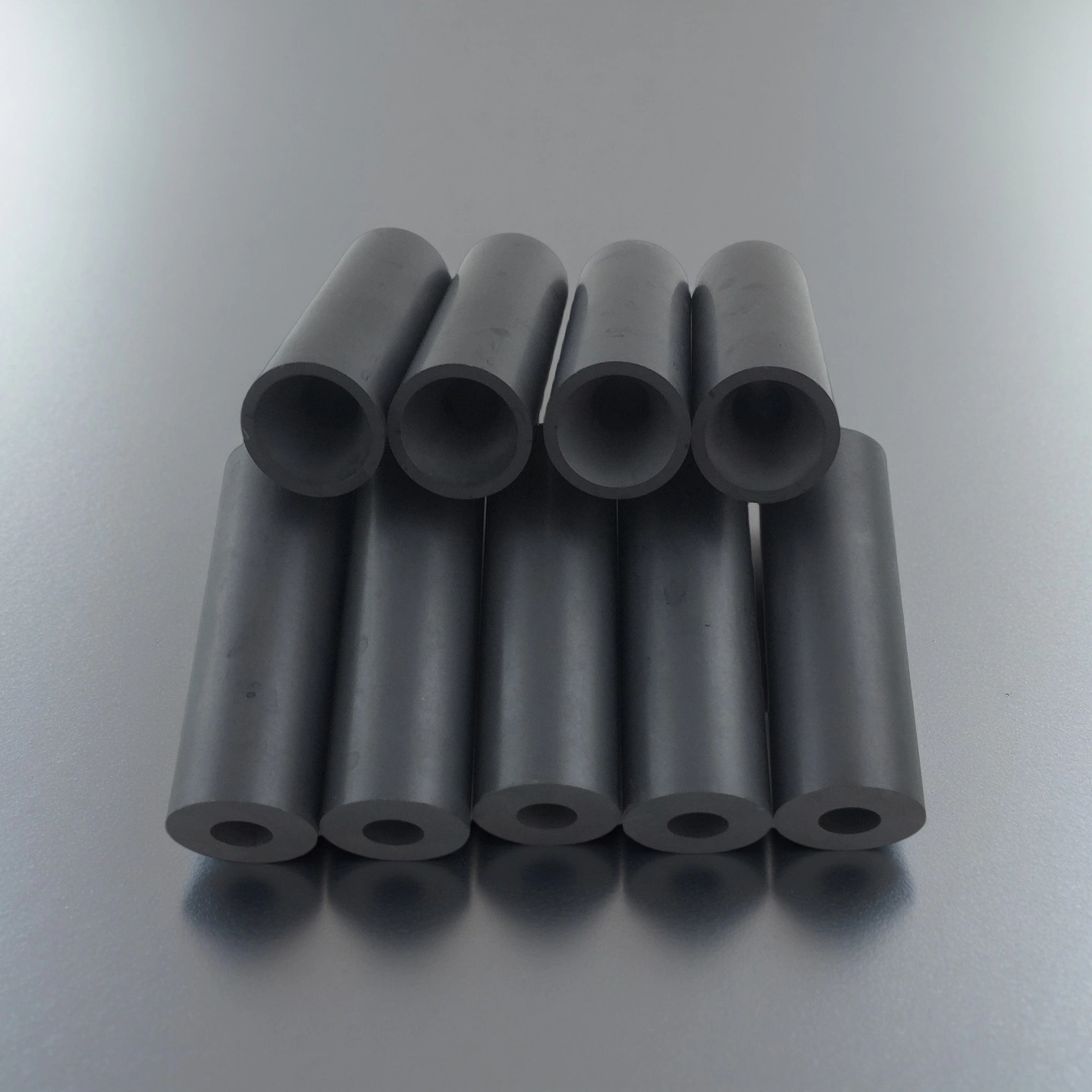
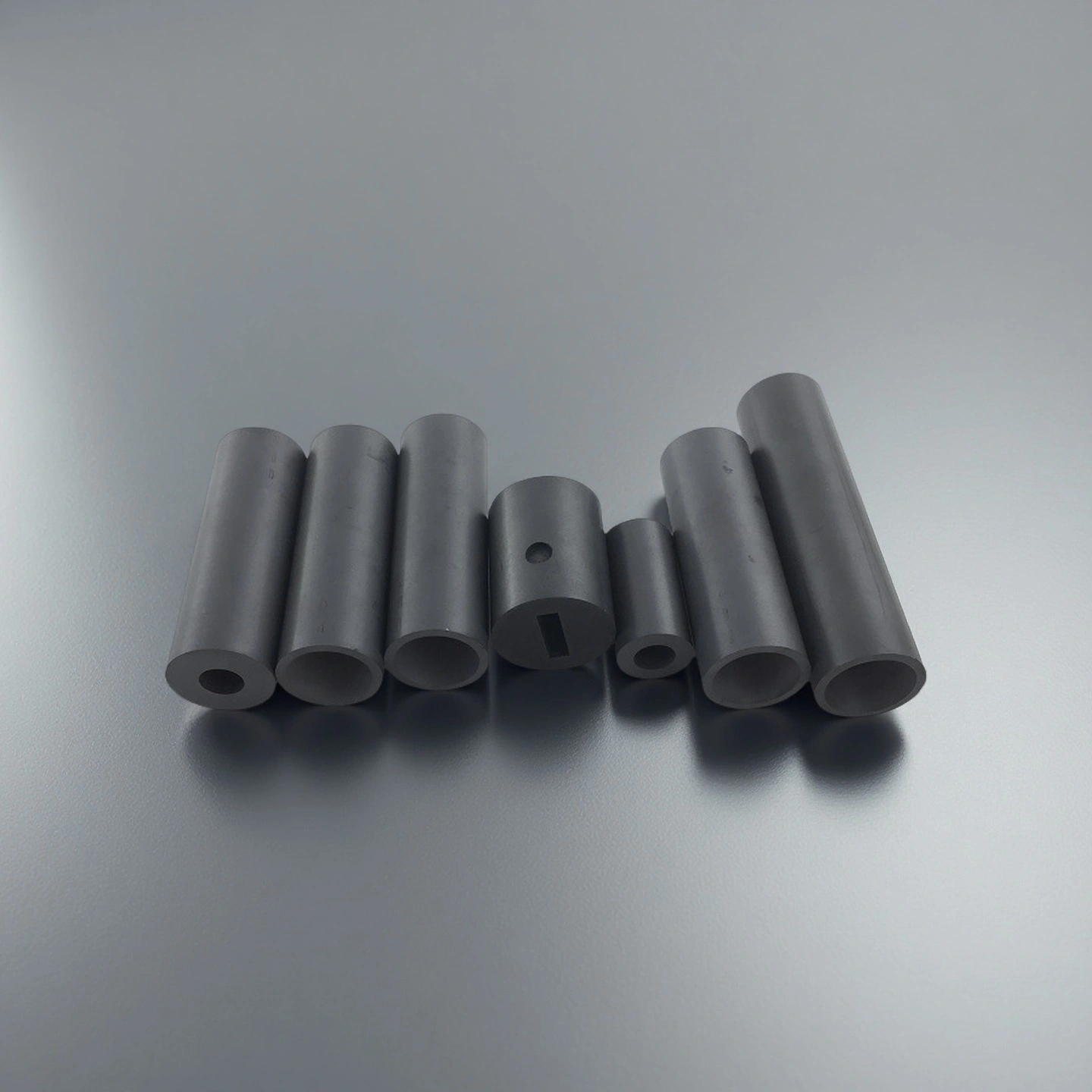
High-Precision Boron Carbide (B4C) Sandblasting Nozzle — Tight Bore Tolerance, Stable Spray Width

Boron carbide (B₄C) blast nozzles are exceptionally hard and lightweight, helping maintain bore geometry and blasting consistency with aggressive abrasives. Protective jackets help shield the brittle liner from impact. Send your old-nozzle photo or drawing (bore/entry bore, length, venturi type, thread/holder, jacket and abrasive) and our engineers will review manufacturability before quoting.

Catalogue No. AT-BC-PZ1001
Material Boron Carbide (B₄C)
Thread interface 1-1/4–11-1/2 NPSM (Metric on request)
Overall length/geometry Short, Long Venturi, Double Venturi
Dimensions/Sizes Download PDF
Engineering RFQ Review
Small-Batch Custom Support
Factory-Direct Manufacturing
Drawing & Process Review

A Boron Carbide Sandblasting Nozzle is a wear-resistant component made from ultra-hard, lightweight boron carbide (B₄C) that directs compressed-air-driven abrasive media for surface cleaning and preparation. Its hardness helps maintain bore geometry and blasting consistency with aggressive abrasives, while an aluminum, steel, or polyurethane jacket protects the brittle ceramic liner from impact.

Benefits of Boron Carbide Nozzles

  • Long wear life on hard abrasives — the very hard B₄C bore helps resist erosion from aluminium oxide, garnet, SiC and steel grit, so bore growth and change-outs are typically reduced (life is application-dependent).
  • Stable spray pattern — an optimised venturi and exit geometry help hold a consistent pattern and stand-off across a shift.
  • Lightweight for operators — B₄C is lighter than tungsten carbide, which can lower operator fatigue on long passes.
  • Interface precision — repeatable thread/holder and sealing face support tight coupling and multi-gun setups.
  • Protected by a jacket — because B₄C is hard but brittle, the liner is carried in an aluminium, steel, or PU jacket for impact protection.

B₄C vs WC vs SiC vs Alumina Blast Nozzle

Material Relative hardness Weight Wear life on hard abrasives (public sources, typical) Best fit
Boron Carbide (B₄C) Highest (after diamond/CBN), Mohs ~9.3 Lightest (~2.5 g/cm³) Public sources describe B₄C outlasting tungsten carbide several-fold on aggressive media (application-dependent) Hard abrasives (alumina/garnet/SiC/steel grit), long shifts, fewer change-outs
Tungsten Carbide (WC) High Heavy Shorter on hard abrasives; mature supply General blasting, established holders
Silicon Carbide (SiC) High, Mohs ~9 Medium Between WC and B₄C; brittle under impact Medium-duty, lower-cost setups
Alumina (Al₂O₃) Medium Medium Lower wear life Light-duty / low-pressure / low-budget

Note: Figures reflect public manufacturer sources and are typical, application-dependent, and not ADCERAX guarantees.

Boron Carbide Sandblasting Nozzle Properties

B₄C Propertites
Hot Pressed Sintered B4C
Purity of B₄C ≥90
Flexture strength (MPa) 480
Elastic Modulus (GPa) 450
Poisson's ratio 0.21
Compressive strength (MPa) 2500
Hardness (GPa) ≥24
Fracture toughness (MPa*m1/2) 4
Maximum working temperature (℃) 1600
Thermal conductivity (W/m*K) 150
Thermal expansion coefficient (/℃) 4.4*10-6
Thermal shock resistance (ΔT ℃) 400

Specifications of Boron Carbide Nozzles

Model Size (mm) Bore Diameter (mm) Mounting Type Working Temperature Working Pressure (MPa) Applicable Media
AT-BC-PZ1001 15×55×8 8 Slot-mounted ≤600 °C 2.2 All types of blasting abrasives
AT-BC-PZ1002 20×35×6 6 Sleeve / Rubber sleeve / Snap-fit ≤600 °C 2.2 All types of blasting abrasives
AT-BC-PZ1003 20×35×8 8 Sleeve / Rubber sleeve / Snap-fit ≤600 °C 2.2 All types of blasting abrasives
AT-BC-PZ1004 20×35×10 10 Sleeve / Rubber sleeve / Snap-fit ≤600 °C 2.2 All types of blasting abrasives
AT-BC-PZ1005 20×45×6 6 Sleeve / Rubber sleeve / Snap-fit ≤600 °C 2.2 All types of blasting abrasives
AT-BC-PZ1006 20×45×8 8 Sleeve / Rubber sleeve / Snap-fit ≤600 °C 2.2 All types of blasting abrasives
AT-BC-PZ1007 20×45×10 10 Sleeve / Rubber sleeve / Snap-fit ≤600 °C 2.2 All types of blasting abrasives
AT-BC-PZ1008 20×60×6 6 Sleeve / Rubber sleeve / Snap-fit ≤600 °C 2.2 All types of blasting abrasives
AT-BC-PZ1009 20×60×8 8 Sleeve / Rubber sleeve / Snap-fit ≤600 °C 2.2 All types of blasting abrasives
AT-BC-PZ1010 20×60×10 10 Sleeve / Rubber sleeve / Snap-fit ≤600 °C 2.2 All types of blasting abrasives
AT-BC-PZ1011 20×80×6 6 Sleeve / Rubber sleeve / Snap-fit ≤600 °C 2.2 All types of blasting abrasives
AT-BC-PZ1012 20×80×8 8 Sleeve / Rubber sleeve / Snap-fit ≤600 °C 2.2 All types of blasting abrasives
AT-BC-PZ1013 20×80×10 10 Sleeve / Rubber sleeve / Snap-fit ≤600 °C 2.2 All types of blasting abrasives
AT-BC-PZ1014 26×83×8 8 Sleeve-mounted ≤600 °C 2.2 All types of blasting abrasives
AT-BC-PZ1015 26×83×12 12 Sleeve-mounted ≤600 °C 2.2 All types of blasting abrasives
AT-BC-PZ1016 29×10×77 10 Sleeve-mounted ≤600 °C 2.2 All types of blasting abrasives
AT-BC-PZ1017 31×6.5×1.8 1.8 Snap-fit ≤600 °C 2.2 All types of blasting abrasives
AT-BC-PZ1018 20×35×3 3 Sleeve / Rubber sleeve / Snap-fit ≤600 °C 2.2 All types of blasting abrasives
AT-BC-PZ1019 20×35×4 4 Sleeve / Rubber sleeve / Snap-fit ≤600 °C 2.2 All types of blasting abrasives
AT-BC-PZ1020 20×35×12 12 Snap-fit ≤600 °C 2.2 All types of blasting abrasives
AT-BC-PZ1021 20×45×12 12 Snap-fit ≤600 °C 2.2 All types of blasting abrasives
AT-BC-PZ1022 20×60×12 12 Snap-fit ≤600 °C 2.2 All types of blasting abrasives
AT-BC-PZ1023 20×80×12 12 Snap-fit ≤600 °C 2.2 All types of blasting abrasives

Boron Carbide Blast Nozzle Packaging

Each nozzle is packed in an individual shock-proof box with silica gel and protective caps on both ends.
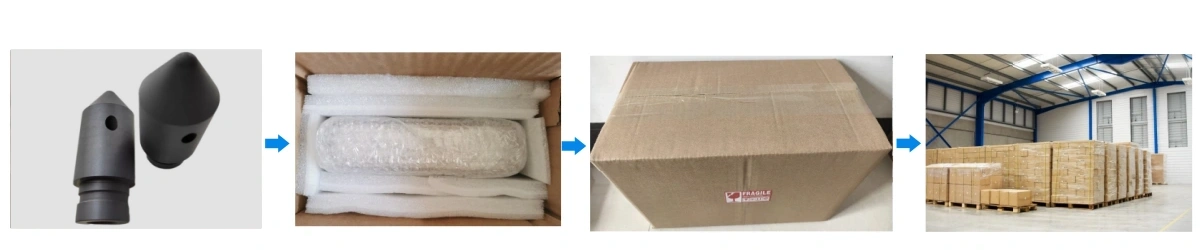
Boron Carbide Blast Nozzle Packaging

Applications of Boron Carbide Sandblasting Nozzles

Boron carbide (B₄C) nozzles are commonly selected for continuous abrasive blasting where bore wear, spray-pattern drift, and frequent change-outs affect productivity. Final nozzle selection should be reviewed against the abrasive media, working pressure, compressor capacity, bore size, nozzle geometry, and holder connection.

  • Shipbuilding & Heavy Corrosion Protection

    Suitable for blasting hulls, tanks, decks, and large steel surfaces before coating.

    Key Advantages

    1. Long-venturi coverage: Supports a broad, high-velocity blasting pattern for large surface areas.
    2. Wear-resistant bore: Helps limit bore growth when using garnet, aluminum oxide, or steel grit.
    3. Lightweight handling: Aluminum or polyurethane jackets can reduce operator fatigue during long shifts.

    Typical Challenge Addressed

    Helps reduce spray-pattern changes and unplanned nozzle replacement during large-area marine blasting.

    Recommended Configuration

    Long-venturi profile with the bore, thread, and jacket selected to match the abrasive, available airflow, and nozzle holder.

  • Bridges, Towers & Infrastructure

    Suitable for surface preparation on beams, rivets, towers, pipelines, and other structural-steel components.

    Key Advantages

    1. Double-venturi pattern: Supports smoother edge feathering around rivets, joints, and complex profiles.
    2. Stable bore geometry: Helps maintain consistent blasting coverage throughout extended work periods.
    3. Protected construction: An aluminum, steel, or polyurethane jacket helps protect the brittle B₄C liner from impact.

    Typical Challenge Addressed

    Helps maintain consistent surface preparation across complex structures while reducing interruptions caused by nozzle wear.

    Recommended Configuration

    Double-venturi or long-venturi design selected according to the target surface profile, working distance, abrasive, pressure, and airflow.

  • Automotive Remanufacturing & Industrial Coating Removal

    Suitable for removing coatings, rust, scale, and deposits from components, fixtures, and difficult-to-reach areas.

    1. Controlled bore geometry: Supports repeatable surface preparation before recoating or rebuilding.
    2. Flexible nozzle profiles: Straight nozzles suit focused cleaning, while curved nozzles improve access to corners and recesses.
    3. Custom interfaces: Bore, length, holder connection, and jacket can be reviewed for manual or automated blasting systems.

    Typical Challenge Addressed

    Helps reduce fixture repositioning and maintain a more consistent blasting pattern across different component geometries.

    Recommended Configuration

    Straight or curved nozzle selected according to the access space, target area, abrasive media, working pressure, and equipment interface.

Boron Carbide Blaster Nozzle Usage Instructions

Correct installation, operation, and maintenance help maintain blasting efficiency, surface quality, and nozzle life. Use the following guidance together with your equipment specifications.

  • Handling & Care

    Boron carbide is extremely hard but brittle. Keep the liner inside its protective jacket, avoid impact or dropping, and tighten the holder evenly without over-torquing. Never insert metal tools into the bore.

  • Installation

    1. Confirm that the NPSM, metric, or quick-connect interface matches the nozzle holder.
    2. Inspect the gasket or O-ring and replace it if worn or damaged.
    3. Hand-fit the nozzle, then tighten it according to the equipment specification.
    4. Match the bore to the available compressor CFM and pressure. As a typical reference, a 3/8" nozzle may require approximately 350–400 CFM at 100 PSI.
    5. Perform an air-only test to check alignment, sealing, and airflow before adding abrasive.

  • Operation

    1. Use 150–300 mm as a typical starting standoff range, then adjust it for the required surface profile.
    2. Match the bore, pressure, and abrasive size to maintain stable flow and limit unnecessary wear.
    3. Monitor pressure and abrasive delivery to prevent pot starvation or irregular flow.
    4. Check the blasting pattern periodically; an uneven pattern may indicate wear, blockage, or misalignment.

  • Storage

    1. Purge the nozzle with clean, dry air after use.
    2. Clean the exterior with a soft brush.
    3. Store it in a foam cavity or molded tray, protected from impact and moisture.
    4. Keep the bore-size and batch markings visible for reordering and traceability.

  • Cleaning & Maintenance

    1. Use clean, dry compressed air to clear residual abrasive; do not scrape the bore with metal rods.
    2. Inspect the bore, sealing face, threads, jacket, and gasket whenever the nozzle is removed.
    3. Measure the bore with a go/no-go gauge and replace the nozzle when wear exceeds the equipment’s allowable limit or the blasting pattern deteriorates.
    4. Record inspection and wear data for preventive maintenance in high-duty blasting lines.

Boron Carbide Nozzle for Sand Blast FAQ

  1. Q: How do I choose the correct bore size for a boron carbide blasting nozzle?A: Bore size selection depends on compressor air volume (CFM), working pressure, and abrasive grain size.
    For example:
    a. 3/8" (No.6) → 350–400 CFM @ 100 PSI
    b. 7/16" (No.7) → 450–500 CFM @ 100 PSI
    c. 1/2" (No.8) → 600–650 CFM @ 100 PSI
    Selecting the correct bore ensures proper velocity, prevents pot starvation, and maintains a uniform surface finish.
  2. Q: When should I replace a boron carbide sandblasting nozzle?A: Replace the nozzle when the bore enlarges by more than 1 mm or spray width narrows by 15–20%.
    A worn nozzle reduces blast pressure, increases media consumption, and results in uneven cleaning.
    Regular inspection using a go/no-go gauge or flow rate monitoring helps predict replacement timing.
  3. Q: How does the nozzle geometry affect blasting efficiency?
    A: a. Straight nozzles: short-range, focused cleaning, cabinet systems.
    b. Long venturi: broad pattern, higher velocity, efficient for large surfaces.
    c. Double venturi: smoother edge feathering and reduced rebound.
    d. Curved (“banana”) design: access to corners, beams, and hard-to-reach areas.
    Selecting geometry based on project size and part shape can improve productivity by up to 25%.
  4. Q: How should I clean and store the boron carbide sandblasting nozzle after use?A: Purge the nozzle with clean dry air, remove all residual abrasives, and store it in a foam cavity or protective box. Avoid striking or dropping the nozzle; although boron carbide is hard, it is brittle under impact.
    Mark the bore size and batch number for quick reordering and traceability.
  5. Q: Can boron carbide sandblasting nozzles be customized for my blasting system?A: Yes. ADCERAX supports full customization:
    a. Length, bore, and exit angle
    b. Thread type (NPSM, metric, or quick-lock)
    c. Aluminum or PU jacket
    d. Laser marking for ID traceability
    Customized geometry allows airflow optimization, ensuring maximum velocity and longer nozzle life for specific blasting setups.
  6. Q: What makes a boron carbide sandblasting nozzle different from tungsten carbide or silicon carbide nozzles?
    A: The difference lies mainly in material hardness, wear resistance, density, and service life.
    Boron carbide (B₄C) nozzles offer a superior combination of durability, lightweight design, and efficiency, making them the top choice for heavy-duty or continuous blasting operations.

    Property Boron Carbide (B₄C) Tungsten Carbide (WC) Silicon Carbide (SiC)
    Hardness (Mohs) ≈ 9.3 ≈ 8.5–9.0 ≈ 9.0
    Density (g/cm³) 2.5 14.5 3.1
    Relative Weight Light — reduces operator fatigue Heavy — difficult for handheld use Medium — manageable
    Service Life 5–10× longer than WC, 2–3× longer than SiC Shorter, wears faster under hard abrasives Moderate
    Abrasion Resistance Excellent — best suited for alumina, SiC, or steel grit Good for general use Good, but brittle under impact
    Typical Applications Long-duty blasting, shipyards, coating removal, OEM equipment Medium-duty blasting, general surface prep Light- to medium-duty, lower-cost setups
    Temperature Resistance Up to 600 °C continuous Up to 550 °C Up to 650 °C
    Cost Level Higher initial cost, lowest total cost per use Medium Lower
    Best Choice For High-pressure and high-abrasion environments where long life and stability are key Standard blasting operations Occasional or low-pressure blasting

    Boron carbide nozzles combine maximum hardness, lowest density, and longest life, making them ideal for continuous blasting with hard abrasives (alumina, steel grit, SiC).
    Although the initial cost is higher, the total operating cost per hour is significantly lower due to fewer replacements and consistent spray performance.

  7. Q: Why does a boron carbide nozzle need an outer jacket?
    A: Boron carbide is one of the hardest materials, but it is brittle. The aluminium, steel or polyurethane jacket protects the liner from impact and dropping during handling and installation, so the hard B₄C bore can do the wear-resistance job without chipping.

RFQ Checklist — what to send for a fast, accurate review

1. Old nozzle photo or drawing

2. Bore/orifice + entry bore

3. Overall length

4. Venturi type (straight / long venturi / double venturi / wet-blast / angle)

5. Thread & holder (e.g. 1-1/4 NPSM, 50 mm contractor thread, or slot/sleeve mount) + equipment model

6. Jacket (aluminium/steel/polyurethane)

7. Abrasive media & mesh (alumina/garnet / SiC/steel grit)

8. Blast pressure / CFM, wet or dry

9. Quantity & annual usage

10. Current nozzle material, service life and failure photos. Typical lead time: quoted per drawing after engineering review (typical, not a guarantee).

customize size

Customize Boron Carbide Blast Nozzle

We provide full customization and engineering support to adapt the boron carbide blasting nozzle to specific blasting systems, media types, and operational environments.

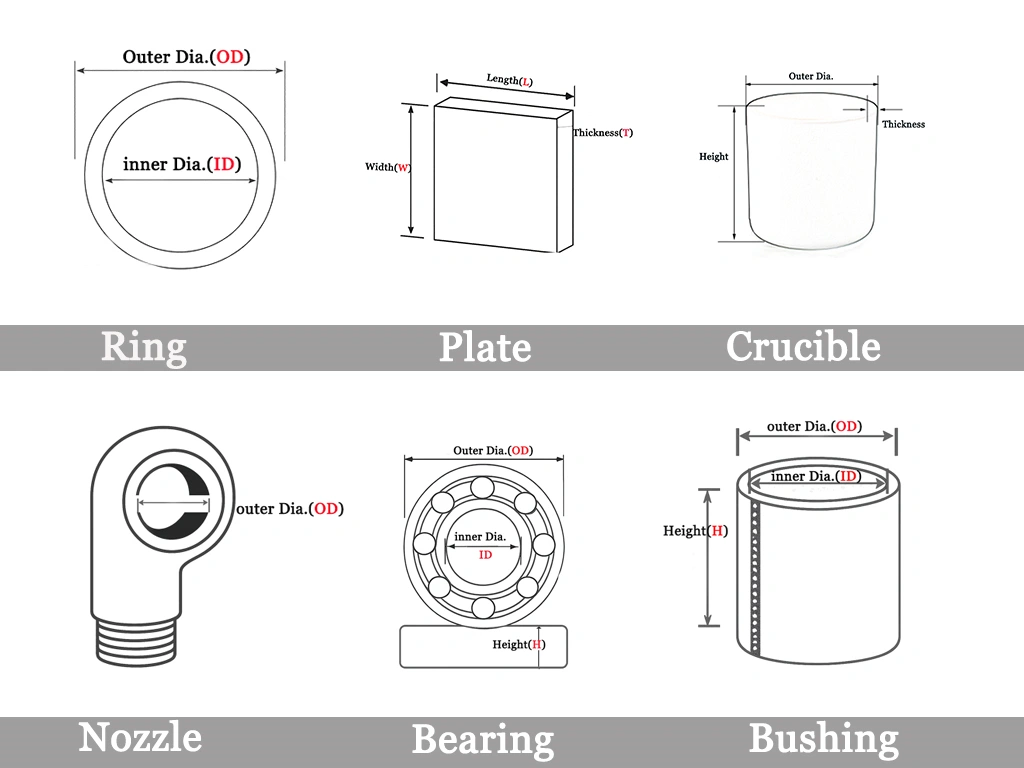
1. Dimensions
Define critical geometry parameters for system integration:
– Overall length (50 mm – 250 mm typical)
– Outer diameter (OD) and bore ID series (#5 – #8 or 3/16″ – 1/2″)
– Throat diameter and exit cone ratio for pressure optimization
– Tolerance options: up to ±0.05 mm for precision setups
– Custom length ratio for high-reach or compact guns

2. Geometry
Choose from multiple venturi or direct-flow configurations:
– Straight, Long Venturi, Double Venturi, or Curved (“banana”) types
– Custom internal profile for media acceleration and uniform dispersion
– Exit cone angle adjustment (8°, 10°, or 12°) for desired spray width
– Hybrid throat design for low-pressure efficiency or high-flow systems

3. Threads & Ends
Interface options for universal and proprietary holders:
– Standard 1-1/4–11-1/2 NPSM or Metric M32–M36 thread options
– Special couplings, bayonet-lock, or quick-release interface types
– End forms: open, closed, chamfered, or sloped
– Dual-seal configurations for extreme pressure environments

4. Jackets & Construction
Enhance ergonomics and durability with jacket materials:
– Aluminum alloy: lightweight for field operators
– Polyurethane (PU): shock-absorbing and impact-resistant
– Optional knurled grip texture for anti-slip handling
– Replaceable protective collars and outer sleeves for heavy-use zones
– Colour-coded jackets for bore-size identification and workshop sorting

5. Media/Pressure Fit
Fine-tune performance to match operating parameters:
– Recommended bore vs. pressure matrix (0.3 MPa – 1.0 MPa)
– High-flow “wide throat” variants for large coverage blasting
– Low-pressure designs for fine finishing and sensitive substrates
– Media compatibility optimization for Al₂O₃, SiC, glass beads, steel grit, garnet, and plastic abrasives

Related Products

ADCERAX - Your Trusted Advanced Ceramics Manufacturing Partner

Direct factory manufacturing with comprehensive ceramic materials expertise and global supply capabilities

China-Based Manufacturer

ADCERAX supplies ceramic components for overseas OEMs, equipment builders, and labs.

Custom Drawing Support

We review drawings, dimensions, materials, and application conditions before quotation.

Ceramic Process Control

Forming, sintering, machining, grinding, and finishing are arranged by part requirements.

Pre-Shipment Inspection

Dimensional checks, visual inspection, and packaging review help reduce procurement risk.

Get in Touch with Us

Our team will be happy to respond to you in less than 24 hours.

Pingxiang Factory — Silicon carbide, silicon nitride, high-temperature ceramics

Quick Quotation

*Our team will answer your inquiries within 24 hours.

*Your information will be kept strictly confidential.

Ready to Solve Your Engineering Challenge?

Partner with ADCERAX for reliable, high-performance advanced ceramic solutions. Our engineers are ready to discuss your project.

E-mail

info@adcerax.com

Phone

Tel: +86-0731-84428843 WhatsApp: +86 19311583352

Response Time

Within 24 hours

A Boron Carbide Sandblasting Nozzle is a wear-resistant component made from ultra-hard, lightweight boron carbide (B₄C) that directs compressed-air-driven abrasive media for surface cleaning and preparation. Its hardness helps maintain bore geometry and blasting consistency with aggressive abrasives, while an aluminum, steel, or polyurethane jacket protects the brittle ceramic liner from impact.

Benefits of Boron Carbide Nozzles

  • Long wear life on hard abrasives — the very hard B₄C bore helps resist erosion from aluminium oxide, garnet, SiC and steel grit, so bore growth and change-outs are typically reduced (life is application-dependent).
  • Stable spray pattern — an optimised venturi and exit geometry help hold a consistent pattern and stand-off across a shift.
  • Lightweight for operators — B₄C is lighter than tungsten carbide, which can lower operator fatigue on long passes.
  • Interface precision — repeatable thread/holder and sealing face support tight coupling and multi-gun setups.
  • Protected by a jacket — because B₄C is hard but brittle, the liner is carried in an aluminium, steel, or PU jacket for impact protection.

B₄C vs WC vs SiC vs Alumina Blast Nozzle

Material Relative hardness Weight Wear life on hard abrasives (public sources, typical) Best fit
Boron Carbide (B₄C) Highest (after diamond/CBN), Mohs ~9.3 Lightest (~2.5 g/cm³) Public sources describe B₄C outlasting tungsten carbide several-fold on aggressive media (application-dependent) Hard abrasives (alumina/garnet/SiC/steel grit), long shifts, fewer change-outs
Tungsten Carbide (WC) High Heavy Shorter on hard abrasives; mature supply General blasting, established holders
Silicon Carbide (SiC) High, Mohs ~9 Medium Between WC and B₄C; brittle under impact Medium-duty, lower-cost setups
Alumina (Al₂O₃) Medium Medium Lower wear life Light-duty / low-pressure / low-budget

Note: Figures reflect public manufacturer sources and are typical, application-dependent, and not ADCERAX guarantees.

Boron Carbide Sandblasting Nozzle Properties

B₄C Propertites
Hot Pressed Sintered B4C
Purity of B₄C ≥90
Flexture strength (MPa) 480
Elastic Modulus (GPa) 450
Poisson's ratio 0.21
Compressive strength (MPa) 2500
Hardness (GPa) ≥24
Fracture toughness (MPa*m1/2) 4
Maximum working temperature (℃) 1600
Thermal conductivity (W/m*K) 150
Thermal expansion coefficient (/℃) 4.4*10-6
Thermal shock resistance (ΔT ℃) 400

Specifications of Boron Carbide Nozzles

Model Size (mm) Bore Diameter (mm) Mounting Type Working Temperature Working Pressure (MPa) Applicable Media
AT-BC-PZ1001 15×55×8 8 Slot-mounted ≤600 °C 2.2 All types of blasting abrasives
AT-BC-PZ1002 20×35×6 6 Sleeve / Rubber sleeve / Snap-fit ≤600 °C 2.2 All types of blasting abrasives
AT-BC-PZ1003 20×35×8 8 Sleeve / Rubber sleeve / Snap-fit ≤600 °C 2.2 All types of blasting abrasives
AT-BC-PZ1004 20×35×10 10 Sleeve / Rubber sleeve / Snap-fit ≤600 °C 2.2 All types of blasting abrasives
AT-BC-PZ1005 20×45×6 6 Sleeve / Rubber sleeve / Snap-fit ≤600 °C 2.2 All types of blasting abrasives
AT-BC-PZ1006 20×45×8 8 Sleeve / Rubber sleeve / Snap-fit ≤600 °C 2.2 All types of blasting abrasives
AT-BC-PZ1007 20×45×10 10 Sleeve / Rubber sleeve / Snap-fit ≤600 °C 2.2 All types of blasting abrasives
AT-BC-PZ1008 20×60×6 6 Sleeve / Rubber sleeve / Snap-fit ≤600 °C 2.2 All types of blasting abrasives
AT-BC-PZ1009 20×60×8 8 Sleeve / Rubber sleeve / Snap-fit ≤600 °C 2.2 All types of blasting abrasives
AT-BC-PZ1010 20×60×10 10 Sleeve / Rubber sleeve / Snap-fit ≤600 °C 2.2 All types of blasting abrasives
AT-BC-PZ1011 20×80×6 6 Sleeve / Rubber sleeve / Snap-fit ≤600 °C 2.2 All types of blasting abrasives
AT-BC-PZ1012 20×80×8 8 Sleeve / Rubber sleeve / Snap-fit ≤600 °C 2.2 All types of blasting abrasives
AT-BC-PZ1013 20×80×10 10 Sleeve / Rubber sleeve / Snap-fit ≤600 °C 2.2 All types of blasting abrasives
AT-BC-PZ1014 26×83×8 8 Sleeve-mounted ≤600 °C 2.2 All types of blasting abrasives
AT-BC-PZ1015 26×83×12 12 Sleeve-mounted ≤600 °C 2.2 All types of blasting abrasives
AT-BC-PZ1016 29×10×77 10 Sleeve-mounted ≤600 °C 2.2 All types of blasting abrasives
AT-BC-PZ1017 31×6.5×1.8 1.8 Snap-fit ≤600 °C 2.2 All types of blasting abrasives
AT-BC-PZ1018 20×35×3 3 Sleeve / Rubber sleeve / Snap-fit ≤600 °C 2.2 All types of blasting abrasives
AT-BC-PZ1019 20×35×4 4 Sleeve / Rubber sleeve / Snap-fit ≤600 °C 2.2 All types of blasting abrasives
AT-BC-PZ1020 20×35×12 12 Snap-fit ≤600 °C 2.2 All types of blasting abrasives
AT-BC-PZ1021 20×45×12 12 Snap-fit ≤600 °C 2.2 All types of blasting abrasives
AT-BC-PZ1022 20×60×12 12 Snap-fit ≤600 °C 2.2 All types of blasting abrasives
AT-BC-PZ1023 20×80×12 12 Snap-fit ≤600 °C 2.2 All types of blasting abrasives

Boron Carbide Blast Nozzle Packaging

Each nozzle is packed in an individual shock-proof box with silica gel and protective caps on both ends.
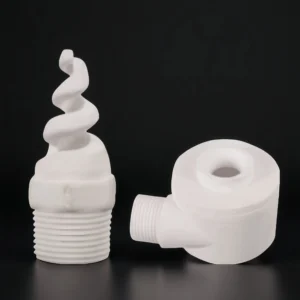
Boron Carbide Blast Nozzle Packaging

Quick Quote

The more details you provide, the faster we can quote.

*All inquiries are confidential.

Get Your Custom Solution

The more details you provide, the faster we can respond.

customize size

*We respond within 24 hours. All inquiries are confidential.

Download Catalog