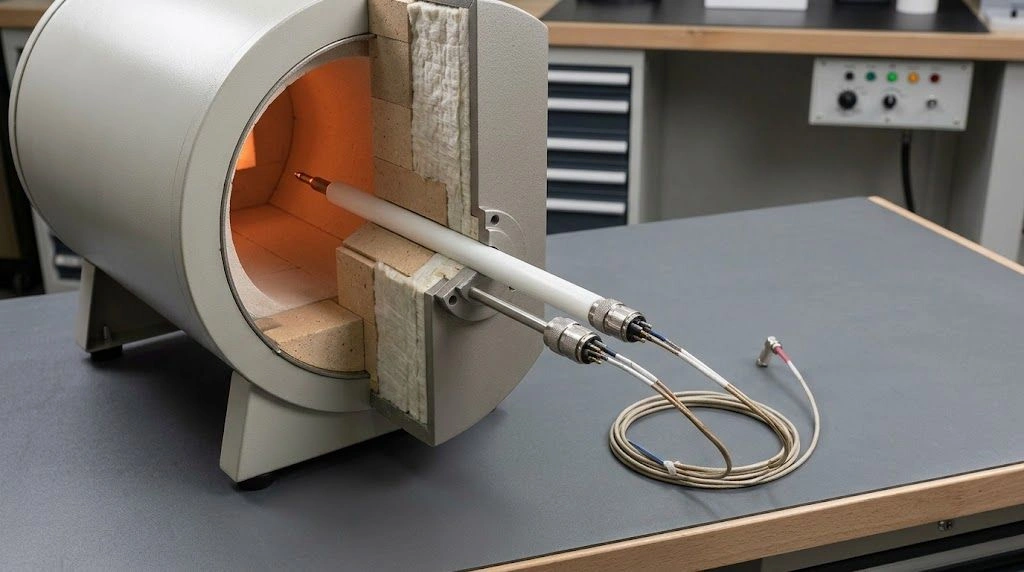
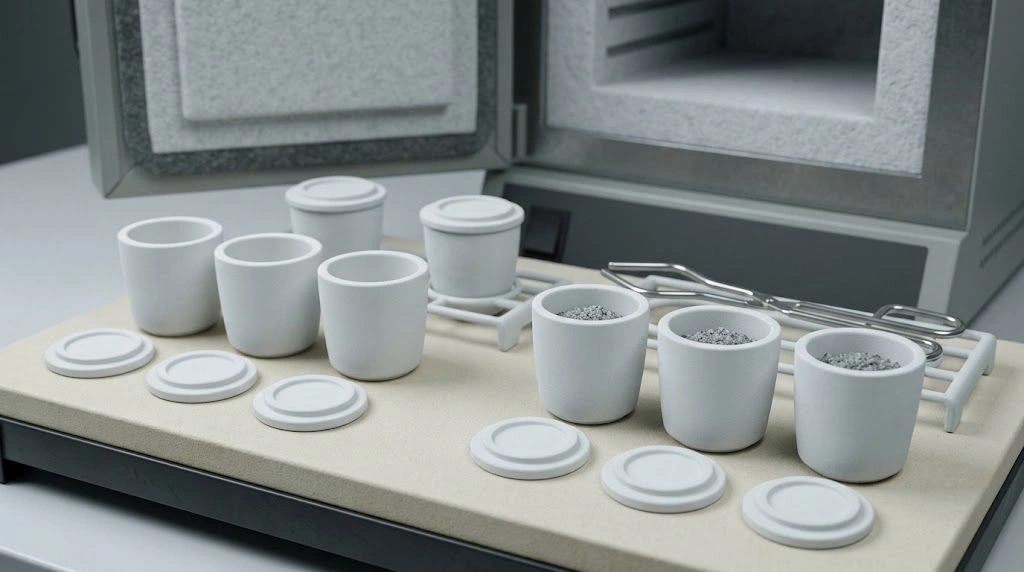
BN crucibles survive thermal shock better than alumina crucibles because boron nitride combines low thermal expansion, useful thermal conductivity, a layered structure, and non-wetting behavior that reduces stress during rapid heating, cooling, and melt release. Alumina is highly refractory, but it is more vulnerable when steep temperature gradients, thick walls, residual melt, or uneven cooling create tensile stress that exceeds its fracture tolerance. BN should replace alumina when rapid cycling, sticking, or residue-driven cracking dominates — especially in vacuum or inert atmospheres — and alumina remains the better choice when the environment is oxidizing air, cost matters, or the thermal profile can be controlled.
That conditional framing is the central engineering point. A cracked alumina crucible does not automatically mean alumina is the wrong material, and switching to BN will not fix a problem caused by poor furnace control, oversized charge, or chemical incompatibility. The decision requires understanding what is actually failing and why.
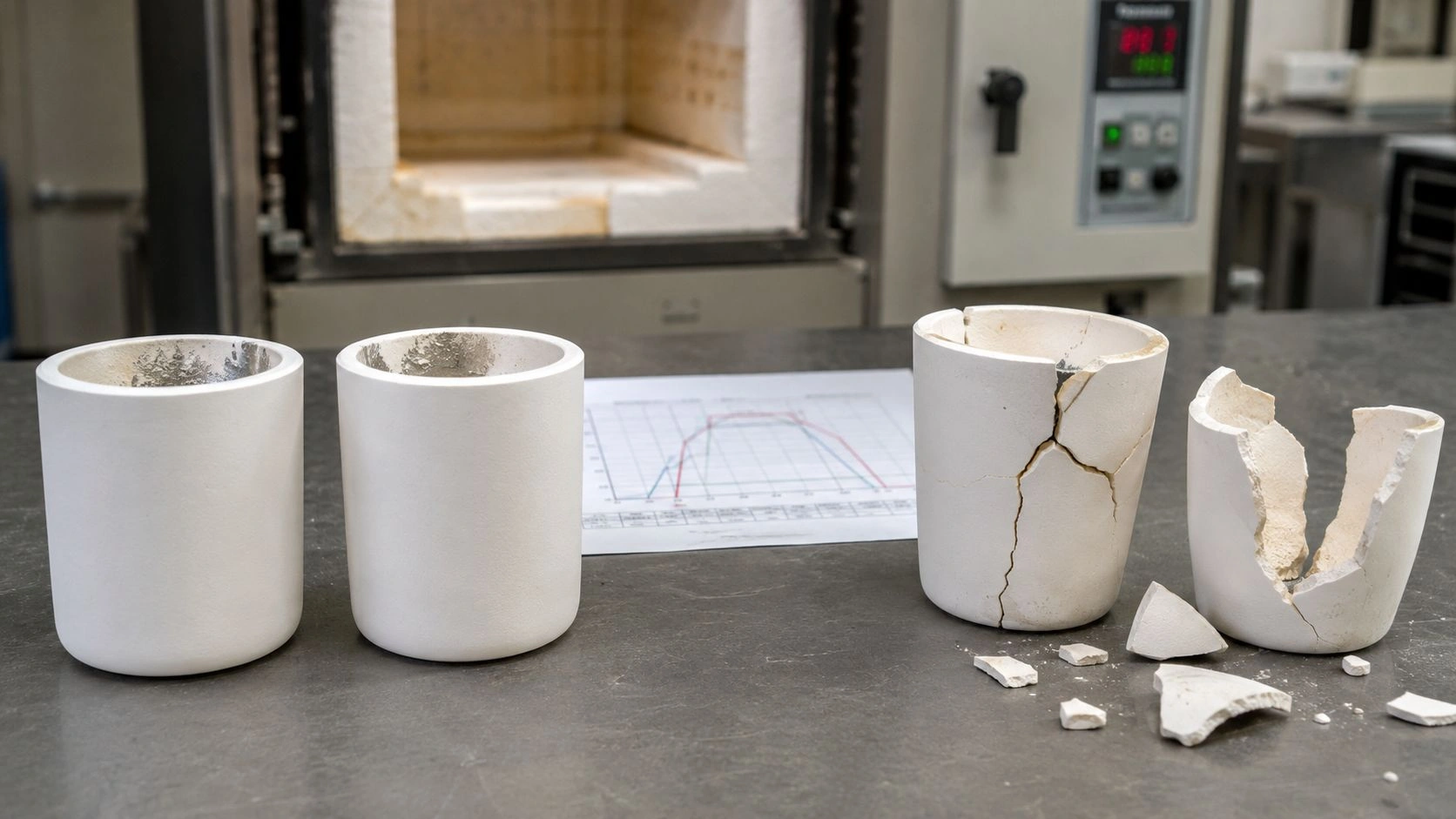
BN crucibles resist thermal shock through low expansion, heat spreading, and non-wetting melt release — but the decision to switch from alumina requires confirming which failure mechanism is actually responsible.
The boron nitride crucibles described in this guide — hot-pressed HPBN grades and PBN grades for high-temperature metal processing — represent the BN material family whose thermal shock behavior is compared against alumina below.
What thermal shock does to alumina crucibles
Alumina crucibles rarely fail because they reach their melting point. They fail because heating or cooling creates uneven expansion inside the crucible wall. When the outside surface cools faster than the interior, or when the rim, base, and wall experience different temperatures simultaneously, tensile stress builds. If that stress exceeds the fracture tolerance of the ceramic, cracking follows — even when the bulk temperature is well within alumina's refractory range.
Published thermal shock guidance for high-temperature ceramics frames this consistently: rapid heating or cooling creates uneven internal stress, and cracking results when that stress exceeds the ceramic's strength limit. The risk is not a fixed temperature threshold but a combination of temperature gradient, wall geometry, and boundary conditions.
Several factors amplify that stress. Thick walls create a larger temperature difference from surface to interior. Sharp corners concentrate stress at geometric transitions. Heavy charge loads press against the crucible wall and transmit additional mechanical force during expansion. Overfilling leaves residual melt that freezes against the ceramic wall and then contracts differently from it during cooling. And local flame contact or direct gas impingement can create a small hot zone on one section of the wall while the rest remains cooler — a condition that generates the steepest local gradient.
Thermal shock is a stress problem, not a temperature problem
The practical consequence is that two crucibles can reach the same peak temperature and produce completely different outcomes if their thermal gradients differ. A slow ramp into a uniformly heated furnace with a moderate charge generates far less tensile stress than a rapid insertion, a cold furnace door opened mid-cycle, or a water quench. Alumina's thermal shock performance is not a material constant — it is a function of the operating profile.
Why cooling can be more dangerous than heating
Alumina crucibles often survive the heating cycle and crack during cooling. The reason is that the outer surface loses heat faster than the interior during air cooling, reversing the gradient and placing the now-shrinking outer layer in tension. Controlled slow cooling in a closed furnace is far less damaging than opening the furnace door at temperature or placing the hot crucible on a cold surface.
Why BN survives: low expansion, heat spreading, and non-wetting release
BN performs well under thermal shock because it addresses several of the stress mechanisms simultaneously. The property combination matters more than any single attribute.
[CITE: Published BN materials documentation from multiple ceramic suppliers consistently describes boron nitride as combining low thermal expansion, useful thermal conductivity, good thermal shock resistance, and electrical insulation — a property combination that reduces the temperature-gradient stress that drives ceramic cracking, rather than simply raising the refractory temperature limit.]
Low thermal expansion means that for the same temperature swing, BN generates less dimensional change than alumina. Less dimensional change means lower thermal stress in the wall. Thermal conductivity helps equalize temperature differences within the crucible wall more quickly, reducing the peak gradient that develops during a rapid thermal event. And BN's layered hexagonal structure — the same property that makes it a natural lubricant — gives the material a relatively forgiving fracture behavior compared with the more brittle response of dense alumina.
The Why BN Survives table below maps each stress factor to the alumina failure mode and BN advantage:
| Stress factor | Alumina crucible risk | BN crucible advantage | Verification needed |
|---|---|---|---|
| Rapid heating | Wall temperature gradient creates tensile stress | Lower expansion and better heat spreading reduce stress | Heating rate and wall thickness |
| Rapid cooling | Surface contracts faster than interior | Better thermal shock resistance reduces crack risk | Cooling method and quench exposure |
| Melt sticking | Residue bonds to wall and pulls during cooling | Non-wetting surface improves release | Melt compatibility test |
| Freeze-back stress | Solidified charge expands/contracts against wall | BN reduces adhesion for many molten metals | Fill level and residue after run |
| Thick wall | Higher thermal gradient through section | BN can tolerate stronger cycling, but geometry still matters | OD/ID/bottom radius |
| Atmosphere | Alumina stable in air; BN may oxidize at high air temperature | BN strongest in vacuum/inert/reducing settings | Atmosphere and oxygen level |
| Mechanical load | Alumina often stronger structurally | BN may be softer and easier to machine | Charge mass and support method |
Values indicative; verify with supplier-specific BN/alumina grade data, atmosphere, thermal-cycle profile, and real charge testing.
Non-wetting reduces sticking and freeze-back stress
The non-wetting behavior of BN toward many molten metals is not just a cleanliness feature — it is a stress-reduction mechanism. When a charge sticks to an alumina wall and then contracts during cooling, the ceramic wall is pulled in tension by the contracting melt. BN's non-wetting behavior reduces that adhesion, so the cooling charge separates more cleanly and transmits less mechanical force to the crucible wall. The thermal shock advantage and the melt-release advantage reinforce each other.
BN liners can deliver both properties when the outer vessel serves other functions
When the outer crucible must be graphite or metal for induction coupling, cost, or structural reasons, a BN liner for graphite and ceramic crucibles placed inside the outer vessel provides both the non-wetting interface and the thermal shock tolerance at the melt-contact surface, while the outer vessel handles mechanical load and geometry support.
Do not misdiagnose every alumina failure as a material problem
A cracked alumina crucible is not proof that alumina was the wrong material. Before specifying BN as a replacement, the root cause of the failure needs to be identified — because BN does not fix operational problems, only material ones.
The most common misdiagnoses fall into four patterns:
Ramp or cooling error mistaken for material weakness. If the furnace door is opened at peak temperature, the crucible is placed on a cold surface while hot, or the heating ramp exceeds the recommended rate, the thermal shock is imposed by the operating procedure rather than by the material's limits. Alumina handling guidance consistently identifies gradual heating, preheating, and controlled cooling as the first thermal shock prevention measure — before any material change is considered. Switching to BN may extend the tolerance window, but it does not substitute for controlled thermal profiles.
Overfilling or charge expansion misread as crucible brittleness. If the charge occupies too large a fraction of the crucible volume, the expanding melt or powder during heating creates mechanical pressure on the inner wall in addition to thermal stress. BN is more forgiving here because of its lower stiffness and non-wetting behavior, but the correct first step is confirming the fill percentage and allowing adequate headspace.
Residual melt freeze-back blamed on the crucible material. When a partial pour leaves melt residue that solidifies against the alumina wall, the different thermal contraction rates between the solidified charge and the ceramic can crack the crucible during the next cooling cycle. BN reduces this risk through its non-wetting behavior, but if the fill and pour protocol are the real cause, establishing a consistent empty-after-each-run discipline may reduce the failure rate in alumina as well.
Chemical reaction described as thermal shock. Some metals and salts react with alumina at high temperature, forming interfacial reaction products that can crack or corrode the crucible wall. This may appear identical to thermal shock failure but requires a different fix: a different crucible material overall, or a BN liner that prevents direct melt-alumina contact. Confirming whether the fracture surface shows reaction products, glass-phase formation, or clean tensile fracture helps distinguish the two mechanisms.
When BN should replace alumina — and when alumina still fits
After ruling out operational and procedural causes, the material selection becomes a conditional engineering decision based on the combination of atmosphere, thermal profile, melt behavior, and load.
[CITE: Engineering analysis of crucible selection for thermal shock and melt release applications confirms the conditional rule: choose BN or BN liner when rapid thermal cycling, melt sticking, residue release, or graphite contamination isolation drives failure; choose PBN when vacuum purity and low outgassing dominate; keep alumina when oxidizing-air stability, cost, or mechanical load is more important and the thermal cycle can be controlled — because the material selection should follow from the documented failure mechanism, not from a preference for one material family.]
The Material Selection Matrix below maps seven common operating conditions to the best candidate:
| Application condition | Better candidate | Why | Caution |
|---|---|---|---|
| Rapid thermal cycling | BN | Better thermal shock resistance | Confirm atmosphere boundary |
| Sticky molten metal | BN or BN liner | Non-wetting behavior supports release | Confirm melt compatibility |
| High-purity vacuum evaporation | PBN | Dense, low-outgassing, non-wetting wall | Size and cost constraints |
| Oxidizing air furnace | Alumina | Strong oxide stability in air | Use slower ramp/cooling |
| Heavy mechanical load | Alumina or supported BN liner | Alumina often stronger structurally | Thermal shock may still limit |
| Graphite crucible contamination | BN liner | Separates melt from graphite | Clearance and fit are critical |
| Low-cost routine lab heating | Alumina | Economical and widely available | Avoid sudden heating/cooling |
Route guidance based on published BN material property references, alumina thermal shock guidance, and ADCERAX product documentation.
BN is strongest in vacuum, inert gas, and reducing atmospheres. In oxidizing air at sustained high temperature, BN begins to oxidize, and its surface properties change. For applications where the furnace is air-atmosphere, BN's boundary temperature in that environment must be confirmed with the supplier before making a material change — alumina may remain the better long-term option even if BN survives individual thermal cycles more reliably.
PBN crucibles become the right choice when the application is vacuum evaporation, effusion source service, or semiconductor-adjacent deposition where low outgassing, high purity, and dense non-wetting walls are all required simultaneously. PBN is produced by CVD rather than hot-pressing, which gives it a different microstructure, lower impurity content, and better performance in ultra-high-vacuum environments — at higher cost and with tighter geometry constraints than hot-pressed BN.
The ceramic crucible material options across BN, PBN, alumina, zirconia, and SiC illustrate that crucible material selection is always driven by the combination of temperature, atmosphere, melt chemistry, and thermal profile — not by one property in isolation.
RFQ checklist for thermal-shock-resistant BN crucibles
After identifying the failure mechanism and confirming that BN, a BN liner, or PBN is the right route, the RFQ must capture the operating conditions that determine which grade, geometry, and test requirements apply.
| RFQ field | Why it matters | Recommended wording |
|---|---|---|
| Failure history | Identifies real root cause | "Alumina cracked during heating/cooling/release" |
| Thermal profile | Defines shock severity | "Heating rate, peak temperature, cooling method" |
| Atmosphere | BN performance depends on oxygen exposure | "Vacuum/argon/nitrogen/air; oxygen level if known" |
| Melt material | Determines wetting and reaction | "List alloy, metal, salt, oxide, or powder system" |
| Fill level | Controls wall pressure and freeze-back | "Specify charge mass and fill percentage" |
| Geometry | Controls thermal stress | "Confirm OD, ID, height, wall, bottom radius, taper" |
| Material route | BN/PBN/liner selection | "Supplier to recommend hot-pressed BN, PBN, or BN liner" |
| Validation test | Confirms performance | "Run sample thermal-cycle test with actual charge" |
RFQ fields are the minimum for a thermal-shock-driven crucible inquiry; add application-specific requirements as needed.
The most important principle is that the RFQ should describe the failure rather than pre-specify the solution. A supplier who receives a failed crucible photograph, the melt material, the thermal profile, and the atmosphere information can recommend a grade and geometry. A supplier who receives only "I need a BN crucible" cannot confirm that BN is appropriate for the specific condition, or which BN grade, wall thickness, and bottom radius will perform best.
For critical applications, running a small-batch thermal-cycle test with the actual charge — rather than relying only on catalog temperature ratings — remains the most reliable path to confirming that a material change actually solves the problem before committing to production quantities.
Are alumina crucibles cracking during rapid heating, cooling, or demolding? Share your melt material, atmosphere, temperature profile, charge mass, fill level, residue condition, and crucible drawing. ADCERAX engineers review whether BN crucible, BN liner, PBN, or optimized alumina is the better route; turnaround depends on inquiry complexity — no RFQ commitment required at this stage.
Frequently Asked Questions
Why does BN resist thermal shock better than alumina?
BN combines low thermal expansion, useful thermal conductivity, and good thermal shock resistance. These properties reduce temperature-gradient stress during rapid heating and cooling, while BN's non-wetting behavior also reduces melt adhesion and the cooling stress generated when a solidified charge contracts against the crucible wall.
Why do alumina crucibles crack during rapid heating or cooling?
Alumina crucibles crack when different parts of the crucible expand or contract unevenly, creating tensile stress that exceeds the material's fracture tolerance. Thick walls, fast ramp rates, sudden cooling, sharp corners, overfilling, and residue stuck to the wall all increase the risk. The problem is stress geometry, not simply temperature.
Does BN always replace alumina for high-temperature work?
No. BN is often better for thermal shock resistance, non-wetting melt release, and vacuum or inert atmospheres. Alumina is still the better choice for oxidizing air service, lower cost, higher mechanical load, and gradual heating and cooling conditions where the thermal profile can be controlled.
Is BN crucible suitable for use in air at high temperature?
BN is strongest in vacuum, inert gas, and reducing atmospheres. In oxidizing air, BN has a lower long-term usable temperature than alumina — the specific boundary depends on the grade and oxygen level. Atmosphere must be confirmed with the supplier before replacing alumina with BN in any air-furnace application.
Should I choose a BN crucible, BN liner, or PBN crucible?
Choose hot-pressed BN for thermal shock resistance and non-wetting melt release in most high-temperature metal processing applications. Choose a BN liner when the outer crucible must be graphite or metal for structural or induction-coupling reasons. Choose PBN when high purity, low outgassing, and vacuum evaporation compatibility are the governing requirements.
What should I send to a supplier when alumina crucibles keep cracking?
Send photographs of the failed crucible, the melt material and alloy composition, the peak temperature, the furnace atmosphere, the heating and cooling profile, the charge mass, the fill percentage, the residue condition after each run, the crucible drawing with wall thickness and bottom radius, and whether failure occurs during heating, holding, cooling, or demolding. That information allows the supplier to distinguish a thermal shock problem from a chemical, mechanical, or procedural one.