High Purity Alumina Insulating Bases for Mounting & Alignment

Custom high-purity alumina insulating bases combine mounting and alignment with electrical separation between assembly components.

Catalogue No. AT-HP-JYJ01
Material Al₂O₃
Base forms Plate, block, spacer and stepped configurations
Mounting and alignment Seating faces, holes and datums matched to the fixture
Dimensions/Sizes Download PDF
Engineering RFQ Review
Small-Batch Custom Support
Drawing-Based Production
Drawing & Process Review

What Is a High Purity Alumina Insulating Base?

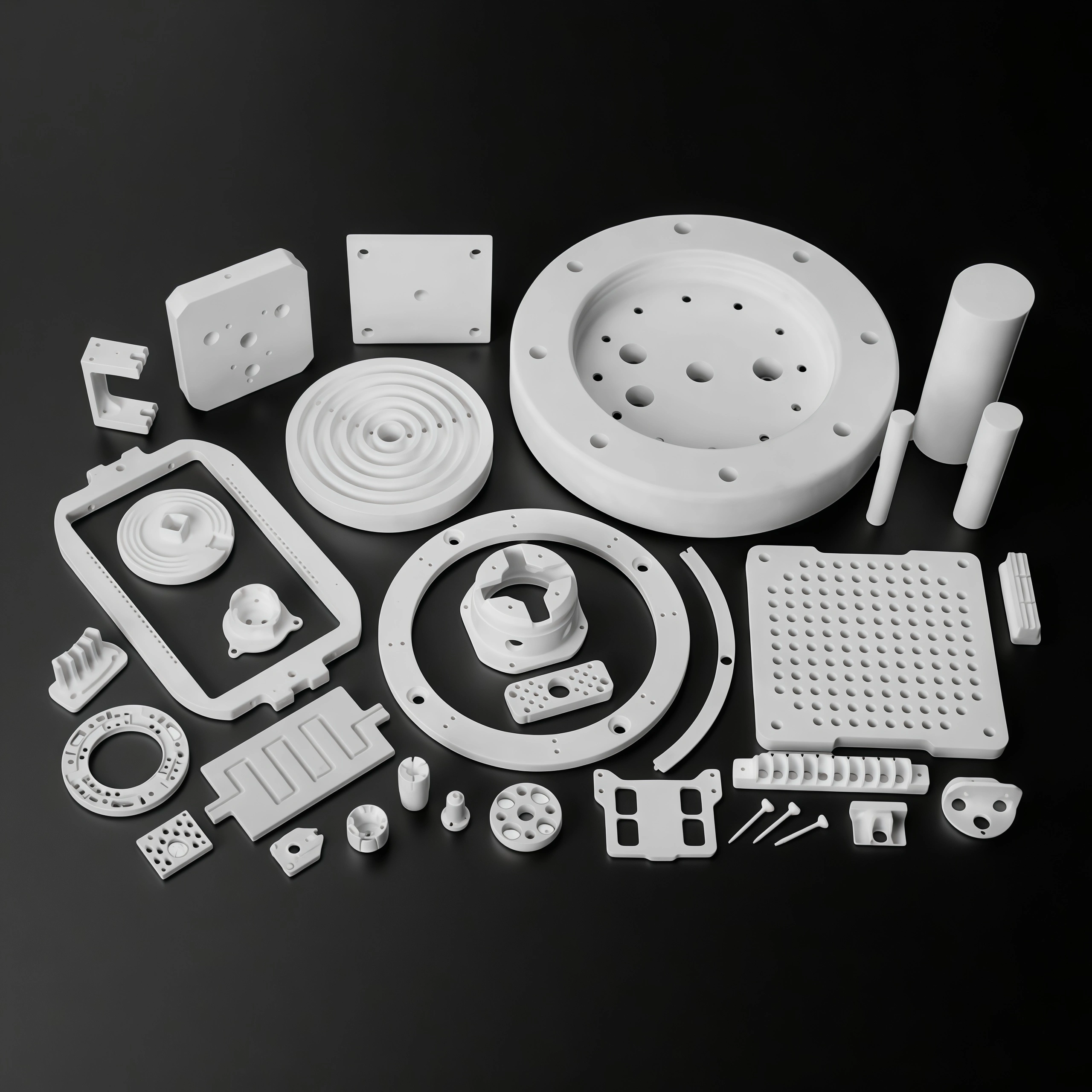
A high purity alumina insulating base is a machined alumina ceramic (Al₂O₃) part that supports, locates and electrically separates components inside an assembly. It is made to the customer's drawing, with seating faces, mounting holes, slots, steps and datums defined for the fixture it fits. ADCERAX supplies these bases in four grades from 99.00 to 99.90 wt% Al₂O₃.

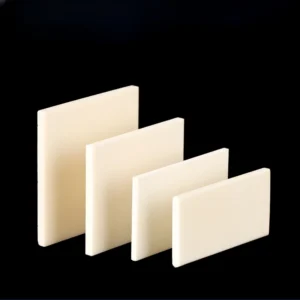
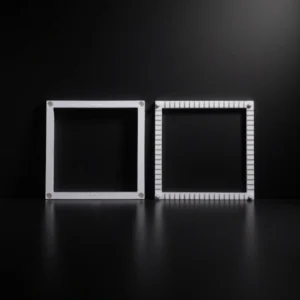
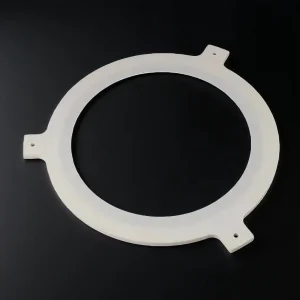
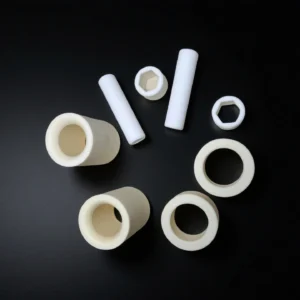
The ceramic body carries both jobs at once: the same part provides mounting height and alignment while separating energized and grounded features. Bases are supplied as plates for a flat mounting plane, blocks for support height, spacers for separation between mating parts, or stepped bases for different contact heights.

High Purity Alumina Insulating Base Specifications

High Purity Alumina Insulating Base
Item No. Geometry Thickness (mm)
AT-HP-JYJ01 Plate, block, spacer or stepped base Customize

Download the Product Catalogue

High Purity Alumina Insulating Base Properties

Property AD-ALU-999 AD-ALU-997 AD-ALU-995 AD-ALU-990
Volume resistivity (20°C, Ω·cm) >10¹⁴ >10¹⁴ >10¹⁴ >10¹⁴
Dielectric strength (kV/mm, 5 mm sample) 16 16 15 14
Dielectric constant (1 MHz, 25°C) 9.8 9.7 9.5 9.2
Flexural strength (MPa) 380 370 350 310
Thermal conductivity (W/m·K, 20°C) 35 33 30 25
Thermal expansion (×10⁻⁶/K, 20-800°C) 8.0 8.1 8.2 8.3

Property values are material references measured on standard test specimens under laboratory conditions. Finished-base performance depends on geometry, processing, surface condition and service environment.

How to Choose an Alumina Grade for Your Base

Select the alumina grade to match your mounting, insulation, operating conditions and budget.

AD-ALU-999 (99.90% purity)
For demanding electrical, high-temperature and thermal-management applications, including high-voltage insulation, RF and microwave mounting, and precision instrumentation.

AD-ALU-997 (99.70% purity)
Strong electrical and thermal performance at a slightly lower cost than AD-ALU-999. Suitable when the added purity of 99.90% does not justify the price premium.

AD-ALU-995 (99.50% purity)
Good electrical insulation and mechanical strength at a more accessible price. Suitable for industrial equipment, heating elements and moderate-temperature electrical assemblies.

AD-ALU-990 (99.00% purity)
A cost-effective option for mechanical support and basic electrical separation where maximum material performance is not required.

Share your operating temperature, voltage, thermal cycling conditions and budget with your enquiry. ADCERAX can help select a suitable grade without over-specifying.

Alumina Compared to Other Insulating Base Materials

Alumina vs. Polymers
Alumina suits higher temperatures and applications requiring dimensional stability under heat. Polymers such as PEEK or polyimide may suit lower-temperature assemblies where machinability, cost or impact resistance matters more.

Alumina vs. Aluminum Nitride
Aluminum nitride (AlN) conducts heat much more effectively but generally costs more. Choose AlN when the base must remove heat from mounted components; choose alumina when insulation and cost are the main priorities.

Alumina vs. Zirconia
Zirconia offers higher fracture toughness, making it useful where impact or edge chipping is a concern. Alumina provides a practical balance of electrical insulation, thermal conductivity and cost.

Alumina vs. Machinable Ceramics
Machinable glass ceramics such as MACOR suit prototypes and complex, low-volume parts because they can be machined with conventional tools. Alumina offers higher strength and temperature capability for more demanding service.

High Purity Alumina Insulating Base Packaging

  • Individual part protection: Each insulating base is separated to prevent edge-to-edge contact and chipping during transit.
  • Shock buffering: Foam or moulded inserts support corners and reference faces to reduce micro-chips.
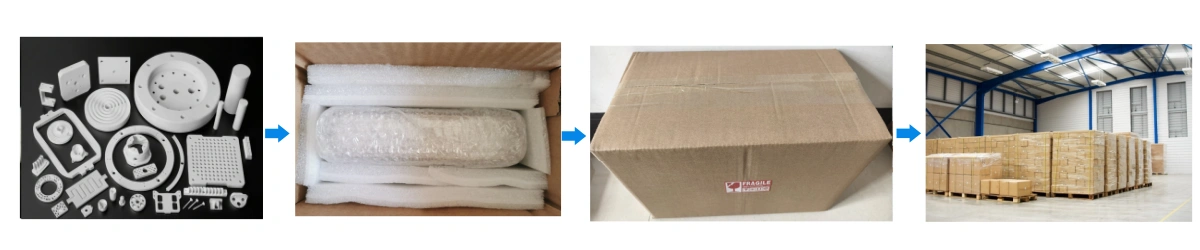
High Purity Alumina Insulating Base Packaging

Where Alumina Insulating Bases Are Used

  • Industrial Furnaces and Heater Fixtures

    High purity alumina insulating bases are used under heater assemblies, support frames and hot-zone fixtures where metal contact must be isolated from energized or high-temperature parts. The ceramic base helps maintain insulation while supporting stable seating during repeated thermal cycling.

    Problem Solved:

    It reduces the risk of leakage paths, unstable mounting and heat-related deformation when polymer or metal supports cannot meet the insulation requirement.

  • Electrical Isolation and Power-Test Assemblies

    These bases can be used in electrical test fixtures, AC-driven modules and insulating support stacks where low leakage, stable creepage distance and controlled mounting geometry are important.

    Problem Solved:

    It helps separate conductive parts while keeping holes, steps and reference surfaces aligned with the equipment design.

  • Vacuum Coating and Surface Treatment Equipment

    Dense alumina insulating bases can support mounting blocks, isolation pads and fixture interfaces inside vacuum coating, plasma treatment or surface-processing equipment.

    Problem Solved:

    It provides a cleaner ceramic interface and stable support surface where contamination, thermal stability and electrical isolation must be considered together.

  • Precision Mounting and Replacement Parts

    For equipment maintenance, alumina insulating bases can be manufactured according to an existing sample or drawing to match hole positions, datum faces and installation height.

    Problem Solved:

    It helps reduce retrofit work, on-site drilling and re-alignment when replacing damaged or worn insulation bases.

Use Guide — High Purity Alumina Insulating Base

  • Check the Fit

    1. Confirm mounting-hole alignment, seating faces, step heights and conductor positions against the assembly drawing.
    2. Trial-fit the base with fasteners and mating parts before applying torque or making electrical connections.

  • Install Fasteners Carefully

    1. Use suitable washers or spacers to spread clamping loads.
    2. Tighten gradually in a cross pattern to maintain even seating pressure.
    3. Follow the drawing’s torque limits. If none are specified, establish limits through controlled testing.
    4. Avoid overtightening, especially near holes and edges.

  • Prepare the Seating Surfaces

    1. Inspect and clean both the ceramic base and the mating fixture.
    2. Ensure contact surfaces are flat and free from burrs, particles and debris.
    3. Remove high spots that could concentrate clamping loads and crack the ceramic.

  • Allow for Thermal Expansion

    1. Account for expansion differences between alumina and mating materials across the operating temperature range.
    2. Alumina expands at approximately 8 × 10⁻⁶/K; metals typically expand at 10–20 × 10⁻⁶/K.
    3. Include suitable hole clearance, compliant washers or expansion joints in the assembly design to accommodate movement.

  • Maintain Electrical Separation

    1. Position conductors and electrodes according to the drawing.
    2. Avoid sharp conductive edges or points that can concentrate electric fields.
    3. Maintain adequate surface creepage distances and air clearances.
    4. Follow the applicable electrical standards for the voltage and operating environment.

  • Clean and Inspect Regularly

    1. Use isopropyl alcohol or another approved cleaning solvent.
    2. Avoid abrasive pads or chemicals that could damage functional faces or leave residue.
    3. Follow contamination-control procedures for vacuum or high-purity service.
    4. Inspect seating faces, hole edges and alignment features for wear, chipping or cracks.

Alumina Insulating Base FAQs

  1. What is a high purity alumina insulating base used for?
    It supports and locates parts in an assembly while keeping energized and grounded features electrically separated. Typical uses include heater and furnace fixtures, electrical test and power assemblies, vacuum and coating equipment, and replacement bases for existing equipment.
  2. Why use alumina ceramic instead of metal for an insulating base?
    Alumina ceramic is an electrical insulator, so one part can hold conductive components in position and separate them from the grounded fixture. A metal base conducts, so it needs extra insulating sleeves, washers or spacers, and each added part is another interface to align. Alumina also stays dimensionally stable at elevated temperature.
  3. Which alumina grade should I choose for an insulating base?
    Start from the operating temperature, electrical requirement and cost target. All four reference grades have volume resistivity above 10¹⁴ Ω·cm at 20°C. AD-ALU-995 (99.5%) suits many industrial insulating bases. Review AD-ALU-997 or AD-ALU-999 when you need lower impurity content or a higher material temperature screening ceiling. AD-ALU-990 fits cost-sensitive mounting where a dielectric loss of 0.0006 at 1 MHz is acceptable.
  4. Does higher alumina purity also mean a cleaner surface?
    No. Purity describes the Al₂O₃ content of the ceramic. Surface cleanliness depends on machining, cleaning and handling, so specify the two separately. For seating and insulating faces, agree the particle, metal or residue limits and the cleaning or drying procedure. Vacuum projects can add bake-out and outgassing requirements.
  5. What causes an alumina insulating base to crack during installation?
    Common causes are point loading on an uneven metal seating face, over-tightening near holes or thin sections, sharp internal corners, missing chamfers, restrained thermal expansion against metal parts, and impact during handling. To reduce the risk, use clean, flat mating surfaces and the approved washers or spacers, tighten gradually and evenly to the fixture's torque, and put chamfered edges on the drawing.
  6. How is electrical performance checked on a finished base?
    The resistivity and dielectric strength values come from 5 mm material test specimens, not from your finished part. For the finished base or assembly, agree the test: AC or DC voltage, electrode and ground positions, test medium, ramp and hold time, and the leakage or pass criteria.
  7. Can you make a custom base from my drawing, and what do you need for a quote?
    Yes. Bases can be made with through and blind holes, countersinks, counterbores, slots, steps, chamfers and ground reference faces. For a quote, send a drawing, sketch, photos of the old part or a sample, plus the quantity and intended use. Mark the datum faces, hole layout and critical dimensions. The alumina grade, operating temperature, voltage and load can be confirmed during drawing review.
  8. How do you keep repeat orders consistent with the approved base?
    The approved drawing revision and the first-article inspection record become the baseline. That record covers the datums, support points, measurement method, and the results for hole position, step height, face flatness and alignment. Repeat orders are inspected the same way. Any change to the grade, seating faces, fastener stack, conductor positions, load or thermal cycle is reviewed against that first article.
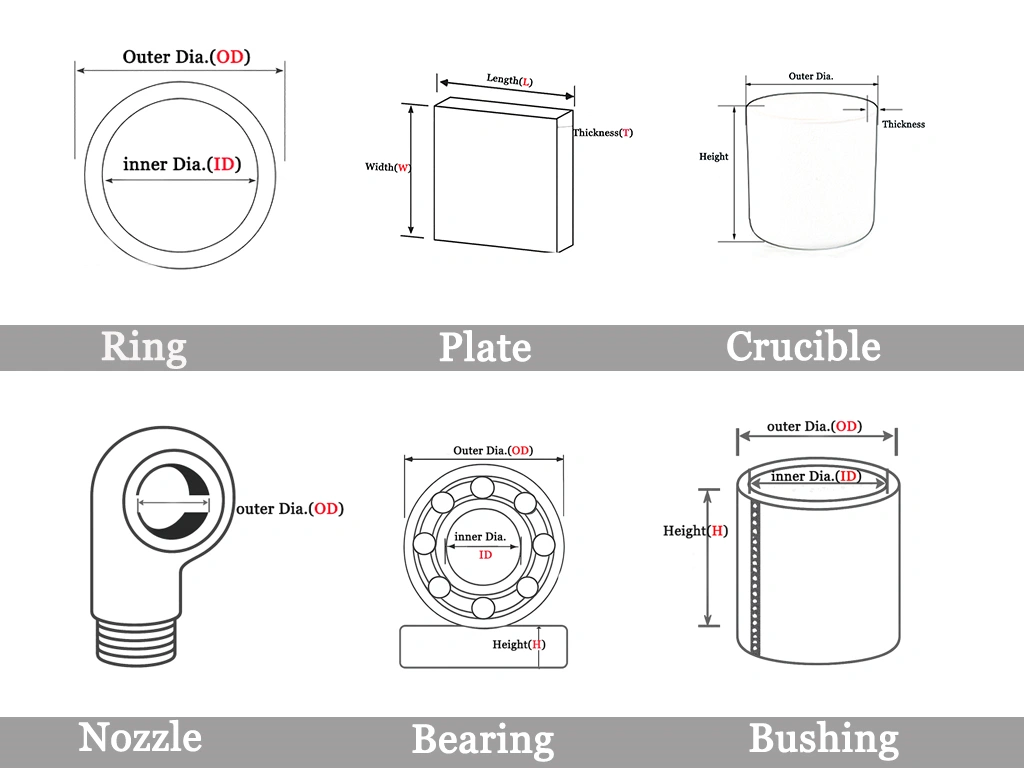
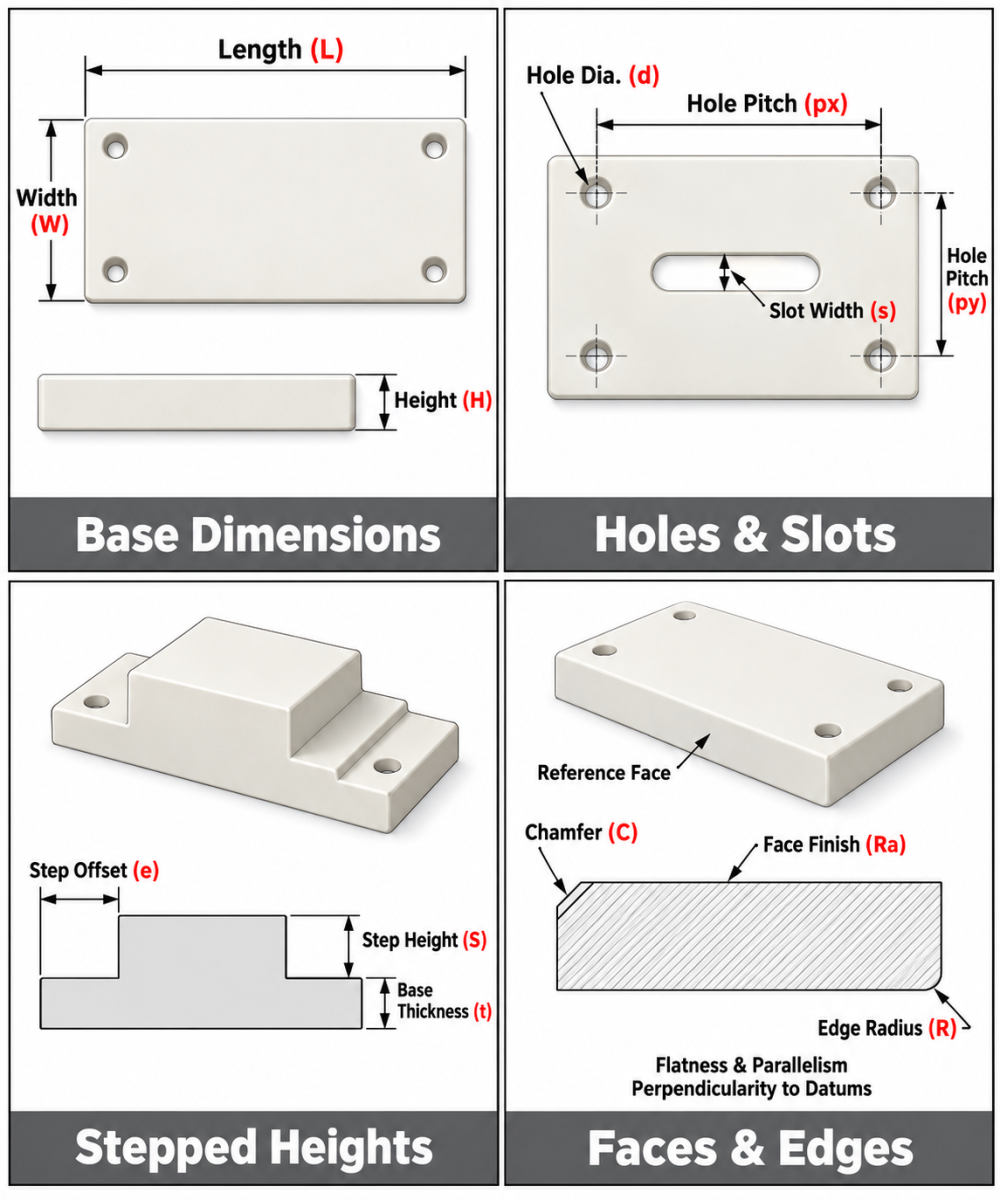
High purity alumina insulating base diagrams showing overall dimensions, hole spacing, slot width, step height, base thickness, reference faces and edge details.

Custom High Purity Alumina Insulating Bases

If you need a high purity alumina insulating base that matches a fixture interface or insulates a heater mounting assembly, you can specify the geometry, tolerances and surface requirements directly from your drawing or a measured sample.

  • Outer dimensions and envelope: Overall length, width and height, corner radii, step offsets and datum scheme, sized to the existing fixture window or mounting pocket.
  • Thickness and contact heights: Uniform thickness, multi-level thickness or a stepped pedestal, so heater stacks, spacers and different conductor heights are supported by one part.
  • Holes and slots: Through or blind holes, countersinks, counterbores, elongated slots, keyways and clearance or fit diameters for bolts, dowel pins and sensor leads.
  • Position and alignment: Hole pitch, position to datum, coaxiality between stacked holes and symmetry about a centerline or reference edge.
  • Reference faces: Ground primary and secondary datums, required flatness and parallelism bands, and perpendicularity between seating and mounting faces.
  • Edge details: Chamfer size, edge radius, corner breaks, notch reliefs around holes and protected edges for frequent handling or tight clearances.
  • Surface condition: As-sintered surfaces where roughness is acceptable, ground faces for stable seating, and fine-ground contact areas for precise alignment or sealing.
  • Material and service: One of the four alumina grades above, plus the intended temperature cycle and atmosphere.

Related Products

ADCERAX - Your Trusted Advanced Ceramics Manufacturing Partner

ADCERAX – Custom Ceramic Supply and Engineering Coordination
ADCERAX coordinates drawing review, production and inspection with manufacturing partners against agreed specifications.

China-Based Ceramic Supply Partner

ADCERAX coordinates custom ceramic supply for overseas OEMs, equipment builders, and labs.

Custom Drawing Support

We review drawings, dimensions, materials, and application conditions before quotation.

Ceramic Process Control

Forming, sintering, machining, grinding, and finishing are arranged by part requirements.

Pre-Shipment Inspection

Dimensional checks, visual inspection, and packaging review help reduce procurement risk.

Get in Touch with Us

Our team will be happy to respond to you in less than 24 hours.

Adcerax's factory

Quick Quotation

*Our team will review your inquiry and respond with the next steps.

*Your information will be kept strictly confidential.

Ready to Solve Your Engineering Challenge?

Partner with ADCERAX for reliable, high-performance advanced ceramic solutions. Our engineers are ready to discuss your project.

E-mail

info@adcerax.com

Phone

Tel: +86-0731-84428843 WhatsApp: +86 19311583352

Response Time

Within 24 hours

Quick Quote

The more details you provide, the faster we can quote.

*All inquiries are confidential.

Get Your Custom Solution

The more details you provide, the faster we can respond.

customize size

*We respond within 24 hours. All inquiries are confidential.

Download Catalog