
Silicon Carbide Ceramic Rods for High-Temperature Kilns, Furnaces & Process Equipment
ADCERAX produces structural silicon carbide ceramic rods, SiC rollers, support rods and guide rods, custom-made from your drawing, sample or worn part. They are used in roller kilns and sintering furnaces, glass annealing, tempering and bending lines, and metallurgical and chemical high-temperature equipment, where straightness and stability matter most.
Their low thermal expansion holds straightness under load, high stiffness resists mid-span bending on long spans, and stable Si–C bonding withstands oxidation and acid or alkali atmospheres — with RBSiC, SSiC, RSiC or NBSiC routes matched to your temperature, load and corrosion condition.
0.5–1.0 mm/m
Straightness (review target)
What Is a Silicon Carbide Ceramic Rod?
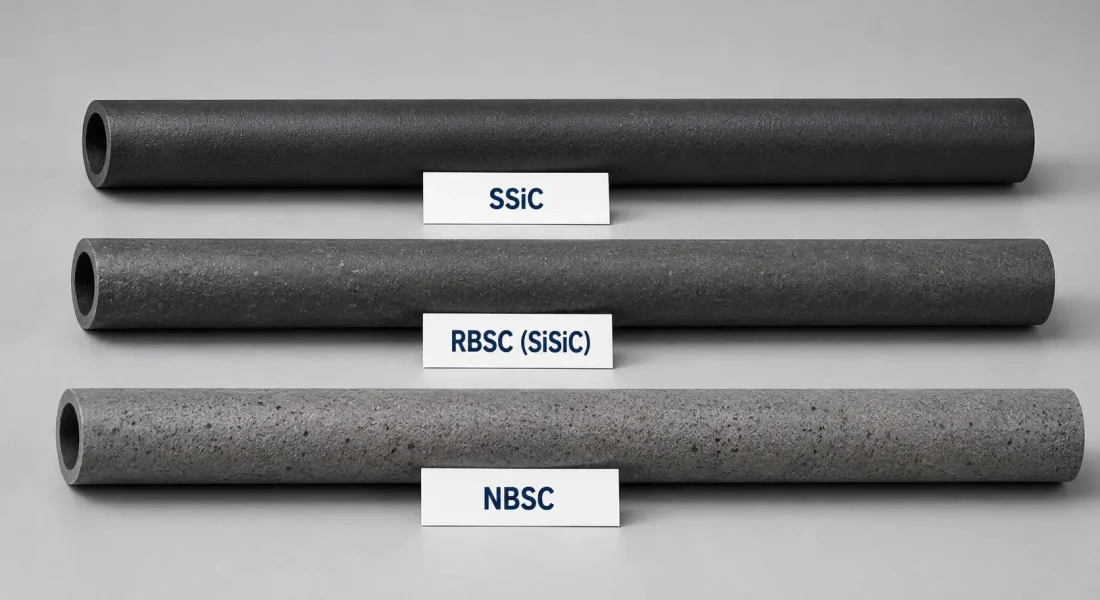
Which silicon carbide route fits your rod?
Choose the material route by service temperature, atmosphere, load and failure mode — typical / reference only.
SSiC
sintered
up to ~1500–1600°C
High purity, strong oxidation and corrosion resistance.
→ Corrosive / high-temp guide rods, stirrer shafts
RBSiC / SiSiC
reaction-bonded
up to ~1350–1400°C
Dense and cost-effective; free Si limits alkali/HF use.
→ Roller-kiln rollers, support bars
RSiC
recrystallized
up to ~1600°C+
Very high temperature, open structure, low deformation.
→ Long-span rollers, kiln furniture
NBSiC
nitride-bonded
high-temp, thermal cycling
Good thermal-shock and wear resistance, economical.
→ Wear / thermal-shock exposed supports
Technical Specification of Silicon Carbide Rod
Typical properties of ADCERAX SiC rods across RBSiC, SSiC and RSiC routes. Values confirmed by our production team; exact figures per part are confirmed by engineering review.
| Material | Reaction-Bonded Silicon Carbide (RBSiC) / Sintered Silicon Carbide (SSiC) / Recrystallized SiC (RSiC) |
| Density | 2.6-3.2 g/cm³ |
| Maximum Continuous Operating Temperature | 1350–1600°C |
| Thermal Expansion Coefficient (CTE) | 4.0–4.5 × 10⁻⁶ /K |
| Thermal Conductivity | 20-200 W/m·K |
| Flexural Strength | 150–350 MPa (RT), stable at elevated temperatures |
| Elastic Modulus | 300–420 GPa |
| Hardness | HV 2000–2400 |
| Corrosion Resistance | Stable in acid, alkaline, salt, and oxidizing atmospheres |
| Straightness / Dimensional Characteristics | Straightness reviewed to a target of 0.5–1.0 mm/m, confirmed per drawing |
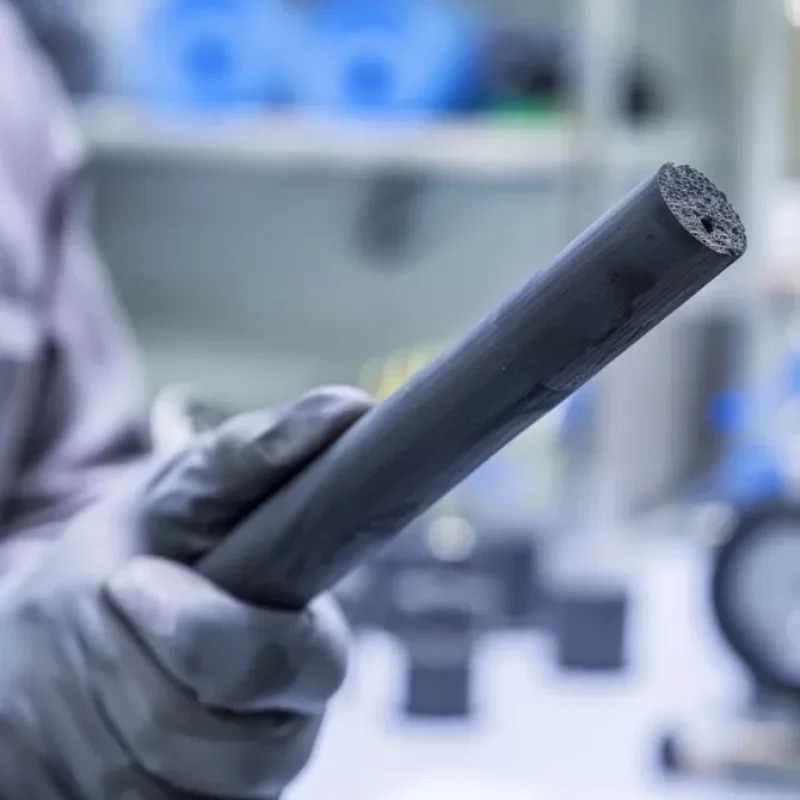
Silicon Carbide Ceramic Rod Product Showcase
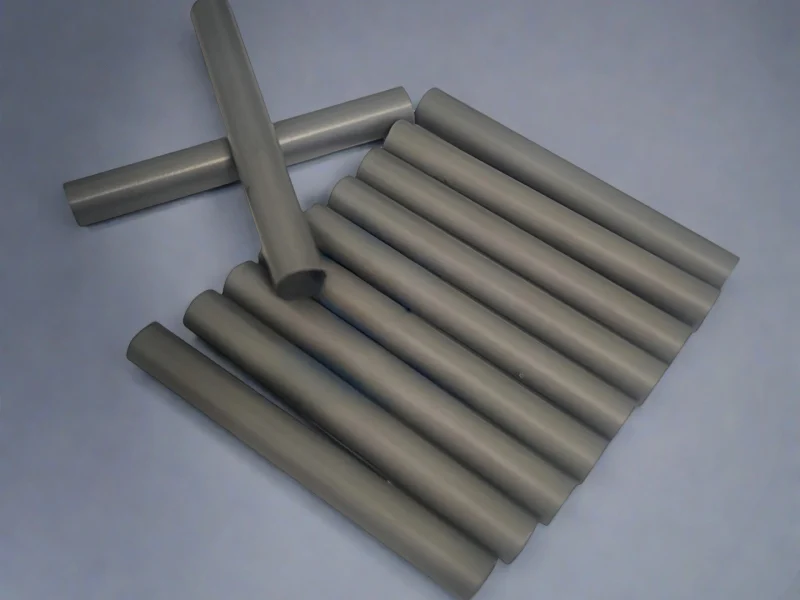
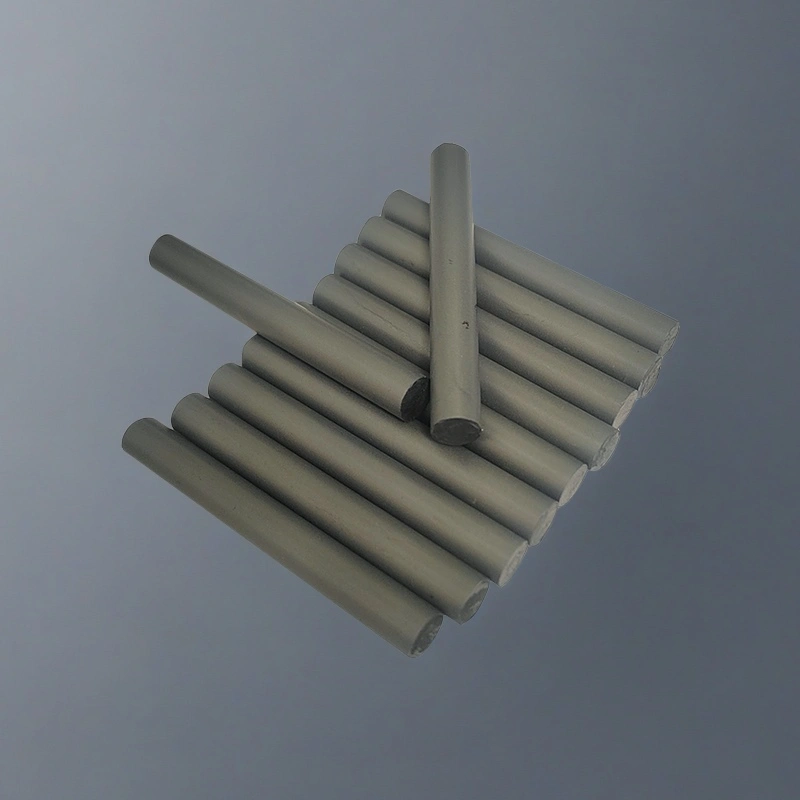
SiC ceramic rods for furnace, conveying and mechanical systems — made to your drawing in RBSiC, SSiC, RSiC or NBSiC.
- High-temperature operation sustained to 1600°C with minimal deformation (route-dependent)
- Low thermal expansion minimizing bending deviation during furnace heating cycles.
- Corrosion-resistant performance supporting acidic or alkaline industrial atmospheres.
Where SiC Rods & Rollers Are Used
Silicon carbide ceramic rods serve as rollers, support bars, guide rods and shafts in high-temperature and corrosive equipment — holding straightness and strength where metal parts deform, oxidize or wear out.
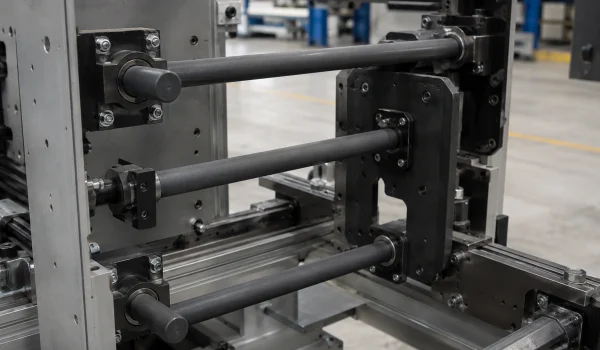
SiC Rods as Shafts, Rollers & Support Bars
A SiC rod works as a transmission shaft, roller or support bar in precision mechanical assemblies where metal rods lose stiffness or wear out.
-
High stiffness under load:
Resists mid-span bending on long spans, keeping assemblies aligned. -
Straightness through heat cycles:
Low thermal expansion holds the long axis straight during repeated heating and cooling. -
Wear-resistant surface:
Hard sintered surface maintains integrity in long rotating and sliding duty.
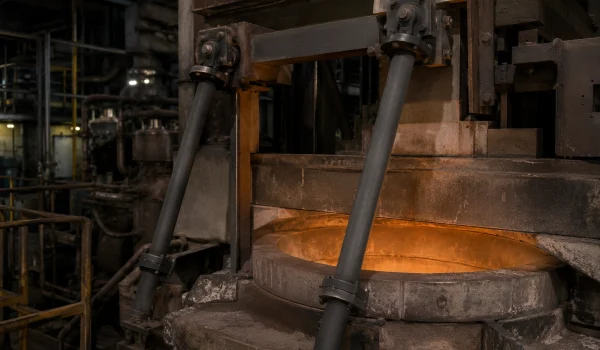
Metallurgical & Chemical Processing
A SiC rod acts as a guide rod, positioning bar or stirrer shaft where heat and corrosion defeat metal parts.
- Stable Si–C bonding resists acid, alkali and oxidizing atmospheres in long service.
- Retains strength under repetitive mechanical and thermal cycles.
- Straightness retention keeps positioning accurate through thermal exposure.
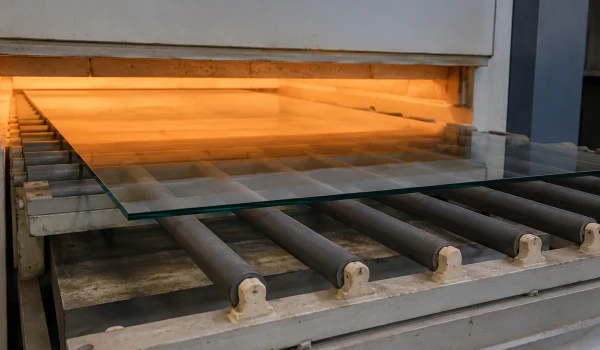
SiC Rods in Glass Annealing & Tempering Lines
A silicon carbide rod provides stable support and thermal transfer in annealing, bending and tempering furnaces.
- Dimensional stability through heat cycles keeps glass transport aligned.
- Good thermal conductivity supports uniform heat distribution across the line.
- Surface resists furnace vapor exposure over long service periods.
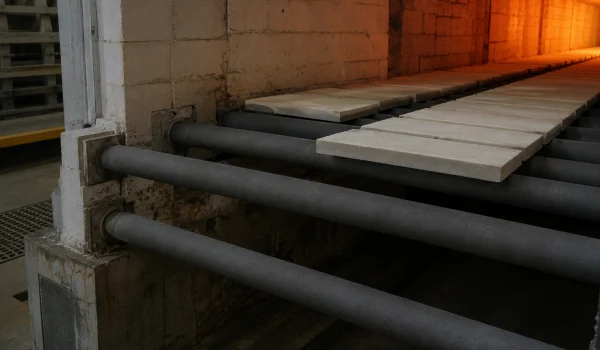
High-Temperature Kiln Systems
A SiC ceramic rod serves as a roller, kiln rod or support bar inside roller kilns and sintering furnaces.
- Keeps structural integrity through repeated firing cycles at kiln temperatures.
- Controlled mid-span deflection — reviewed against your load and span before quoting.
- Low glaze adhesion keeps roller surfaces clean and stable over long firing service.
Customized Silicon Carbide Rods — Special Sizes, Tolerances & Shapes
We specialize in customizing silicon carbide rod with special sizes, tight tolerances, and complex features. OEM and small-batch support available.
Customization Options
Extra-large / Extra-small diameters, non-standard thicknesses, and ultra-long / ultra-short lengths.
Provide higher - level dimensional accuracy and concentricity control than the standard.
Flanges, steps, threads, drilling holes, grooves, etc.
Adjust the material according to the application requirements.
Polish and grind the surface to achieve a specific surface roughness.
Customization Process
Send us your drawing, CAD file, or physical sample with material grade, dimensions, tolerances, and quantity. Our engineers will evaluate the design and provide a detailed quotation with lead time and pricing.
Once the quote is approved, we proceed with sample prototyping (1–50 pcs) if needed, for testing and validation.
After sample approval or direct confirmation, we begin batch manufacturing using CNC machining, sintering, and polishing. All parts undergo dimensional checks, material purity testing, and surface finish inspection.
Finished products are securely packed and shipped via DHL/FedEx/UPS or your preferred method. We support global delivery with full documentation.
Start With an Engineering Review — Not a Catalog Number
Whether you are selecting a new SiC rod or replacing one that failed in service, ADCERAX engineers review your case before quoting.
Selecting a new rod
Send a drawing — or simply your operating condition:
- Temperature and atmosphere
- Load and support span
- Diameter, length, end features
We route the material (RBSiC / SSiC / RSiC / NBSiC), review straightness and end machining, then quote.
Replacing a failed rod
Rod bent, cracked, worn or oxidized in service? Send:
- Old-part photo or drawing
- Support span and temperature profile
- Thermal cycle and duty
We compare OD, length, straightness, end features and duty — we do not offer an unverified drop-in replacement.
Free engineering review · Reply within 24 hours
ADCERAX Engineering-First Service Workflow
Before production, every rod is checked against its real duty — temperature, load and failure risk. During production, dimensions and thermal performance are verified by instrument, not assumption.
-
Thermal & Load Profile Matching:
Operating temperature, thermal gradients and load paths are analyzed to verify the selected route suits your furnace or mechanical environment. -
Failure-Mode Prevention Analysis:
Bending drift, thermal shock, glaze adhesion and corrosion-induced roughness are reviewed before production begins. -
Measured, Not Assumed:
Every batch is verified by laser dimensional scanning and thermal-cycling tests before shipment.


Industrial Manufacturing Capabilities for High-Performance Silicon Carbide Ceramic Rods
From sintering furnaces to laser dimensional scanning, these are the production and inspection capabilities behind every ADCERAX SiC rod batch.
| Manufacturing Capabilities Overview | |||
|---|---|---|---|
| Capability | Description | ||
| High-Temperature Sintering Furnaces | Multiple 1600–1750°C industrial furnaces enabling RBSiC/SSiC/RSiC rod sintering in consistent thermal profiles | ||
| Large-Length Rod Forming | Support for rod lengths up to 1500–2500 mm depending on material grade and geometry | ||
| CNC Precision Machining | Multi-axis CNC lines achieving OD tolerances of ±0.05–0.10 mm and end-form accuracy for custom geometries | ||
| Long-Axis Straightness Control | Post-sintering correction process, straightness reviewed to a target of 0.5–1.0 mm/m | ||
| Surface Finishing Systems | Dedicated grinding and sand-blasting units producing Ra 0.8–1.6 µm finish for conveying or structural applications | ||
| Metrology & Dimensional Scanning | Laser scanning systems measuring OD, ID, runout, and straightness with ±0.02 mm resolution | ||
| Thermal Cycling Verification | Test chambers supporting 300–600 thermal shock cycles for SiC rod performance validation | ||
| Material Purity Control | Raw material screening — SiC content typically ≥98% (route-dependent), confirmed per grade requirement | ||
Technical FAQs About Silicon Carbide Ceramic Rod
A Silicon Carbide Ceramic Rod retains structural integrity because its low thermal expansion (4.0–4.5×10⁻⁶/K) minimizes thermal stress accumulation. High bonding strength and stable grain structure prevent creep during prolonged high-temperature operation. These characteristics allow consistent performance in kilns, glass furnaces, and metallurgical equipment.
A Silicon Carbide Ceramic Rod features an elastic modulus above 300 GPa, which suppresses bending under 80–150 kg loading. Dimensional deviation typically remains within 0.5–1.0 mm per meter when operated in continuous thermal cycles. This helps maintain alignment in transmission shafts, rollers, and kiln support bars.
Its strong covalent Si–C bonding and chemically inert surfaces maintain stability in acidic, alkaline, or chloride-rich environments. Degradation rates remain low even at 800–1200°C, supporting long service cycles. This enables reliable performance in chemical reactors, gas-phase corrosion chambers, and metallurgical work zones.
The non-wetting behavior of SiC surfaces reduces chemical interaction with molten glazing materials. Stable oxidation layers prevent the formation of sticky compounds during 300–600 furnace cycles. This lowers maintenance frequency and reduces sticking events in ceramic firing lines.
Metal rods often suffer oxidation, creep, and dimensional drift above 900–1100°C, whereas a Silicon Carbide Ceramic Rod maintains shape and strength above 1350°C. Low deformation rates prevent roller misalignment. This improves transport stability for glass sheets, ceramic tiles, and sintered components.
Finishes may include as-sintered, ground, or sand-blasted surfaces, supporting Ra 0.8–1.6 µm ranges. Controlled roughness enhances grip or reduces friction depending on application needs. This improves performance in hydraulic shafts, rollers, or mechanical guide components.
Its low thermal expansion and high thermal conductivity distribute thermal gradients evenly. These characteristics reduce the probability of thermal shock failure during 200–500 rapid cycles. This reliability is critical for roller kilns and rapid-heating glass lines.
It depends on temperature, atmosphere, load and cost. SSiC gives high strength and oxidation resistance; RBSiC/SiSiC is cost-effective with good conductivity (watch strong alkali/HF); RSiC suits very high temperature and light kiln-furniture; NBSiC is an economical kiln-furniture route. No single route is best for everything — we route by your duty.
A drawing or old-part photo; diameter, length and solid/hollow; end features; target straightness; surface/Ra; operating temperature, atmosphere and load; the old rod's failure mode; and quantity. We run a replacement review rather than an unverified drop-in.
What to Send for a Silicon Carbide Rod Quote
For a fast engineering review, please share:
- Rod type — roller, support bar, guide rod, shaft or custom structural rod
- Diameter and length, solid or hollow — with tolerance and straightness target
- End features — chamfer, flat, hole, groove, thread or stepped end
- Furnace temperature, thermal cycling and atmosphere
- Load and support span — plus wear or corrosion media if present
- Drawing, photo or old rod — PDF, DXF, STEP or image
Plus quantity — prototype, spare or repeat production. Our engineers confirm the SiC route (RBSiC / SSiC / RSiC / NBSiC), feasibility and typical lead time by review before quotation.
*Our team will answer your inquiries within 24 hours.
*Your information will be kept strictly confidential.
info@adcerax.com
Tel:+86-0731-84428843
WhatsApp:+86 19311583352
Within 24 hours
