The grade decision for a silicon carbide tube — pressureless sintered (SSiC), reaction-bonded (RBSC, also written RBSiC/SiSiC), or nitride-bonded (NBSC, also NBSiC) — is usually made under three pressures at once: a temperature ceiling defined by the worst-case service excursion, a chemical or atmosphere boundary that one of the three bond phases will not survive, and a geometry/cost envelope that quietly excludes one route before any datasheet is opened. Engineers specifying thermocouple protection, immersion, burner, or furnace tubes rarely fail because they don't know SiC is hard and conductive. They fail when they treat the three grades as interchangeable quality tiers of one material and miss that they are three different bonding strategies with three different working windows. This article resolves the grade choice by tracing manufacturing route to microstructure to tube behavior, then closing with the if/then rule and the supplier-data list a specifying engineer needs.
Scope: This page is the tube-duty grade decision among SSiC, RBSC (also RBSiC/SiSiC), and NBSC (also NBSiC, nitride-bonded). For cross-form grade selection beyond tubes, use the SSiC vs RBSiC vs SiSiC grade selection guide — not a catalog shortcut.
SSiC, RBSC, and NBSC tubes differ mainly by how the SiC grains are bonded: SSiC is pressureless-sintered dense SiC with no free silicon, RBSC is silicon-infiltrated SiC with a residual free-silicon phase, and NBSC is porous SiC bonded by silicon nitride. That manufacturing difference determines the tube decision. Choose SSiC for the harshest corrosion duty and the highest dense-grade service window, near 1600°C in air for tube applications. Choose RBSC for larger or more dimensionally precise near-net-shape tubes where free silicon is acceptable and service stays at or below the 1380°C application-temperature ceiling. Choose NBSC for thermally shocked, oxidizing, or non-ferrous-melt-adjacent tube duties where a porous nitride-bonded structure trades density for thermal-shock resilience and low wettability.
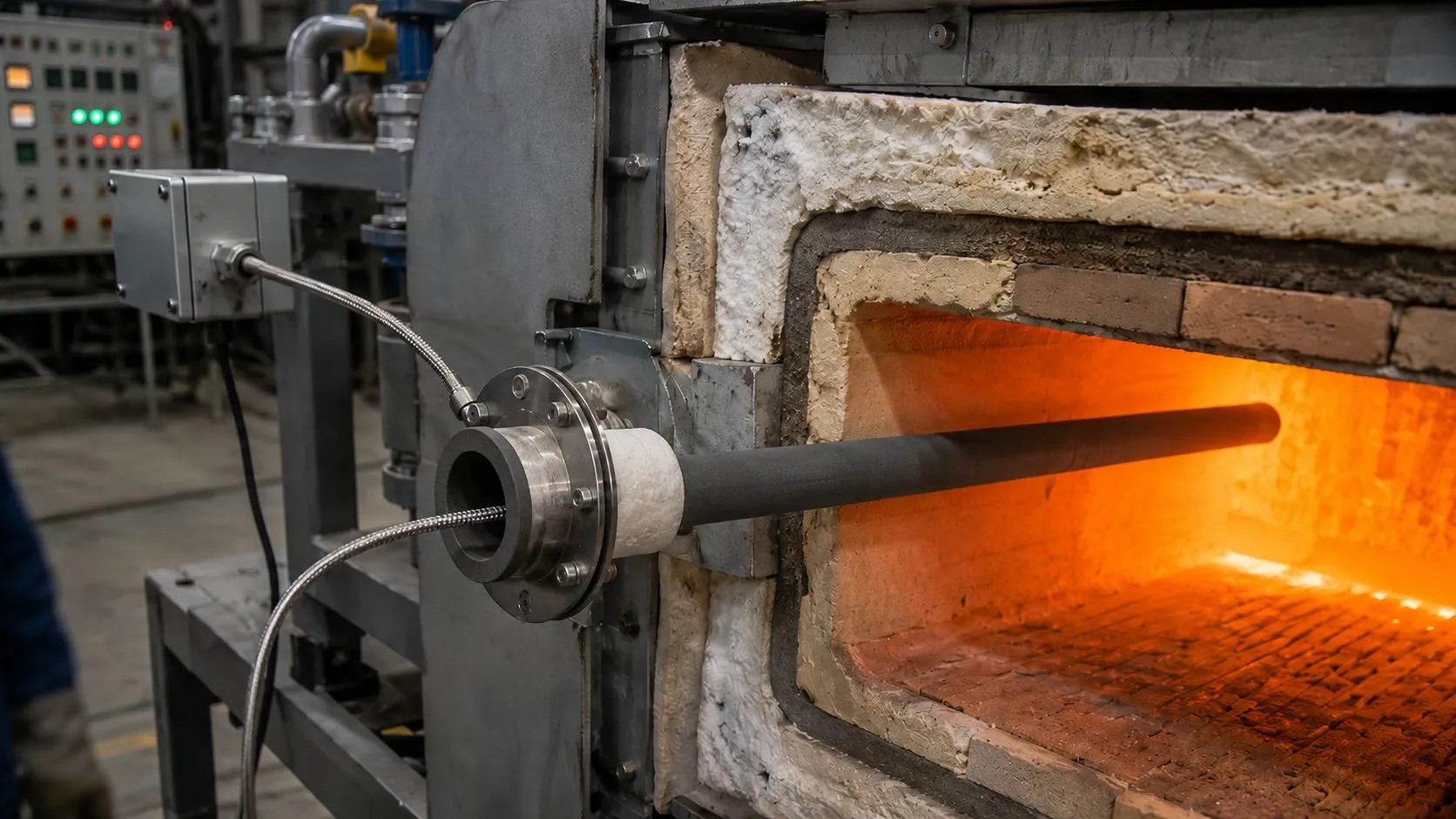
Tube grade is decided by service window, not by the SiC label — atmosphere, temperature ceiling, and geometry separate the three routes.
For broader context on how SiC tubes fit into the wider tube-material landscape, the silicon carbide tube product forms overview covers the family beyond the three bonded grades discussed here.
How the three tube grades are manufactured
The most useful way to compare SSiC, RBSC, and NBSC tubes is to stop treating them as three brand-like names and start treating them as three bonding strategies. Pressureless sintered silicon carbide starts as high-purity, ultra-fine SiC powder with small sintering-aid additions, fired at densifying sintering temperature until the body becomes a near-fully-dense single-phase SiC ceramic. Reaction-bonded silicon carbide starts as a porous SiC/carbon preform, then molten silicon is infiltrated and reacts with the carbon to form secondary SiC, leaving a residual free-silicon phase distributed through the matrix. Nitride-bonded silicon carbide is produced by firing mixtures of SiC and silicon in nitrogen so a Si₃N₄ bond phase forms around the SiC grains.
The three routes converge on the same chemical name but diverge on bond phase, porosity, and impurity profile — and that divergence is what changes a tube's working window. A typical RBSC formulation contains about 15 wt% free silicon nominal (SiC ~85 wt% nominal; confirm on the lot datasheet), while NBSC/NBSiC typically carries about 12 vol% porosity with an 80/20 SiC/Si₃N₄ nominal bond balance. SSiC sits at the dense, single-phase end with effectively no free silicon and near-zero porosity. The same family of silicon carbide ceramic shapes is built from these three routes — but a tube specification has to choose one.
Dense sintering versus silicon infiltration versus nitridation
Pressureless sintering is the slowest, hottest, and tightest of the three. Powder, sintering aids, shaping, debind, and high-temperature densifying firing produce a dense body that machines hard but is dimensionally stable in service. RBSC trades that purity for processing economy: the SiC/C preform is shaped first, then siliconized in a furnace where molten silicon wicks into the porosity and reacts with carbon. The result is a near-zero-porosity body with a residual silicon network — strong, dimensionally generous, and shape-friendly, but capped at the silicon-controlled temperature ceiling.
NBSC takes a third route. SiC particles are bound by an in-situ-formed Si₃N₄ matrix produced by firing SiC + Si in nitrogen. The body stays porous by design, with the nitride bond phase acting as the structural cement. That porosity is not a defect; it is the source of NBSC's thermal-shock and oxidation behavior in tube duty.
Why bond phase and porosity matter more than the shared ""SiC"" label
The chemistry says SiC. The microstructure says three different materials. A tube specification reads the microstructure, not the chemistry.
Bond phase decides what survives at the service interface — atmosphere, melt, reactant. Porosity decides how the body responds to thermal gradients, mechanical loads, and oxidation. The SiC grains themselves are nearly identical across the three routes, so most of the engineering difference in a tube is carried by what is between the grains: dense SiC-to-SiC contact in SSiC, silicon network in RBSC, Si₃N₄ matrix and open pores in NBSC.
Which tube properties change because of the manufacturing route
Once the bond phase is identified, the tube-property ranking becomes much easier to read. SSiC is almost fully dense and contains no free silicon, so it offers the highest dense-grade hardness, corrosion resistance, and high-temperature mechanical stability among the three; published material pages for SSiC list density typically ~3.10 g/cm³, flexural strength typically ~380 MPa (selection typical), thermal conductivity in the 100–120 W/(m·K) ambient selection band, and hardness that is grade- and indentation-setup dependent (confirm on the grade datasheet — no single overview GPa is published here). RBSC keeps very low porosity but contains the free-silicon phase that improves near-net-shape manufacturability and large-part capability while introducing the silicon-controlled temperature ceiling. NBSC/NBSiC is lighter and more porous (typically ~2.80 g/cm³, ~12 vol% porosity), and is valued less for full density than for thermal-shock behavior, oxidation resistance, and poor wetting by non-ferrous melts.
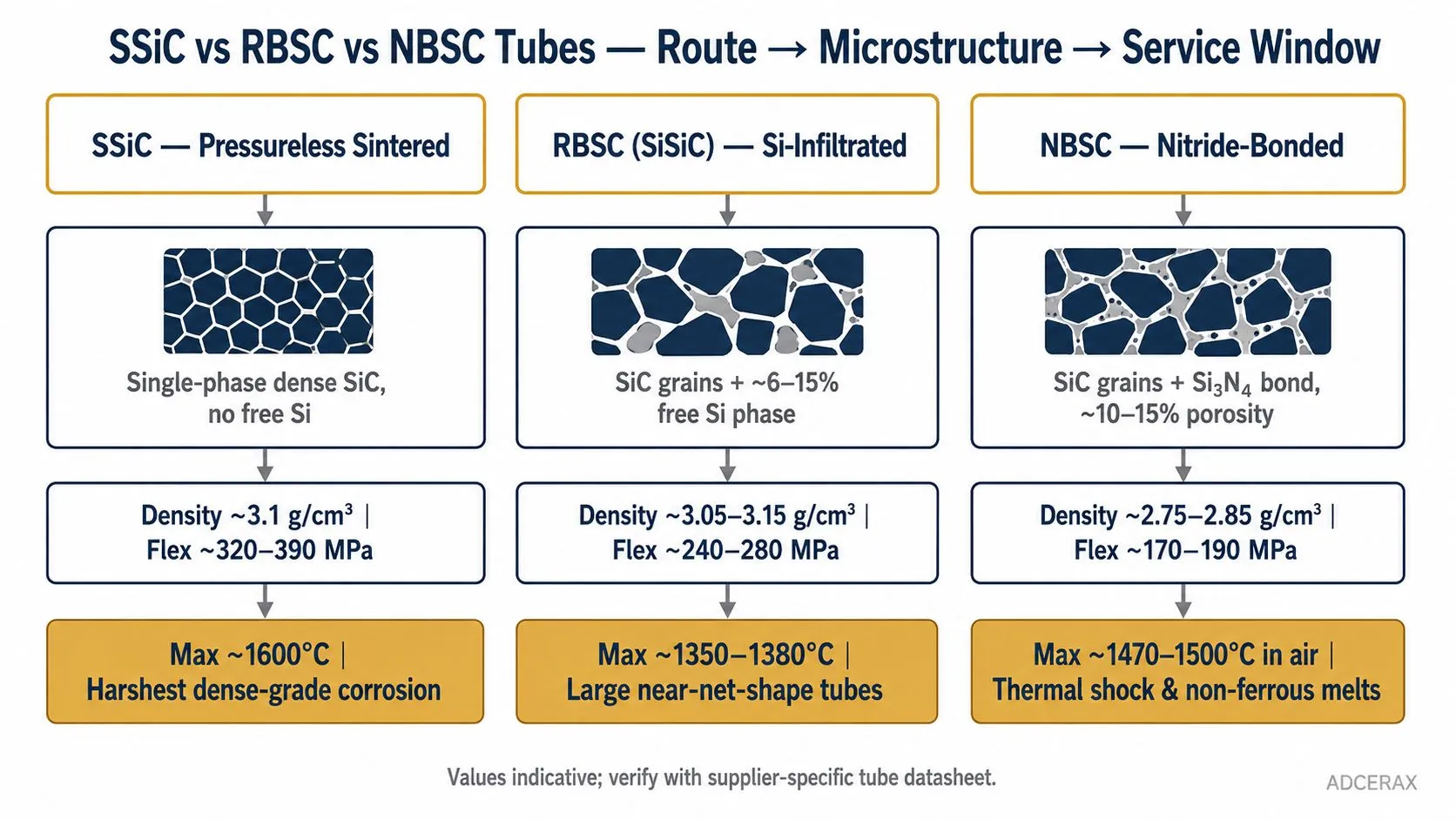
Manufacturing route fixes bond phase and porosity, which then fix the temperature ceiling, corrosion limit, and shape envelope a tube can hold.
Quick property comparison
The three-grade table below is a scan-reader anchor; the real selection logic is in the threshold table further down.
| Property | SSiC tube | RBSC (SiSiC) tube | NBSC tube |
|---|---|---|---|
| Bonding route | Pressureless sintering of fine SiC | Molten-Si infiltration of SiC/C preform | Nitridation of Si + SiC → Si₃N₄ bond |
| Composition cue | ~99% SiC, no free Si | ~85% SiC + ~15 wt% free Si nominal | SiC/Si₃N₄ ~80/20 nominal |
| Density (typical) | ~3.10 g/cm³ | ≥3.02 g/cm³ | ~2.80 g/cm³ |
| Porosity | Near zero | Near zero / very low | ~12 vol% |
| Flexural strength (RT, indicative) | ~380 MPa typical | 250 @20°C / 280 @1200°C | 160 @20°C / 180 @1200°C |
| Max working temp (tube/material pages) | ~1600°C | 1380°C | 1550°C |
| Tube-use logic | Harshest dense-grade service | Larger / more precise dense tubes below Si ceiling | Oxidation, thermal shock, non-ferrous-adjacent service |
Values indicative; verify per supplier-specific grade, atmosphere, and tube geometry.
Density, porosity, and strength hierarchy
SSiC sits at the top of the dense-grade hierarchy: highest hardness, highest flexural strength, lowest porosity, and the cleanest single-phase microstructure. RBSC matches SSiC closely on density but trails on strength because the free-silicon phase yields a softer load path and a temperature-limited ceiling. NBSC falls below both on bulk density and flexural strength on paper, yet its open-porous Si₃N₄-bonded structure delivers a different value profile that flexural strength alone does not capture.
Why free silicon helps shaping but hurts the high-temperature window
Free silicon is what makes RBSC manufacturable at large size and tight tolerance with little or no shrinkage during siliconizing, which is the route's core economic advantage. The same phase becomes the thermal limiter: silicon's melting point fixes a service ceiling, and approaching that ceiling triggers softening, slow loss of mechanical integrity, and grade failure. RBSC tubes are therefore overspecified above the 1380°C application-temperature ceiling and underspecified at large diameters where SSiC becomes uneconomical to sinter — a real trade-off, not a marketing axis.
Why NBSC remains attractive despite being porous
NBSC's porosity reads as a weakness on a generic property table, but in tube duty it is often the reason engineers pick it. The Si₃N₄ matrix and interconnected porosity together give NBSC a thermal-shock tolerance, an oxidation-protective surface behavior, and a poor-wetting interface against non-ferrous melts that dense SiC routes cannot match without paying elsewhere. For thermocouple protection tubes, immersion tubes, and quill tubes contacting molten aluminum, zinc, or similar non-ferrous melts, the porous nitride-bonded body is frequently the practical answer.
Where each tube grade breaks down or becomes the wrong choice
The wrong tube choice usually happens when the engineer optimizes for the wrong variable. RBSC looks attractive because it is dense, strong, and dimensionally economical for larger or more complex shapes, but the free-silicon phase that enables that economy also caps the service window. Selection ceilings used on this page: SSiC near 1600°C, RBSC at 1380°C, and NBSC/NBSiC at 1550°C application-temperature ceiling. SSiC removes the silicon limitation and is typically the better dense-grade choice for aggressive corrosion or higher-temperature service. NBSC sits on a different branch entirely: not the best answer for the harshest dense-ceramic corrosion duties, but often the strongest fit for oxidative or molten-non-ferrous-adjacent tube service.
A typical specification review for a thermocouple protection tube in a high-temperature kiln or furnace begins by separating these three failure boundaries before any pricing or geometry conversation. The most common diagnostic error in this category is reading a generic ""silicon carbide tube"" datasheet as if it applied to all three grades — and discovering the bond-phase difference only after a tube has spalled, softened, or wet a melt it was not supposed to wet. For a wider view of where SiC tubes fit relative to other materials in industrial furnace ceramics, the route-driven boundaries explained here apply equally to grade selection within those broader furnace-component families.
RBSC failure boundary: free silicon becomes the limiter
RBSC's silicon ceiling. Pushing RBSC near the 1380°C ceiling is not a ""derating"" question — it is a phase-limit question. The free silicon network that makes the route possible defines the upper service edge. Above that edge the silicon phase softens, the load path degrades, and the tube no longer behaves as the datasheet flexural-strength value implies. Specifying RBSC above this window is the most common avoidable failure mode for the route.
SSiC exception: best dense grade, but not the cheapest route for large near-net-shape tubes
SSiC's geometry economics. SSiC is the strongest default for the most aggressive service window, but it is also the slowest and most expensive of the three to fire to full density, and it shrinks during sintering. For large-diameter, long, or shape-sensitive tubes, SSiC can become uneconomical compared with RBSC's near-net-shape route. Where temperature is moderate and geometry dominates, SSiC's dense-grade advantage may not justify its cost.
NBSC exception: porous, but often better than expected in oxidation and non-ferrous contact
NBSC's selection inversion. A reader looking only at density and flexural strength will rank NBSC last and stop reading. In immersion tubes for non-ferrous melts, thermocouple protection in oxidative atmospheres, and burner-adjacent duty with thermal cycling, NBSC frequently outperforms expectations because the nitride-bonded porous structure resolves thermal shock and wetting in ways the dense routes do not. The selection error is to compare grades on a single table column rather than on the service-window combination.
When the shortlist is specifically nitride-bonded (NBSC/NBSiC) rather than dense SSiC or infiltrated RBSC, confirm bond-phase and porosity expectations on the nitride-bonded silicon carbide product page after the tube-duty gates on this page.
The if/then selection rule for tube applications
A practical tube-selection rule is straightforward when the three driving variables — temperature ceiling, chemical/atmosphere severity, and geometry/economics — are scored separately. SSiC wins when all three are pushed upward simultaneously: harsh corrosion, high temperature, dense-grade integrity required. RBSC wins when geometry or cost dominates and the service window stays below the silicon-limited ceiling. NBSC wins when thermal shock, oxidation, light weight, or low non-ferrous wetting matter more than maximum density. The rule below sequences those variables for fast triage.
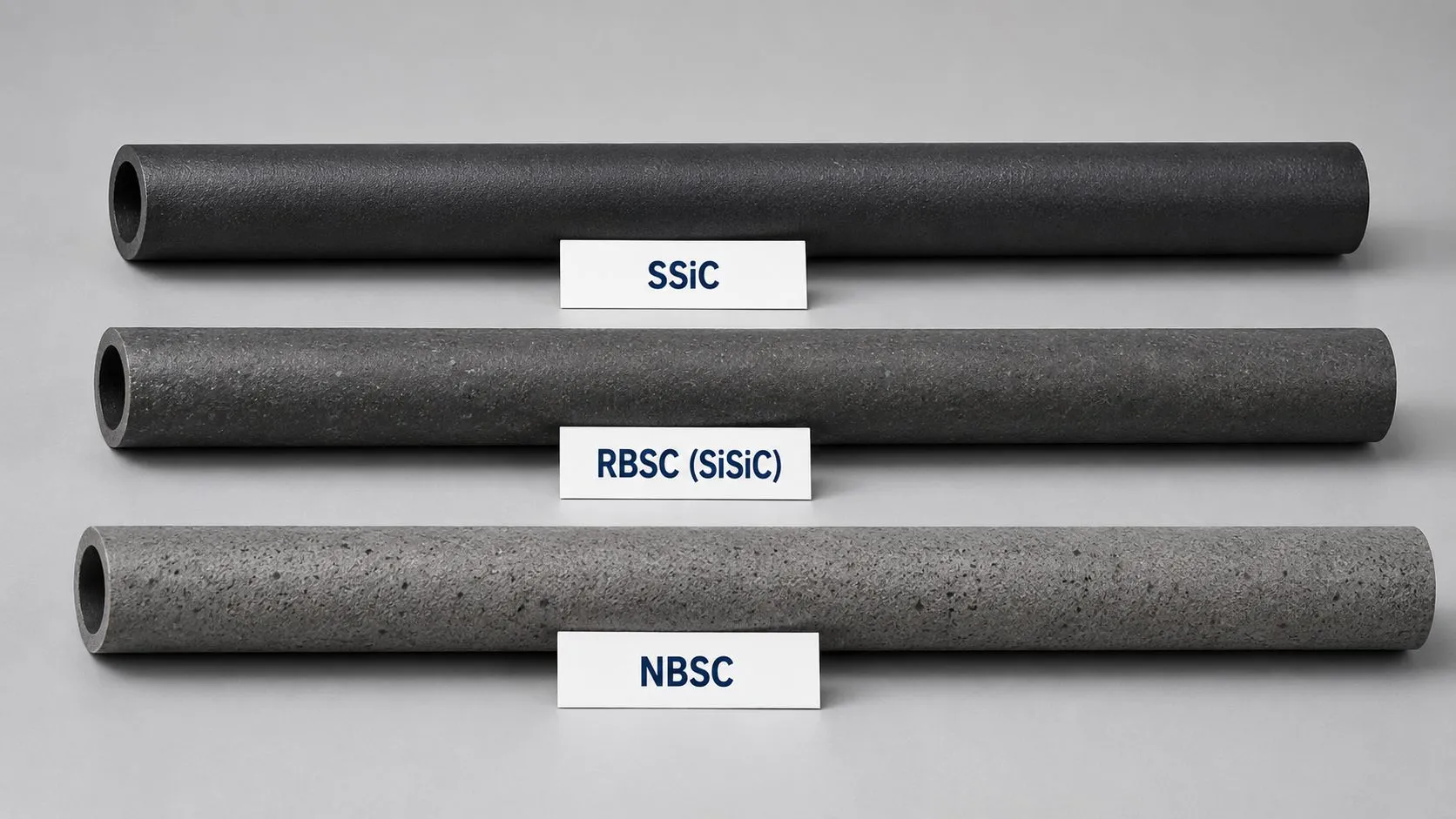
Three bonding routes produce three visually similar tubes — but the surface, density, and porosity cues map directly to the service-window decision.
The decision sequence:
- Score the service temperature ceiling first. If peak service exceeds roughly 1380°C in a stable atmosphere, RBSC drops out; the choice narrows to SSiC or NBSC.
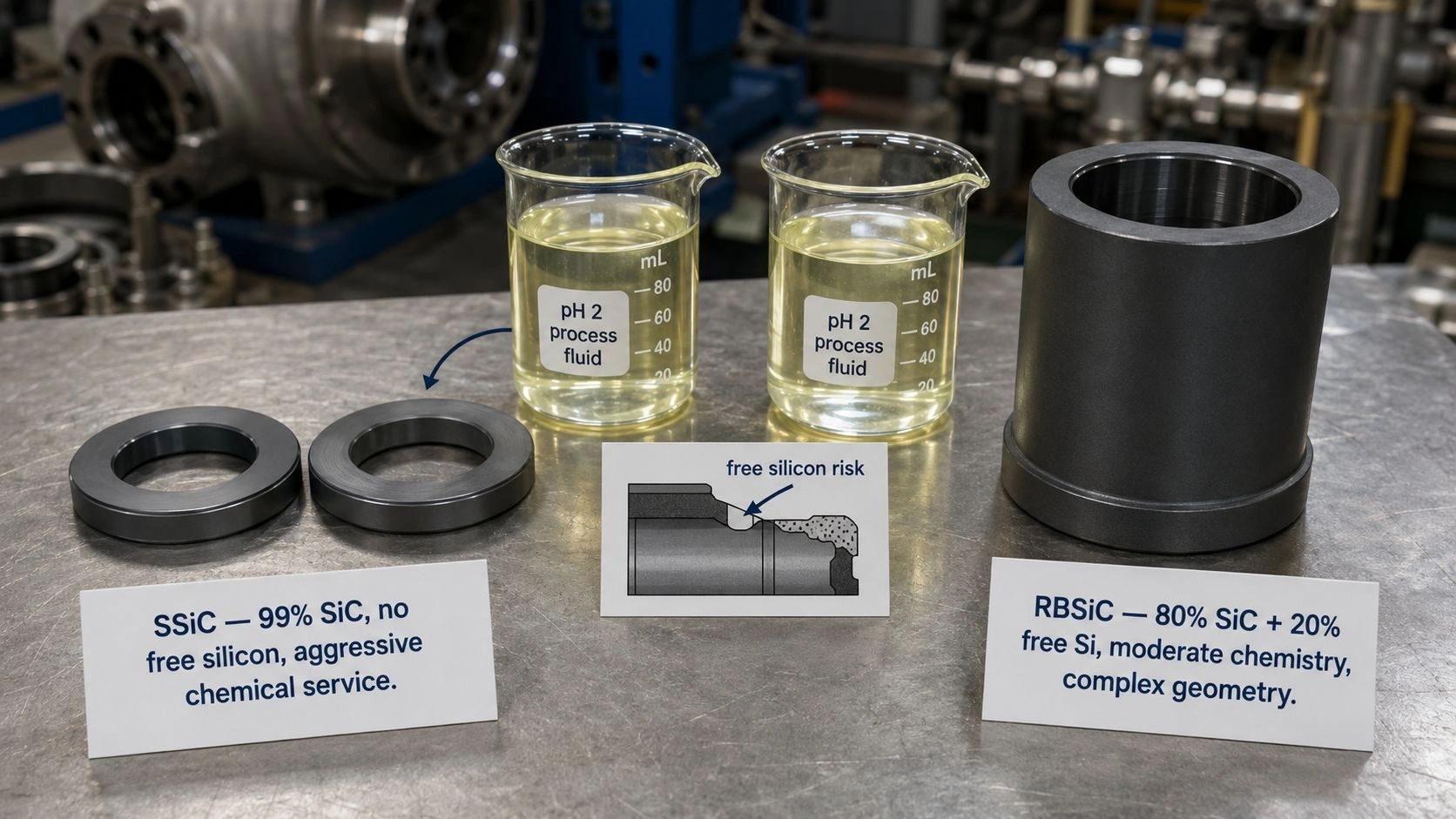
- Score the chemical / atmosphere severity next. If aggressive acid, alkali, or high-temperature corrosive media are the main constraint, SSiC's dense single-phase body is the strongest default. NBSC's porosity becomes a liability in dense-corrosion duty.
- Score thermal shock and cycling. Frequent, steep thermal transients favor NBSC's porous nitride-bonded structure; SSiC and RBSC are more sensitive to shock loading at comparable wall thicknesses.
- Score molten-metal contact, especially non-ferrous. Aluminum, zinc, and similar non-ferrous melts often favor NBSC's poor-wetting interface for immersion, protection, or quill tubes.
- Score tube geometry and cost. Large diameter, long length, tight near-net-shape tolerance, or low-shrink processing requirements push the selection toward RBSC when the service window allows.
- Resolve conflicts top-down. When two variables disagree, the higher-ranked variable in this list wins; conflict between thermal shock and corrosion is the most common reason engineers rebalance toward NBSC against an instinct to choose SSiC.
- Confirm with the supplier's tube-grade datasheet, not the generic material page. Tube-specific values for max service temperature, porosity, and flexural strength can differ from the bulk material card.
The threshold matrix below is the same logic in scan-reader form.
| Decision variable | Choose SSiC | Choose RBSC | Choose NBSC |
|---|---|---|---|
| Highest dense-grade corrosion resistance needed | Required | Acceptable below silicon ceiling | Usually not first choice |
| Temperature ceiling is the dominant constraint | Best fit (~1600°C window) | Avoid above ~1380°C | Acceptable in oxidative service (application-temperature ceiling 1550°C) |
| Free silicon acceptable in microstructure | Not relevant | Required to accept | No free silicon; porous Si₃N₄ bond instead |
| Large or near-net-shape tube geometry needed | Less attractive (cost / shrink) | Strongest fit | Acceptable |
| Thermal shock / cycling severity high | Acceptable | Acceptable in moderate cases | Strongest fit |
| Non-ferrous melt contact (immersion / quill / protection) | Possible | Possible | Frequently preferred |
Values indicative; verify with supplier-specific test data, applicable atmosphere, and the actual tube geometry.
The counterintuitive result for a reader scoring corrosion and temperature on instinct: NBSC, the porous one, is often the right answer when the duty is thermally cyclic and oxidative rather than chemically aggressive. The instinct to default to SSiC for ""high temperature"" misses that NBSC's working window in air can sit closer to SSiC than the density column suggests.
Choose SSiC when the service window is the real constraint
When the engineering decision is dominated by aggressive corrosion, the highest dense-grade temperature window, and zero tolerance for a free-silicon phase, SSiC is the default answer. Examples include tubes contacting strongly oxidizing or acidic process media at elevated temperature, tubes specified for the maximum dense-grade flexural and hardness performance, and tubes where any silicon-related softening near the ceiling would compromise the assembly.
Choose RBSC when shape and cost dominate under a softer ceiling
RBSC wins on near-net-shape capability, low or zero shrinkage during siliconizing, and accessible cost for larger tube envelopes. When the service temperature stays comfortably below the silicon-limited window and the chemical environment is moderate, RBSC is often the best total-cost answer for long, large-diameter, or dimensionally precise tubes that would be expensive to sinter dense.
Choose NBSC when thermal shock, oxidation, or non-ferrous contact drive the decision
NBSC's porous Si₃N₄-bonded body is selected for the duty profiles where dense routes underperform: thermocouple protection tubes in oxidizing atmospheres, immersion tubes for molten aluminum and similar non-ferrous melts, and burner or furnace-adjacent tubes that see thermal cycling. The selection logic is not ""NBSC is weaker""; it is ""NBSC's microstructure resolves a different problem.""
Once the route is shortlisted, lock OD/ID/wall/length and end finish against manufacturable silicon carbide tube geometry before treating the inquiry as drawing-complete.
What to ask the supplier before approving an SSiC, RBSC, or NBSC tube
Before locking a grade, request the tube-specific data that actually reflect the manufacturing route, not just the bulk material card. Composition or bond-phase identification, density, porosity, maximum recommended working temperature in the target atmosphere, room-temperature and (where available) elevated-temperature flexural strength, thermal conductivity, coefficient of thermal expansion, and any note on molten-metal wetting or corrosion limits should all appear before approval. The exact same RFQ template will not serve all three grades; each has a route-specific confirmation set that resolves the failure boundary the route is most exposed to. The list below is structured by the three grades plus the universal tube-geometry block that applies regardless of route.
The verification checklist:
SSiC tube confirmation
- Confirm the actual SSiC grade and any sintering-aid system noted on the datasheet.
- Confirm post-machining dimensional tolerance capability for the tube envelope (OD, ID, length, end style).
- Confirm whether the tube size or wall thickness pushes cost beyond the practical sintering range, and whether RBSC is being offered as a cost alternative.
- Confirm corrosion-relevant data for the target atmosphere (acid, alkali, oxidizing, reducing).
- Confirm the maximum working temperature stated for the tube specifically, not for a generic SSiC plate sample.
RBSC (SiSiC) tube confirmation
- Confirm residual free-silicon content or, equivalently, the stated maximum working temperature for the tube.
- Confirm whether the silicon-related ceiling is reported in air, inert, vacuum, or reducing service.
- Confirm whether the tube's near-net-shape advantage applies at the requested diameter and length, including any siliconization-related dimensional notes.
- Confirm chemical compatibility — RBSC is generally limited where strong alkalis or fluorides can attack the silicon phase.
- Confirm flexural strength at room temperature and at the planned service temperature where available.
NBSC tube confirmation
- Confirm whether the tube is open-porous or low-open-porosity, and the reported total porosity.
- Confirm whether the application depends primarily on oxidation resistance, thermal-shock performance, or low wettability against non-ferrous melts.
- Confirm the maximum working temperature in air for the tube.
- Confirm whether the porous structure has been engineered for a specific melt contact (e.g., aluminum, zinc) and any service-life expectation is reported as a range, not a point value.
- Confirm any surface treatment or sealing layer that changes the porous behavior in service.
Universal tube-geometry block (all three grades)
- Confirm OD, ID, wall thickness, length, and end style (square-cut, chamfered, closed-end, multi-bore).
- Confirm tolerance class for OD, ID, length, straightness, and concentricity.
- Confirm whether the tube is supplied as-fired, as-machined, or ground to a specified surface finish.
- Confirm thermal conductivity and CTE values used by the assembly designer for thermal stress and joint planning.
- Confirm whether dimensional or strength data are reported per a recognized test method (room-temperature flexural strength, density by Archimedes, etc.) rather than free-form descriptors.
For broader context across the wider ceramic tube materials family — alumina, mullite, zirconia, and the SiC routes — the same route-to-microstructure-to-service-window logic applies. The SiC three-route decision documented here is one branch of a wider tube-material decision tree.
Conclusion
The grade decision for SiC tubes flips on three variables more than anything else: temperature ceiling, chemical or atmosphere severity, and geometry/economics. SSiC wins when all three are pushed upward and a dense single-phase body is non-negotiable; RBSC wins when geometry and cost dominate under a service window below the silicon ceiling; NBSC wins when thermal shock, oxidation, or non-ferrous melt contact reshapes the property weight. The mistake that keeps repeating across tube projects is treating the three as quality tiers of the same material, and reading the bulk material page instead of the tube-specific datasheet. The next move is to request the route-specific confirmation set above before any RFQ approval.
Send peak temperature, atmosphere or melt chemistry, and the tube envelope (OD, ID, length, end style). Engineering review can return a route-fit checklist with the recommended grade family, the supplier-data confirmation list scoped to that grade, and verification points; turnaround depends on inquiry complexity.
Frequently Asked Questions
Which SiC tube grade is usually best for the harshest corrosion and highest dense-grade service window?
SSiC is usually the strongest default among the three when the goal is maximum dense-grade corrosion resistance and a higher working-temperature window — typically reported near 1600°C for tubes — without the free-silicon limitation of RBSC. NBSC, despite useful air-service performance, is generally not the first choice in dense-corrosion-dominated duty because its porosity opens additional pathways for chemical attack.
Why is RBSC often more economical for larger tubes even though it is not the highest-grade option?
The reaction-bonding route allows near-net-shape production with little or no shrinkage during siliconizing, which helps with larger or more dimensionally precise tubes that would be expensive to sinter dense. The trade-off is the residual free-silicon phase, which sets a service ceiling at 1380°C and limits chemical compatibility with strong alkalis and certain reactive media.
Why would an engineer choose NBSC if it is more porous than SSiC or RBSC?
NBSC's Si₃N₄-bonded porous structure delivers a useful combination of oxidation resistance, thermal-shock performance, light weight, and low wettability to non-ferrous melts, which is attractive for thermocouple protection tubes, immersion tubes, and burner-adjacent tubes. The decision is not about maximum density; it is about matching the bond-phase behavior to oxidative or thermally cyclic service.
Can SiC tube datasheets be treated as interchangeable when the base chemistry is still SiC?
No. Bond phase and porosity differ enough between SSiC, RBSC, and NBSC that interchangeable treatment is the most common diagnostic error in tube selection. In tube service, the bond-phase difference directly affects temperature ceiling, corrosion behavior, thermal-shock response, and the route-specific datasheet values that matter for approval.
Related reading
- SSiC vs RBSiC vs SiSiC grade selection guide — cross-form grade gate; this page stays on tube duty
- Free-silicon content in RBSC tubes and chemical resistance — RBSC free-Si boundary deep dive
- Active vs passive oxidation SiC failure modes — high-temperature oxide behavior; not the tube grade shortlist