Recrystallized SiC tubes are suitable for ultra-high-temperature furnace service when the application needs high-purity SiC, thermal shock resistance, dimensional stability, and better high-temperature capability than metal, alumina, or silicon-infiltrated SiC tubes. ReSiC is most useful in hot zones where temperature, thermal cycling, and oxidation resistance matter more than maximum room-temperature mechanical strength. The specification must define temperature, atmosphere, tube length, wall thickness, load, support spacing, end constraint, and whether open porosity is acceptable.
"Ultra-high temperature" in the context of industrial SiC furnace tubes typically means demanding service approaching the upper practical range of recrystallized SiC — commonly around 1600–1650°C depending on atmosphere and load. It does not mean unlimited temperature capability, and the useful service range must be confirmed against specific operating conditions before an RFQ is issued.
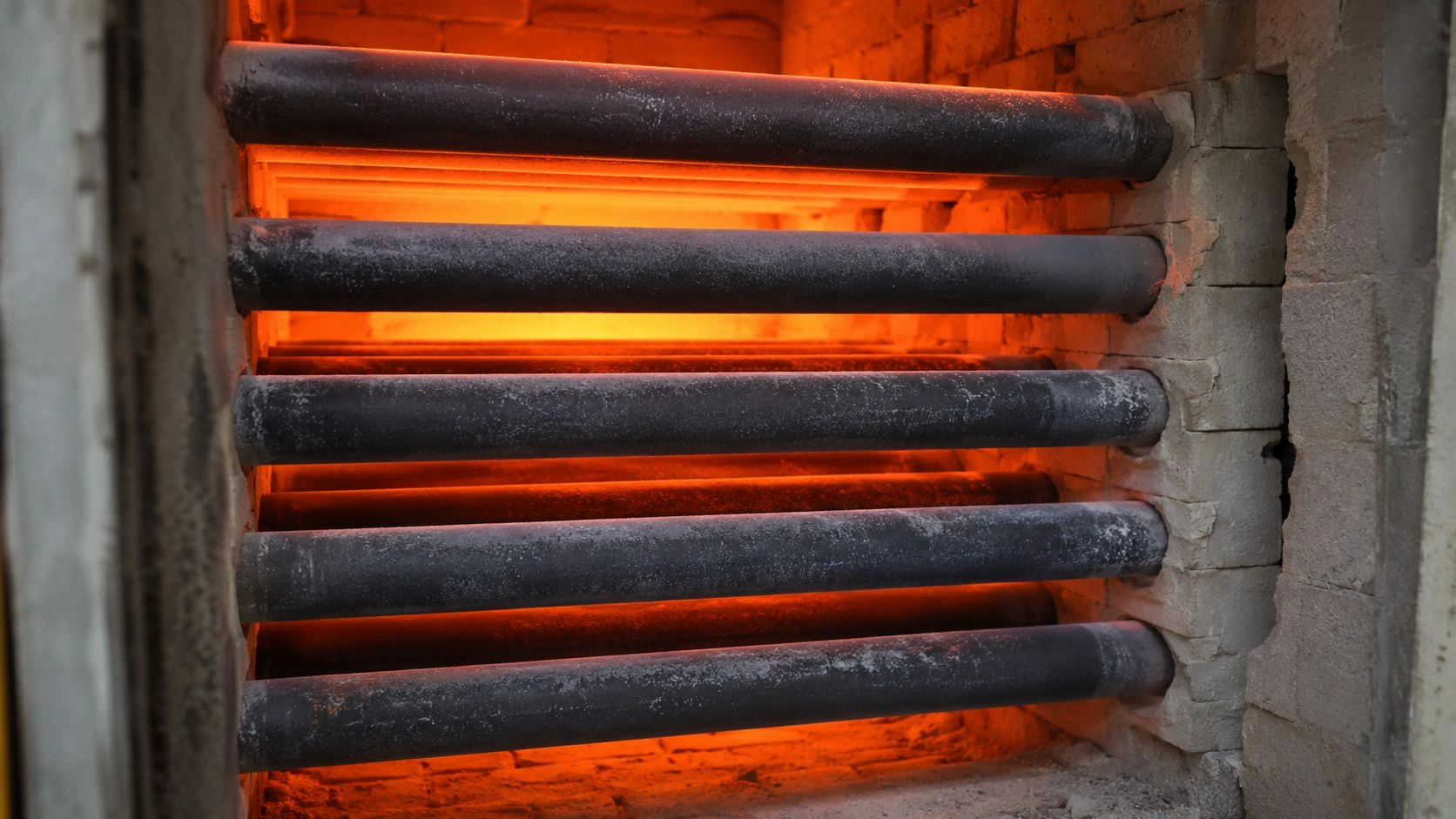
Recrystallized SiC tubes in ultra-high-temperature furnace service — open-porosity structure, high thermal conductivity, and no free-silicon phase make ReSiC the right choice for specific temperature and atmosphere conditions.
This guide is part of ADCERAX's silicon carbide tubes for high-temperature furnace systems coverage, which includes ReSiC, RBSiC, SSiC, and NBSiC grades for protection tubes, radiant tubes, heat exchangers, and kiln rollers.
3-minute decision: Specify a recrystallized SiC (ReSiC) tube when the hot-zone duty needs recrystallized silicon carbide — no free-silicon phase — and thermal shock / dimensional stability matter more than dense strength or hermetic walls. Stay on RBSiC/SiSiC when the free-silicon temperature boundary is acceptable and near-net strength wins. Move to dense SSiC when low porosity / chemical resistance dominates and the geometry is manufacturable. If the drawing requires gas-tight containment, do not assume ReSiC open porosity is acceptable — state permeability or reject the route. Catalog forms and multi-grade tube types live on the SiC tubes product page linked above; this article only decides when the recrystallized route fits ultra-high-temperature furnace service.
When ReSiC tubes should be selected for ultra-high-temperature service
ReSiC tubes should be placed on the candidate list when the furnace tube must operate in a hot zone where thermal shock resistance, oxidation stability at high temperature, and dimensional retention under sustained heat are the governing requirements.
The ReSiC Selection Matrix below maps six key decision variables to acceptance and caution conditions:
| Decision variable | ReSiC fits when | ReSiC needs caution when | What to verify |
|---|---|---|---|
| Temperature | Furnace service approaches upper SiC tube range | Temperature claim ignores load and atmosphere | Supplier-rated temperature by specific condition |
| Atmosphere | Clean air or controlled furnace atmosphere | Water vapor, alkali vapor, reducing or corrosive gases | Oxidation / corrosion compatibility |
| Tube size | Large high-temp tube geometry is needed | Long unsupported span or heavy internal load | Support spacing and wall thickness |
| Gas-tightness | Open porosity is acceptable for the application | Process requires hermetic containment | Porosity and leak requirement |
| Thermal cycling | Rapid thermal cycling is expected | Ends are rigidly restrained during expansion | Expansion allowance design |
| Material comparison | RBSiC free-silicon limit is unsuitable | Dense strength is the dominant requirement | ReSiC vs SSiC / RBSiC selection |
Values indicative; verify with supplier-specific ReSiC grade data, furnace atmosphere, load condition, and application trials.
Recrystallized SiC is commonly described as a high-purity SiC body without a secondary free-silicon bonding phase — the absence of free silicon is the key structural reason why ReSiC's useful temperature ceiling extends above that of reaction-bonded SiC grades. Supplier data commonly places ReSiC maximum working temperature around 1650°C, and the material family is consistently cited in high-temperature furnace literature for its high thermal conductivity, low thermal expansion coefficient, and thermal shock resistance relative to oxide ceramics.
ReSiC as a high-temperature furnace construction material
The practical use cases for ReSiC tubes in ultra-high-temperature service include thermocouple protection tubes in high-temperature kiln and furnace environments, radiant tube heating systems in indirect-fired industrial furnaces, kiln roller and furniture support components, and heat-transfer tubes in thermal processing applications. In each case, the value comes from the combination of thermal conductivity (which enables efficient heat transfer without overheating the tube surface), thermal shock tolerance (which allows cycling without cracking), and high-temperature dimensional stability (which keeps tube geometry within tolerance across many thermal cycles).
Why maximum temperature must include atmosphere and load
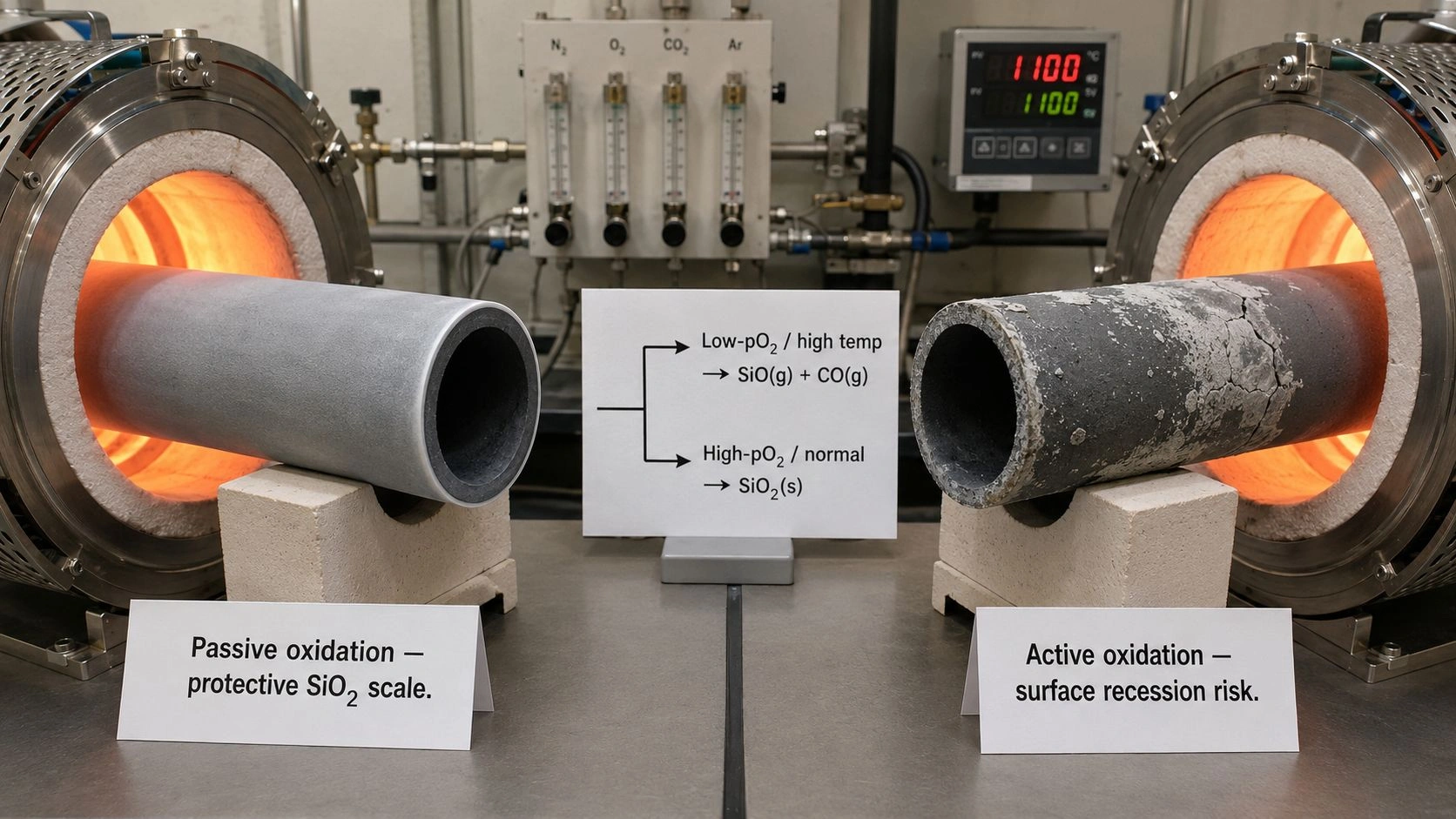
A ReSiC tube rated to 1650°C in one published data table does not mean 1650°C is safe in every atmosphere under every load condition. In oxidizing air service, ReSiC develops a passive silica surface layer that provides protection. In water vapor, alkali vapor, or strongly reducing conditions, the degradation mechanism changes. Under mechanical load or with an excessive unsupported span, creep or bending may become limiting before the nominal temperature ceiling is reached. The specification must state temperature, atmosphere, and load together.
Where ReSiC fits in radiant tubes, protection tubes, and kiln furniture
For radiant tube applications, the SiC tubes for high-temperature furnace systems include single-ended, U-tube, and straight configurations in SiC grades appropriate for indirect-fired furnace heating. For protection tube applications, the tube must isolate a thermocouple or sensor from the furnace atmosphere while surviving repeated thermal cycling. For kiln furniture and roller applications, the tube must carry mechanical load at temperature. Each of these roles requires different attention to support, wall thickness, and end-restraint design — not just material grade.
How ReSiC compares with RBSiC, SSiC, NSiC, and alumina tubes
The grade comparison table below places ReSiC against five common alternatives:
| Material / grade | Typical strength | Main advantage | Main limitation | Best-fit use |
|---|---|---|---|---|
| ReSiC | Moderate vs dense SiC | High-temperature construction, thermal shock, purity, no free-silicon | Open porosity and lower strength than dense SiC | Furnace tubes, kiln furniture, radiant tubes |
| RBSiC / SiSiC | High mechanical strength | Near-net-shape and good thermal conductivity | Free silicon limits upper temperature ceiling | Structural parts below free-silicon boundary |
| SSiC | High dense-ceramic strength | Low porosity, chemical resistance | Cost / size / processing constraints for large tubes | Dense wear and corrosion parts |
| NSiC | Good kiln-furniture utility | Thermal shock and structural support | Nitride bond has its own oxidation boundary | Kiln furniture and supports |
| Alumina | Electrical insulation, wide availability | Low cost and high-temperature oxide stability | Lower thermal shock resistance vs SiC | Insulating protection tubes |
| Metal tube | Tough and machinable | Easy fabrication and joining | Creep and oxidation at high temperature | Lower-temperature structural tube |
Grade comparison is indicative; verify all boundaries against supplier-specific data and specific furnace operating conditions.
General SiC property data from published NIST and NASA sources confirms why the SiC material family is attractive for high-temperature applications: high thermal conductivity, good oxidation resistance in clean atmospheres, and thermal shock resistance. Within that family, ReSiC's position is defined by the absence of free silicon and the resulting higher temperature ceiling relative to RBSiC, alongside the open-porosity tradeoff relative to SSiC.
ReSiC vs RBSiC: the free-silicon boundary
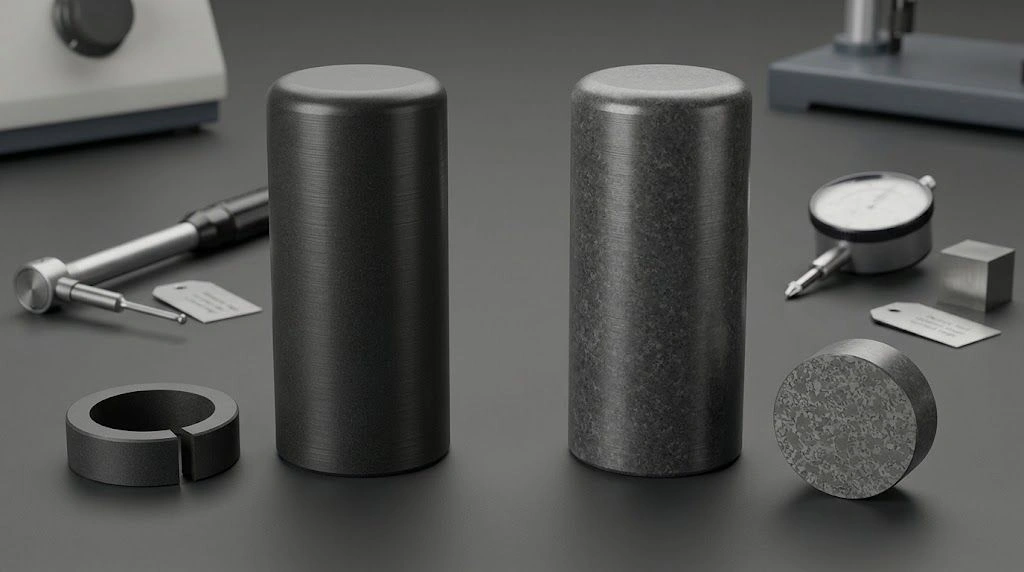
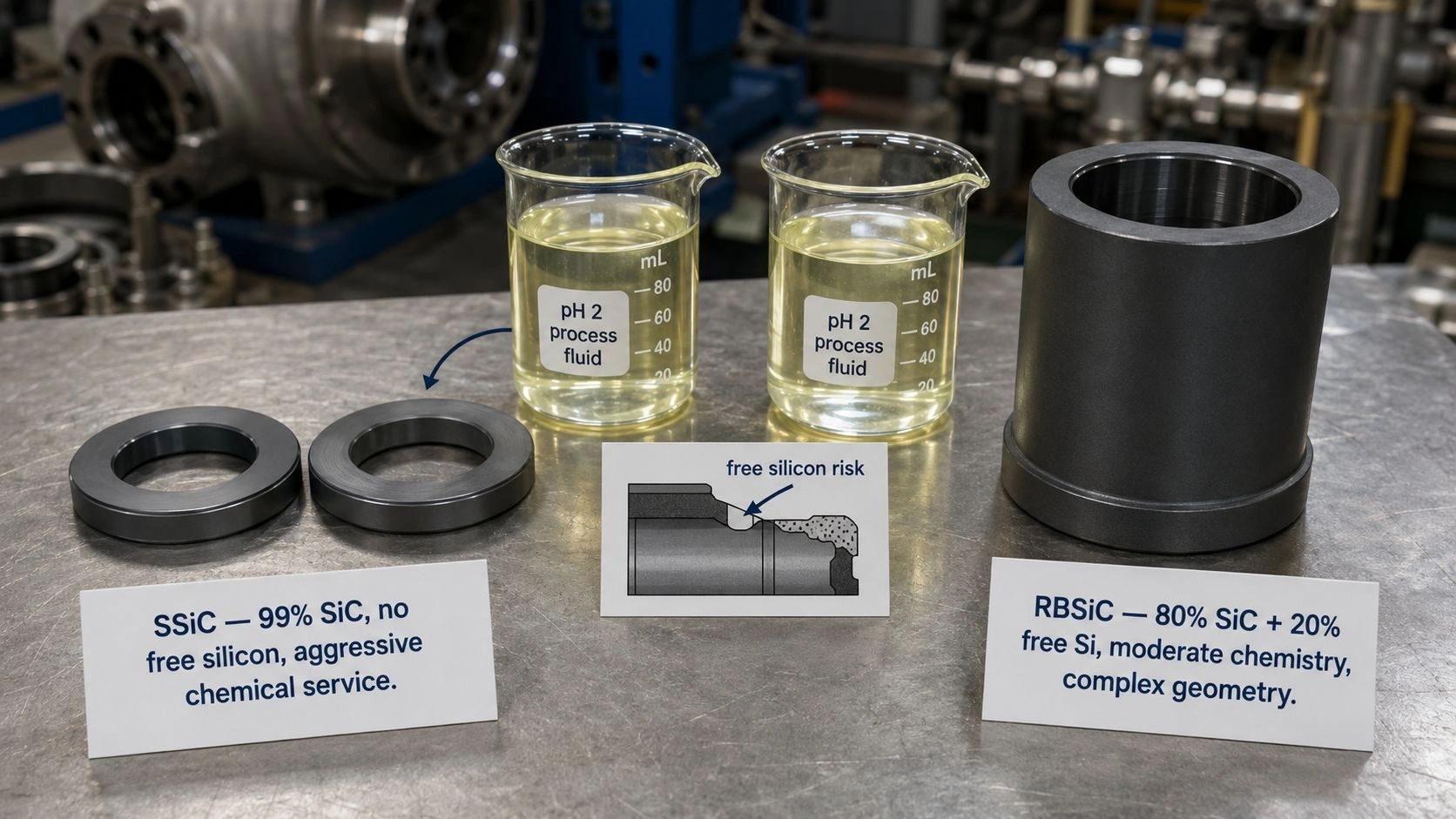
Reaction-bonded SiC (RBSiC or SiSiC) contains residual free silicon from the manufacturing process. That silicon phase limits the upper service temperature because silicon melts at approximately 1414°C and softens below that. ReSiC avoids this limitation by using a recrystallization process rather than silicon infiltration, making it better suited to service conditions that approach or exceed the RBSiC practical ceiling.
ReSiC vs SSiC: high-temperature construction vs dense strength
Sintered SiC (SSiC) achieves higher mechanical strength and lower porosity through pressure-assisted or additive-aided densification. That gives it better wear resistance, chemical resistance, and structural strength in applications where those are the governing requirements. For large-format furnace tubes where thermal cycling and high-temperature dimensional stability are the priorities, ReSiC may be more practical to manufacture at the required scale and dimensions, and its thermal shock tolerance under cycling conditions is a genuine advantage.
ReSiC vs alumina: thermal shock and heat transfer
Alumina is the baseline ceramic for thermocouple protection tubes and furnace tube service in the temperature range up to approximately 1700°C in clean air. Alumina is electrically insulating — a property relevant when protecting precious-metal thermocouples — and is compatible with many furnace atmospheres. SiC routes, including recrystallized SiC, typically offer substantially higher thermal conductivity than alumina (alumina often cited around 20–30 W/m·K; dense SSiC selection values in ADCERAX TDS Rev05 are 100–120 W/m·K — do not transfer dense SSiC numbers onto porous AD-SIC-RC/ReSiC; confirm ReSiC conductivity per ordered grade), which affects both heat transfer performance and thermal shock behavior. When rapid heating and response are required, or when the tube must conduct heat efficiently rather than insulate, ReSiC's higher conductivity becomes an engineering advantage.
When open porosity becomes a limitation
ReSiC's open porosity — a defining trait of the porous recrystallized skeleton (ADCERAX AD-SIC-RC: porosity, hot strength, and permeability are specified per ordered kiln/furnace component; there is no universal numeric grade table) — means gas and liquid can permeate through the tube wall if no other barrier exists. For applications where the tube must maintain a hermetic separation between two atmospheres — a gas-tight thermocouple sheath, a sealed process tube, or a gas barrier in a chemical processing system — ReSiC is not appropriate unless the supplier confirms that the specific grade and wall geometry meet the required permeability specification. Specifying ReSiC and assuming gas-tightness is one of the most common procurement errors in high-temperature ceramic tube applications.
Do not misdiagnose support, atmosphere, or load problems as ReSiC failure
Not every cracked, sagging, or degraded ReSiC tube represents a material quality failure. Before attributing a failure to the ReSiC grade, four system-level causes should be evaluated first:
Crack at a support point suggests point loading or thermal expansion restraint rather than bulk ceramic fracture. When the tube is restrained at both ends and cannot elongate during heating, axial stress builds up over thermal cycles and eventually produces circumferential cracking near the constraint points. Prevention requires securing the tube at one end only and allowing free axial expansion at the other.
Oxidation surface layer vs corrosive atmosphere damage. In clean air at high temperature, ReSiC forms a passive silica surface layer that provides continued protection. That is a normal feature of the material, not evidence of degradation. However, in water vapor, alkali salt vapor, or highly reducing conditions, the silica layer dissolves or destabilizes and the degradation mechanism changes fundamentally. Published NASA research on oxidation behavior of SiC-based ceramics identifies environment as a primary variable in determining how SiC oxidizes at high temperature — confirming that not all surface changes on ReSiC tubes represent the same failure mode.
Open porosity vs gas-tightness requirement. If the application specified a gas-tight tube and ReSiC was supplied without confirmation of the porosity level, the apparent failure is a specification mismatch, not a material defect. ReSiC open porosity must be declared and accepted or rejected as part of the purchasing specification.
Long-span sag vs wrong support design. ReSiC has lower mechanical strength than SSiC and can sag under sustained load at high temperature, especially in horizontal furnaces with long unsupported spans. When sagging appears, the first diagnostic question should be whether the support spacing exceeds the tube's sag-resistance specification for the given temperature and load — not whether the material grade is incorrect.
The most useful misdiagnosis prevention rule for ReSiC tubes: do not replace the tube with a higher-grade material until support spacing, end constraint, atmosphere compatibility, and load condition have each been confirmed as within the tube's specification. Most repeat failures after ReSiC tube replacement occur because the system cause was not corrected.
The SiC tubes and heat exchange components at ADCERAX include tubes in multiple SiC grades — and the correct selection for a given application depends on confirming which of the above conditions is the governing variable, not on selecting a higher-purity or higher-strength grade generically.
Design variables that control ReSiC tube reliability
Four design variables govern ReSiC tube reliability in high-temperature service:
Wall thickness and thermal gradient. Thicker walls increase mechanical margin but also increase the temperature difference between the outer and inner tube surface under rapid heating. For kiln applications with frequent thermal cycling, moderate wall thickness with controlled ramp rates is often preferable to maximum wall thickness.
Tube length, support spacing, and load. The bending stress in a horizontal tube under its own weight or under internal load increases sharply with unsupported span length. For long horizontal ReSiC tubes, the support spacing should be confirmed against the tube's published sag resistance at the operating temperature — not assumed from room-temperature mechanical data.
End constraint and expansion allowance. ReSiC has a low coefficient of thermal expansion relative to metals, but it still expands measurably at high temperature. If the tube is rigidly clamped at both ends in a metal fixture, thermal expansion during heating creates compressive stress that can crack the tube. One-end-fixed, one-end-free is the standard design recommendation for ceramic furnace tubes.
Atmosphere and gas-tightness boundary. The atmosphere specification must accompany the tube grade specification. A tube that is suitable for clean air service may not be suitable for reducing atmosphere, water-vapor-rich exhaust, or alkali-containing furnace chemistry without additional evaluation.
RFQ checklist for ReSiC tubes in ultra-high-temperature furnaces
The RFQ Fields table below provides minimum specification language for procurement:
| RFQ field | Why it matters | Recommended wording |
|---|---|---|
| SiC grade | Prevents ReSiC/RBSiC/SSiC confusion | "Quote recrystallized SiC tube; identify grade and forming route" |
| OD / ID / length / wall | Controls fit and thermal stress | "Confirm dimensions, tolerance, and straightness" |
| Operating temperature | Defines service boundary | "Confirm suitability for continuous and peak temperature" |
| Atmosphere | Controls oxidation/corrosion behavior | "State air, inert, reducing, water vapor, or process gas" |
| Support spacing | Controls bending and point stress | "Review horizontal support layout and minimum support spacing" |
| Load condition | Determines stress and sag risk | "Specify internal fixtures, samples, or external loading" |
| Porosity / gas-tightness | ReSiC may be open porous | "Confirm whether open porosity is acceptable or state required permeability" |
| Thermal cycling | Controls shock and expansion stress | "Review ramp/cooling profile and end constraint design" |
In addition to the RFQ fields, the inquiry should include a furnace layout drawing showing support point locations, hot-zone length, and end-seal or mounting hardware details for horizontal installations. For long tubes, include the span dimension between supports and the expected internal load per support point.
The silicon carbide ceramic material and ceramic tubes category at ADCERAX provide cross-grade and cross-material context for completing this evaluation — including comparison against alumina, zirconia, and BN tube options when the SiC route requires further qualification.
Evaluating ReSiC tubes for ultra-high-temperature furnace service? Share your tube drawing, operating temperature, atmosphere, thermal cycling profile, support layout, load condition, and gas-tightness requirement. ADCERAX engineers review whether ReSiC, RBSiC, SSiC, NSiC, or another ceramic tube grade is the better fit and return a grade recommendation with dimensional confirmation and application notes; turnaround depends on inquiry complexity — no RFQ commitment required at this stage.
Frequently Asked Questions
What is a recrystallized SiC (ReSiC) tube?
A recrystallized SiC tube (also written recrystallized silicon carbide tube, ReSiC, or RSiC) is a tube made from recrystallized silicon carbide — a high-purity porous SiC skeleton formed by recrystallization rather than by silicon infiltration or pressure sintering. The absence of a free-silicon bonding phase is the key structural feature, giving ReSiC a higher practical temperature ceiling than reaction-bonded SiC grades when atmosphere and load allow.
What temperature can ReSiC tubes withstand?
Supplier data commonly places ReSiC working temperature around 1650°C, but that figure is meaningful only when combined with atmosphere, mechanical load, tube size, and thermal cycling conditions. In water vapor, alkali vapor, or heavily reducing conditions, the effective service temperature may be lower. Grade-specific data from the supplier under the specific operating conditions must be confirmed before committing to a specification.
Is ReSiC better than RBSiC?
ReSiC is better when the application involves temperatures that approach or exceed the free-silicon melting point boundary of reaction-bonded SiC, or when high-purity SiC without a secondary phase is required. RBSiC may be better when higher mechanical strength, near-net-shape forming, or lower-temperature structural duty is more important and the temperature window does not require exceeding the RBSiC practical ceiling.
Is ReSiC gas-tight?
Not automatically. ReSiC is often associated with open porosity, typically in the range of approximately 10–20% depending on grade and process. For gas-tight process tubes, the supplier must confirm permeability or leak performance for the specific grade and wall geometry. Assuming gas-tightness without that confirmation is one of the most common specification errors in ReSiC tube procurement.
Why do ReSiC tubes still crack or sag?
Cracking most commonly results from point loading at a support, rigid end constraint that prevents thermal expansion, or thermal gradient stress from rapid cycling — not from material quality alone. Sagging most commonly results from excessive unsupported span or load at temperature relative to the tube's creep resistance specification. Before replacing a cracked or sagged tube with a higher-grade material, the support layout, end constraint, and load condition should be reviewed against the tube's design limits.
What should I send to a supplier for ReSiC tube evaluation?
Send OD, ID, length, wall thickness, operating and peak temperature, atmosphere type, thermal ramp and cooling cycle, furnace orientation, horizontal support spacing, internal or external load description, end connection hardware details, gas-tightness requirement, and current failure photos or description if replacing an existing installation. A furnace layout drawing showing the hot-zone position and support point spacing is especially useful for long horizontal tubes.