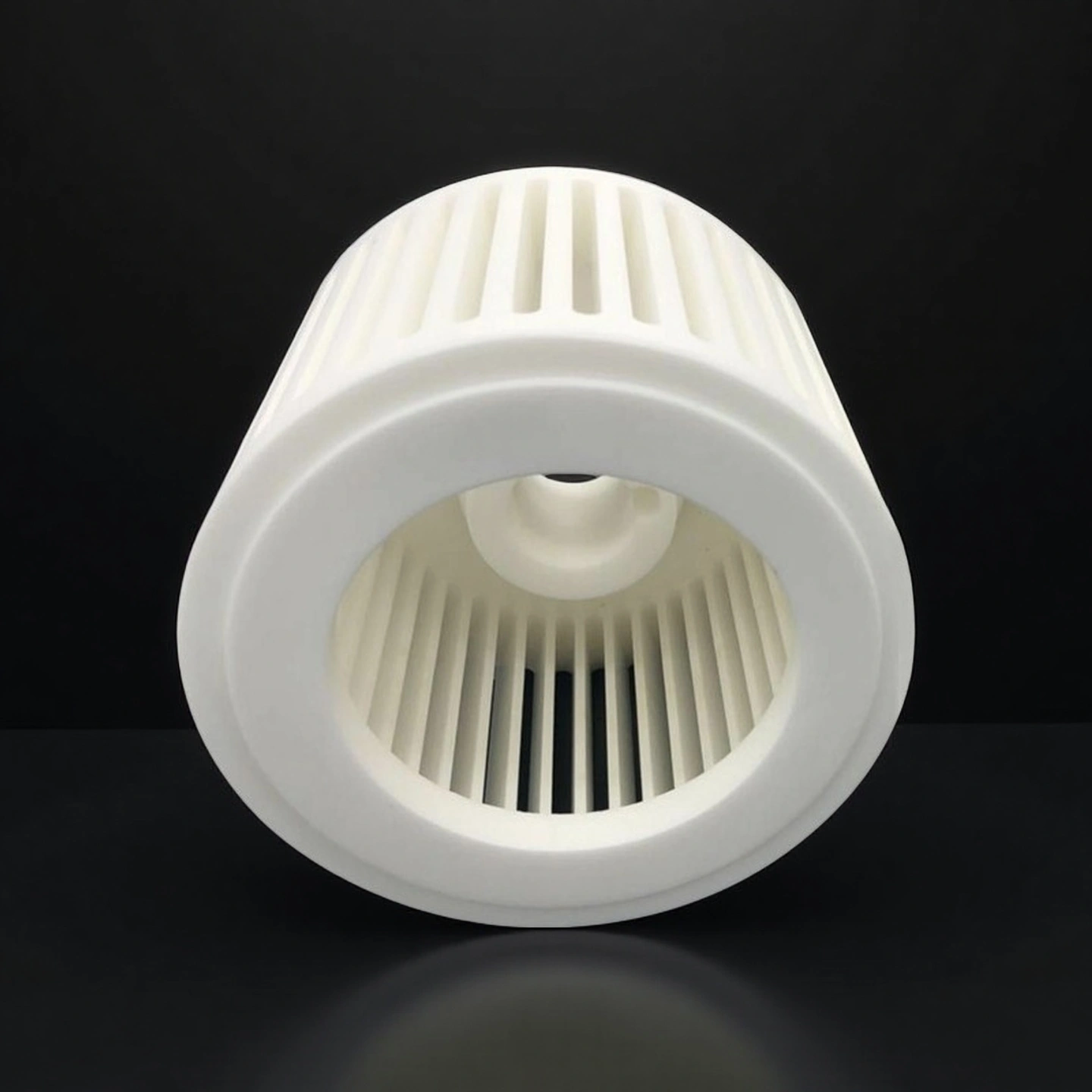
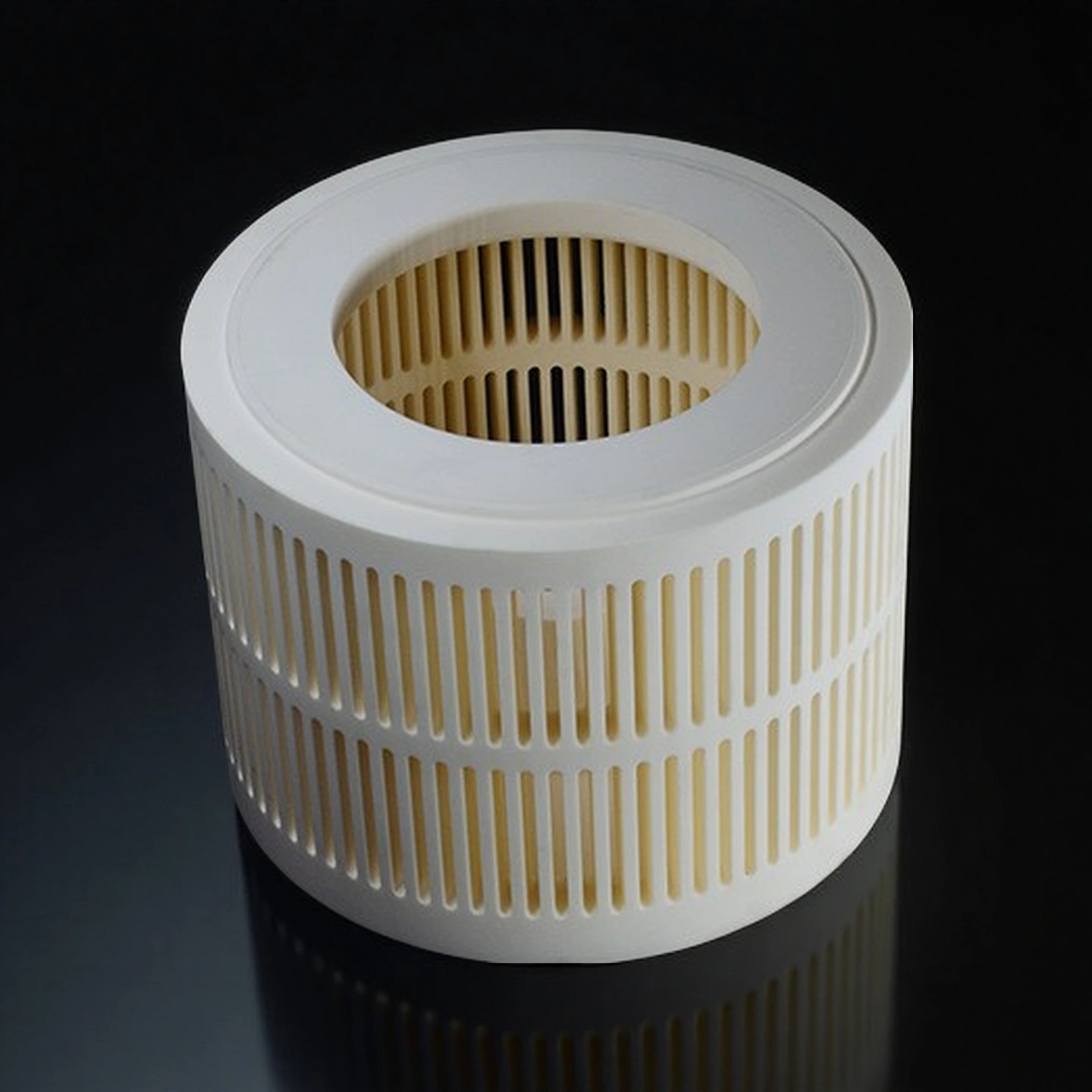
Alumina Ceramic Classifier Wheel for Air Classifier and Sand Mill Systems

This alumina classifier wheel for air classifiers and sand mills is supplied in standard diameters for common mill models and in fully customized designs by drawing or sample. Outer and inner diameters, thickness, slot number and profile can be tailored to your powder cut size, process air volume and machine layout.

Catalog No. AT-SM-A001
Material 95% -99.7% Al2O3
Process duty Dry-powder separation in air classifiers and classifier mills.
Equipment fit Blade/slot layout and hub interface matched to your drawing.
Diameter/Size Download More Sizes
Engineering RFQ Review
Small-Batch Custom Support
Drawing-Based Production
Drawing & Process Review

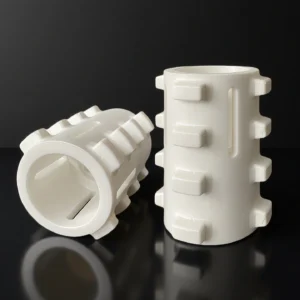
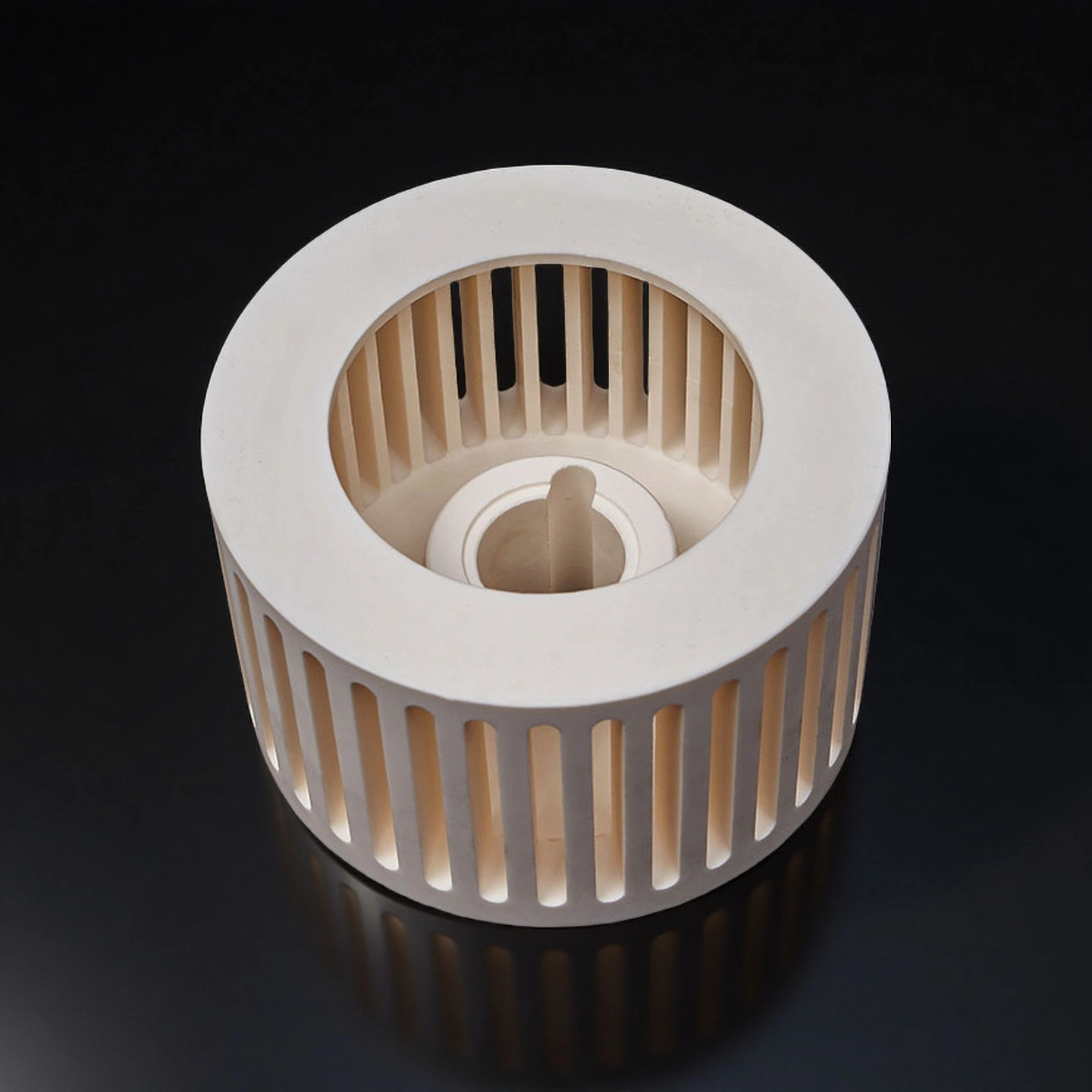
An alumina ceramic classifier wheel is the rotating ceramic part inside an air classifier, classifier mill or jet mill. It works with the airflow to separate fine powder from coarse powder, and it is supplied as a wheel body with slots or blades and a bored hub, made to the geometry your equipment uses.

Dense Alumina Material Performance for Classifier Wheels

The six wheel references above list 95–99% Al₂O₃. The columns below support grade comparison; the grade and inspection criteria for the ordered wheel are set in the accepted specification.

Composition and Mechanical Reference

Property / basis 99.9% Al₂O₃ 99.7% Al₂O₃ 99.5% Al₂O₃ 99% Al₂O₃ 96% Al₂O₃ 95% Al₂O₃
Nominal Al₂O₃, wt% 99.90 99.70 99.50 99.00 96 95
IEC 60672-3 composition grouping C799 C799 C799 C795 C795 C795
Density, g/cm³; typical 3.94 3.94 3.90–3.92 3.80–3.91 3.70 3.75
Flexural strength, MPa; 20°C; typical 315–340 330 320–350 300–320 300 280
Compressive strength, MPa; 20°C; typical 2558–2900 2500 2400 2400 2000 2000
Young’s modulus, GPa; typical 359–375 370 365 355 275 at 20°C 340
KIC, MPa·m½; method-dependent 3.8–4.2 3.6 3.5 3.3 3.5 at 20°C 3.0
Color Ivory Ivory Ivory Ivory White Ivory / white
Water absorption, %; selection limits except 96% ≤0.01 ≤0.05 ≤0.10 ≤0.10 ≈0; typical, rounded ≤0.20
Mohs hardness; typical 9 9 9 9 — 9
Vickers hardness; HV1, 1 kgf; typical — — — — 1600 —

*IEC C795/C799 identify material composition groups. Values are material-level; the ordered wheel drawing defines dimensions and acceptance. A dash marks a property to request when it governs selection.

Thermal Material Selection

Property / basis 99.9% Al₂O₃ 99.7% Al₂O₃ 99.5% Al₂O₃ 99% Al₂O₃ 96% Al₂O₃ 95% Al₂O₃
Thermal conductivity, W/(m·K); typical 35–42 at 25°C 35–40 at 25°C 30–38 at 25°C 24 at 25°C 25 at 20°C 18–25 at 25°C
Mean CTE, 10⁻⁶/K; stated interval 7.6; 25–800°C 7.6; 25–800°C 7.6; 25–800°C 7.2; 25–800°C 8.2; 25–1000°C 7.6; 25–800°C
Material service-temperature guide, °C; application-dependent 1750 1700 1650 1600 1600 maximum in air 1400

*The temperature values guide material selection. Set the operating envelope for the wheel, hub, joints, shaft and bearings using the actual load, atmosphere, gradient, dwell and cycle; the 96% column's 1600°C value is a maximum-in-air material reference.

Electrical Material Selection

Property / basis 99.9% Al₂O₃ 99.7% Al₂O₃ 99.5% Al₂O₃ 99% Al₂O₃ 96% Al₂O₃ 95% Al₂O₃
Dielectric strength, kV/mm; typical; specimen conditions 10; 5 mm 10; 5 mm 10; 5 mm 10; 5 mm 8.3; AC, 6.35 mm 10; 5 mm
Relative permittivity; 1 MHz; typical 9.8 at 25°C 9.8 at 25°C 9.7 at 25°C 9.6 at 25°C 9.0 at room temperature 9.4 at 25°C
Dissipation factor; 1 MHz <0.0001 at 25°C <0.0001 at 25°C <0.0001 at 25°C 0.0006 at 25°C 0.0002 at 20°C 0.0004 at 25°C
Volume resistivity, Ω·cm; 20°C >10¹⁴ >10¹⁴ >10¹⁴ >10¹⁴ 10¹⁴; typical >10¹²

*For an electrical duty, define the finished component or assembly test, temperature, specimen or part geometry, method, sampling and acceptance limit.

Alumina Ceramic Classifier Wheel Specifications

Alumina Grading Wheel
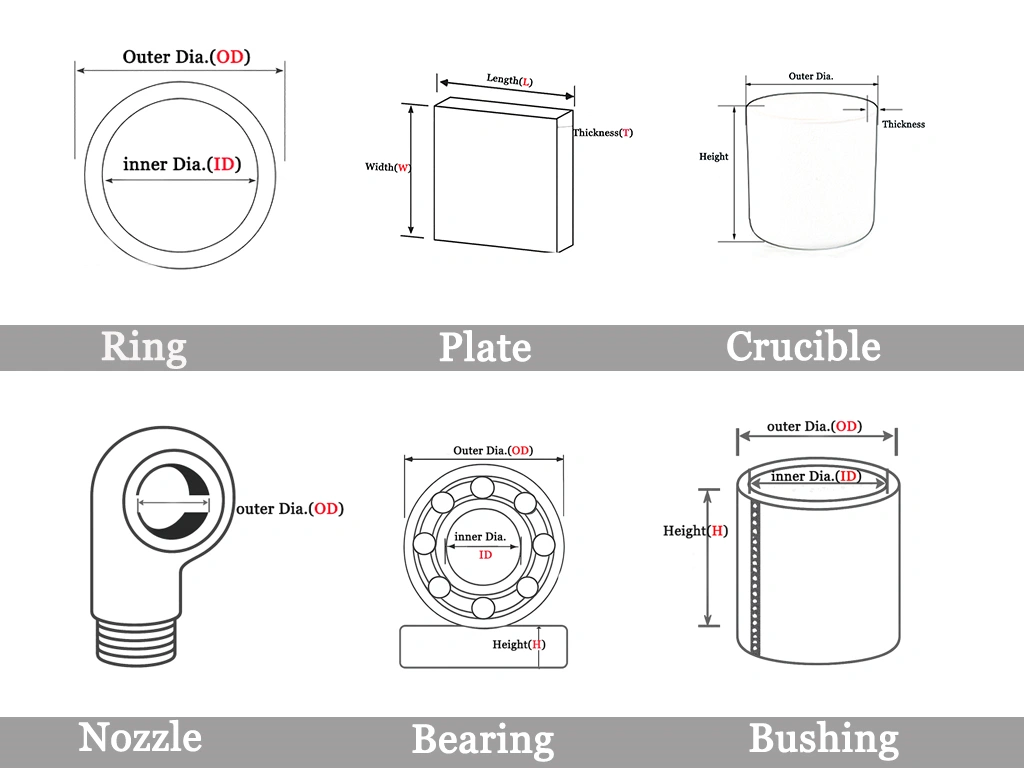
Item No. Outer Diameter(mm) Inner Diameter  (mm) Height (mm) Purity
AT-SM-A001 50 30 70 95%-99%
AT-SM-A002 80 65 90 95%-99%
AT-SM-A003 100 75 80 95%-99%
AT-SM-A004 155 135 95 95%-99%
AT-SM-A005 250 220 100 95%-99%
AT-SM-A006 260 240 120 95%-99%

Download the Product Catalogue

How to Choose an Alumina Ceramic Classifier Wheel

Most enquiries come from five situations. Find yours in the table below, then check the two columns that matter for it. If you are not sure which one applies, send the wheel drawing or a photo of the worn part and we will tell you what we need.

Your situation What decides the wheel you need What we will ask you first
You build air classifiers, classifier mills or jet mills and need the ceramic wheel as a bought-in component The drawing revision, the rotation, the bore and hub fit, and the wheel envelope inside the housing. Equipment model and the drawing or 3D model; the direction of rotation; whether the wheel is supplied alone or as part of a rotor assembly.
You run a powder line and a wheel is worn out and needs replacing The part number or the worn wheel itself, plus the slot and blade geometry that changed during wear. Photos of the worn wheel, the part number if it is visible, and how long it lasted; whether anything else changed before it failed.
You classify an abrasive mineral or ceramic powder Where the wear appears — slot edges, blade leading edges, the disc or the rim — and how you measure it. Powder type, typical particle size, throughput, and the wear measurement you already use.
You classify a powder where metal pickup must stay low The alumina grade and the full powder contact path, not only the wheel body. The elements you monitor, your current analytical method and detection limits, and your allowed increase over the incoming powder.
You buy spare parts or maintain powder equipment for others A repeatable specification: the accepted drawing, grade and sample kept on file. Your expected quantities and whether you want one size or several; the parts you normally keep in stock.
You need a size that is not in the listed table The drawing-based custom route, approximately 80–600 mm OD. A sketch, drawing or sample with the main dimensions; the machine model; and any speed or balance requirement you already know.

Two things decide whether a ceramic wheel fits your machine: the bore and hub interface, and the slot and blade geometry together with the direction of rotation. The same outside diameter does not make two wheels interchangeable — slot count, slot width, angle, effective height and the hub fit all have to match.

Alumina vs Silicon Nitride, Zirconia and Metal Classifier Wheels

Wheel material Normally chosen when What to watch
Dense alumina (Al₂O₃) Abrasive powders, and powders where metal pickup must stay low. Widely used for mineral, ceramic, pigment, chemical and battery-material classification. Edges and thin blade sections are the first places to inspect. Dense alumina has good hardness and wear resistance but less tolerance for impact than some other ceramics.
Silicon nitride (Si₃N₄) Where impact and thermal shock are the concern and edge chipping drives replacement. Different grade family and a different price level. Request the grade data for the actual material if you compare it with alumina.
Zirconia (ZrO₂) Where a dense, high-strength ceramic is wanted and the powder is sensitive to contamination from the wheel. Considerably heavier than alumina, which changes the rotating mass and the balance work on the assembly. Confirm the grade family, because zirconia grades differ a lot.
Steel or alloy wheels Low-abrasion powders, or where a metal wheel has been acceptable and cost drives the decision. Metal is removed at the blade and slot edges by abrasive powder, and that material enters the powder stream. Wear changes the geometry, so the cut size drifts between replacements.

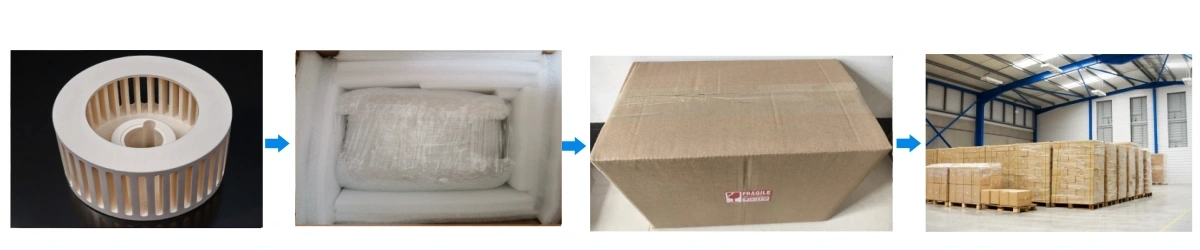
Alumina Ceramic Classifier Wheel Packaging

  • Each alumina ceramic classifier wheel is wrapped with soft cushioning material around the blades and bore to minimize impact and edge chipping during transit.
Alumina Ceramic Classifier Wheel Packaging

Where Alumina Ceramic Classifier Wheels Are Used

  • Battery-material powders

    Keeping metal pickup low and holding the particle size distribution you specified
    1. The alumina grade and the full powder contact path are the basis for the contamination check
    2. The wheel geometry works with the classifier process to reach the cut size
    3. Verify by comparing incoming powder, process blanks and classified powder

  • Mineral and abrasive powders

    1. Wear at the slot edges, blade edges and contact surfaces
    2. Planning the replacement interval
    3. The alumina grade and the geometry are selected for the abrasive duty
    4. Wear at named locations over a stated throughput is the basis for confirming the cut size stays within your limit

  • Chemical and functional powders

    Exposure to the powder and build-up on the wheel
    1. A cleaning method that does not damage the edges
    2. Material compatibility and accessible surface geometry define how the wheel can be cleaned, dried and inspected before reuse
    3. Agree the cleaning agent and method with us if you reuse the part

For any of the three, compare results using the same powder, the same airflow, the same feed rate and the same sampling method for the wheel configuration you are testing. A result from one powder and one machine does not carry over to another.


Alumina Ceramic Classifier Wheel Usage Instructions

  • Before installation

    1. Verify the wheel diameter, bore size, direction of rotation and mounting pattern against the machine manual
    2. Check the part number and drawing revision against the accepted specification
    3. Clean the hub, shaft and contact surfaces, and inspect the slot edges, blade edges and bore for chips, cracks or transit damage

  • Mounting

    1. Seat the wheel on clean mating surfaces; use the fastening sequence and torque set by the equipment maker
    2. Tighten in a cross pattern with a calibrated wrench to avoid point loading on the ceramic hub
    3. Check axial and radial runout with a dial indicator, and adjust until it is within the mill manufacturer's limits

  • Commissioning

    1. Ramp up speed according to the machine's standard start-up procedure; avoid sudden acceleration
    2. Monitor vibration and noise during the first hours of operation
    3. Run within the machine-approved speed programme and air volume. If the cut size has to change, review the process settings and the wheel specification with us rather than raising speed

  • Cleaning and reuse

    1. Clean at planned shutdowns, and inspect the slot edges, blade edges and hub surfaces each time
    2. Choose a cleaning method that protects the thin edges; dry the part fully after a wet clean before restart
    3. Re-check fit and balance before putting the wheel back into service

  • Storage

    1. Store indoors on flat, cushioned surfaces, and do not stack unprotected wheels directly
    2.  Keep the part number and drawing revision visible for quick identification

FAQ – Alumina Ceramic Classifier Wheel

  1. Q: What is an alumina ceramic classifier wheel used for?
    A: An alumina ceramic classifier wheel is used inside air classifiers, jet mills and classifier mills to separate fine and coarse powder fractions, controlling the particle size distribution of minerals, pigments, chemicals and battery materials.
  2. Q: Why choose an alumina ceramic classifier wheel instead of a metal wheel?
    A: Compared with metal wheels, an alumina ceramic classifier wheel offers higher wear resistance and a metal-free powder path, which reduces iron contamination and extends service life in abrasive and high-purity applications.
  3. Q: What alumina purity is typical for your alumina ceramic classifier wheel?
    A: Alumina ceramic classifier wheels are commonly produced in 95–99.7% Al₂O₃ grades to balance wear resistance, mechanical strength and cost, depending on the target application and cut size.
  4. Q: Can an alumina ceramic classifier wheel handle abrasive mineral powders?
    A: Yes. Dense alumina ceramics with hardness above 15–20 GPa are widely used for abrasive mineral and ceramic powders; the alumina ceramic classifier wheel is suited to feldspar, quartz, talc and similar materials in air classifier circuits.
  5. Q: What operating temperature range is suitable for an alumina ceramic classifier wheel?
    A: High-purity alumina ceramics can operate continuously in air up to around 1600 °C, with short-term exposure possible at higher temperatures in suitable conditions, which covers typical gas temperatures in fine grinding and classification systems.
  6. Q: How do I specify a custom alumina classifier wheel for my air classifier mill?
    A: To specify a custom alumina ceramic classifier wheel, provide the existing wheel or drawing with outer diameter, inner bore, thickness, slot geometry, blade angle, material grade and machine operating speed so that the new design can match your cut size and mounting.
  7. Q: Is a classifier wheel the same as a grinding wheel?
    A: No. A classifier wheel is the rotating part in an air classifier, classifier mill or jet mill that works with the airflow to separate fine powder from coarse powder. A grinding wheel removes material by abrasion, and a bead or sand mill keeps grinding media in a liquid process. Tell us the equipment function, and we will specify the part for that duty. If you are not sure, send a photo of the machine position and we will confirm.
  8. Q: What is a useful basis for comparing wheel wear?
    A: Compare mass, thickness or profile change at named slot, blade and rim locations over a stated processing time or powder throughput. Use the same powder and the same operating conditions, and record the initial geometry and surface before the wheel goes into service. A percentage figure without the powder, the speed and the measurement points cannot be compared with another plant.
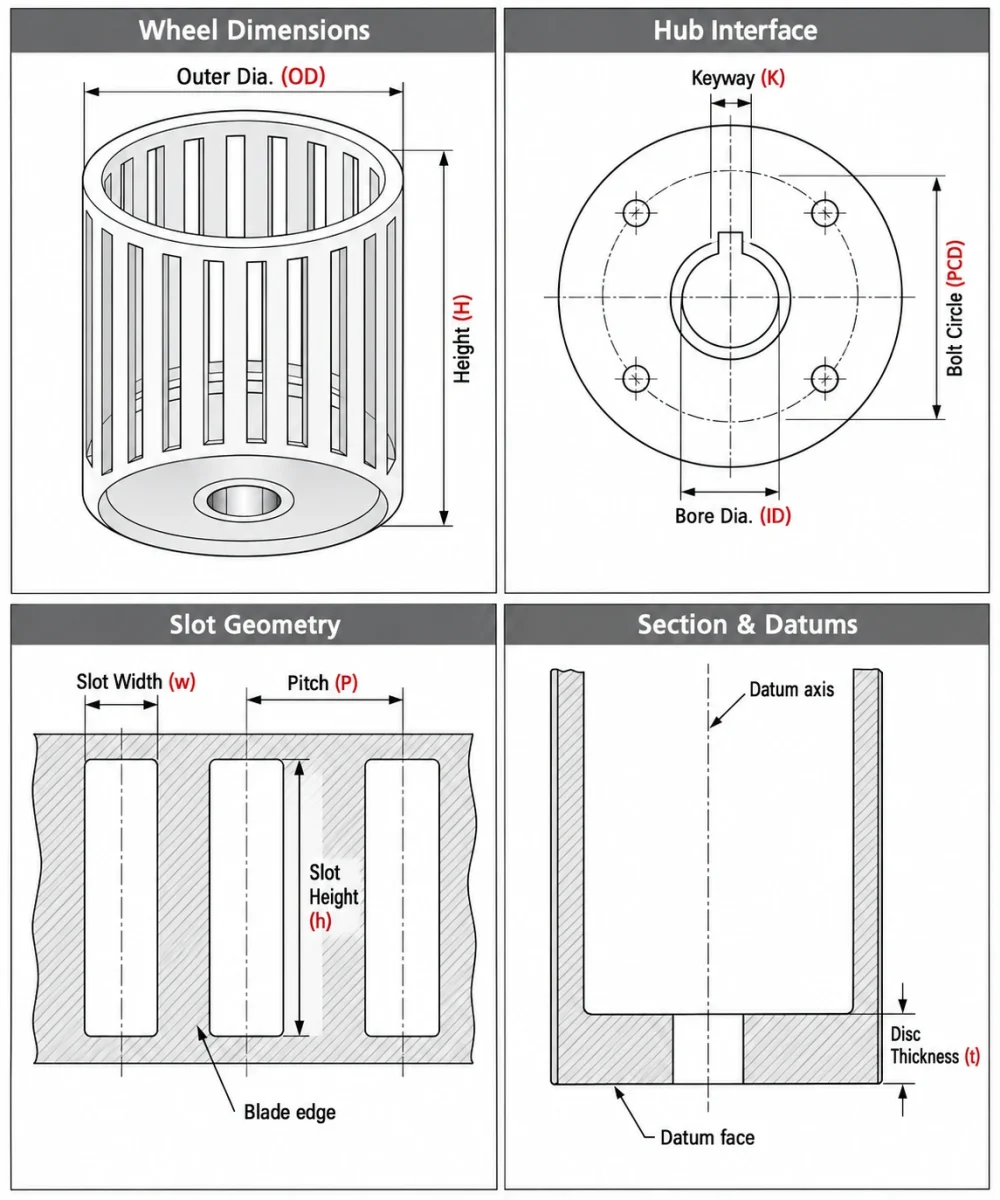
Alumina ceramic classifier wheel diagrams showing wheel dimensions, hub bore, keyway, bolt circle, slot geometry and inspection datums.

Custom Alumina Ceramic Classifier Wheel

ADCERAX alumina ceramic classifier wheel customization is focused on matching your existing classifier or mill platform while optimizing cut size, throughput and wear life.

Wheel envelope
· Outer diameter, overall height, disc and step thickness
· Clearance to the housing; custom route approximately 80–600 mm OD
· Sets the rotor size and its fit inside your housing

Bore and hub interface
· Bore diameter, steps or taper
· Keyway, bolt pattern and locating shoulder
· Fit on your shaft; decides whether the machine needs any change

Slot and blade geometry
· Count, width, depth and pitch
· Profile, angle and direction of rotation
· Sets the wheel layout for your powder and your air volume

Datums and runout
· Coaxiality of bore to outside diameter
· Face and radial runout, with the datum and support used to measure them
· How the wheel is checked before it leaves us, and what you re-check on the shaft

Material
· Alumina grade for the wheel body
· Defined sleeves, inserts and joints
· Sets the material and powder contact path for your duty

Precision and surfaces
· Critical fits and datums
· Ground, lapped or as-fired surfaces
· Published tolerance examples are approximately ±0.05–0.1 mm depending on size

Related Products

ADCERAX - Your Trusted Advanced Ceramics Manufacturing Partner

ADCERAX – Custom Ceramic Supply and Engineering Coordination
ADCERAX coordinates drawing review, production and inspection with manufacturing partners against agreed specifications.

China-Based Ceramic Supply Partner

ADCERAX coordinates custom ceramic supply for overseas OEMs, equipment builders, and labs.

Custom Drawing Support

We review drawings, dimensions, materials, and application conditions before quotation.

Ceramic Process Control

Forming, sintering, machining, grinding, and finishing are arranged by part requirements.

Pre-Shipment Inspection

Dimensional checks, visual inspection, and packaging review help reduce procurement risk.

Get in Touch with Us

Our team will be happy to respond to you in less than 24 hours.

Adcerax's factory

Quick Quotation

*Our team will review your inquiry and respond with the next steps.

*Your information will be kept strictly confidential.

Ready to Solve Your Engineering Challenge?

Partner with ADCERAX for reliable, high-performance advanced ceramic solutions. Our engineers are ready to discuss your project.

E-mail

info@adcerax.com

Phone

Tel: +86-0731-84428843 WhatsApp: +86 19311583352

Response Time

Within 24 hours

Quick Quote

The more details you provide, the faster we can quote.

*All inquiries are confidential.

Get Your Custom Solution

The more details you provide, the faster we can respond.

customize size

*We respond within 24 hours. All inquiries are confidential.

Download Catalog