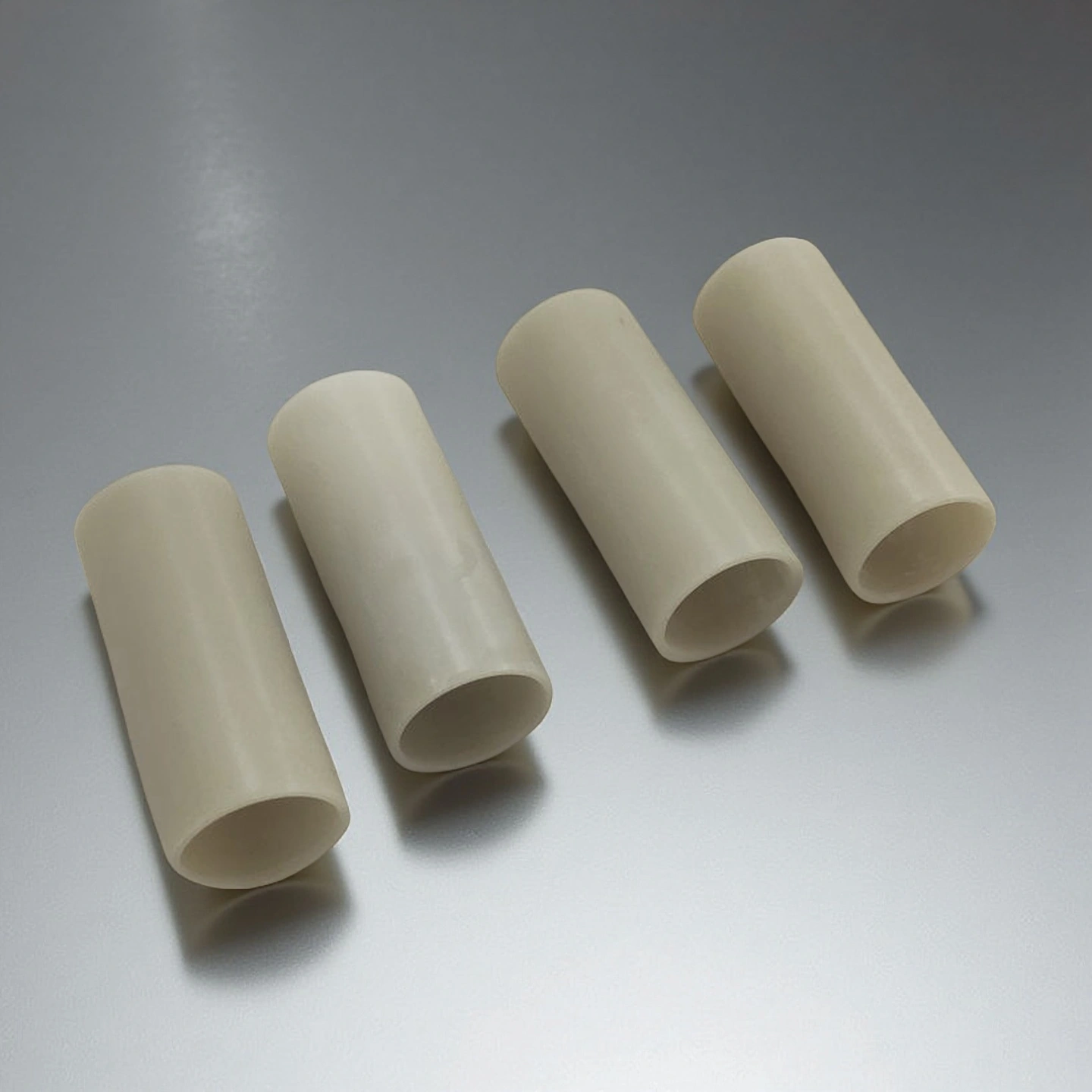
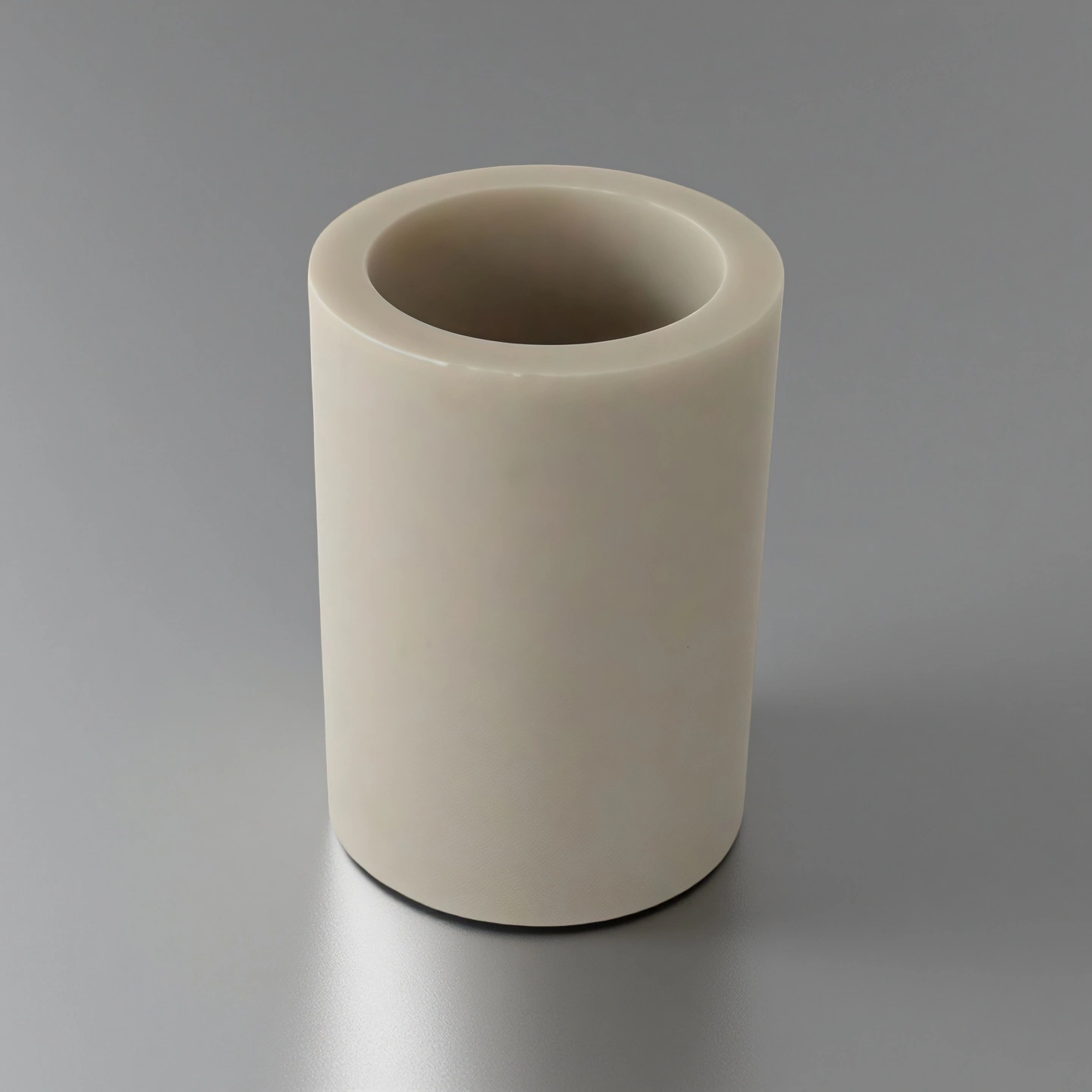
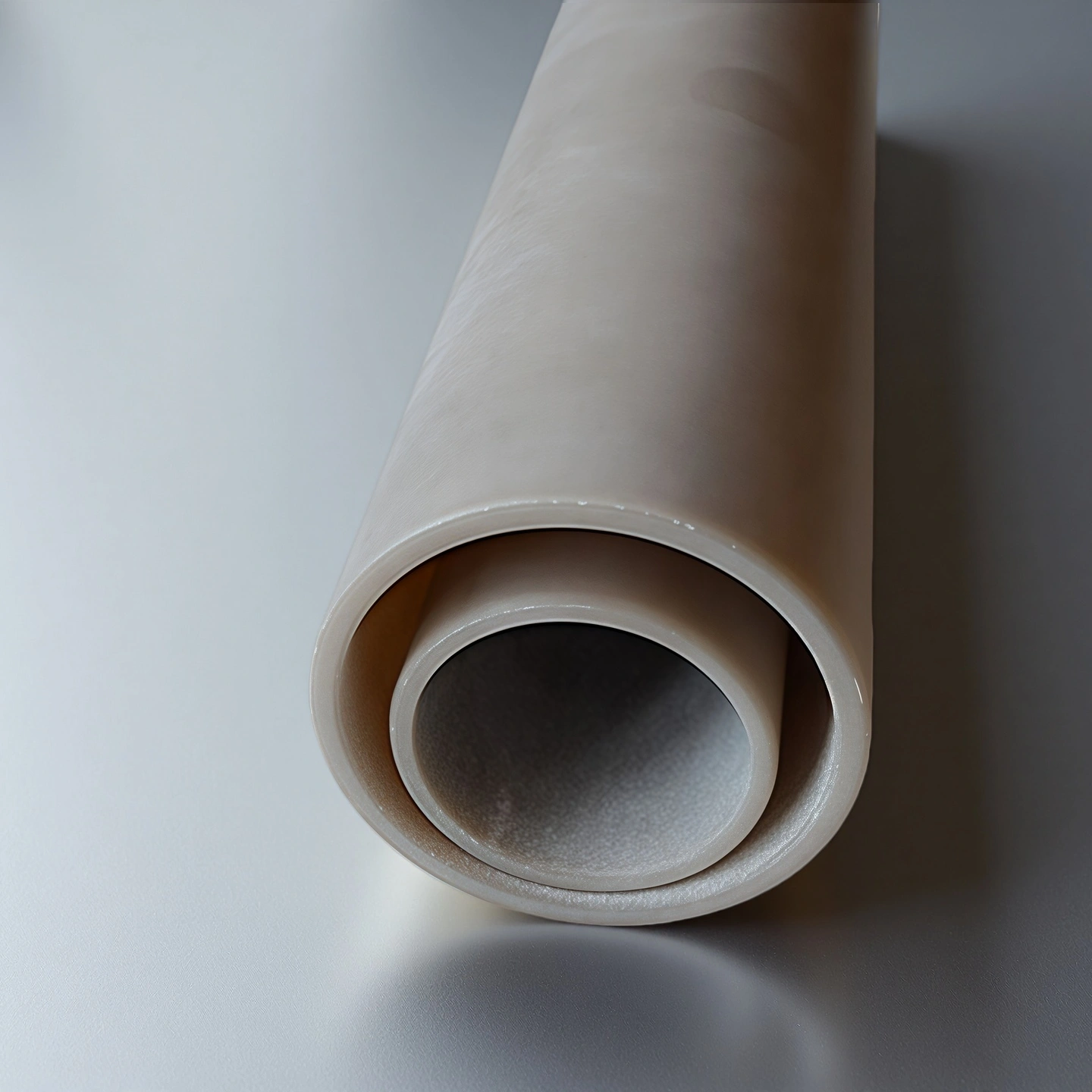
An aluminum nitride tube is a thermally conductive, electrically insulating ceramic component used when heat transfer and electrical isolation must be achieved simultaneously. Compared with conventional insulating ceramics such as alumina and quartz, aluminum nitride offers substantially higher thermal conductivity while maintaining reliable electrical insulation and a relatively low coefficient of thermal expansion close to that of silicon.
Aluminum Nitride Tube Benefits
- High heat transfer efficiency: Aluminum nitride tube offers thermal conductivity typically in the 170–220 W/m·K range, which helps remove heat quickly from furnace zones, thermocouple sheaths and power modules.
- Electrical insulation at elevated temperature: AlN tube maintains high volume resistivity and dielectric strength, making it suitable where high voltage and high temperature appear in the same assembly.
- Low thermal expansion for stable alignment: The coefficient of thermal expansion around 4.5–5.6×10⁻⁶/K reduces thermal stress between aluminum nitride tubes and silicon or metal components in repeated heating cycles.
- Thermal shock resistance in fast cycling: Typical AlN ceramics can tolerate temperature jumps on the order of 300–400 °C, which supports rapid ramp-up or emergency cooling in many furnace and process conditions.
- Suitability for aggressive atmospheres: Aluminum nitride tubes remain stable in many inert and certain process gases, including hydrogen and carbon dioxide, within their specified temperature limits.
Aluminum Nitride Ceramic Tube Properties
|
Property Content |
Property |
Unit |
ALN-170 |
ALN-200 |
ALN-230 |
|
Basic Properties |
Color |
|
gray |
light yellow |
light yellow |
|
Density |
g/cm³ |
3.2-3.3 |
3.2-3.3 |
3.2-3.3 |
|
Surface Roughness |
μm |
0.2-0.75 |
0.2-0.75 |
0.2-0.8 |
|
Camber |
length ‰ |
≤3‰ |
≤3‰ |
≤3‰ |
|
Hardness |
HV |
1100 |
1100 |
1100 |
|
Thermal Properties |
Max Operating Temperature |
°C |
1100 |
1100 |
1100 |
|
Thermal Conductivity |
W/m·K |
170-190 |
190-220 |
220-230 |
|
Coefficient of Thermal Expansion |
10⁻⁶/K(20-400°c) |
4-5 |
4-5 |
4-5 |
|
Coefficient of Thermal Expansion |
10⁻⁶/K(400-800°c) |
5-6 |
5-6 |
5-6 |
|
Mechanical Properties |
Flexural Strength |
MPa |
300-400 |
350-450 |
400-500 |
|
Tensile Strength |
MPa |
200-300 |
250-350 |
280-380 |
|
Compressive Strength |
MPa |
2000-3000 |
2200-3200 |
2500-3500 |
|
Electrical properties |
Dielectric Constant |
at 1MHz |
8-9 |
8-9 |
8-9 |
|
Dielectric strength |
KV/mm |
≥15 |
≥15 |
≥15 |
|
Volume resistivity |
20℃ Ω.cm |
≥1014 |
≥1014 |
≥1014 |
Aluminium Nitride Tube Specifications
|
Aluminum Nitride Tube |
|
Item No. |
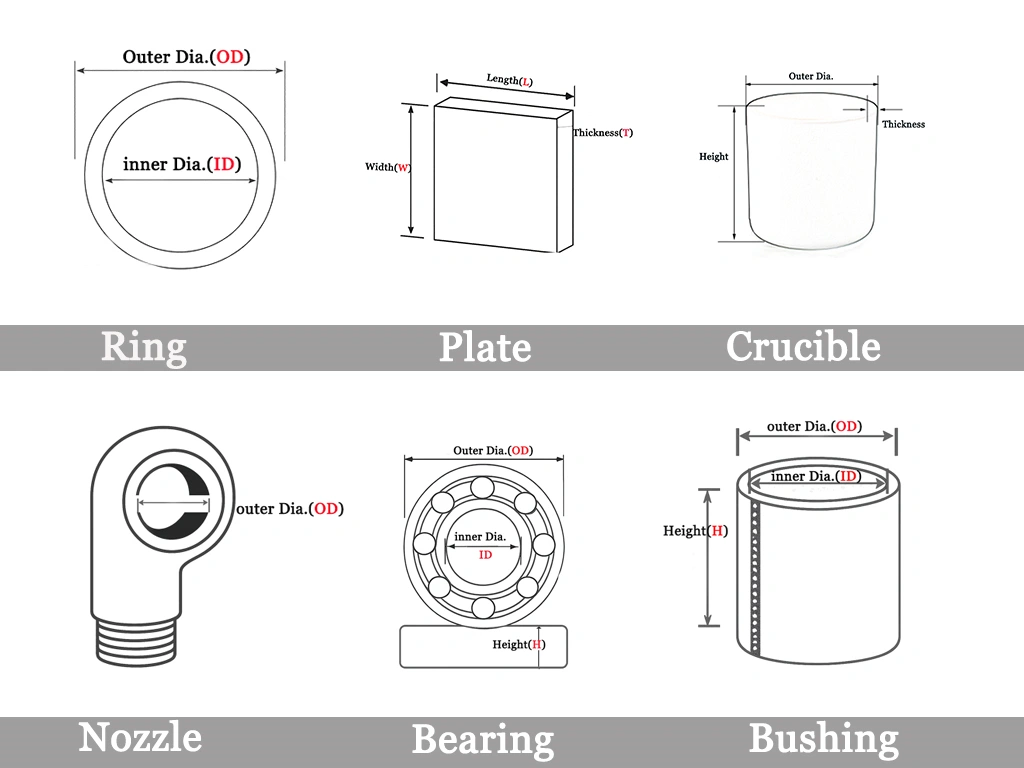
Outer Diameter(mm) |
Inner Diameter(mm) |
Thickness(mm) |
Length(mm) |
|
AT-ALN-G1001 |
5 |
3 |
1.0 |
≤100 |
|
AT-ALN-G1002 |
8 |
4 |
2.0 |
|
AT-ALN-G1003 |
10 |
6 |
2.0 |
|
AT-ALN-G1004 |
12 |
7 |
2.5 |
|
AT-ALN-G1005 |
15 |
10 |
2.5 |
|
AT-ALN-G1006 |
20 |
14 |
3.0 |
|
AT-ALN-G1007 |
30 |
24 |
3.0 |
≤300 |
|
AT-ALN-G1008 |
50 |
46 |
2.0 |
|
AT-ALN-G1009 |
55 |
49 |
3.0 |
|
AT-ALN-G1010 |
65 |
57 |
4.0 |
|
AT-ALN-G1011 |
70 |
60 |
5.0 |
|
AT-ALN-G1012 |
80 |
67 |
6.5 |
|
AT-ALN-G1013 |
90 |
82 |
4.0 |
|
AT-ALN-G1014 |
100 |
92 |
4.0 |
|
AT-ALN-G1015 |
150 |
139 |
5.5 |
AlN ceramic tube Packaging
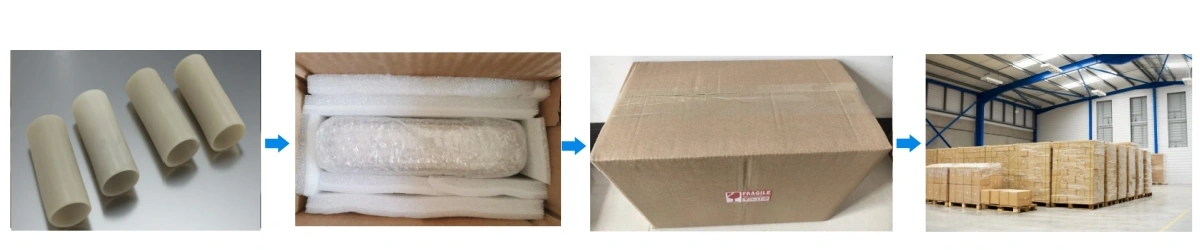
- Each aluminum nitride tube is wrapped with soft cushioning material to protect the ceramic from vibration and point impact.
Aluminium Nitride Tube Applications
ADCERAX manufactures aluminum nitride tubes around the requirements of real assemblies rather than limiting customers to a fixed standard design. By adapting the tube diameter, wall thickness, length, end configuration and machined features, we can develop open-end or closed-end AlN tubes that fit existing furnace, sensor, vacuum and power-electronics systems.
-
High-Temperature Furnaces and Vacuum Systems
Common design problems: Conventional ceramic tubes may transfer heat too slowly, creating temperature gradients, localized hot zones and thermal stress during repeated heating and cooling. A mismatch between the tube and surrounding components may also contribute to cracking or unstable alignment.
How ADCERAX can help: ADCERAX can manufacture custom open-end or closed-end aluminum nitride tubes that combine efficient heat transfer, electrical insulation and relatively low thermal expansion. Tube diameter, wall thickness, length and end geometry can be adapted to fit the available installation space and surrounding components.
Potential engineering value: A properly designed AlN tube can help distribute heat more efficiently, reduce temperature differences across the assembly and limit thermal mismatch while maintaining electrical isolation. Material grade and geometry are selected according to the actual furnace or vacuum operating conditions.
-
Power Electronics and Electrically Insulated Thermal Assemblies
Common design problems: Metal heat-transfer components normally require additional electrical insulation layers. These extra interfaces can increase thermal resistance, occupy valuable space and make the assembly more difficult to manufacture and maintain.
How ADCERAX can help: ADCERAX can produce custom AlN tubes and sleeves that provide a direct thermal path while electrically isolating conductive components. Bore size, wall thickness, mounting surfaces, end features and functional machining can be matched to the surrounding power module or cooling structure.
Potential engineering value: Combining heat transfer and electrical insulation in one ceramic component can simplify the thermal path, reduce the number of interface layers and support a more compact assembly. The final tube design can be developed around the available space, electrical-isolation requirement and thermal-management objective.
-
Thermocouple and Sensor Protection in Inert or Process Gases
Common design problems: Metal protection tubes may introduce an unwanted conductive path, electrical interference or material interaction with the sensing environment. Conventional insulating ceramics may also slow the transfer of heat to the sensing junction when rapid temperature response is important.
How ADCERAX can help: ADCERAX can manufacture open-end or closed-end aluminum nitride protection tubes with customized wall thickness, length and end geometry. The tube can electrically isolate the sensor from surrounding metal structures while providing a shorter and more efficient heat-transfer path.
Potential engineering value: An application-specific AlN tube can help improve sensor isolation, reduce direct contact with surrounding metal components and support a faster, more stable thermal response. Compatibility with the process gas, temperature range and sensing environment is reviewed for each application.