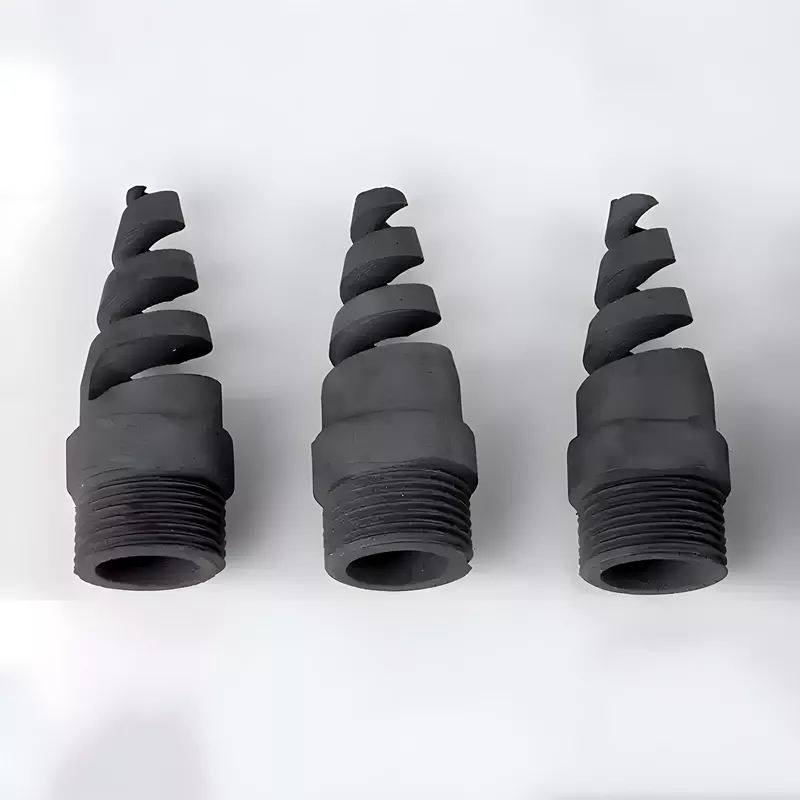
Silicon Carbide Spiral Nozzle for FGD and Scrubber Systems

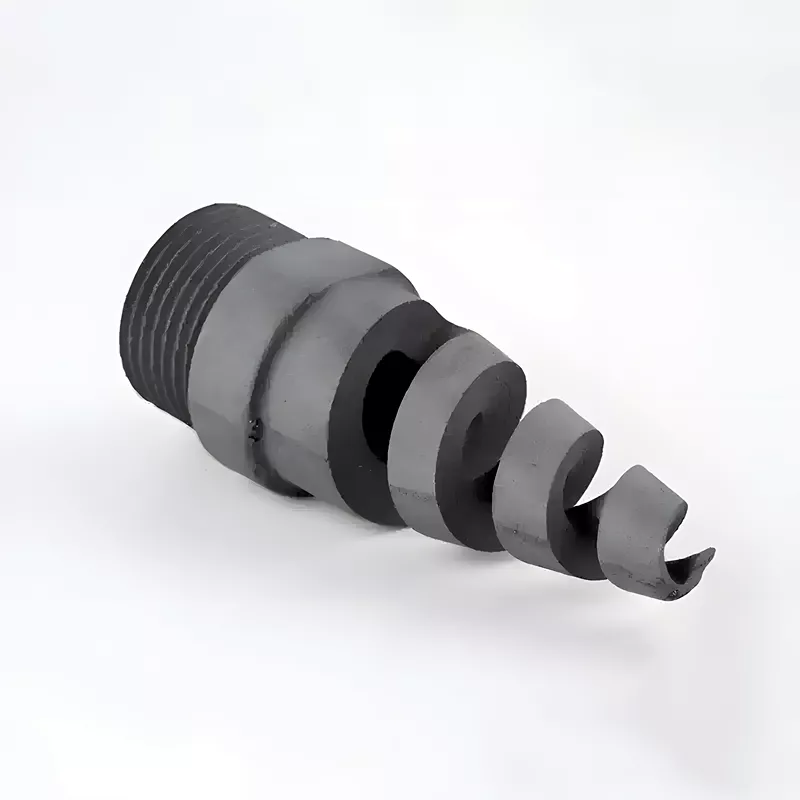
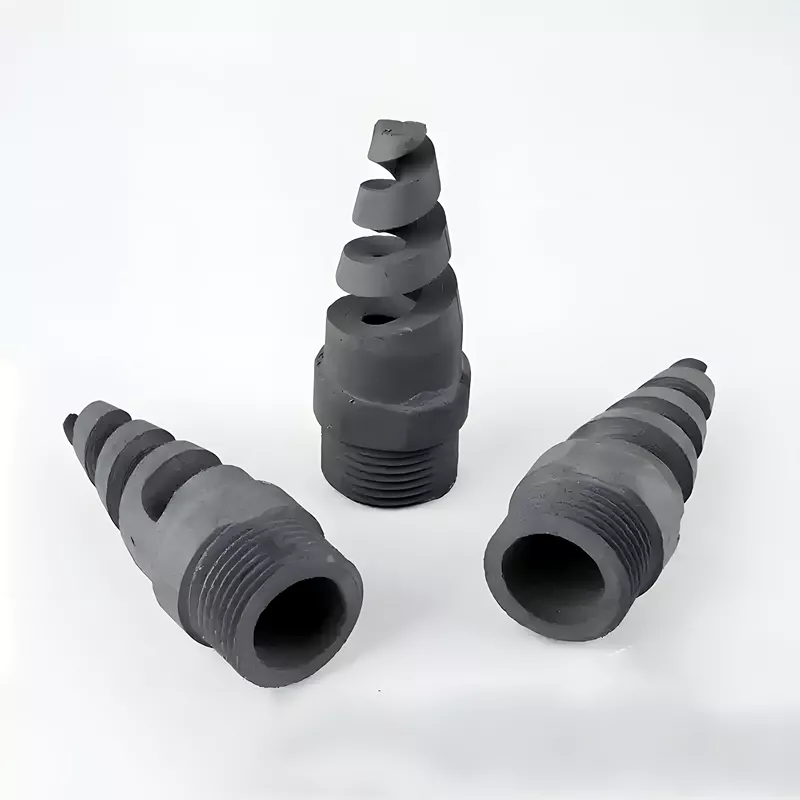
ADCERAX supplies silicon carbide spiral nozzles for wet FGD absorbers, industrial scrubbers, gas-washing towers and quench spray systems. The open spiral flow path helps maintain spray coverage when the liquid contains suspended solids, scale-forming compounds or corrosive scrubber media.

Each SiC spiral nozzle can be reviewed according to flow rate, spray angle, connection type, nozzle size, slurry condition, operating temperature and installation position. RBSiC / SiSiC material options are available for applications where metal or polymer nozzles may wear, corrode or deform too quickly.

Catalogue No. AT-THG-LW001
Material Reaction-Bonded Silicon Carbide (RBSiC / SiSiC)
Geometry Stability Maintains spiral profile accuracy after >5,000 operating hours in abrasive slurry environments.
Corrosion & Wear Resistance Mass-loss rate below 0.1% after 24 h in FGD acidic solutions; hardness 25–28 GPa for long wear life.
Hydraulic Performance Flow rate stability within ±5%, spray uniformity deviation <±10%, and droplet SMD typically 250–900 μm.
Engineering RFQ Review
Small-Batch Custom Support
Factory-Direct Manufacturing
Drawing & Process Review

What Is a Silicon Carbide Spiral Nozzle?

A silicon carbide spiral nozzle is a ceramic spray nozzle with an open spiral flow path that forms a full-cone spray pattern for gas washing, slurry scrubbing, quenching and desulfurization systems. It is commonly selected for FGD absorbers and industrial scrubbers where abrasive particles, acidic liquids, chloride-containing media and thermal fluctuation can shorten the service life of metal or plastic spray nozzles.

Why Silicon Carbide Spiral Nozzles Are Used in Scrubber Systems

  • Open Spiral Flow Path for Slurry Handling
    The spiral flow path does not rely on narrow internal vanes, which helps reduce blockage risk when the liquid contains gypsum, fly ash, mineral particles or scale-forming solids. This makes the nozzle suitable for wet FGD and industrial gas-washing systems where slurry cleanliness may vary during operation.

  • SiC Wear Resistance for Abrasive Spray Media
    Silicon carbide offers high hardness and strong erosion resistance, helping the nozzle maintain its spray geometry when exposed to abrasive slurry or dust-contaminated liquid circuits. This supports more predictable spray coverage between inspection cycles.

  • Corrosion and Thermal Stability in Harsh Gas Treatment
    RBSiC / SiSiC ceramic materials provide stable performance in acidic, alkaline and chloride-containing scrubber environments. Their thermal stability also helps the nozzle withstand temperature changes in quench zones and gas-cooling sections.

Technical Specifications of Silicon Carbide Spiral Nozzle

ADCERAX Silicon Carbide Spiral Nozzles are reviewed for hydraulic behavior, corrosion resistance and structural stability under abrasive, corrosive and thermally fluctuating scrubber conditions.

Parameter Typical Reference Why It Matters for Buyers
Material System RBSiC / SiSiC Defines corrosion resistance, wear behavior and thermal stability in scrubber service.
Spray Pattern Full-cone spiral spray Supports gas-liquid contact in absorber towers and washing zones.
Flow Rate Range 2.5–100 m³/h based on model table Helps engineers match nozzle capacity with pump and header design.
Standard Spray Angle 120° in current model table Determines spray coverage and tower layout. Other angles should be confirmed before quotation.
Connection Method Threaded / Bonded Affects installation compatibility with existing spray headers.
Bulk Density 2.95–3.10 g/cm³ Indicates dense ceramic structure for wear and corrosion service.
Open Porosity <1% Lower porosity helps reduce liquid penetration and chemical attack.
Flexural Strength >250 MPa Supports mechanical stability during installation and operation.
Vickers Hardness 25–28 GPa Helps resist erosion from abrasive particles and slurry solids.
Thermal Expansion 4.0–4.5 ×10⁻⁶ /K Helps reduce dimensional change during heating and cooling cycles.
Max Service Temperature Up to 1350°C, environment-dependent Provides a reference for high-temperature gas-treatment and quench sections.
Chemical Compatibility Review by pH, chloride level and temperature Prevents material mismatch in acidic, alkaline or chloride-rich media.

Dimensions of Silicon Carbide Spiral Nozzle


Spiral Flow Silicon Carbide Nozzle
Model Inch Thread Size (mm) Atomization Angle Flow Rate Range (m³/h) Coverage Diameter (m) Connection Method
AT-THG-LW001 3/8 inch 18 120° 2.5 0.8 Threaded
AT-THG-LW002 1/2 inch 20 120° 4 1 Threaded
AT-THG-LW003 3/4 inch 25 120° 6 1.2 Threaded
AT-THG-LW004 1 inch 32 120° 12 1.4 Bonding/Threaded
AT-THG-LW005 1.2 inch 40 120° 15 1.6 Bonding/Threaded
AT-THG-LW006 1.5 inch 46 120° 20 1.8 Bonding/Threaded
AT-THG-LW007 2 inch 58 120° 30 2.3 Bonding/Threaded
AT-THG-LW008 2.5 inch 73 120° 45 2.3 Bonding/Threaded
AT-THG-LW009 3 inch Bonding 120° 70 2.8 Bonding
AT-THG-LW010 4 inch Bonding 120° 100 3 Bonding

The values above are reference options for model selection. Final nozzle size, flow rate, connection type and spray coverage should be reviewed according to pump pressure, header layout, liquid density, suspended solids, tower diameter and required gas-liquid contact area.

Packaging Instructions for Silicon Carbide Spiral Nozzle

Silicon Carbide Spiral Nozzle is packaged using dense shock-absorbing foam blocks to secure the spiral structure and prevent vibration-related chipping during transport. Each nozzle is individually seated in a precision-cut cavity to avoid surface contact and ensure stability throughout international shipping. The outer carton is reinforced to withstand stacking loads and maintain the integrity of the ceramic component until final installation.

ADCERAX® Packaging Instructions for Silicon Carbide Spiral Nozzle

Applications of Silicon Carbide Spiral Nozzles

The Silicon Carbide Spiral Nozzle from ADCERAX is applied in industrial environments where corrosive liquids, abrasive slurries, and fluctuating gas loads cause frequent failures of metallic and polymeric spray components.

  • Wet FGD Absorber Towers

    In wet flue-gas desulfurization systems, silicon carbide spiral nozzles are used to distribute limestone or alkaline slurry across absorber zones. The open spiral flow path helps reduce blockage risk when gypsum crystals, fly ash and suspended solids are present in the circulation liquid. This makes the nozzle suitable for power plants, boiler systems and industrial emission-control units that require stable spray coverage under abrasive slurry conditions.

  • Industrial Scrubbers and Gas-Washing Towers

    Chemical plants, incineration lines and industrial gas-treatment systems use SiC spiral nozzles to improve gas-liquid contact in washing and absorption sections. The corrosion resistance of silicon carbide helps the nozzle operate in acidic, alkaline or chloride-containing liquids where metal spray components may corrode or lose dimensional accuracy.

  • Quench and Gas-Cooling Systems

    In quench towers and hot-gas cooling sections, silicon carbide spiral nozzles support stable liquid distribution while exposed to temperature fluctuation and chemically aggressive condensates. The thermal stability of SiC helps protect nozzle geometry when process conditions shift during startup, shutdown or load changes.

  • High-Solids Slurry Spray Circuits

    The spiral design is useful where the liquid contains suspended particles, scaling compounds or abrasive solids. Compared with spray nozzles that use narrow internal passages, the open spiral structure can provide better tolerance to contaminated liquids, provided that filtration, pressure and slurry concentration remain within the system design range.

Silicon Carbide Spiral Nozzle Installation and Usage Guide

Silicon carbide spiral nozzles are widely used in scrubbers, cooling, quench, and gas-treatment systems. Proper installation, operation, cleaning, and handling help maintain stable spray performance and reduce the risk of blockage, wear, or accidental damage.

  • Installation Preparation and System Compatibility

    1. Confirm system fit and spray direction

    Verify nozzle size, connection type, and mounting interface before installation. Proper alignment helps maintain uniform spray coverage.

    2. Inspect sealing and support points
    Check sealing surfaces and support structures for wear, looseness, or deformation. Stable mounting helps reduce vibration and positional shift.

    3. Flush pipelines before startup
    Clean the surrounding pipeline before operation to reduce the risk of debris entering the spiral flow path.

  • Operational Best Practices

    1. Maintain suitable operating pressure
    Operate within the system’s recommended pressure range. Stable pressure helps maintain consistent spray behavior.

    2. Monitor the slurry or liquid condition
    Changes in solids content, viscosity, or scaling tendency may affect nozzle performance and should be checked regularly.

    3. Avoid sudden thermal shock
    Where possible, reduce abrupt temperature changes to help protect structural stability.

  • Cleaning and Maintenance

    1. Schedule routine inspections
    Regular inspection helps identify early blockage, wear, or installation-related issues.

    2. Use non-abrasive cleaning methods
    Clean with water or other non-abrasive media to protect the spiral surface and spray geometry.

    3. Track performance changes
    Record changes in spray pattern, pressure, or flow condition to support maintenance planning.

  • Storage, Handling, and Transportation

    1. Handle as a precision ceramic part
    Avoid dropping, striking, or applying concentrated force to the nozzle.

    2. Store in protective packaging
    Use shock-resistant packaging and keep the nozzle protected from contamination and moisture.

    3. Use reinforced packaging for shipment
    Secure the nozzle properly during transport to reduce the risk of vibration damage or edge chipping.

Technical FAQs About Silicon Carbide Spiral Nozzle

  1. Q1: What is a silicon carbide spiral nozzle used for?
    A silicon carbide spiral nozzle is used for FGD absorbers, industrial scrubbers, gas-washing towers, quench systems and slurry spray circuits. It distributes liquid through an open spiral flow path to support gas-liquid contact while resisting corrosion, abrasion and thermal fluctuation.

  2. Q2: Why choose a silicon carbide spiral nozzle instead of a metal nozzle?
    Silicon carbide is selected when metal nozzles wear, corrode or lose spray geometry too quickly in abrasive or chemically aggressive liquids. Its hardness, corrosion resistance and thermal stability make it suitable for limestone slurry, acidic scrubber liquid, chloride-containing media and high-dust gas-treatment systems.

  3. Q3: How should I choose the correct flow rate and spray angle?
    Flow rate and spray angle should be selected according to pump pressure, tower diameter, spray header layout, liquid density, suspended solids and required coverage area. ADCERAX can review your drawing, system data or existing nozzle sample before recommending a suitable model.

  4. Q4: Can silicon carbide spiral nozzles reduce clogging in slurry service?
    The open spiral structure can help reduce blockage risk compared with nozzles that use narrow internal vanes or small passages. However, clogging performance still depends on slurry particle size, filtration, scaling tendency, operating pressure and maintenance conditions.

  5. Q5: Are these nozzles suitable for acidic or chloride-rich scrubber liquids?
    RBSiC and SiSiC materials are commonly used in corrosive scrubber environments, including acidic and chloride-containing liquids. Final suitability should be checked against pH, chloride concentration, temperature, slurry composition and exposure time.

  6. Q6: Can ADCERAX make custom silicon carbide spiral nozzles from drawings?
    Yes. ADCERAX supports drawing-based and sample-based customization for silicon carbide spiral nozzles. Custom options may include size, connection type, flow capacity, spray angle, material grade, surface condition and packaging requirements.
  7. Q7: What is the difference between a spiral nozzle and a vortex spray nozzle?
    A spiral nozzle uses an open spiral surface to form the spray pattern and is often selected for slurry tolerance and reduced blockage risk. A vortex spray nozzle relies on internal liquid rotation to control atomization and spray distribution. The better choice depends on liquid cleanliness, required droplet behavior, pressure condition and tower layout.
customize size

Customization Services for SiC Spiral Nozzle

ADCERAX provides customization options for the Silicon Carbide Spiral Nozzle to align its hydraulic behavior, mounting interface, and corrosion-resistance characteristics with the technical requirements of diverse industrial scrubbing and gas-treatment systems.

Structural and Geometry Adaptation Options

Adaptation requirements are evaluated to ensure compatibility with system-specific hydraulic and mechanical conditions.

  • Spiral Path Configuration
    Adjusted to influence droplet formation behavior effectively.

  • Body Geometry Profile
    Modified to enhance spray coverage stability as required.

  • Mounting Interface Form
    Adapted to support reliable positioning during operation.

  • Flow Passage Architecture
    Adjusted to balance solids tolerance and spray uniformity.

Material and Surface Condition Customization

Material and surface characteristics are refined to optimize longevity under corrosive, abrasive, or chloride-rich operating environments.

  • SiC Grade Selection
    Chosen to enhance resistance under aggressive liquids.

  • Surface Treatment Finish
    Modified to improve fluid interaction characteristics.

  • Chemical Exposure Suitability
    Adjusted to match process-specific corrosive media.

  • Thermal-Cycle Durability Tuning
    Optimized to withstand repeated thermal fluctuations.

Related Products

ADCERAX - Your Trusted Advanced Ceramics Manufacturing Partner

Direct factory manufacturing with comprehensive ceramic materials expertise and global supply capabilities

China-Based Manufacturer

ADCERAX supplies ceramic components for overseas OEMs, equipment builders, and labs.

Custom Drawing Support

We review drawings, dimensions, materials, and application conditions before quotation.

Ceramic Process Control

Forming, sintering, machining, grinding, and finishing are arranged by part requirements.

Pre-Shipment Inspection

Dimensional checks, visual inspection, and packaging review help reduce procurement risk.

Get in Touch with Us

Our team will be happy to respond to you in less than 24 hours.

Pingxiang Factory — Silicon carbide, silicon nitride, high-temperature ceramics

Quick Quotation

*Our team will answer your inquiries within 24 hours.

*Your information will be kept strictly confidential.

Ready to Solve Your Engineering Challenge?

Partner with ADCERAX for reliable, high-performance advanced ceramic solutions. Our engineers are ready to discuss your project.

E-mail

info@adcerax.com

Phone

+(86) 0731-74427743 | WhatsApp: +(86) 19311583352

Response Time

Within 24 hours

Quick Quote

The more details you provide, the faster we can quote.

*We respond within 24 hours. All inquiries are confidential.

Get Your Custom Solution

The more details you provide, the faster we can respond.

customize size

*We respond within 24 hours. All inquiries are confidential.

Download Catalog