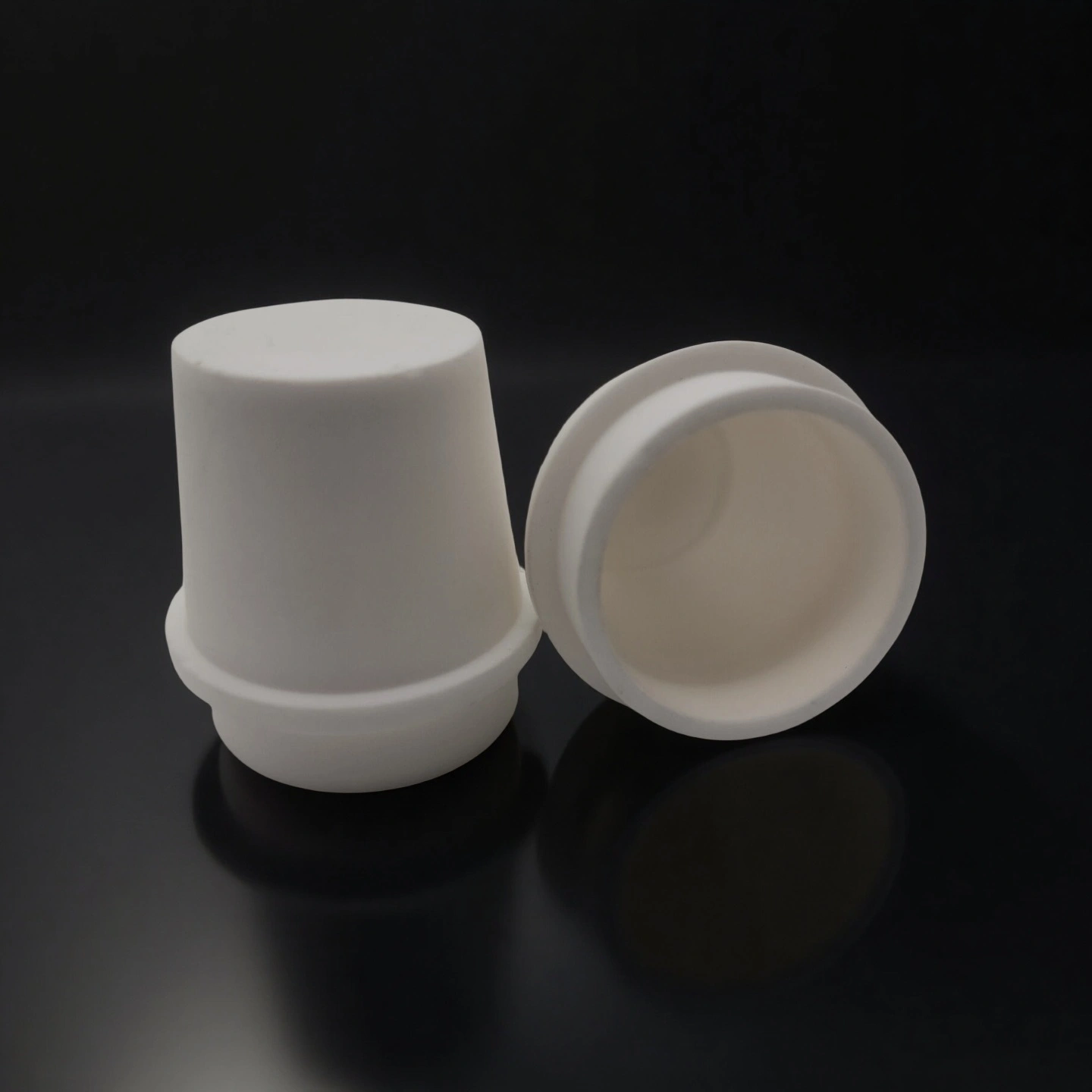
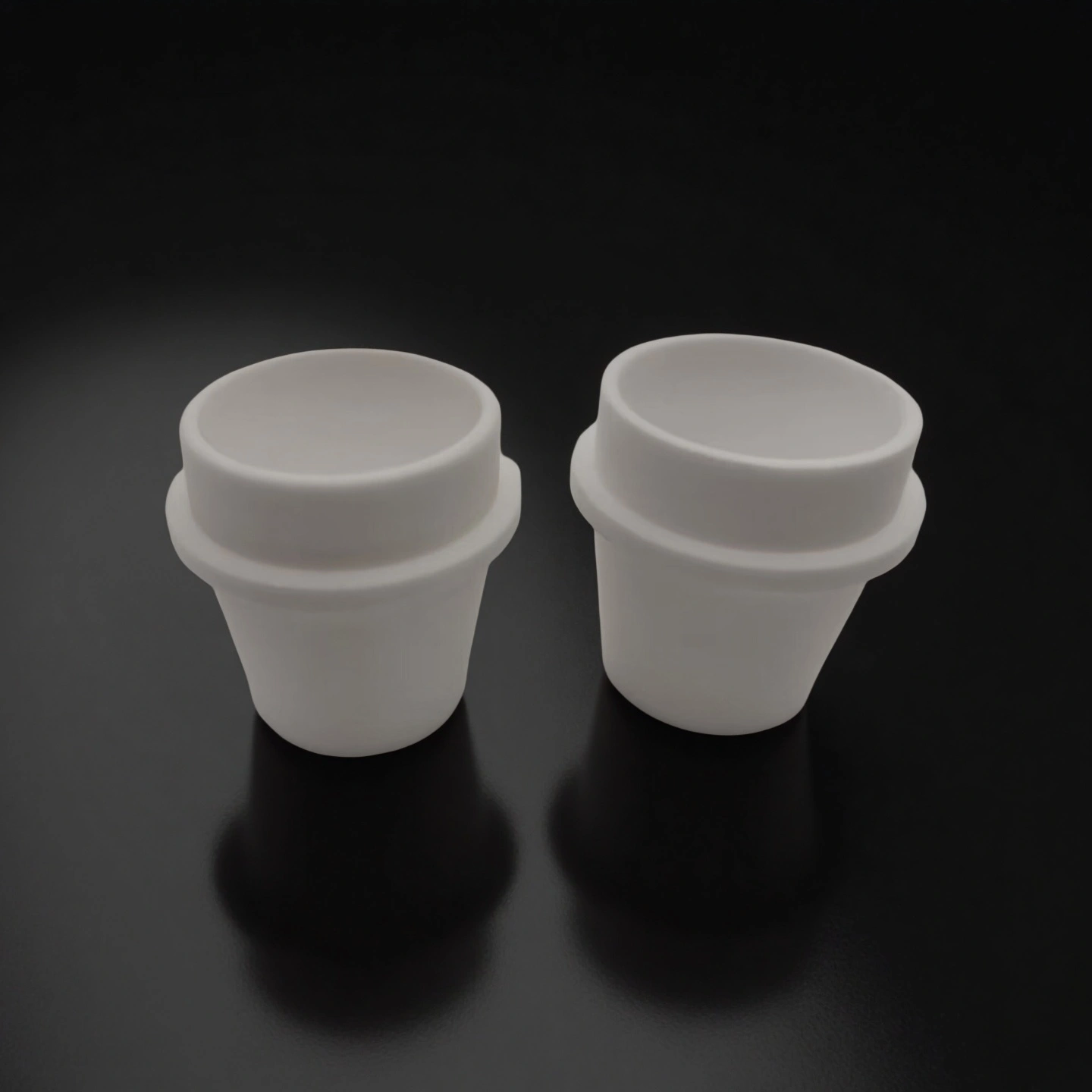
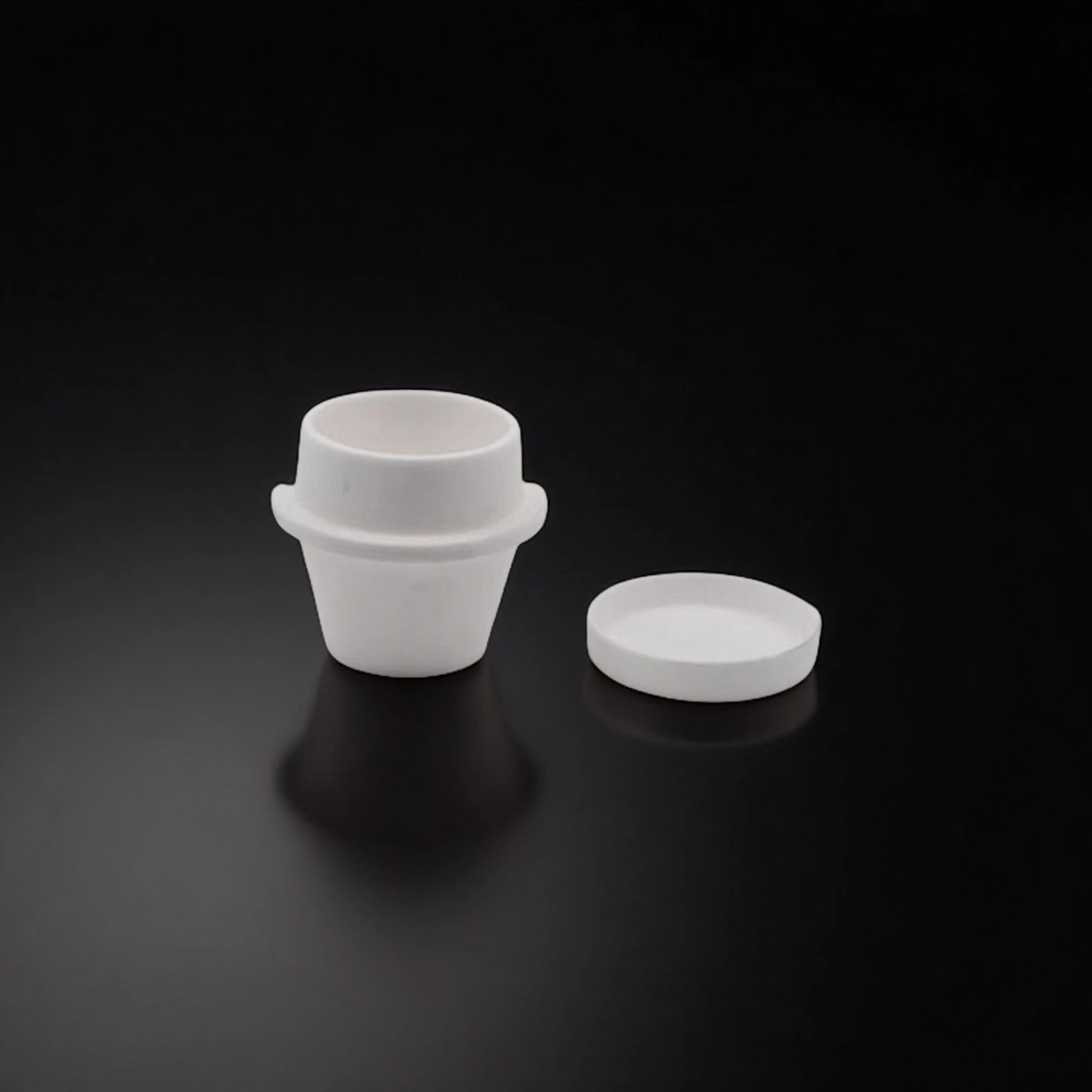
TGA Alumina Crucible for Thermogravimetric Analysis | Repeatable High-Temperature Runs

Our TGA alumina crucibles are designed specifically for thermogravimetric analysis applications requiring high temperature stability and chemical inertness. Made from high purity 99.5% alumina (Al2O3), these crucibles deliver reliable performance in thermal analysis testing from room temperature to 1700°C.

Catalog No. AT-ALG-001-1
Material 99.5% (standard), 99.7% and 99.9% available
Max Operating Temperature Up to 1700°C
Density 3.9 g/cm³
Dimensions/Sizes Download PDF
Engineering RFQ Review
Small-Batch Custom Support
Drawing-Based Production
Drawing & Process Review

A TGA alumina crucible is a high-temperature Al₂O₃ cup used to hold samples during thermogravimetric analysis. For batch/macro TGA systems (LECO TGA801, ELTRA Thermostep), these crucibles typically range from 10 to 37 cc, with glazed or unglazed finishes. They enable reliable weight-change tracking across heating programs for industrial QC, fuel analysis, and research applications.

Alumina Crucible TGA Properties

Property Unit/condition AD-ALU-999 AD-ALU-997 AD-ALU-995 AD-ALU-990
Al₂O₃ content wt%, nominal 99.90 99.70 99.50 99.00
Bulk density g/cm³, typical 3.94 3.94 3.90–3.92 3.80–3.91
Flexural strength MPa, 20°C, typical 315–340 330 320–350 300–320
Thermal conductivity W/(m·K), typical; temperature as stated 35–42 at 25°C 35–40 at 25°C 30–38 at 25°C 24 at 25°C
Mean linear thermal expansion 10⁻⁶/K; temperature interval as stated 7.6 (25–800°C) 7.6 (25–800°C) 7.6 (25–800°C) 7.2 (25–800°C)
Water absorption %, selection limits ≤0.01 ≤0.05 ≤0.10 ≤0.10
Material service-temperature guide °C, application-dependent 1750 1700 1650 1600
Color Visual reference Ivory Ivory Ivory Ivory

Performance Characteristics

  • Thermal StabilityAlumina crucibles maintain dimensional stability throughout the entire temperature range of TGA testing. The high purity alumina composition prevents unwanted reactions with most sample materials, ensuring accurate weight measurements during thermogravimetric analysis.
  • Low Background SignalOur TGA alumina crucibles produce minimal background signal, which is critical for accurate thermal analysis. The consistent wall thickness and high purity material reduce baseline drift during temperature ramping.
  • ReusabilityWhen properly cleaned, alumina crucibles can be reused multiple times for compatible samples. This makes them cost-effective for routine TGA testing in research and quality control laboratories.

TGA Alumina Crucible Specifications and Part Numbers

Item NO. Item name Capacity MOQ Part# Compatible with
AT-ALG-001-1 Alumina Crucible (Glazed Inside) 14cc; Purity99.5% 20PCS AR9047 For LECO 701
AT-ALG-001 Alumina Crucible (Glazed Inside) 14cc; Purity99.5% 20PCS AR9047 For LECO 701
AT-ALG-002 Alumina Crucible (Unglazed) 14cc; Purity99.5% 20PCS AR9047 For LECO 701
AT-018 LECO Large Al₂O₃Crucible (Glazed Inside) 20CC; Purity99.5% 20PCS 621-331 /529-047 AR9047 For LECO 701
AT-018-1 ELTRA Al₂O₃Crucible 18CC; Purity99.5% 20PCS Eltra 26063
AT-018-4 LECO Large Al₂O₃Crucible (Yellow, Glazed Inside) 20CC; Purity99.5% 20SET 621-331 /529-047 AR9047 For LECO 701
AT-018-2 LECO Large Al₂O₃Crucible (Unglazed) 20CC; Purity99.5% 20PCS 621-331 /529-047 AR9047 For LECO 701
AT-MY-17 LECO Small Al₂O₃Crucible (Glazed Inside) 16CC; Purity99.5% 20PCS 529-042 529-402 AR9042 For LECO TGA 500/501/601/701; MAC 400/500
AT-MY-17-5 LECO Small Al₂O₃Crucible (Unglazed) 16CC; Purity99.5% 20PCS 529-042 529-402 AR9042 For LECO TGA 500/501/601/701; MAC 400/500
AT-020 LECO Large Al₂O₃Crucible (Fully Glazed) 37CC; Purity99.5% 20PCS customized product
AT-021 LECO Small Al₂O₃Crucible (Unglazed) 10CC; Purity99.5% 20PCS customized product
AT-019 LECO Large Al₂O₃Crucible Lid OD36.5*H6.5*T1.0mm. Purity99.5% 20PCS 529-048 Alpha AR9043 For TGA 20cc
AT-MY-18 LECO Al₂O₃Crucible Lid OD34.5*H6.5*T1.0mm Purity99.5% 20PCS 529-043 Alpha AR9043 For TGA 16cc

*Note: The table above shows only some standard specifications. For more specifications, please refer to the complete product catalogue or contact us for customization


Download Size Guide

How to Choose the Right TGA Crucible Material

Selecting the appropriate crucible material is essential for accurate thermogravimetric analysis results. Here's how alumina crucibles compare to other common TGA crucible materials:

Alumina vs. Platinum Crucibles

Alumina crucibles offer excellent thermal stability up to 1700°C and are chemically inert to most samples. They are significantly more affordable than platinum and suitable for most TGA applications. However, platinum crucibles provide better thermal conductivity and are necessary for oxidizing atmospheres above 1700°C or when testing samples that may react with alumina.

Alumina vs. Ceramic Crucibles

Standard ceramic crucibles typically have lower purity than our high purity alumina crucibles, which can lead to sample contamination or reactions during thermal analysis. High purity alumina crucibles provide superior chemical resistance and cleaner baselines for TGA measurements.

Alumina vs. Quartz Crucibles

Quartz crucibles are limited to approximately 1100°C, while alumina crucibles can withstand temperatures up to 1700°C. For high-temperature TGA work, alumina is the better choice.

When to Use Alumina Crucibles

  • General purpose thermogravimetric analysis
  • Testing of polymers, pharmaceuticals, and organic materials
  • Inorganic material characterization up to 1700°C
  • Applications requiring chemical inertness
  • Budget-conscious laboratories needing reliable performance

When to Consider Alternative Materials

  • Strongly reducing atmospheres (consider graphite or carbon)
  • Samples that react with alumina (consider platinum or sapphire)
  • Ultra-high purity requirements (consider 99.9% alumina or sapphire)
  • Applications requiring maximum thermal conductivity (consider platinum)

Common Issues with TGA Crucibles and How to Avoid Them

Crucible Contamination

Problem: Residue from previous samples affects baseline or causes unexpected reactions.

Solution: Clean alumina crucibles thoroughly between uses. For organic residues, burn off at high temperature in air. For inorganic contaminants, soak in appropriate cleaning solution (dilute acid or base depending on contaminant).

Sample-Crucible Reactions

Problem: Sample chemically reacts with the alumina crucible at high temperature.

Solution: Review the chemical compatibility of your sample with alumina. For reactive samples, consider switching to platinum or sapphire crucibles, or lower the maximum test temperature if possible.

Poor Thermal Contact

Problem: Uneven sample distribution or air gaps lead to temperature measurement errors.

Solution: Distribute sample evenly across the crucible bottom. Ensure the crucible sits flat on the sample platform. For powder samples, gentle tapping can improve packing.

Baseline Drift

Problem: TGA baseline shows drift during temperature ramping.

Solution: Perform blank run with empty crucible to establish baseline correction. Ensure crucible is completely clean and dry before use. Verify temperature calibration of TGA instrument.


TGA Alumina Crucibles Packaging and Shipping

  • Individual protective compartments prevent crucible-to-crucible contact
  • Sealed packaging maintains cleanliness until use
  • Clear labeling with size and material specifications
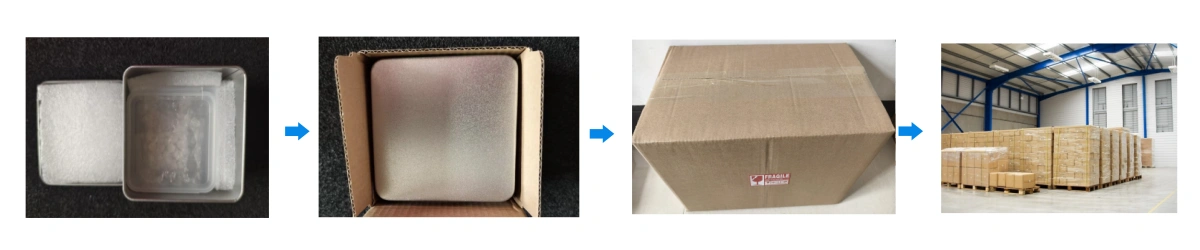
Alumina TGA Crucibles Packaging

Applications: Batch TGA Crucibles in Industrial and Research Labs

Batch TGA alumina crucibles produce repeatable mass-loss curves on samples of several hundred milligrams or more. Selection is driven by your sample position, fill mass, and whether the sample evolves gas.

  • Polymer Analysis

    Use alumina crucibles for TGA characterization of polymers, including thermal decomposition studies, filler content determination, and thermal stability evaluation. The chemical inertness of alumina prevents catalytic effects on polymer degradation.

  • Pharmaceutical Testing

    TGA alumina crucibles are ideal for pharmaceutical applications such as moisture content analysis, thermal stability testing of active ingredients, and decomposition studies. The non-reactive surface ensures accurate measurement of drug substance properties.

  • Materials Research

    Research laboratories use alumina crucibles for studying thermal properties of ceramics, composites, catalysts, and nanomaterials. The wide temperature range and stability make them suitable for diverse material characterization work.

  • Quality Control

    Manufacturing facilities rely on TGA alumina crucibles for routine quality control testing including ash content determination, volatiles analysis, and thermal stability verification of incoming materials and finished products.

  • Environmental Analysis

    Environmental laboratories use alumina crucibles for TGA analysis of soils, sediments, and waste materials to determine organic content, moisture levels, and thermal decomposition profiles.


Alumina TGA Crucibles Usage Instructions

  • Before First Use

    1. Rinse new crucibles with deionized water to remove any dust from manufacturing
    2. Dry completely in an oven at 150°C for at least 1 hour
    3. Allow to cool to room temperature in a desiccator
    4. Run a blank TGA cycle to condition the crucible and verify baseline

  • Sample Preparation

    1. Handle crucibles with clean tweezers or gloves to avoid contamination
    2. Tare the empty crucible on the TGA balance
    3. Add sample to crucible - typical sample size is 5-20 mg
    4. Distribute sample evenly across crucible bottom
    5. Place lid on crucible if testing atmosphere control is needed
    6. Position crucible carefully on TGA sample platform

  • After Testing

    1. Allow crucible to cool completely before handling
    2. Remove residue carefully - some samples may adhere strongly to crucible
    3. Clean crucible according to residue type (see cleaning section)
    4. Inspect crucible for cracks or damage before reuse
    5. Store clean, dry crucibles in a dust-free environment

  • Cleaning Procedures

    For organic residues: Heat crucible in muffle furnace at 600-800°C in air to burn off organic material.

    For inorganic residues: Soak in dilute acid (typically 10% HCl or HNO3) or dilute base (typically 10% NaOH) depending on residue chemistry. Rinse thoroughly with deionized water and dry.

    For stubborn residues: Combine acid/base treatment with mechanical cleaning using appropriate brushes. Avoid metal tools that could scratch the crucible surface.

  • Storage

    Store clean TGA alumina crucibles in a sealed container or desiccator to prevent dust accumulation and moisture absorption. Keep crucibles separate from chemicals that might cause contamination.

Frequently Asked Questions About TGA Alumina Crucibles

  1. Can I use alumina crucibles in reducing atmospheres?
    Yes, alumina is stable in mildly reducing atmospheres. However, for strongly reducing conditions (such as hydrogen at high temperature), graphite or carbon crucibles may be more suitable.
  2. How many times can I reuse an alumina crucible?
    With proper cleaning and handling, alumina crucibles can typically be reused 50-100+ times. Inspect crucibles regularly for cracks, chips, or permanent staining that might affect performance. Discard damaged crucibles.
  3. Can I request a custom depth, inner diameter or pierced lid?
    Yes. Send a drawing or retained sample showing the required dimensions, tolerances and cup/lid geometry. For a pierced or vented lid, specify the hole diameter, position and intended function. Feasibility, inspection requirements and lead time are confirmed after drawing and application review.
  4. What's the difference between 99.5%, 99.7%, and 99.9% purity alumina?
    Our TGA alumina crucibles are available in three purity levels. Standard 99.5% purity is suitable for most routine thermogravimetric analysis applications and offers the best value. 99.7% purity provides lower levels of trace impurities for improved chemical resistance and cleaner baselines. 99.9% purity offers the highest quality with minimal contamination, ideal for ultra-sensitive measurements or when sample purity is critical. For most laboratory applications, 99.5% purity delivers reliable performance.
  5. Will my sample react with the alumina crucible?
    Alumina is chemically inert to most organic and inorganic materials at typical TGA temperatures. However, strongly basic samples, certain molten salts, and some reactive metals can interact with alumina at high temperature. Contact us if you're unsure about compatibility with your specific sample.
  6. What size crucible should I choose?
    Choose crucible size based on your typical sample quantity and TGA instrument specifications. 100 µL crucibles work well for 5-10 mg samples, while 150-170 µL sizes accommodate 10-20 mg. Larger samples may require better thermal equilibration time. Check your instrument manual for recommended crucible dimensions.
  7. How do I know when to replace a crucible?
    Replace crucibles when you observe visible cracks, chips on the rim, permanent discoloration that can't be cleaned, or when baseline behavior changes significantly compared to new crucibles. Regular inspection before each use helps maintain data quality.
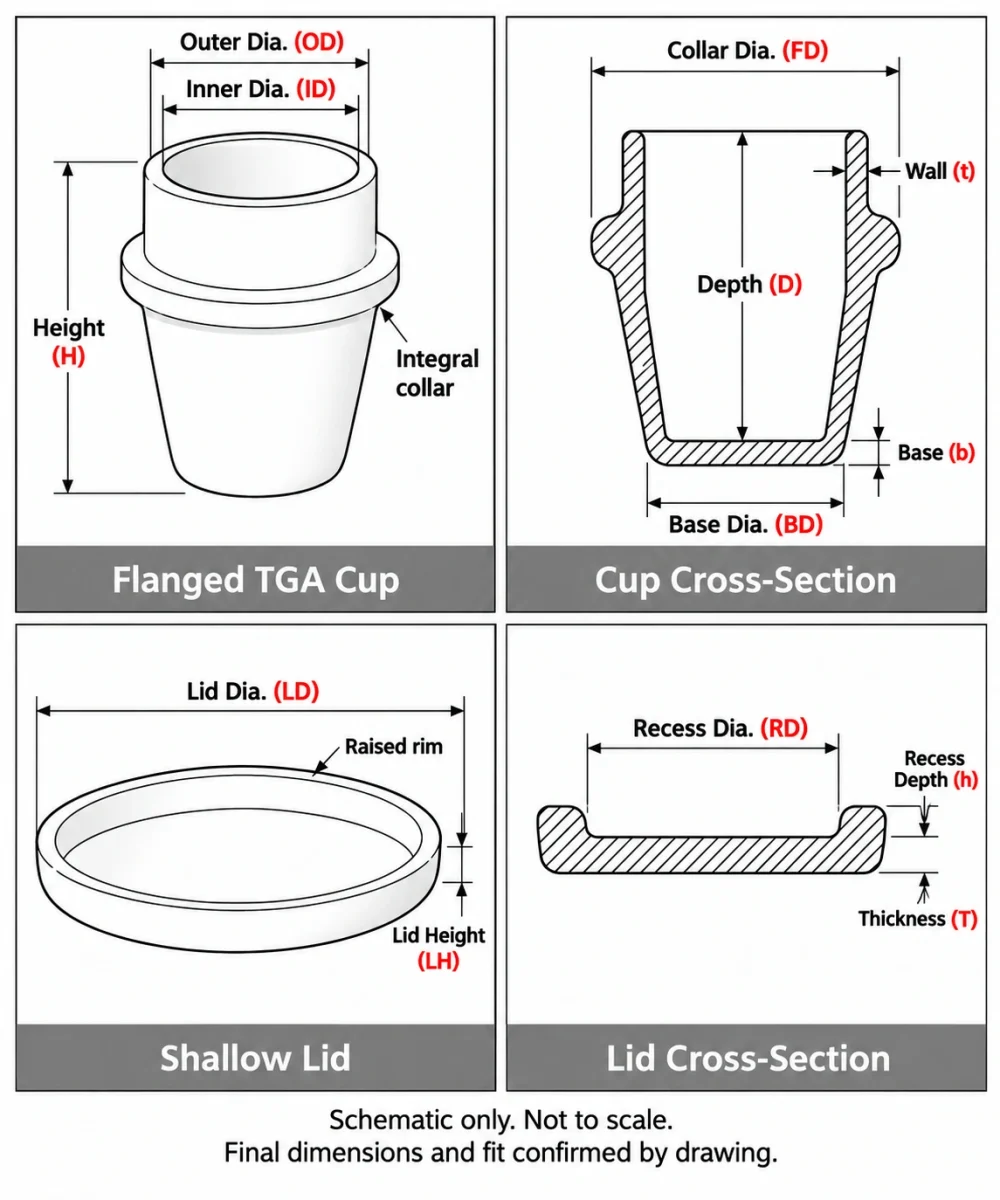
Dimension diagrams and cross-sections of a flanged TGA alumina crucible and shallow lid, showing cup diameter, depth, collar, wall thickness and lid geometry.

Custom TGA Alumina Crucibles

We offer customization options to meet your specific thermal analysis requirements:

Custom Dimensions

Need a different size for your TGA instrument? We can manufacture alumina crucibles to your exact dimensional specifications. Provide us with your required volume, diameter, and height, and we’ll create crucibles that fit your sample platform perfectly.

Higher Purity Options

For ultra-clean applications, we offer 99.9% purity alumina crucibles that minimize potential contamination and provide even lower background signals during thermal analysis.

Lid Options

Choose from flat lids, lids with vent holes, or self-sealing lids depending on your testing atmosphere requirements. We can customize lid designs to control sample atmosphere during TGA testing.

Volume Orders

Bulk pricing available for laboratories with high crucible consumption. Contact us for volume discounts on orders of 100+ crucibles.

Related Products

ADCERAX - Your Trusted Advanced Ceramics Manufacturing Partner

ADCERAX – Custom Ceramic Supply and Engineering Coordination
ADCERAX coordinates drawing review, production and inspection with manufacturing partners against agreed specifications.

China-Based Ceramic Supply Partner

ADCERAX coordinates custom ceramic supply for overseas OEMs, equipment builders, and labs.

Custom Drawing Support

We review drawings, dimensions, materials, and application conditions before quotation.

Ceramic Process Control

Forming, sintering, machining, grinding, and finishing are arranged by part requirements.

Pre-Shipment Inspection

Dimensional checks, visual inspection, and packaging review help reduce procurement risk.

Get in Touch with Us

Our team will be happy to respond to you in less than 24 hours.

Adcerax's factory

Quick Quotation

*Our team will review your inquiry and respond with the next steps.

*Your information will be kept strictly confidential.

Ready to Solve Your Engineering Challenge?

Partner with ADCERAX for reliable, high-performance advanced ceramic solutions. Our engineers are ready to discuss your project.

E-mail

info@adcerax.com

Phone

Tel: +86-0731-84428843 WhatsApp: +86 19311583352

Response Time

Within 24 hours

Quick Quote

The more details you provide, the faster we can quote.

*All inquiries are confidential.

Get Your Custom Solution

The more details you provide, the faster we can respond.

customize size

*We respond within 24 hours. All inquiries are confidential.

Download Catalog