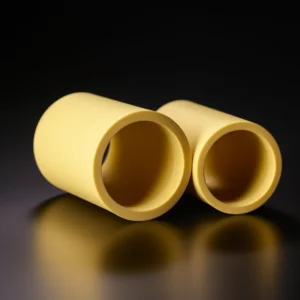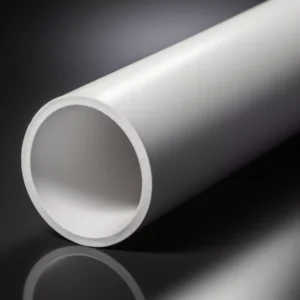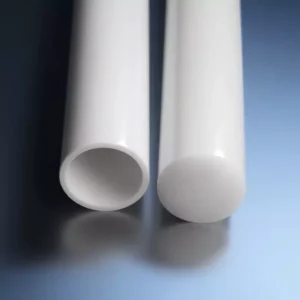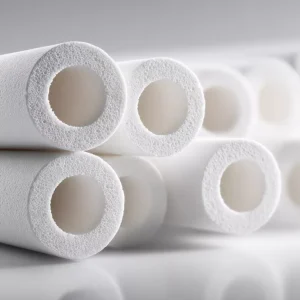
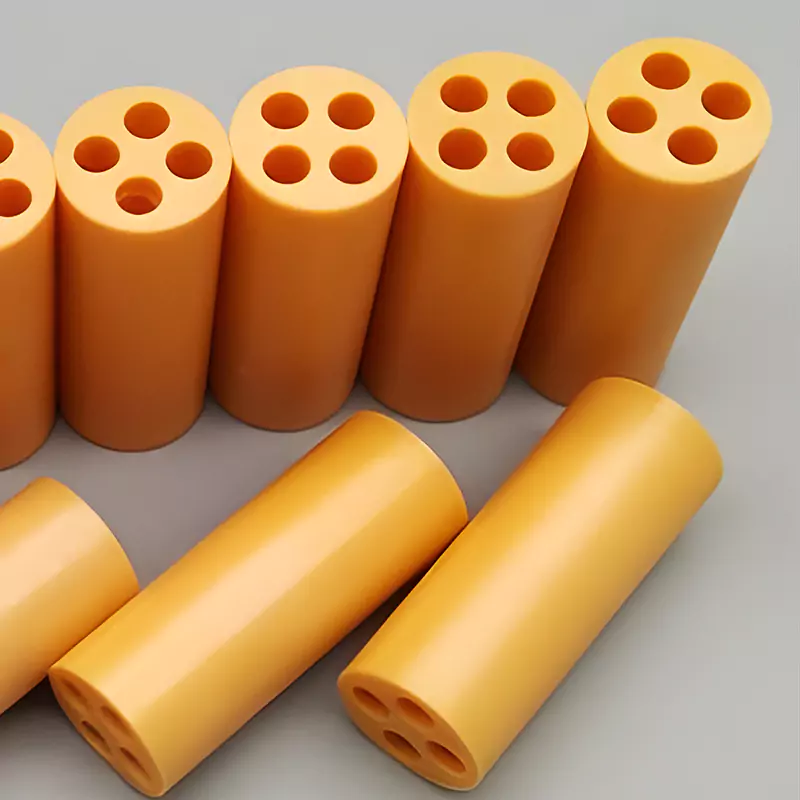
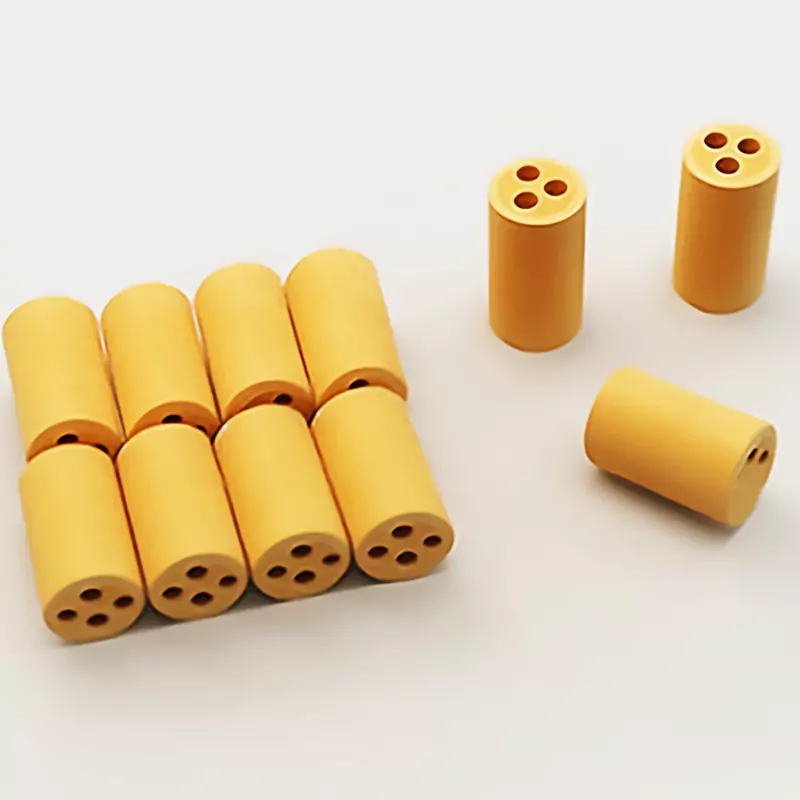
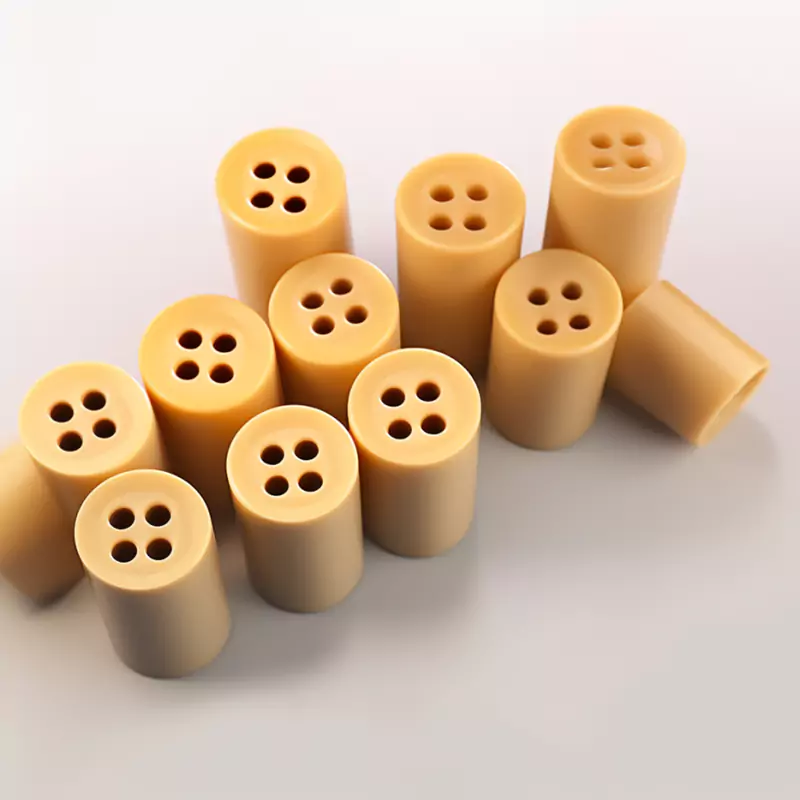
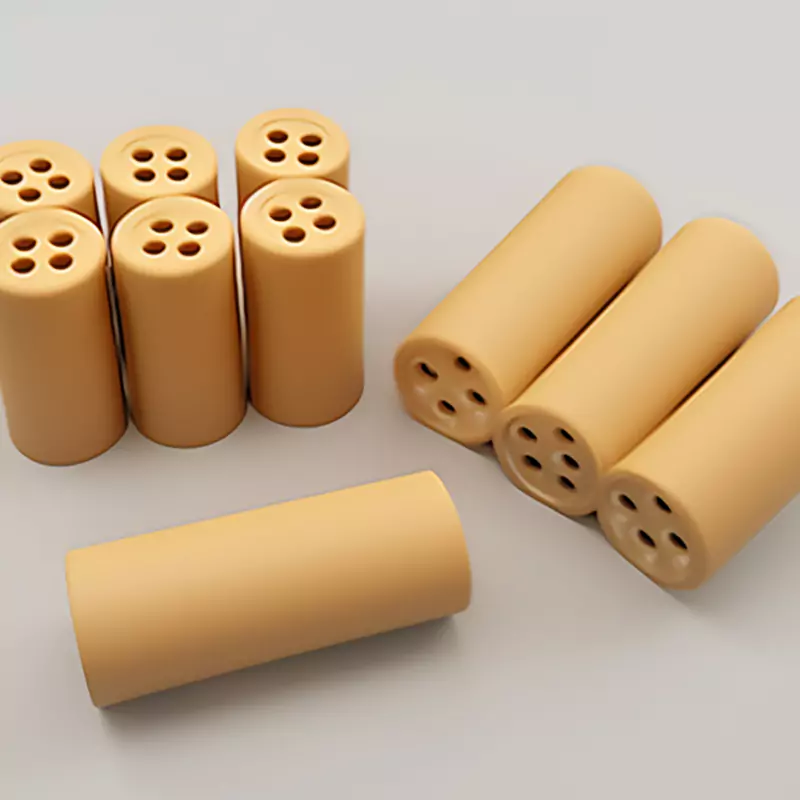
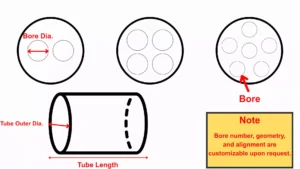
A magnesia stabilized zirconia multi bore tube is a short ceramic component made from magnesia-stabilized zirconia (Mg-PSZ, also MSZ) containing two or more separate bores in a single body. An MSZ tube multi bore part is used to keep wires, pins or fluid passages apart from each other. The bores are discrete machined passages, not a connected pore network, so bore count is not a filtration rating. Choose the model by its full size and bore-count combination. A numbered section drawing then defines bore alignment, end details and the mating interface for your assembly.
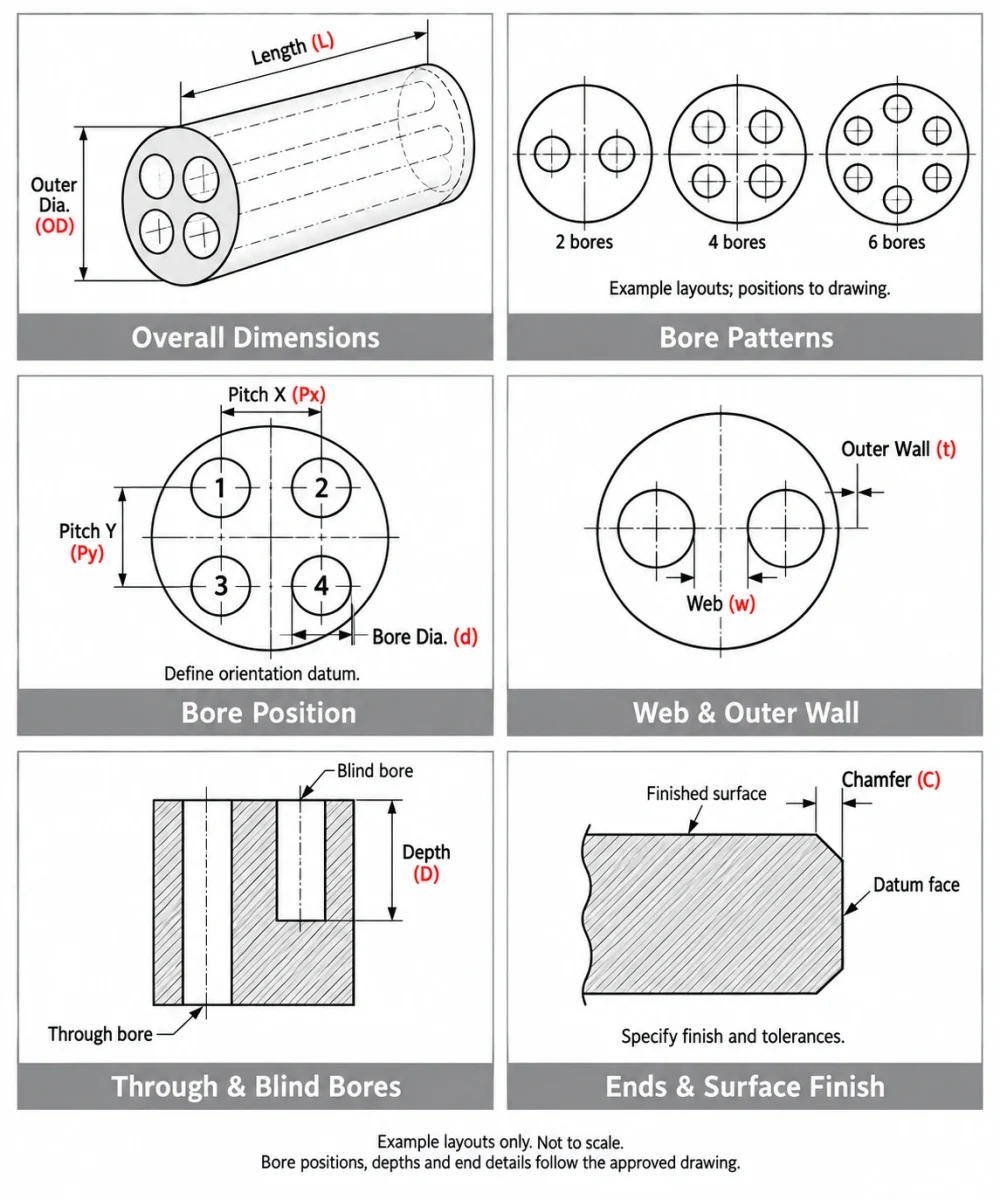
MSZ Multi Bore Tube Reference Dimensions
| Model | Tube Outer Dia.(mm) | Bore Dia.(mm) | Length(mm) | Bores |
| AT-MGO-G2001 | 5 | 1.2 | 4 | 2 |
| AT-MGO-G2002 | 5 | 1.2 | 10 | 2 |
| AT-MGO-G2003 | 5.3 | 1.2 | 8 | 4 |
| AT-MGO-G2004 | 5.3 | 1.2 | 15 | 4 |
| AT-MGO-G2005 | 6.5 | 1.2 | 15 | 6 |
| AT-MGO-G2006 | 6.5 | 1.2 | 20 | 6 |
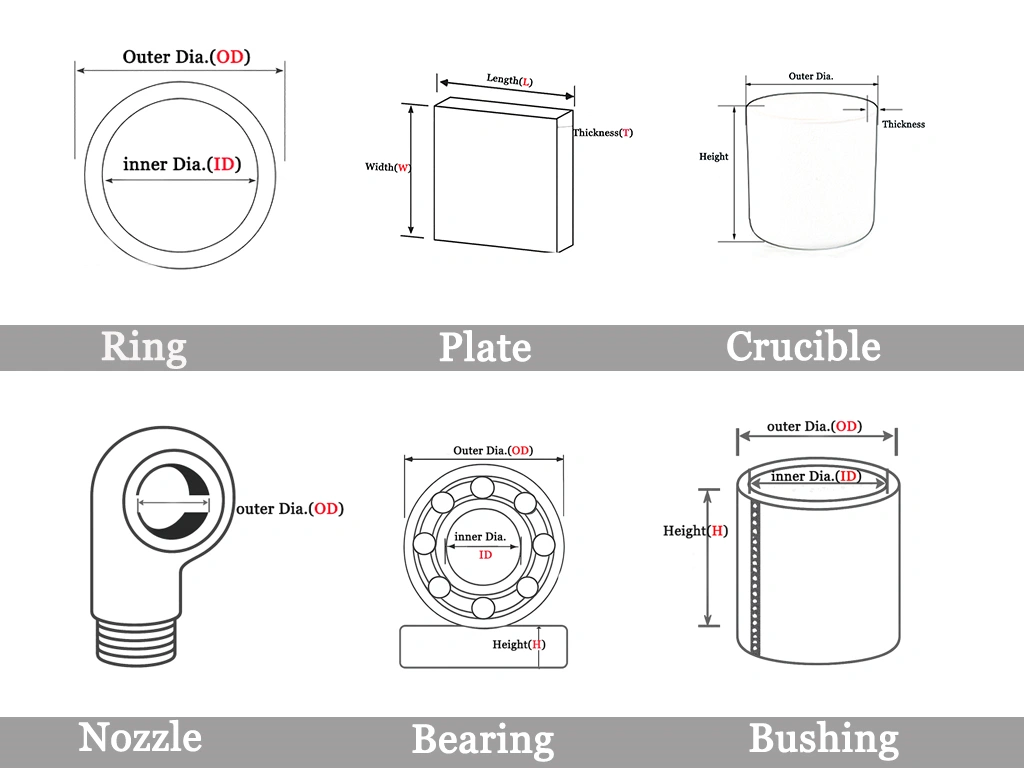
*The schematic explains bore count and dimension terminology. Production bore positions, depths and end features follow the selected part drawing; custom layouts are reviewed against the requested geometry.
Technical Properties for Magnesia Stabilized Zirconia MSZ Tube Multi Bore
Material-grade reference values only, not part measurements and not design allowables. Confirm the supplied grade and test conditions before use.
| Property | Material reference | Condition or limitation |
|---|---|---|
| ZrO₂ + HfO₂ | 95–99 wt% | Grade composition range; MgO is the stabilizer added to the zirconia body. |
| Stabilizer | MgO | Mg-PSZ / MSZ material route; the supplied grade specifies the composition. |
| Bulk density | Typical 5.70–5.80 g/cm³ | Typical value for dense sintered MSZ material. |
| Flexural strength | Typical 500–755 MPa | Typical material-specimen value at 20°C. |
| Compressive strength | Typical 2100 MPa | Typical material-specimen value at 20°C. |
| Fracture toughness, KIC | Typical 6–12 MPa·m½ | Typical material value at 20°C; comparison requires the test method. |
| Vickers hardness | Typical 11.5 GPa | Typical material value; state test force and dwell time for comparison. |
| Young's modulus | Typical 200 GPa | Typical material value at 20°C; useful for stiffness calculations. |
| Water absorption | Typical 0% | Typical value for the dense sintered material; assembly leakage is assessed separately. |
| Thermal conductivity | Typical 2.5 W/(m·K) | Typical material value at 20°C. |
No universal finished-part working temperature, pressure rating, electrical rating or service-life multiplier follows from this table. Bore geometry, web thickness, surface condition, supports, seals, atmosphere, contact medium and operating cycles all have to be assessed for the actual part.
How to select a Multi-Bore Mg-PSZ Tube
Match the bore count to the required pattern, then compare the listed body size and length. The points below explain what changes between configurations; detailed drawing requirements are grouped in the custom-part section.
- Bore centre distance, end-face fit and support for the selected length.
- Bore-array alignment and the minimum ceramic web between openings.
- Bore-array alignment, minimum webs and the outer wall around the pattern.
| Bore count | Published reference rows | What still has to be defined |
|---|---|---|
| 2 bores | OD 5 mm, bore 1.2 mm, length 4 or 10 mm | Bore centre distance, end faces, retention and support. Two lengths at the same OD are not interchangeable in an assembly. |
| 4 bores | OD 5.3 mm, bore 1.2 mm, length 8 or 15 mm | Bore array coordinates, minimum web, assembly datum and the task assigned to each channel. A concept four-bore drawing is not a production section. |
| 6 bores | OD 6.5 mm, bore 1.2 mm, length 15 or 20 mm | Web and outer-wall thickness at the actual bore positions. A higher bore count does not by itself give more even distribution or better separation. |
Mg-PSZ Compared with Other Multi-bore Ceramic Materials
Select the ceramic route together with the component geometry and required function. Each route uses its own grade data and assembly assessment.
| Material route | How it is normally specified | What to confirm before switching to it |
|---|---|---|
| Mg-PSZ / MSZ magnesia-stabilized zirconia | Specified as a partially stabilized zirconia grade, with MgO as the stabilizer. | The supplied grade and its test conditions, plus bore layout, webs, ends and the actual service conditions for your part. |
| 3Y-TZP / YSZ yttria-stabilized zirconia | A different stabilizer system, specified by its own grade. | That your requirement is genuinely written against the yttria-stabilized route; if so, the single-bore and closed-end zirconia pages are the correct starting point. |
| Alumina and mullite | The established route for many multi-hole thermocouple and RTD insulators and for gas-sampling insulators, usually specified by purity. | Use the original insulator specification as the baseline for any material-change evaluation; see the replacement question in the FAQ. |
| Porous filtration ceramics | Specified by pore structure, permeability and filtration duty. | For connected-pore filtration, use the porous filter tube link in Related Products. |
No working temperature, pressure rating, cycle count or service life is established for the reference sizes. Where a function is critical, the corresponding test method, conditions and acceptance limit are agreed as part of the order.
Packaging of Magnesia Stabilized Zirconia MSZ Tube Multi Bore
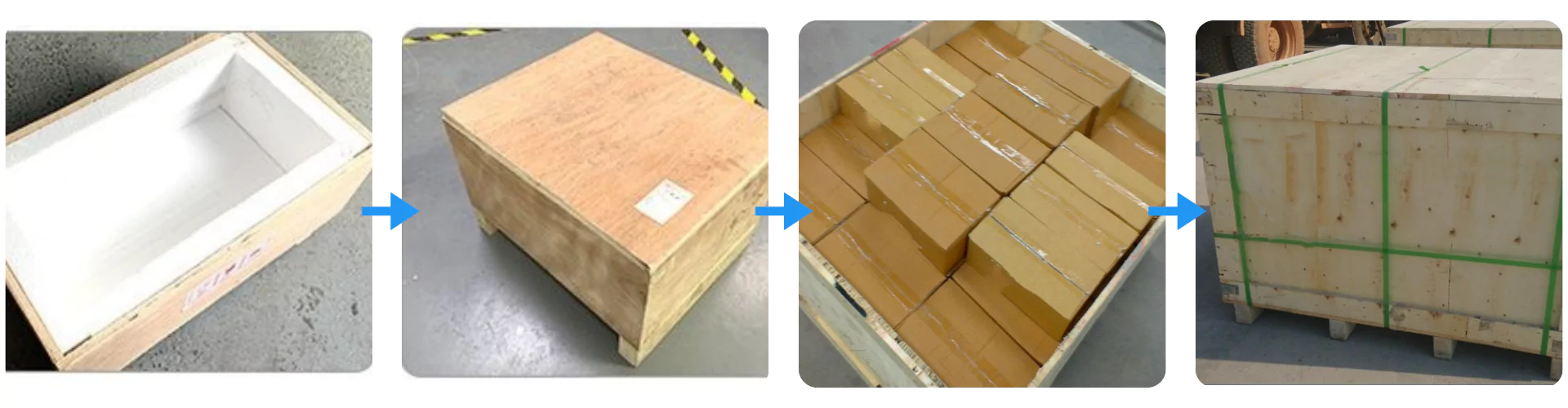
Packing is agreed for part dimensions, bore edges, quantity and route. Multi-bore pieces are separated to keep end faces and bore openings unloaded; state any separation, cleanliness or documentation needs with the shipment.
On receipt, check quantity, package condition, edge cracks or chips and the agreed dimensions before assembly, and report damage with photographs. The image shows concepts only, not a packing record or a fixed method.