Choose alumina tubes when the job is general high-temperature ceramic protection, electrical insulation, and stable support for temperature measurement hardware, especially noble-metal thermocouples. Choose SiC tubes when the job becomes harsher — faster thermal response, stronger resistance to thermal cycling, abrasion, sag, corrosion, or process-duty chemistry. In short: alumina is usually the baseline route; SiC is usually the harsher-duty upgrade route.
Neither material is universally "better." The clearest indication of that is a guidance statement from a major SiC tube supplier: SiC tubes can be used with platinum-wire thermocouples, but an inner alumina protection tube is still recommended in that assembly. That means the two materials are often complementary rather than simply competing — alumina as the inner protection interface, SiC as the outer harsh-duty shell. Understanding where each material belongs in the protection stack is more useful than asking which material wins.
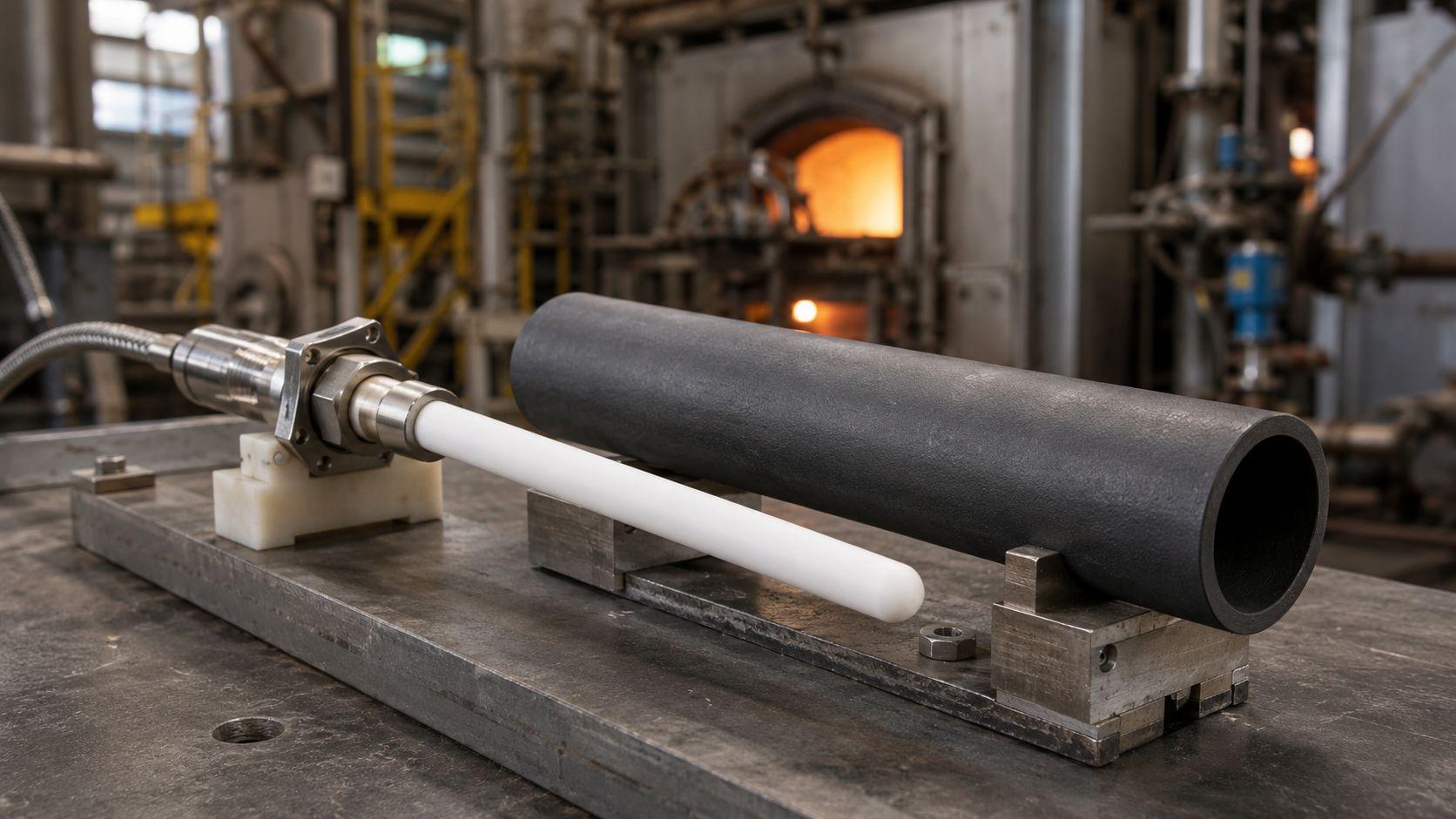
Alumina and SiC tubes serve different tube-duty roles: alumina is the standard baseline for thermocouple protection and insulation; SiC is the upgrade for harsher process-duty environments.
The alumina tubes and silicon carbide tubes described in this guide represent the two most common high-temperature ceramic tube routes in industrial temperature measurement and process-tube applications.
What alumina tubes are actually better at
Alumina tubes are usually the better answer when the application is primarily about protecting the sensor and insulating it electrically rather than surviving the harshest possible process chemistry. Published ceramic protection-tube documentation consistently positions alumina-based ceramic protection and insulating tubes as the first choice for temperature measuring and control devices, specifically because of high-temperature resistance, chemical resistance, electrical insulation, and reliable performance in aggressive atmospheres up to approximately 1,700°C.
Noble-metal thermocouples represent the clearest alumina-favorable case. High-purity alumina protective sheaths with very low silica content are explicitly positioned for use with type S platinum-rhodium thermocouples in this service, where the low silica prevents eutectic interactions with the platinum wire at high temperature. Published guidance describes alumina as providing gas-tight protection for noble-metal thermocouples up to approximately 1,900°C — a level of protection that requires the combination of alumina's electrical insulation and chemical compatibility with the precious-metal element, not just its temperature rating.
In plain engineering terms: alumina's strengths in this comparison are electrical insulation, noble-metal thermocouple compatibility, gas-tightness, and broad chemical resistance in a cost-effective ceramic. Its weaknesses relative to SiC are modest thermal-shock resistance, lower thermal conductivity (which slows response), and lower durability in the most abrasive or chemically demanding process environments.
Alumina is the right default for protection and insulation duties
When the primary requirement is to protect a thermocouple element from the furnace or process environment without the tube itself becoming a process component, alumina covers the duty reliably and with better compatibility for precious-metal sensor wire than SiC. The specification question is then about alumina purity and impurity control — not whether to switch to SiC.
Thermal-shock resistance is alumina's most important practical limitation
Published protection-tube guidance notes that alumina has only fair thermal-shock resistance and recommends preheating to approximately 480°C before inserting into hot service. That handling requirement is not a defect — it is a real specification variable that distinguishes alumina from SiC in installations where rapid temperature exposure is unavoidable.
What SiC tubes are actually better at
SiC tubes become the better answer when the application shifts from a classic insulation and protection problem to a harsh industrial process-duty problem. The distinction in published documentation is clear: alumina protection tubes are positioned for temperature measurement and control hardware, while SiC tube ranges are described with language like fast response, chemical inertness, sag resistance, oxidation resistance to approximately 1,650°C in air, excellent corrosion resistance against a wide range of chemicals, high mechanical strength, erosion and abrasion resistance, and superior resistance to thermal cycling.
That property combination fits a different type of duty. When a tube must act more like a structural process component than a protective ceramic enclosure — when it faces particulate abrasion from a moving gas or fluid stream, repeated thermal cycling between furnace temperature and ambient, aggressive chemical attack from sulfur, halogens, or mixed acids, or sag under load at sustained high temperature — SiC provides a meaningfully stronger performance profile than alumina.
SiC's high thermal conductivity (approximately 125 W/m·K at room temperature for sintered grades, compared with approximately 20–30 W/m·K for alumina) is also significant for thermocouple response time. In applications where fast thermal response matters — gas analyzer probes, heat-treatment furnace monitoring, or rapidly cycling processes — a thin-walled SiC tube can respond substantially faster than an alumina tube of equivalent wall thickness.
SiC is the right choice when the tube is closer to a process component than a protective sheath
Published SiC tube documentation explicitly separates "thermocouple protection tubes" from "process tubes" within the SiC product range. That separation signals the duty class distinction: once a tube is defined by process-side demands — chemistry, abrasion, thermal cycling, response speed — SiC earns its specification. Once it is defined by sensor-side demands — insulation, noble-metal compatibility, gas-tightness — alumina retains its advantage.
Nitride-bonded SiC is the economical path for some non-ferrous process duties
Not all SiC process-tube applications require the performance and cost of sintered SiC grades. Nitride-bonded SiC (NB SiC) is positioned in published documentation as the economical choice for sensor tube service, specifically noting it does not contaminate non-ferrous melts — which is the governing criterion for aluminum, zinc, and copper foundry thermocouple protection rather than extreme temperature or chemical resistance.
Which tube applications are being confused when buyers compare them
Four confusions appear most often when engineers compare SiC and alumina tubes:
Using alumina where the duty has become a process-tube problem. When an alumina protection tube in a harsh chemical, high-abrasion, or thermally cycling service is failing prematurely, the instinct is often to look for a better alumina grade rather than to ask whether the duty class has moved past alumina's natural operating window. The application has become a SiC job, but the specification still says alumina.
Assuming SiC universally replaces alumina around noble-metal thermocouples. Published SiC tube guidance explicitly states that when SiC is used with platinum-wire thermocouples, an inner alumina protection tube should be retained. SiC is not simply a higher-performance alumina in that assembly — it is an outer harsh-duty barrier that still depends on alumina for direct noble-metal thermocouple protection.
Treating "ceramic tube" as a single undifferentiated specification. The current tube literature describes at least three distinct tube roles: insulating/protection tubes, sensor tubes, and process tubes. Alumina is the more natural baseline for the first role. SiC becomes progressively more appropriate in the second and third. Comparing the two materials without specifying the tube role first produces a misleading comparison.
Ignoring alumina's thermal-shock sensitivity in fast-installation or cycling service. Alumina can be the correct material and still fail early if handling protocols do not include preheating. This is not a reason to switch to SiC in a fundamentally alumina-appropriate application — it is a reason to add preheat requirements to the operating SOP.
When the decision clearly stays with alumina, and when it flips to SiC
The Selection Matrix below maps the six most common tube duty configurations:
| If the dominant requirement is… | Best first-look route | Why |
|---|---|---|
| General thermocouple protection and electrical insulation | Alumina tube | Ceramic protection and insulating tubes are positioned as first-choice temperature-measurement ceramics for high temperature resistance, chemical resistance, and electrical insulation |
| Noble-metal thermocouple protection | High-purity alumina tube | Very low silica content in high-purity alumina protects platinum thermocouple wires; gas-tight noble-metal protection up to approximately 1,900°C |
| Fast thermal response in harsh process duty | SiC tube | Thin-walled SiC tube positioned for fast response; chemically inert; excellent sag resistance in harsh conditions |
| Severe corrosion, abrasion, or thermal cycling | SiC tube | High oxidation resistance to approximately 1,650°C in air; excellent corrosion resistance; high mechanical strength; superior thermal-cycling resistance |
| Economy-minded harsh-duty sensor tube for non-ferrous service | NB SiC tube | Nitride-bonded SiC positioned as the economical choice for sensor tube service; does not contaminate non-ferrous melts |
| Platinum-wire thermocouple with SiC outer protection | SiC outer + alumina inner | SiC outer tube can be used with platinum-wire thermocouples if an inner closed-end alumina protection tube is retained |
Route guidance synthesized from published ceramic protection-tube, SiC process-tube, and alumina sheath documentation.
The two materials are often complementary, not just competing. The real design question is not "alumina or SiC?" but "where in the protection stack does each material belong?"
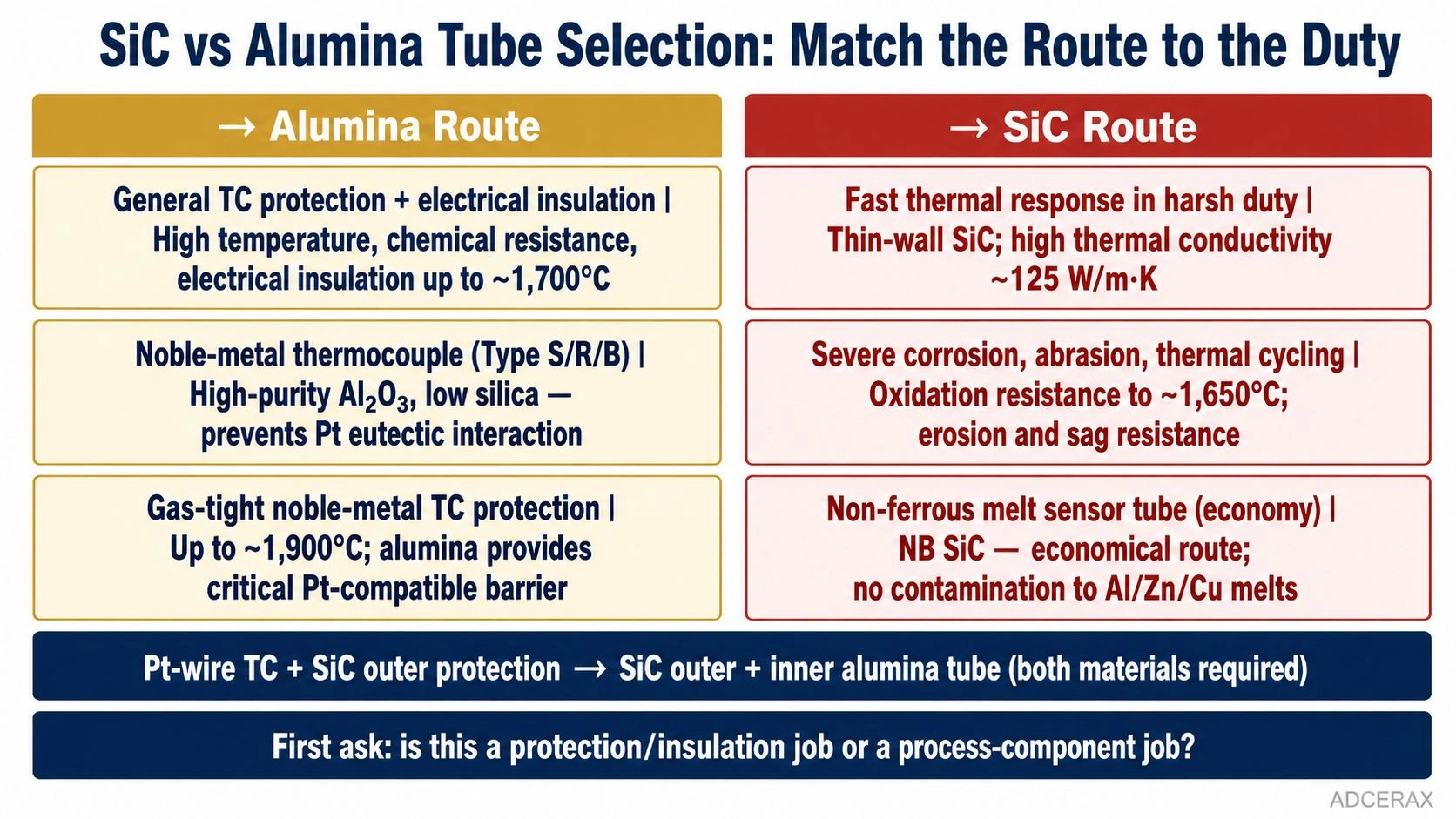
Six common tube duty configurations — and which ceramic route fits each one. The key insight: alumina and SiC are often used together in the same assembly rather than as simple alternatives.
The ceramic tube material options covering both alumina and SiC grades for industrial tube service illustrate the same duty-class discipline: the specification should name the tube role and the sensor or process chemistry before it names the ceramic material.
The clearest alumina advantage is noble-metal thermocouple compatibility
No amount of SiC performance advantage in thermal cycling or abrasion resistance makes SiC compatible with the direct contact requirement of platinum thermocouple wire. That compatibility is alumina's domain, and it remains alumina's domain even in a hybrid SiC-outer assembly. A specification that removes the inner alumina sheath in a platinum-wire thermocouple installation to save material cost or simplify assembly has removed the critical protection interface, not just a redundant component.
The clearest SiC advantage is process-duty robustness under combined stress
When a tube faces abrasion, strong chemical attack, repeated thermal shock, and sustained sag load at temperature simultaneously, alumina's fair thermal-shock resistance and lower mechanical strength become binding constraints. SiC's property combination was specifically developed for exactly that loading combination. Using alumina in that duty is not simply conservative — it is specifying the wrong material for the governing failure mode.
What should go into the RFQ and operating specification
Before writing "ceramic tube" or even "SiC tube" or "alumina tube" in an RFQ, the specification should resolve the tube role and the sensor or process context. Without those two variables, the material cannot be confirmed.
The specification and operating checklist for industrial ceramic components in ceramic tube service:
- Tube role — specify insulating/protection tube, sensor tube, or process tube; this is the first and most important variable because it determines whether alumina or SiC leads the specification.
- Sensor type — specify base-metal or noble-metal thermocouple (Type K/N vs Type R/S/B); noble-metal thermocouples require high-purity alumina with low silica for the inner protection layer.
- Environment summary — specify chemistry (acids, alkalis, reducing gases, halides), temperature, thermal cycling frequency, fluid or gas velocity, and particulate loading; these variables determine whether the duty is alumina-adequate or SiC-required.
- Thermal response requirement — specify whether fast response is a design requirement; if yes, note that SiC's higher thermal conductivity and availability in thin-wall form gives it a significant response advantage over alumina at equivalent geometry.
- Assembly architecture — specify single-tube, double-tube, or SiC outer / alumina inner; for platinum-wire thermocouples in SiC outer assemblies, the inner alumina tube is not optional.
- Thermal-shock handling — for alumina tubes, specify preheat requirement (approximately 480°C before insertion into hot service) explicitly in the operating SOP; do not assume the material's temperature rating implies shock immunity.
- Alumina purity — for noble-metal thermocouple service, specify minimum Al₂O₃ content (≥99.7%) and require silica content confirmation from the supplier.
- SiC grade — for SiC tube service, specify sintered SiC (SSiC/Hexoloy SA) or nitride-bonded SiC (NB SiC) depending on whether the duty requires maximum density and corrosion resistance or economical non-ferrous-compatible sensor service.
If the RFQ says only "ceramic protection tube" without specifying the tube role, sensor type, and environment, the material selection cannot be confirmed and the tube may arrive as either alumina or SiC without the distinction being functionally meaningful to the supplier.
Conclusion
The SiC versus alumina tube comparison resolves to a duty-class question rather than a performance ranking. Alumina is the standard baseline for thermocouple protection and electrical insulation, especially where noble-metal thermocouples require low-silica ceramic compatibility and gas-tight protection. SiC is the escalation route when the service adds thermal cycling, abrasion, corrosion, sag resistance, or fast response to the requirement set. And when SiC outer protection is used with platinum-wire thermocouples, alumina remains inside the assembly as the essential direct-contact protection element. The correct specification names the tube role, the sensor type, and the environment — then selects the ceramic.
Specifying alumina or SiC tubes for thermocouple protection or process service? Send the tube role, thermocouple type, maximum temperature, environment summary, and response requirements. ADCERAX engineers return a grade recommendation with material confirmation, assembly guidance, and purity documentation for the confirmed duty; turnaround depends on inquiry complexity — no RFQ commitment required at this stage.
Frequently Asked Questions
When should I choose alumina tubes instead of silicon carbide tubes?
Choose alumina when the duty is standard thermocouple protection and electrical insulation, especially with noble-metal thermocouples where high-purity alumina with low silica content is required to protect the platinum wire. Alumina is also more natural when gas-tightness around a noble-metal element is the primary requirement and the process environment does not impose the abrasion, thermal cycling, or fast-response demands that define SiC's strongest use case.
Are SiC tubes better for thermocouple protection in harsh environments?
Yes, when the environment is genuinely harsh — strong corrosion, abrasion, repeated thermal cycling, or high-flow process gas — SiC provides substantially better durability than alumina. However, when SiC is used with platinum-wire thermocouples, an inner alumina protection tube is still recommended for the direct precious-metal contact layer. In that assembly, SiC handles the outer harsh-duty protection while alumina maintains the thermocouple compatibility function.
Is alumina better for noble-metal thermocouples?
Yes, consistently. High-purity alumina with low silica content is explicitly positioned for noble-metal thermocouple protection because low silica prevents eutectic interactions with platinum at high temperature. Published documentation describes alumina as providing gas-tight protection for noble-metal thermocouples up to approximately 1,900°C. SiC is not a direct substitute for alumina in the noble-metal thermocouple contact layer, even when SiC is used as the outer protection in the same assembly.
Which material gives faster thermal response?
SiC. Its thermal conductivity — approximately 125 W/m·K at room temperature for sintered grades, compared with approximately 20–30 W/m·K for alumina — gives it a significantly faster response at equivalent wall geometry. Published SiC sensor tube documentation specifically highlights fast response as a key advantage of thin-walled SiC sensor tubes. When response speed matters — gas analyzers, rapidly cycling furnaces, heat-treatment monitoring — SiC's conductivity advantage translates directly to a smaller measurement lag.
When does SiC become over-specified and when does alumina become under-specified?
SiC is over-specified when the application is a standard thermocouple protection or insulation duty in a moderate chemical environment where alumina's temperature rating, chemical resistance, and noble-metal compatibility fully cover the requirement — adding SiC adds cost without adding functional benefit. Alumina is under-specified when the service environment imposes abrasion, strong corrosion, repeated thermal cycling, or sustained mechanical load at temperature that exceed alumina's natural operating window. The duty-class question — is this primarily a protection/insulation job or a process-component job — is the fastest way to identify which over- or under-specification condition applies.